
Market Overview
| Study Period | 2020 - 2031 |
|---|---|
| Forecast Data Period | 2026 - 2031 |
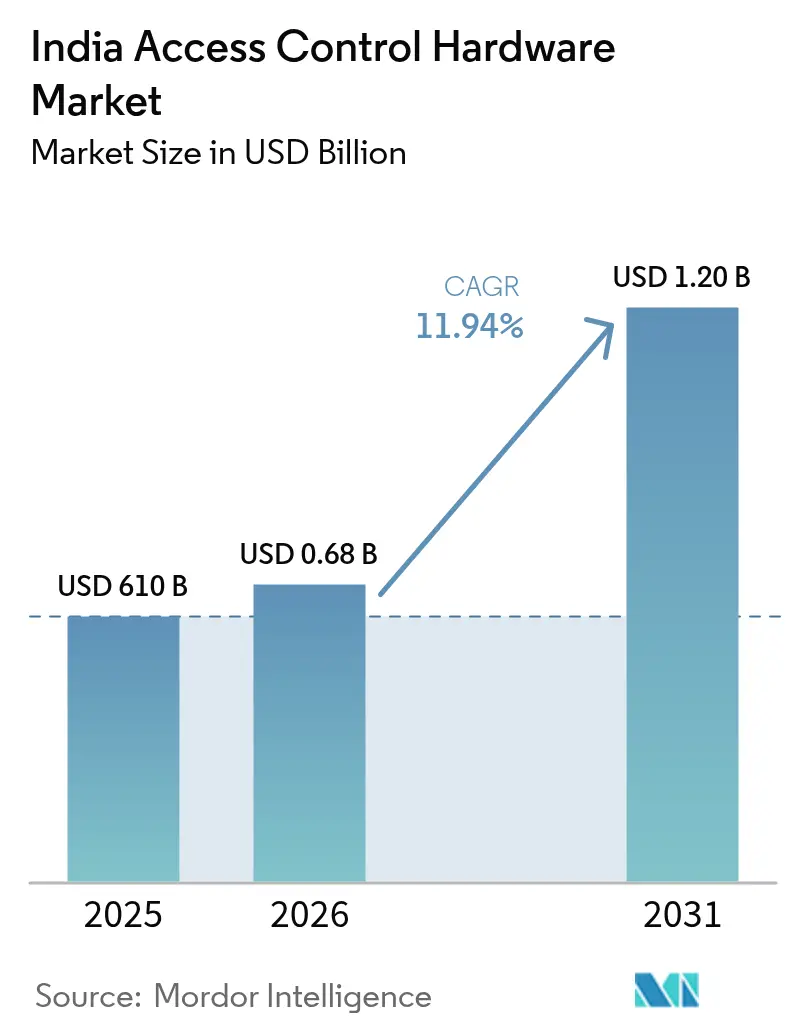
| Base Year Market Size (2025) | USD 610 Billion |
| Market Size (2026) | USD 0.68 Billion |
| Market Size (2031) | USD 1.2 Billion |
| Growth Rate (2026 - 2031) | 11.94 % |
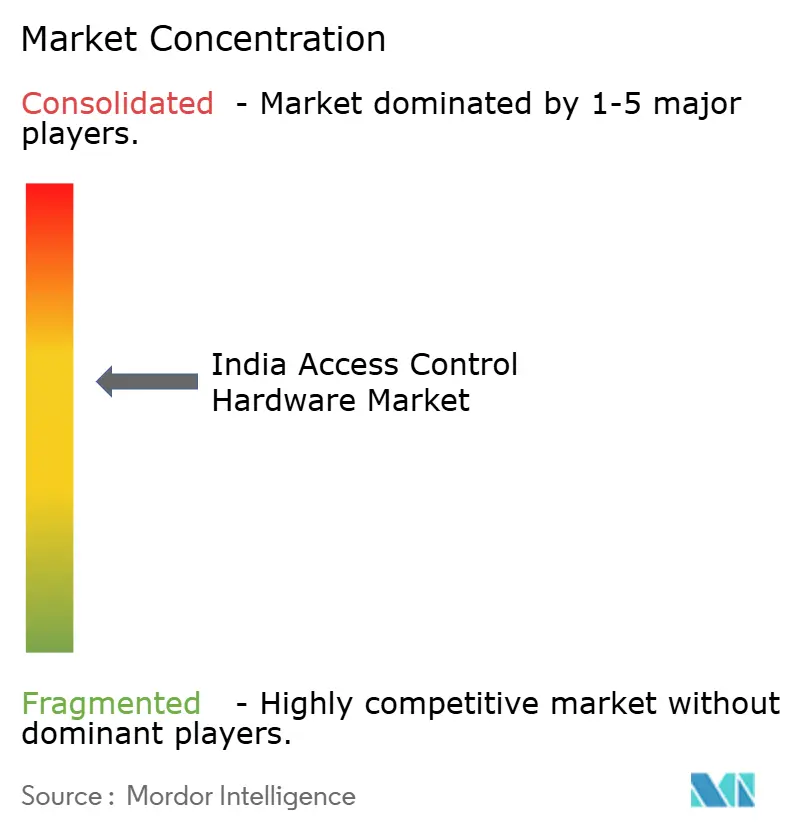
| Market Concentration | Medium |
Major Players *Disclaimer: Major Players sorted in no particular order Image © Mordor Intelligence. Reuse requires attribution under CC BY 4.0. | |
India Access Control Hardware Market Analysis by Mordor Intelligence
India access control hardware market size in 2026 is estimated at USD 682.83 million, growing from 2025 value of USD 610 million with 2031 projections showing USD 1.2 billion, growing at 11.94% CAGR over 2026-2031. This brisk expansion stems from sovereign digital-identity programs, the doubling of domestic data center capacity, and the Smart Cities Mission, which together create sustained demand for card readers, biometric panels, controllers, and electronic locks across public and private sectors.[1]Ministry of Housing and Urban Affairs, “Smart Cities Mission Extended Till March 2025,” Press Information Bureau, pib.gov.in Vendors benefit from Make-in-India incentives that shorten component lead times, while falling average selling prices for Internet-of-Things-enabled smart locks spur residential adoption. The Reserve Bank of India’s 2024 Master Direction requires banks and payment operators to deploy multi-factor authentication at server rooms, driving demand for tamper-alert locks and biometric readers.[2]Reserve Bank of India, “Master Direction on IT Framework for Payment System Operators,” rbi.org.in Meanwhile, fragmented state procurement rules raise integration costs; however, the recent standardization of GeM reduces bid cycles, allowing smaller municipalities to adopt hardware that was previously limited to metropolitan projects.
Key Report Takeaways
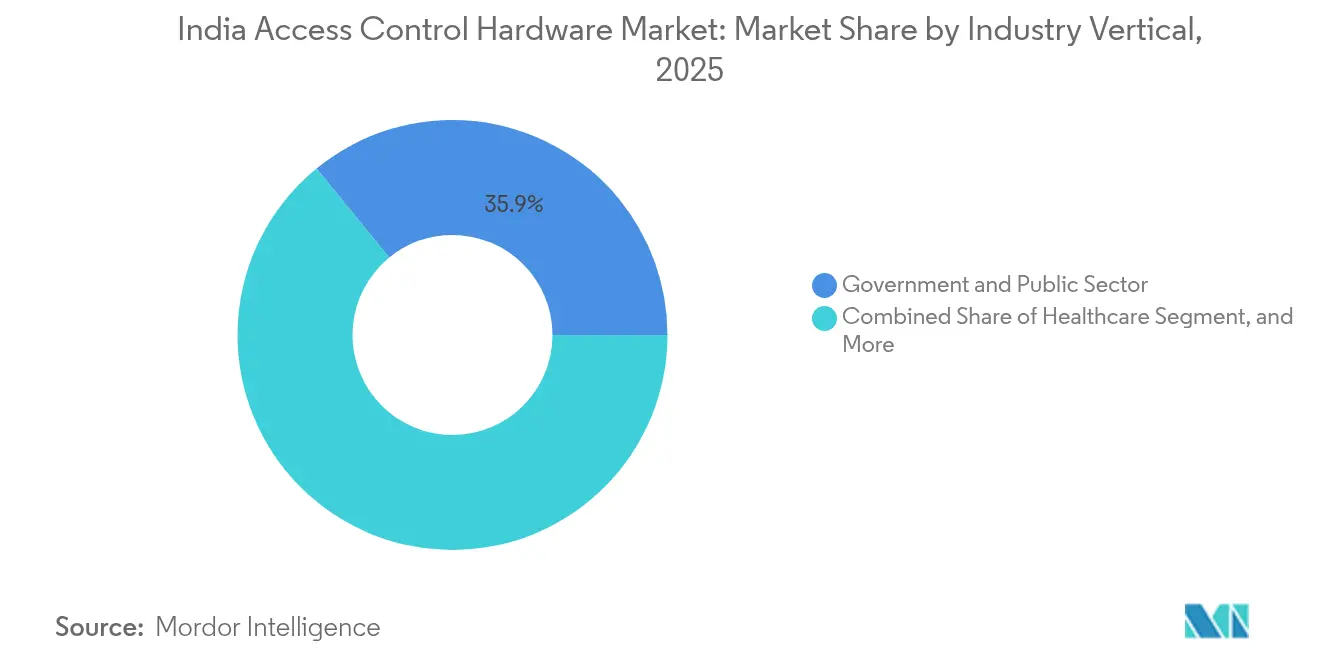
- By industry vertical, the government and public sector segment held a 35.90% share of the India access control hardware market in 2025, while the Healthcare segment is advancing at a 14.72% CAGR through 2031.
- By product type, card readers led with 43.20% revenue share of the India access control hardware market in 2025; biometric readers are forecast to expand at a 13.98% CAGR to 2031.
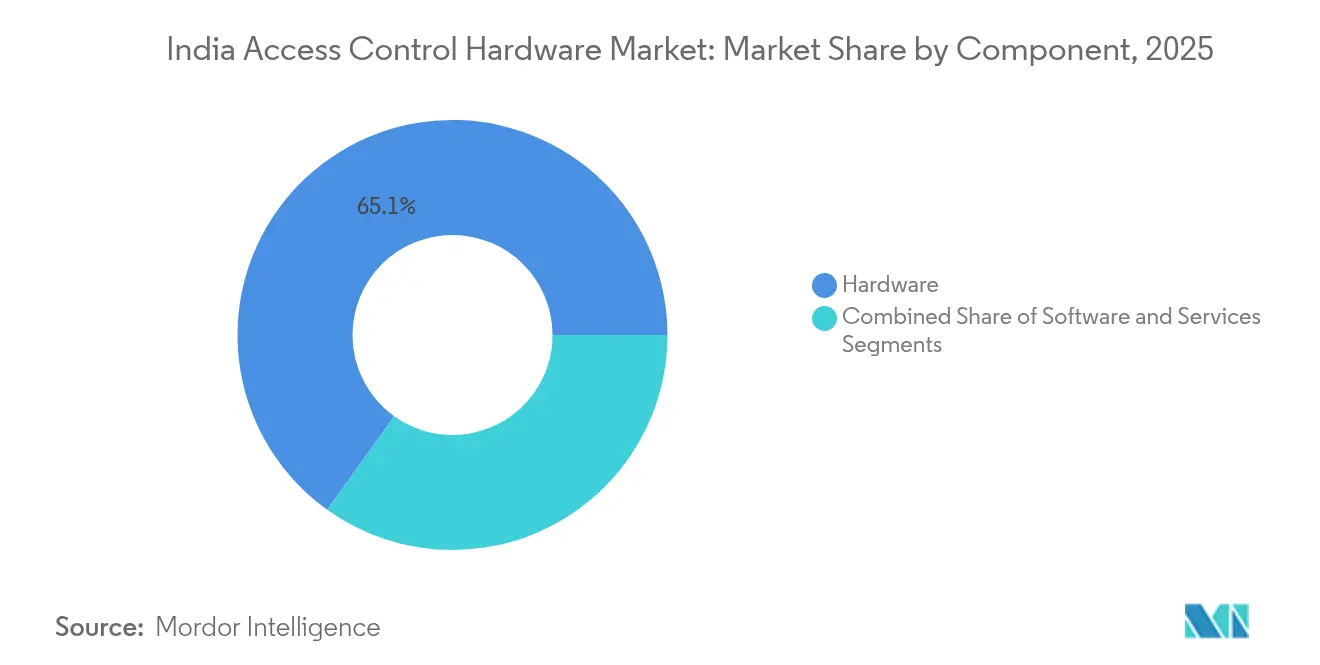
- By component, hardware accounted for 65.10% of the India access control hardware market size in 2025; however, services are expected to represent the fastest-growing segment at a 13.05% CAGR from 2025 to 2031.
Note: Market size and forecast figures in this report are generated using Mordor Intelligence’s proprietary estimation framework, updated with the latest available data and insights as of 2026.
India Access Control Hardware Market Trends and Insights
Drivers Impact Analysis*
| Driver | (~) % Impact on CAGR Forecast | Geographic Relevance | Impact Timeline |
|---|---|---|---|
| Surge in Government Smart-City Public-Safety Spending | +2.1% | National, with early gains in Tier-1 and Tier-2 cities under Smart Cities Mission | Medium term (2-4 years) |
| Rising Adoption of Mobile-Credential and Cloud-Based Access Management | +1.8% | National, concentrated in IT and Telecom hubs (Bengaluru, Hyderabad, Pune, NCR) | Short term (≤2 years) |
| Rapid Growth of Contactless Biometrics in Post-Pandemic Workplaces | +2.3% | National, accelerated in metros and state capitals with high office density | Short term (≤2 years) |
| Expansion of Data-Center Infrastructure Demanding High-Security Hardware | +2.0% | National, led by Maharashtra, Tamil Nadu, Telangana, Haryana | Medium term (2-4 years) |
| Falling ASPs of IoT-Enabled Smart Locks Boosting Residential Uptake | +1.4% | Urban clusters (Mumbai, Delhi, Bengaluru, Chennai, Kolkata) | Long term (≥4 years) |
| Make-in-India Incentives Catalyzing Local Hardware Manufacturing | +1.7% | National, with manufacturing clusters in Gujarat, Tamil Nadu, Karnataka | Medium term (2-4 years) |
| Source: Mordor Intelligence | |||
Surge in Government Smart-City Public-Safety Spending
The Smart Cities Mission extension allocated INR 48,000 crore (USD 5.76 billion) through March 2025 and installed more than 83,000 CCTV cameras plus integrated command-and-control centers across 100 cities. Municipalities have progressed from passive cameras to active identity verification, procuring card readers, biometric gates, and electronic locks for civic buildings and transport hubs. Tamil Nadu’s Safe City Project awarded contracts in late 2024 to deploy facial-recognition turnstiles at 42 district headquarters, while Uttar Pradesh is fitting biometric panels at 75 police stations. The Government e-Marketplace portal accelerated hardware uptake by publishing unified specifications, letting smaller towns buy proven devices with 90-day procurement cycles. Collectively, these deployments amplify baseline demand in the India access control hardware market as states replicate flagship models in second-tier cities.
Rapid Growth of Contactless Biometrics in Post-Pandemic Workplaces
Touchless modalities, including facial recognition, iris scanning, and palm-vein analysis, became mainstream in 2024 when enterprises replaced fingerprint scanners to curb infection risks. Digi Yatra’s facial-recognition boarding processed 15 million passengers across 24 airports by mid-2024, validating sub-two-second authentication at scale. Corporate campuses in Bengaluru and Hyderabad subsequently shifted to kiosk-based face readers linked to cloud dashboards that log entries in real time. AIIMS New Delhi reduced outpatient wait times by 40% after implementing similar technology in early 2024. Falling sensor costs and Aadhaar interoperability reduce integration expenses, allowing domestic suppliers such as Mantra Softech to win state tenders with contactless kits priced 18% below those of their multinational equivalents. As deployment experience compounds, the India access control hardware market gains a virtuous cycle of cost decline and feature enrichment.
Expansion of Data-Center Infrastructure Demanding High-Security Hardware
Domestic data-center capacity is set to double to roughly 2,100 MW by FY 2027, driven by investments topping INR 55,000 crore (USD 6.6 billion). The Reserve Bank of India’s 2024 mandate enforces multi-factor authentication, biometric logs, and SIEM integration for server-room doors. In response, hyperscalers in Mumbai, Chennai, Hyderabad, and Noida specify dual-sensor readers, tamper-alert locks, and PoE controllers capable of 10,000 events per second. Given the high value of each rack, operators pay premiums for hardware-software bundles that include 24/7 managed access, fuelling services revenue within the India access control hardware market.
Rising Adoption of Mobile-Credential and Cloud-Based Access Management
IT parks and telecom campuses are pushing toward badgeless entry, issuing smartphone credentials that revoke instantly upon role change. Early pilots at fintech towers in Gurugram cut card issuance costs by 60% while improving visitor throughput. Cloud-native controllers synchronize over secure APIs, allowing facilities teams to adjust access zones without the need for on-site technicians. Although the Digital Personal Data Protection Act 2023 requires local storage of biometric templates, vendors now deliver India-hosted instances that comply with this rule. As telcos roll out 5G campuses, low-latency connectivity further enhances mobile credential performance, adding momentum to the Indian access control hardware market.
Restraints Impact Analysis*
| Restraint | (~) % Impact on CAGR Forecast | Geographic Relevance | Impact Timeline |
|---|---|---|---|
| Fragmented State-Level Procurement Standards Delaying Roll-outs | -1.3% | National, with acute friction in states lacking unified e-governance frameworks | Short term (≤2 years) |
| High Initial CAPEX for Multi-Modal Systems Deterring SME Adoption | -1.1% | National, concentrated in Tier-2 and Tier-3 cities with limited access to credit | Medium term (2-4 years) |
| Supply-Chain Volatility for Semiconductor Components | -0.9% | National, affecting vendors reliant on imported microcontroller units and sensors | Short term (≤2 years) |
| Increasing Cyber-Physical Convergence Raising Data-Privacy Risks | -0.8% | National, with heightened scrutiny in metros and state capitals | Long term (≥4 years) |
| Source: Mordor Intelligence | |||
Fragmented State-Level Procurement Standards Delaying Roll-outs
Maharashtra mandates iris scanners for police armories, Karnataka prefers palm-vein readers for citizen centers, and Rajasthan still specifies fingerprint modules. Such divergence forces vendors to maintain multiple SKUs and certifications, eroding scale economies. Although GeM published unified specs in 2024, only 18 states adopted them by November, leaving integrators to juggle legacy clauses. Documentation rework and variant testing add 8-10 weeks to project timelines and increase integration costs by up to 12%, dampening the near-term uptake of the India access control hardware market.
High Initial CAPEX for Multi-Modal Systems Deterring SME Adoption
A dual-sensor terminal with card, face, and fingerprint recognition still costs approximately INR 50,000 (USD 600), a figure that exceeds the budget of many manufacturing SMEs. A 2024 FICCI survey found that 62% of such firms cited hardware cost as their primary barrier, despite paybacks under two years.[3]Federation of Indian Chambers of Commerce and Industry, “SME Technology Adoption Survey 2024,” ficci.in Credit to SMEs grew only 8.3% year-over-year, constraining discretionary tech spend. Vendors now market phased deployments, cards first, biometrics later, and subscription models that convert capital outlay to opex, but uptake outside metros remains tepid, trimming upside for the India access control hardware market.
*Our forecasts treat driver/restraint impacts as directional, not additive. The impact forecasts reflect baseline growth, mix effects, and variable interactions.
Segment Analysis
By Industry Vertical: Government Dominates, Healthcare Accelerates
Government and Public Sector deployments accounted for 35.90% of the Indian access control hardware market share in 2025, with widespread installations at smart city command centers, police stations, and bus depots. The vertical keeps steady procurement funnels via GeM, though price sensitivity invites competition from domestic integrators. Healthcare is forecast to compound at 14.72% through 2031, the fastest among verticals, driven by Ayushman Bharat Health Account requirements that mandate biometric verification at registration desks in more than 150,000 health and wellness centers.
Other verticals reinforce volume. BFSI entities retrofit biometric panels into branch server rooms to comply with the RBI directive, while manufacturing sites implement zone-based controls that feed attendance data into HR systems. Transport hubs are testing facial-recognition gates, with the Delhi Metro reporting a 30% faster throughput on its pilot line. IT and telecom campuses advance mobile credentials, while defense facilities maintain a niche demand for multi-factor authentication. Altogether, diverse end-user mandates sustain the India access control hardware market.



By Product Type: Cards Lead, Biometrics Surge
Card readers retained 43.20% of the revenue in 2025, anchored by long-running installations and standardized specifications that simplify replacement cycles. Yet, biometric readers are projected to clock the highest 13.98% CAGR to 2031 as workplaces abandon touch surfaces. Face recognition scales fastest, validated by Digi Yatra’s 1.5 crore passenger milestones. As a result, the India access control hardware market size for biometric readers is projected to exceed USD 0.51 billion by 2031, doubling its 2025 base. Electronic locks ride on residential momentum; Godrej’s Wi-Fi model, priced at INR 12,000 (USD 144), undercuts earlier products by 25% and illustrates ASP declines.
Controllers and panels serve as the system's brain, shifting toward cloud management despite data localization constraints. Vendors address privacy challenges by hosting instances in India and implementing edge encryption, enabling compliance without compromising analytics. Ancillary hardware, including turnstiles, bollards, and vehicle barriers, rounds out perimeter defense at industrial parks and logistics yards, providing integrators with upsell avenues within the Indian access control hardware market.
By Component: Hardware Dominates, Services Scale
Hardware contributed 65.10% of 2025 revenue; however, managed services and integration are expected to grow at an annual rate of 13.05% to 2031, as enterprises outsource 24/7 monitoring. Data-center operators, in particular, sign five-year contracts that blend hardware refresh, cloud software, and manned guarding. Consequently, the India access control hardware market size allocated to services is forecast to surpass USD 0.41 billion by 2031.
Software revenues are shifting to subscriptions, blurring the lines between software and services. Vendors that combine devices, cloud dashboards, and analytics lock in sticky margins, whereas pure-hardware players risk attrition unless they cultivate partner ecosystems.
Geography Analysis
North India attracts smart-city and data-center investments in Delhi-NCR, Agra, and Lucknow, with Gurugram alone securing over INR 10,000 crore (USD 1.2 billion) in data-center commitments in 2024. Inter-state spec divergence, however, pushes integrators to customize SKUs, stretching project lead times.
South India is the fastest-growing region in the India access control hardware market, driven by IT corridors in Bengaluru, Hyderabad, and Chennai that adopt mobile credentials and cloud dashboards. Tamil Nadu’s Safe City rollout and Telangana’s 500 MW data center pipeline accelerate biometric demand. Abundant electronics and automotive factories further lift hardware volumes, while channel partners in Bengaluru and Coimbatore provide after-sales density.
West and Central India concentrate hyperscale data centers in Mumbai and Pune, together hosting almost 60% of the installed capacity in 2024. Gujarat’s semiconductor fabs, backed by Tata Electronics and CG Power, localize the supply of microcontrollers and insulate vendors from overseas shortages.
East India trails in absolute numbers yet posts swift percentage growth as Kolkata IT parks and Bhubaneswar smart-city projects adopt standardized readers via GeM.
Regulatory Landscape
India access control hardware demand is shaped by security, safety, and data-governance requirements across public procurement and critical infrastructure. The Digital Personal Data Protection Act, 2023 has elevated scrutiny on biometric-template handling and data residency, pushing vendors to offer India-hosted deployments for biometric readers and controllers used in workplaces, healthcare facilities, and campuses.
On the surveillance-adjacent side that often bundles with access projects, the Electronics and Information Technology Goods (Requirements for Compulsory Registration) Order, 2021 and MeitY-driven essential security requirements have tightened cybersecurity compliance expectations for connected devices. This is supported by STQC testing procedures and product-series consistency guidelines, including controls around SoC, PCBA layouts, and firmware versions. In regulated verticals, the Reserve Bank of India (RBI) Master Direction on the IT framework for payment system operators that took effect in December 2024 has reinforced multi-factor access controls and biometric access logs for server rooms, accelerating adoption of tamper-aware electronic locks and biometric readers in BFSI facilities.
Value Chain Analysis
The value chain spans semiconductor sensors and microcontrollers, PCB and connector fabrication, OEM/ODM device manufacturing (readers, locks, controllers, and panels), firmware and device-security hardening aligned to Indian compliance requirements, and downstream integration into access management platforms. Channel layers include national distributors, regional security dealers, and system integrators that handle site surveys, cabling, installation, and annual maintenance, with procurement in government and public sector frequently routed through GeM and standardized specifications.
Compliance has become a visible upstream constraint and differentiator. STQC-aligned testing procedures and product-series guidelines require tighter configuration control on critical components, such as SoC and PCB layouts, and can trigger retesting when hardware or firmware changes, influencing sourcing decisions and product refresh cycles. At the same time, localization is deepening in manufacturing and assembly, supported by central incentives such as the Electronics Component Manufacturing Scheme cleared in March 2025, and by facility-level expansions such as Godrej Enterprises Group highlighting digital lock manufacturing at its Tivim, Goa site (assembly-driven, semi-automated footprint). This combination shifts value toward compliant design, traceable component supply, and integrator-led services for high-security deployments such as data centers and regulated BFSI sites.
Competitive Landscape
The India access control hardware industry displays moderate concentration. Multinationals such as Honeywell, Johnson Controls, ASSA ABLOY, HID Global, and IDEMIA retain dominance in critical infrastructure and Fortune 500 campuses, due to their legacy accounts and brand assurance. Domestic integrators Matrix Comsec, Mantra Softech, eSSL Security, Godrej & Boyce, and Realtime Biometrics capture cost-sensitive sectors through value-added compliance and agile customization. The 2025 Electronics Component Manufacturing Scheme awards subsidies for PCB and connector production, allowing Indian firms to trim their bills of material by 15%.[4]Ministry of Electronics and Information Technology, “Electronics Component Manufacturing Scheme,” pib.gov.in
Strategic moves underline vertical integration and partnerships. Matrix Comsec acquired a Tamil Nadu contract manufacturer in 2024 to secure supply and reduce lead times. Honeywell and Johnson Controls co-develop India-hosted cloud controllers with local system integrators to satisfy data-residency mandates. Emergent challengers such as ZKTeco and Suprema leverage AI edge analytics to bypass cloud storage, highlighting a privacy-first differentiation in the Indian access control hardware market.
M&A appetite centers on niche biometric technologies, such as palm vein and 3D facial algorithms, as well as regional distribution networks. Vendors increasingly bundle managed services, driving recurring revenue above 30% of topline. This transition elevates barriers to entry, even as Make-in-India policies level hardware cost differentials.
India Access Control Hardware Industry Leaders
Honeywell International Inc.
Johnson Controls International plc
Robert Bosch GmbH
ASSA ABLOY AB
IDEMIA Identity and Security India Private Limited
- *Disclaimer: Major Players sorted in no particular order

Market Opportunities and Future Outlook
Program-backed deployments continue to widen the addressable footprint for access control hardware beyond traditional enterprise campuses. Safe City and allied public-safety builds are expanding the installed base of connected endpoints and command centers that increasingly pair surveillance with controlled entry at civic buildings, police facilities, and transport nodes. Recent examples include Delhi Police rolling out Phase 1 of the Safe City Project (with a C4I center and integration of existing cameras) and Maharashtra sanctioning a Phase 3 Mumbai surveillance project for 15,000 AI-powered cameras. These architectures create whitespace for readers, controllers, turnstiles, and electronic locks that integrate into unified platforms and meet government procurement requirements.
Cybersecurity and cryptographic roadmaps are also surfacing as procurement filters that affect hardware selection and lifecycle planning. The Department of Science and Technology task force published a post-quantum cryptography (PQC) migration calendar for critical sectors, including government, defense, power, telecom, and banking, through December 2029. This prompts vendors and integrators to position controllers, credential technologies, and secure elements around upgradeability and cryptographic agility. In parallel, data-center expansion in India and the RBI-driven emphasis on multi-factor access controls in payment and banking environments sustain demand for higher-spec biometric readers, audit-capable locks, and managed access services where device security, logging, and integration readiness are purchased as a bundle rather than standalone hardware.
Recent Industry Developments
- April 2026: Johnson Controls announced OpenBlue Visitor, positioning visitor management as a software layer that integrates with access control to automate onboarding and compliance workflows. The release supports convergence between hardware endpoints and cloud-managed identity and visitor journeys, strengthening pull-through for controllers and readers that integrate with building platforms.
- March 2025: The Electronics Component Manufacturing Scheme was cleared by the government to boost local manufacturing of electronics components used in access control hardware. This policy step aligns with domestic manufacturing incentives and supports local supply chains for readers, locks, and controllers.
- December 2024: The Reserve Bank of India Master Direction on the IT Framework for Payment System Operators took effect, reinforcing multi-factor authentication and access logging requirements for sensitive areas such as server rooms. This compliance trigger accelerated refresh cycles for biometric readers and tamper-alert locking hardware across BFSI sites and their outsourced data-center partners.


Research Methodology Framework and Report Scope
Market Definition and Coverage
For this study, the India access control hardware market covers physical devices used to identify users and control entry at doors, gates, and secure zones in commercial, industrial, and public facilities. Revenue is counted in value terms for shipments and deployments of these devices across India.
Scope exclusions: We exclude ongoing guarding services, monitoring subscriptions, and broad building automation hardware that is not primarily used for access control.
Segmentation Overview
- By Industry Vertical
- IT and Telecom
- Banking, Financial Services and Insurance
- Government and Public Sector
- Manufacturing
- Healthcare
- Transportation and Logistics
- Defense and Aerospace
- Other Industry Verticals
- By Product Type
- Card Readers and Access Devices
- Biometric Readers
- Electronic Locks
- Controllers and Panels
- Other Types
- By Component
- Hardware
- Software
- Services
Data Sources, Market Sizing, and Validation
Desk Research
Desk research was used to set the market boundary and to build a clear demand map across end users that buy readers, locks, and controllers for controlled entry. We referenced public sources such as MOSPI industrial statistics, DPIIT and other Government of India releases on infrastructure and manufacturing, Smart Cities Mission disclosures, and relevant Bureau of Indian Standards references for electronic security products.
We also reviewed import export signals for electronics and access device categories using a shipment-level import export database, since access control hardware depends on traded components. Company annual reports, investor presentations, and reputed press were used to cross-check product mix shifts such as biometrics adoption and electronic locks usage in commercial buildings. The sources listed above are illustrative only, and we also pulled from other public and subscription sources for data collection, validation, and research clarification.
Primary Interviews and Surveys
Primary interviews and structured surveys were done with OEM and channel-side participants, installers, system integrators, and large end users that procure access control devices for offices, plants, hospitals, and public infrastructure. The respondent inputs were used to confirm product share splits, typical deal sizes, replacement cycles, and how quickly ASP changes can occur when projects move from card readers to biometrics.
Distribution of primary research fieldwork respondents
| Company type | Respondent position |
|---|---|
| Top tier: 26% | CXOs: 14% |
| Mid tier: 56% | Functional/Unit leaders: 37% |
| Smaller Players: 18% | Managers: 49% |
Market-Sizing & Forecasting
The core sizing was built using the top-down and bottom-up combination, where construction activity, commercial space additions, and public infrastructure rollout signals were used to reconstruct the addressable demand pool in India. That pool was then translated into annual hardware value by applying adoption rates for access control and mapping device mix across readers, electronic locks, and controllers.
To keep totals realistic, selective bottom-up approximations were used as a check, such as channel feedback on shipment volumes, sampled project bill-of-material splits, and volume times ASP calculations for high-frequency devices. Key inputs in the model included office and data center additions, Smart City and transport facility upgrades, replacement cycles for legacy systems, the share of biometric reader demand, and average selling price movement for controllers and locks when specifications tighten.
For forecasting, scenario analysis was applied around infrastructure project timing, enterprise security modernization, and electronics cost trends, and the selected path was aligned to what interviewees described as the most likely rollout cadence. Where bottom-up signals were thin in certain states or verticals, the gap was handled through calibrated adoption and device mix assumptions, which were then re-tested in follow-up calls.
Data Validation & Update Cycle
Validation was done by comparing model outputs against independent signals such as import movement direction, project pipeline visibility, and the implied device counts per site for common facility types. Any large variance was reviewed and then assumptions were revisited in steps, starting with scope checks, followed by price logic, and then adoption rate realism.
Before sign-off, the work goes through multi-step analyst review, and re-contact is triggered when a metric moves sharply, such as a noticeable change in electronics pricing or a sudden shift in public sector procurement pace. Reports are refreshed annually, with interim updates when material events occur, and a final pre-delivery pass is completed so clients receive the latest updated view.
Mordor Intelligence's India Access Control Hardware Market Size Compared With Other Published Estimates
Published market numbers can look far apart even when they discuss similar security devices, because the line between hardware, software, and services is not always treated the same way. Timing differences also matter, since currency conversion date, the part of the year when prices are captured, and how replacement demand is counted can each move the value.
When ASPs are refreshed to reflect recent controller and electronic lock pricing, and the implied device counts per site are re-validated through repeated channel checks, the 2025 total stays anchored to current deployment realities, which is why Mordor Intelligence arrives at USD 0.61 B (2025) rather than figures built on older price points or broader solution bundles.
Benchmark comparison
| Source | Market Size | Gaps in Research Methodology |
|---|---|---|
| Mordor Intelligence | USD 0.61 B (2025) | |
| Trade Journal B | USD 0.16 B (2021) | The estimate is anchored to an older year and appears to reflect a narrower spend pool, so it can understate current biometric and electronic lock deployment intensity and the associated ASP mix shift. |
| Regional Consultancy A | USD 0.49 B (2026) | The lower 2026 value can come from a different product basket and slower adoption assumptions for public infrastructure projects, which reduces volumes for controllers, readers, and lock hardware in the forward years. |
The spread in values is mainly explained by year alignment and what is counted as hardware versus the full solution, followed by how ASP change and project timing are handled. Our market model keeps the steps traceable to visible demand signals and repeatable checks, which helps users compare scenarios without hidden scope jumps.


Key Questions Answered in the Report
How big is the India access control hardware market in 2026?
The India access control hardware market size stands at USD 682.83 million in 2026.
What CAGR is forecast for access-control hardware in India to 2031?
The market is projected to post a 11.94% CAGR between 2026 and 2031.
Which industry vertical shows the fastest demand growth?
Healthcare is predicted to grow at a 14.72% CAGR through 2031, driven by biometric mandates under Ayushman Bharat Health Account guidelines.
Why are biometric readers outpacing card readers?
Post-pandemic hygiene priorities and rapid facial-recognition adoption at airports, metros, and corporate campuses fuel a 13.98% CAGR for biometric readers.
How do Make-in-India policies influence pricing?
Subsidies for PCB and semiconductor assembly cut bill-of-material costs by about 15%, allowing domestic vendors to price competitively against imports.
What restrains SME uptake of advanced systems?
Multi-modal terminals still cost around INR 50,000 (USD 600) per door, and limited credit access in Tier-2 and Tier-3 cities slows adoption despite quick payback periods.
Page last updated on:





