
Idler Arm Market Size and Share
Market Overview
| Study Period | 2019 - 2030 |
|---|---|
| Market Size (2025) | USD 6.18 Billion |
| Market Size (2030) | USD 7.76 Billion |
| Growth Rate (2025 - 2030) | 4.66 % |
| Fastest Growing Market | Asia Pacific |
| Largest Market | Asia Pacific |
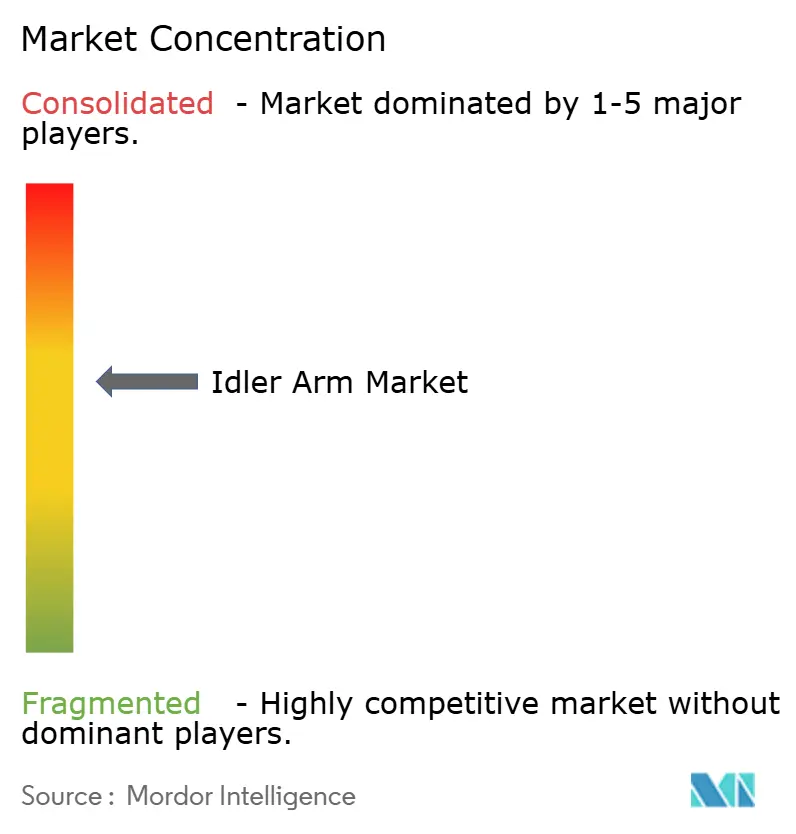
| Market Concentration | Medium |
Major Players *Disclaimer: Major Players sorted in no particular order Image © Mordor Intelligence. Reuse requires attribution under CC BY 4.0. | |

Idler Arm Market Analysis by Mordor Intelligence
The idler arms market size stood at USD 6.18 billion in 2025 and is forecast to grow at a 4.66% CAGR, reaching USD 7.76 billion by 2030. Rising demand for steering-linkage support in light-truck, SUV, and electrified commercial platforms anchors current value while emerging steer-by-wire prototypes sustain the outlook. Automakers continue to add heavier battery packs, prompting a shift toward lightweight aluminum idler arms that preserve ride dynamics without sacrificing strength. Meanwhile, extended vehicle life cycles enlarge replacement cycles, keeping aftermarket volumes high even as new-vehicle output plateaus in mature regions. Suppliers that combine material innovation with ISO 26262-compliant design stand to capture outsized gains as vehicle architectures migrate toward higher electronic content[1]“IAA Transportation 2024: ZF Further Expands Its Position as a Pacesetter of the Commercial Vehicle Industry,” ZF Press Center, zf.com.
Key Report Takeaways
- By material type, alloy steel accounted for 42.97% of the automotive idler arms market share in 2024; aluminum is projected to register a 6.94% CAGR through 2030.
- By vehicle type, passenger cars accounted for 55.76% of the automotive idler arms market size in 2024, while medium and heavy commercial vehicles are projected to post a 5.61% CAGR to 2030.
- By application, steering linkage support held 64.46% of the automotive idler arms market share in 2024, and belt-drive systems are projected to expand at a 5.97% CAGR during the same period.
- By sales channel, the aftermarket commanded 65.48% of the automotive idler arms market size in 2024 and is projected to advance at a 6.38% CAGR through 2030.
- By geography, Asia-Pacific secured 37.86% of the automotive idler arms market share in 2024 and is forecasted to post a 5.34% CAGR to 2030.
Note: Market size and forecast figures in this report are generated using Mordor Intelligence’s proprietary estimation framework, updated with the latest available data and insights as of January 2026.
Market Trends and Insights
Drivers Impact Analysis of Idler Arm Market*
| Driver | (~) % Impact on CAGR Forecast | Geographic Relevance | Impact Timeline |
|---|---|---|---|
| Light-Truck and SUV Production | +1.2% | Global, with APAC and North America leading | Medium term (2-4 years) |
| Growing Aftermarket Demand | +1.0% | Global, concentrated in Europe and North America | Long term (≥ 4 years) |
| Lightweight Aluminum Idler Arms | +0.8% | APAC core, spill-over to North America and Europe | Medium term (2-4 years) |
| ADAS and Steer-By-Wire Prototypes | +0.7% | North America and Europe, expanding to APAC | Long term (≥ 4 years) |
| Autonomous Shuttle Deployments | +0.6% | North America and Europe pilot programs | Long term (≥ 4 years) |
| New Micro-Plastic Limits | +0.4% | Europe and California, expanding globally | Short term (≤ 2 years) |
| Source: Mordor Intelligence | |||
Surging Global Light-Truck and SUV Production
Light-truck and SUV assembly keeps climbing, lifting demand for robust idler arms that manage higher curb weights and more complex belt-drive accessories. ZF's strong demand for electric drives in commercial vehicles underscores the critical role of durable steering components in larger vehicles. This emphasizes the need for mechanical strength and reliability as the industry shifts towards electrified heavy-duty transportation. Chinese and North American factories increasingly co-locate suppliers, a trend reinforced by Mexican operations established by parts makers serving Tesla’s forthcoming pickup lineup[2]“Business Trends of Chinese Parts Suppliers in Mexico,” MarkLines, marklines.com. Larger vehicles also force automakers to specify longer-life idler arms, raising average selling prices. In parallel, integrated lane-change assistance packages need mechanical supports that are tolerant of tighter alignment tolerances, widening the addressable pool for precision-machined idler arms.
Growing Aftermarket Demand From Aging Vehicle Parc
Remote software updates enable vehicle owners to delay replacements, increasing the global average age of vehicles. However, mechanical wear from high mileage continues to drive service visits, with workshops focusing on steering components like idler arms in older vehicles. This trend boosts demand for premium replacement parts that meet original equipment standards. Suppliers like Continental are expanding product lines for popular European models, leveraging their reputation for aftermarket growth. Digital supply chains help distributors align inventory with regional failure trends, ensuring timely deliveries and reducing risks. Meanwhile, electric and hybrid drivetrains' added weight and torque are accelerating part wear and driving growth in specific aftermarket segments. The shift to electrification reshapes service priorities and creates new opportunities for parts suppliers and distributors.
Lightweight Aluminum Idler Arms To Offset EV Battery Mass
Electric vehicle manufacturers are increasingly using lightweight materials like aluminum to enhance driving ranges, particularly in components such as idler arms. This shift is supported by suppliers relocating operations to cost-efficient hubs near assembly plants, with expansions in regions like Nuevo León and Guanajuato. Suppliers with expertise in casting and heat treatment gain a competitive edge, while innovations in material science drive the development of hybrid idler arms. These designs, combining aluminum forgings with composite bushings, meet environmental standards like microplastic reduction targets without compromising performance, presenting growth opportunities in the EV supply chain.
ADAS and Steer-By-Wire Prototypes Requiring Tighter Steering Tolerances
As advanced driver-assistance features like automated lane-keeping and highway pilot systems become standard, steering components face stricter performance standards. Manufacturers continue to use mechanical backups, such as idler arms, alongside steer-by-wire technology to ensure safety, driving up validation costs but strengthening intellectual property through traceable practices. The push for quieter, smoother rides highlights the importance of precision in surface finishes, with idler arms reducing noise, vibration, and harshness. As electronic and mechanical systems integrate further, traditional component suppliers evolve into systems integrators, positioning Tier-1 suppliers as key contributors to vehicle performance and safety in intelligent mobility.
Restraints Impact Analysis of Idler Arm Market*
| Restraint | (~) % Impact on CAGR Forecast | Geographic Relevance | Impact Timeline |
|---|---|---|---|
| Steel and Aluminum Price Volatility | -0.8% | Global, with emerging markets most affected | Short term (≤ 2 years) |
| Shift to EPS Rack-and-Pinion | -0.7% | Global, led by premium segments | Medium term (2-4 years) |
| In-Wheel Motor Chassis Architectures | -0.6% | APAC and Europe early adoption | Long term (≥ 4 years) |
| Longer OEM Warranties | -0.5% | North America and Europe primarily | Medium term (2-4 years) |
| Source: Mordor Intelligence | |||
Steel and Aluminum Price Volatility
Fluctuations in raw material costs, such as alloy surcharges and ingot pricing, strain supplier margins and complicate fixed-price agreements. Smaller foundries, lacking financial flexibility, face greater risks, driving industry consolidation as larger players gain dominance. Procurement teams mitigate risks by tying price-adjustment clauses to commodity benchmarks, which limits gains during market stabilization. Advanced cost-modeling and strategic inventory management are becoming critical for maintaining just-in-time delivery and minimizing capital tied up in stock, offering agile suppliers a competitive edge amid economic uncertainties and supply-chain complexities.
Shift To EPS Rack-And-Pinion Eliminating Idler Arms In Some Platforms
Electric-power-assisted rack-and-pinion steering in compact unibody passenger cars reduces demand for traditional steering components like idler arms. Initially adopted by luxury automakers to optimize engine-bay space and assembly, the technology is now entering high-volume segments as costs decline, further impacting conventional steering parts. However, demand persists from heavier utility vehicles relying on parallel-bar steering systems. To address this, suppliers focus on flexible production lines and R&D efforts aimed at multifunctional knuckles that integrate electric and mechanical systems, ensuring compatibility across diverse vehicle platforms in a rapidly evolving market.
*Our forecasts treat driver/restraint impacts as directional, not additive. The impact forecasts reflect baseline growth, mix effects, and variable interactions.
Idler Arm Market Segment Analysis
By Material Type:
Aluminum Gains Momentum Despite Steel DominanceAlloy Steel retained 42.97% of the automotive idler arms market share in 2024, validating its durability in mixed-duty fleets. Aluminum, however, posts the segment’s fastest 6.94% CAGR as OEMs target curb-weight parity between electric and combustion models. The automotive idler arms market size for aluminum units is projected to rise significantly between 2025 and 2030, reflecting broad OEM adoption for pickup and crossover programs. Carbon steel and cast iron keep relevance in cost-sensitive emerging-market nameplates but cede share steadily.
OEM engineers mandate tighter dimensional tolerances for aluminum forgings to ensure fatigue performance equal to steel, prompting investments in multi-axis CNC machining and X-ray inspection. Composite-bushing hybrids gain ground as Europe’s microplastic limits tighten, adding a lightweight damping interface without increasing mass. Suppliers with vertically integrated smelting and finishing operations weather raw-material swings better than brokers reliant on spot ingots. Consequently, aluminum’s share climb reshapes supplier rankings inside the automotive idler arms market.




By Vehicle Type:
Commercial Vehicles Drive Growth AccelerationPassenger cars controlled 55.76% of the automotive idler arms market size in 2024, due to sheer volume; yet medium and heavy commercial trucks are advancing at a 5.61% CAGR on the back of electrified logistics fleets. Load factors in last-mile vans surge with e-commerce, pushing steering linkages toward higher fatigue thresholds. ZF’s EUR 5 billion production ramp for e-drive systems implicitly lifts idler-arm call-offs tied to those chassis. Light commercial vehicles mirror the trend, benefiting from municipal incentives for zero-emission delivery.
Conversely, compact car platforms increasingly favor single-piece EPS racks, removing idler arms altogether and tempering overall unit demand. Suppliers offset the erosion by diversifying into reinforced heavy-duty assemblies tailored for autonomous shuttles and yard tractors. The automotive idler arms market share commanded by commercial applications therefore widens even as absolute passenger-car volumes stay larger.
By Application:
Belt-Drive Systems Emerge as Growth DriverSteering-linkage support still accounted for 64.46% of the automotive idler arms market share in 2024, underscoring its foundational role in directional control. Yet belt-drive-system installations expand at 5.97% CAGR through 2030 as electrified accessories rely on optimized belt paths to power auxiliary compressors and pumps. The automotive idler arms market size tied to belt-drive tensioners is projected to grow robustly by decade-end as EV adoption accelerates.
Electric architectures demand precise belt geometry to avoid NVH penalties, so idler arms migrate to lightweight cast-aluminum with molded-in bearing races. Hybrid models further compound demand by retaining combustion accessories alongside electric modules, raising part counts per vehicle. Engineers, meanwhile, unify steering-linkage idler arms with belt guides in shared castings, delivering cost and mass savings while boosting per-unit revenue for integrated suppliers.

By Sales Channel:
Aftermarket Accelerates Beyond OEM GrowthAftermarket volumes represented 65.48% of the automotive idler arms market share in 2024, and the channel is on pace for a 6.38% CAGR to 2030 as vehicles stay on the road longer. Continental’s expansion into steering and chassis lines underscores the revenue potential of OE-grade replacements targeting high-mileage European sedans. Digital cataloging and VIN-level fitment confirmation improve install confidence, nudging garages toward premium brands.
OEM demand tracks the underlying production curve and remains critical for design validation loops, yet volume growth lags aftermarket momentum amid plateauing global assemblies. Tier-1s therefore court fleet service networks and extended-warranty providers to lock multiyear supply agreements that blur traditional OEM-aftermarket boundaries. Remanufacturing programs complement fresh parts, keeping circular-economy commitments and widening total addressable value inside the automotive idler arms market.
Geography Analysis
APAC Idler Arm Market
Asia-Pacific held 37.86% of the automotive idler arms market share in 2024 and is expected to register a 5.34% CAGR to 2030 as China scales premium EV lines and India ramps medium truck output. Chinese policies that favor autonomous driving investments stimulate demand for precision idler arms compatible with steer-by-wire redundancies. Supplier parks in Anhui and Zhejiang secure large cross-orders, while joint-venture tooling in Thailand and Vietnam provides low-cost overflow capacity. Japanese incumbents leverage advanced metallurgy to supply lightweight variants that meet stringent domestic durability tests, protecting their stronghold in regional premium nameplates.
North America Idler Arm Market
North America grows at a more measured growth rate, driven mainly by replacement demand and sustained pickup production. The automotive idler arms market size here also benefits from onshoring that ushers Mexican castings into U.S. assembly plants, shrinking lead times and boosting regional content compliance. Fleet electrification programs by parcel carriers ignite incremental orders for heavy-duty idler arms capable of coping with regenerative-braking torque spikes. Strict U.S. FMVSS rules preserve mechanical fallback paths in steer-by-wire trials, assuring ongoing idler-arm integration even as electronics proliferate.
Europe Idler Arm Market
Europe shows moderate growth as emissions and micro-plastic directives raise R&D outlays but create premium price niches for compliant components. German suppliers co-engineer composite bushings with Scandinavian polymer specialists to address the new requirements, then export the solutions globally. Continental’s aftermarket push consolidates distribution in key EU hubs, offering OE-labeled chassis parts to independent garages and raising brand share. The region’s focus on Level-3 highway pilot applications keeps demand steady for idler arms that dovetail with redundant steering setups, offsetting any volume loss from compact EPS-only platforms.


Competitive Landscape
Competitive intensity remains moderate, with the top three brands, ZF Friedrichshafen, MOOG, and ACDelco, holding a combined majority share. Technology-centric acquisitions persist; Schaeffler’s earlier buy of Paravan’s SPACE DRIVE underpins commercial agreements to supply steer-by-wire hardware in Europe and Asia[3]“Schaeffler Acquires Drive-by-Wire Technology,” Schaeffler, schaeffler.com. ZF leverages cross-divisional scale to offer bundled chassis-plus-e-drive packages, landing system contracts that lock in idler-arm content for years.
Premium aftermarket battles heat up as Continental moves beyond sensors into hard parts, challenging entrenched MOOG catalog breadth with OE-grade positioning. Distribution alliances with pan-European part retailers grant immediate shelf presence, forcing rivals to refresh packaging and warranty terms. Aluminum machining specialists from Taiwan and South Korea expand footprints in Mexico, aligning with North American localization mandates and injecting new cost competition.
R&D spending tilts toward multi-material designs that marry aluminum bodies with bio-composite bushings, a domain where smaller innovators patent niche solutions and then license them to majors. Meanwhile, digital twins and predictive-maintenance analytics allow suppliers to upsell fleet dashboards that flag impending idler-arm wear, embedding service revenue beyond hardware. Overall, differentiation migrates from standalone forged parts to integrated mechanical–electronic subsystems that anticipate automated-driving needs.
Idler Arm Industry Leaders
ZF Friedrichshafen AG
MOOG
ACDelco
Mando Corporation
Sankei Industry Co.,Ltd.
- *Disclaimer: Major Players sorted in no particular order
Idler Arm Market Companies Covered in this Report
- ZF Friedrichshafen AG (TRW)
- MOOG (Federal-Mogul)
- ACDelco (General Motors)
- Mando Corporation
- High Link Auto Parts Co., Ltd.
- Datta Industries
- MEVOTECH LP
- Febi Bilstein
- Delphi Technologies
- NSK Ltd.
- JTEKT Corporation
- Central Corp. (CTR)
- Chih Chi Enterprise Co., Ltd.
- Great Auto Parts (GAP)
- Aisin Corporation
- Rare Parts Inc.
- MAPCO Autotechnik

Recent Industry Developments in Idler Arm Market
- April 2025: Mevotech released 193 new steering and suspension part numbers, bringing coverage to 106.8 million United States vehicles in operation and 10 million in Canada, including 58 first-to-market SKUs.
- March 2025: QA1, a leading manufacturer of high-performance suspension components, launched lowering-kit packages for Ford F-150 and GM Silverado/Sierra half-ton pickups.


Global Idler Arm Market Report Scope
| Alloy Steel |
| Carbon Steel |
| Cast Iron |
| Aluminum |
| Others |
| Passenger Cars |
| Light Commercial Vehicles |
| Medium and Heavy Commercial Vehicles |
| Steering Linkage Support |
| Belt-Drive System |
| OEM |
| Aftermarket |
| North America | United States |
| Canada | |
| Rest of North America | |
| South America | Brazil |
| Argentina | |
| Rest of South America | |
| Europe | United Kingdom |
| Germany | |
| Spain | |
| Italy | |
| France | |
| Russia | |
| Rest of Europe | |
| Asia-Pacific | China |
| India | |
| Japan | |
| South Korea | |
| Rest of Asia-Pacific | |
| Middle East and Africa | United Arab Emirates |
| Saudi Arabia | |
| Turkey | |
| Egypt | |
| South Africa | |
| Rest of Middle East and Africa |
| By Material Type | Alloy Steel | |
| Carbon Steel | ||
| Cast Iron | ||
| Aluminum | ||
| Others | ||
| By Vehicle Type | Passenger Cars | |
| Light Commercial Vehicles | ||
| Medium and Heavy Commercial Vehicles | ||
| By Application | Steering Linkage Support | |
| Belt-Drive System | ||
| By Sales Channel | OEM | |
| Aftermarket | ||
| By Geography | North America | United States |
| Canada | ||
| Rest of North America | ||
| South America | Brazil | |
| Argentina | ||
| Rest of South America | ||
| Europe | United Kingdom | |
| Germany | ||
| Spain | ||
| Italy | ||
| France | ||
| Russia | ||
| Rest of Europe | ||
| Asia-Pacific | China | |
| India | ||
| Japan | ||
| South Korea | ||
| Rest of Asia-Pacific | ||
| Middle East and Africa | United Arab Emirates | |
| Saudi Arabia | ||
| Turkey | ||
| Egypt | ||
| South Africa | ||
| Rest of Middle East and Africa | ||


Key Questions Answered in the Report
What is the projected value of the automotive idler arms market in 2030?
The market is forecasted to reach USD 7.76 billion by 2030 under a 4.66% CAGR scenario.
Which region leads demand for idler arms?
Asia-Pacific commanded 37.86% share in 2024 and will remain the largest, helped by a 5.34% CAGR through 2030.
Why are aluminum idler arms gaining popularity?
Aluminum delivers up to 50% weight savings that offset battery mass in EVs while meeting durability targets, driving the fastest 6.94% CAGR in material adoption.
How does aftermarket demand compare with OEM demand?
The aftermarket held 65.48% share in 2024 and is expanding at 6.38% CAGR, outpacing OEM channels as vehicles stay in service longer.
What impact do steer-by-wire systems have on idler arm design?
They impose tighter tolerances and ISO 26262 compliance, yet hybrid designs still use idler arms for mechanical redundancy during the transition to full electronic steering.
Page last updated on:


 Your data is secure and never sold or shared.


