
Identity Verification Orchestration Market Size and Share
Market Overview
| Study Period | 2020 - 2031 |
|---|---|
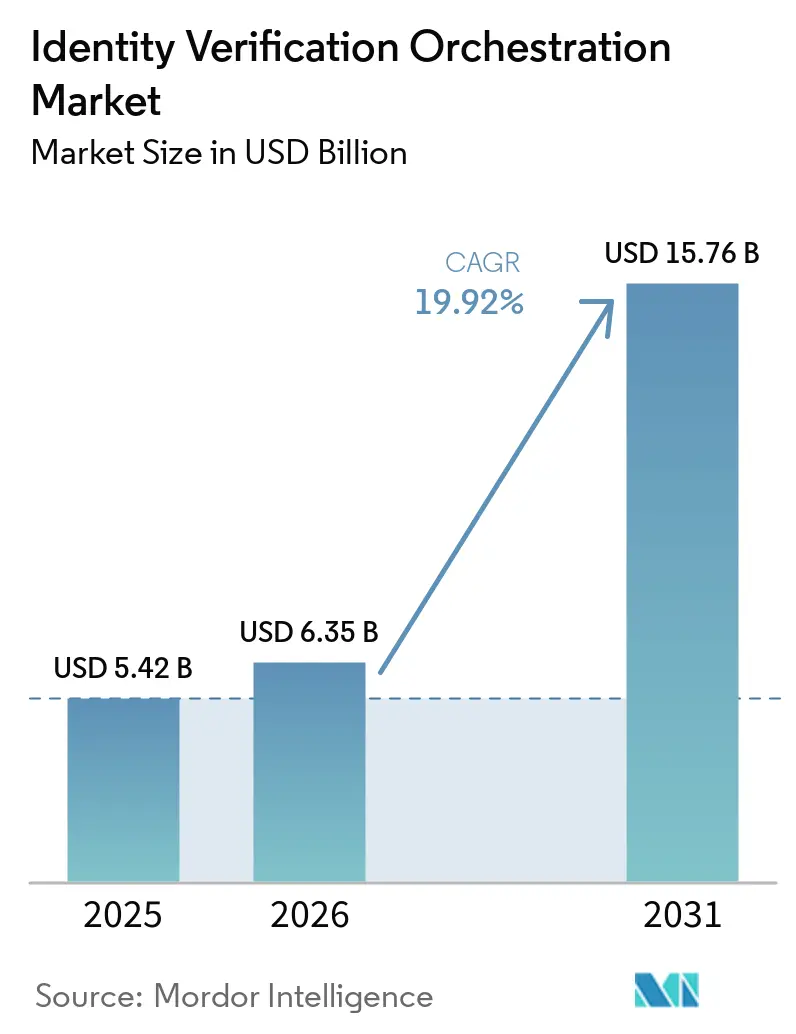
| Market Size (2026) | USD 6.35 Billion |
| Market Size (2031) | USD 15.76 Billion |
| Growth Rate (2026 - 2031) | 19.92 % |
| Fastest Growing Market | Asia-Pacific |
| Largest Market | North America |
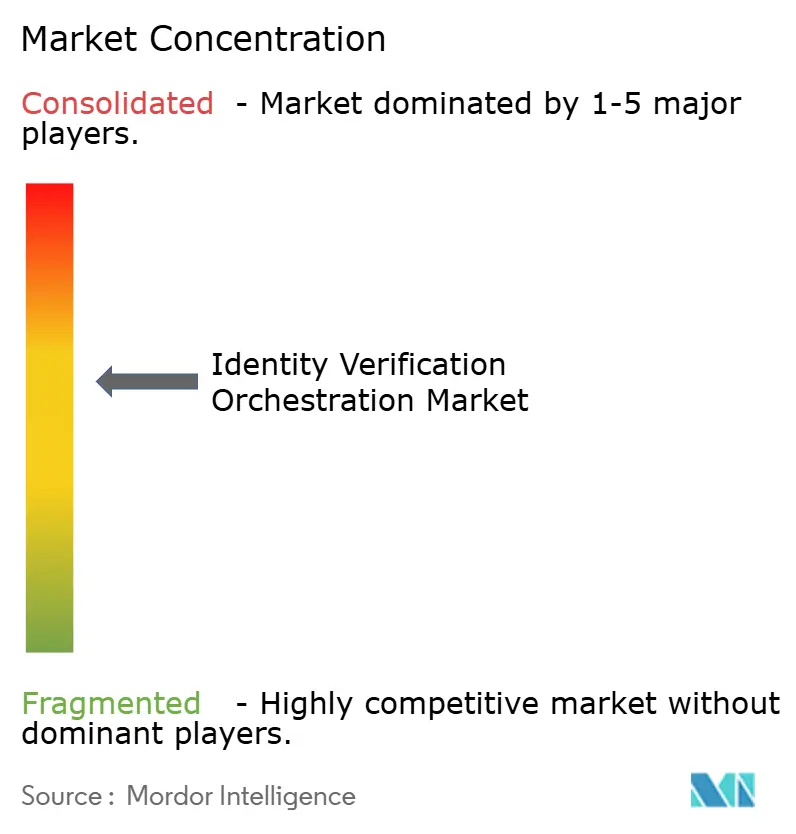
| Market Concentration | Medium |
Major Players *Disclaimer: Major Players sorted in no particular order Image © Mordor Intelligence. Reuse requires attribution under CC BY 4.0. | |
Identity Verification Orchestration Market Analysis by Mordor Intelligence
The Identity Verification Orchestration Market size is expected to increase from USD 5.42 billion in 2025 to USD 6.35 billion in 2026 and reach USD 15.76 billion by 2031, growing at a CAGR of 19.92% over 2026-2031. Growth reflects a shift away from single-provider verification tools toward platforms that can select and combine methods based on risk signals. Digital onboarding, cross-border compliance, and more advanced identity fraud are increasing the need for this approach. Providers are also building broader platforms that integrate KYC, KYB, AML screening, fraud intelligence, and ongoing monitoring into a single commercial relationship. This favors vendors that can maintain reliable routing, audit records, and provider alternatives without adding friction for legitimate users. The Identity Verification Orchestration Market, therefore, has opportunities in regulated onboarding, reusable credentials, and complex verification programs operating across multiple jurisdictions. The Identity Verification Orchestration Market also supports more controlled responses when risk conditions change during a customer journey. Its value increases where organizations need several verification methods without separate manual workflows.
Key Report Takeaways
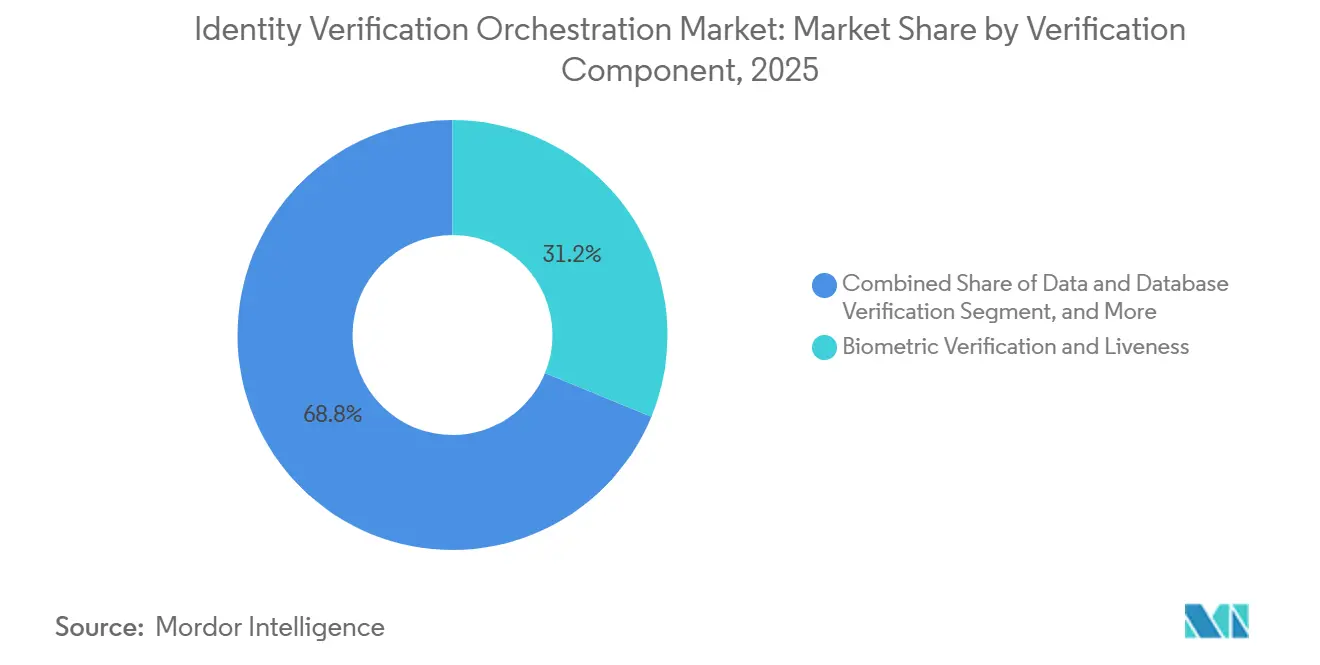
- By verification component, biometric verification and liveness held 31.20% of the Identity Verification Orchestration Market share in 2025, while fraud, device, and network intelligence is projected to expand at a 20.66% CAGR through 2031.
- By deployment, cloud held 68.32% of the Identity Verification Orchestration Market revenue in 2025, while hybrid is projected to grow at a 21.25% CAGR through 2031.
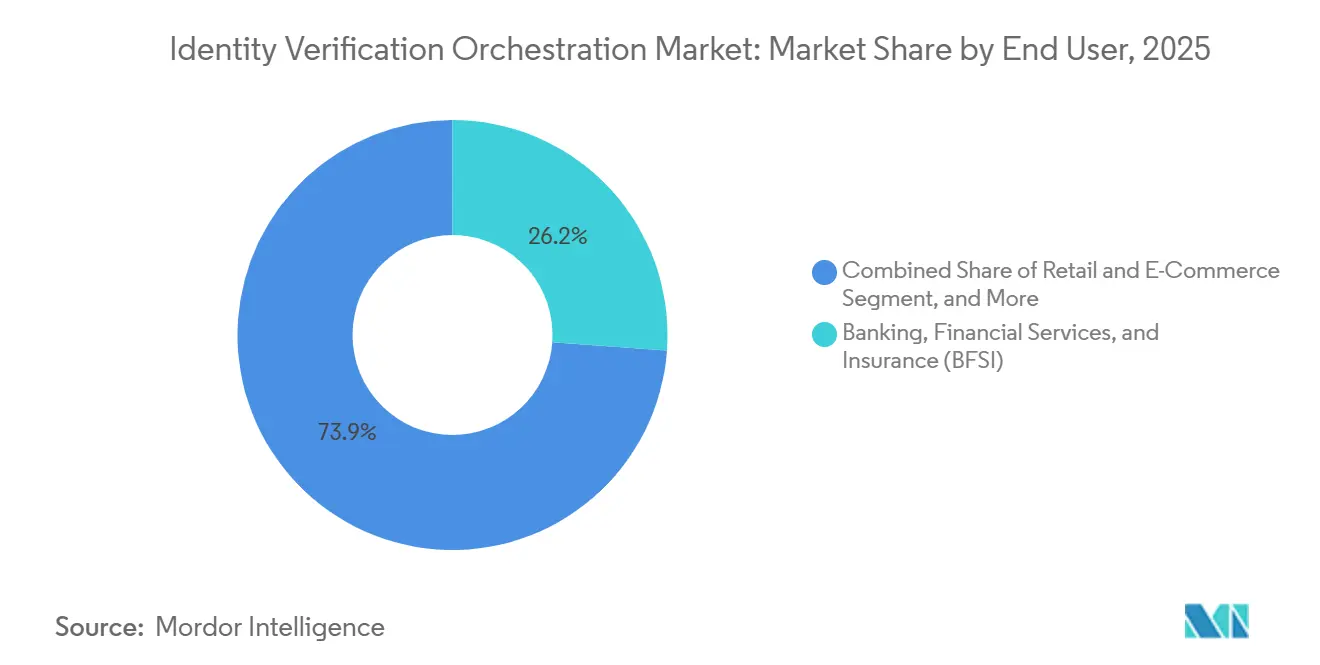
- By end user, BFSI held 26.15% of the Identity Verification Orchestration Market revenue in 2025, while healthcare and life sciences are expected to expand at a 20.45% CAGR through 2031.
- By organization size, large enterprises held 70.44% of the Identity Verification Orchestration Market revenue in 2025, while small and medium-sized enterprises are projected to grow at a 21.56% CAGR through 2031.
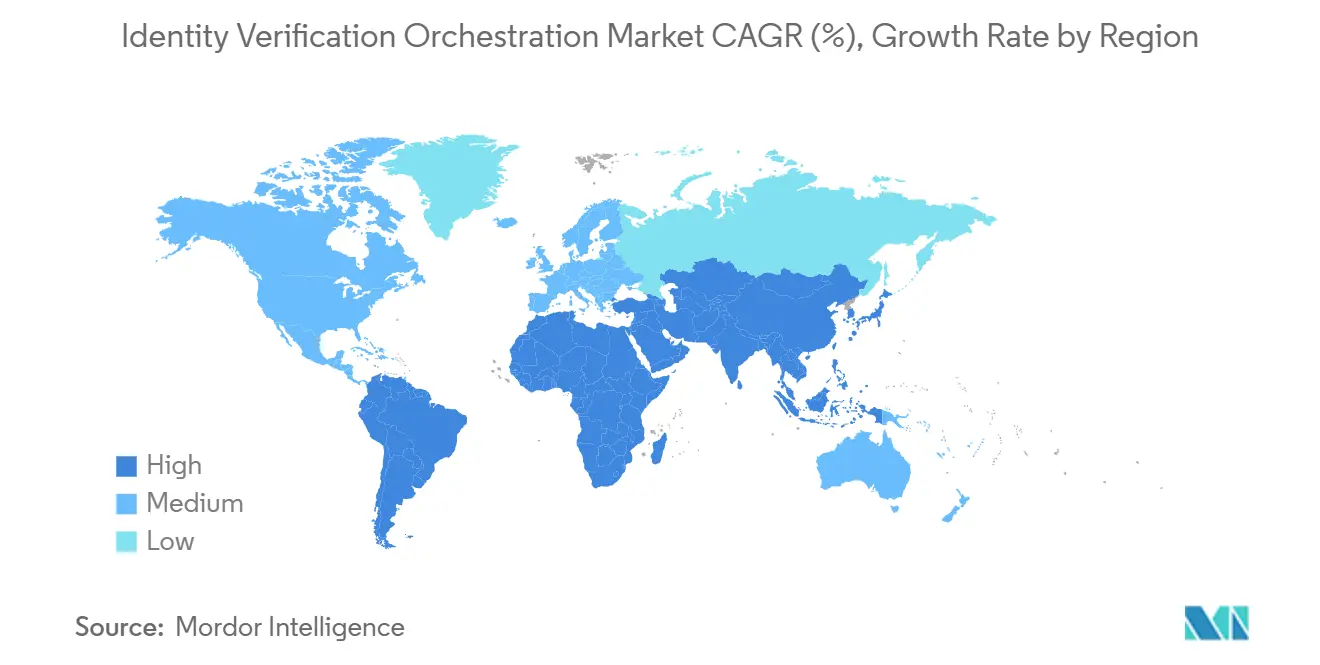
- By geography, North America held 38.11% of the Identity Verification Orchestration Market revenue in 2025, while Asia-Pacific is projected to expand at a 20.89% CAGR through 2031.
Note: Market size and forecast figures in this report are generated using Mordor Intelligence’s proprietary estimation framework, updated with the latest available data and insights as of January 2026.
Global Identity Verification Orchestration Market Trends and Insights
Drivers Impact Analysis*
| Driver | (~) % Impact on CAGR Forecast | Geographic Relevance | Impact Timeline |
|---|---|---|---|
| Escalating Synthetic-Identity and Deepfake Fraud | +5.2% | Global | Short-term (≤ 2 years) |
| Expansion of Digital Onboarding and E-KYC | +4.1% | Global, strongest momentum in Asia-Pacific and North America | Medium-term (2-4 years) |
| Tightening AML, KYC, and Age-Assurance Enforcement | +3.6% | Europe and North America, with spillover to Asia-Pacific | Medium-term (2-4 years) |
| Growth of Cross-Border Digital Services | +2.8% | Asia-Pacific core, with spillover to Europe and Middle East and Africa | Medium-term (2-4 years) |
| Adaptive Routing to Reduce Cost per Good Verified User | +2.1% | North America and Europe | Long-term (≥ 4 years) |
| AI-Agent Identity and Machine-to-Machine Trust Requirements | +1.5% | North America and Europe, early stage in Asia-Pacific | Long-term (≥ 4 years) |
| Source: Mordor Intelligence | |||
Escalating Synthetic-Identity and Deepfake Fraud Redefines Verification Architecture
Synthetic identities and deepfakes are putting pressure on verification designs that rely on a single method or provider. Sumsub reported that synthetic identity document fraud rose 311% across its network between Q1 2024 and Q1 2025, while biometric injection attacks rose 741% over the same period. The Identity Verification Orchestration Market responds by combining document checks, passive liveness detection, device intelligence, and behavioral data into a workflow that can adapt as risk evolves. This makes a complete verification path more difficult to defeat than an isolated check. CEN/TS 18099:2025 established a framework for evaluating the detection of biometric data injection attacks across face, fingerprint, and other biometric modalities. The standard gives providers and buyers a clearer basis for assessing defenses against injected biometric data.
Expansion of Digital Onboarding and E-KYC Creates Demand for Modular Verification Stacks
Digital onboarding requires firms to complete checks quickly while applying controls that match each applicant’s risk. The UK government found that 53% of digital identity providers cited KYC and AML compliance as a use case in 2026, compared with 32% at the baseline measurement. This shift supports the Identity Verification Orchestration Market because document capture, biometric matching, liveness detection, and screening can be integrated into a workflow rather than purchased as disconnected processes. Sumsub introduced a Model Context Protocol integration in 2026 that lets AI agents configure compliance environments, reducing the setup burden for organizations without dedicated compliance engineering teams. The CFIT Blueprint Report found that 81% of surveyed UK SMEs would pay for a digital company identity service. It also found that 65% expected such a service to reduce friction in opening business bank accounts.
Tightening AML, KYC, and Age-Assurance Enforcement Elevates Compliance Requirements
Regulation is adding credential types, screening obligations, and reporting expectations to digital onboarding. The European Union’s Anti-Money Laundering Regulation requires financial institutions to accept the European Digital Identity Wallet for customer onboarding by 2027. EU member states were required to transpose specified provisions of the Sixth Anti-Money Laundering Directive by July 10, 2026, increasing the focus on beneficial ownership data and sanctions screening. In September 2026, US banking agencies clarified that banks may use state-issued mobile driver’s licenses and government-issued verifiable digital credentials under the Customer Identification Program rule. These changes create more inputs for the Identity Verification Orchestration Market, but they also make the operating model more demanding. Platforms need to route, weight, document, and retain the appropriate evidence for each credential and use case.
Growth of Cross-Border Digital Services Requires Multi-Jurisdiction Verification
Cross-border digital services face differences in document formats, identity systems, assurance levels, and local compliance rules. Among 28 UK digital identity firms that disclosed geographic revenue in 2024/25, international activity generated 60% of revenue, up from 57% at baseline. Revenue from the European Union and European Economic Area exceeded US revenue for the first time in this group. The Identity Verification Orchestration Market helps enterprises direct applicants to the credential format and assurance level required by the receiving jurisdiction. A Japan-European Union pilot in July 2026 validated cross-border verification of credentials from Japan’s My Number Card system and the EUDI Wallet using open standards. This supports the technical case for systems capable of coordinating verification across jurisdictions. The commercial value is in reducing manual workflow changes when an enterprise expands into another market.
Restraints Impact Analysis*
| Restraint | (~) % Impact on CAGR Forecast | Geographic Relevance | Impact Timeline |
|---|---|---|---|
| Fragmented Identity Standards and Regulatory Rules | -3.8% | Global, most acute in Asia-Pacific and South America | Long-term (≥ 4 years) |
| Privacy, Consent, and Data-Residency Constraints | -3.2% | Europe core, with spillover to Asia-Pacific and North America | Medium-term (2-4 years) |
| Adversarial Attacks Against Verification Telemetry | -2.5% | Global | Short-term (≤ 2 years) |
| Verification Friction and False-Decision Risk | -1.8% | Global | Short-term (≤ 2 years) |
| Source: Mordor Intelligence | |||
Fragmented Identity Standards and Regulatory Rules Create Integration Complexity
Platforms serving several countries must work with eIDAS 2.0, NIST SP 800-63-3, FATF Travel Rule requirements, ISO/IEC 29115, and national AML rules. The Identity Verification Orchestration Market must address this complexity through jurisdiction-specific workflows rather than a single universal configuration. Some requirements can conflict, such as rules on data retention and privacy obligations. Such conflicts need legal review and cannot be resolved solely by automated routing. The challenge is particularly relevant in South America, where Brazil’s LGPD, Argentina’s data protection law, and financial-sector requirements create separate obligations. Different Travel Rule message formats and trust frameworks also mean that global crypto exchanges must retain jurisdiction-specific verification pathways.
Privacy, Consent, and Data-Residency Constraints Limit Cross-Regional Data Flows
Biometric data is often subject to strict consent, processing, and storage requirements. Under GDPR Article 9, biometric data used to uniquely identify a person is a special category of personal data, requiring explicit consent and carefully defined processing controls. The Identity Verification Orchestration Market must support regional processing patterns when financial regulators require local storage alongside GDPR safeguards. The European Data Protection Board’s 2026 coordinated enforcement action examined KYC transparency under GDPR Articles 12-14, reinforcing the importance of clear communication at the point of data collection.[1] Hybrid systems address part of this issue by keeping biometric and document processing in regional or on-premises infrastructure. They can retain centralized cloud functions for routing, audit trails, and provider fallback, but the split adds cost and operating complexity.
*Our forecasts treat driver/restraint impacts as directional, not additive. The impact forecasts reflect baseline growth, mix effects, and variable interactions.
Segment Analysis
By Verification Component: Biometrics Lead While Fraud Intelligence Expands Fastest
Biometric verification and liveness held 31.20% of the Identity Verification Orchestration Market share in 2025. This position reflects the need to confirm that a person is present and that a submitted face or biometric sample is genuine. Passive liveness and injection-attack detection have become central controls as digital identity fraud becomes more sophisticated. CEN/TS 18099:2025 provides a European framework for evaluating biometric data injection attack detection systems across facial, fingerprint, and multimodal settings. Document and identity verification also remain central to the initial onboarding process. Data and database verification are important, where access to government registries can support document-free checks.
Fraud, device, and network intelligence is projected to grow at a 20.66% CAGR from 2026 to 2031. In the Identity Verification Orchestration Market, device telemetry, IP information, and behavioral signals are increasingly used before requesting a biometric check. A known and trusted device may proceed with less friction, while an unfamiliar environment can trigger additional checks. Socure acquired Fravity in August 2026, adding more than 70 specialized AI agents for fraud, risk, and compliance operations to its platform. AML, PEP, sanctions, and adverse media screening comprise the compliance component of the workflow. Address, income, and source-of-funds checks also become more relevant as customer due diligence requirements become more detailed.

By Deployment: Cloud Leads While Hybrid Addresses Residency Requirements
Cloud deployment held 68.32% of the Identity Verification Orchestration Market share in 2025. A cloud layer can switch among providers without requiring an enterprise to update its onboarding code for each provider. This supports quicker failover and reduces the effort required to introduce a new verification service. The model is well-suited to organizations that use application programming interfaces and need rapid workflow changes. On-premises deployment remains relevant for public-sector, defense-adjacent, and other environments with strict sovereignty requirements. This is particularly important in jurisdictions that restrict offshore processing of citizen identity data.
Hybrid deployment is projected to grow at a 21.25% CAGR from 2026 to 2031. Organizations are separating the location of sensitive processing from the location of routing and audit functions. Biometric and document processing can occur on-premises or in a regional cloud, while central services manage provider selection, audit trails, and fallback options. Sumsub was recertified under eIDAS 2.0 at the High Level of Confidence for Auto Identification, Video Identification, e-ID Verification, and KYB Verification. The regulation requires each EU member state to make at least 1 European Digital Identity Wallet available by the end of 2026. These requirements make interoperability and controlled processing locations more important for platform design.
By End User: BFSI Anchors Demand While Healthcare and Life Sciences Grows Fastest
BFSI held 26.15% of the Identity Verification Orchestration Market share in 2025. Banks, insurers, and financial services firms handle high volumes of verification and have formal KYC and AML obligations. They also need evidence that risk teams and regulators can review. Crypto, digital asset, and payment providers face a more complex mix of sanctions screening, KYC, and Travel Rule obligations. Retail, e-commerce, and marketplace users adopt these systems to reduce account-opening fraud. Gaming, gambling, and digital media operators use similar workflows for age assurance and account recovery.
Healthcare and life sciences are projected to expand at a 20.45% CAGR from 2026 to 2031. The segment’s demand is linked to patient identity verification as a quality and safety control, not only as a fraud control. Ping Identity Verification and Fraud Protection was listed in Epic Toolbox in July 2026 for MyChart-connected workflows, allowing healthcare organizations to use identity verification, fraud detection, and no-code orchestration. ID.me was also listed in Epic Toolbox for the Identity Verification for MyChart category in April 2026. LexisNexis Risk Solutions launched a healthcare identity-management platform in February 2026 that combined identity verification, duplicate record resolution, and behavioral enrichment.[2] Government and public administration also represent demand as public agencies standardize identity checks for citizen services.
By Organization Size: Large Enterprises Lead While SMEs Offer Faster Growth
Large enterprises held 70.44% of revenue in 2025. Their requirements commonly involve multiple countries, high transaction volumes, internal risk governance, and detailed records for regulatory review. The Identity Verification Orchestration Market provides these buyers with a way to manage service-level expectations and provider fallbacks from a single operating layer. For a large financial institution, a verification outage can disrupt onboarding and transaction activity at scale. These conditions support multi-year arrangements and make continuity a major purchasing requirement. Large enterprises also need to show why a decision was made when regulators or internal committees review a case.
Small and medium-sized enterprises are projected to expand at a 21.56% CAGR from 2026 to 2031. Consumption-based pricing ties verification costs to transaction volume, thereby reducing initial technology spending. Self-service dashboards and no-code workflow builders also reduce the integration burden for smaller firms. The CFIT Blueprint Report found that 81% of surveyed UK SMEs would pay for a digital company identity service. This points to demand among firms that need stronger controls but do not have large compliance engineering teams. The identity verification orchestration industry can serve this group when configurations remain understandable and can be deployed without extensive customization.
Geography Analysis
North America held 38.11% of the Identity Verification Orchestration Market share in 2025. The region combines a large base of regulated financial institutions, enterprise government deployments, and active rulemaking. In September 2026, US banking agencies stated that banks may use state-issued mobile driver’s licenses and government-issued verifiable digital credentials for Customer Identification Program requirements.[3] This gives orchestration platforms another credential type to integrate with existing verification processes. Socure secured a 5-year USD 163 million contract for Login.gov in May 2026, showing the scale of government demand for identity-proofing technology.
Asia-Pacific is projected to grow at a 20.89% CAGR from 2026 to 2031. Large populations are entering digital financial services, while governments are expanding digital identity infrastructure. India’s Aadhaar system remains a major biometric identity program in the region. Japan’s My Number Card is also moving beyond government use toward private-sector digital services. The July 2026 Japan-European Union pilot demonstrated that My Number Card and EUDI Wallet credentials could be exchanged and verified across borders using open standards. The Philippines and Malaysia also announced a July 2026 framework to explore mutual recognition of government-issued digital credentials for employment, banking, and public services. These developments broaden the use cases for regional routing and credential interoperability.
Europe’s Identity Verification Orchestration Market is being reshaped by eIDAS 2.0 and the rollout of the European Digital Identity Wallet. Each EU member state must provide at least 1 wallet by the end of 2026, while financial institutions must accept the wallet for AML onboarding by 2027. The UK digital identity sector employed 9,624 full-time employees in 2024/25. Brazil is an important South American market because its identity data infrastructure can support document-free verification. Sumsub launched a Brazil solution for regulated online betting in September 2026 that uses a CPF number and a liveness selfie to retrieve identity data from national databases. The Middle East and Africa offer a longer-term opportunity as national digital identity systems and customer due diligence requirements develop.
Competitive Landscape
The Identity Verification Orchestration Market has moderate concentration. The largest 20 firms accounted for 68% of UK digital identity sector revenue, based on the UK government’s 2026 sector analysis.[4] Specialized vendors continue to serve specific regions, regulated sectors, reusable credentials, and machine-to-machine use cases. Buyers increasingly prefer platforms that combine KYC, KYB, AML screening, fraud intelligence, and decisioning. This can reduce the number of providers and data-processing agreements a buyer must manage. It can also give a firm a more connected view of identity risk across the onboarding process.
Socure raised USD 156 million at a USD 5.2 billion valuation in August 2026 and acquired Fravity during the same period. The acquisition added agentic fraud investigation capabilities rather than another document or biometric service. Sumsub launched the Non-Doc Nordic eID Bundle in September 2026, providing a single integration for Swedish BankID, Danish MitID, Norwegian BankID, and Finnish FTN. This approach packages regional credential complexity into one commercial connection. Jumio integrated with Trinsic in June 2026 to support global digital ID acceptance at scale, combined with biometric authentication, liveness detection, and Identity Graph risk signals. These moves show that credential coverage and integrated risk signals are key areas of competition.
Differentiation depends on geographic coverage, the quality of real-time provider fallback, and the ability to create explainable records. The Identity Verification Orchestration Market also has room for provider-neutral systems that can switch among document, biometric, data, and AML providers without weakening the audit trail. This part of the Identity Verification Orchestration Market matters most where a buyer must preserve evidence through a provider change. Point-solution providers can find this difficult because their products were built around a limited part of the workflow. CrowdStrike introduced an Agentic Identity Provider in September 2026 to issue cryptographically verifiable identities to AI agents and manage minimum-privilege access. This expands the competitive scope toward non-human identity and machine-to-machine trust. The identity verification orchestration industry is therefore moving toward broader identity decisioning platforms, while regional and vertical specialists retain roles where local coverage or domain requirements matter.
Identity Verification Orchestration Industry Leaders
-
Jumio Corporation
-
Trulioo Information Services Inc.
-
Veriff OÜ
-
Socure, Inc.
-
Persona Identities, Inc.
- *Disclaimer: Major Players sorted in no particular order
Recent Industry Developments
- September 2026: CrowdStrike introduced its Agentic Identity Provider at Fal.Con 2026, issuing cryptographically verifiable identities to AI agents and brokering minimum-privilege access with full auditability. The product marked CrowdStrike’s entry into identity trust infrastructure for non-human machine-to-machine contexts.
- September 2026: US banking regulators, including FinCEN, OCC, the Federal Reserve Board, FDIC, and NCUA, jointly issued FAQs clarifying that banks may use state-issued mobile driver’s licenses and government-issued verifiable digital credentials to satisfy Customer Identification Program requirements under the Bank Secrecy Act.
- September 2026: Sumsub launched its Non-Doc Nordic eID Bundle, providing a single integration covering Swedish BankID, Danish MitID, Norwegian BankID, and Finnish FTN under 1 shared monthly commitment. The launch completed Sumsub’s coverage of 4 primary Nordic electronic identity schemes through 1 API.
- July 2026: Ping Identity Verification and Fraud Protection was listed in Epic Toolbox, enabling healthcare organizations to deploy identity verification, real-time fraud and risk detection, and no-code orchestration within MyChart-connected workflows for patient onboarding and account recovery.
Global Identity Verification Orchestration Market Report Scope
The Identity Verification Orchestration Market comprises software platforms and solutions that enable organizations to coordinate, manage, and optimize identity verification workflows across multiple verification providers, data sources, fraud intelligence tools, compliance systems, and risk engines. These platforms orchestrate document verification, biometric authentication, database verification, fraud detection, AML screening, sanctions checks, and other identity-proofing processes through a unified decisioning framework, helping organizations improve onboarding efficiency, fraud prevention, compliance management, and customer experience.
The Identity Verification Orchestration Market Report is Segmented by Verification Component (Document and Identity Verification, Biometric Verification and Liveness, Data and Database Verification, Fraud, Device and Network Intelligence, AML, PEP, Sanctions and Adverse Media Screening, and Address, Income and Source-of-Funds Verification), Deployment (Cloud, On-Premises, and Hybrid), End User (Banking, Financial Services, and Insurance [BFSI], Retail and E-Commerce, Healthcare and Life Sciences, Government and Public Administration, IT and Telecommunications, and Other End Users), Organization Size (Large Enterprises, and Small and Medium-Sized Enterprises), and Geography (North America, South America, Europe, Asia-Pacific, and Middle East and Africa). The Market Forecasts are Provided in Terms of Value (USD).
| Document and Identity Verification |
| Biometric Verification and Liveness |
| Data and Database Verification |
| Fraud, Device and Network Intelligence |
| AML, PEP, Sanctions and Adverse Media Screening |
| Address, Income and Source-of-Funds Verification |
| Cloud |
| On-Premises |
| Hybrid |
| Banking, Financial Services, and Insurance (BFSI) |
| Retail and E-Commerce |
| Healthcare and Life Sciences |
| Government and Public Administration |
| IT and Telecommunications |
| Other End Users |
| Large Enterprises |
| Small and Medium-Sized Enterprises |
| North America | United States | |
| Canada | ||
| South America | Brazil | |
| Mexico | ||
| Rest of South America | ||
| Europe | Germany | |
| United Kingdom | ||
| France | ||
| Italy | ||
| Rest of Europe | ||
| Asia-Pacific | China | |
| Japan | ||
| India | ||
| South Korea | ||
| Rest of Asia-Pacific | ||
| Middle East and Africa | Middle East | Saudi Arabia |
| United Arab Emirates | ||
| Rest of Middle East | ||
| Africa | South Africa | |
| Rest of Africa | ||
| By Verification Component | Document and Identity Verification | ||
| Biometric Verification and Liveness | |||
| Data and Database Verification | |||
| Fraud, Device and Network Intelligence | |||
| AML, PEP, Sanctions and Adverse Media Screening | |||
| Address, Income and Source-of-Funds Verification | |||
| By Deployment | Cloud | ||
| On-Premises | |||
| Hybrid | |||
| By End User | Banking, Financial Services, and Insurance (BFSI) | ||
| Retail and E-Commerce | |||
| Healthcare and Life Sciences | |||
| Government and Public Administration | |||
| IT and Telecommunications | |||
| Other End Users | |||
| By Organization Size | Large Enterprises | ||
| Small and Medium-Sized Enterprises | |||
| By Geography | North America | United States | |
| Canada | |||
| South America | Brazil | ||
| Mexico | |||
| Rest of South America | |||
| Europe | Germany | ||
| United Kingdom | |||
| France | |||
| Italy | |||
| Rest of Europe | |||
| Asia-Pacific | China | ||
| Japan | |||
| India | |||
| South Korea | |||
| Rest of Asia-Pacific | |||
| Middle East and Africa | Middle East | Saudi Arabia | |
| United Arab Emirates | |||
| Rest of Middle East | |||
| Africa | South Africa | ||
| Rest of Africa | |||
Key Questions Answered in the Report
What is the size of the Identity Verification Orchestration Market?
The Identity Verification Orchestration Market is expected to grow from USD 6.35 billion in 2026 to USD 15.76 billion by 2031, at a 19.92% CAGR.
What is identity verification orchestration?
It is a platform approach that coordinates document, biometric, fraud, data, and compliance checks using risk signals and routing rules.
Which verification component leads revenue?
Biometric verification and liveness led revenue with a 31.20% share in 2025.
Which deployment model is growing fastest?
Hybrid deployment is projected to grow at a 21.25% CAGR through 2031 as organizations balance cloud functions with data-residency needs.
Which end-user group is expected to grow fastest?
Healthcare and life sciences is expected to expand at a 20.45% CAGR through 2031, supported by patient identity verification workflows.
Which region is growing fastest?
Asia-Pacific is projected to grow at a 20.89% CAGR through 2031, supported by digital identity programs and financial-services onboarding.