
Identity Exposure Management Market Size and Share
Market Overview
| Study Period | 2021 - 2032 |
|---|---|
| Market Size (2027) | USD 0.71 Billion |
| Market Size (2032) | USD 1.56 Billion |
| Growth Rate (2027 - 2032) | 17.05 % |
| Fastest Growing Market | Asia-Pacific |
| Largest Market | North America |
| Market Concentration | Medium |
Major Players *Disclaimer: Major Players sorted in no particular order Image © Mordor Intelligence. Reuse requires attribution under CC BY 4.0. | |
Identity Exposure Management Market Analysis by Mordor Intelligence
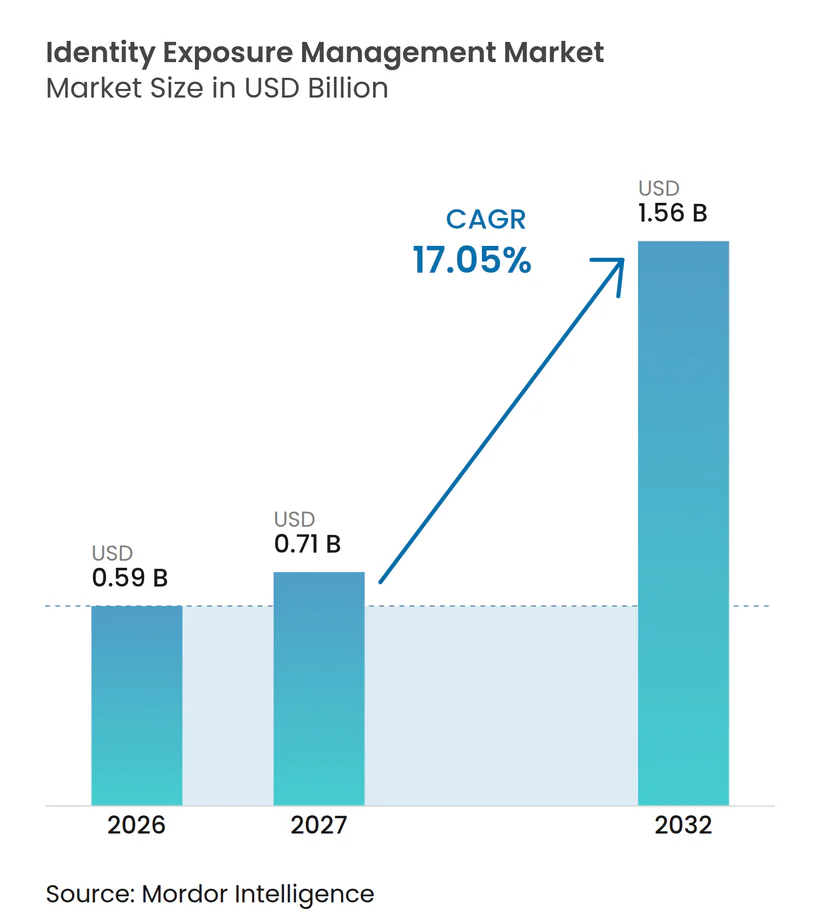
The Identity exposure management market size is projected to expand from USD 0.59 billion in 2026 and USD 0.71 billion in 2027 to USD 1.56 billion by 2032, registering a CAGR of 17.05% between 2027 and 2032. Credential-harvesting malware is changing buyer priorities because stolen session cookies can bypass login controls that depend on passwords and multi-factor authentication. The Identity exposure management market is also benefiting from the need to detect exposed identities continuously and connect findings directly to identity-provider remediation. Cloud adoption, non-human identity sprawl, and AI-agent credentials are widening the monitoring requirement beyond employee accounts. Vendors that combine criminal-underground intelligence, automated triage, and direct remediation integrations have a clearer opportunity to become part of core enterprise security programs.
Key Report Takeaways
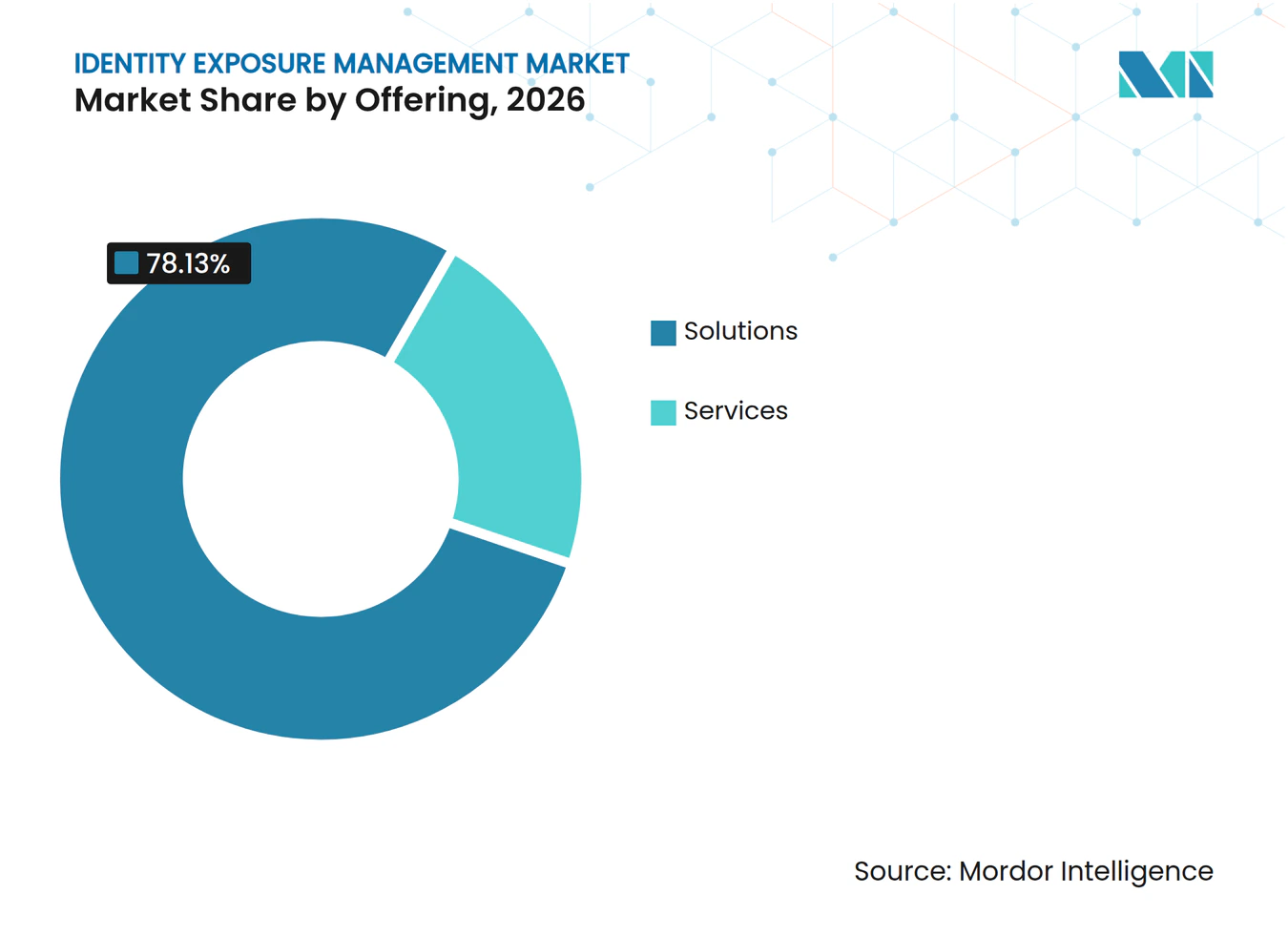
- By offering solutions, held 78.13% of the Identity exposure management market share in 2026, while services are projected to expand at a 17.46% CAGR through 2032.
- By deployment mode, cloud accounted for 57.21% of the Identity exposure management market size in 2026 and is projected to expand at a 17.64% CAGR through 2032.
- By organization size, large enterprises held 74.37% of revenue in 2026, while small and medium-sized enterprises are projected to expand at a 17.43% CAGR through 2032.
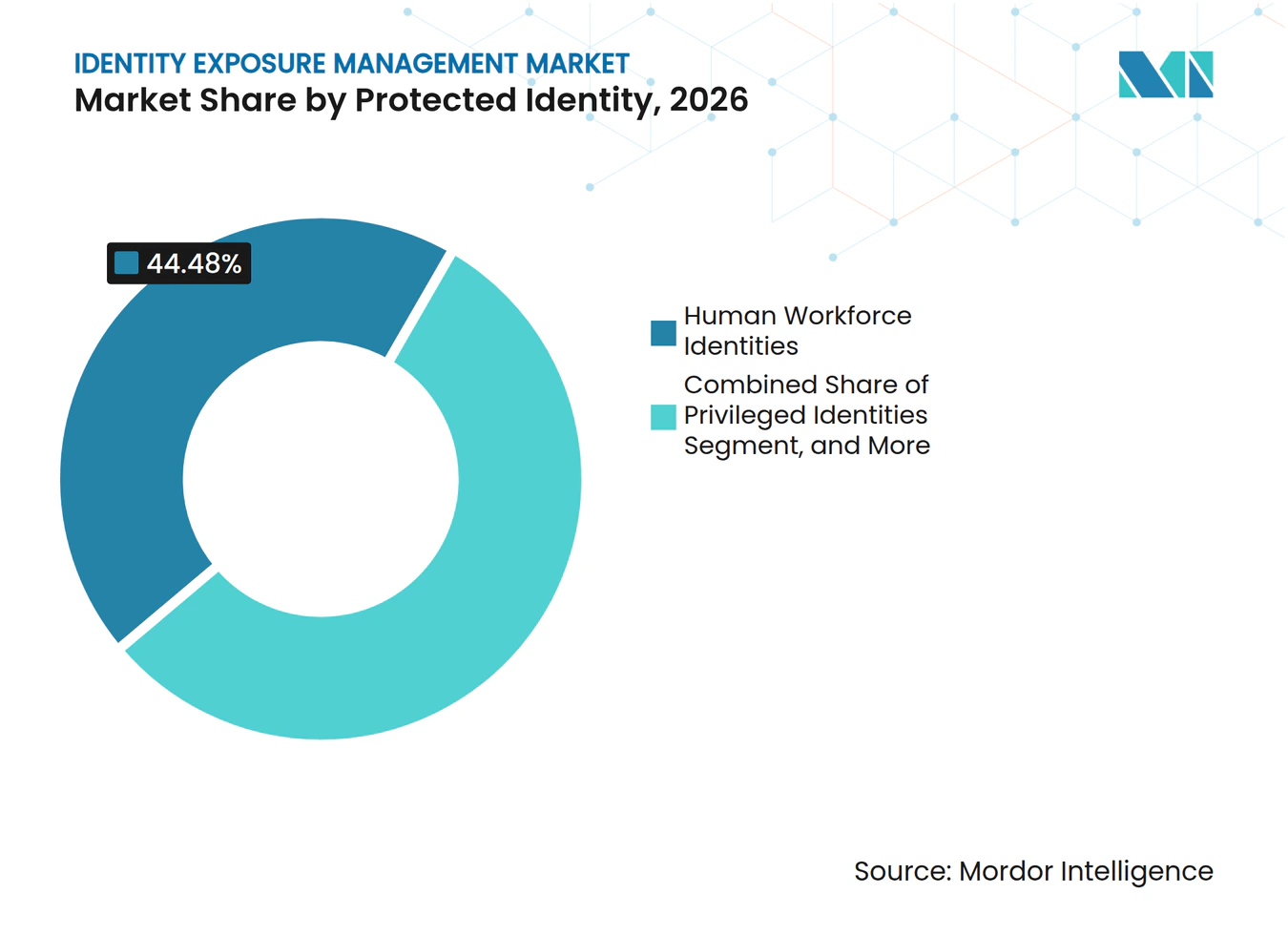
- By protected identity type, human workforce identities accounted for 44.48% of revenue in 2026, while AI-agent identities are projected to grow at an 18.04% CAGR through 2032.
- By industry vertical, BFSI held 25.03% of revenue in 2026, while healthcare and life sciences are projected to expand at an 18.42% CAGR through 2032.
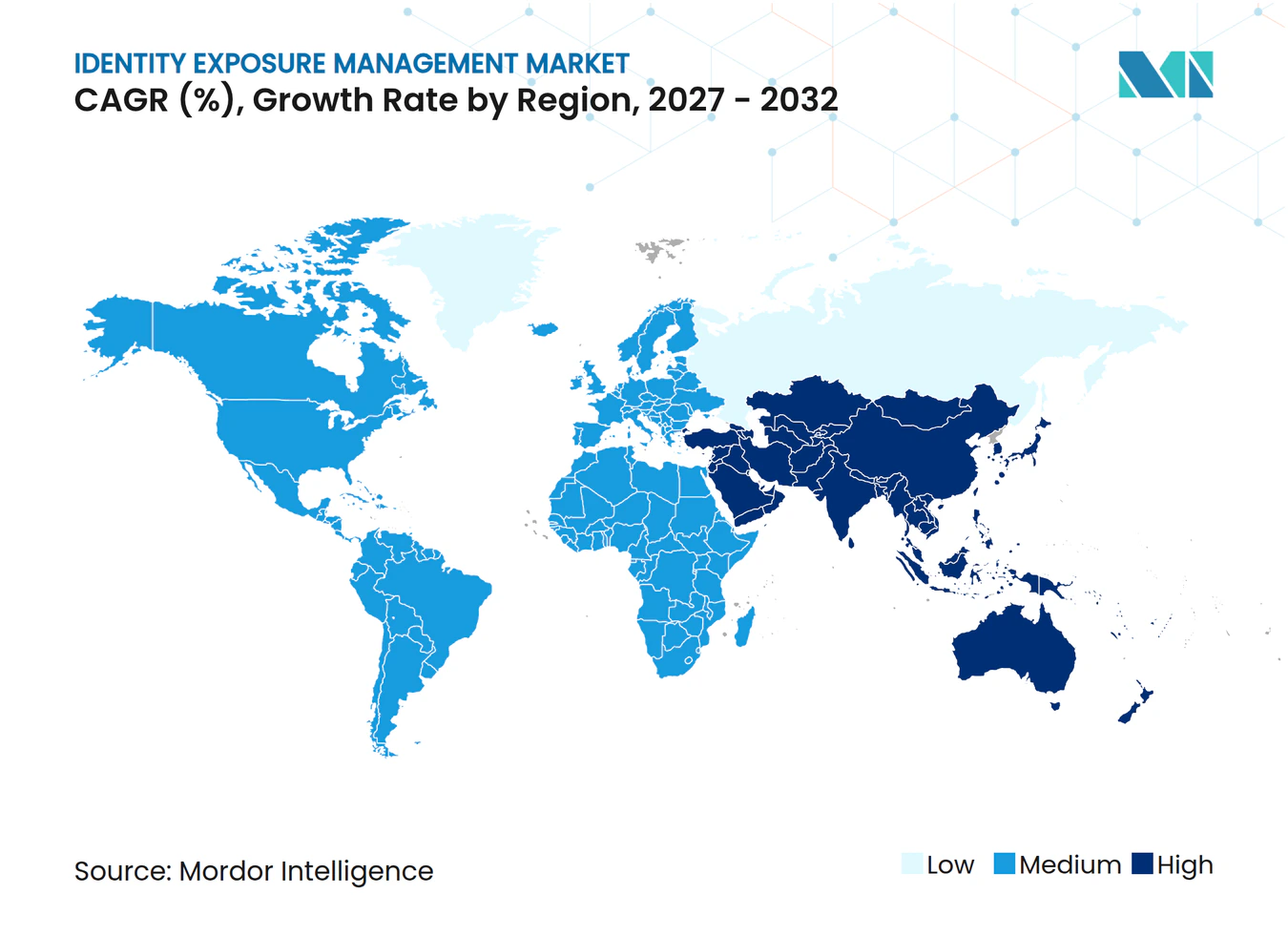
- By geography, North America held 39.28% of revenue in 2026, while Asia-Pacific is projected to expand at an 18.12% CAGR through 2032.
Note: Market numbers in this report are based on Mordor Intelligence's proprietary estimation framework, which combines nine months of actuals with Q4 projections for base year 2026.
Market Trends and Insights
Drivers Impact Analysis of Identity Exposure Management Market*
| Driver | (~) % Impact on CAGR Forecast | Geographic Relevance | Impact Timeline |
|---|---|---|---|
| Identity-Centric Attacks Bypassing Perimeter Controls | +4.2% | Global | Short term (≤ 2 years) |
| Stealer Logs and Session Tokens Enabling Account Takeover | +3.5% | North America and Europe, spill-over to Asia-Pacific | Short term (≤ 2 years) |
| Expansion of Non-Human and Machine Identities | +3.0% | North America and Europe, Asia-Pacific emerging | Medium term (2-4 years) |
| Cloud and Hybrid Identity Sprawl | +2.5% | Global | Medium term (2-4 years) |
| Automated Validation and Remediation Reducing Exposure-to-Containment Time | +1.8% | North America and Europe, early gains in Singapore and Australia | Medium term (2-4 years) |
| Identity Exposure Monitoring for Executives and High-Risk Personnel | +1.2% | North America and Europe | Long term (≥ 4 years) |
| Source: Mordor Intelligence | |||
Identity-Centric Attacks Bypassing Perimeter Controls
Traditional perimeter defenses do not adequately address attacks built around legitimate but compromised identities, because the access request can appear valid after a credential or session artifact has been stolen. Sophos reported that 71% of surveyed organizations experienced at least 1 identity-related security breach in 2025, and the average remediation cost was USD 1.64 million per incident.[1] The Identity exposure management market gains relevance when a valid credential allows an attacker to access systems without exploiting a network weakness, making network-only controls less useful for identifying initial misuse. Stolen credentials and session artifacts make access controls harder to evaluate because activity can appear to be that of an authorized user, remain within normal application paths, and avoid the obvious warning signs associated with malware on a managed endpoint. Organizations with limited visibility into stolen cookies and personal device activity face a larger monitoring gap, particularly when they cannot determine whether a legitimate account holder or an intruder initiated the session. DORA and NIS2 also underscore the importance of documented access controls and identity risk management for financial services and critical infrastructure, giving security leaders a compliance reason to strengthen monitoring and a technical reason to reduce attacker dwell time.
Stealer Logs and Session Tokens Enabling Account Takeover
Infostealer malware has become a recurring source of enterprise credentials sold on criminal marketplaces, turning the theft of browser-stored data and saved authentication credentials into a repeatable access route. Recorded Future indexed 892 million malware-log credential exposures in 2025, with the second half of the year 50% higher than the first half. This volume makes continuous exposure monitoring more relevant to security teams that cannot manually review every exposed credential, especially when an exposed employee account can grant access to many connected cloud applications. The same research found that 36.4% of stolen credentials were indexed within 24 hours of exfiltration and 52.9% within 1 week, which limits the time available for manual review and password reset. Session cookies can authenticate users to cloud and SaaS applications without requiring a new password or a multi-factor authentication challenge, meaning that password resets alone may not always address every active-session risk. The Identity exposure management market, therefore, favors platforms that can validate exposure signals, identify linked applications, and trigger containment before the attacker uses the available access or moves to another service.
Expansion of Non-Human and Machine Identities
Machine identities have become a large surface area of exposure because applications, scripts, services, and automation tools use credentials continuously, often without the routine review that applies to named workforce accounts. CyberArk found that 79% of security leaders expected machine identities to increase by up to 150% in the following year. The scale of this change makes it harder for identity teams to know which credentials are active, who owns them, and whether the permissions associated with them still align with business needs. Exposed API keys, tokens, and unattended service accounts create a different remediation challenge because ownership may be unclear, and an immediate reset can interrupt a production service. SpyCloud recaptured 18.1 million exposed API keys and tokens in 2025, including more than 60,000 linked to payment and remittance platforms. The Identity exposure management market can address this gap when monitoring is connected to secret rotation, identity governance, workload remediation processes, and clear records that allow security teams to distinguish a dormant credential from one supporting a critical service.
Cloud and Hybrid Identity Sprawl
Multi-cloud and hybrid architectures create identity records across cloud platforms, SaaS applications, legacy systems, and local directories, so access decisions are often spread across systems with different owners and logging practices. RSA found that 75% of organizations operated in hybrid environments in 2026. Fortinet separately reported that 88% of organizations used hybrid or multi-cloud environments. This mix can leave security teams with overlapping controls and incomplete visibility into which identities can access which systems, while ephemeral cloud credentials may be created and retired more quickly than standard identity records. Permiso reported that 57% of applications did not route authentication through a central identity provider, making the coverage gap visible even in organizations that have invested heavily in central identity tools. The Identity exposure management market benefits as buyers seek a common view of credentials, tokens, permissions, and exposure signals across cloud and legacy environments rather than separate dashboards that cannot provide a reliable enterprise-wide picture.
Restraints Impact Analysis of Identity Exposure Management Market*
| Restraint | (~) % Impact on CAGR Forecast | Geographic Relevance | Impact Timeline |
|---|---|---|---|
| Fragmented Identity Telemetry and Incomplete Asset Ownership | -2.5% | Global | Short term (≤ 2 years) |
| Privacy, Data Residency, and Dark-Web Collection Constraints | -2.0% | Europe, Asia-Pacific, national gains in the UAE and Saudi Arabia | Medium term (2-4 years) |
| False Positives and Remediation Friction in Legacy Environments | -1.5% | Global, most acute in government and manufacturing | Medium term (2-4 years) |
| Limited Buyer Awareness of IEM as a Distinct Category | -1.2% | South America, Middle East and Africa, Asia-Pacific emerging markets | Long term (≥ 4 years) |
| Source: Mordor Intelligence | |||
Fragmented Identity Telemetry and Incomplete Asset Ownership
Platform effectiveness depends on a complete identity inventory, but many enterprises lack a consolidated view of accounts, credentials, related applications, and the people or teams responsible for them. Orchid Security found that 40% of enterprise accounts belonged to users no longer in HR systems. It also found that two-thirds of non-human identities were authenticated and authorized locally within applications rather than through a central identity provider, which reduces a central team's ability to confirm whether a credential is still needed.[2] ManageEngine reported that more than half of large enterprises manage 3 or more IAM vendors simultaneously. Unassigned service accounts and legacy application tokens can delay remediation because no accountable owner can approve a reset, assess operational effects, or confirm that replacement credentials are configured correctly. The Identity exposure management market faces slower deployment cycles, in which buyers must first reconcile assets, telemetry, ownership records, and duplicate identity data before an alert can be reliably treated as actionable.
Privacy, Data Residency, and Dark-Web Collection Constraints
Platforms that use criminal-marketplace data must manage different legal requirements for personal data, cross-border processing, customer notification, retention, and reporting. European privacy obligations can complicate the use of data collected from criminal sources, even when the stated purpose is defensive, because vendors and customers must determine which data can be processed and how it can be linked to a specific individual or account. This issue requires vendors to design clear processes for data minimization, reporting, customer controls, and the separation of intelligence data from the records used to take remediation actions. Data-residency requirements in Singapore, India, the UAE, and Saudi Arabia can also require regional handling arrangements, local storage decisions, and contract terms that account for jurisdiction-specific restrictions. The need to separate intelligence data by jurisdiction increases product and operating complexity for global vendors and can make a uniform service model more difficult to deliver. The Identity exposure management market may face a slower international rollout when data architecture does not meet local requirements or when buyers require further assurance before connecting sensitive identity information to an external intelligence platform.
*Our forecasts treat driver/restraint impacts as directional, not additive. The impact forecasts reflect baseline growth, mix effects, and variable interactions.
Identity Exposure Management Market Segment Analysis
By Offering:
Solutions Lead as Managed Services Gain MomentumSolutions held 78.13% of revenue in 2026, making them the leading offering in the Identity exposure management market. Enterprises prefer platform deployments when they can connect exposure findings to workflows in Okta, Ping Identity, and Microsoft Entra ID. These integrations reduce the delay between alerting and remediation. Direct integrations also make it easier to document actions taken on exposed credentials. Large security teams often prefer a platform that fits their existing identity and security operations processes. The segment remains centered on continuous monitoring of compromised credentials, tokens, and other identity artifacts.
Services are projected to expand at a 17.46% CAGR through 2032 as smaller security teams seek operational support. Managed offerings can combine dark-web intelligence collection, alert triage, remediation guidance, escalation procedures, and reporting within a subscription model, so the customer does not need to assemble all these capabilities internally. The Identity exposure management industry is seeing service demand rise as non-human identity monitoring and multi-jurisdiction data handling become more difficult, particularly when a buyer must assess a mix of workforce credentials, API keys, cookies, and application tokens. Flare expanded its platform and its identity exposure management offering in June 2026, reflecting vendor interest in broader operational support. Managed services also allow buyers to begin monitoring without the long implementation cycle associated with major enterprise deployments, while still giving internal teams a defined process for prioritizing and resolving the most urgent exposure findings.


By Deployment Mode:
Cloud Deployment Sustains Both Scale and GrowthCloud deployment accounted for 57.21% of revenue in 2026 and is projected to grow at a 17.64% CAGR through 2032. This mode supports large data collections, behavioral analytics, and application programming interface integrations without requiring customers to operate the full intelligence infrastructure. The cloud segment holds the leading share because the Identity exposure management market requires frequent updates from both external and internal sources. Cloud services can also enable rapid integration with identity providers and SaaS applications. These capabilities are important when exposed credentials or session tokens require a fast response.
On-premises deployment remains relevant for financial institutions, defense organizations, and regulated utilities with air-gapped environments, where the movement of external intelligence data into local systems is subject to heightened review. These buyers may require additional controls, records, and approvals before external intelligence feeds are allowed to enter local systems, even when the potential security value of the information is clear. Hybrid deployment is also gaining interest because it lets organizations retain sensitive telemetry locally while using cloud-based intelligence services that can collect and update external exposure information at scale. RSA found that 75% of organizations operated hybrid environments in 2026. The Identity exposure management industry is therefore likely to retain several delivery models, even as cloud architectures become the default option for new deployments and vendors focus product development on simpler integration. The need to cover both cloud and legacy systems makes a single control view valuable for hybrid buyers, since separate teams otherwise may investigate related identity events with incomplete context.
By Organization Size:
Small and Medium-Sized Enterprises Emerge as the High-Growth TierLarge enterprises accounted for 74.37% of revenue in 2026 because they manage large, complex identity environments. Their security operations teams are more likely to have the staff needed to investigate exposure alerts and coordinate resets. Research published in 2025 reported that average enterprises manage more than 250,000 machine identities. Large organizations also face more regulatory scrutiny and more supply-chain exposure than smaller firms. Their scale makes platform-based continuous monitoring a practical addition to existing identity security programs.
Small and medium-sized enterprises are projected to expand at a 17.43% CAGR through 2032. SaaS platforms and managed services reduce the infrastructure and specialist staffing previously needed for meaningful credential monitoring, enabling a smaller security team to use established intelligence and remediation workflows rather than build them from the ground up. The Identity exposure management market offers these organizations a way to monitor risk without building a large internal identity engineering function or maintaining a separate environment for data collection and analysis. Supply-chain requirements can also encourage adoption when larger customers ask partners to demonstrate identity controls as part of commercial qualification, security reviews, or ongoing vendor management. Orchid Security’s finding that 40% of enterprise application accounts belonged to users absent from HR systems shows the challenge that weaker governance can create. Accessible managed services can help narrow the adoption difference between large and mid-sized organizations by giving smaller firms a clearer route from exposure detection to a practical remediation decision.
By Protected Identity Type:
AI-Agent Credentials Drive the Fastest-Growing Exposure SegmentHuman workforce identities held 44.48% of revenue in 2026 because employee credentials remain a common starting point for unauthorized access. Workforce users require monitoring for passwords, cookies, authentication tokens, and credentials exposed through personal devices. Privileged identities also receive significant attention because administrator access can enable broad lateral movement. Customer and consumer identities create a separate exposure layer that overlaps with customer identity and access management systems. The Identity exposure management market needs different workflows for each identity type because the owner, business impact, and remediation path vary.
AI-agent identities are projected to expand at an 18.04% CAGR through 2032, the fastest rate among protected identity types. These agents may inherit credentials at deployment and operate beyond the direct oversight of traditional identity teams, creating a need to understand not only the agent’s purpose but also the access it can request, use, and pass to connected services. Orchid Security projected that 40% of enterprise applications would embed task-specific AI agents by the end of 2026, compared with less than 5% 1 year earlier. Non-human and machine identity monitoring also includes API key discovery, secrets-vault connections, CI/CD pipeline credential scanning, and checks for credentials that remain active after the underlying automation has changed. The Identity exposure management industry is responding by extending detection and remediation workflows beyond workforce accounts, rather than treating automated access as an exception to the core identity program. This expansion matters because automated workloads can hold broad permissions with limited evidence of human ownership, making a clear record of identity, purpose, and remediation authority increasingly important.


By Industry Vertical:
Healthcare Advances as BFSI Anchors RevenueBFSI held 25.03% of revenue in 2026, the largest vertical share in the Identity exposure management market. Financial institutions face credential-based fraud, regulatory obligations, and high reputational consequences from identity breaches. DORA became enforceable on January 17, 2025, increasing the need for financial entities to maintain documented technology and identity risk controls. Regula reported that the share of banks planning to increase their identity-verification budgets above 50% rose from 4.4% to 15% over 2 years. These conditions support ongoing demand for systems that detect compromised credentials and related access artifacts.
Healthcare and life sciences are projected to expand at an 18.42% CAGR through 2032. Healthcare organizations must protect patient information while managing a mix of workforce accounts, clinical applications, partner access, connected services, and legacy systems, each with different authentication and ownership practices. Identity monitoring can support this requirement by flagging exposed credentials before those accounts are used to access sensitive services, while also documenting the response for internal security and compliance teams. Government and defense are also adding continuous identity posture monitoring to zero-trust programs, where verifying the condition of a credential remains important after access has been granted. IT and telecommunications providers are increasing investment because cloud infrastructure accounts and API keys are attractive targets and can support access to many customers or connected systems. Retail, e-commerce, energy, and utilities represent a smaller but expanding opportunity as consumer and workforce credential theft affects their digital services, supplier connections, and application accounts.
Geography Analysis
North America Identity Exposure Management Market
North America accounted for 39.28% of global revenue in 2026, the largest regional share in the Identity exposure management market. The region has a high concentration of financial, healthcare, and technology organizations subject to active cybersecurity requirements, with large enterprise environments that often integrate cloud services, locally managed directories, and extensive third-party application connections. US healthcare organizations have faced repeated identity-related risks through legacy infrastructure and complex vendor connections. These operating conditions make it important for security teams to identify exposed accounts, determine what applications they can reach, and coordinate a response across more than 1 system. This environment supports buyer interest in identity intelligence, credential remediation, and direct connections to enterprise identity platforms, especially for security leaders who need a faster way to assess the impact of an exposure signal across a distributed environment.
North America and APAC Identity Exposure Management Market
Canada and Mexico add to the regional opportunity through financial services and technology buyers seeking stronger threat-intelligence operations. The Identity exposure management market in North America also benefits from vendors with established local data infrastructure, mature customer support capabilities, and direct product integrations that enable findings to integrate into existing security and identity workflows. Asia-Pacific is projected to expand at an 18.12% CAGR through 2032. Digital infrastructure investment in China, India, Japan, South Korea, Australia, and Singapore expands the number of workforce, consumer, cloud, and machine identities that require monitoring, while more organizations adopt applications that rely on distributed authentication and automated access. Semperis received accreditation from Singapore’s Infocomm Media Development Authority in September 2026 and reported triple-digit revenue growth across Asia-Pacific. Regulatory requirements and cloud adoption support demand, though local data-residency rules can complicate regional delivery and require vendors to provide a clearer explanation of where exposure data is collected, processed, and retained.
EMEA and South America Identity Exposure Management Market
Europe retains a substantial share because DORA and NIS2 reinforce identity management obligations for financial firms and critical infrastructure operators, placing identity controls within a wider operational resilience and cyber-risk agenda. The United Kingdom, Germany, and France are important European markets because large organizations in these countries face both national and cross-border compliance needs. GDPR requirements for personal data can make criminal-marketplace intelligence harder to process and report, particularly where a service must link external evidence to a customer account and preserve a defensible record of the decision taken. This has encouraged vendors to consider data-residency options and anonymized reporting for European customers. South America, the Middle East, and Africa are at earlier adoption stages, but digital banking, telecommunications, and national digital-transformation programs are broadening demand. Brazil’s LGPD, modernization efforts in the UAE and Saudi Arabia, and expanding digital services in South Africa, Egypt, and Nigeria create an emerging base for identity exposure monitoring, even though buyer awareness and local implementation resources can remain less developed than in North America or Europe.
Competitive Landscape
Market Concentration
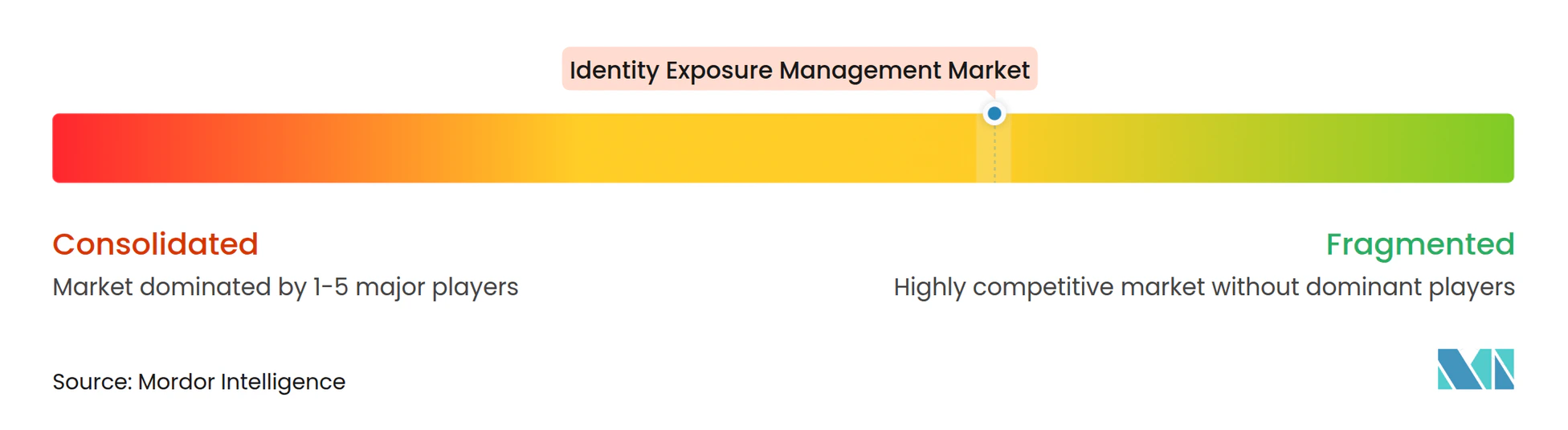
The Identity exposure management market is moderately fragmented, with specialist vendors competing on the breadth, freshness, and usefulness of their recaptured identity data. SpyCloud and Flare Systems are central to the pure-play field, while Silverfort, Semperis, and Saviynt extend into the category from identity security, resilience, and governance foundations. SpyCloud reported surpassing 1 trillion recaptured identity assets in July 2026.[3] Flare was recognized in the 2026 Gartner Magic Quadrant for Cyber Threat Intelligence, according to the company’s June 2026 announcement. Competition is increasingly shaped by whether a provider can turn an exposure signal into an action inside the customer’s identity environment.
Direct integrations are one of the most important strategic moves in the Identity exposure management market. SpyCloud expanded its Okta integration in June 2026 to reduce exposure-to-remediation time from days to under 5 minutes in Okta-managed environments. It also announced integrations with Ping Identity’s PingOne DaVinci and PingOne Advanced Identity Cloud in April 2026. Semperis acquired MightyID in February 2026 to extend its coverage to Okta and Ping Identity in hybrid environments. These moves show that remediation integration is becoming as important as detection coverage.
Acquisition and platform expansion are also changing the competitive boundary as vendors seek to connect identity intelligence with the systems used to govern permissions, investigate incidents, and manage automated workloads. Silverfort launched Access Intelligence and Identity Graph in October 2025, adding visibility across human, machine, and AI-agent identities. The Identity exposure management market remains open to providers that can deliver autonomous remediation for non-human identities and data architectures that address requirements in Europe and Asia-Pacific. The ability to move from an exposure finding to a measured, traceable containment action will remain a key point of differentiation as customers compare specialist intelligence providers with larger identity security platforms.
Identity Exposure Management Industry Leaders
-
SpyCloud, Inc.
-
Flare Systems Inc.
-
Recorded Future, Inc.
-
Constella Intelligence, Inc.
-
ZeroFox Holdings, Inc.
- *Disclaimer: Major Players sorted in no particular order
Identity Exposure Management Market Companies Covered in this Report
- SpyCloud, Inc.
- Flare Systems Inc.
- Constella Intelligence, Inc.
- KELA Technologies Ltd.
- Intel 471 Inc.
- Flashpoint Intelligence, Inc.
- ZeroFox Holdings, Inc.
- Recorded Future, Inc.
- Black Kite, Inc.
- CyCognito, Inc.
- Censys, Inc.
- IONIX Ltd.
- XM Cyber Ltd.
- Outpost24 AB
- SecurityScorecard, Inc.
- Armis Security Ltd.
- JupiterOne, Inc.
- Panorays, Inc.
- Silverfort, Inc.
- Veza Technologies, Inc.
- Semperis, Inc.
- Saviynt, Inc.
Recent Industry Developments in Identity Exposure Management Market
- September 2026: Semperis launched Migrator for Active Directory 2.0, a ground-up architectural rebuild making Active Directory migrations observable and security-centric at every stage, with worldwide availability across regulated industries in North America, Europe, and Asia-Pacific. The release introduced Directory Synchronization Sets for wave-based execution and staging reports that preview every change prior to commit, reducing migration-related identity exposure windows.
- September 2026: SpyCloud released its annual Identity Threat Report, introducing the Identity Threat Protection Maturity Model grouping organizations across 4 tiers, Reactive, Building, Operational, and Optimized, based on exposure visibility, monitoring, governance, automation, and remediation maturity. The report identified non-human identities as the most common route for attackers into enterprise environments, with 42% of respondents reporting NHI misuse or compromise.
- September 2026: Semperis received accreditation from Singapore's Infocomm Media Development Authority, confirming triple-digit revenue growth across Asia-Pacific, with new senior sales and leadership hires made across Southeast Asia, Australia and New Zealand, and Japan.
- July 2026: Saviynt launched Zuma, an AI identity security platform for discovering and governing AI agents, large language models, and non-human identities, simultaneously reporting annual recurring revenue above USD 300 million, bookings growth exceeding 80%, and 96% customer retention.
Global Identity Exposure Management Market Report Scope
The Identity Exposure Management Market refers to the market for solutions and services that identify, assess, prioritize, and remediate identity-related security risks across human, privileged, non-human, machine, customer, consumer, and AI agent identities. These solutions help organizations discover excessive access privileges, misconfigurations, compromised credentials, dormant accounts, identity vulnerabilities, and potential attack paths across cloud, on-premises, and hybrid environments. The market includes identity exposure assessment, continuous monitoring, risk analysis, access governance, privilege management, and automated remediation capabilities that enable organizations to reduce identity-based cyber threats and strengthen their overall security posture.
The Identity Exposure Management Market Report is Segmented by Offering (Solutions and Services), Deployment Mode (Cloud, On-Premises, and Hybrid), Organization Size (Large Enterprises and Small and Medium Enterprises), Protected Identity Type (Human Workforce Identities, Privileged Identities, Non-Human and Machine Identities, Customer and Consumer Identities, and AI-Agent Identities), Industry Vertical (BFSI, Government and Defense, IT and Telecom, Healthcare and Life Sciences, Retail and E-Commerce, Energy and Utilities, Manufacuturing, and Other Industry Verticals), and Geography (North America, South America, Europe, Asia-Pacific, and Middle East and Africa). The Market Forecasts are Provided in Terms of Value (USD).
Segmentation Overview
| Solutions |
| Services |
| Cloud |
| On-Premises |
| Hybrid |
| Large Enterprises |
| Small and Medium-Sized Enterprises |
| Human Workforce Identities |
| Privileged Identities |
| Non-Human and Machine Identities |
| Customer and Consumer Identities |
| AI-Agent Identities |
| Banking, Financial Services and Insurance |
| Government and Defense |
| IT and Telecommunications |
| Healthcare and Life Sciences |
| Retail and E-Commerce |
| Energy and Utilities |
| Manufacturing |
| Education |
| Other Industry Verticals |
| North America | United States |
| Canada | |
| Mexico | |
| South America | Brazil |
| Argentina | |
| Rest of South America | |
| Europe | United Kingdom |
| Germany | |
| France | |
| Italy | |
| Spain | |
| Rest of Europe | |
| Asia-Pacific | China |
| India | |
| Japan | |
| South Korea | |
| Australia | |
| Rest of Asia-Pacific | |
| Middle East | United Arab Emirates |
| Saudi Arabia | |
| Israel | |
| Turkey | |
| Rest of Middle East | |
| Africa | South Africa |
| Egypt | |
| Nigeria | |
| Rest of Africa |
| By Offering | Solutions | |
| Services | ||
| By Deployment Mode | Cloud | |
| On-Premises | ||
| Hybrid | ||
| By Organization Size | Large Enterprises | |
| Small and Medium-Sized Enterprises | ||
| By Protected Identity Type | Human Workforce Identities | |
| Privileged Identities | ||
| Non-Human and Machine Identities | ||
| Customer and Consumer Identities | ||
| AI-Agent Identities | ||
| By Industry Vertical | Banking, Financial Services and Insurance | |
| Government and Defense | ||
| IT and Telecommunications | ||
| Healthcare and Life Sciences | ||
| Retail and E-Commerce | ||
| Energy and Utilities | ||
| Manufacturing | ||
| Education | ||
| Other Industry Verticals | ||
| By Geography | North America | United States |
| Canada | ||
| Mexico | ||
| South America | Brazil | |
| Argentina | ||
| Rest of South America | ||
| Europe | United Kingdom | |
| Germany | ||
| France | ||
| Italy | ||
| Spain | ||
| Rest of Europe | ||
| Asia-Pacific | China | |
| India | ||
| Japan | ||
| South Korea | ||
| Australia | ||
| Rest of Asia-Pacific | ||
| Middle East | United Arab Emirates | |
| Saudi Arabia | ||
| Israel | ||
| Turkey | ||
| Rest of Middle East | ||
| Africa | South Africa | |
| Egypt | ||
| Nigeria | ||
| Rest of Africa | ||
Key Questions Answered in the Report
What is the size of the identity exposure management market?
The Identity exposure management market size is projected to expand from USD 0.59 billion in 2026 and USD 0.71 billion in 2027 to USD 1.56 billion by 2032, at a 17.05% CAGR. The estimate reflects a forecast period from 2027 through 2032, during which demand is supported by the need to identify compromised credentials, session cookies, API keys, and other identity artifacts before they are used for unauthorized access.
What is driving adoption of identity exposure management platforms?
Credential theft, stolen session cookies, non-human identities, and cloud identity sprawl are increasing the need for continuous monitoring and faster remediation. Platforms in the Identity exposure management market are increasingly expected to connect exposure detection with identity-provider actions, clear ownership, and documented response processes.
Which offering leads revenue?
Solutions led with 78.13% of revenue in 2026, while services are projected to expand at a 17.46% CAGR through 2032. Services address demand from organizations that need help with monitoring, alert triage, remediation workflows, operational reporting, and escalation support when internal resources are limited.
Which deployment model is advancing fastest?
Cloud deployment held 57.21% of revenue in 2026 and is projected to expand at a 17.64% CAGR through 2032. Cloud delivery supports large-scale intelligence collection and direct connections to SaaS applications and identity providers.
Which customer group is expected to expand fastest?
Small and medium-sized enterprises are projected to expand at a 17.43% CAGR through 2032 as managed services and SaaS platforms reduce adoption barriers. These delivery models can reduce the need for extensive in-house identity engineering resources.
Which region has the highest projected CAGR?
Asia-Pacific is projected to expand at an 18.12% CAGR through 2032, supported by digital infrastructure investment and evolving cybersecurity requirements. Data-residency obligations can influence how vendors deliver the Identity exposure management market offering across the region.