
Hydrogen Sulfide Scavengers Market Size and Share
Market Overview
| Study Period | 2022 - 2032 |
|---|---|
| Market Size (2027) | USD 429.64 Million |
| Market Size (2032) | USD 510.03 Million |
| Growth Rate (2027 - 2032) | 3.49 % |
| Fastest Growing Market | Asia-Pacific |
| Largest Market | North America |
| Market Concentration | Medium |
Major Players *Disclaimer: Major Players sorted in no particular order Image © Mordor Intelligence. Reuse requires attribution under CC BY 4.0. | |
Hydrogen Sulfide Scavengers Market Analysis by Mordor Intelligence
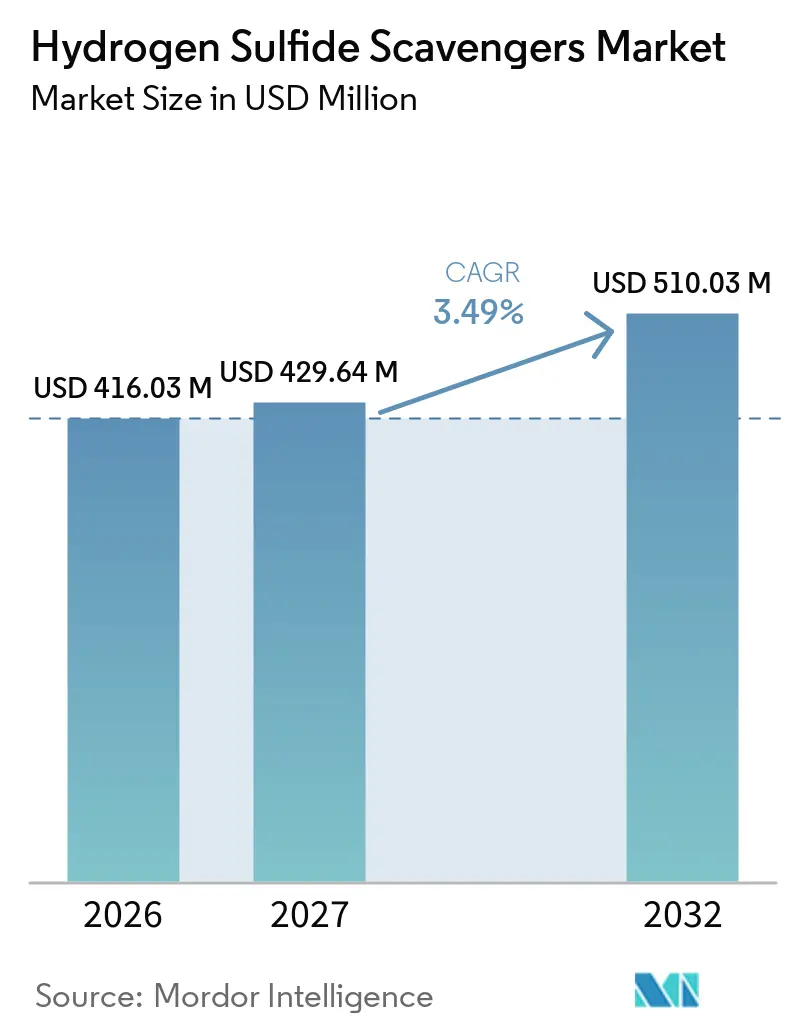
The hydrogen sulfide scavengers market size was valued at USD 416.03 million in 2026 and is estimated to grow from USD 429.64 million in 2027 to USD 510.03 million by 2032, at a CAGR of 3.49% during the forecast period (2027-2032). The hydrogen sulfide scavengers market follows sour hydrocarbon production more closely than oil prices because hydrogen sulfide (H2S) must be treated regardless of commodity cycles, production location, or the point at which sour fluids enter field infrastructure. This requirement provides revenue with a degree of resilience that upstream spending indicators may miss, as operators must protect workers, equipment, pipelines, and fluid quality before sale or transport. This applies to mature assets with changing water cuts and newer fields where sour-fluid behavior is still being established during early development and daily operations. Sour crude discoveries in the Middle East, Latin America, and Southeast Asia support baseline demand, while workplace exposure regulations, emissions requirements, and pipeline specifications increase treatment rates at existing facilities. LNG, biogas, and decentralized gas facilities also require H2S removal before gas processing or liquefaction, extending demand beyond conventional oil and gas operations and attracting customers with different plant sizes and purchasing practices. Integrated service companies are responding with bundled chemical programs, monitoring tools, technical support, and systems that link dosing to changing field conditions. At the same time, disposal costs, complex production fluids, and weaker upstream spending remain near-term constraints.
Key Report Takeaways
- By type, water-soluble scavengers held 60.13% market share in 2026, while oil-soluble scavengers are projected to grow at a 3.78% CAGR through 2032.
- By chemistry, triazine held 55.57% market share in 2026 and is forecast to expand at a 3.89% CAGR through 2032.
- By end-use industry, crude oil production and stabilization accounted for 37.25% market share in 2026, while refining and refined products are projected to advance at a 4.15% CAGR through 2032.
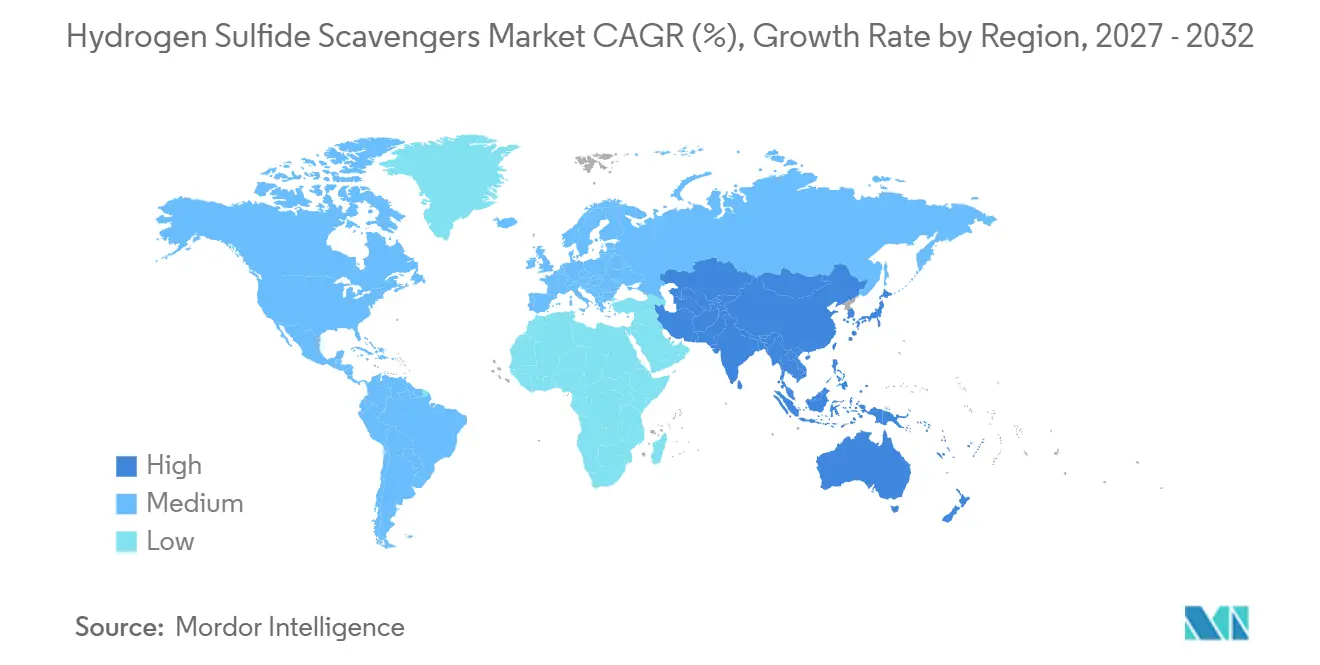
- By geography, North America held 31.48% market share in 2026, while Asia-Pacific is forecast to grow at a 4.03% CAGR through 2032.
Note: Market numbers in this report are based on Mordor Intelligence's proprietary estimation framework, which combines nine months of actuals with Q4 projections for base year 2026.
Market Trends and Insights
Drivers Impact Analysis of Hydrogen Sulfide Scavengers Market*
| Drivers | (~) % Impact on CAGR Forecast | Geographic Relevance | Impact Timeline |
|---|---|---|---|
| Expansion of Sour Oil and Gas Production | +1.2% | Global, with concentrated gains in the Middle East and Africa (MEA), Latin America, and Southeast Asia | Short term (≤ 2 years) |
| Stricter H2S Exposure, Emissions, and Product-Specification Requirements | +0.9% | North America and the EU, with expanding compliance frameworks in Asia-Pacific (APAC) | Medium term (2-4 years) |
| Growth of Liquefied Natural Gas (LNG), Biogas, and Decentralized Gas Processing | +0.6% | Global, with primary traction in Europe, APAC, and North America | Medium term (2-4 years) |
| Offshore and Deepwater Production Requiring In-Situ H2S Control | +0.5% | Middle East and Africa (MEA), Latin America, and Southeast Asia | Long term (≥ 4 years) |
| Digital Monitoring and Automated Chemical Dosing | +0.3% | Global, with early adoption in North America and the North Sea | Medium term (2-4 years) |
| Source: Mordor Intelligence | |||
Expansion of Sour Oil and Gas Production
The hydrogen sulfide scavengers market benefits as sour field development continues to attract capital, particularly in the Middle East and offshore Latin America. China reported record crude output of 216.09 million metric tons in 2025, while its natural gas output reached 261.89 billion cubic meters. Gas production recorded its ninth consecutive annual increase of more than 10 billion cubic meters, supporting additional treatment demand across production and processing facilities. H2S levels can be variable and unpredictable in these fields, prompting operators to secure scavenger supplies at an early stage of development. A 2025 deepwater study documented H2S concentrations exceeding 100 parts per million (ppm) in a field previously described as sweet, underscoring the need for treatment planning to account for geological uncertainty.
Stricter H2S Exposure, Emissions, and Product-Specification Requirements
Enforcement actions are influencing procurement decisions across the hydrogen sulfide scavengers market. On April 15, 2025, the U.S. Department of Justice announced a USD 1 million fine and 2-year probation for Aghorn Operating following worker-safety and Clean Air Act violations related to H2S incidents. A co-defendant also received a 5-month prison sentence[1]. OSHA Process Safety Management rules identify H2S as a highly hazardous chemical, while the U.S. EPA extended selected oil and gas compliance deadlines through its 2025 interim final rule. Pipeline gas specifications also require controlled H2S levels, making chemical treatment necessary for access to transmission systems. China tightened its natural gas sulfur specification to 15 mg/m³ from 20 mg/m³, increasing the need for treatment at processing and downstream nodes. These requirements extend demand from upstream production into midstream polishing applications.
Growth of Liquefied Natural Gas (LNG), Biogas, and Decentralized Gas Processing
H2S removal is required before LNG and bioLNG liquefaction, creating demand outside conventional upstream production. Wärtsilä Gas Solutions received a 2025 order to supply a bioLNG solution for Andion Scandinavia AB, with planned output of up to 17 tons of bioLNG per day from organic waste. The hydrogen sulfide scavenger market is gaining traction as facilities require raw biogas treatment before liquefaction. A 2025 review found that membrane and chemical approaches are central to biogas upgrading, with chemical scavengers suited to smaller decentralized plants where amine systems may be less practical. This demand brings biogas operators and distributed energy developers into the hydrogen sulfide scavenger market. These customers have different procurement cycles, formulation needs, and compliance requirements than large oil and gas companies. Gas-quality requirements in China and European pipeline-entry rules reinforce the need for consistent treatment across gas sources.
Offshore and Deepwater Production Requiring In-Situ H2S Control
Deepwater reservoir souring requires treatment methods that differ from those used in conventional onshore operations. A 2025 Society of Petroleum Engineers study found that injected-water conditions can allow sulfate-reducing bacteria to generate material H2S even where sulfate removal is used, making subsea-qualified formulations necessary when topside treatment is insufficient. In the North Sea, SLB reported that subsea injection of its pH-neutral HR-2746 multiphase scavenger reduced H2S from 170 ppm to 60 ppm, reduced topside scavenger use by 50%, and eliminated the need for monthly hydrocyclone cleanouts. Baker Hughes received a multiyear specialty chemicals contract from ExxonMobil Guyana in February 2025, covering topsides, subsea, water-injection, and utility chemicals for the Errea Wittu and Jaguar Floating Production Storage and Offloading units (FPSOs), which have a combined capacity of 500,000 barrels per day. These long-duration offshore programs support demand for specialized, premium formulations.
Restraints Impact Analysis of Hydrogen Sulfide Scavengers Market*
| Restraints | (~) % Impact on CAGR Forecast | Geographic Relevance | Impact Timeline |
|---|---|---|---|
| Spent-Scavenger Disposal and Byproduct Compliance Costs | -0.4% | North America and the EU, with emerging compliance pressure in the Gulf Cooperation Council (GCC) and APAC | Medium term (2-4 years) |
| Variable H2S Loading Increases Overdosing and Treatment Uncertainty | -0.3% | Global, especially mature fields with changing water cuts | Short term (≤ 2 years) |
| High Water Cut, Temperature, and Multiphase Conditions Reduce Efficiency | -0.4% | Offshore APAC, MEA deepwater, and mature North American fields | Medium term (2-4 years) |
| Source: Mordor Intelligence | |||
Spent-Scavenger Disposal and Byproduct Compliance Costs
Spent-scavenger management adds an additional operating cost to the hydrogen sulfide scavenger market that increases with treatment quantities. MEA-triazine produces spent and unspent scavenger wastewater that can be difficult to manage in offshore operations. A 2025 study examined the hydrothermal oxidation of this stream and identified the need for treatment pathways to address its chemical burden[2]. North Sea operators face increasing scrutiny of triazine discharge in produced-water streams. Residual triazine can also introduce nitrogen compounds into crude feedstock, which may contribute to fouling and refinery penalties. This cost exposure drives work on non-triazine formulations and recovery technologies that may recycle unspent chemicals. The Convention for the Protection of the Marine Environment of the North-East Atlantic (OSPAR) discharge requirements set an additional practical limit on triazine dosing at offshore installations.
Variable H2S Loading Increases Overdosing and Treatment Uncertainty
H2S concentration can change substantially during the life of a reservoir. Fixed-rate dosing systems may not respond well to those changes, resulting in systematic overtreatment. A 2025 study of H2S scavengers in crude oil found that performance varied across organic media at temperatures above 70°C. The study also found that ethoxylated-compound scavengers outperformed MEA-triazine under conditions representing low-water-content new oil wells. In mature fields, a rising water cut can widen the gap between the required dose and the applied dose. Real-time analyzers and proportional dosing can reduce this uncertainty, but many smaller operators defer the required capital investment. For the hydrogen sulfide scavengers market, overtreatment supports a consumption floor but increases chemical costs and byproduct quantities.
*Our forecasts treat driver/restraint impacts as directional, not additive. The impact forecasts reflect baseline growth, mix effects, and variable interactions.
Hydrogen Sulfide Scavengers Market Segment Analysis
By Type:
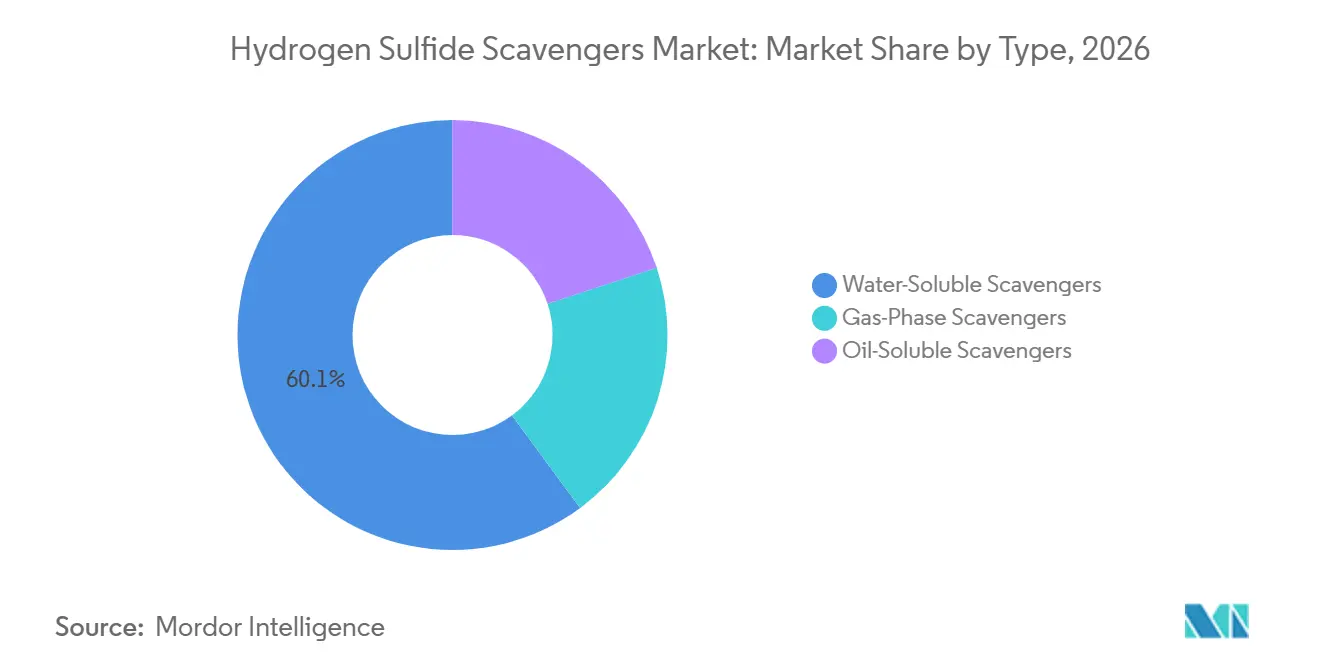
Aqueous Treatment Remains the Largest Use CaseWater-soluble scavengers held 60.13% of the hydrogen sulfide scavengers market share in 2026, reflecting their broad use in produced-water streams, pipeline gas, and surface crude treatment. Aqueous-phase injection is well-suited to conventional onshore and shallow-offshore sites because it aligns with existing equipment and operating practices used by field teams. These products support continuous treatment where H2S must be controlled before fluids enter separation, handling, storage, or export systems. Their established role also gives operators familiar approaches to managing routine H2S exposure and meeting product specifications. This installed operational base keeps water-soluble products central to the hydrogen sulfide scavengers market, even as more demanding wells require other formulations.
Oil-soluble scavengers are projected to grow at a 3.78% CAGR through 2032 because deepwater and high-temperature completions can limit the reactivity or phase distribution of water-based products. A Petrobras study tested products at 130°C and 33.1 kPa across oils of different densities and found that ethoxylated oil-phase scavengers outperformed monoethanolamine (MEA), triazine, and glyoxal under these conditions. Gas-phase scavengers remain necessary in dry-gas pipelines and at wellheads where liquid application is not practical, while non-formaldehyde and non-triazine options are also advancing. A 2025 Society of Petroleum Engineers (SPE) paper reported that lignosulfonate-based products achieved competitive H2S removal with lower pH elevation. This feature can reduce the risk of calcite scaling in offshore carbonate reservoirs. The resulting type mix allows treatment programs to be adapted to phase behavior, operating temperature, equipment design, and the constraints of downstream facilities.

By Chemistry:
Triazine Retains Scale While Alternatives Address Specific LimitsTriazine held a 55.57% share in 2026 and is expected to grow at a 3.89% CAGR through 2032. Its continued use reflects its wide operating temperature range, established field record, relatively low raw-material cost, and long-standing supply chains across diverse producing environments. Nitrite-based products serve selected pH and temperature windows where triazine performance may decline, while iron sponge systems retain a role in small, intermittent applications such as marginal wells and gas-distribution laterals. This range of options allows the hydrogen sulfide scavengers market to match treatment chemistry to a facility's fluid conditions, operating profile, and practical handling requirements. Triazine's market share, therefore, remains substantial even where alternative products are better suited to a specific stream.
Other chemistries in the hydrogen sulfide scavengers market include glyoxal, zinc carboxylate, and newer lignosulfonate-based products that become more relevant where triazine raises pH, creates scaling risk, or faces discharge restrictions. A 2025 simulation of triazine spray injection in 80-mm pipelines found that 50-micrometer particles remained entrained in the gas longer, while 500-micrometer particles formed wall films. This work provides operators with a clearer basis for injection design in smaller pipeline systems that were previously managed with limited operating guidance. Research on spent MEA-triazine also examined membrane nanofiltration and reported preliminary rejection factors exceeding 80%, suggesting a possible route for recovering unspent chemicals. Such recovery work may become more valuable where offshore disposal requirements and byproduct costs limit the use of conventional triazines.
By End-Use Industry:
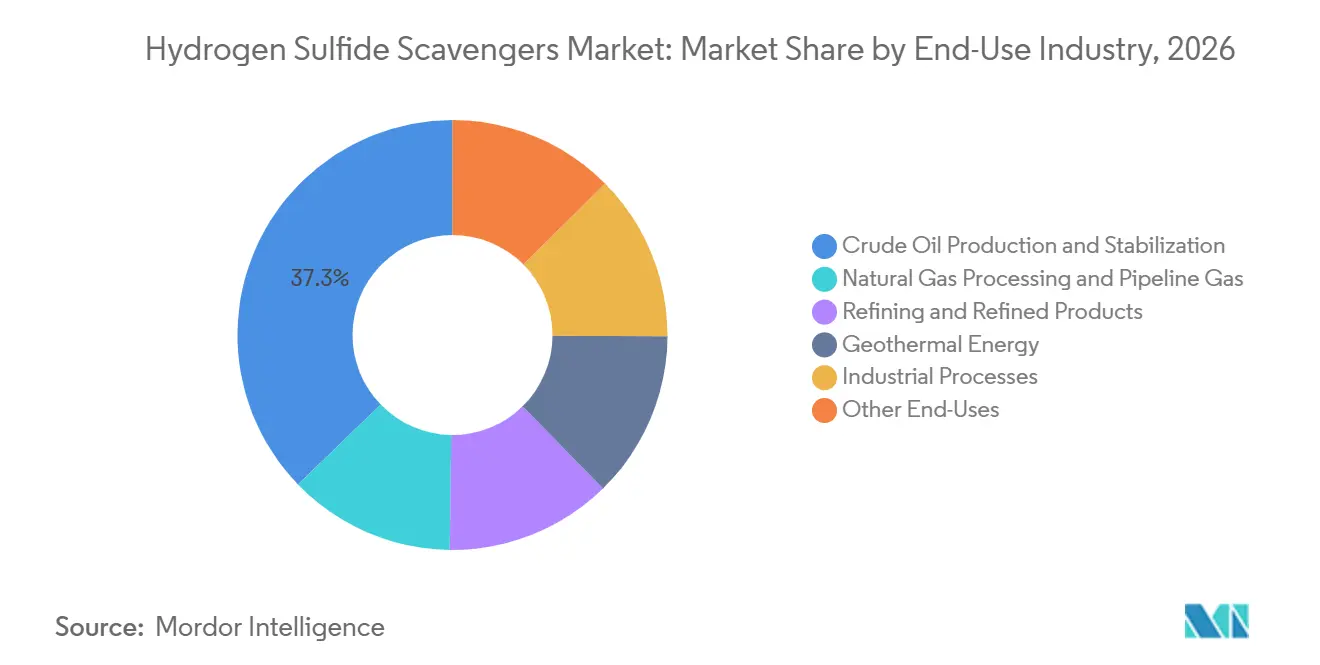
Refining Gains Importance Alongside Upstream DemandCrude oil production and stabilization accounted for 37.25% of the total in 2026 because sour crude requires treatment at wellheads and separators to protect equipment and meet sales specifications. High-American Petroleum Institute (API) gravity sour crudes require control before they move through field infrastructure, making chemical use an operating requirement rather than a discretionary efficiency measure. Natural gas processing and pipeline gas form the next major demand area, as transmission systems often require H2S levels below 4 ppm at inlet separators and gathering compressors. Continuous injection or sweetening is therefore necessary where gas must meet pipeline-quality limits before onward delivery. This upstream and midstream foundation gives the hydrogen sulfide scavengers market a broad base across oil and gas handling activities.
Refining and refined products represent the fastest-growing end-use category, with a forecast CAGR of 4.15% through 2032, as refineries process heavier sour feedstocks while meeting limits on residual H2S in product streams. A 2025 review of refinery dry-gas treatment identified process intensification and advances in amine and physical-solvent systems as important efficiency levers. Geothermal operations manage high H2S levels despite their smaller geographic footprint, and industrial applications include pulp and paper, wastewater treatment, and mining, where H2S is a secondary biological or chemical byproduct. These settings use chemistry adapted from oil-field formulations and have different flow rates, operating conditions, and procurement patterns. This broader customer base provides the hydrogen sulfide scavenger market with exposure to treatment requirements beyond conventional upstream activity.
Geography Analysis
North America Hydrogen Sulfide Scavengers Market
North America accounted for 31.48% of the hydrogen sulfide scavengers market share in 2026, supported by Permian Basin sour-crude production and dense infrastructure for crude oil and associated gas. US Process Safety Management rules and Texas H2S contingency requirements establish a compliance baseline, while Permian wells may require continuous injection as H2S levels change with production stage and water cut. Canada adds demand through Alberta oil sands and heavy-crude activity, where bitumen upgrading produces H2S streams that require dedicated treatment. Mexico contributes through mature Gulf of Mexico assets that increasingly use chemical scavengers as gas-sweetening capacity ages. Together, these conditions support recurring use across production, processing, transport, and related field services.
APAC Hydrogen Sulfide Scavengers Market
In the hydrogen sulfide scavengers market, Asia-Pacific is forecast to grow at a 4.03% CAGR through 2032 as upstream activity, refinery sour-feedstock throughput, LNG infrastructure, and biogas facilities expand. China's record gas production in 2025 and its stricter 15 mg/m³ sulfur specification support investment at processing nodes. India, South Korea, and Southeast Asian countries process increasing quantities of sour crude that require refinery-side treatment. Japan's declining crude demand is an offset, but does not alter the wider regional pattern of upstream and refinery-side growth. This mix of oil, gas, LNG, biogas, and refining activity makes Asia-Pacific the fastest-growing regional demand base.
EMEA and South America Hydrogen Sulfide Scavengers Market
Europe has a mature base in the hydrogen sulfide scavengers market, centered on the North Sea, where aging wells with higher water cuts create variable H2S loading and encourage automated dosing. Disposal rules under the OSPAR Convention and the EU Industrial Emissions Directive support lower-footprint formulations. Brazil and Guyana generate offshore demand for subsea-qualified programs, and Baker Hughes' 2025 contract with ExxonMobil Guyana demonstrates the scale of integrated chemical supply at those Floating Production, Storage, and Offloading (FPSO) developments. The Middle East and Africa have significant structural exposure to sour-gas fields in Saudi Arabia, Kuwait, and Abu Dhabi, while the development of LNG import activity in South Africa and other sub-Saharan markets supports related gas-treatment investment.
Competitive Landscape
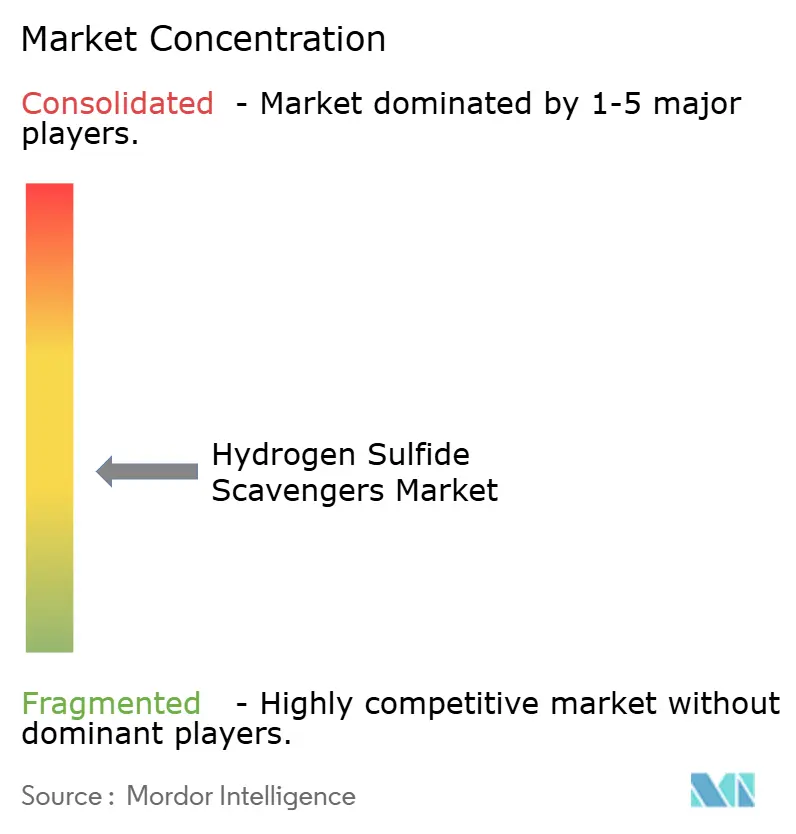
The hydrogen sulfide scavengers market is moderately fragmented. SLB, Baker Hughes, and Halliburton combine H2S treatment with corrosion inhibitors, scale inhibitors, monitoring tools, and broader production chemistry programs, giving them an advantage in multibasin contracts. Smaller suppliers compete through specialized formulations, responsive technical service, and local knowledge of operating conditions and regulations. Dorf Ketal, Merichem Technologies, Q2 Technologies, and Vink Chemicals are among the specialty participants. Regional formulators and niche product houses also remain relevant when customers prioritize specific chemistries, rapid supply, or local field support.
SLB completed its ChampionX acquisition in July 2025, combining production chemistry with digital production optimization and targeting USD 400 million in annual pre-tax synergies. Baker Hughes' Leucipa Chemicals Optimizer updates dosing every minute, while Halliburton inaugurated a world-scale Chemical Reaction Plant in Saudi Arabia in February 2026 to localize specialty chemical manufacturing. These developments highlight the importance of digital dosing, supply responsiveness, and broad chemical portfolios in competitive tenders. They also raise the difficulty for suppliers that offer only a standalone scavenger product without wider operational support. The hydrogen sulfide scavengers market is moving toward more integrated technical and commercial offerings.
Key opportunities in the hydrogen sulfide scavengers market include subsea-qualified non-triazine formulations, integrated packages for biogas-to-LNG facilities, and modular units for marginal and distributed wells. Recent patent activity includes Ecolab's U.S. Patent 12,305,123, the 2025 WO-2025141442-A1 publication for polyamine combination scavengers, and U.S. Patent 12,275,889 for scale-inhibiting triazine compositions. Protected formulation technology remains important as core products become more comparable. Suppliers without subsea qualification, regulatory approval data, or digital dosing capabilities face higher barriers in competitive tenders, making large project awards more difficult for smaller participants to secure.
Hydrogen Sulfide Scavengers Industry Leaders
-
SLB
-
SUEZ
-
Baker Hughes Company
-
Halliburton
-
CLARIANT
- *Disclaimer: Major Players sorted in no particular order
Hydrogen Sulfide Scavengers Market Companies Covered in this Report
- Arkema
- Baker Hughes Company
- BASF
- ChemTreat, Inc.
- CLARIANT
- Dorf Ketal
- Ecolab Inc.
- Halliburton
- Hexion Inc.
- Kurita Water Industries Ltd.
- Lubrizol
- Merichem Technologies
- Q2Technologies
- SLB
- SUEZ
- Veolia
- Vink Chemicals GmbH & Co. KG
Recent Industry Developments in Hydrogen Sulfide Scavengers Market
- February 2026: Halliburton inaugurated a large-scale chemical reaction plant in Saudi Arabia, enabling local manufacturing of specialty chemicals, including hydrogen sulfide scavengers and other production treatment products for upstream operations in the Middle East. The facility improved supply chain reliability and reduced lead times for ARAMCO and other GCC operators running large sour-field chemical programs.
- October 2025: Streamline Innovations deployed the first 1.5-ton VALKYRIE H2S treating units, capable of handling up to 60 Million Metric Cubic Feet per Day (MMCFD) of gas and delivering a 50% increase in sulfur extraction capacity compared to the standard system. These liquid redox chemistry-based units offered the lowest-cost on-site treatment option for large-scale sour gas applications in the hydrogen sulfide scavenger industry.
- July 2025: SLB completed its all-stock acquisition of ChampionX, valued at USD 7.8 billion, creating an integrated production-chemistry and digital-monitoring platform. SLB targeted USD 400 million in annual pre-tax synergies by integrating corrosion inhibitors, scale inhibitors, and H2S scavengers with digital Electric Submersible Pump (ESP) and chemical-injection control systems.
Global Hydrogen Sulfide Scavengers Market Report Scope
Hydrogen sulfide scavengers are chemical compounds that react with toxic and corrosive hydrogen sulfide gas or liquid in oil, natural gas, and wastewater streams, converting it into safe, stable, and non-hazardous byproducts.
The hydrogen sulfide scavengers market is segmented by type, chemistry, end-use industry, and geography. By type, the market is segmented into water-soluble scavengers, oil-soluble scavengers, and gas-phase scavengers. By chemistry, the market is segmented into triazine, nitrite, iron sponge, and other chemistries. By end-use industry, the market is segmented into crude oil production and stabilization, natural gas processing and pipeline gas, refining and refined products, geothermal energy, industrial processes, and other end-uses. The report also covers market sizes and forecasts for hydrogen sulfide scavengers across 15 countries in major regions. The market sizes and forecasts are provided in terms of value (USD).
Segmentation Overview
| Water-Soluble Scavengers |
| Oil-Soluble Scavengers |
| Gas-Phase Scavengers |
| Triazine |
| Nitrite |
| Iron Sponge |
| Other Chemistries |
| Crude Oil Production and Stabilization |
| Natural Gas Processing and Pipeline Gas |
| Refining and Refined Products |
| Geothermal Energy |
| Industrial Processes |
| Other End-Uses |
| Asia-Pacific | China |
| India | |
| Japan | |
| South Korea | |
| ASEAN Countries | |
| Rest of Asia-Pacific | |
| North America | United States |
| Canada | |
| Mexico | |
| Europe | Germany |
| United Kingdom | |
| France | |
| Italy | |
| NORDIC Countries | |
| Rest of Europe | |
| South America | Brazil |
| Argentina | |
| Rest of South America | |
| Middle East and Africa | Saudi Arabia |
| South Africa | |
| Rest of Middle East and Africa |
| By Type | Water-Soluble Scavengers | |
| Oil-Soluble Scavengers | ||
| Gas-Phase Scavengers | ||
| By Chemistry | Triazine | |
| Nitrite | ||
| Iron Sponge | ||
| Other Chemistries | ||
| By End-Use Industry | Crude Oil Production and Stabilization | |
| Natural Gas Processing and Pipeline Gas | ||
| Refining and Refined Products | ||
| Geothermal Energy | ||
| Industrial Processes | ||
| Other End-Uses | ||
| By Geography | Asia-Pacific | China |
| India | ||
| Japan | ||
| South Korea | ||
| ASEAN Countries | ||
| Rest of Asia-Pacific | ||
| North America | United States | |
| Canada | ||
| Mexico | ||
| Europe | Germany | |
| United Kingdom | ||
| France | ||
| Italy | ||
| NORDIC Countries | ||
| Rest of Europe | ||
| South America | Brazil | |
| Argentina | ||
| Rest of South America | ||
| Middle East and Africa | Saudi Arabia | |
| South Africa | ||
| Rest of Middle East and Africa | ||
Key Questions Answered in the Report
What is current market size of Hydrogen Sulfide Scavengers Market?
The hydrogen sulfide scavengers market size was valued at USD 416.03 million in 2026 and is estimated to grow from USD 429.64 million in 2027 to USD 510.03 million by 2032, at a CAGR of 3.49% during the forecast period (2027-2032).
Which end-use application is growing fastest through 2032?
Refining and refined products are the fastest-growing end-use category, with a forecast 4.15% CAGR through 2032.
Which region is expanding fastest for H2S treatment products?
Asia-Pacific is projected to grow at a 4.03% CAGR through 2032, supported by upstream activity, sour refinery feedstocks, LNG, and biogas infrastructure.
Why are non-triazine scavengers gaining attention?
They can address discharge restrictions, pH-related scaling concerns, and treatment needs in complex offshore or high-temperature applications.