
Market Overview
| Study Period | 2021 - 2031 |
|---|---|
| Forecast Data Period | 2026 - 2031 |
| Base Year Market Size (2025) | USD 21.87 Billion |
| Market Size (2026) | USD 23.28 Billion |
| Market Size (2031) | USD 32.46 Billion |
| Growth Rate (2026 - 2031) | 6.87 % |
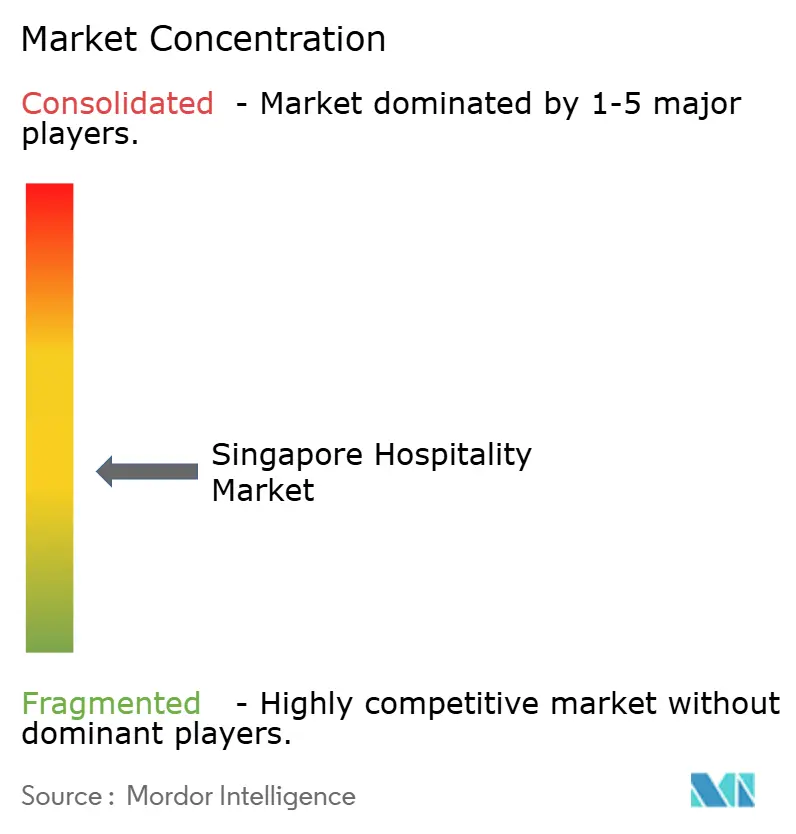
| Market Concentration | Medium |
Major Players *Disclaimer: Major Players sorted in no particular order Image © Mordor Intelligence. Reuse requires attribution under CC BY 4.0. | |
Singapore Hospitality Market Analysis by Mordor Intelligence
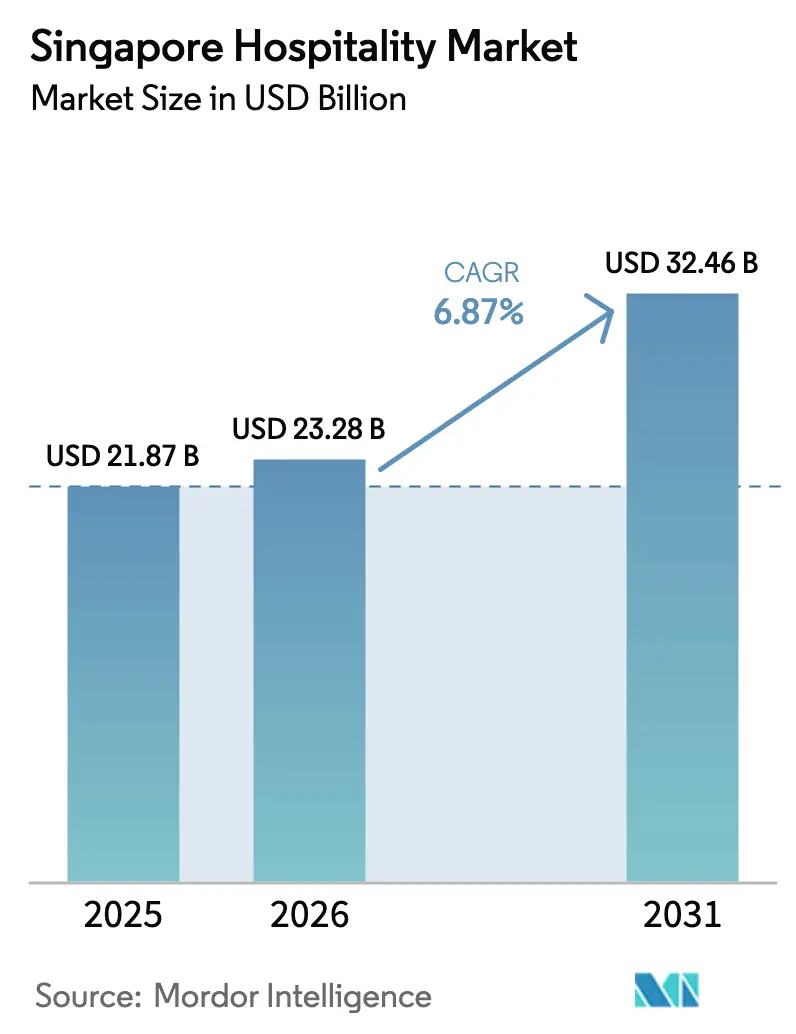
The Singapore Hospitality Market size is expected to increase from USD 21.87 billion in 2025 to USD 23.28 billion in 2026 and reach USD 32.46 billion by 2031, growing at a CAGR of 6.87% over 2026-2031.
Demand is broadening beyond a post-pandemic rebound, as MICE and leisure continue to recover while extended stays lift serviced apartments that cater to corporate relocations and co-living use cases. Operators are leaning into pricing discipline as supply remains tight, which supports rate integrity even when occupancy normalization lags peak years of the past. Companies are using this window to prioritize sustainability retrofits that improve operating margins and align with national standards and traveler preferences for certified stays. Digital adoption across booking and on-property systems is deepening, supporting better conversion on brand.com and contactless experiences that reduce front-line staffing pressure, while strengthening the long-term revenue mix of the Singapore hospitality market.
Key Report Takeaways
- By type, chain hotels led with 61.65% of the Singapore hospitality market share in 2025. Service apartments are projected to expand at a 9.76% CAGR through 2031.
- By accommodation class, luxury properties accounted for 47.65% of the Singapore hospitality industry share in 2025. Budget and economy are forecast to grow at an 8.67% CAGR through 2031.
- By booking channel, OTAs captured 52.77% of the Singapore hospitality market share in 2025. Direct digital is projected to grow at a 12.68% CAGR through 2031.
- By geography, Marina Bay and Downtown Core accounted for 38.77% of the Singapore hospitality market share in 2025. Changi and East Coast are projected to grow at an 8.66% CAGR through 2031.
Note: Market size and forecast figures in this report are generated using Mordor Intelligence’s proprietary estimation framework, updated with the latest available data and insights as of January 2026.
Market Trends and Insights
Drivers Impact Analysis of Singapore Hospitality Market*
| Driver | (~) % Impact on CAGR Forecast | Geographic Relevance | Impact Timeline |
|---|---|---|---|
| Integrated Resort Ecosystem Supporting Visitor Spending Growth | 1.10% | Marina Bay Tourism Hub | Short term (≤ 2 years) |
| Regional Wealth Management Hub Supporting Premium Visitor Segments | 0.80% | Luxury Banking Districts | Medium term (2–4 years) |
| Global Events Ecosystem Supporting Short-Term Demand Peaks | 0.90% | MICE & Event Zones | Short term (≤ 2 years) |
| Cruise Hub Development Strengthening Leisure Tourism | 0.60% | Cruise Hospitality Corridors | Medium term (2–4 years) |
| Urban Entertainment and Lifestyle District Expansion | 0.60% | Lifestyle Entertainment Precincts | Long term (≥ 4 years) |
| Smart Nation Capabilities Enhancing Hospitality Efficiency | 0.50% | AI-Enabled Hotel Clusters | Long term (≥ 4 years) |
| Source: Mordor Intelligence | |||
Integrated Resort Ecosystem Supporting Visitor Spending Growth
Singapore’s two Integrated Resorts (IRs), Marina Bay Sands (MBS) and Resorts World Sentosa (RWS), continue to serve as the structural backbone of the city-state’s hospitality and visitor spending model. In July 2025, Las Vegas Sands broke ground on MBS’s USD 8 billion (SGD 10.3 billion) ultra-luxury IR2 expansion. This project will add a 570-suite luxury hotel tower with signature rooftop experiences, approximately 200,000 sq ft of premium MICE space, a 15,000-seat arena for international events, and expanded F&B and retail offerings. Development costs have more than doubled from the initial USD 3.3 billion estimate in 2019. Completion is expected by June 2030, with opening in January 2031. MBS reported record Q1 2026 revenues of USD 1.5 billion, with EBITDA rising 30% year-on-year, driven by high-value tourism[1]. At RWS, 2025 openings included Minion Land, Singapore Oceanarium, and Weave. The Greater Sentosa Master Plan, unveiled in July 2026, aims to double visitor throughput. SEG category receipts surged 22.8% YoY to SGD 2 billion (USD 1.56 billion) in receipts during Q1 2026, while 2025 tourism receipts reached a record SGD 32.8 billion (USD 25.54 billion).
Regional Wealth Management Hub Supporting Premium Visitor Segments
Singapore’s position as Asia’s premier cross-border wealth management hub directly supports demand for premium and ultra-luxury hospitality. The UHNWI population grew 55% over five years, rising from 4,642 in 2021 to 7,171 in 2026, and is forecast to increase another 46% by 2031 to approximately 10,495. The city added 35 billionaires, bringing the total to 63. Singapore hosts over 1,400 single-family offices managing more than SGD 500 billion (USD 389.29 billion) in AUM, with broader private banking assets estimated at USD 1.8–1.9 trillion[2]. In 2025, the three largest banks attracted SGD 77 billion (USD 59.95 billion) in net new wealth inflows. Julius Baer’s Global Wealth and Lifestyle Report 2026 named Singapore the world’s most expensive city for HNWIs for the second consecutive year. Luxury goods spending was projected at SGD 13.9 billion (USD 10.82 billion) in 2025, growing 7–9% YoY. Indian visitor arrivals reached 1.03 million in the first 10 months of 2025, reinforcing high-end spending on hotels, F&B, and experiences. HNWIs’ mobile lifestyle creates steady demand for luxury accommodation and services.
Global Events Ecosystem Supporting Short-Term Demand Peaks
Singapore’s strategy of hosting high-profile global events generates consistent short-term demand peaks across the hospitality sector. In 2025, the city maintained its ranking as Asia-Pacific’s No. 1 MICE destination for the 22nd year, with MICE receipts surging more than 35% to SGD 2.3 billion (USD 1.79 billion). Key events included the World Aquatics Championships, F1 Singapore Grand Prix (300,641 attendees, +11.7% YoY), POP TOY SHOW (>45,000 attendees), and ART SG (>41,000 visitors). The 2026 calendar remains strong with the Singapore Airshow (~60,000 attendees), BTS World Tour (four nights), Cirque du Soleil KOOZA, Guns N’ Roses, Post Malone, Disney Cruise Line’s first Asia homeport, and the Herbalife Extravaganza (expected 25,000 visitors). Future-secured events include the ASEAN Tourism Forum 2027 and D23 Asia 2027. The planned Straits View MICE hub aims to triple MICE receipts by 2040. The SHINE initiative involves 22 hotels, while STB allocated over SGD 20 million (USD 15.57 million) in partnerships and new grant funds[3]. These events drive occupancy, F&B, gaming, and retail spending.
Cruise Hub Development Strengthening Leisure Tourism
Singapore’s cruise sector delivered strong results in 2025 with 375 ship calls (+10% YoY) and over 2.0 million passenger movements (+9% YoY), the highest since 2023. The Marina Bay Cruise Centre completed a SGD 40 million (USD 31.14 million) expansion, doubling capacity from 6,800 to 11,700 passengers with dedicated facilities for dual-ship operations.
In July 2026, the new Singapore Cruise Centre at HarbourFront opened, featuring airport-style automated check-in, biometric immigration clearance with 26 lanes, VIP lounge, and expanded retail[4]. A joint feasibility study is underway for a larger integrated cruise and ferry terminal at Straits View, capable of supporting significantly higher capacity. STB highlights cruise as a key growth lever amid aviation challenges. Changi Airport’s 42.6 million seats in 2025 support fly-cruise models favoured by visitors from Australia, Europe, and Northeast Asia, enhancing overall leisure tourism.
Restraints Impact Analysis of Singapore Hospitality Market*
| Restraint | (~) % Impact on CAGR Forecast | Geographic Relevance | Impact Timeline |
|---|---|---|---|
| Land Scarcity Limits Hospitality Expansion and Raises Development Costs | −0.8% | High Development Costs in Prime Locations | Long term (≥ 4 years) |
| Competition From Lower-Cost Southeast Asian Hospitality Markets | −0.6% | Regional Competition Pressuring Hotel Rates | Medium term (2–4 years) |
| Dependence on International Travel Increases Sensitivity to External Demand Shifts | −0.7% | Dependence on International Visitor Demand | Short term (≤ 2 years) |
| Competition from Regional Hospitality Hubs Intensifies | −0.5% | Growing Competition in MICE and Luxury Segments | Medium term (2–4 years) |
| Source: Mordor Intelligence | |||
Land Scarcity Limits Hospitality Expansion and Raises Development Costs
Singapore’s small land area of approximately 735 sq km imposes a fundamental constraint on hospitality supply growth, as it competes with housing, industry, and infrastructure. The MBS IR2 expansion exemplifies this: costs escalated from an initial USD 3.3 billion in 2019 to USD 8 billion by 2025. Las Vegas Sands' cumulative investment in Singapore will exceed USD 15 billion.
Replacement costs exceed asset values, making it cheaper to buy than build. Average hotel ARR remains high at SGD 250–274 (USD 194.65–213.34). New supply growth is expected to slow to just 1.5% per annum between 2026 and 2030. As of April 2026, inventory stands at 79,566 keys, with only 6,768 additional rooms forecast by 2030. Government Land Sales for hotels remain limited. While scarcity supports strong occupancy (81.9% Jan–Sep 2025) and pricing power, it restricts volume growth and favours only well-capitalised players.
Competition From Lower-Cost Southeast Asian Hospitality Markets
Singapore’s premium positioning leaves mid-market and price-sensitive segments vulnerable to lower-cost regional competitors. With a Numbeo cost index of 88.9 (versus Bangkok at ~40), Singapore hotel rooms cost 3–5 times as much as comparable options in Vietnam. Thailand, Indonesia, Vietnam, and Malaysia actively market to travellers priced out of Singapore.
Vietnam achieved 21 million international arrivals in 2025, Indonesia 15.4 million, and Thailand over 11.68 million visitors in the first four months of 2026 alone. This competition squeezes mid-tier hotels between luxury properties, which capture high spenders, and budget options, which retain cost-conscious guests. Industry occupancy remains about 6.5 percentage points below 2019 levels. While STB focuses on quality tourism and higher per-visitor yield, volume-dependent operators face increased risk of demand leakage to more affordable destinations.
*Our forecasts treat driver/restraint impacts as directional, not additive. The impact forecasts reflect baseline growth, mix effects, and variable interactions.
Singapore Hospitality Market Segment Analysis
By Type:
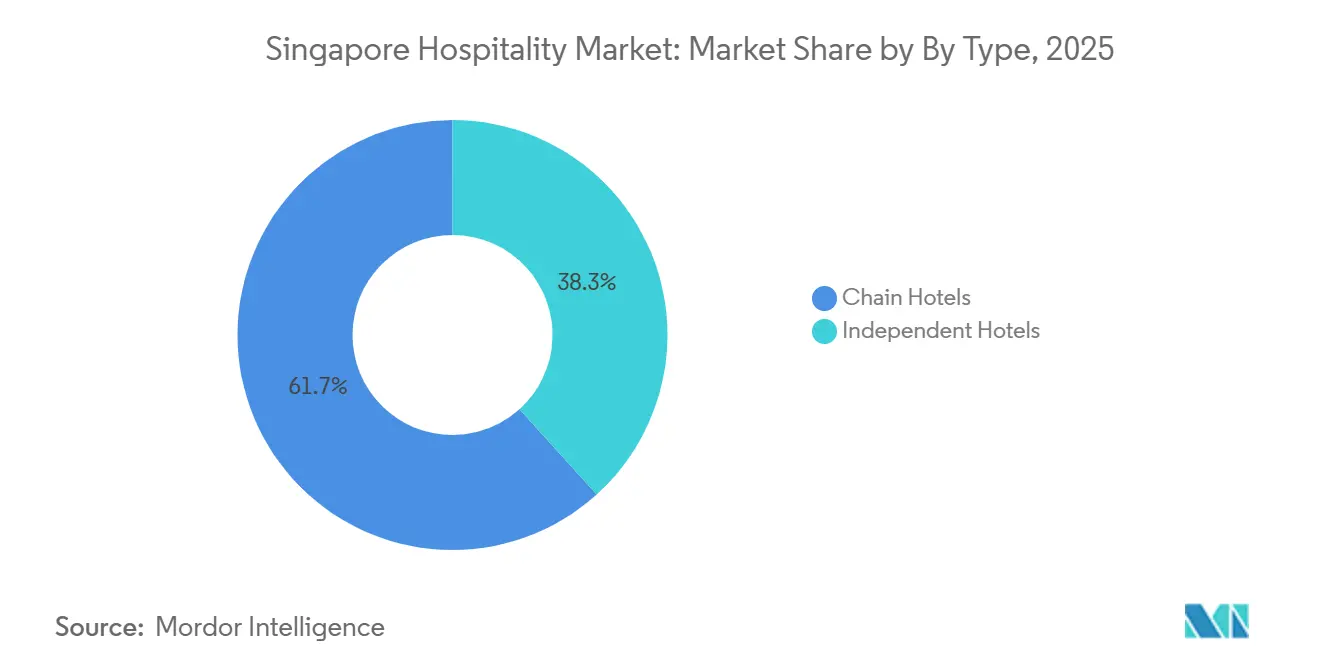
Service Apartments Capture Extended-Stay SurgeChain hotels held 61.65% of the Singapore hospitality market share in 2025, reflecting the distribution scale and loyalty ecosystems that global brands built over multiple cycles. Service apartments are projected to expand at a 9.76% CAGR through 2031, and this growth directly increases the Singapore hospitality market size for extended-stay formats that bundle residential functionality with hotel-grade services. The demand profile includes relocating executives, digital nomads, and medical travelers, all of whom prioritize space, kitchenette access, and reliable connectivity that traditional rooms often do not optimize. Independent hotels continued to differentiate through localized experiences and nimble operations, although their digital marketing and OTA bargaining positions are structurally weaker than those of chains. In practice, chains and serviced apartment platforms use scale to tender better rates on technology, sustainability upgrades, and workforce training, which supports cost control and consistency across the Singapore hospitality market.
Asset conversion has accelerated as owners re-evaluate the economics of older office blocks and pursue higher-yield hospitality uses, an approach that aligns with urban renewal and reactivation in the Downtown Core. Redevelopment projects by listed platforms illustrated this shift, including serviced residence pipelines designed around co-living concepts that anchor occupancy with community programming and flexible leases. National green-building initiatives guide design choices, incentivizing energy performance that lowers life-cycle costs and reduces exposure to future carbon pricing. Portfolio managers framed these upgrades as both compliance and brand strategy, given that sustainability certification increasingly influences enterprise procurement and corporate travel policies. The direction of travel suggests the Singapore hospitality industry will continue to converge around flexible living models that balance asset efficiency with evolving guest expectations.
By Accommodation Class:
Budget Assets Gain as Luxury Sustains PremiumLuxury properties captured 47.65% of the Singapore hospitality market size in 2025, anchored by integrated resorts and iconic brands that attract high-net-worth travelers seeking premium experiences. Budget and economy properties are forecast to grow the fastest, at an 8.67% CAGR, driven by cost-conscious regional visitors who trade amenities for location and value. Upper-mid and mid-scale hotels faced persistent pressure from tighter corporate travel policies and hybrid work patterns that reduced trip frequency and shortened the length of stay. Performance within luxury diverged by sustainability credentials and integration of wellness, culinary, and event-programming that support longer stays and repeat visitation. The composition of demand across classes reinforces revenue management discipline and mix optimization across the Singapore hospitality market.
Integrated resort benchmarks remained strong in 2025, with Marina Bay Sands reporting record mass segment performance and high occupancy, which supported premium ADRs and strengthened confidence in the depth of luxury demand. At the same time, scalable green retrofits spread across mid-scale and upscale properties, which cut energy use and improved net operating income in a high-tariff environment. The emergence of co-living and serviced suites that straddle mid-scale and premium positioning allowed operators to flex pricing by season and event calendar. Properties with visible sustainability achievements and proven operational efficiency signaled resilience across cycles, an important consideration for lenders and investors. These dynamics underscore how both ends of the spectrum can expand alongside a growing core in the Singapore hospitality market.
By Booking Channel:
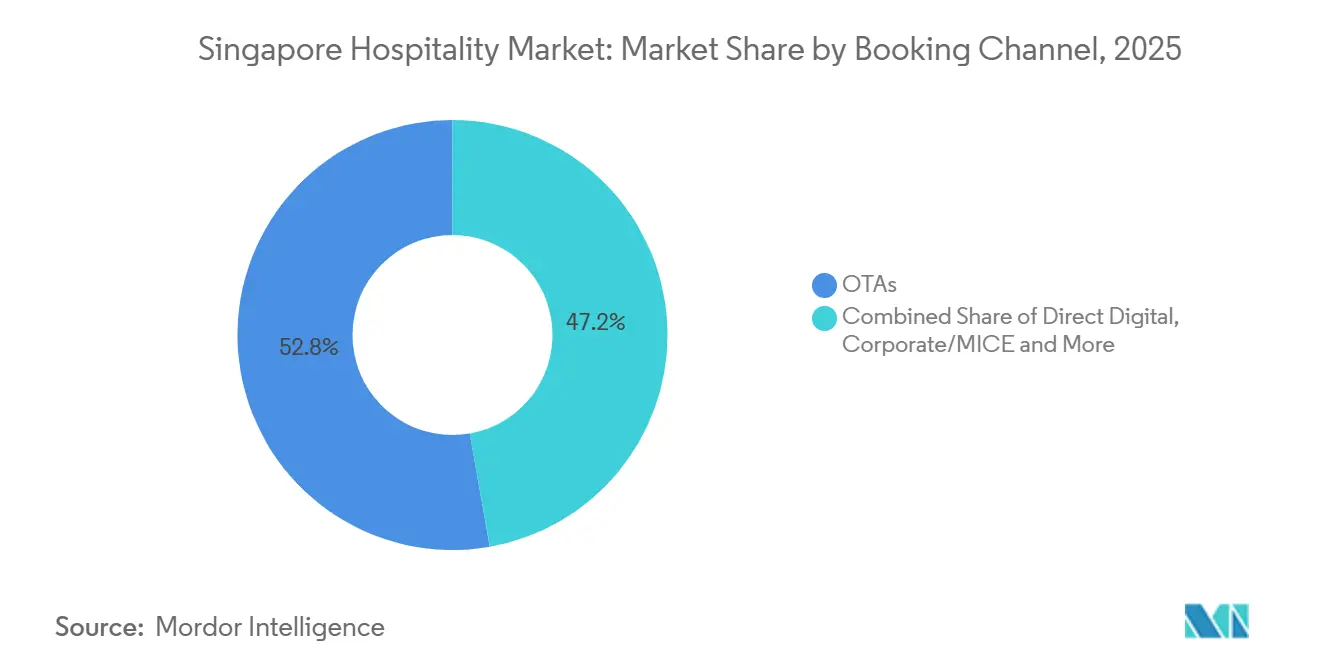
Direct Digital Disrupts OTA DominanceOTAs accounted for 52.77% of the Singapore hospitality market size in 2025, reflecting traveler trust in comparison engines and reviews that support leisure decisions. Direct digital is projected to grow at a 12.68% CAGR, reinforced by loyalty ecosystems, co-branded cards, and members-only rates that reduce commission leakage and improve contribution margins. Corporate and MICE channels remained critical for mid-week base load but operated under stricter enterprise budgets that required sharper yield management. Wholesale and traditional agents continued to serve specific source markets and group tours, although their relative weight moderated as younger travelers shifted further to self-service booking flows. Together, these trends shape a booking mix that supports stronger brand control and lifetime value in the Singapore hospitality market.
Digitalization accelerated under the National Hotel Industry Transformation Map, which encourages the adoption of interoperable tools that improve revenue capture and on-property efficiency. Check-in and identity verification are more automated today, creating smoother arrivals and reducing desk queues, while also lowering reliance on manual processes. Data integration across property-management, channel, and CRM systems supports targeted offers and loyalty-point accelerators that can lift direct conversion. The resulting data exhaust helps teams refine content and dynamic pricing on brand.com and app channels without overexposing discounts on third-party sites. The outcome is a healthier channel mix that enhances profitability and brand equity across the Singapore hospitality market.

Geography Analysis
Marina Bay and Downtown Core captured 38.77% of the Singapore hospitality market size in 2025, a concentration driven by flagship properties and large MICE footprints that support premium pricing power. Changi and East Coast are projected to grow at an 8.66% CAGR through 2031 as aviation and cruise deployments expand, supported by long-term infrastructure plans. Orchard Road leveraged retail and dining to draw leisure travelers, while heritage districts like Bugis and Little India attracted value-seeking visitors whose stays often align with cultural events. Sentosa and the Southern Waterfront continued to benefit from integrated attractions, though renovation cycles and asset mix evolution shaped quarterly share dynamics. The geographic pattern reflects how infrastructure and anchor attractions steer demand distribution in the Singapore hospitality market.
Cruise homeporting added a new layer of demand diversification, highlighted by the five-year deployment of Disney Adventure from December 2025, which encourages pre- and post-cruise stays. Airport performance is also critical for the East Coast corridor, where strong passenger flows underpin hotels serving early departures and late arrivals as well as crews. Future phases of airport development are expected to improve long-haul connectivity and strengthen Singapore’s role as a regional hub, a dynamic that multiplies lodging opportunities beyond the city center. These changes reinforce the case for targeted investments in Changi-adjacent neighborhoods that can capture spillovers from air and cruise growth. The regional footprint will continue to rebalance as supply, events, and transport plans come online across the Singapore hospitality market.
Competitive Landscape
Competitive intensity remains high even as pricing holds, since operators must compete on service design, sustainability, and digital experiences rather than rates alone. Integrated resorts exert an outsized influence on premium segments and event-led demand, which lifts RevPAR in adjacent submarkets during peak calendars. At the same time, a broad field of international chains and strong domestic owners keeps the market moderately fragmented, which encourages ongoing innovation in product and service. Sustainability certifications are now a commercial lever as much as a compliance task, with many enterprise bookers preferring certified hotels for their travel programs. These patterns continue to shape investment priorities and brand strategies across the Singapore hospitality market.
Technology has become a core competitive dimension, with operators deploying smart building systems, efficient kitchens, and digital guest journeys to compress costs and improve experience. Case studies include mid-scale properties that now operate low-carbon kitchens and use intelligent controls to optimize heating and cooling without sacrificing comfort. Brand ecosystems also matter, as loyalty programs can steer share from OTAs and improve repeat rates, which compound value when paired with data-driven personalization. Owners with strong balance sheets are reweighting capex toward upgrades that reduce energy usage and enhance space activation, rather than pure key additions. This orientation supports better cash flow resilience and brand differentiation in the Singapore hospitality market.
Scale continues to confer advantages in procurement and financing, with listed hospitality vehicles recycling capital to maintain competitive products and pursue accretive redeployment. Investor updates from leading platforms highlighted divestment and reinvestment strategies that tilt portfolios to higher-yield assets and flexible living models. Integrated resort disclosures for 2025 pointed to strong premium-mass performance and high occupancy, reinforcing the sustained depth of luxury demand into 2026. Portfolio-wide sustainability roadmaps also signal faster progress toward certifications, which can unlock premium corporate demand and longer-tenure agreements. The cumulative effect is a market where capital, capability, and credibility align to reinforce leadership positions in the Singapore hospitality market.
Singapore Hospitality Industry Leaders
-
Far East Hospitality
-
Pan Pacific Hotels Group
-
Marina Bay Sands
-
Resorts World Sentosa
-
Accor Asia Pacific
- *Disclaimer: Major Players sorted in no particular order
Singapore Hospitality Market Companies Covered in this Report
- Marina Bay Sands
- Resorts World Sentosa
- Pan Pacific Hotels Group
- Far East Hospitality
- Capella Hotel Group
- Accor Asia Pacific (Singapore)
- IHG Hotels & Resorts (Singapore)
- Hilton Hotels & Resorts (Singapore)
- Wyndham Hotels & Resorts (Singapore)
- Millennium & Copthorne
- Shangri-La Group (Singapore)
- The Ascott Limited
- Frasers Hospitality
- Oakwood Hospitality
- Como Hotels & Resorts
- The Fullerton Hotels
- Park Hotel Group
- Minor Hotels (Singapore)
- Artyzen Hospitality Group
- Raffles & Fairmont Hotels
Recent Industry Developments in Singapore Hospitality Market
- December 2025: Disney Cruise Line’s Disney Adventure commenced its maiden voyage from Singapore and began a five-year exclusive homeporting arrangement that is expected to extend pre- and post-cruise stays.
- October 2025: IHG Hotels & Resorts named Holiday Inn Express Singapore Clarke Quay its first Low Carbon Pioneer hotel in Asia, featuring fully electric kitchens, hot water heat pumps, and intelligent building systems.
- October 2025: Las Vegas Sands reported Marina Bay Sands Q3 2025 net revenue of USD 1.436 billion with record mass gaming win and a 51.7% EBITDA margin, underscoring integrated resort resilience.
- January 2025: CapitaLand Ascott Trust’s lyf Funan Singapore began contributing revenue, supported by its co-living design and proximity to major MICE venues.
Singapore Hospitality Market Report Scope
The hospitality sector encompasses a diverse array of service-based occupations, including accommodations, theme parks, travel agencies, food and beverage services, event management, hotels, restaurants, and bars. The research covers a comprehensive background examination of the Singaporean hospitality sector, including an evaluation of industry associations, the general economy, emerging market trends by category, notable shifts in the market dynamics, and a market overview.
The Singapore Hospitality Market Report is Segmented by Type (Chain Hotels, Independent Hotels), Accommodation Class (Luxury, Mid & Upper-Mid-scale, Budget & Economy, Service Apartments), Booking Channel (Direct Digital, OTAs, Corporate / MICE, Wholesale & Traditional Agents), and Geography (Marina Bay / Downtown Core, Orchard Road, Sentosa & Southern Waterfront, Bugis & Little India, Changi & East Coast, Rest of Singapore).
Segmentation Overview
By Type
| Chain Hotels |
| Independent Hotels |
By Accommodation Class
| Luxury |
| Mid & Upper-Mid-scale |
| Budget & Economy |
| Service Apartments |
By Booking Channel
| Direct Digital |
| OTAs |
| Corporate / MICE |
| Wholesale & Traditional Agents |
By Geographic Region
| Marina Bay / Downtown Core |
| Orchard Road |
| Sentosa & Southern Waterfront |
| Bugis & Little India |
| Changi & East Coast |
| Rest of Singapore |
| By Type | Chain Hotels |
| Independent Hotels | |
| By Accommodation Class | Luxury |
| Mid & Upper-Mid-scale | |
| Budget & Economy | |
| Service Apartments | |
| By Booking Channel | Direct Digital |
| OTAs | |
| Corporate / MICE | |
| Wholesale & Traditional Agents | |
| By Geographic Region | Marina Bay / Downtown Core |
| Orchard Road | |
| Sentosa & Southern Waterfront | |
| Bugis & Little India | |
| Changi & East Coast | |
| Rest of Singapore |
Key Questions Answered in the Report
What is the outlook for the Singapore hospitality market through 2031?
The Singapore hospitality market size is USD 23.28 billion in 2026 and is projected to reach USD 32.46 billion by 2031 at a 6.87% CAGR, underpinned by diversified demand across MICE, leisure, and extended stays.
Which segments are growing fastest in Singapore hospitality?
Service apartments lead by type at a 9.76% CAGR, budget and economy lead by class at an 8.67% CAGR, direct digital leads among booking channels at a 12.68% CAGR, and Changi and East Coast lead by geography at an 8.66% CAGR.
How are direct channels affecting bookings in Singapore hotels?
Direct digital channels are growing at a 12.68% CAGR through 2031 as loyalty programs, subscription offers, and brand apps shift share from OTAs while reducing commissions.
What role does sustainability play in hotel performance in Singapore?
Hotels with recognized certifications benefit from stronger corporate demand and traveller preference, with national programs supporting greener operations that improve margins and brand trust.
Which locations are most important for premium demand in Singapore?
Marina Bay and Downtown Core concentrate premium inventory and citywide MICE activity, while Changi and East Coast are set to grow fastest due to air and cruise-led connectivity.
How do mega-events and MICE shape demand in Singapore hotels?
Large events drive citywide compression and premium pricing during event windows, and a growing slate of conventions secures mid-week base load that supports year-round performance.