
Market Overview
| Study Period | 2020 - 2031 |
|---|---|
| Forecast Data Period | 2026 - 2031 |
| Base Year Market Size (2025) | USD 47.39 Billion |
| Market Size (2026) | USD 49.34 Billion |
| Market Size (2031) | USD 60.35 Billion |
| Growth Rate (2026 - 2031) | 4.12 % |
| Market Concentration | Low |
Major Players *Disclaimer: Major Players sorted in no particular order Image © Mordor Intelligence. Reuse requires attribution under CC BY 4.0. | |
Japan Hospitality Market Analysis by Mordor Intelligence
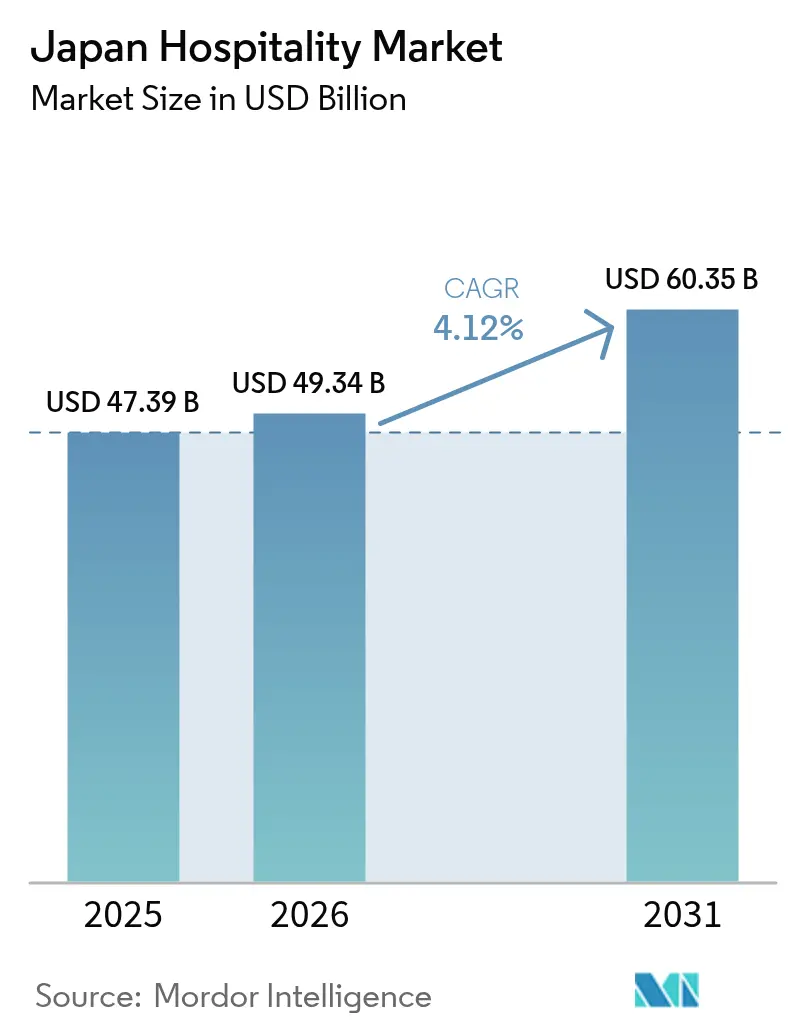
The Japan Hospitality market size is expected to grow from USD 47.39 billion in 2025 to USD 49.34 billion in 2026 and is forecast to reach USD 60.35 billion by 2031 at 4.12% CAGR over 2026-2031.
The growth momentum is driven by a mix of inbound demand, technology adoption, and supportive regulation[1]. Strong visitor inflows tied to a weaker yen, steady domestic leisure spending, and robust investment in regional tourism assets are strengthening top-line revenue streams for operators. Government stimulus programs that subsidize barrier-free retrofits, together with relaxed visa policies for priority source markets, underpin a medium-term surge in room demand that offsets lingering softness in domestic corporate travel. Operators are also deploying service robots, smart-check-in kiosks, and energy-saving systems to counter labor shortages and rising utilities, which improves operating margins even as wage levels move higher. New supply remains disciplined because construction-material inflation and seismic-retrofit costs raise development hurdles, so existing properties enjoy solid pricing power during the recovery phase.
Key Report Takeaways
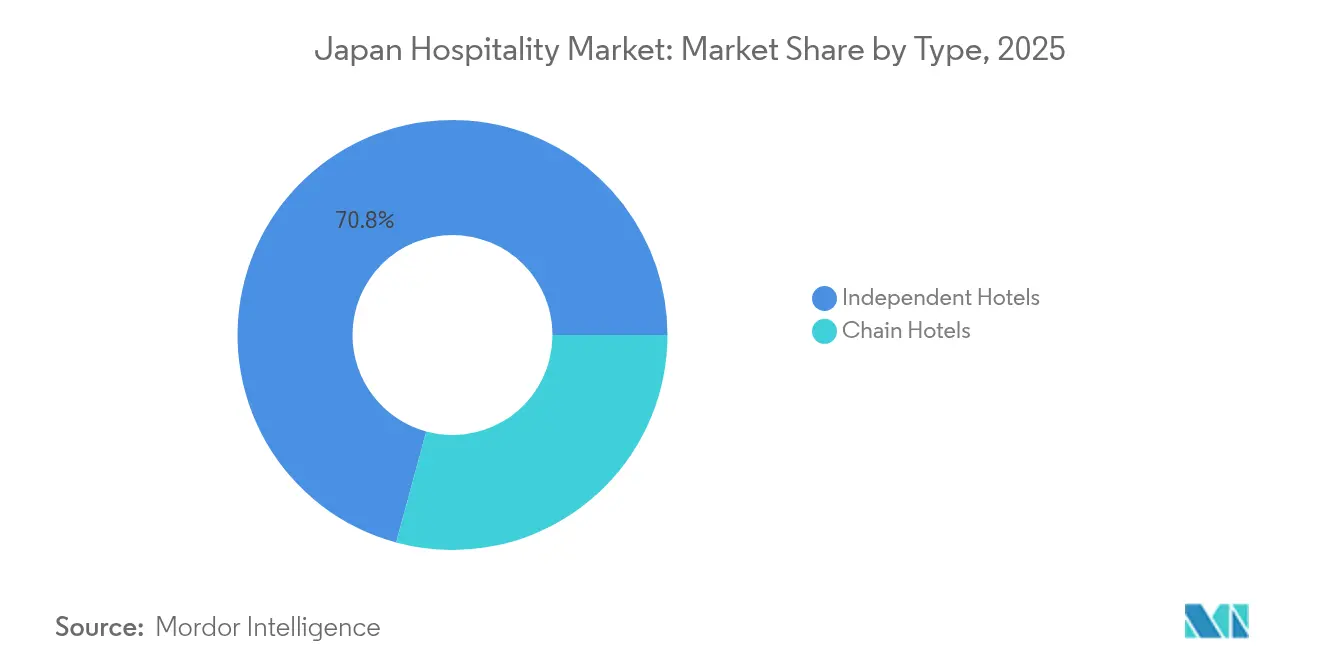
- By type, Independent Hotels led with 70.78% of the Japan hospitality market share in 2025 while Chain Hotels are projected to post a 6.11% CAGR through 2031.
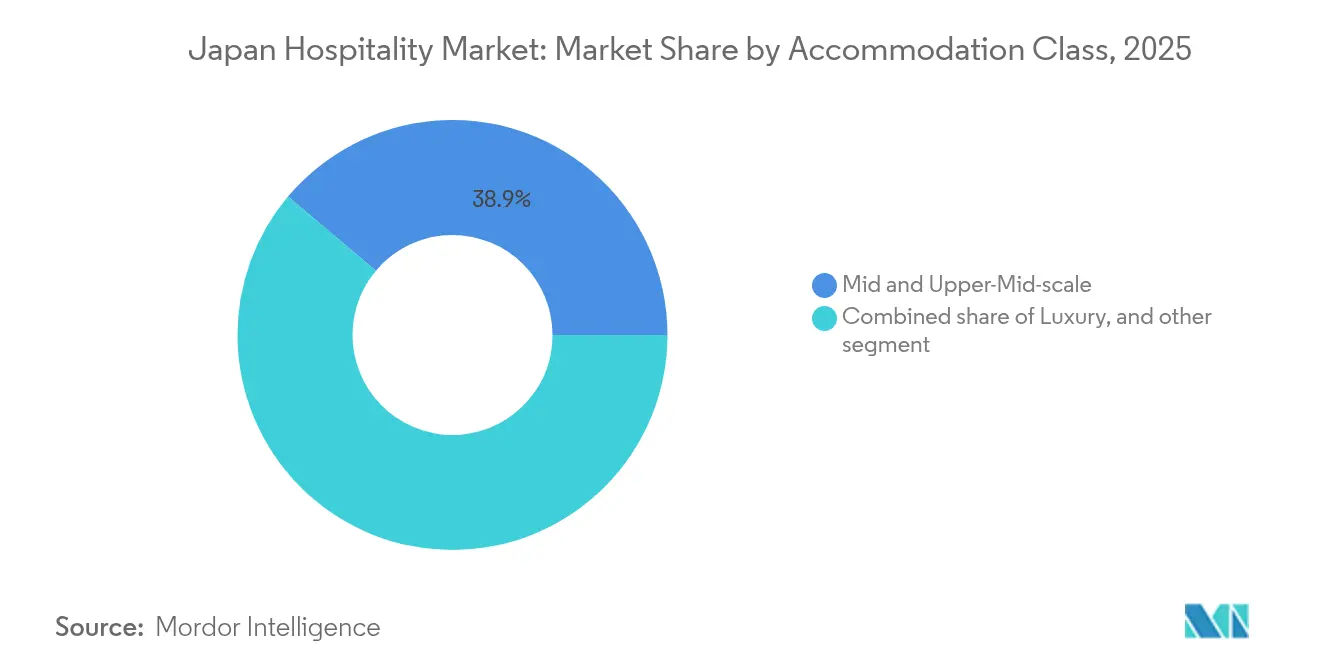
- By accommodation class, Mid & Upper-Mid-scale properties commanded 38.87% of the Japan hospitality market size in 2025; Service Apartments are forecast to grow at a 6.95% CAGR to 2031.
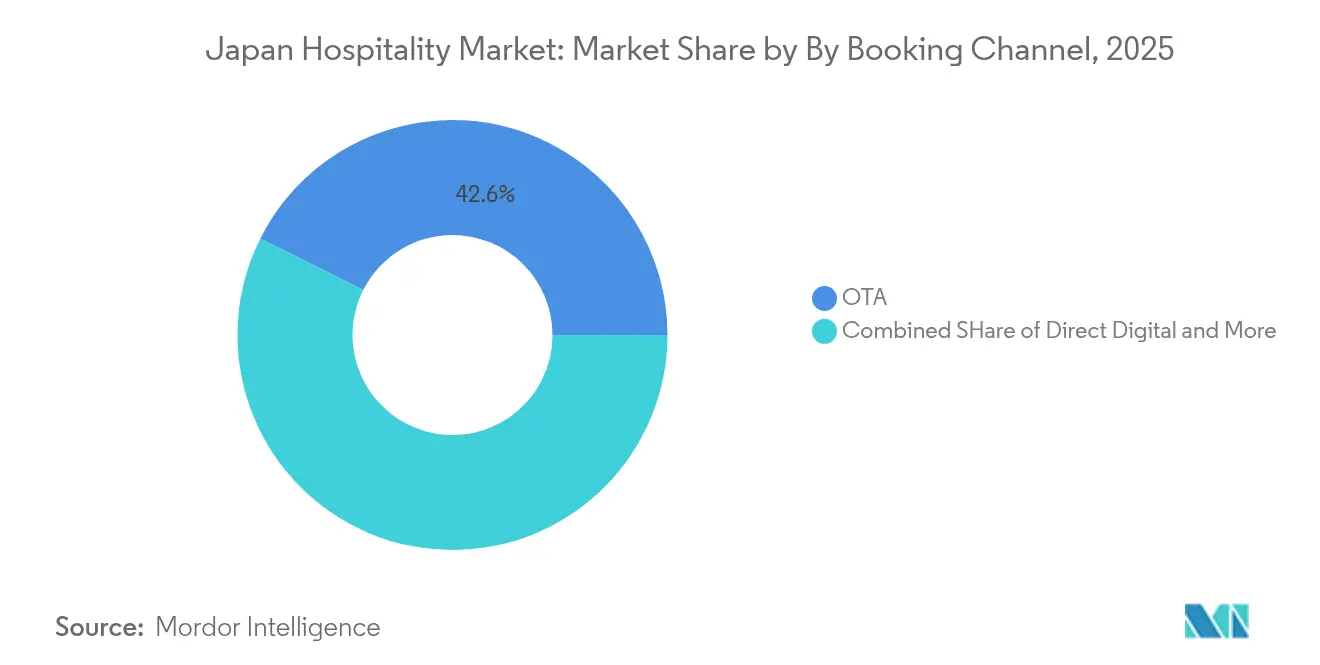
- By booking channel, OTAs controlled 42.59% of the Japan hospitality market size in 2025, whereas Direct Digital platforms are advancing at an 8.55% CAGR through 2031.
- By geography, Kanto accounted for 23.93% of the Japan hospitality industry share in 2025, while Kyushu & Okinawa are expanding at a 5.62% CAGR toward 2031.
Note: Market size and forecast figures in this report are generated using Mordor Intelligence’s proprietary estimation framework, updated with the latest available data and insights as of 2026.
Japan Hospitality Market Trends and Insights
Drivers Impact Analysis*
| Driver | (~) % Impact on CAGR Forecast | Geographic Relevance | Impact Timeline |
|---|---|---|---|
| Seasonal Tourism Economy Supporting Diverse Travel Demand | 0.80% | Cherry Blossom Tourism Corridors | Medium term (2–4 years) |
| Traditional Accommodation Revival Through Ryokan Experiences | 0.70% | Onsen & Ryokan Destinations | Medium term (2–4 years) |
| Regional Tourism Promotion Reducing Tokyo-Kyoto Concentration | 0.60% | Emerging Regional Tourism Hubs | Long term (≥ 4 years) |
| Anime, Pop Culture, and Entertainment Tourism Expansion | 0.50% | Pilgrimage & Fan Tourism | Short term (≤ 2 years) |
| Inbound Spending Growth From Premium International Visitors | 1.00% | Premium Urban Tourism Districts | Short term (≤ 2 years) |
| Smart Hospitality Adoption Addressing Workforce Constraints | 0.50% | AI-Enabled Hospitality Hubs | Long term (≥ 4 years) |
| Source: Mordor Intelligence | |||
Seasonal Tourism Economy Supporting Diverse Travel Demand
Japan's hospitality sector benefits from a highly seasonal tourism calendar. This creates demand peaks across all four seasons and reduces reliance on any single travel period. Demand has historically centered on cherry blossom season (late March-April) and autumn foliage (October-November). Still, it is broadening as campaigns promote summer festivals, winter snow sports, and spring-greenery travel. According to the Japan National Tourism Organization (JNTO), international arrivals are expected to reach 3.9 million in April 2025, up 28.5% year-on-year, supported by cherry blossom tourism and favorable shoulder-season weather. October 2025 is also expected to set a monthly record, with nearly 3.9 million visitors (+17.6% YoY), driven by demand for autumn foliage. Full-year 2025 arrivals are projected at 42.68 million, a record level and a 16% increase over 2024, with stronger seasonal dispersal. May 2026 data is expected to reinforce this diversification. In May 2025, 21 markets are projected to set all-time arrival highs, and in May 2026, more than 17 markets are expected to post monthly records for two consecutive years. Regional resort prefectures such as Nagano, Yamanashi, and Oita, favored by Western individual travelers during the fresh-greenery season, are expected to record a late-May "second peak." Average Daily Rates (ADR) are projected at JPY 44,000-47,700, comparable to or above Kyoto's levels. On the domestic side, same-day trips in 2024 rose 14.1% year-on-year to 246.8 million, while overnight visits increased 4.2% to 293.1 million. This shows that domestic seasonal leisure travel continues to support hotel occupancy in off-peak periods. For Golden Week 2026, JTB forecasts 24.47 million domestic travelers and a travel-intent rate of 23.4%. OTA booking data supports this, showing ADR increases of 4-13% across major prefectures. According to HotelBank, Kyoto's ADR is expected at JPY 48,900 (+7.0% YoY), Hokkaido at JPY 37,300 (+9.6%), and Fukuoka at JPY 38,800 (+9.2%).
Traditional Accommodation Revival Through Ryokan Experiences
Japan's traditional inn (ryokan) sector is undergoing a structural revival, supported by rising inbound demand, succession reforms, and government investment in facility regeneration. The Japan Ryokan Index 2026, covering 560 ryokan across Japan, reports that 89.6% of properties have on-site hot-spring baths, while 59.3% offer private onsen[2]. Once a rare luxury, private onsen are now a mainstream guest expectation. According to the Japan Ryokan Guide, international travelers increasingly seek ryokan experiences, including tatami rooms, kaiseki dining, futon bedding rituals, and yukata culture. Premium operators are leading the revival. Hoshino Resorts’ KAI portfolio, with properties in Hakone, Nikko, Ito, and Matsumoto, is a benchmark for modern ryokan that preserve cultural rituals while adding contemporary infrastructure. The Michelin Keys Guide recognized 10 ryokan in 2026 as model reinventions, from restored century-old villas in Yufu to luxury-tradition properties in Nagato and Ise-Shima. The Japan Tourism Agency (JTA) introduced an FY2026 subsidy program to remove long-derelict ryokan and support redevelopment in onsen resort towns. The scheme raises the cost-coverage ceiling above the earlier JPY 50 million cap, encouraging private operators to rebuild distressed sites rather than abandon them. Gensen Holdings shows the asset-regeneration model by acquiring distressed onsen ryokan, retaining local staff, and repositioning properties for sustainable tourism without new construction. Japan recognizes this approach as a model for preserving regional cultural identity while maintaining commercial viability. The Ryokan Collection, founded to promote premium ryokan to international audiences, reports stronger overseas engagement. International travelers now account for 49% of votes in its annual poll, confirming the segment's global appeal.
Regional Tourism Promotion: Reducing Tokyo-Kyoto Concentration
Inbound tourism remains concentrated along the Tokyo-Osaka-Kyoto “Golden Route,” which accounts for about 60% of international tourist accommodation nights. Government policy, airline partnerships, and destination marketing are addressing this concentration and opening hospitality demand in underserved prefectures. The Japan Tourism Agency (JTA) and JNTO’s rural destination development project is expected to expand in 2025 to the foothills of Mount Fuji, Niigata, and Yamagata. It will support 14 model destinations through investments in product development, accommodation capacity, workforce training, and overseas trade connections[3]. A new JTA subsidy program will also support regional Destination Management Organizations (DMOs) in attracting visitors and stimulating local economies. JAL, JTB, J-AIR, and Japan Air Commuter are expected to launch a co-creation inbound project in 2025, offering regional tour packages in Kyushu, Chugoku, and Tohoku. A Western Japan coalition is also expected to launch the “Western Golden Route” initiative to promote the Chugoku-Shikoku corridor to European, American, and Australian visitors, leveraging the Osaka-Kansai Expo (expected to attract 28.2 million visitors) and the Setouchi Triennale art festival. JNTO’s Singapore office is expected to run its “Beyond the Cities, Into the Heart of Japan” campaign in August 2025, promoting Okinawa, Chugoku, Chubu, Hokuriku Shinetsu, and Hokkaido. JNTO’s GCC office is expected to launch a parallel Hokkaido campaign for repeat visitors from Gulf markets. The market response is expected to be measurable. May 2026 ADR data is projected to show Fukuoka (+9.2%), Hiroshima, Kagoshima, Naha, and Kanazawa posting double-digit YoY growth. Nine markets are expected to set all-time monthly highs in April 2026, despite a 5.5% drop in arrivals due to softness in China’s outbound travel. The national average ADR is projected to reach JPY 32,340 in May 2026, a new high (+19% over three years), as regional destinations increasingly match or exceed major city rates.
Anime, Pop Culture, and Entertainment Tourism Expansion
Anime and pop culture tourism, known in Japan as seichi junrei (sacred location pilgrimages), has become a measurable driver of inbound hospitality demand. It is also bringing visitors to smaller towns and regional prefectures. Japan Tourism Agency data show that 11.8% of tourists to Japan in 2024 visited anime- and movie-related sites as a primary reason for travel, up from 4.6% in 2019 and 7.5% in 2023. Overseas votes in the annual Anime Tourism Association poll are expected to reach 49% in 2025. Trip.com reported a 195% year-on-year rise in searches for anime- and comic-related travel experiences across Asia for 2025-26, led by travelers from Hong Kong, Taiwan, Indonesia, the Philippines, and South Korea[4]. AnimeJapan 2026 in Tokyo is expected to attract visitors from 82 countries and record a 697% year-on-year increase in international ticket sales. JNTO’s Sydney office is expected to confirm in June 2026 that “anime locations are now a measurable driver of inbound tourism, not just a subculture.” It is also expected to note the benefits for smaller towns and lesser-known prefectures such as Kumamoto and Sendai. India is emerging as a high-growth market for anime tourism. Indian arrivals to Japan are expected to reach 315,000 in 2025, up 37% from 230,000 in 2024. JNTO data for early 2026 show Indian arrivals growing 22.7% in February and 14.3% in January, with anime a key motivator for India outbound travel. Hotels, ryokan, and regional tourism operators are developing themed accommodations and interactive experiences, including anime-themed glamping cabins and studio-linked itineraries.
Restraints Impact Analysis*
| Restraint | (~) % Impact on CAGR Forecast | Geographic Relevance | Impact Timeline |
|---|---|---|---|
| Accommodation Capacity Constraints in High-Demand Tourism Markets | −0.7% | Peak Season Supply Constraints | Short term (≤ 2 years) |
| Language Accessibility Challenges Affecting International Visitor Experience | −0.5% | Rural Tourism Infrastructure Gaps | Medium term (2–4 years) |
| Overtourism Pressures Affecting Destination Sustainability and Local Acceptance | −0.6% | Overtourism in Heritage Destinations | Medium term (2–4 years) |
| High Development Complexity Due to Land Costs and Regulatory Requirements | −0.7% | Urban Development Restrictions | Long term (≥ 4 years) |
| Source: Mordor Intelligence | |||
Accommodation Capacity Constraints in High-Demand Tourism Markets
Despite record inbound arrivals, Japan’s hotel room supply pipeline has stalled, especially in gateway cities. This has widened the gap between demand and room availability, limiting revenue capture and visitor satisfaction. Tokyo’s hotel room capacity has plateaued since early 2025, according to a Nikkei Asia analysis published in March 2026. The report cited labor shortages and renovation delays. The Bank of Japan’s March–April 2026 Outlook Reports also identified hospitality staffing and airport service constraints as limits on flight capacity and hotel room availability. Construction costs in Japan’s major urban markets have nearly doubled from pre-COVID-2020 levels, although escalation has eased slightly. Land prices in prime hospitality locations rose 12% in 2024. In Tokyo, Kyoto, and Osaka, FAR (Floor Area Ratio) restrictions and slant-plane regulations under the Building Standards Act and City Planning Act continue to limit building heights and densities. Hospitality investors are favoring office-to-hotel conversions and asset repositioning over greenfield development. Pacifica Hotels is pursuing conversions, but labor shortages are pushing timelines out. Colliers Japan Hospitality Insights, published in February 2026, noted that Japanese guest nights fell 3.5% year-on-year in late 2025, as higher accommodation costs priced out some domestic leisure travelers while inbound demand remained strong. Accommodation operators report missed revenue opportunities. Regional and resort ryokan are limiting room availability due to staffing shortages, even when bookings exist. Some hotels are turning away groups rather than lowering service standards. Japan’s 2030 target of 60 million visitors and JPY 15 trillion in spending requires faster growth in accommodation supply and hospitality workforce capacity, as noted in the 2026 White Paper on Tourism.
Language Accessibility Challenges Affecting International Visitor Experience
Despite record inbound arrivals, Japan still faces a language accessibility gap. This affects visitor experience and limits operators’ ability to serve non-English-speaking Asian travelers, who account for most tourist arrivals. An Agoda industry report published in 2025-2026 highlights a major “localization gap” in Japan’s hospitality sector. While international hotel chains and major city properties have improved English support, the broader hospitality market often lacks Mandarin, Cantonese, Korean, and Thai support across websites, booking platforms, in-room materials, and front-desk services. A survey of Japan’s restaurant sector found that 60.2% of operators cited language barriers as their top challenge when serving foreign tourists. Also, 15.2% of foreign visitors reported difficulty communicating with staff who spoke only Japanese. Although 75% of foreign visitors rate Japanese service quality higher than in their home country, language remains a friction point, especially outside major urban hotels. The ryokan sector faces this challenge more sharply. Regional inns increasingly rely on foreign workers as their main staffing solution, making it harder to teach complex cultural protocols and omotenashi traditions to multilingual teams. Properties spend weeks onboarding staff from Nepal, Taiwan, China, Sri Lanka, and Indonesia, but comprehension often remains inconsistent. Improvements are emerging but remain uneven. Since the 2020 Tokyo Olympics, Japan’s tourism infrastructure has advanced through smartphone translation tools, AI concierge systems, multilingual digital signage, and OTA-mediated multilingual bookings. FamilyMart and other consumer-facing businesses have deployed AI translation systems at scale. However, multilingual support drops sharply in regional destinations, budget accommodations, and independent ryokan, the same segments the government is prioritizing for inbound growth.
*Our forecasts treat driver/restraint impacts as directional, not additive. The impact forecasts reflect baseline growth, mix effects, and variable interactions.
Segment Analysis
By Type: Independent hotels remain dominant but chains scale rapidly
Independent hotels accounted for 70.78% of the Japan hospitality market share in 2025, reflecting the country’s preference for locally run properties that showcase cultural authenticity. Chain hotels, however, are growing at a 6.11% CAGR, supported by standardized systems and strong loyalty programs that tackle labor shortages with centralized training and technology. Marriott opened its 100th Japanese property in 2024 and has 12 more projects slated, signaling confidence in brand power to attract international guests. Seibu Prince Hotels adopted a cloud reservation platform that strengthens distribution reach and data analytics, improving revenue management across its expanding estate. Independent operators are responding by joining soft-brand collections or investing in property-management systems that integrate with OTAs. Consolidation is expected as family-owned ryokans face succession challenges, creating acquisition opportunities for well-capitalized chains. Over time, the combined room count of top brands will increase even if independents hold numerical property advantage, subtly reshaping competitive intensity across major gateways.
The Japan hospitality market size for Chain Hotels is projected to climb steadily as investors favor scalable models with predictable returns. Franchising frameworks have eased entry for domestic real-estate players who supply land while global brands deliver booking engines and loyalty pipelines. Independent hotels must leverage unique location attributes, bespoke design and high-touch service to stay competitive. Some adopt automation selectively to protect warm service elements while trimming back-office tasks. Others collaborate with regional tourism boards to craft thematic itineraries that highlight local culture, thereby winning group bookings from niche operators. Market share movement will hinge on each segment’s ability to balance authenticity, efficiency and digital reach under tightening labor and cost conditions.

By Accommodation Class: Mid & Upper-Mid-scale holds the bulk while Service Apartments surge
Mid & Upper-Mid-scale properties commanded 38.87% of the Japan hospitality market size in 2025 by offering quality rooms at price points acceptable to both leisure and corporate travelers. The tier’s broad footprint across gateway cities makes it the go-to option for tour packages and loyalty redemption stays. Luxury developments remain active, such as Park Hyatt Sapporo opening in 2029, but their share growth is moderated by high land and construction costs. Budget and economy hotels face margin compression because rising wages offset lean staffing models, prompting some to pivot toward capsule formats or partner with coworking providers for blended revenue. Service Apartments, meanwhile, enjoy a 6.95% CAGR as they cater to digital nomads, relocation clients, and long-vacation guests seeking kitchenettes and extra space.
Japan's hospitality market share gains for Service Apartments stem from regulatory tweaks that clarify licensing under the Hotel and Ryokan Management Law, encouraging institutional capital to fund professionally managed projects. Brands streamline operations through cloud check-in and bundled housekeeping, improving profit per square meter. Mid-scale operators defend share by adding family rooms, contactless vending, and wellness amenities. Luxury hot-spring ryokan concepts such as the ATONA chain aim to blend traditional aesthetics with global service standards, illustrating the creative evolution of the upper tier. Overall, accommodation-class dynamics reward operators that can align guest experience with extended-stay and wellness trends while meeting rigorous environmental standards.
By Booking Channel: OTAs dominate but Direct Digital is rising fast
OTAs controlled 42.59% of bookings in 2025 thanks to large advertising budgets, deep user bases and comprehensive multilingual support that attracts first-time international visitors. Hotels, however, are investing in mobile apps, chatbot engagement, and member-only rates, spurring an 8.55% CAGR for Direct Digital channels. Japan hospitality market size for Direct Digital is thus expected to expand faster than any other channel segment, lowering distribution costs for proactive operators. Corporate and MICE channels face structural weakness as companies trim travel and replace small meetings with virtual sessions. Nonetheless, when meetings occur, hotels with integrated hybrid-event technology and flexible hall configurations capture residual demand. Wholesale and traditional agents still serve pilgrimage groups and educational tours, but continue to lose share as customized online itineraries proliferate.
Rate-parity clauses and loyalty tier perks entice repeat guests to book directly, improving data ownership and upsell potential. Seamless mobile check-in shortens wait times and allows staff redeployment to personalized services. OTAs remain critical for visibility in new markets yet charge commission of 15–20%, so most operators calibrate inventory quotas daily to optimize margin. Meta-search advertising and retargeting campaigns boost direct-channel traffic at manageable cost, though success hinges on continuous website upgrades and localized content. Properties that integrate channel analytics with revenue-management tools will extract the greatest value from the mixed distribution landscape.
Geography Analysis
Kanto held 23.93% of the Japan hospitality market share in 2025, driven by Tokyo’s role as the primary international gateway and corporate hub. The region benefits from year-round flight connectivity, diversified demand and world-class transport, yet land prices and zoning curbs inhibit rapid capacity expansion. Average daily rate growth remains supported by high occupancy, especially during citywide events, though policymakers are experimenting with crowd-dispersion incentives to reduce overtourism. Kansai follows as the cultural heartland with UNESCO sites, but strict caps on short-term rentals in Kyoto temper supply growth and push visitors toward Osaka and nearby prefectures. Hokkaido leverages dual-season appeal, attracting skiers in winter and outdoor enthusiasts in summer, which smooths revenue seasonality for resort operators.
Kyushu & Okinawa log the fastest 5.62% CAGR, aided by infrastructure upgrades, cruise-terminal expansions and the USD 1.12 billion Four Seasons resort scheduled for 2027. Visa-free travel from Taiwan and charter flights from Southeast Asia channel fresh leisure segments into these islands, supporting upscale and eco-resort pipelines. Chubu, Tohoku, Chugoku and Shikoku gain from government programs that promote regional tourism through grants, marketing campaigns and rail-pass discounts. Local authorities emphasize immersive cultural experiences, such as craft tours and agritourism, to differentiate from metropolitan circuits. Japan hospitality market size growth in these regions remains modest but steady, relying on infrastructure rollouts and digital way-finding tools that mitigate language barriers.
Competitive Landscape
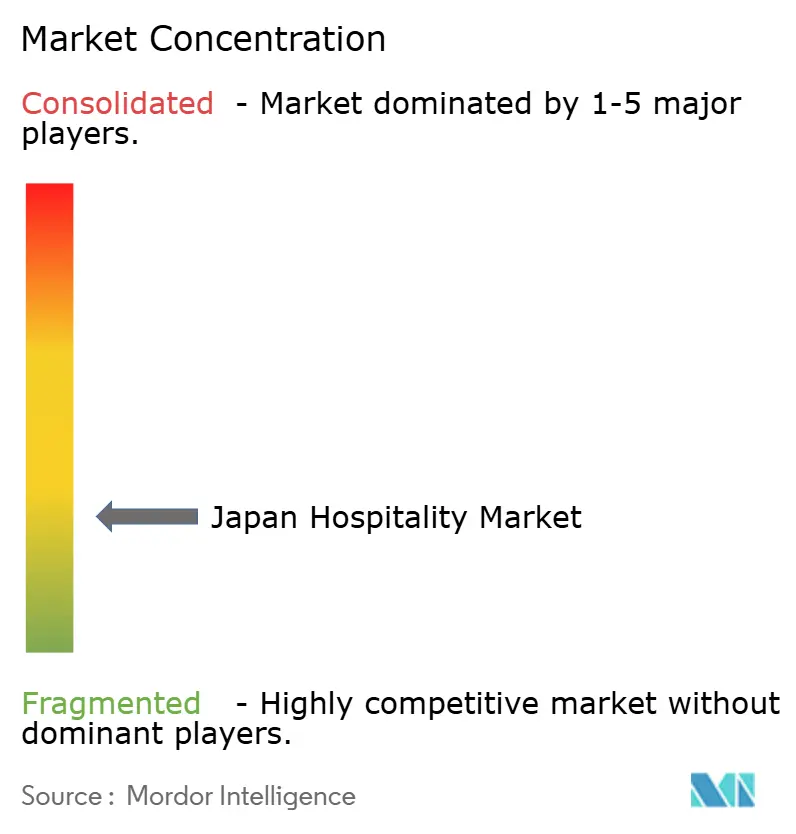
Japan’s hospitality sector is highly fragmented, with the top five operators accounting for a relatively small portion of the total room supply. APA Hotel & Resort holds the leading position, while Toyoko Inn follows closely, maintaining its focus on the budget segment through uniform room designs and eco-friendly cleaning practices. Marriott, Hilton and IHG expand through management contracts, riding loyalty ecosystems to capture premium international travelers. Domestic groups such as Hoshino Resorts differentiate by embedding local culture and sustainability, which appeals to higher-spending guests seeking authentic experiences. Automation strategies give early adopters a cost edge; APA’s nationwide rollout of self-check-in kiosks cut front-desk staffing hours while maintaining guest-satisfaction scores above 85%.
Seibu Prince Hotels’ new cloud-based reservation engine integrates with Sabre SynXis to consolidate inventory and dynamic pricing in real time, helping the chain drive higher direct bookings and cross-brand loyalty redemptions. Fortress Investment Group doubled wages at select assets to stabilize labor, highlighting divergent strategies in a tight human-resource environment. Emerging disruptors include platforms that match traveling gig workers with short-staffed inns, broadening labor solutions beyond pure automation. International brands increasingly partner with domestic developers to navigate zoning and licensing, a model demonstrated by Park Hyatt Sapporo and Four Points Flex Osaka.
Service Apartments represent an acquisition target for real-estate investment trusts that value longer average stay and predictable occupancy. ESG imperatives accelerate retrofits: operators tap government green grants to install solar panels and low-flow fixtures that reduce utilities by up to 20%. Supply discipline stemming from high construction costs strengthens pricing across existing stock, while regional subsidies entice chains into underserved prefectures. Competitive intensity centers on digital distribution and personalized experience rather than raw room count, steering capital toward technology and training that deepen guest engagement and lifetime value.
Japan Hospitality Industry Leaders
-
APA Hotel & Resort
-
Prince Hotels, Inc.
-
Tokyu Hotels & Resorts Co., Ltd.
-
Fujita Kanko Inc.
-
Hotel Okura Co., Ltd.
- *Disclaimer: Major Players sorted in no particular order
Recent Industry Developments
- January 2025: Hyatt Hotels Corporation signed a management contract for the 157-key Park Hyatt Sapporo, with opening slated for 2029.
- February 2025: Pan Pacific Hotels Group, in partnership with Tokyu Hotels, opened The Hotel Higashiyama Kyoto Tokyu, featuring 143 rooms.
- November 2024: Marriott International unveiled its 100th Japanese hotel, Four Points Flex by Sheraton Osaka Umeda, and outlined 12 additional openings through early 2025.
- November 2024: Mitsui Fudosan announced Hotel The Mitsui Hakone, a 126-room luxury property scheduled for 2026.
- August 2024: Hyatt and Kiraku launched ATONA, a luxury hot-spring ryokan brand with initial funding of JPY 10 billion (USD 71 million).
Japan Hospitality Market Report Scope
The hospitality industry is a broad category of fields within the service industry, including lodging, food, drink service, event planning, theme parks, travel, and tourism. It includes hotels, tourism agencies, restaurants, and bars. The Hospitality Industry in Japan is Segmented by Type (Chain Hotels and Independent Hotels) and by Segment (Service Apartments, Budget and Economy Hotels, Mid and Upper Mid-scale Hotels, and Luxury Hotels). The report offers market size and forecasts in value (USD billion) for all the above segments.
By Type
| Chain Hotels |
| Independent Hotels |
By Accommodation Class
| Luxury |
| Mid & Upper-Mid-scale |
| Budget & Economy |
| Service Apartments |
By Booking Channel
| Direct Digital |
| OTAs |
| Corporate / MICE |
| Wholesale & Traditional Agents |
By Geographic Region
| Hokkaido |
| Tohoku |
| Kanto |
| Chubu |
| Kansai |
| Chugoku |
| Shikoku |
| Kyushu & Okinawa |
| By Type | Chain Hotels |
| Independent Hotels | |
| By Accommodation Class | Luxury |
| Mid & Upper-Mid-scale | |
| Budget & Economy | |
| Service Apartments | |
| By Booking Channel | Direct Digital |
| OTAs | |
| Corporate / MICE | |
| Wholesale & Traditional Agents | |
| By Geographic Region | Hokkaido |
| Tohoku | |
| Kanto | |
| Chubu | |
| Kansai | |
| Chugoku | |
| Shikoku | |
| Kyushu & Okinawa |
Key Questions Answered in the Report
How large is the Japan hospitality market in 2026 and where is it projected by 2031?
The market is valued at USD 49.34 billion in 2026 and is forecast to reach USD 60.35 billion by 2031, reflecting a 4.12% CAGR during the period.
Which region currently contributes the most revenue?
Kanto region leads with 23.93% of national revenue due to Tokyo’s gateway status and high year-round demand.
What is the fastest-growing region?
Kyushu & Okinawa are expanding at a 5.62% CAGR, supported by infrastructure investments and relaxed visa policies.
Which accommodation class is growing the quickest?
Service Apartments top growth tables with a projected 6.95% CAGR as long-stay and digital-nomad demand rise.
How are hotels tackling the labor shortage?
Operators deploy service robots, automate check-in, and, in some cases, raise wages to secure staff while maintaining service standards.
What is the main factor restraining new hotel construction?
Construction-material inflation coupled with seismic-retrofit costs raises project budgets, making greenfield developments less attractive in the short term.