
Hong Kong Data Center Rack Market Size and Share
Market Overview
| Study Period | 2020 - 2031 |
|---|---|
| Forecast Data Period | 2026 - 2031 |
| Base Year Market Size (2025) | USD 209.88 Million |
| Market Size (2026) | USD 241.06 Million |
| Market Size (2031) | USD 481.68 Million |
| Growth Rate (2026 - 2031) | 14.86 % |
| Market Concentration | Medium |
Major Players *Disclaimer: Major Players sorted in no particular order Image © Mordor Intelligence. Reuse requires attribution under CC BY 4.0. | |
Hong Kong Data Center Rack Market Analysis by Mordor Intelligence
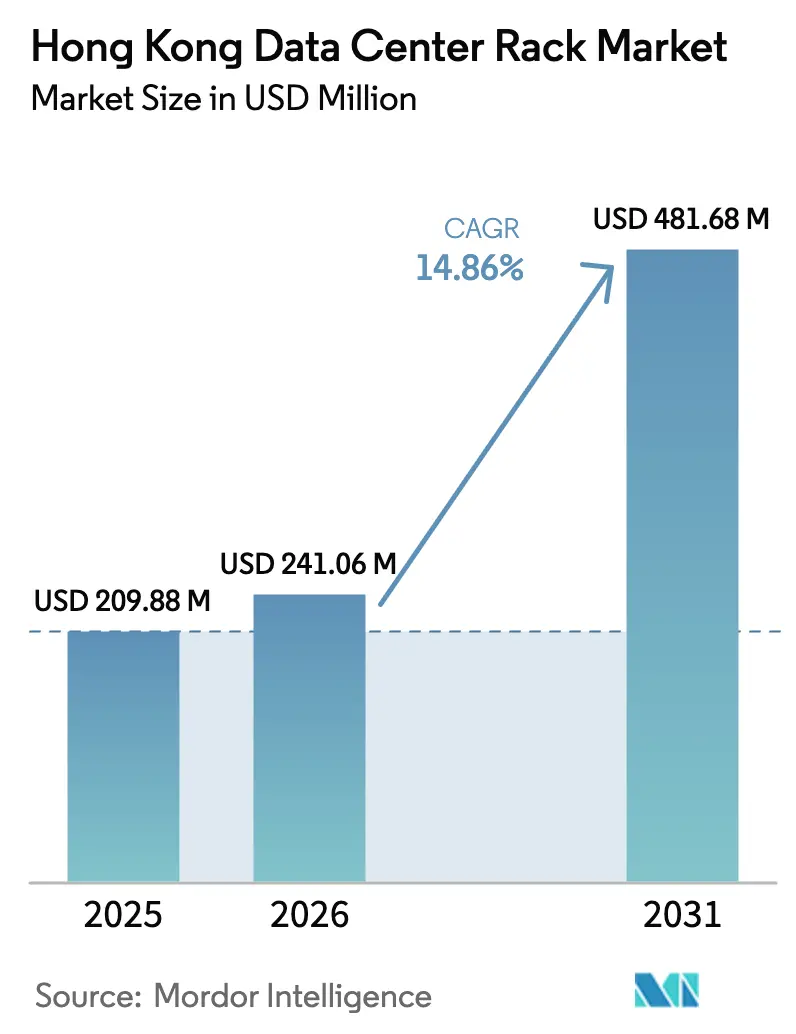
The Hong Kong data center rack market size was valued at USD 209.88 million in 2025 and estimated to grow from USD 241.06 million in 2026 to reach USD 481.68 million by 2031, at a CAGR of 14.86% during the forecast period (2026-2031). Surging hyperscale investment, accelerated 5G deployment, and policy incentives under Smart City 2.0 are converging to raise rack densities, promote taller form factors, and favor liquid-ready designs that support AI workloads. Demand is further boosted by the territory’s 2.6-minute average annual power-outage record, which reassures operators that high-density deployments can run with limited interruption. A sizeable share of capital is flowing toward cabinet systems that deliver both environmental control and tamper resistance, critical in Hong Kong’s humid subtropical climate and tightly regulated financial sector. Meanwhile, the Hong Kong data center rack market is seeing a steady shift from steel to aluminum as ESG-oriented buyers prioritize recyclability and embodied-carbon reductions.
Key Report Takeaways
- By rack size, full racks led with 65.10% of the Hong Kong data center rack market share in 2025 while growing at 16.85% CAGR through 2031.
- By rack height, 42U held 50.45% of the Hong Kong data center rack market size in 2025, whereas 48U is poised for the fastest 15.72% CAGR to 2031.
- By rack type, cabinets accounted for 71.65% revenue share and are advancing at 14.98% CAGR on stronger security and airflow management needs.
- By data-center type, colocation facilities commanded 55.10% share in 2025, but hyperscale sites will outpace the overall Hong Kong data center rack market with a 15.18% CAGR to 2031.
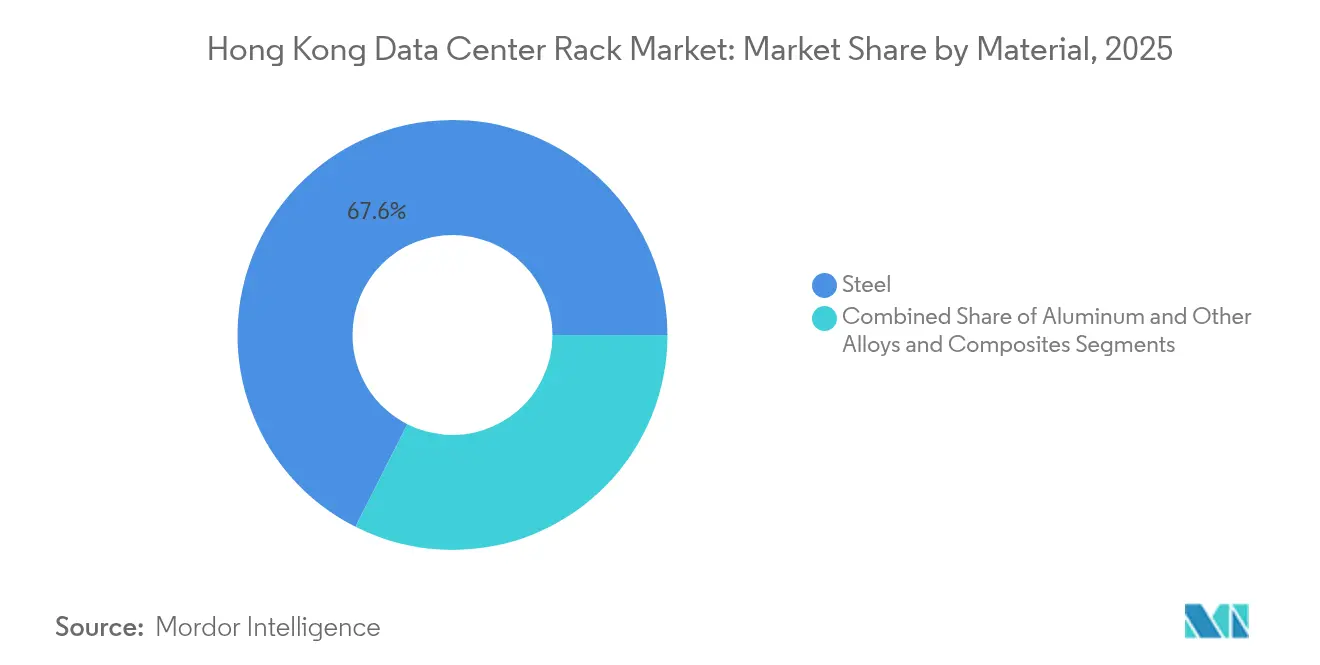
- By material, steel retained 67.55% share in 2025; aluminum will expand the Hong Kong data center rack market size for sustainable racks at a 16.05% CAGR.
Note: Market size and forecast figures in this report are generated using Mordor Intelligence’s proprietary estimation framework, updated with the latest available data and insights as of 2026.
Hong Kong Data Center Rack Market Trends and Insights
Drivers Impact Analysis*
| Driver | (~)% Impact on CAGR Forecast | Geographic Relevance | Impact Timeline |
|---|---|---|---|
| 5G rollout and explosive IoT traffic | +3.2% | Hong Kong territory-wide, spillover to Greater Bay Area | Medium term (2-4 years) |
| Fiber backhaul densification across the territory | +2.8% | Hong Kong core districts, extending to New Territories | Short term (≤ 2 years) |
| Surge in hyperscale and cloud colocation build-outs | +4.1% | Tseung Kwan O, Sha Tin industrial zones | Medium term (2-4 years) |
| Smart-City 2.0 digital-infrastructure incentives | +2.3% | Hong Kong government-designated areas | Long term (≥ 4 years) |
| Adoption of liquid/immersion-ready high-density racks | +1.9% | Hyperscale facilities, enterprise edge deployments | Medium term (2-4 years) |
| ESG push for recyclable modular aluminium racks | +1.2% | Global multinational enterprises, local government facilities | Long term (≥ 4 years) |
| Source: Mordor Intelligence | |||
5G Rollout and Explosive IoT Traffic
Territory-wide 5G coverage has surpassed 90%, forcing operators to shift compute resources from centralized halls to distributed edge nodes that demand hybrid racks capable of housing both IT and radio equipment.[1]HKT, “5G Coverage Reaches 90% of the Population,” hkt.com HKBN’s adoption of 25 Gbit/s PON fiber accentuates the need for racks that can deliver high-density power, optimized cable management, and field-swappable optics within a single enclosure. As Smart City 2.0 pilots add thousands of lamppost sensors, micro stations, and AI cameras, rack suppliers must support short-depth devices and outdoor IP-rated cabinets on rooftops and street furniture. High bandwidth, low latency, and small-footprint demands together pull the Hong Kong data center rack market toward multifunctional, compact designs.
Fiber Backhaul Densification Across the Territory
Hong Kong’s nine international cable systems funnel traffic through carrier-neutral sites like MEGA-i, where each suite may terminate 900–1,200 fiber pairs.[2]iAdvantage, “MEGA-i Carrier-Neutral Connectivity Factsheet,” iadvantage.netSuch densities require racks that integrate structured fiber trays, rollable-ribbon managers, and front-access MPO modules that speed Moves-Adds-Changes. The USD 500 million E-MEA cable further cements the territory’s role as Asia’s gateway and drives additional landing-station expansions that lift specialized rack demand. As these cross-connect hubs proliferate in Kowloon and Sha Tin, the Hong Kong data center rack market pursues corrosion-resistant alloys and quick-release panels that simplify optical maintenance within tight spaces.
Surge in Hyperscale and Cloud-Colocation Build-outs
Hyperscale tenants now design for 40 kW-plus per rack loads, accelerating the shift to liquid-capable enclosures and 48U heights that optimize cubic utilization. Global Switch’s adoption of direct liquid cooling highlights the need for structural rigidity that can handle coolant manifolds and high-mass cold plates while still meeting Hong Kong’s seismic code. BDx’s financing round confirms investors’ willingness to back new hall expansions even as land scarcity intensifies. These specifications compel vendors to ship pre-verified rack-power-cooling bundles, driving the Hong Kong data center rack market toward integrated, scalable platforms.
Smart City 2.0 Digital-Infrastructure Incentives
The HKD700 million (USD 89.17 million) state budget for Smart City 2.0 earmarks funds for “smart lamppost” nodes, mobile edge pods, and cyber-secure data hubs, all needing hardened, compact racks . Back-end processing for the iAM Smart digital-ID platform further elevates requirements for trusted-platform modules, tamper logs, and dual-factor rack locks. Suppliers that align with these public-sector standards benefit from predictable procurement cycles and city-wide visibility, deepening the Hong Kong data center rack market penetration over the long term.
Restraints Impact Analysis*
| Restraint | (~)% Impact on CAGR Forecast | Geographic Relevance | Impact Timeline |
|---|---|---|---|
| Escalating ransomware & cyber-extortion incidents | -2.1% | Global impact with Hong Kong financial sector concentration | Short term (≤ 2 years) |
| Land-and-power scarcity for new data-centre halls | -3.4% | Hong Kong territory-wide, acute in core districts | Medium term (2-4 years) |
| Export-control delays for advanced metal alloys | -1.8% | China-Hong Kong trade corridor, global supply chains | Medium term (2-4 years) |
| Skilled precision-fabrication labour deficit | -1.3% | Hong Kong manufacturing sector, regional spillover | Long term (≥ 4 years) |
| Source: Mordor Intelligence | |||
Escalating Ransomware and Cyber-Extortion Incidents
Fifty-nine percent of local enterprises reported a ransomware event in 2024, prompting CFOs to reallocate budgets from expansion to resilience upgrades. The USD 75 million DarkAngels payout underscored the financial stakes facing regulated banks that anchor many Hong Kong colocation room.[3]ISACA, “Ransomware Trends and Record Payouts,” isaca.orgAs boards demand real-time physical-cyber convergence, rack manufacturers must embed intrusion sensors, smart locks, and logging firmware, raising bill-of-materials costs and slowing order volumes for conventional SKUs in the Hong Kong data center rack market.
*Our forecasts treat driver/restraint impacts as directional, not additive. The impact forecasts reflect baseline growth, mix effects, and variable interactions.
Segment Analysis
By Rack Size: Full Racks Drive Standardization
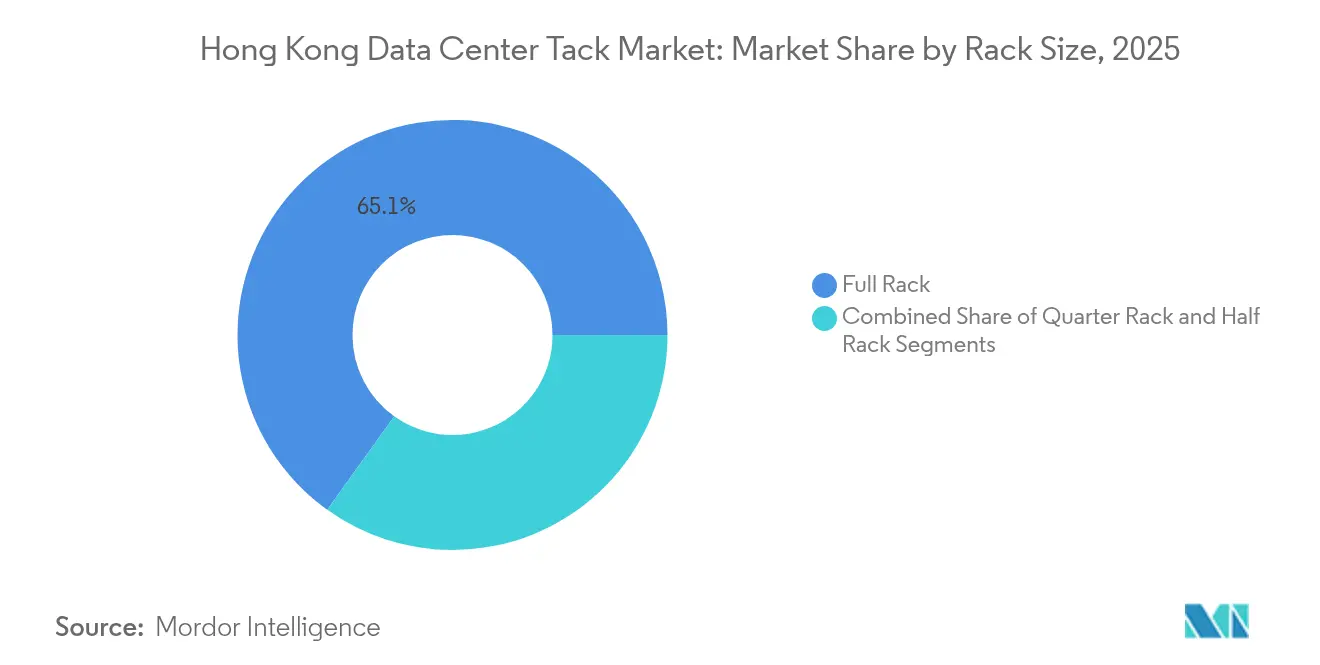
Full racks seized 65.10% of the Hong Kong data center rack market share in 2025 and will grow at 16.85% CAGR as hyperscale entrants impose uniform 42U and 48U blocks that streamline automation and spares logistics. This preference accelerates the adoption of cartridge-ready power shelves and top-of-rack coolant manifolds that can be factory-tested before roll-in. Quarter racks still support Smart City sensor hubs and pop-up 5G micro sites, but their unit economics limit uptake beyond edge niches. Half racks remain a middle-ground choice for SMEs needing colocation presence without over-allocating capital.
Liquid cooling is an additional catalyst for full-rack dominance. Supermicro’s rack-scale immersion kit reaches 100 kW per rack and depends on consistent width, depth, and height to optimize manifold routing. Standardized footprints simplify hot-aisle containment, door-based heat exchangers, and front-serviceable PDUs. Consequently, full racks will continue to influence how builders provision floor tiles, cable trenches, and raised-floor airflow across the Hong Kong data center rack market.



By Rack Height: 48U Gains Ground Despite 42U Dominance
The 42U format controlled 50.45% of the Hong Kong data center rack market size in 2025, reflecting its historical ubiquity among enterprise applications. Yet 48U will expand at 15.72% CAGR as hyperscale firms chase vertical density, reducing white-space leasing costs per kilowatt. Taller frames allow additional bus-bar segments, side-car manifolds, and blanking-panel arrangements that improve airflow modeling.
LiquidStack’s DataTank 48U immersion chassis exemplifies how the extra elevation accommodates coolant expansion tanks and service cranes within a single bay. Operators gain more compute per tile while maintaining ergonomic service reach using lift-assist tools. As AI GPU clusters push rack weights past 1,500 kg, manufacturers reinforce 48U frames with higher-gauge steels or double-folded aluminum rails, which enhances competitiveness in the Hong Kong data center rack market.
By Rack Type: Cabinets Dominate Security-Conscious Market
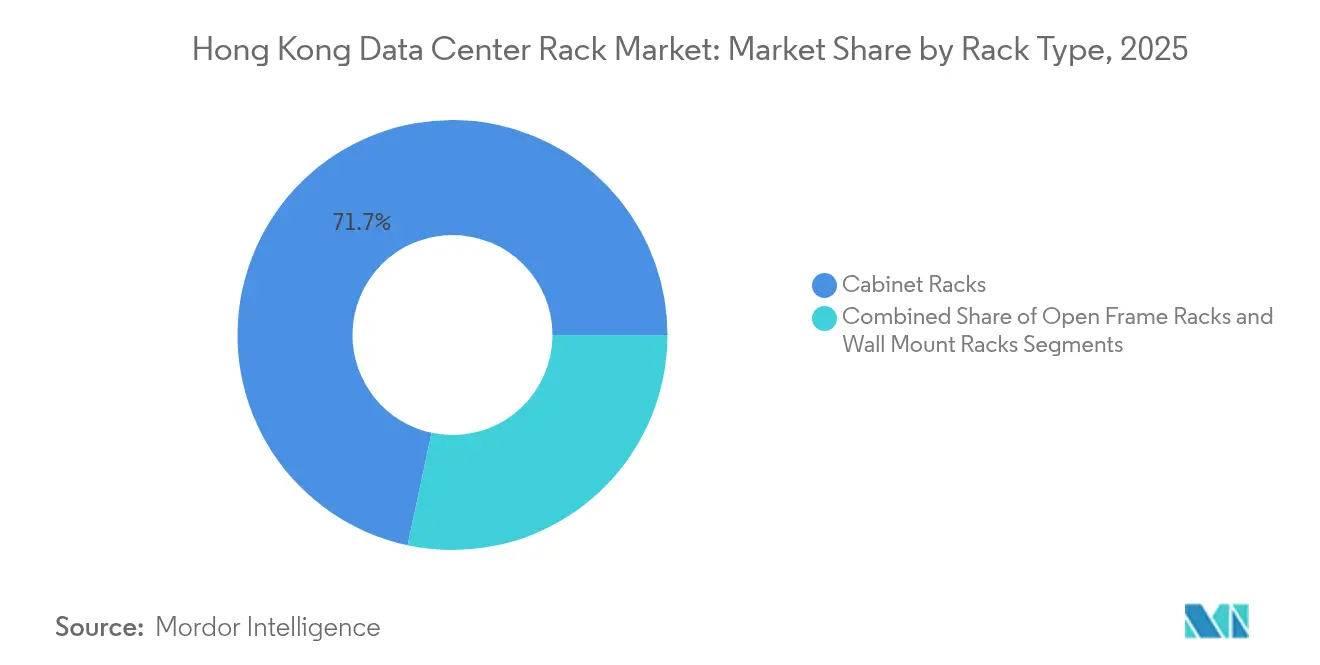
Cabinet-style enclosures captured 71.65% share in 2025 as Hong Kong’s finance-driven customer base demands side-panel locking, gasketed doors, and real-time access logs. Sealed cabinets also mitigate salt-air corrosion in waterfront facilities and control humidity swings during typhoon seasons. Open-frame racks persist inside hot-aisle containment pods where airflow efficiency outranks physical security, while wall-mount skews fulfill retail-branch or smart-building edge closets with shallow depth and limited load ratings.
Security anxiety following the 2024 ransomware surge pushes procurement toward intelligent cabinets with BLE badges and biometric handles. Vendors that supply these secure enclosures are expanding the Hong Kong data center rack market size through value-added software modules that integrate with SIEM dashboards. This convergence between physical and cyber monitoring has become a buying criterion in nearly every RFP issued by financial tenants during 2025.
By Data Center Type: Colocation Leads While Hyperscale Accelerates
Colocation halls retained 55.10% revenue share in 2025 because international carriers, OTTs, and fintech firms prize Hong Kong’s carrier neutrality and dense cross-connect ecosystem. Yet hyperscale growth will outpace the overall Hong Kong data center rack market at 15.18% CAGR as cloud majors replicate mainland availability zones on local soil to meet data-residency demands. Hybrid enterprises leverage the same halls for cloud on-ramps that sit meters away from private cages, a pattern that sustains cabinet sales even in hyperscale shells.
SUNeVision’s MEA Plus campus in Tseung Kwan O uses prefabricated steel frames that can swing between retail colo layouts and single-tenant mega-pods, enabling rapid mix-and-match leasing. Hyperscale appetite for taller racks and liquid loops forces colo landlords to retrofit chilled-water capacity and floor loading. As a result, rack vendors that can supply delivered-in-place systems ready for 45 kW racks secure larger contracts in the Hong Kong data center rack market.
By Material: Steel Dominates Despite Aluminum’s Sustainability Push
Steel held a 67.55% share in 2025 due to its lower cost and mature fabrication ecosystem in Guangdong factories that ship overnight into Hong Kong. Aluminum, however, will log 16.05% CAGR as ESG scorecards incorporate recycled content and embodied-carbon metrics into tender scoring. Lighter alloys reduce transportation CO₂ and ease manual handling in constrained goods lifts serving upper-floor server rooms.
Tate’s Grid LEC aisle, assembled with renewable-energy aluminum, cuts embodied carbon 55% without sacrificing stiffness. Clients pursuing LEED Platinum or BREAM Outstanding goals assign bonus weight to such innovations, lifting aluminum’s share of the Hong Kong data center rack market. Trade frictions on aerospace-grade alloys and export licensing, however, slow advanced alloy imports, compelling buyers to dual-source between domestic steel and international aluminum over the medium term.
Geography Analysis
Hong Kong’s compact geography concentrates more than 40 facilities within a 30 km radius, enabling cross-facility latency of under 1 ms and fostering a unique ecosystem where hyperscalers colocate with liquidity venues and FX gateways. Tseung Kwan O, the designated data-center corridor, clusters mega-campuses beside the territory’s first dedicated power substation, supporting multi-hundred-megawatt footprints that amplify demand in the Hong Kong data center rack market. Sha Tin hosts second-tier halls targeting mainland enterprise overflow, while Kowloon and Hong Kong Island maintain premium edge rooms serving banking, trading, and copyright-sensitive media.
Integration with the Greater Bay Area magnifies growth prospects. Cross-border fiber spines allow Shenzhen and Guangzhou manufacturers to back up mission-critical workloads in Hong Kong under dual-jurisdiction compliance.. Nevertheless, geopolitical concerns around data inspection temper inbound investments from some Western cloud studios, prompting sovereign-edge deployments in Hong Kong for customer PII while pushing less-sensitive archives to Singapore.
Regulatory Landscape
Data center rack deployment in Hong Kong is shaped by a multi-agency approval pathway that covers planning permissions, lease modifications, and building plan approvals, with the Planning Department, Lands Department, and Buildings Department involved across the process. The Buildings Department also applies Practice Note APP-150 to enable converting redundant car parks into electrical and mechanical space for data center use, which supports retrofits when new-build options are constrained.
At the policy coordination level, the Digital Policy Office acts as a public-sector interface for digital infrastructure and data center facilitation services. In 2026, the government advanced land-use enablement for new digital infrastructure through the Sandy Ridge site rezoning for innovation and technology purposes and awarded a 50-year land grant to the successful tenderer, indicating an administratively supported pathway for large, high-tier capacity additions that drive demand for compliant, security-ready, high-density rack systems.
Competitive Landscape
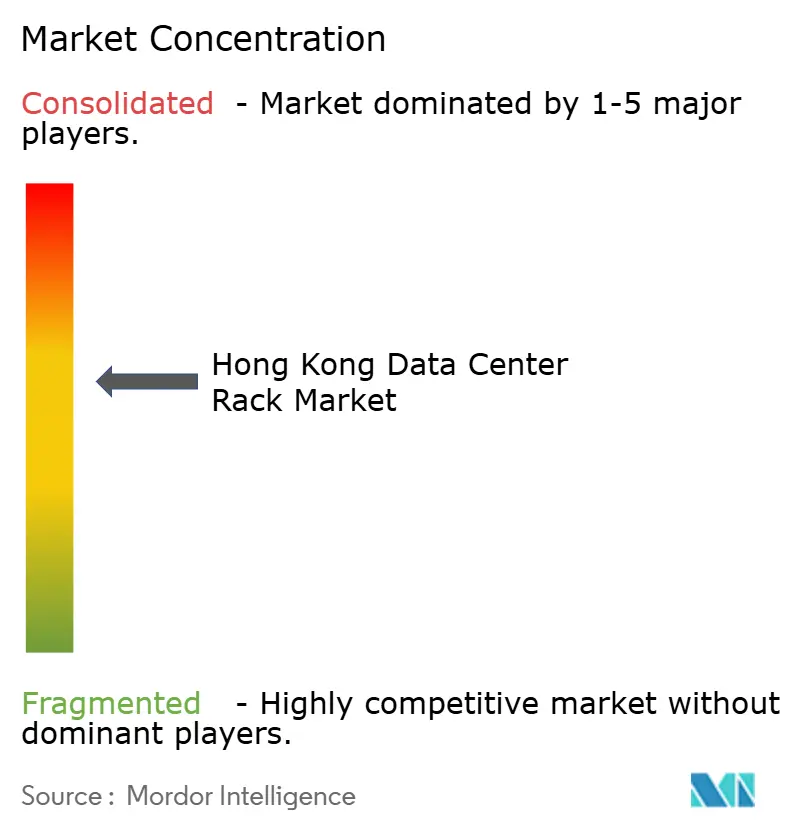
Moderate fragmentation defines the Hong Kong data center rack market. Global OEMs such as Vertiv, APC, and Rittal compete with regional specialists like Chatsworth Products and local sheet-metal fabricators that customize for typhoon-proof logistics constraints. Market leaders differentiate through holistic bundles that merge rack, busway, containment, and cooling distribution under a single warranty, reducing integration risk for hyperscalers. Start-ups meanwhile court edge deployments with IP-65-rated micro cabinets that can bolt to smart lampposts or shopping-mall rooftops.
Strategic partnerships have become the route to securing specification lock-in. Vertiv’s joint reference designs with NVIDIA incorporate rear-door heat exchangers certified for HGX H100 clusters, creating pull-through demand for its D-Series cabinets among AI tenants. Rittal collaborates with Stulz for ChillerTFM pods that couple rack shells with precision free-cooling coils, accelerating time-to-production in land-scarce plots where building heights are restricted. These alliances illustrate how rack vendors evolve into solution orchestrators rather than commodity sheet-metal suppliers, a trend shaping purchasing in the Hong Kong data center rack market.
Hong Kong Data Center Rack Industry Leaders
Eaton Corporation
Vertiv Group Corp.
Schneider Electric SE
Rittal GmbH & Co. KG
Delta Electronics Inc.
- *Disclaimer: Major Players sorted in no particular order

Market Opportunities and Future Outlook
A key near-term whitespace for rack vendors is tied to new land-enabled data center supply and the modernization of existing halls to accommodate AI-grade densities. The Sandy Ridge Data Facility Cluster awarded on March 2, 2026 includes 250,000 square meters of gross floor area, with around 90% intended for high-tier data centers, which creates room for large-volume rack outfitting and supports the move toward liquid-ready cabinets, higher floor-loading designs, and more integrated power and cable management for higher per-rack loads.
Opportunities also sit in AI and digital-government programs that raise demand for infrastructure that is secure, auditable, and resilient across both core data centers and distributed deployments. By early 2026, Hong Kong reached 5,000 petaFLOPS of aggregate computing power, while the Hong Kong Artificial Intelligence Research and Development Institute Company Limited is scheduled to begin operations in the second half of 2026 to support AI governance and commercialization. In parallel, the government allocation of HKD 100 million for adopting industrial AI technologies in digital government transformation supports procurement for trusted and tamper-resistant cabinet systems, including smart-locking and monitoring features aligned with security-sensitive workloads.
Recent Industry Developments
- July 2026: HKT announces AI Data Centre Inter-connect (DCI) Superhighway service linking Lok Ma Chau Loop and Tseung Kwan O using hollow core fibre. The AI-focused interconnect expands cross-border low-latency connectivity for Hong Kong AI workloads, shaping data-center traffic and capacity planning in the market.
- June 2026: Equinix launches AI-Ready Data Center with Direct Connectivity to Hong Kong-Shenzhen Innovation and Technology Park. The market gains AI-ready infrastructure readiness in Hong Kong, strengthening cross-border connectivity and influencing rack-density and cooling requirements for new facilities.
- June 2026: Equinix HK6 data center officially launched (3,550 cabinets, liquid cooling features). The capacity addition strengthens Hong Kong to support high-density AI deployments, impacting market dynamics and rack market demand.


Research Methodology Framework and Report Scope
Market Definition and Coverage
For this methodology, the market covers revenue earned from data center rack cabinets sold into Hong Kong, including standard and specialized racks used to house IT and network equipment across data center facilities.
Scope exclusions: We exclude IT hardware (servers, storage, switches), power and cooling equipment, and colocation services revenue, even if they are purchased as part of a wider data center build.
Segmentation Overview
- By Rack Size
- Quarter Rack
- Half Rack
- Full Rack
- By Rack Height
- 42U
- 45U
- 48U
- Other Heights (52U and Custom)
- By Rack Type
- Cabinet (Closed) Racks
- Open-Frame Racks
- Wall-Mount Racks
- By Data Center Type
- Colocation Facilities
- Hyperscale and Cloud Service Provider DCs
- Enterprise and Edge
- By Material
- Steel
- Aluminum
- Other Alloys and Composites
Data Sources, Market Sizing, and Validation
Desk Research
Desk research was used to map the local data center footprint and the demand signals that translate into rack procurement. We referred to public infrastructure and telecom signals, planning and land updates, and electricity availability cues, which can shift deployment plans in Hong Kong due to tight space and power constraints.
For grounding inputs, we used reputable public sources such as Hong Kong Census and Statistics Department releases, the Office of the Communications Authority (OFCA), Hong Kong government planning and land publications, ITU statistics, and trade data references like UN Comtrade. We also reviewed listed-company filings and investor presentations, reputable press, and association websites to cross-check facility additions, density shifts, and typical refresh cycles. Select paid subscriptions were used where needed for company financials, patent look-ups around rack designs, and shipment-level import/export reads linked to enclosure systems. This list is not exhaustive and many other sources were reviewed to collect, validate, and clarify data points.
Primary Interviews and Surveys
Primary work focused on confirming how racks are specified and bought in Hong Kong, and then translating that into realistic unit and price assumptions. We spoke with a mix of operators, integrators, and infrastructure suppliers, and then cross-checked assumptions using project-level perspectives from people closer to deployments and day-to-day operations. To reduce one-sided inputs, views were balanced across major buyer groups and across Asia-linked procurement flows that commonly support Hong Kong facilities.
Distribution of primary research fieldwork respondents
| Company type | Respondent position |
|---|---|
| Top tier: 39% | CXOs: 19% |
| Mid tier: 41% | Functional/Unit leaders: 38% |
| Smaller Players: 20% | Managers: 43% |
Market-Sizing & Forecasting
Sizing started from a top-down demand pool build that ties Hong Kong data center expansion to expected rack deployments, and then converts that into value using realistic price ladders by rack type and form factor. The model was subsequently checked using selective bottom-up approximations, including sampled supplier revenue splits, channel checks on order timing, and a simple ASP multiplied by estimated rack shipments to adjust totals when gaps showed up.
Key inputs used in the model include planned and commissioned data center capacity additions, rack density trends (including the move to higher kW racks), the mix shift between open frame and enclosed cabinets, preferred rack heights used in new halls, and material choices that affect pricing. Where inputs were not available at a clean annual level, we used conservative interpolation anchored to project milestones and procurement cycles, and then pressure-tested the outputs with interview feedback.
Forecasting relied on scenario analysis supported by a short multivariate regression layer, where demand was linked to facility additions and utilization trends, and pricing was linked to material cost direction and adoption of higher-spec racks. Assumptions were tightened when primary feedback indicated timing slippage, changes in density targets, or substitutions between rack categories.
Data Validation & Update Cycle
Outputs were triangulated across independent checks, so the market total aligns with multiple signals rather than a single series. We ran variance checks by year, by rack category, and by implied units, and any outliers were reviewed in a second analyst pass before sign-off.
When model results moved beyond reasonable ranges, we re-checked definitions, re-contacted selected experts, and re-tested price and volume drivers until the step-by-step logic held. Reports refresh annually, with interim updates when material events occur, such as large campus announcements, power allocation changes, or sudden shifts in procurement lead times. Before delivery, an analyst performs a fresh pass so clients receive the latest updated view.
Mordor Intelligence's Hong Kong Data Center Rack Market Size Measured Against Other Published Estimates
Published estimates for Hong Kong data center racks often differ because sources do not always count the same revenue pool, and because timing assumptions around project delivery can vary by a full year. Differences also show up when pricing is treated as a flat average instead of being adjusted for rack height, enclosure level, and higher-density readiness.
Some external estimates are built from a broader data center spending view that can quietly blend racks with adjacent infrastructure purchases, and then a single blended ratio is applied to reach a rack number. Mordor Intelligence counts only rack cabinet revenue in Hong Kong, and totals are kept tied to facility expansion signals and rack-density assumptions that are validated through interviews and cross-checks.
Benchmark comparison
| Source | Market Size | Gaps in Research Methodology |
|---|---|---|
| Mordor Intelligence | USD 209.88 M (2025) | |
| Regional Consultancy A | USD 312.50 M (2026) | Uses a broader infrastructure spend lens and converts to racks using an assumed share, which can over-include items like containment and non-rack enclosures, and it also shifts the base year to a later capex cycle. |
| Trade Journal B | USD 180.00 M (2025) | Leans on a conservative shipment view that can miss project-driven bulk orders and higher-spec cabinet pricing, and it often applies a narrow price band that undercounts premium enclosed and high-density-ready configurations. |
Taken together, the spread is mainly explained by how tightly the definition is held to rack cabinet revenue, and by how clearly project timing and pricing ladders are treated. By keeping the build logic traceable to capacity additions, density shifts, and realistic ASP progression, the final number stays repeatable and easier to audit across years.


Key Questions Answered in the Report
What is the current size of the Hong Kong data center rack market?
The Hong Kong data center rack market stands at USD 241.06 million in 2026 and is projected to reach USD 481.68 million by 2031.
Which rack size segment leads the Hong Kong data center rack market?
Full racks lead with 65.10% share in 2025 due to hyperscale standardization and are growing at 16.85% CAGR.
How does land scarcity affect rack deployment in Hong Kong?
Limited greenfield plots delay new halls, pushing operators to deploy higher-density racks within existing sites and slightly dampening near-term growth.
Why are aluminum racks gaining traction?
Aluminum offers recyclability and lower embodied carbon, aligning with ESG mandates and expanding at a 16.05% CAGR through 2031 despite steel’s current dominance.
Page last updated on:
- Africa Data Center Rack Market
- Australia Data Center Rack Market
- Belgium Data Center Rack Market
- Brazil Data Center Rack Market
- Canada Data Center Rack Market
- Chile Data Center Rack Market
- China Data Center Rack Market
- Data Center Rack Market
- Denmark Data Center Rack Market
- Europe Data Center Rack Market
- France Data Center Rack Market
- Artificial Intelligence (AI) Data Center Market AI facilities across the global market, covering facility type, component and tier.
- Data Center Construction Market Construction across all regions, split by tier, facility size and facility type.
- Data Center Server Market Servers across all regions, split by tier, facility size and facility type.





