
Market Overview
| Study Period | 2020 - 2031 |
|---|---|
| Forecast Data Period | 2026 - 2031 |
| Base Year Market Size (2025) | USD 6.12 Billion |
| Market Size (2026) | USD 6.37 Billion |
| Market Size (2031) | USD 7.78 Billion |
| Growth Rate (2026 - 2031) | 4.07 % |
| Market Concentration | Medium |
Major Players *Disclaimer: Major Players sorted in no particular order Image © Mordor Intelligence. Reuse requires attribution under CC BY 4.0. | |
North America Thermoplastics Market Analysis by Mordor Intelligence
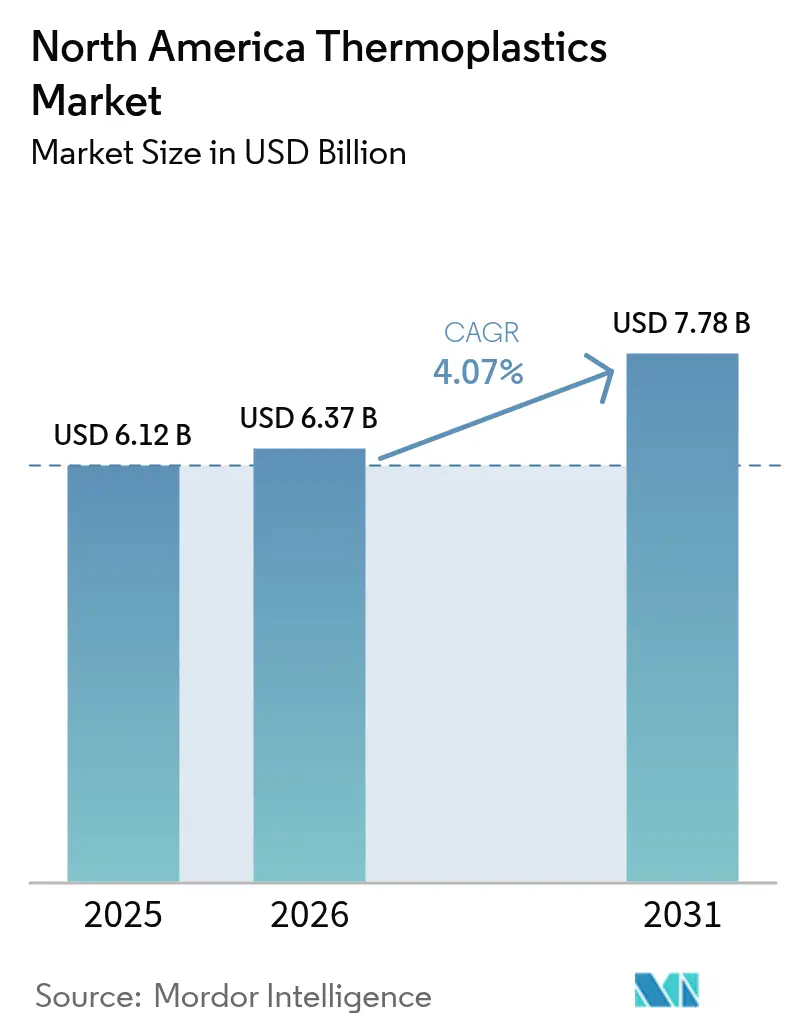
North America thermoplastics market size in 2026 is estimated at USD 6.37 billion, growing from 2025 value of USD 6.12 billion with 2031 projections showing USD 7.78 billion, growing at 4.07% CAGR over 2026-2031. Momentum is steady, yet structural forces are reshaping supply chains. Passenger-vehicle electrification is driving the use of engineered resins in under-hood parts, state laws are mandating higher recycled content in packaging, and processors are relocating molding assets to Mexico to capitalize on tariff relief and lower labor costs. Producers with Gulf Coast crackers continue to monetize cost-advantaged ethane streams, while brand owners pursue chemically recycled feedstocks to meet circularity pledges. Capacity additions in high-performance polymers outpace those in commodity polymers, as aerospace and semiconductor customers specify materials that can withstand harsher thermal and dielectric demands. Competitive dynamics now favor vertically integrated suppliers that can lock in long-term offtake agreements and insulate margins from feedstock swings.
Key Report Takeaways
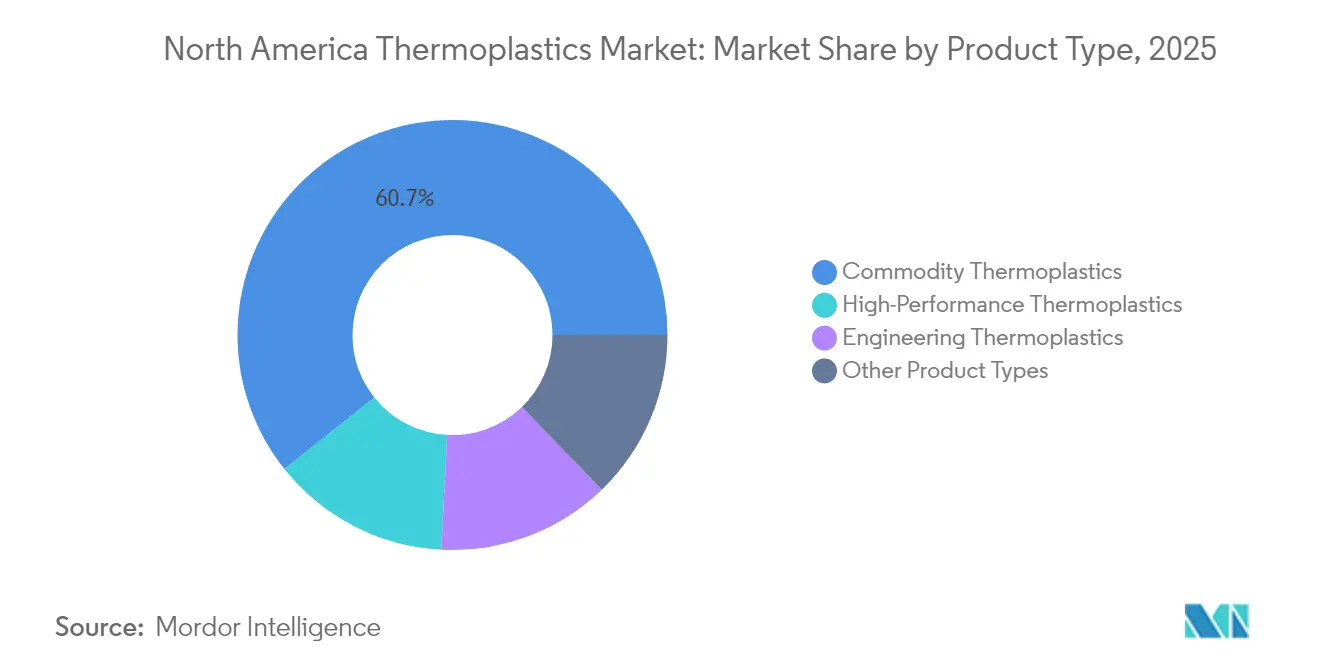
- By product type, commodity thermoplastics accounted for 60.72% of the North American thermoplastics market share in 2025. High-performance thermoplastics are advancing at a 5.96% CAGR through 2031.
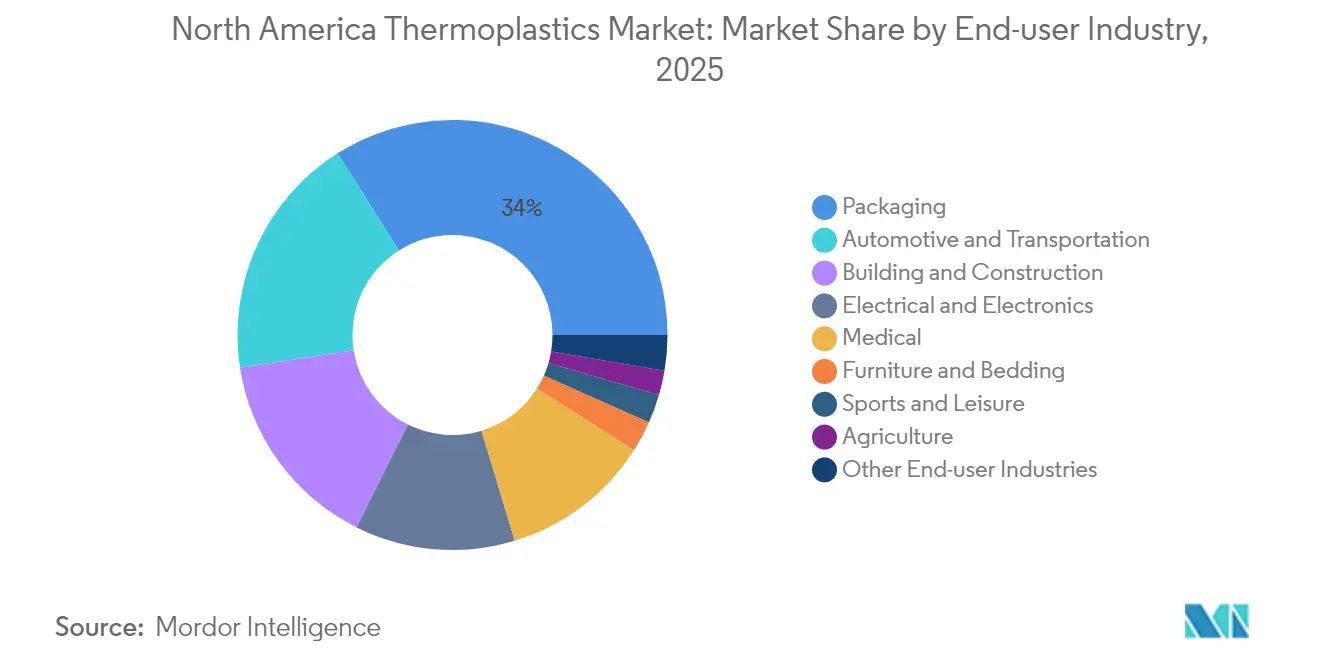
- By end-user industry, packaging captured 33.98% revenue in 2025; medical devices are set to expand at a 5.89% CAGR over the same horizon.
- By geography, the United States accounted for 71.86% of 2025 revenue and is expected to grow at a 5.57% CAGR through 2031.
Note: Market size and forecast figures in this report are generated using Mordor Intelligence’s proprietary estimation framework, updated with the latest available data and insights as of 2026.
Market Trends and Insights
Drivers Impact Analysis of North America Thermoplastics Market*
| Drivers | (~) % Impact on CAGR Forecast | Geographic Relevance | Impact Timeline |
|---|---|---|---|
| Surging demand for lightweight electric-vehicle components | +1.2% | United States and Canada, with spillover into Mexican assembly corridors | Medium term (2–4 years) |
| Mandatory post-consumer-recycled-content mandates | +0.9% | United States, led by California, Oregon, Colorado, and Maine | Short term (≤ 2 years) |
| Re-shoring of plastics conversion capacity to Mexico | +0.7% | Mexico plants supplying regional automotive and consumer-goods chains | Medium term (2–4 years) |
| Chemical-recycling investments securing circular feedstock | +0.6% | U.S. Gulf Coast with early pilots in Canada | Long term (≥ 4 years) |
| AI-enabled process control cutting scrap rates | +0.4% | Major molding clusters across the United States, Canada, and Mexico | Short to medium term (≤ 4 years) |
| Source: Mordor Intelligence | |||
Surging Demand for Lightweight Electric Vehicle Components
Battery-electric platforms require 10–15% curb-weight reductions to extend the single-charge range beyond 300 miles. Polyamide 6.6 and polyphthalamide are now replacing aluminum in brackets, battery housings, and thermal management parts because these resins can endure continuous service at 150 °C while delivering a 40% mass savings[1]. SABIC’s long-fiber polypropylene composite underpins General Motors’ Ultium battery tray, providing stiffness previously reserved for stamped steel. A 2024 SAE technical paper quantified that swapping 50 kg of metal for engineering plastics extends range by 8–12 km per charge. Automakers Ford and Stellantis now qualify resin grades during concept design, accelerating adoption and concentrating volume among suppliers with North American compounding lines.
Mandatory Post-Consumer-Recycled-Content Mandates Across U.S. States
California, Oregon, Colorado, and Maine enacted laws requiring all plastic packaging to meet specific recycling rates, effectively creating a nationwide floor because brand owners avoid SKU complexity. Berry Global budgeted USD 65 million in 2024 for optical-sorting upgrades that isolate multilayer films into food-grade polyethylene streams. Amcor pledged to reach 30% recycled content across its North American flexible packaging by 2025, requiring annual intake of 120,000 t of certified PCR resin. PCR polyethylene still commands USD 200–400 per-ton premiums over virgin resin, a delta that narrows only when Brent crude exceeds USD 90 bbl.
Re-shoring of Plastics Conversion Capacity to Mexico
The USMCA grants tariff-free status to molded parts that meet 75% regional-content rules, and hourly wages near USD 4.50 in Guanajuato and Nuevo León entice Tier 1 suppliers to relocate their injection-molding cells. Flex-N-Gate, Magna, and Lear now place presses within 50 km of final-assembly plants, slashing delivery lead times to 48 hours. Mexican output already accounts for a growing share of U.S. automotive components as OEMs electrify their pickup and SUV lines, driving demand for engineering thermoplastics over commodity resins.
Chemical-Recycling Investments Securing Circular Feedstock
Eastman doubled its Longview, Texas, polyester-from-waste capacity to 200,000 tons per year with a USD 375 million investment in 2024. Brightmark is constructing a USD 950 million renewable plant in Thomaston, Georgia, to process 400,000 tons per year of PE and PP into synthetic crude for monomer recovery. Cyclyx opened a USD 135 million feedstock aggregation hub in Fort Worth, Texas, partnering with ExxonMobil to channel contaminated plastics into advanced recyclers. Brand owners Procter & Gamble and Unilever signed multi-year take-or-pay contracts for chemically recycled polyethylene, insulating sustainability budgets from the volatility of virgin resin.
Restraints Impact Analysis of North America Thermoplastics Market*
| Restraints | (~) % Impact on CAGR Forecast | Geographic Relevance | Impact Timeline |
|---|---|---|---|
| Volatile ethane and naphtha feedstock prices | -0.8% | United States Gulf Coast and Alberta crackers | Short term (≤ 2 years) |
| Escalating extended-producer-responsibility fees | -0.5% | U.S. states with active EPR statutes | Medium term (2–4 years) |
| Skilled-labor shortages in high-precision molding | -0.6% | High-precision molding clusters in the United States and Mexico | Medium term (2–4 years) |
| Source: Mordor Intelligence | |||
Volatile Ethane and Naphtha Feedstock Prices
Ethane at Mont Belvieu fluctuated between USD 0.18 and USD 0.32 per gallon in 2024 due to shifts in associated-gas supply[2]. Naphtha-tracked crude prices rose, squeezing margins for merchant crackers in Canada that rely on external feedstocks. Integrated giants Dow, Chevron Phillips, and ExxonMobil sheltered spreads with captive ethane. Volatility drives converters to quarterly rather than annual resin contracts, transferring risk downstream and deterring greenfield cracker commitments that need 15-year paybacks.
Escalating Extended-Producer-Responsibility Fees
Oregon’s Recycling Modernization Act adds an estimated USD 80 million in annual compliance costs that are funnel into producer-responsibility organizations. Some converters absorb these levies to maintain shelf pricing, while others shift to mono-material structures that raise recyclability scores but compromise barrier performance. Scale players such as Amcor and Berry Global amortize fees across national networks, widening the cost gap with mid-tier processors.
*Our forecasts treat driver/restraint impacts as directional, not additive. The impact forecasts reflect baseline growth, mix effects, and variable interactions.
North America Thermoplastics Market Segment Analysis
By Product Type:
High-Performance Polymers Outpace Commodity VolumeCommodity-grade thermoplastics held 60.72 % of the North America thermoplastics market share in 2025. Polyethylene dominates due to its broad film and pipe applications, while polypropylene grows in automotive interiors and hygiene non-wovens because of a 10% density edge that reduces weight. Polyvinyl chloride remains entrenched in building pipe, though scrutiny over chlorine chemistries prompts some municipalities to favor polyethylene. Polystyrene faces bans on single-use packaging, dampening demand.
Engineering polymers fill the middle tier, serving under-hood parts, connectors, and appliance housings. They fetch 30–50% premiums over commodity grades thanks to improved heat and impact resistance. High-performance thermoplastics are the fastest risers, with a 5.96% CAGR, driven by the aerospace, semiconductor, and medical segments. Polyether ether ketone, liquid-crystal polymer, and polyimide withstand continuous service temperatures of≥200 °C and maintain dimensional precision under cycling loads. Producers with regional compounding lines secure faster adoption because OEMs insist on local supply continuity.

By End-User Industry:
Medical Devices Accelerate as Packaging MaturesPackaging accounted for 33.98% of the 2025 demand. Flexible snack-film and stand-up pouches represent the bulk, while rigid bottles and e-commerce cushioning round out the category. Legislative PCR targets are prompting converters to retrofit their lines for higher recycled content, marginally tempering the growth of virgin resin.
Medical devices are projected to expand at a rate of 5.89% annually through 2031. Single-use surgical tools, drug-delivery systems, and implantable polyamides that meet ISO 10993 biocompatibility standards underpin the rise. Specialized molders with FDA-registered cleanrooms capture disproportionate value, sustaining double-digit operating margins. The automotive industry accounts for a sizable volume, as battery enclosures, body panels, and interior trim trade metal for plastics to meet corporate average fuel economy targets. Electrical and electronics remain a steady buyer of UL 94-rated resins, with the rollout of 5G driving demand for liquid-crystal polymer in high-frequency connectors. Sports, furniture, agriculture, and niche industrial uses collectively contribute 9% of consumption, serving items ranging from synthetic turf to drip irrigation tubing.
Geography Analysis
United States Thermoplastics Market
The United States led with 71.86% of regional revenue in 2025 and is expected to post a 5.57% CAGR through 2031, driven by its Gulf Coast feedstock advantage and USD 1.2 billion of announced chemical-recycling projects. Dow’s Freeport cracker recently added 600,000 t yr of polyethylene capacity aimed at converters chasing PCR mandates. The EPA proposal to list certain PFAS-containing fluoropolymers under CERCLA introduces regulatory headwinds for PTFE suppliers, prompting some aerospace OEMs to pre-qualify non-fluorinated alternatives. Packaging remains the largest domestic outlet, but medical devices are capturing incremental share as single-use instruments gain hospital acceptance.
Mexico and Canada Thermoplastics Market
Mexico is evolving into a molding hub, absorbing conversion work for the automotive, electronics, and consumer goods industries. USMCA guarantees duty-free status for compliant parts, and labor costs roughly one-third of U.S. levels, drawing investment to Guanajuato and Nuevo León. Flex-N-Gate and Magna co-locate presses adjacent to EV assembly lines, enabling just-in-sequence delivery and compressing inventory buffers. Engineering thermoplastics benefit the most as OEMs chase lightweighting gains across new electric platforms. Canada contributes a smaller portion yet retains strategic importance through integrated ethane-fed crackers in Alberta and an automotive corridor in Ontario. NOVA Chemicals supplies polyethylene to regional film and pipe extruders through two Alberta crackers. Ontario’s auto cluster integrates polypropylene-glass composites into electric-truck chassis; Magna trialed a tailgate that meets crash ratings while trimming 35% weight. A 2024 federal ban on certain single-use plastics redirects polyethylene and polystyrene toward industrial applications.
Value Chain Analysis
North America thermoplastics value chains begin with hydrocarbon feedstocks (ethane-advantaged U.S. Gulf Coast and Canada-linked naphtha streams), which flow through crackers and polymerization assets into commodity resins (PE, PP, PVC, PS) and into smaller-volume, higher-spec engineering and high-performance resins via compounding and formulation. Midstream activity is increasingly shaped by circular inputs, as advanced and mechanical recycling operators and feedstock aggregators supply certified recycled streams that brand owners and converters use to satisfy packaging recycled-content mandates, with cross-border movements of parts and secondary polymers supported by USMCA.
Downstream, resin producers sell to large converters and OEMs serving packaging, automotive, medical, and electrical and electronics end markets, and also via distributors to smaller processors. Mexico continues to absorb conversion work tied to regional automotive assembly corridors. Recent network changes illustrate both specialization and consolidation. Röhm reached full industrial-scale operation at its Bay City, Texas, methyl methacrylate facility using LiMA technology, adding regional monomer supply for PMMA chains, while INEOS Styrolution announced the permanent closure of its Channahon, Illinois, polystyrene site by Q4 2026, concentrating PS supply into fewer plants and increasing the importance of logistics, inventory hubs, and qualified alternative materials for buyers.
Competitive Landscape
The North America thermoplastics market is moderately fragmented. The top five producers, including LyondellBasell and Dow, command significant polyolefin capacity, while the engineering and high-performance segments remain fractured across 15–20 specialty suppliers. Integrated majors exploit captive ethane and propylene streams to undercut merchant crackers during price spikes, as evidenced by ethane surpassing USD 0.30/gal in Q2 2024. Specialty players embed design-engineering teams inside OEM centers, locking in resin grades before tooling and securing margin insulation. Smaller innovators enter joint ventures with brand owners to secure feedstock and bypass commodity sales. Their closed-loop agreements sidestep traditional distributors and may pressure spot-resin liquidity over time.
North America Thermoplastics Industry Leaders
-
Dow
-
LyondellBasell
-
Exxon Mobil Corporation
-
BASF
-
INEOS
- *Disclaimer: Major Players sorted in no particular order

North America Thermoplastics Market Companies Covered in this Report
- 3M
- Arkema
- Asahi Kasei Corporation
- BASF
- Celanese Corporation
- Chevron Phillips Chemical Company
- Covestro AG
- Dow
- DSM
- DuPont
- Eastman Chemical Company
- Evonik Industries AG
- Exxon Mobil Corporation
- INEOS
- LANXESS
- LG Chem
- LyondellBasell
- Mitsubishi Engineering-Plastics Corporation
- Polyplastics Co.
- Röchling
- SABIC
- Solvay
- TEIJIN LIMITED
Market Opportunities and Future Outlook
Circular polymers and compliant packaging structures remain a primary whitespace for thermoplastics suppliers and converters as extended producer responsibility and recycled-content programs move from legislation to implementation. A near-term demand signal is California SB 54, where Circular Action Alliance filed the program plan in June 2026 and opened public comment through mid-August 2026. This is pushing packaging value chains toward documented PCR sourcing, mass-balance claims management, and tighter quality specifications. ExxonMobil commissioning its third advanced recycling unit at Baytown, Texas (February 2026) expands circular feedstock at industrial scale, which supports brand owners that are shifting from spot purchases to contracted volumes for certified circular PE and PP.
On the supply side, opportunities are increasingly tied to targeted capacity and localization moves rather than broad commodity expansions. Mitsubishi Chemical announced an expansion of its engineering plastics production footprint in Pennsylvania (July 2026), aligning with OEM preference for locally compounded and qualified materials in automotive, electrical and electronics, and medical applications, where change control and lead times matter. In commodities and vinyl chains, Shintech Louisiana announced a multi-billion-dollar complex expansion in Iberville Parish (March 2026), reinforcing the role of integrated regional assets in securing monomer and resin availability for construction and packaging. Processors upgrading extrusion capacity, such as LDPE film-focused lines, also create room for specialty grades that can run recycled content with fewer performance tradeoffs.
Recent Industry Developments in North America Thermoplastics Market
- July 2026: Mitsubishi Chemical announced an expansion of its engineering plastics production capacity at its Pennsylvania facility. The company expects this to support shorter lead times and local qualification cycles for automotive, electrical and electronics, and other applications that rely on consistent compounded resin supply across North America.
- February 2026: ExxonMobil commissioned its third advanced plastics recycling unit at the Baytown, Texas, complex, raising the site’s annual plastic waste processing capacity to about 250 million pounds. The added throughput is intended to strengthen the availability of circular feedstocks used to make certified polymers for packaging and consumer goods, supporting brand owners pursuing recycled-content targets.
- February 2025: Dow committed USD 500 million to expand its Freeport, Texas, polyethylene complex by 300,000 t/yr and add an on-site line to recycle 50,000 t/yr of post-use film into food-contact resin. The investment links virgin PE capacity with circular resin output at one site, helping converters manage compliance needs while keeping supply anchored to the Gulf Coast.
North America Thermoplastics Market Report Scope and Research Methodology
Market Definition and Coverage
For this study, the market covers revenues generated from thermoplastic resins sold and used across North America, counted at the point where resin is supplied to converters and end users for processing into finished goods.
Scope exclusions: We exclude thermoset plastics and finished plastic products where the resin value cannot be separated in a consistent, repeatable way.
Segments Covered in This Report
- By Product Type
- Commodity Thermoplastics
- Polyethylene (PE)
- Polypropylene (PP)
- Polyvinyl Chloride (PVC)
- Polystyrene (PS)
- Engineering Thermoplastics
- Polyamide (PA)
- Polycarbonate (PC)
- Polymethyl Methacrylate (PMMA)
- Polyoxymethylene (POM)
- Polyethylene Terephthalate (PET)
- Polybutylene Terephthalate (PBT)
- Acrylonitrile-Butadiene-Styrene (ABS) / SAN
- High-Performance Thermoplastics
- Polyether Ether Ketone (PEEK)
- Liquid Crystal Polymer (LCP)
- Polytetrafluoroethylene (PTFE)
- Polyimide (PI)
- Other Product Types (PPE, PSU, PEI, PPS, ETFE, PFA, FEP, PBI)
- Commodity Thermoplastics
- By End-user Industry
- Packaging
- Building and Construction
- Automotive and Transportation
- Electrical and Electronics
- Sports and Leisure
- Furniture and Bedding
- Agriculture
- Medical
- Other End-user Industries
- Geography
- United States
- Canada
- Mexico
Data Sources, Market Sizing, and Validation
Desk Research
Desk research was used to set the market boundaries, build the historical context, and create sensible input ranges before any model math was finalized. We leaned on public and official sources such as the US Census Bureau, the US International Trade Commission trade data, the US Geological Survey, and Statistics Canada to understand production indicators, trade flows, and industrial activity tied to resin consumption.
To keep assumptions grounded, additional checks were taken from sources such as peer-reviewed polymer and materials journals, customs and tariff schedules, and industry and association publications that describe resin usage patterns and substitution trends. Company filings, investor presentations, and reputable press releases were also used to validate capacity additions, shutdowns, and pricing commentary, and then complemented with a paid subscription for company financials and an import and export shipment-level database where needed to confirm directional movements. These examples are not exhaustive, and many other sources were also reviewed for data collection, validation, and research clarification.
Primary Interviews and Surveys
Primary work focused on validating demand drivers and pricing logic through interviews and short surveys with resin producers, compounders, distributors, and large converting customers across packaging, construction, and automotive supply chains. We also used these discussions to test country-level splits across the United States, Canada, and Mexico, and to close gaps where public data does not separate resin family mixes cleanly.
Distribution of primary research fieldwork respondents
| Company type | Respondent position |
|---|---|
| Top tier: 30% | CXOs: 13% |
| Mid tier: 55% | Functional/Unit leaders: 40% |
| Smaller Players: 15% | Managers: 47% |
Market-Sizing & Forecasting
The core sizing approach is a top-down reconstruction where resin demand is built from North America end-use activity and trade signals, and then translated into value using observed price ranges. In practice, we start from country-level indicators and usage patterns, and then apply conversion factors that reflect how much thermoplastic resin is typically consumed per unit of output in key manufacturing streams.
To keep the totals realistic, the model is corroborated with selective bottom-up approximations such as sampled supplier revenue roll-ups, channel feedback on volumes, and ASP times volume checks for large resin families, which are then used to adjust outliers. Inputs that matter most include resin price movements by polymer family, apparent consumption signals (production plus imports minus exports), packaging and construction activity indicators, automotive output trends, and shifts in recycling content and substitution that can change virgin resin intensity.
For forecasting, scenario analysis was used so the outlook could reflect different paths for industrial production, construction spending, and resin pricing, followed by primary-expert confirmation on which scenario best matches expected operating conditions. Where bottom-up checks had missing company coverage, gaps were handled by applying conservative scaling factors based on known capacity, product mix, and distribution reach rather than assuming uniform shares.
Data Validation & Update Cycle
Validation is done through several layers of checks so the final number can be traced back to clear inputs. We compare model outputs against independent signals such as trade balances, announced capacity changes, and public price direction, and then investigate large variances before sign-off.
A second analyst review is used to challenge assumptions and re-check calculations, and experts are re-contacted when a data point materially changes the totals or the implied price or volume looks inconsistent. Reports are refreshed annually, with interim updates when major events occur, and a final pre-delivery review is completed so clients receive the most current view available at the time of purchase.
Mordor Intelligence's North America Thermoplastics Market Estimate Compared With Other Published Estimates
Published market sizes for North America thermoplastics can look far apart because the same term is often used for different scope boundaries and pricing bases. Differences also come from whether a number is built from resin-level demand signals, from finished product revenues, or from mixed plastics groupings that are not directly comparable.
By tracking resin-level apparent consumption signals and refreshing polymer family price bands each year, Mordor Intelligence keeps the value tied to a resin supply boundary instead of blending in finished plastic parts revenue, which can inflate totals. Gaps also show up when a study includes thermosets alongside thermoplastics, applies aggressive price escalation across the full period, or uses a different currency timing and base year that shifts the starting point.
Benchmark comparison
| Source | Market Size | Gaps in Research Methodology |
|---|---|---|
| Mordor Intelligence | USD 6.12 B (2025) | |
| Global Consultancy A | USD 54.96 B (2024) | This estimate appears to use a much broader value boundary that can include finished plastic goods or a wider plastics basket, plus a different base year, which makes it materially higher than a resin-supply-focused view. |
| Industry Association B | USD 6.37 B (2026) | The value is close but is presented for a different year, and small differences can come from using a single blended resin price assumption and less explicit separation of imports and exports in apparent consumption checks. |
The spread in the table is mainly explained by scope boundaries and year selection, and then amplified by how pricing is handled across resin families. When the market is kept at the resin supply level with clear trade and demand checks, the result is easier to reconcile and to update as new capacity, trade, and price signals emerge.
Key Questions Answered in the Report
What is the current revenue value for the North America thermoplastics market?
The North America thermoplastics market is estimated at USD 6.37 billion in 2026, a path to reach USD 7.78 billion by 2031.
Which product category is growing fastest?
High-performance thermoplastics are projected to lead with a 5.96% CAGR to 2031, driven by demand from aerospace, semiconductor, and medical customers.
How significant is the United States in regional consumption?
The country accounts for 71.86% of the revenue and is projected to grow at a rate of 5.57% through 2031.
What regulatory trend drives demand for recycled resin?
State laws, such as California’s SB 54, mandate a 30% PCR in plastic packaging by 2030, prompting converters to secure chemically or mechanically recycled feedstocks.
Which end-user industry shows the highest growth rate?
Medical devices are projected to post a 5.89% CAGR through 2031, driven by the adoption of single-use surgical tools and implantable thermoplastic components.
How are major producers responding to circularity goals?
Firms like Eastman, Dow, and ExxonMobil are adding molecular- and pyrolysis-recycling capacity and signing long-term offtake agreements with brand owners.