
Programming Language Training Market Size and Share
Market Overview
| Study Period | 2021 - 2031 |
|---|---|
| Market Size (2026) | USD 19.80 Billion |
| Market Size (2031) | USD 32.98 Billion |
| Growth Rate (2026 - 2031) | 10.74 % |
| Fastest Growing Market | Asia-Pacific |
| Largest Market | North America |
| Market Concentration | Medium |
Major Players *Disclaimer: Major Players sorted in no particular order Image © Mordor Intelligence. Reuse requires attribution under CC BY 4.0. | |
Programming Language Training Market Analysis by Mordor Intelligence
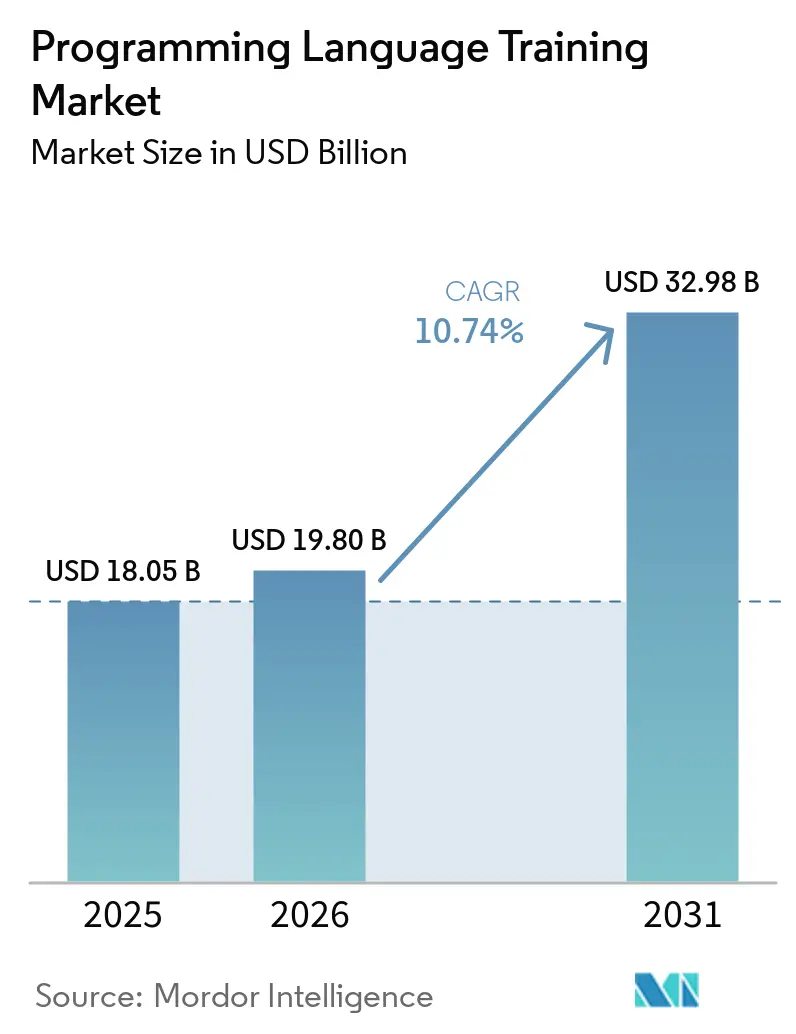
The Global Programming Language Training Market was valued at USD 18.05 billion in 2025 and estimated to grow from USD 19.80 billion in 2026 to reach USD 32.98 billion by 2031, at a CAGR of 10.74% during the forecast period (2026-2031). This growth is driven by the shift in technical education from a one-time credential purchase to a recurring business need. The Official Data Survey reported that 69% of developers spent the prior year learning new coding techniques or languages, integrating that learning into their daily work. In 2026, the Linux Foundation noted that 94% of organizations prioritized upskilling, with companies 3.5 times more likely to train existing talent than hire externally, sustaining enterprise demand[1]. Factors such as Python's role in AI, increased employer preference for certifications, and structured enterprise contracts are supporting market growth. However, rapid changes in language popularity require providers to update content frequently.
Key Report Takeaways
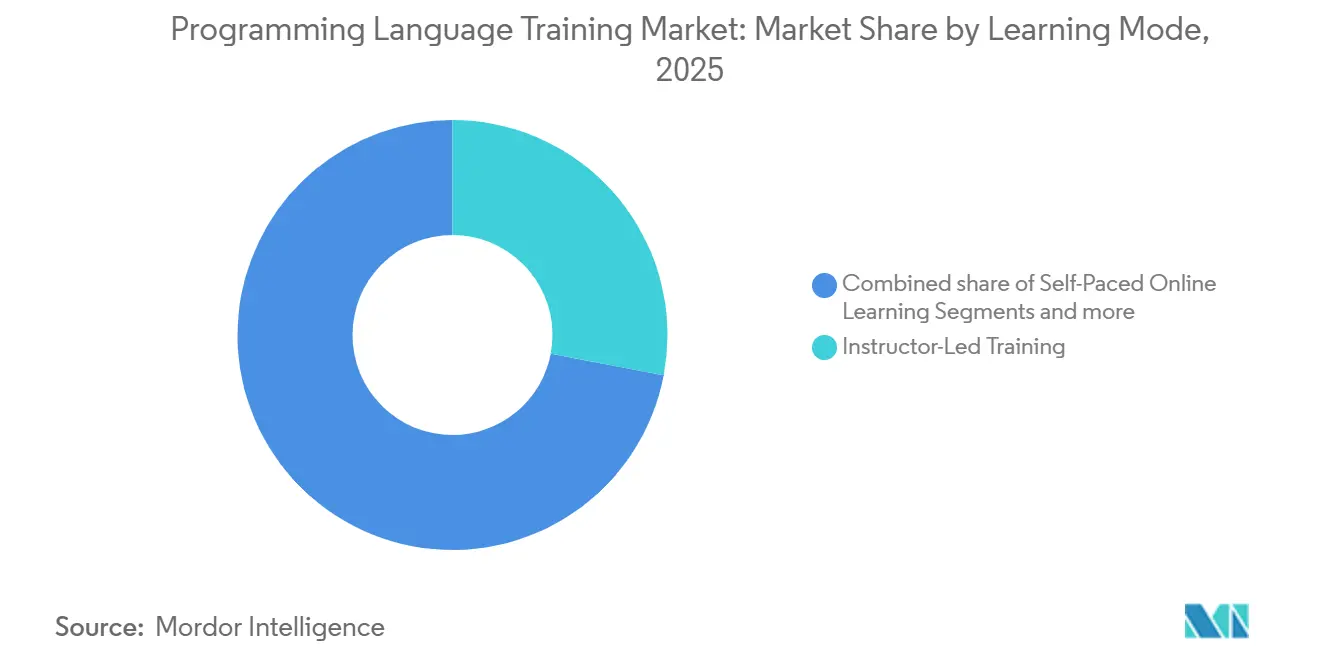
- By learning mode, Instructor-Led Training held 28.0% share of the Global Programming Language Training Market in 2025, while Corporate Training Programs are projected to record the highest CAGR at 15.50% by 2031.
- By programming language, Python accounted for 26.0% share of the Global Programming Language Training Market in 2025, while Data & Analytics Languages (SQL & R) are forecast to grow at the fastest CAGR of 14.30% by 2031.
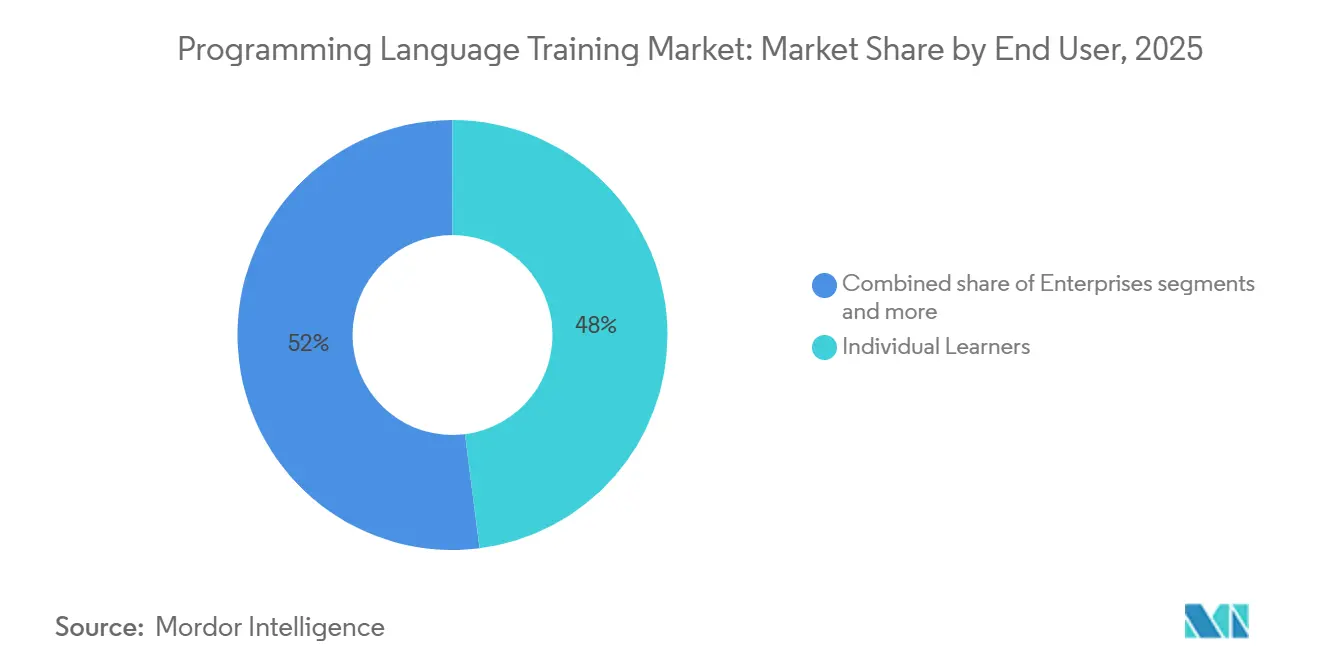
- By end user, Individual Learners held 48.0% share of the Global Programming Language Training Market in 2025, while Enterprises are expected to advance at the fastest CAGR of 14.90% by 2031.
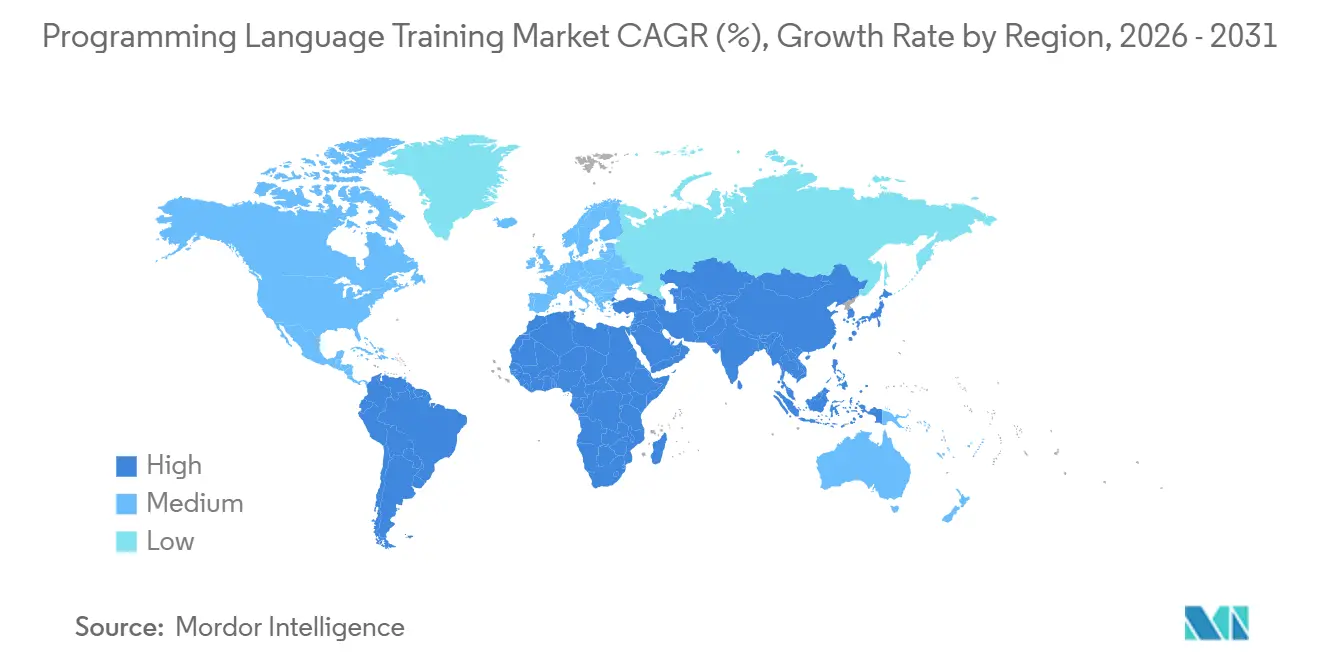
- By geography, North America held 35.0% share of the Global Programming Language Training Market in 2025, while Asia-Pacific is forecast to expand at the fastest CAGR of 15.20% by 2031.
Note: Market size and forecast figures in this report are generated using Mordor Intelligence’s proprietary estimation framework, updated with the latest available data and insights as of January 2026.
Global Programming Language Training Market Trends and Insights
Drivers Impact Analysis*
| Driver | (~) % Impact on CAGR Forecast | Geographic Relevance | Impact Timeline |
|---|---|---|---|
| Expansion of Enterprise Upskilling Budgets | +2.5% | Global, with a concentration in North America, Europe, and the Asia-Pacific core | Medium term (2-4 years) |
| Continuous Adoption of New Programming Frameworks and Libraries | +1.3% | Global, strongest in North America and Asia-Pacific developer ecosystems | Short term (≤ 2 years) |
| Rising Demand for Job-Ready Developer Certification Programs | +1.5% | Global, with early gains in India, Southeast Asia, and North America | Medium term (2-4 years) |
| Remote and Hybrid Learning Normalizing Self-Paced Technical Training | +1.1% | Global, with spillover to the Middle East, Africa, and South America | Short term (≤ 2 years) |
| Growing Adoption of Programming Skills Beyond Traditional IT Roles | +1.2% | Global, strongest in North America, Europe, and India | Medium term (2-4 years) |
| Increasing Cloud, Data, and AI Technology Adoption Across Enterprises | +2.0% | Global, led by North America, Europe, and Asia-Pacific core | Long term (≥ 4 years) |
| Source: Mordor Intelligence | |||
Expansion of Enterprise Upskilling Budgets
The global programming language training market benefits from steady support from enterprise learning budgets as technical training integrates into workforce planning. Organizations have increasingly emphasized upskilling, with many prioritizing internal talent development over external hiring. This shift positions structured training as a recurring investment rather than a one-time expense. Recurring contracts in this market are typically larger, easier to renew, and better aligned with measurable skill objectives. The adoption of remote and hybrid work models further accelerates this trend by enabling self-paced and blended technical learning across distributed teams, regardless of their location. Providers that align their courses with internal role frameworks and procurement standards are well-positioned to secure multi-team contracts in this evolving market.
Rising Demand for Job-Ready Developer Certification Programs
The global programming language training market is experiencing growing interest in certifications as employers seek clear evidence of technical skills. Reports indicate that professionals are increasingly pursuing additional certifications, with a notable rise in demand for AI-related credentials in recent years[2]. Research by the Linux Foundation highlights that hiring managers often prioritize certifications over formal university degrees when evaluating technical expertise. This trend reflects a shift in hiring practices, emphasizing practical, verifiable skills. In response, providers like O’Reilly have introduced credentials with auditability and skill mapping, covering areas such as Python, Power BI, Java, and Kubernetes. These advancements enhance the appeal of certifications by focusing on job-ready skills rather than traditional course completion badges. The market benefits from this shift, as credentials aligned with labor market needs attract employers, government programs, and learners seeking faster career recognition.
Growing Adoption of Programming Skills Beyond Traditional IT Roles
The global programming language training market is growing as programming and data skills become essential across a range of job functions, not just software teams. An official survey highlighted widespread adoption and learning of Python and SQL, reflecting the growing use of data querying and automation across diverse roles. DataCamp’s initiative to provide free AI and data training to one million teachers and students globally demonstrates efforts to expand demand beyond traditional developers[3]. This trend is reshaping the market, with teams in finance, operations, marketing, and product management increasingly relying on Python, SQL, and dashboard skills for daily tasks. India plays a crucial role in this transformation due to its large digital talent pool, certification-driven hiring practices, and rising enterprise demand for applied technical skills, which are driving programming education into broader segments of the workforce.
Increasing Cloud, Data, and AI Technology Adoption Across Enterprises
The global programming language training market is benefiting from the growing adoption of cloud, data, and AI technologies in enterprise operations. Research by the Linux Foundation indicated that organizations increasingly plan to integrate AI into their processes, with many expecting significant value in software development. Official data show that Python is a dominant language for new AI repositories, reflecting its importance in AI deployment and the resulting demand for training in programming and data tools. The continuous evolution of programming frameworks and libraries is driving the need for faster learning cycles, enabling developers to stay up to date with changing technologies. This trend is fueling market growth, attracting both new learners and professionals seeking to refresh their skills more frequently than in previous years.
Restraints Impact Analysis*
| Restraint | (~) % Impact on CAGR Forecast | Geographic Relevance | Impact Timeline |
|---|---|---|---|
| Rapid Obsolescence of Course Content | -1.2% | Global, most acute in North America and Asia-Pacific where language shifts are fastest | Short term (≤ 2 years) |
| High Learner Drop-Off in Long Form Technical Courses | -0.9% | Global, with stronger effect on individual learners across regions | Short term (≤ 2 years) |
| Price Sensitivity in Individual Learner and SME Segments | -0.8% | South America, Africa, the Middle East, and SME segments in Europe | Medium term (2-4 years) |
| Fragmented Quality and Credential Recognition Across Providers | -0.7% | Global, strongest in markets without clear accreditation frameworks | Long term (≥ 4 years) |
| Source: Mordor Intelligence | |||
Rapid Obsolescence of Course Content
The global programming language training market is under pressure as course materials become less relevant more quickly than before. Official data reported that TypeScript became the most-used language by monthly contributors in 2025, surpassing Python and JavaScript. Shell scripting also experienced significant growth in AI-generated repositories during the same period. These trends indicate that course libraries developed in one year may appear outdated by the next. Skillsoft’s 2026 release of its AI-driven Percipio Platform highlights the industry's focus on AI-assisted content updates, role mapping, and faster refresh cycles to meet evolving demands[4]. Smaller providers face greater challenges, needing to fund frequent updates while ensuring quality, accreditation, and learner trust remain intact.
High Learner Drop-Off in Long Form Technical Courses
The global programming language training market faces challenges, as lengthy technical courses often fail to retain learners until they achieve the desired skills. This issue is particularly evident in self-paced formats, where flexible access boosts enrollment but reduces accountability for many participants. Price sensitivity among individual learners and small businesses further complicates the situation. While lower-cost subscriptions attract sign-ups, they do not guarantee sustained engagement. Additionally, inconsistent quality and varying levels of credential recognition across providers hinder the market. Employers do not equally value all certificates, which diminishes the benefits of completing long courses for some learners. As a result, cohort-based models, instructor-led training, and enterprise-sponsored programs are gaining traction. These formats enhance structure, promote course completion discipline, and increase employer trust in the credentials earned.
*Our forecasts treat driver/restraint impacts as directional, not additive. The impact forecasts reflect baseline growth, mix effects, and variable interactions.
Segment Analysis
By Learning Mode: Corporate Formats Accelerate as Self-Paced Scales
Instructor-Led Training accounted for 28.0% of the global programming language training market share in 2025, making it the largest learning mode by value. This reflects employer preference for live formats due to clearer accountability, stronger learner support, and easier measurement of completion quality. Enterprises continue to value instructor-led models for their association with lower drop-off rates and better skill verification. Corporate Training Programs are growing at a 15.50% CAGR through 2031, driven by a shift from single-course purchases to broader contracts tied to team and business outcomes. In India, large employers increasingly demand scalable delivery, role-based content, and clearer reporting for distributed technical teams.
Self-Paced Online Learning holds a significant share of enrollment volume in the global programming language training market. Its broad catalogs, easy access, and discount-driven pricing attract individual users. While effective for initial exploration and cost-efficient trials, it generates lower average revenue per learner due to frequent promotions and inconsistent completion rates. Bootcamps and cohort-based models are viewed as effective for career transitions and faster applied outcomes. The May 2026 merger of Coursera and Udemy strengthened catalog depth and distribution reach in the self-paced learning segment, potentially increasing pricing pressure on mid-tier providers with limited scale. Meanwhile, corporate training formats are expected to grow as enterprise buyers increasingly prefer managed delivery over open-ended access to content.

By Programming Language: Python Dominates but Data Languages Accelerate
Python accounted for 26.0% of the global programming language training market in 2025, making it the largest language segment by value. Official data reported Python usage at 57.9% among all respondents in 2025, a 7-percentage-point increase from 2024, and at 71.8% among developers learning to code. GitHub data showed nearly half of all new AI repositories in 2025 were built in Python. Its demand extends beyond beginners, driven by applications in AI, automation, analytics, and data engineering. In India, Python plays a key role in entry-level courses, certifications, and enterprise reskilling programs.
Data & Analytics Languages, primarily SQL and R, are projected to grow at a 14.30% CAGR through 2031, making them the fastest-growing segment in the programming language training sector. SQL usage reached 58.6% in 2025, reflecting its growing importance as a baseline skill across digital roles. Java, JavaScript, TypeScript, and C/C++ maintain stable demand due to their roles in enterprise applications, web development, Android ecosystems, and systems programming. TypeScript’s rise to the top contributor on GitHub in August 2025 is expected to boost demand for training in web and full-stack development. O’Reilly’s January 2026 rollout of verifiable skills in Python, Java, Power BI, and Kubernetes highlights key areas of enterprise demand in the global programming language training market.
By End User: Individual Learners Lead by Volume, Enterprises Drive Revenue Growth
Individual Learners represented 48.0% of the global programming language training market in 2025, making them the largest end-user group by volume and spending. This segment includes career switchers, fresh graduates, and working professionals who use online courses to enhance employability and income potential. The market relies heavily on this group, particularly in countries like India, where self-funded digital learning is a key pathway to technology jobs. However, price sensitivity remains high due to free and low-cost options from vendor-led and educational platforms, which reduce average revenue per learner. Providers often offer free access, discounts, and short-term programs to attract individuals before transitioning them to higher-value subscriptions or certificates.
Enterprises are expected to grow at a 14.90% CAGR through 2031, becoming the fastest-growing end-user segment. Official data indicated that 50% of organizations prioritized workforce upskilling in AI, reflecting the increasing allocation of business budgets to programming training. Simplilearn reported in July 2025 that its Learning Hub+ reached 25,000 enterprise licenses in its first year and aimed to upskill over 50,000 learners through enterprise clients in 2025. Academic institutions remain a significant channel, while government and public sector demand is rising due to workforce modernization programs. This shift from consumer-driven enrollment to institutional purchasing is improving revenue stability for providers with strong enterprise sales capabilities.
Geography Analysis
North America accounted for 35.0% of the global programming language training market share in 2025, making it the largest regional contributor. The region benefits from mature enterprise learning systems, a large base of software employers, and a strong focus on professional upskilling. Pluralsight reported that upskilling an IT employee in the United States cost USD 5,770 on average in 2025, compared to USD 14,170 for external hiring, driving employer investment in structured technical learning. North America is projected to grow at an 8.20% CAGR through 2031, slower than Asia-Pacific due to higher penetration and intense competition. The Coursera and Udemy merger in May 2026 increases pressure on smaller platforms by enabling cost efficiencies across content, marketing, and sales.
Asia-Pacific is the fastest-growing region in the global programming language training market, with a projected CAGR of 15.20% through 2031. India drives growth with its large technical talent pool, focus on certifications, and rapid enterprise digitization. NIIT’s March 2026 India Skills Gap Report identified digital, data, and cybersecurity skills as critical workforce gaps, supporting demand for structured training. Enterprise digitalization in China and skilling momentum in Southeast Asia further contribute to growth, while Japan, Australia, and South Korea provide steady demand for software training and professional learning programs.
Europe is expected to grow at an 8.50% CAGR through 2031, supported by corporate learning budgets and demand for software, data, and cloud skills. The United Kingdom, Germany, and France are key markets, while the Nordics and Benelux regions show strong training budgets. NIIT’s FY26 acquisitions of MST Group in Germany and SweetRush in the United States reflect consolidation in the enterprise learning market. South America, the Middle East, and Africa are forecast to grow at 10.10%, 10.80%, and 11.40% CAGR, respectively, driven by developer communities, mobile-first learning, and demand for digital skills, despite challenges in pricing and credential recognition.
Competitive Landscape
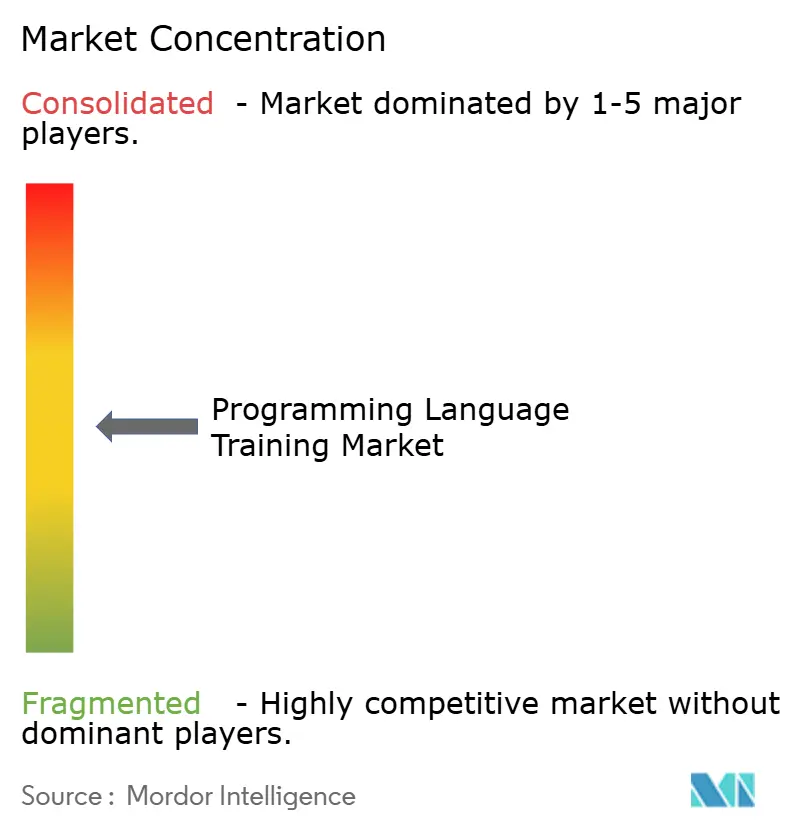
The global programming language training market is moderately fragmented, with no single provider dominating. Brands such as Coursera, Udemy, Pluralsight, edX, O’Reilly, Skillsoft, DataCamp, Simplilearn, and NIIT compete alongside vendor-led ecosystems from IBM, Google, Microsoft, Oracle, and AWS. This competitive environment emphasizes catalog breadth, enterprise distribution, pricing, and content freshness. The merger of Coursera and Udemy created a larger skills platform, increasing competition and challenging smaller firms to match content scale, acquisition budgets, and sales reach.
Competitive strategies now focus on enterprise relevance, AI-driven delivery, and measurable skill outcomes. O’Reilly introduced verifiable skills in Python, Power BI, Java, and Kubernetes, enhancing credential value in hiring and talent reviews. Skillsoft launched its updated Percipio Platform with AI tools like LXStudio and CAISY, reflecting the importance of adaptive learning and rapid content updates. DataCamp expanded its offerings through acquisitions and launched the AI Engineering with LangChain track, prioritizing technical depth over catalog size. These developments highlight a shift from generic course volume to aligning learning products with employer needs.
Vendor-led platforms remain influential by offering low-cost or free foundational content linked to their ecosystems. This pressures independent providers in the individual learner segment, where discounting and low switching costs are common. Enterprise clients prefer providers that connect training to workforce planning and measurable outcomes. Firms like NIIT, Simplilearn, and DataCamp build capabilities through partnerships, product launches, and consolidation. Success in this market depends on combining current technical content, credible credentials, and enterprise-grade delivery with the ability to update courses continuously.
Programming Language Training Industry Leaders
-
Coursera, Inc.
-
Udemy, Inc.
-
Pluralsight LLC
-
Codecademy, Inc.
-
O’Reilly Media, Inc.
- *Disclaimer: Major Players sorted in no particular order
Recent Industry Developments
- June 2026: IBM introduced the AI Builders Challenge through IBM SkillsBuild at its Future of AI in Higher Education Summit in New York City. This initiative offers AI development experiences to students from 20,000 post-secondary institutions globally, enhancing IBM's role in programming education.
- May 2026: Coursera merged with Udemy in an all-stock transaction on May 11, 2026, forming a comprehensive skills platform. Coursera shareholders own approximately 59%, while former Udemy shareholders hold about 41% of the combined entity.
- May 2026: edX (2U) introduced an app within ChatGPT, enabling over 800 million users to search, compare, and enroll in university programs, by passing traditional search-based acquisition methods.
- May 2026: edX, in collaboration with Tuition.io, is offering tuition reductions on around 70-degree programs from 25 prestigious nonprofit universities, such as UC Berkeley and Howard University. This initiative aims to seamlessly integrate higher education credentials into employer benefits platforms.
Global Programming Language Training Market Report Scope
| Instructor-Led Training |
| Self-Paced Online Learning |
| Bootcamps and Cohort-Based Learning |
| Corporate Training Programs |
| Python |
| Java |
| JavaScript and TypeScript |
| C and C++ |
| Data & Analytics Languages (SQL & R) |
| Other Programming Languages |
| Individual Learners |
| Academic Institutions |
| Enterprises |
| Government and Public Sector |
| North America | United States |
| Canada | |
| Mexico | |
| South America | Brazil |
| Peru | |
| Chile | |
| Argentina | |
| Rest of South America | |
| Europe | United Kingdom |
| Germany | |
| France | |
| Spain | |
| Italy | |
| BENELUX (Belgium, Netherlands, and Luxembourg) | |
| NORDICS (Denmark, Finland, Iceland, Norway, and Sweden) | |
| Rest of Europe | |
| Asia-Pacific | India |
| China | |
| Japan | |
| Australia | |
| South Korea | |
| South East Asia (Singapore, Malaysia, Thailand, Indonesia, Vietnam, and Philippines) | |
| Rest of Asia-Pacific | |
| Middle East and Africa | United Arab Emirates |
| Saudi Arabia | |
| South Africa | |
| Nigeria | |
| Rest of Middle East and Africa |
| By Learning Mode | Instructor-Led Training | |
| Self-Paced Online Learning | ||
| Bootcamps and Cohort-Based Learning | ||
| Corporate Training Programs | ||
| By Programming Language | Python | |
| Java | ||
| JavaScript and TypeScript | ||
| C and C++ | ||
| Data & Analytics Languages (SQL & R) | ||
| Other Programming Languages | ||
| By End User | Individual Learners | |
| Academic Institutions | ||
| Enterprises | ||
| Government and Public Sector | ||
| By Geography | North America | United States |
| Canada | ||
| Mexico | ||
| South America | Brazil | |
| Peru | ||
| Chile | ||
| Argentina | ||
| Rest of South America | ||
| Europe | United Kingdom | |
| Germany | ||
| France | ||
| Spain | ||
| Italy | ||
| BENELUX (Belgium, Netherlands, and Luxembourg) | ||
| NORDICS (Denmark, Finland, Iceland, Norway, and Sweden) | ||
| Rest of Europe | ||
| Asia-Pacific | India | |
| China | ||
| Japan | ||
| Australia | ||
| South Korea | ||
| South East Asia (Singapore, Malaysia, Thailand, Indonesia, Vietnam, and Philippines) | ||
| Rest of Asia-Pacific | ||
| Middle East and Africa | United Arab Emirates | |
| Saudi Arabia | ||
| South Africa | ||
| Nigeria | ||
| Rest of Middle East and Africa | ||
Key Questions Answered in the Report
What is the expected value of the programming language training space by 2031?
The global programming language training market is forecast to reach USD 32.98 billion by 2031 from USD 19.80 billion in 2026, with a 10.74% CAGR over 2026 to 2031.
Why are enterprises becoming more important buyers of programming courses?
Enterprise demand is rising because employers increasingly prefer upskilling over external hiring. The Linux Foundation reported that organizations were 3.5 times more likely to upskill existing talent than hire externally in 2026.
Which learning mode is leading and which one is growing fastest?
Instructor-Led Training led with a 28.0% share in 2025, while Corporate Training Programs are projected to grow the fastest at a 15.50% CAGR through 2031.
Which programming language segment leads current demand?
Python led with a 26.0% share in 2025, supported by strong adoption in AI and data workflows and high learning demand among both developers and new learners.
Why is Asia-Pacific the fastest-growing regional cluster?
Asia-Pacific is projected to grow at 15.20% CAGR through 2031 because of strong developer growth, enterprise digitization, and large-scale skilling demand, with India playing a central role in regional expansion.
What is the main competitive risk for providers?
Fast content obsolescence is the main risk. Language and framework priorities are shifting quickly, which forces providers to update technical courses more often to remain relevant.