
Online Data Science Training Programs Market Size and Share
Market Overview
| Study Period | 2022 - 2031 |
|---|---|
| Market Size (2026) | USD 11.87 Billion |
| Market Size (2031) | USD 22.39 Billion |
| Growth Rate (2026 - 2031) | 13.53 % |
| Fastest Growing Market | Asia-Pacific |
| Largest Market | North America |
| Market Concentration | Medium |
Major Players *Disclaimer: Major Players sorted in no particular order Image © Mordor Intelligence. Reuse requires attribution under CC BY 4.0. | |
Online Data Science Training Programs Market Analysis by Mordor Intelligence
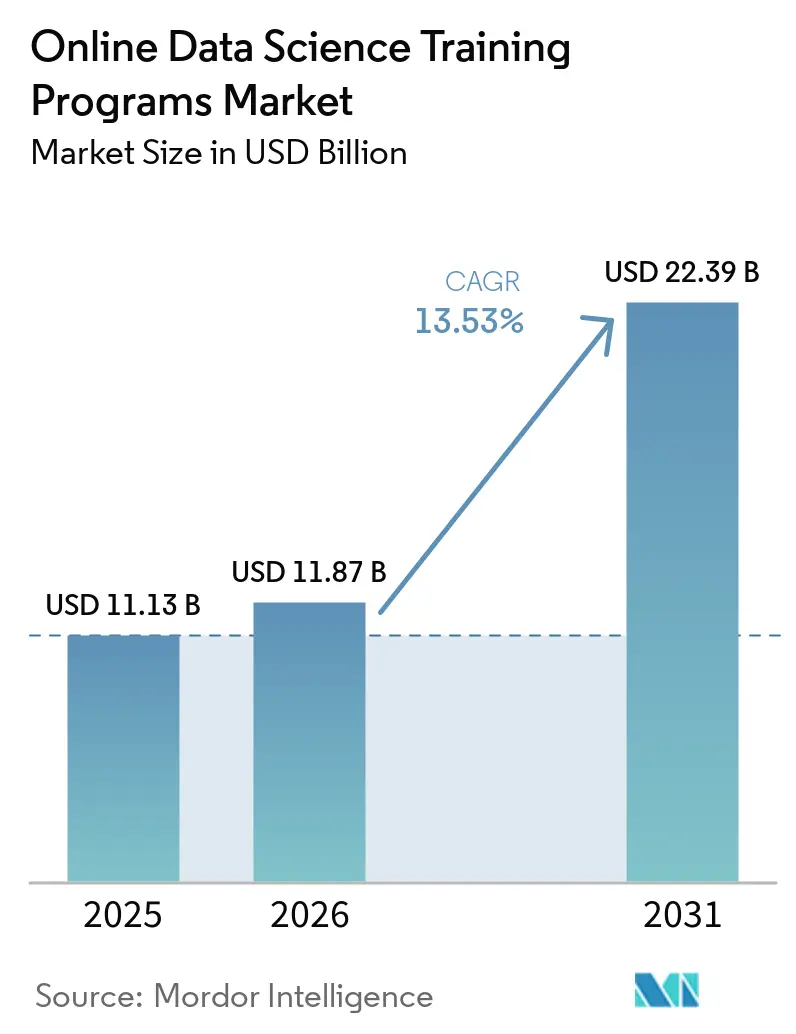
The online data science training programs market size stood at USD 11.87 billion in 2026, up from USD 11.13 billion in 2025, and is projected to reach USD 22.39 billion by 2031, with a 13.53% CAGR. The online data science training programs market is expanding because employers now require data science capabilities across a wider range of business roles, and the share of businesses using data science professionals rose from 48% to 66% between 2020 and 2025. The online data science training programs market is also benefiting from hiring patterns that now extend well beyond software firms, with financial services, healthcare, and manufacturing showing stronger demand for applied analytics and AI skills in operating roles. The online data science training programs market is shifting toward structured enterprise buying as employers seek role-based learning paths, higher completion rates, and clearer skills verification, rather than broad access to content alone[1]. The online data science training programs market is gaining pricing support from digital credential adoption, with 91% of employers actively screening for digital credentials during candidate review[2]. The online data science training programs market remains moderately competitive. Still, scale requirements have risen following Coursera's combination with Udemy in May 2026, increasing pressure on specialist providers to differentiate through curriculum depth, employer partnerships, and integration with enterprise workflows.
Key Report Takeaways
- By program type, certification courses held 51.54% of the online data science training programs market share in 2025, while the others segment, which includes bootcamps and corporate cohort programs, is projected to grow at 13.79% CAGR through 2031.
- By end user, individual learners accounted for 70.93% of the online data science training programs market share in 2025, while corporate learners are projected to expand at 14.26% CAGR through 2031.
- By learning mode, self-paced learning accounted for 56.22% of the online data science training programs market share in 2025, while blended learning is projected to grow at a 14.86% CAGR through 2031.
- By content focus, machine learning and AI accounted for 35.71% of the online data science training programs market share in 2025 and are also the fastest-growing content areas, with a 15.18% CAGR through 2031.
- By geography, North America held 38.95% of the online data science training programs market share in 2025, while Asia-Pacific is projected to expand at 14.95% CAGR through 2031.
Note: Market size and forecast figures in this report are generated using Mordor Intelligence’s proprietary estimation framework, updated with the latest available data and insights as of January 2026.
Global Online Data Science Training Programs Market Trends and Insights
Drivers Impact Analysis*
| Driver | (~) % Impact on CAGR Forecast | Geographic Relevance | Impact Timeline |
|---|---|---|---|
| Rising Demand for Job-Ready Data Science Skills | +3.5% | Global, particularly strong in North America and the Asia-Pacific | Short term (≤ 2 years) |
| Accelerating Enterprise Upskilling for AI and Analytics Adoption | +3.2% | Global, led by North America, the EU, and large enterprise markets in APAC | Medium term (2-4 years) |
| Expansion of Credential-Based Online Learning Pathways | +2.8% | Global, with early gains in North America and Western Europe | Medium term (2-4 years) |
| Growth of Mobile-First and Self-Paced Learning Consumption | +2.1% | APAC core, spill-over to MEA and South America | Short term (≤ 2 years) |
| Increasing Adoption of Simulation-Based Virtual Labs | +1.8% | North America and the EU, with early traction in India and South Korea | Medium term (2-4 years) |
| Rising Demand for Role-Specific Corporate Data Training | +2.5% | Global, concentrated in North America, Germany, India, and Australia | Long term (≥ 4 years) |
| Source: Mordor Intelligence | |||
Rising Demand for Job-Ready Data Science Skills
The online data science training programs market is being driven by employer demand for candidates who can use data tools in real-world settings from the start. The UK Department for Science, Innovation and Technology found that Python appeared in 68% of AI-related job postings, data science methods in 64%, and machine learning in 63%, indicating how closely these skills now co-occur in hiring decisions[3]. The same labor market evidence shows that data and AI hiring is spreading across a broader range of occupations, rather than remaining concentrated in specialist technical roles. That change matters for the online data science training programs market because more workers now need structured learning to move into analytics-adjacent jobs or remain competitive in current roles. It also supports demand for certification-led offerings because employers increasingly want evidence of applied skill readiness rather than informal self-study alone.
Accelerating Enterprise Upskilling for AI and Analytics Adoption
The online data science training programs market is seeing stronger enterprise demand as companies move AI adoption from pilot work into day-to-day workflows. Corporate learners are the fastest-growing end-user group, with a projected 14.26% CAGR through 2031, which shows that budget control is shifting toward employers rather than individual learners. Platform launches also point in the same direction, with Coursera embedding learning directly into Microsoft 365 Copilot and LinkedIn Learning introducing role-based Skills Tracks for data and AI functions. These actions show that buyers are placing more value on occupation-linked learning paths, skills verification, and tighter alignment with enterprise productivity systems. As a result, the online data science training programs market is moving toward multi-seat contracts, cohort models, and stronger reporting on learner outcomes.
Expansion of Credential-Based Online Learning Pathways
The online data science training programs market is benefiting from the wider acceptance of digital credentials by both employers and learners. Accredible reported that digital credential issuance reached 42 million in 2025, its network surpassed 170 million total verified credentials, and 91% of employers actively screened for digital credentials during candidate review. Coursera also reported more than 15.4 million enrollments in entry-level Professional Certificates in 2025, with 37% growth in North America and 36% growth in the Middle East and North Africa. The same company reported that 51% of Professional Certificate completers experienced salary increases, supporting repeat enrollment and improving employer confidence in structured online pathways. This combination of verification, labor-market signaling, and learner payoff is strengthening the position of structured certifications in the online data science training programs market.
Growth of Mobile-First and Self-Paced Learning Consumption
The online data science training programs market continues to rely on flexible access formats because learners often balance study with full-time work and irregular schedules. Self-paced learning accounted for 56.22% of revenue in 2025, indicating that convenience continues to drive a large share of buying behavior. This format is especially relevant in Asia-Pacific, the Middle East, and Africa, where mobile-first usage, time-zone spread, and varied broadband quality make flexible delivery important for learner reach. At the same time, the online data science training programs market faces a completion challenge in pure self-paced formats, as standalone courses reached only 23% completion in the draft evidence base. That gap is one reason providers are adding progress nudges, peer interaction, and blended support layers to protect learner outcomes and improve paid conversion.
Restraints Impact Analysis*
| Restraint | (~) % Impact on CAGR Forecast | Geographic Relevance | Impact Timeline |
|---|---|---|---|
| Free and Low-Cost Open Course Substitutes | -1.2% | Global, the strongest substitution pressure in South America, Southeast Asia, and MEA | Short term (≤ 2 years) |
| Rapid Curriculum Obsolescence in Fast-Changing Tool Stacks | -0.8% | Global | Medium term (2-4 years) |
| Weak Outcome Standardization Across Providers | -0.7% | Global, most pronounced in emerging markets | Long term (≥ 4 years) |
| Credential Overlap and Buyer Confusion Across Similar Programs | -0.6% | North America and Europe primarily | Medium term (2-4 years) |
| Source: Mordor Intelligence | |||
Free and Low-Cost Open Course Substitutes
The online data science training programs market faces steady pricing pressure from free and low-cost beginner-level learning options. Open educational content, video-led instruction, and free platform tiers give learners access to Python, SQL, and entry-level analytics material without paying for a full course path. This does not remove demand for paid programs. Still, it does make it harder for providers to hold pricing on foundation content unless they attach clear credential value, employer recognition, or career support. The risk is greater in price-sensitive regions, where the first learning decision is often based on access cost rather than structured assessment. That dynamic keeps the online data science training programs market focused on value-added differentiation at the intermediate and advanced levels.
Rapid Curriculum Obsolescence in Fast-Changing Tool Stacks
The online data science training programs market is also constrained by the speed at which tool stacks and applied AI workflows are changing. Skills that were outside mainstream training catalogs 24 months earlier are now appearing in production roles, which shortens the useful life of many courses. DataCamp’s March 2026 launch of an AI Engineering with LangChain track shows how providers are reacting to demand for newer production-oriented skills such as LangChain, LangSmith, and LangGraph. Providers with slower content development cycles face a disadvantage because enterprise buyers increasingly ask whether learning paths reflect current tool use rather than legacy curriculum breadth. This keeps content refresh speed as a core competitive factor across the online data science training programs market.
*Our forecasts treat driver/restraint impacts as directional, not additive. The impact forecasts reflect baseline growth, mix effects, and variable interactions.
Segment Analysis
By Program Type: Certification Credentials Anchor Scale, Bootcamps Drive Incremental Growth
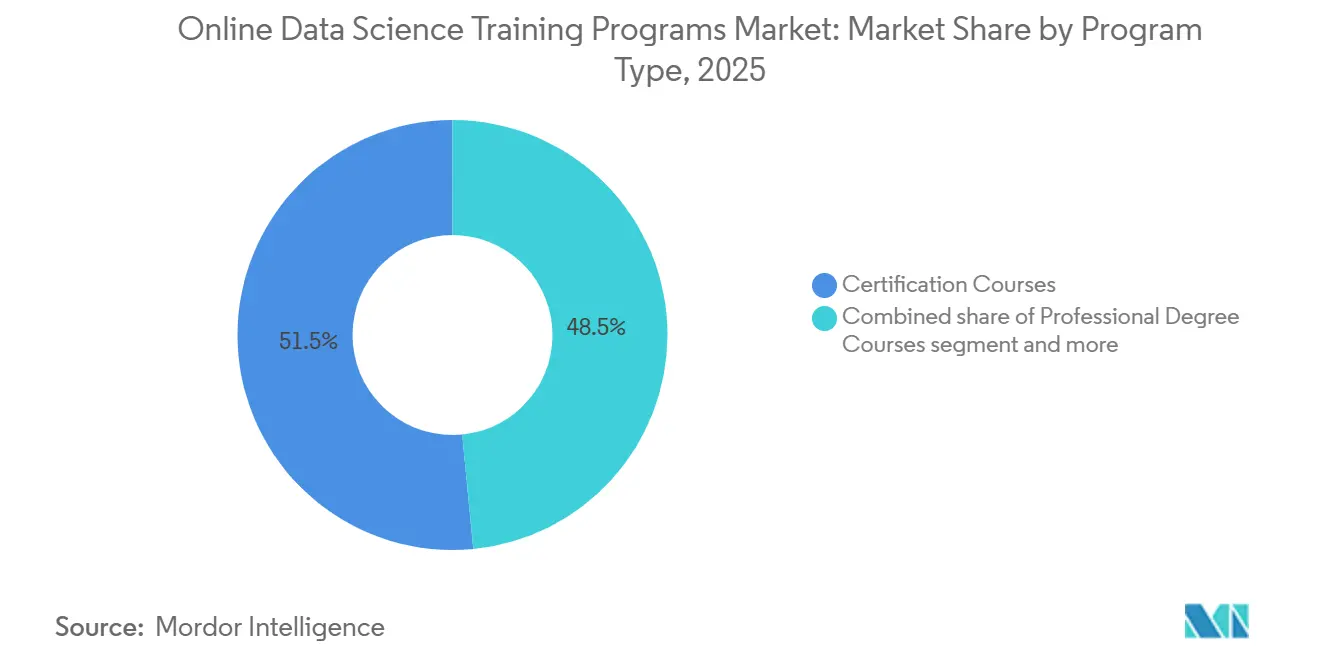
Certification courses held 51.54% of the online data science training programs market share in 2025, which made them the largest program type by revenue. Their scale reflects employers' preference for role-specific proof of capability, especially when hiring managers want a clearer signal than a general course-completion line or an old academic transcript. Digital credential adoption supports this position, since 91% of employers actively screened for digital credentials during candidate review in 2025. That screening behavior gives certification-led offerings stronger commercial logic than broad, non-assessed content libraries. It also helps explain why the online data science training programs market continues to favor structured, accessible learning over informal course consumption alone.
The others segment, which includes bootcamps and corporate cohort programs, is projected to grow at 13.79% CAGR through 2031, making it the fastest-growing program type in the draft. That growth comes from a shift in how bootcamps are sold, with a larger share moving toward enterprise delivery rather than serving only individual career switchers. The online data science training programs industry is also seeing stronger demand for cohort formats, as procurement teams respond better to completion and accountability than to fully self-directed learning. Professional degree courses remain relevant at the premium end, especially where formal accreditation shapes buyer confidence and pricing. This preserves a place for degree-led offerings even though they are not expected to match the growth pace of certification and cohort-based formats.

By Learning Mode: Self-Paced Maintains Scale, Blended Formats Capture Premium Spend
The online data science training programs market size for self-paced learning remained the largest in 2025, with a 56.22% share of revenue. This mode fits working professionals who want flexible pacing, broad course choice, and the ability to learn outside standard business hours. It also supports provider scale because content can be distributed across a wide learner base without the same delivery cost profile as live instruction. Even so, the draft shows that standalone self-paced formats achieved only a 23% completion rate, limiting satisfaction and upsell potential when no support layer is added. That tension explains why the online data science training programs market still values self-paced delivery for reach, but not as a complete solution for all learner types.
The online data science training programs market for blended learning is forecast to grow at a 14.86% CAGR through 2031, making it the fastest-growing mode. Enterprises are favoring blended formats because they combine schedule flexibility with live touchpoints, peer accountability, and stronger completion performance. This is also changing how procurement teams compare vendors, since the buying decision now includes delivery structure and measurable completion rather than course catalog depth alone. Instructor-led live learning remains important for premium, customized training, especially when buyers want direct support and structured evaluation. As a result, the online data science training programs market is likely to maintain a layered delivery mix, with self-paced, at-scale, and blended formats driving faster growth and higher-value contracts.
By Content Focus: Machine Learning and AI Leads on Both Share and Growth
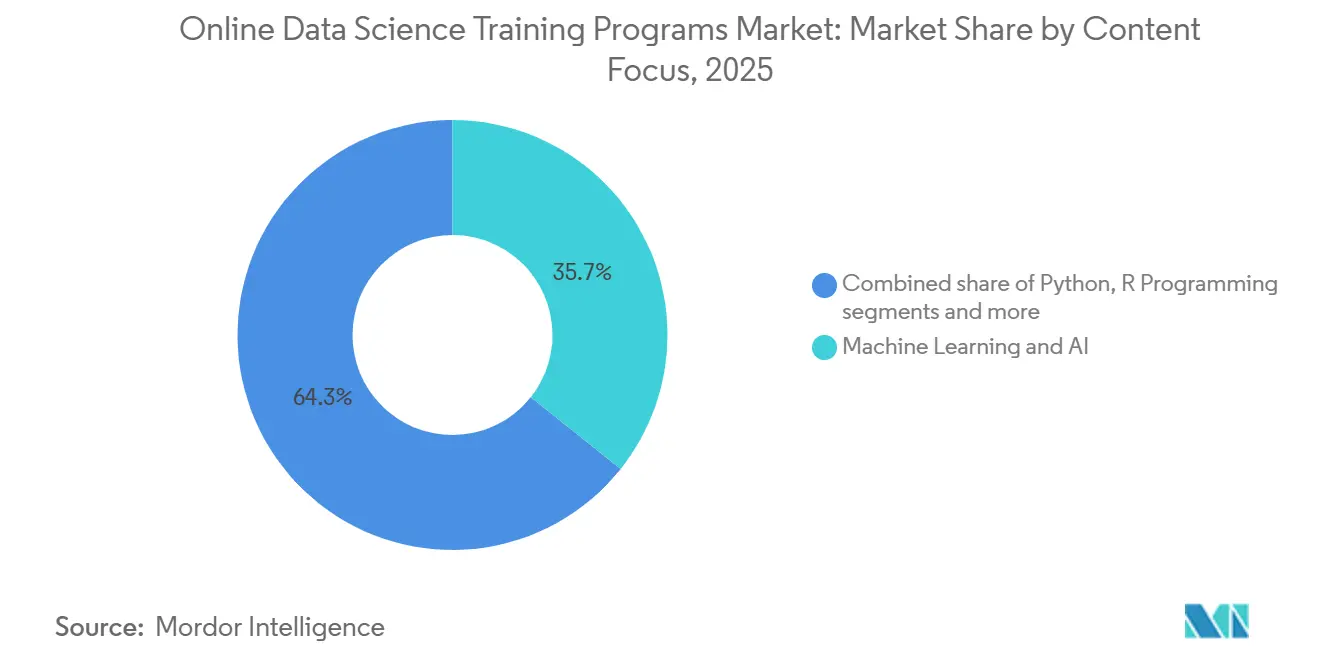
The online data science training programs market for machine learning and AI accounted for 35.71% in 2025 and is projected to expand at a 15.18% CAGR through 2031. This is the only content segment in the draft that leads with both current share and projected growth, showing how closely learner demand now follows employer hiring priorities[4]. UK government job vacancy analysis also showed that machine learning remained one of the most demanded skill areas in AI-related hiring. These signals keep machine learning and AI at the center of the online data science training programs market.
Python remains the leading gateway skill, appearing in 68% of AI-related job postings in the UK analysis and serving as the entry point for many learning journeys. SQL and data engineering are gaining ground because enterprise AI deployment requires stronger data pipelines and production support rather than model building alone. Statistics and probability continue to matter as more learners enter AI-focused programs without a deep quantitative background. R programming still serves academic, research, and life sciences use cases, but its relative position remains narrower than Python’s. This leaves the online data science training programs market tilted toward applied AI content, while still preserving room for foundational and adjacent technical subjects.
By End User: Individual Learners Lead Revenue, Corporations Accelerate Investment
The online data science training programs market size for individual learners remained the largest in 2025, accounting for 70.93% of revenue. This base is supported by career-driven spending, as workers continue to use online learning to move into data roles, strengthen promotion prospects, or add applied AI skills to existing functions. Coursera stated in its 2025 Learner Outcomes Report that 91% of global learners achieved a positive career outcome after completing a program. The same report found that 51% of Professional Certificate completers reported salary increases, which supports the willingness to pay at the advanced certificate level. These return signals keep the online data science training programs market attractive for self-funded learners even as competition intensifies.
The online data science training programs market size for corporate learners is projected to expand at a 14.26% CAGR through 2031, the fastest pace among end users. Companies are moving from ad hoc course reimbursements toward planned learning paths tied to roles, departments, and platform usage goals. LinkedIn Learning’s role-based Skills Tracks and Coursera’s workflow integration with Microsoft 365 Copilot are clear examples of how vendors are responding to this shift. The online data science training programs industry is therefore becoming more dependent on enterprise features such as manager dashboards, cohort administration, and outcome reporting. This strengthens larger platforms that can serve both individual and employer demand from the same content and credential base.
Geography Analysis
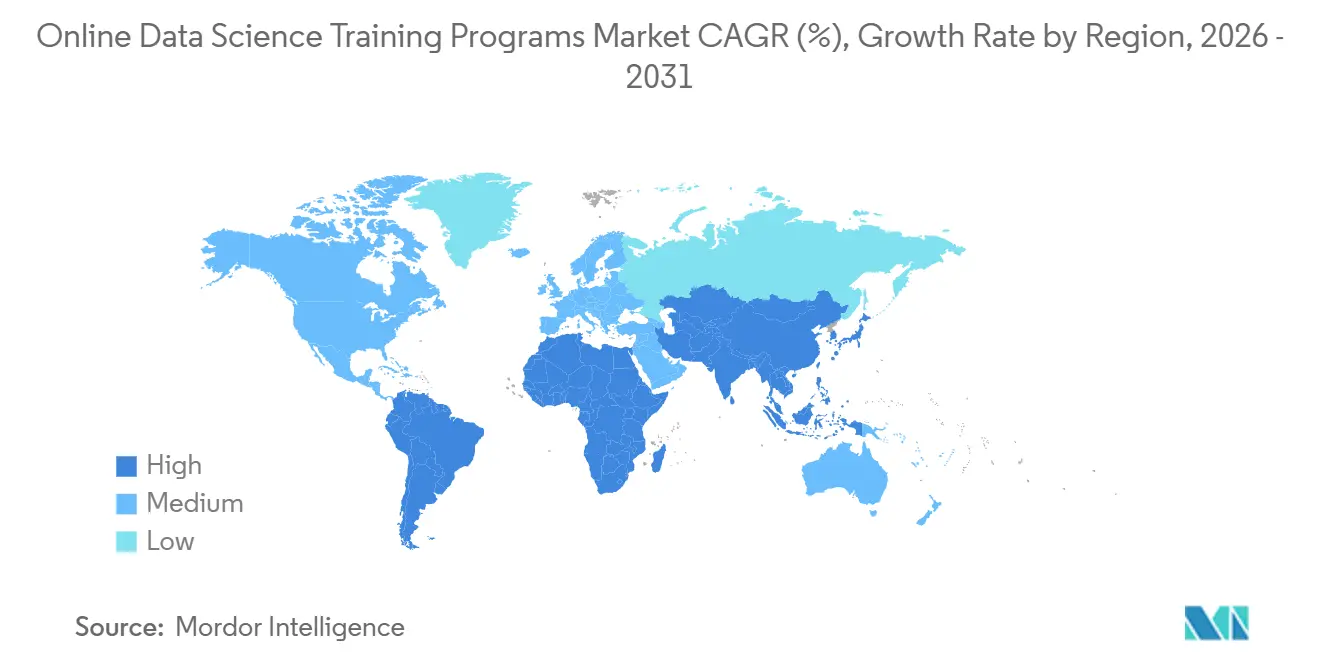
North America held 38.95% of the online data science training programs market share in 2025, which made it the largest regional market by revenue. The region remains the most mature part of the online data science training programs market because enterprise technology spending is high, digital credential acceptance is established, and several leading learning platforms are based there. Growth is projected at 7.00% CAGR through 2031, which is slower than the global average but still reflects healthy expansion from a larger installed base. Employer recognition of structured credentials is an important demand support in the region, especially as hiring managers place more weight on verified skills signals. The United States leads regional demand, while Canada supports the market through institutional partnerships, and Mexico presents an opportunity as demand for Spanish-language technical content rises.
Europe is projected to expand at 6.20% CAGR through 2031, with the UK, Germany, and France acting as the core markets. The online data science training programs market in Europe is supported by formal skills policy, public concern over digital capability gaps, and a stronger quality orientation in workforce training. The UK government’s 2026 Annual Skills Report identified digital and AI capabilities as major shortfalls across priority sectors, which supports institutional demand for structured online learning. France also benefits from a culture of certification that supports the willingness to pay for recognized training pathways.
Asia-Pacific is the fastest-growing region in the online data science training programs market, with a projected growth of 14.95% CAGR through 2031. A large learner base is lifting demand, stronger enterprise AI adoption, and policy action that is pushing digital workforce development higher on national agendas. China’s State Council published an “AI+” action plan in August 2025 that called for greater integration of AI skills across industries, thereby supporting institutional demand for structured training. South America is projected to grow at 8.50% CAGR, led by Brazil, while the Middle East and Africa present two linked but different growth stories, with Africa at 9.00% CAGR and Western Asia at 7.40% CAGR. These regions remain less well served by localized course design, creating space in the online data science training programs market for providers that can adapt their language, industry examples, and delivery methods to local conditions.
Competitive Landscape
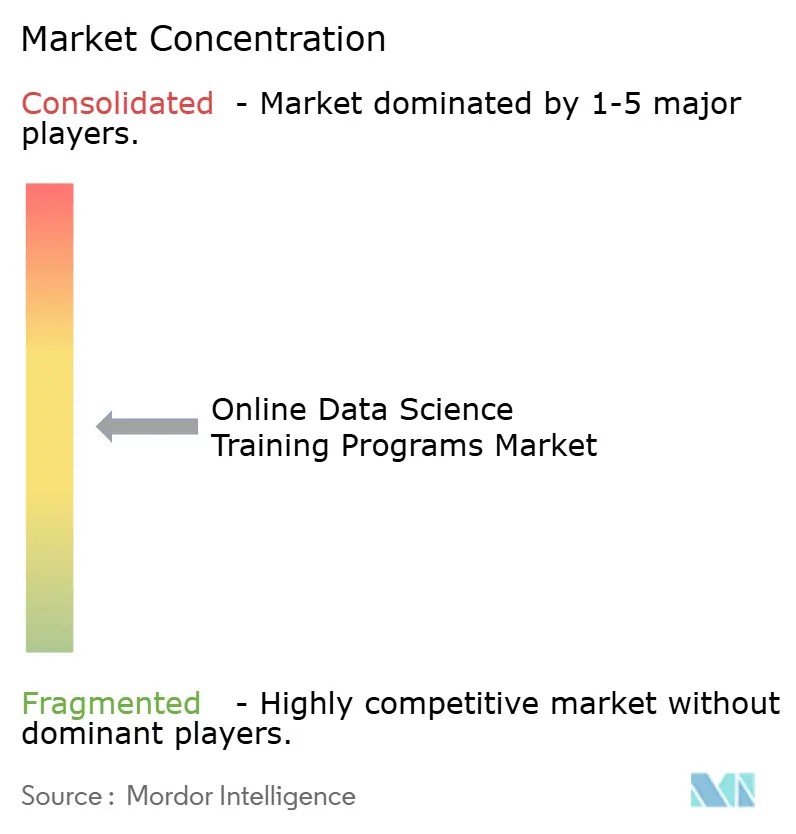
The online data science training programs market is moderately fragmented, with the top 5 providers, Coursera, Udemy, LinkedIn Learning, edX, and DataCamp, together holding 49% of revenue in 2025. No single company held more than 12%, so the online data science training programs market had not yet consolidated around one dominant platform. The most important competitive event in the current cycle was Coursera’s combination with Udemy in May 2026, which created a platform spanning 290 million learners, 18,000 enterprise customers, 95,000 instructors, and more than USD 1.5 billion in combined annual revenue. This deal raises the scale threshold for smaller providers that cannot easily match breadth across university credentials, open marketplace content, and enterprise contracts. It also puts more pressure on regional and specialist players to compete on depth, verification, or delivery model rather than on course volume alone.
Competition is now moving beyond catalog size and into workflow integration, role mapping, and targeted certification architecture. Coursera’s March 2026 launch of a learning agent within Microsoft 365 Copilot shows how providers are trying to embed learning directly in workplace tools rather than relying on separate platforms. LinkedIn Learning’s Skills Tracks and DataCamp’s role-specific enterprise offerings point in the same direction, with more focus on job families, applied progression, and verified outcomes. These moves show that the online data science training programs market is rewarding providers that can link learning more directly to workplace execution.
Mergers and acquisitions are also becoming a stronger part of the competitive pattern in the online data science training programs market. Inverness Graham’s March 2026 acquisition of Axcel Learning showed continued investor interest in certification-led learning brands that can scale through focused portfolio strategies. LearnUpon’s acquisition of Courseau in November 2025 showed another strategic angle, with content creation speed and multilingual delivery becoming part of platform differentiation. White space remains strongest in outcome-verified enterprise programs and in regionally adapted technical pathways. That leaves the online data science training programs market open to providers that move quickly to improve assessment quality, align corporate workflows, and deliver locally.
Online Data Science Training Programs Industry Leaders
-
Coursera, Inc.
-
Udemy, Inc.
-
LinkedIn Learning (Microsoft Corporation)
-
edX LLC
-
DataCamp, Inc.
- *Disclaimer: Major Players sorted in no particular order
Recent Industry Developments
- May 2026: Coursera completed its combination with Udemy, creating a platform with 290 million learners, 18,000 enterprise customers, and combined annual revenues exceeding USD 1.5 billion. The USD 2.5 billion transaction is the largest consolidation in the online learning sector and is projected to generate USD 115 million in annual cost synergies within 24 months.
- April 2026: Coursera and Microsoft jointly launched 11 new Professional Certificates across AI, data, and software development, growing Microsoft’s Professional Certificate portfolio on Coursera by more than 50% and expanding a catalog that had already surpassed 1 million cumulative enrollments globally.
- April 2026: Google launched its first AI Professional Certificate on Coursera, including 3 months of free access to Google AI Pro for all enrollees, and extended complimentary access to U.S. small businesses, signaling tech-company investment in proprietary data science online learning channels as a distribution and brand strategy.
- March 2026: Coursera launched the first learning agent in Microsoft 365 Copilot, enabling employees to access curated learning pathways directly within enterprise productivity tools. The integration, built on the OpenAI Apps SDK, reflects a strategic shift toward embedding data science online learning into enterprise workflows rather than standalone platforms.
Global Online Data Science Training Programs Market Report Scope
| Professional Degree Courses |
| Certification Courses |
| Others (Bootcamps,Corporate Cohort Programs) |
| Individual Learners |
| Corporate Learners |
| Self-Paced Online Learning |
| Instructor-Led Live Learning |
| Blended Learning |
| Python |
| R Programming |
| SQL and Data Engineering |
| Machine Learning and AI |
| Statistics and Probability |
| North America | United States |
| Canada | |
| Mexico | |
| South America | Brazil |
| Peru | |
| Chile | |
| Argentina | |
| Rest of South America | |
| Europe | United Kingdom |
| Germany | |
| France | |
| Spain | |
| Italy | |
| BENELUX (Belgium, Netherlands, and Luxembourg) | |
| NORDICS (Denmark, Finland, Iceland, Norway, and Sweden) | |
| Rest of Europe | |
| Asia-Pacific | India |
| China | |
| Japan | |
| Australia | |
| South Korea | |
| South East Asia (Singapore, Malaysia, Thailand, Indonesia, Vietnam, and Philippines) | |
| Rest of Asia-Pacific | |
| Middle East and Africa | United Arab Emirates |
| Saudi Arabia | |
| South Africa | |
| Nigeria | |
| Rest of Middle East and Africa |
| By Program Type | Professional Degree Courses | |
| Certification Courses | ||
| Others (Bootcamps,Corporate Cohort Programs) | ||
| By End User | Individual Learners | |
| Corporate Learners | ||
| By Learning Mode | Self-Paced Online Learning | |
| Instructor-Led Live Learning | ||
| Blended Learning | ||
| By Content Focus | Python | |
| R Programming | ||
| SQL and Data Engineering | ||
| Machine Learning and AI | ||
| Statistics and Probability | ||
| By Geography | North America | United States |
| Canada | ||
| Mexico | ||
| South America | Brazil | |
| Peru | ||
| Chile | ||
| Argentina | ||
| Rest of South America | ||
| Europe | United Kingdom | |
| Germany | ||
| France | ||
| Spain | ||
| Italy | ||
| BENELUX (Belgium, Netherlands, and Luxembourg) | ||
| NORDICS (Denmark, Finland, Iceland, Norway, and Sweden) | ||
| Rest of Europe | ||
| Asia-Pacific | India | |
| China | ||
| Japan | ||
| Australia | ||
| South Korea | ||
| South East Asia (Singapore, Malaysia, Thailand, Indonesia, Vietnam, and Philippines) | ||
| Rest of Asia-Pacific | ||
| Middle East and Africa | United Arab Emirates | |
| Saudi Arabia | ||
| South Africa | ||
| Nigeria | ||
| Rest of Middle East and Africa | ||
Key Questions Answered in the Report
What is driving demand for online data science training programs?
Demand is being supported by stronger employer use of data science professionals and wider hiring across finance, healthcare, manufacturing, and other operating roles.
How large is the online data science training programs market expected to become by 2031?
The market is forecast to reach USD 22.39 billion by 2031, up from USD 11.87 billion in 2026, at a 13.53% CAGR over 2026-2031.
Which program type generates the most revenue in this space?
Certification courses led the market with a 51.54% revenue share in 2025, as employers value structured, verifiable credentials.
Which end-user group is growing the fastest?
Corporate learners are the fastest-growing end-user segment, with a projected 14.26% CAGR through 2031.
Which learning mode is expanding the fastest?
Blended learning is projected to grow the fastest, with a 14.86% CAGR, while self-paced learning remained the largest mode in 2025.
Which region offers the strongest growth outlook?
Asia-Pacific has the strongest growth outlook, with a projected 14.95% CAGR through 2031, supported by large learner pools and policy-led digital skills adoption.