
Machine Learning Courses Market Size and Share
Market Overview
| Study Period | 2022 - 2031 |
|---|---|
| Market Size (2026) | USD 4.35 Billion |
| Market Size (2031) | USD 8.18 Billion |
| Growth Rate (2026 - 2031) | 13.46 % |
| Fastest Growing Market | Asia-Pacific |
| Largest Market | North America |
| Market Concentration | Low |
Major Players *Disclaimer: Major Players sorted in no particular order Image © Mordor Intelligence. Reuse requires attribution under CC BY 4.0. | |
Machine Learning Courses Market Analysis by Mordor Intelligence
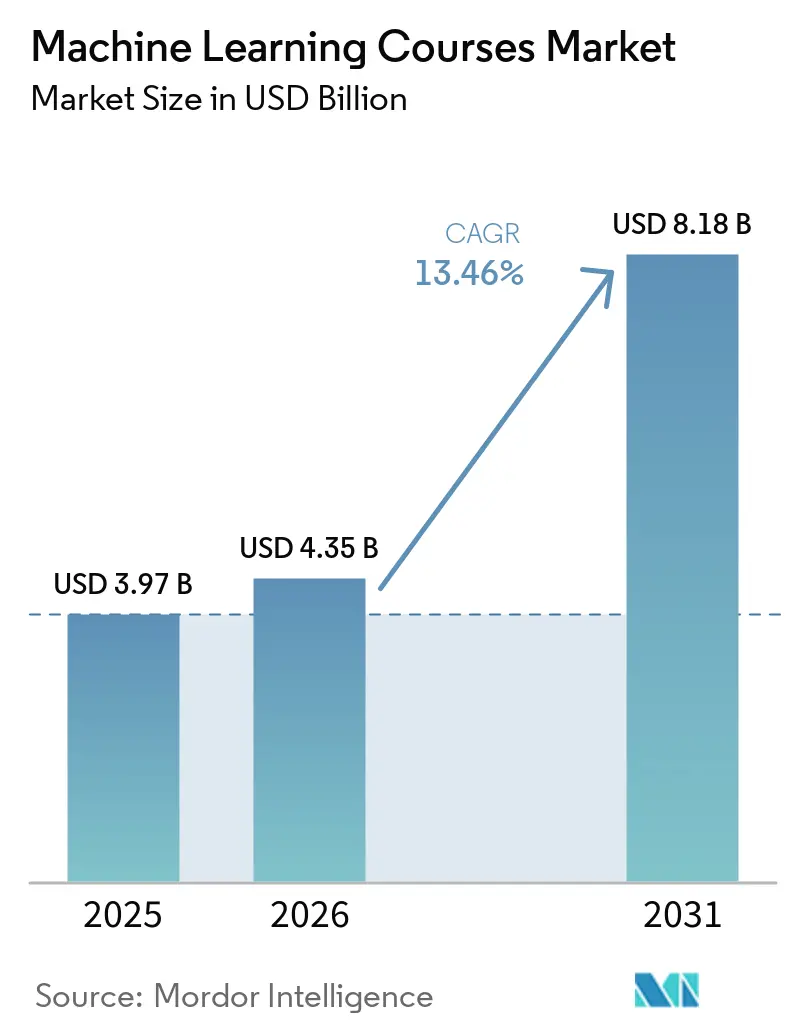
The global machine learning courses market size stood at USD 4.35 billion in 2026, up from USD 3.97 billion in 2025, and is projected to reach USD 8.18 billion by 2031, with a 13.46% CAGR. The machine learning courses market is growing as employers are placing more weight on applied AI skills that can be tested and verified during hiring, rather than relying only on broad digital familiarity or conventional credentials[1]. The machine learning courses market is also benefiting from a sharp rise in demand for GenAI and ML skills across both technical and non-technical roles, which is widening the addressable learner base beyond software and data teams. Verified short-form credentials are becoming increasingly important in the machine learning courses market, as employers signal a strong preference for candidates who can demonstrate formal evidence of AI capability. Enterprise demand is also rising because AI literacy obligations under the EU AI Act are making documented training more relevant for organizations that build, deploy, or use AI systems in regulated settings[2]. At the same time, the machine learning courses market faces pressure from low completion rates in self-paced technical learning and from rapidly evolving ML tools, which are forcing providers to refresh content more often and to improve course design if they want to maintain the credibility of their certificates.
Key Report Takeaways
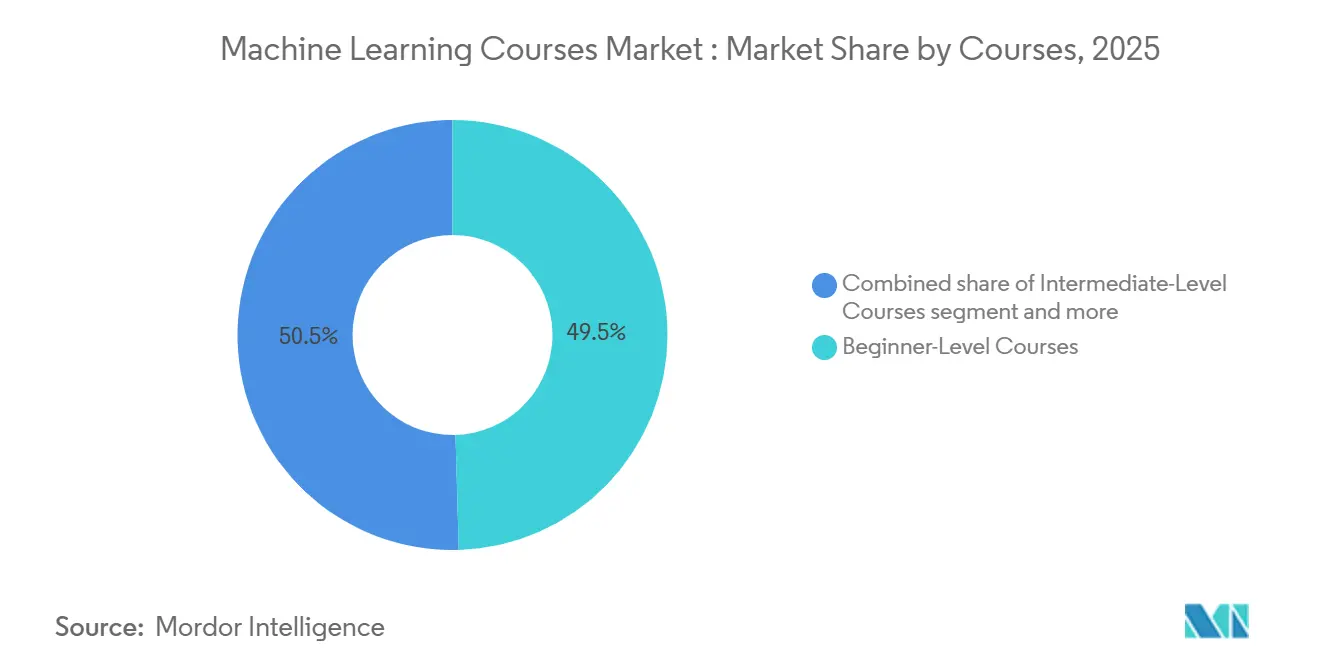
- By course level, beginner-level courses held 49.5% of the machine learning courses market share in 2025, while advanced-level courses are forecast to expand at a 14.9% CAGR through 2031.
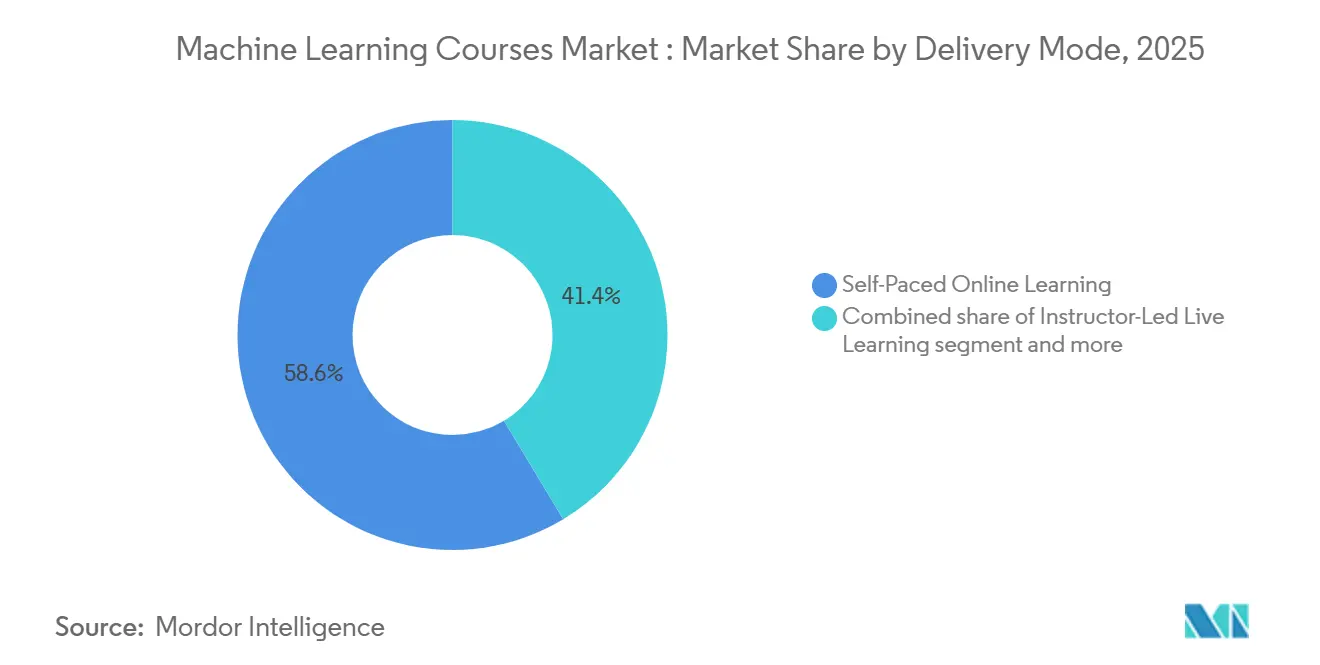
- By delivery mode, self-paced online learning accounted for 58.6% of the machine learning courses market size in 2025, while blended learning is advancing at a 14.6% CAGR through 2031.
- By end user, individual learners held 71.7% of the machine learning courses market share in 2025, while corporate learners recorded the highest projected CAGR at 15.2% through 2031.
- By geography, North America held 37.4% of the machine learning courses market share in 2025, while Asia-Pacific is projected to grow at a 15.7% CAGR through 2031.
Note: Market size and forecast figures in this report are generated using Mordor Intelligence’s proprietary estimation framework, updated with the latest available data and insights as of January 2026.
Global Machine Learning Courses Market Trends and Insights
Drivers Impact Analysis*
| Driver | (~) % Impact on CAGR Forecast | Geographic Relevance | Impact Timeline |
|---|---|---|---|
| Rising Demand for Job-Ready ML and GenAI Skills | +3.8% | Global, with a stronger pull in North America, India, and Southeast Asia | Short term (≤ 2 years) |
| Corporate Upskilling in AI, Data, and Automation Roles | +2.5% | North America and Europe, with spillover into APAC enterprise clusters | Medium term (2-4 years) |
| Employer Preference for Credentialed Micro-Certifications | +2% | Global, with higher adoption in emerging digital labor markets | Short term (≤ 2 years) |
| AI-Personalized Learning Improves Completion and Conversion | +1.8% | Global, strongest on large self-paced platforms | Medium term (2-4 years) |
| Shift Toward Project-Based and Hands-On Learning Formats | +1.2% | North America, Europe, and advanced APAC learner segments | Medium term (2-4 years) |
| Regulatory and Enterprise AI Governance Training Requirements | +1% | EU core, with spillover into adjacent regulated markets | Short term (≤ 2 years) |
| Source: Mordor Intelligence | |||
Rising Demand for Job-Ready ML and GenAI Skills
A stronger employer focus is pushing the machine learning courses market on applied AI capability that can be used on the job without a long transition period. The World Bank reported that GenAI-specific job vacancies increased ninefold globally between 2021 and 2024, and the demand spread beyond traditional ICT roles into functions such as content, design, marketing, and health care. The same report showed that GenAI literacy carried a 25% to 36% wage premium in non-technical white-collar roles, which helps explain why more professionals outside core engineering teams are enrolling in ML and GenAI learning tracks. This shift is changing the machine learning courses market from a niche technical training space into a broader professional education category with relevance across sectors. It also favors providers that can package foundational concepts into shorter application-focused courses with visible outcomes and clearer links to employment needs.
Corporate Upskilling in AI, Data, and Automation Roles
The machine learning courses market is also gaining support from enterprise spending on internal AI capability building. Germany provides a clear example: the TÜV-Verband found that 27% of enterprises had trained employees in AI in 2026, up from 12% in 2024, while 50% reported a high or very high need for AI training[3]. The same study showed that 72% of companies identified application-oriented AI knowledge as the primary qualification target, indicating demand for courses that move beyond theory into deployment and workflow use. This pattern matters for the machine learning courses market because corporate buyers usually prefer structured programs with tracking, assessments, and clearer completion evidence than open catalogs provide. As a result, providers with enterprise-ready delivery models are better placed to capture premium demand, especially where organizations want job-role mapping, internal reporting, and auditable learning records.
Employer Preference for Credentialed Micro-Certifications
The machine learning courses market is being shaped by a clear employer preference for credentials that are shorter than formal degrees but stronger than informal badges. Coursera’s Global Skills Report 2025 found that 94% of employers would be likely to hire a candidate with a verified GenAI credential, and 75% would prefer a less experienced credentialed candidate over a more experienced one without that credential. This is important for the machine learning courses market because it supports continued demand for stackable certificates that can be completed in months rather than years. It also raises the value of proctored, assessed, and employer-recognized programs relative to unverified short courses. Over time, this is likely to sharpen quality differences within the machine learning courses market, as providers with credible assessments and stronger employer alignment will have greater pricing power than those offering only basic completion certificates.
Regulatory and Enterprise AI Governance Training Requirements
Regulation is creating a more durable demand layer in the machine learning courses market, especially for governance, documentation, and responsible AI content. Article 4 of the EU AI Act requires providers and deployers of AI systems to ensure that staff who handle them have sufficient AI literacy. That obligation has been in effect since February 2, 2025. The broader application timetable brings more of the framework into effect from August 2026, raising the urgency for enterprises that need structured, documented training programs. The regulation also provides significant penalties in certain cases, meaning AI training is moving from a discretionary learning budget item to a risk-control requirement for some AI system users. In the machine learning courses market, this favors vendors that can connect technical training with policy understanding, role-based obligations, and completion records that can withstand procurement and compliance reviews.
Restraints Impact Analysis*
| Restraint | (~) % Impact on CAGR Forecast | Geographic Relevance | Impact Timeline |
|---|---|---|---|
| Rapid Content Obsolescence in ML Toolchains and Frameworks | -1.5% | Global, with the sharpest effect on self-paced catalog platforms | Short term (≤ 2 years) |
| High Learner Drop-Off in Self-Paced Technical Courses | -1.3% | Global, especially where mentoring support is limited | Short term (≤ 2 years) |
| Premium Pricing Pressure for Instructor-Led and Mentored Tracks | -0.9% | North America and Europe, with lower pressure in price-competitive APAC markets | Medium term (2-4 years) |
| Credibility Gaps Across Unaccredited Providers and Short Courses | -0.7% | Global, strongest in regulated enterprise procurement | Long term (≥ 4 years) |
| Source: Mordor Intelligence | |||
High Learner Drop-Off in Self-Paced Technical Courses
The machine learning courses market still faces a major demand-side challenge due to weak completion rates in self-paced technical learning. Research published in MDPI Applied Sciences in 2025 found that empirical studies consistently reported completion rates below 10% among registered MOOC learners, with the first graded assessment serving as a key drop-off point[4]. NSF-supported research on MOOC stopout patterns also found that heavier question loads and higher early time commitment were associated with higher stopout rates. This weakens the machine learning courses market in two ways: it reduces the potential for repeat purchases. It lowers the signaling value of certificates when employers suspect that many learners did not finish or retain the material. It is one reason why platforms are investing more in guided pathways, practice-heavy design, and learning support tools that can improve persistence without making the curriculum too easy.
Rapid Content Obsolescence in ML Toolchains and Frameworks
The machine learning courses market is also constrained by the pace of evolution of models, tools, libraries, and platform features. Course content that depends on specific model workflows, APIs, or deployment environments can quickly become irrelevant when a major vendor updates its stack or when enterprise practices shift to new tooling. This issue is more acute in the machine learning courses market than in slower-moving education categories, because practical ML training is closely tied to current software behavior and current documentation habits. The pressure is even higher in governance-focused training because the EU AI Act has made AI literacy an ongoing obligation rather than a one-time exercise for affected organizations. Providers that do not refresh courses quickly enough risk lower completion, weaker learner trust, and reduced enterprise renewals, especially when buyers are using training programs to support real deployment activity rather than only general awareness.
*Our forecasts treat driver/restraint impacts as directional, not additive. The impact forecasts reflect baseline growth, mix effects, and variable interactions.
Segment Analysis
By Courses: Beginner Enrolments Anchor the Market, Advanced Tracks Define Future Revenue Mix
Beginner-level courses held 49.5% of the machine learning courses market share in 2025, while advanced-level courses are projected to expand at a 14.9% CAGR through 2031. Beginner content remains the broadest entry point in the machine learning courses market because many learners are still approaching ML from non-specialist roles and need accessible starting material before moving into model building or deployment. The World Bank reported that GenAI course enrollments on major platforms increased 12-fold between 2023 and 2025, and Coursera alone passed 8 million cumulative GenAI enrollments by April 2025, with 12 people per minute signing up during 2025. That scale strongly supports the continued weight of beginner learning in the machine learning courses market, because first-time learners still make up the largest intake pool. Intermediate courses remain strategically important because they sit between broad awareness and specialized practice, and are increasingly defined by use-case focus rather than by difficulty alone.
The revenue mix is still expected to move upward over time because advanced learning is where specialization, enterprise alignment, and higher willingness to pay come together in the machine learning courses industry. A 2025 peer-reviewed study comparing project-based learning with lecture-based instruction in ML found stronger outcomes for the project-based group in model accuracy, code quality, and problem-solving, including a statistically significant difference in model optimization. This is contributing to a redesign of intermediate and advanced course structures toward labs, capstones, and assessed application work instead of passive lecture sequences. Advanced tracks are also gaining relevance as enterprises want training in areas such as MLOps, fine-tuning, documentation, and responsible deployment. Within the machine learning courses industry, that trend should gradually raise the share of higher-value specialized courses, even though beginner learning remains the largest source of learner volume.

By Delivery Mode: Self-Paced Volumes Dominate, Blended Formats Capture Enterprise Value
Self-paced online learning accounted for 58.6% of the machine learning market in 2025, maintaining its lead by volume. This format remains the default choice for the machine learning courses market because it aligns with the realities of working adults who need flexible access rather than fixed classroom timing. It also benefits from the very large top-of-funnel demand driven by basic AI awareness and entry-level skill-building. Even so, the format is under pressure from free or subsidized alternatives, and Coursera’s early 2026 launch of five free Anthropic AI fluency courses shows how introductory self-paced content is becoming harder to monetize on a stand-alone basis. As a result, large platforms in the machine learning courses market are relying more on scale, subscriptions, and pathway design rather than simple pay-per-course economics.
Blended learning is the fastest-growing delivery segment, with a 14.6% CAGR expected through 2031, because it combines schedule flexibility with the structure that enterprises want. The machine learning courses market is increasingly rewarding formats that include asynchronous modules, live instruction, and shared milestone tracking in a single program. Instructor-led and blended models are especially relevant where buyers want stronger completion evidence, role-based progression, and proof that employees can apply the material to work settings. This becomes more important in regulated environments because documented AI literacy obligations under the EU AI Act make auditable completion and better learning records more valuable than simple access to video libraries. The machine learning courses industry is therefore likely to keep a large self-paced base while shifting more enterprise value toward guided and blended formats.
By End User: Individual Learners Drive Enrolment Volume, Corporate Clients Anchor Premium Revenue
Individual learners accounted for 71.7% of revenue in 2025, but corporate learners are forecast to grow faster at a 15.2% CAGR through 2031. Individual demand remains the structural foundation of the machine learning courses market, as millions of learners use online platforms to improve employability, change roles, or deepen skills in parallel with work. The World Bank found that 54% of GenAI course enrollments on major online platforms came from emerging markets, including India, Colombia, and Mexico, indicating that learners outside traditional Western demand centers are now shaping the machine learning courses market. That pattern also reflects the strong wage and mobility appeal of verified AI skills in markets where formal access to advanced technical education can be uneven. Individual learners should therefore remain essential to scale, brand reach, and pipeline creation even as institutional revenue becomes more important.
Corporate demand is rising faster because employers increasingly need to build AI capability within existing teams rather than rely solely on external hiring. Indeed Hiring Lab reported in 2025 that GenAI could highly transform more than one-quarter of all jobs posted on Indeed, and another 54% could be moderately transformed, underscoring the need for AI-related training far beyond specialist technical roles. This matters for the machine learning courses market because enterprise buyers often purchase training for job families, departments, and workflow groups rather than for isolated individuals. Corporate procurement also tends to favor programs with stronger assessment, administrative visibility, and internal reporting. The machine learning courses industry is therefore moving toward a structure where individual learners drive reach and enrollment volume, while enterprise clients shape pricing, product design, and delivery standards.
Geography Analysis
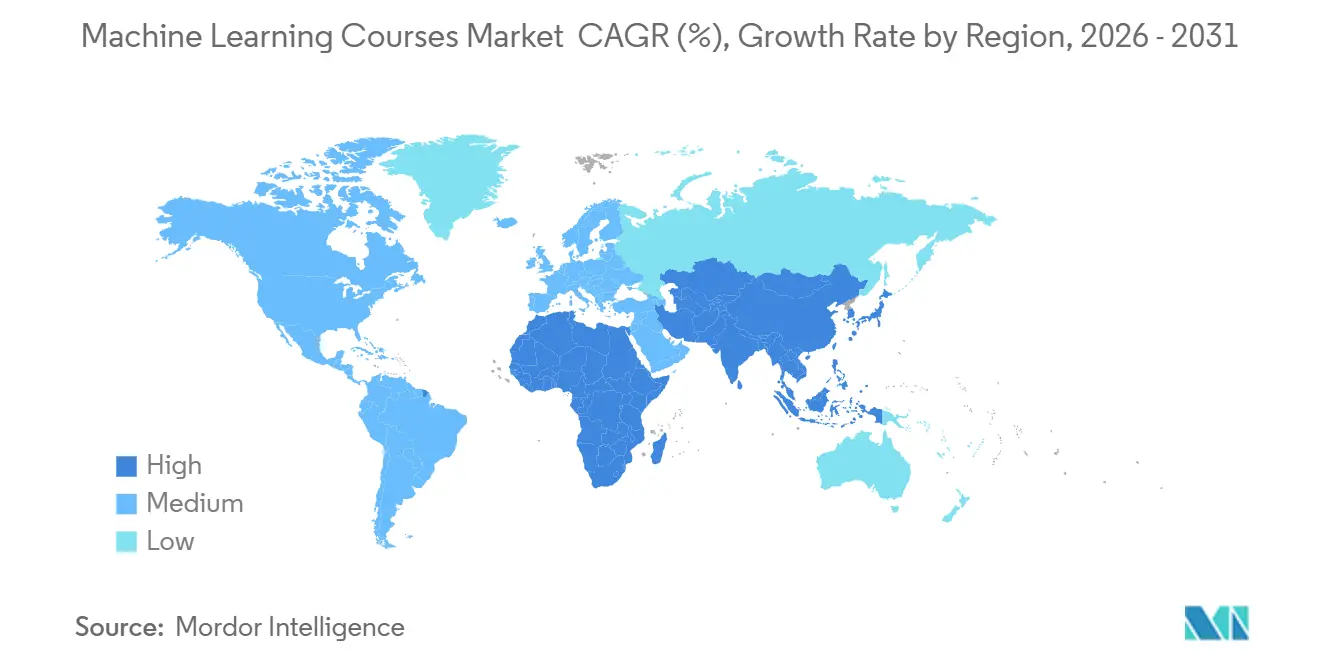
North America held 37.4% of the machine learning courses market share in 2025, and the region is projected to grow at a 15% CAGR through 2031. The United States remains the main anchor for the machine learning courses market because it combines deep technology hiring demand with a mature corporate learning ecosystem and large-scale adoption of online platforms. The World Bank reported that the United States accounted for nearly 30% of global GenAI job vacancies in 2024, with around 84,000 postings compared with roughly 3,000 in 2021. Canada also strengthened the regional demand base, with AI vacancies nearly doubling between 2021 and 2024, according to the same source. South America is projected to grow at a 16.2% CAGR through 2031, and Brazil stands out because GenAI job vacancies increased 82-fold between 2021 and 2024, underscoring the region’s need for scalable training options.
Europe is projected to grow at a 14.8% CAGR through 2031, with demand supported by both labor-market changes and formal regulatory pressure. Germany is the clearest enterprise upskilling case in the region, because the TÜV-Verband found that the share of companies training employees in AI rose from 12% in 2024 to 27% in 2026, while 50% reported a high or very high need for AI training. The EU AI Act adds another layer of urgency because AI literacy obligations have already entered into force, and broader requirements begin applying from August 2026, making it harder for firms using AI systems to postpone documented training. Regional demand is not limited to Germany, as the World Bank recorded around 12,000 GenAI vacancies in the United Kingdom and 53,000 in France in 2024.
Asia-Pacific is the fastest-growing region in the machine learning courses market, with a 15.7% CAGR projected through 2031. India remains a core demand engine, and the World Bank reported that the country sustained roughly 230,000 annual AI-skills job vacancies across 2021 to 2024, which supports continued training demand at scale. Public policy support is also important in the region, and Singapore’s SkillsFuture program remains a useful reference point because it directly funds adult upskilling through an official national framework. Japan also adds depth to the regional opportunity, with AI vacancies nearly doubling between 2021 and 2024, while the University of Tokyo launched an industry-facing deep learning course in 2026 that covers topics such as transformers, large language models, and deep reinforcement learning. The Middle East and Africa add another high-growth layer to the machine learning courses market, with Africa projected at 18.3% CAGR and Western Asia at 17.1% CAGR through 2031, while the World Bank also noted that Kenya recorded a fourfold increase in AI vacancies and that Egypt and Pakistan doubled their AI job postings between 2021 and 2024.
Competitive Landscape
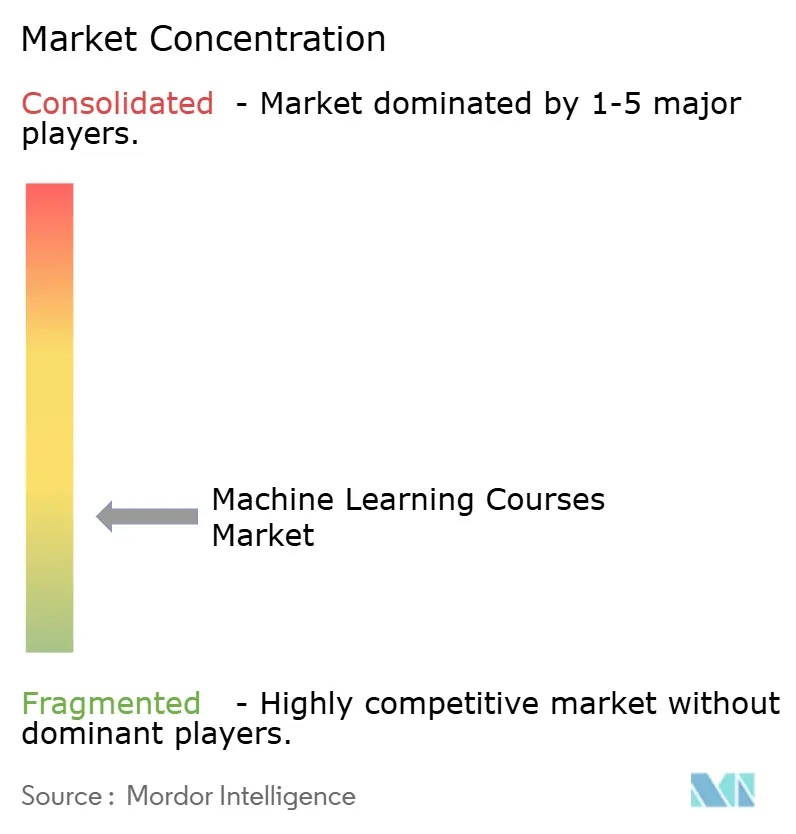
The machine learning courses market remains fragmented because supply is spread across broad MOOC platforms, enterprise learning vendors, academic institutions, specialist ML providers, and technology companies with certification programs. Coursera, Udemy, LinkedIn Learning, DataCamp, and edX remain among the most visible names in the machine learning courses market, but no single provider dominantly controls the field. The strongest recent consolidation move came when Coursera completed its combination with Udemy on May 11, 2026, creating a combined platform with 290 million learners, 18,000 enterprise customers, and 95,000 instructors. That transaction gives the combined business greater scale in catalog breadth, enterprise reach, and learner data, strengthening its position in the machine learning courses market. Even so, specialist providers still retain defensible positions where practitioner credibility, subject depth, or employer trust matters more than sheer catalog size.
Competition in the machine learning courses market is increasingly centered on AI-enabled personalization, credential relevance, and workflow integration. Microsoft expanded its Professional Certificate portfolio on Coursera by more than 50% in early 2026, adding 11 new programs across AI, data, and development, which shows how major technology vendors are using course platforms to shape the skills pipeline around their own tools. Coursera also launched the first learning agent in Microsoft 365 Copilot, signaling that embedded learning in workplace software is becoming a real competitive axis rather than a side feature. Google’s first AI Professional Certificate on Coursera reached nearly 3 million enrollments during its launch year, which underlines how large brand ecosystems can accelerate uptake when the content is closely tied to recognized tools and applied use cases. Anthropic’s launch of five free AI fluency courses on Coursera in 2026 adds another layer of competitive pressure, especially at the entry end of the machine learning courses market, where free content can pull attention away from paid introductory offers.
Academic institutions continue to matter in the machine learning courses market because their brands signal rigor and a deeper curriculum, especially in high-trust, regulated settings. The University of Tokyo’s 2026 deep learning program is a useful example of how universities are extending advanced, structured ML training toward working professionals without relying only on traditional degree pathways. This leaves space for both platform-scale firms and academic providers, but it raises the bar for smaller operators that lack either enterprise distribution or institutional prestige. The best-positioned providers in the machine learning courses market are those that can combine recognized content, verified assessment, enterprise reporting, and regular curriculum refresh without making the learner experience too rigid or too costly.
Machine Learning Courses Industry Leaders
-
Coursera Inc.
-
Udemy, Inc
-
LinkedIn Corporation,
-
DataCamp
-
edX LLC
- *Disclaimer: Major Players sorted in no particular order
Recent Industry Developments
- May 2026: Coursera completed its combination with Udemy, forming a unified platform with 290 million learners, 18,000 enterprise clients, and 95,000 instructors. The transaction, announced in December 2025 and approved by shareholders in April 2026, is the largest consolidation in online learning history and is designed to accelerate AI-native product innovation, including agentic learning solutions.
- April 2026: TÜV-Verband published its Weiterbildungsstudie 2026, confirming that corporate AI training in Germany more than doubled between 2024 and 2026, with 50% of enterprises reporting high or very high AI training needs. The study surveyed 500 companies from January to March 2026 and directly linked the acceleration to EU AI Act compliance pressure.
- March 2026: Coursera launched the first learning agent in Microsoft 365 Copilot, enabling employees to access Coursera courses within Microsoft’s productivity suite. The launch supports a model in which learning is embedded in the workflow rather than separated from daily work.
- January 2026: Anthropic launched five free AI fluency courses on Coursera co-taught by Anthropic instructors. The move nearly doubled the company’s course catalog on the platform and directly targeted educators, students, and nonprofit professionals with content on applied AI skills.
Global Machine Learning Courses Market Report Scope
| Beginner-Level Courses |
| Intermediate-Level Courses |
| Advanced-Level Courses |
| Self-Paced Online Learning |
| Instructor-Led Live Learning |
| Blended Learning |
| Individual Learners |
| Corporate Learners |
| North America | United States |
| Canada | |
| Mexico | |
| South America | Brazil |
| Peru | |
| Chile | |
| Argentina | |
| Rest of South America | |
| Europe | United Kingdom |
| Germany | |
| France | |
| Spain | |
| Italy | |
| BENELUX (Belgium, Netherlands, and Luxembourg) | |
| NORDICS (Denmark, Finland, Iceland, Norway, and Sweden) | |
| Rest of Europe | |
| Asia-Pacific | India |
| China | |
| Japan | |
| Australia | |
| South Korea | |
| South East Asia (Singapore, Malaysia, Thailand, Indonesia, Vietnam, and Philippines) | |
| Rest of Asia-Pacific | |
| Middle East And Africa | United Arab Emirates |
| Saudi Arabia | |
| South Africa | |
| Nigeria | |
| Rest of Middle East And Africa |
| By Courses | Beginner-Level Courses | |
| Intermediate-Level Courses | ||
| Advanced-Level Courses | ||
| By Delivery Mode | Self-Paced Online Learning | |
| Instructor-Led Live Learning | ||
| Blended Learning | ||
| By End User | Individual Learners | |
| Corporate Learners | ||
| By Geography | North America | United States |
| Canada | ||
| Mexico | ||
| South America | Brazil | |
| Peru | ||
| Chile | ||
| Argentina | ||
| Rest of South America | ||
| Europe | United Kingdom | |
| Germany | ||
| France | ||
| Spain | ||
| Italy | ||
| BENELUX (Belgium, Netherlands, and Luxembourg) | ||
| NORDICS (Denmark, Finland, Iceland, Norway, and Sweden) | ||
| Rest of Europe | ||
| Asia-Pacific | India | |
| China | ||
| Japan | ||
| Australia | ||
| South Korea | ||
| South East Asia (Singapore, Malaysia, Thailand, Indonesia, Vietnam, and Philippines) | ||
| Rest of Asia-Pacific | ||
| Middle East And Africa | United Arab Emirates | |
| Saudi Arabia | ||
| South Africa | ||
| Nigeria | ||
| Rest of Middle East And Africa | ||
Key Questions Answered in the Report
What is driving growth in machine learning courses through 2031?
Growth is being supported by stronger employer demand for verified AI skills, a larger non-technical learner base, and compliance-led training demand under frameworks such as the.
How large is the machine learning course space in 2026, and where is it headed?
The machine learning courses market is valued at USD 4.35 billion in 2026 and is forecast to reach USD 8.18 billion by 2031, with a 13.5% CAGR.
Which delivery format leads revenue today?
Self-paced online learning leads with 58.6% of revenue in 2025, mainly because it offers the flexibility individual learners need.
Which customer group is expanding faster, individuals or companies?
Individual learners still lead current revenue with 71.7% in 2025, but corporate learners are growing faster with a 15.2% CAGR through 2031.
Which region is growing the fastest in demand for ML courses?
Asia-Pacific is the fastest-growing region at a 15.7% CAGR, supported by strong hiring demand, public upskilling programs, and broader digital adoption.
What is the main risk for self-paced ML learning platforms?
The biggest risk is low completion, because peer-reviewed research shows many self-paced learners do not finish technical courses, which can weaken repeat demand and certificate credibility.