
Artificial Intelligence Courses Market Size and Share
Market Overview
| Study Period | 2021 - 2031 |
|---|---|
| Market Size (2026) | USD 8.25 Billion |
| Market Size (2031) | USD 16.57 Billion |
| Growth Rate (2026 - 2031) | 14.97 % |
| Fastest Growing Market | Asia-Pacific |
| Largest Market | North America |
| Market Concentration | Medium |
Major Players *Disclaimer: Major Players sorted in no particular order Image © Mordor Intelligence. Reuse requires attribution under CC BY 4.0. | |
Artificial Intelligence Courses Market Analysis by Mordor Intelligence
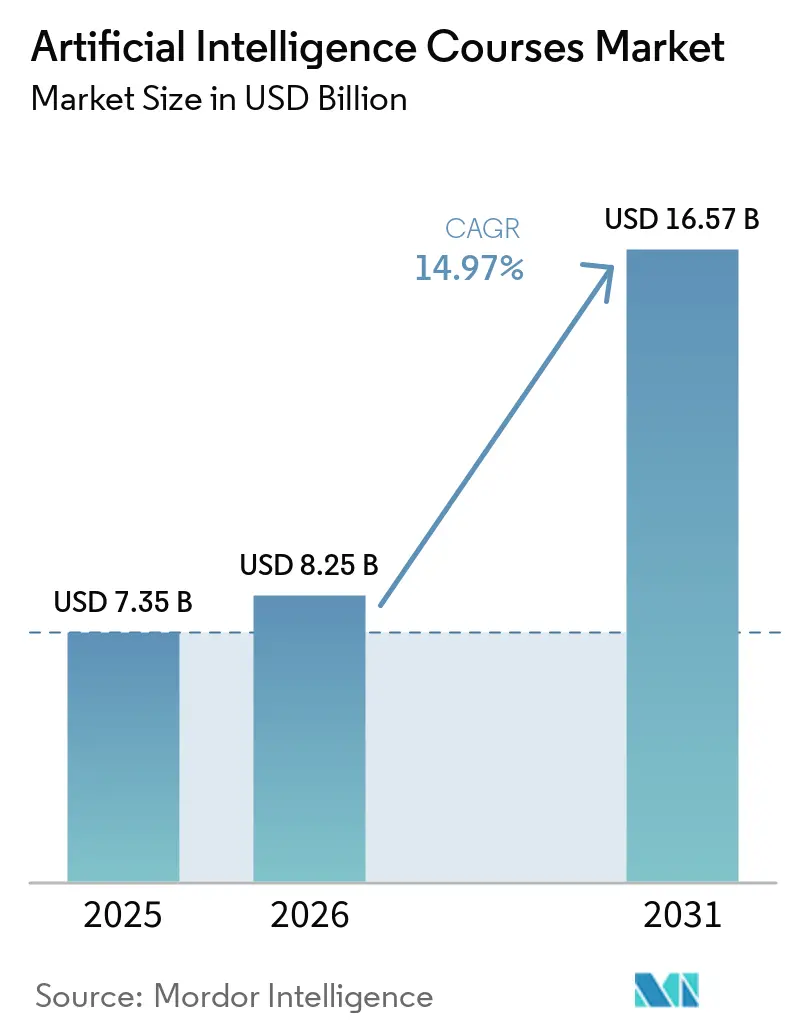
The Global Artificial Intelligence Courses Market is expected to grow from USD 7.35 billion in 2025 to USD 8.25 billion in 2026 and is forecast to reach USD 16.57 billion by 2031 at 14.97% CAGR over 2026 - 2031. Growth is driven by increasing enterprise AI investments, with the Federal Reserve Bank of Atlanta estimating private-firm AI investment at USD 280 billion in 2026, following a rise in per-employee spending from 2025 levels. Organizations are increasingly treating AI training as a critical operational need rather than a standard learning and development activity[1]. Demand is expanding beyond core data science roles, supporting revenue growth across technical, business, and compliance-focused learning paths. Provider competition is shifting toward measurable outcomes, vendor-linked credentials, and structured delivery formats, altering pricing dynamics in the market. This shift is fostering growth in specialized training programs, such as vendor academies and governance-focused courses, even as entry-level offerings become more prevalent.
Key Report Takeaways
- By course subject, Generative AI and Large Language Models held 26.91% of the Global Artificial Intelligence Courses Market share in 2025, while Reinforcement Learning and Agentic AI are projected to grow at 16.20% CAGR through 2031.
- By learning mode, self-paced online courses accounted for 45.83% of the Global Artificial Intelligence Courses Market size in 2025, while cohort-based bootcamps are projected to grow at the fastest CAGR of 16.26% through 2031.
- By end user, individual learners held 42.62% share of the Global Artificial Intelligence Courses Market in 2025, while corporate enterprises are projected to grow at the fastest CAGR of 15.46% through 2031.
- By credential type, Professional Certificates and Specializations held 31.94% share of the Global Artificial Intelligence Courses Market in 2025, while Vendor Certification Preparation is projected to grow at the fastest CAGR of 15.06% through 2031.
- By provider type, MOOC platforms held 34.03% share of the Global Artificial Intelligence Courses Market in 2025, while cloud and technology vendor academies are projected to grow at a 15.39% CAGR through 2031.
- By geography, North America held 36.42% of the Global Artificial Intelligence Courses Market share in 2025, while Asia-Pacific is projected to grow at the fastest CAGR of 15.93% through 2031.
Note: Market size and forecast figures in this report are generated using Mordor Intelligence’s proprietary estimation framework, updated with the latest available data and insights as of January 2026.
Global Artificial Intelligence Courses Market Trends and Insights
Drivers Impact Analysis*
| Drivers | (~) % Impact on CAGR Forecast | Geographic Relevance | Impact Timeline |
|---|---|---|---|
| Enterprise AI reskilling budgets | +3.8% | Global, led by North America, Western Europe, and Japan | Short term (≤ 2 years) |
| Generative AI course demand surge | +3.2% | Global, with highest intensity in Asia-Pacific, North America | Short term (≤ 2 years) |
| Vendor-backed certifications and cloud-credit programs | +2.1% | North America and Europe, with growing penetration in Asia-Pacific core | Medium term (2-4 years) |
| AI-native personalization and skill diagnostics | +1.5% | Global, with early leadership in North America and spillover to Asia-Pacific | Medium term (2-4 years) |
| Benchmark-replay labs using real enterprise workflows | +1.0% | North America and Europe, with emerging uptake in Asia-Pacific core | Long term (≥ 4 years) |
| AI-governance training demand from compliance buyers | +1.8% | Europe primary, with spillover to North America, Middle East and Africa, and Asia-Pacific | Medium term (2-4 years) |
| Source: Mordor Intelligence | |||
Enterprise AI reskilling budgets
The artificial intelligence courses market is benefiting from a shift in training budgets, now closely tied to enterprise AI implementation. Reports indicate that per-employee AI spending among United States firms increased significantly, driving private-sector AI investments to substantial levels. This shift reflects a growing trend where companies integrate workforce readiness into deployment strategies rather than treating it as a separate human resources decision. In Germany, the proportion of companies offering AI training has grown, with a notable rise in adoption over recent years. A significant percentage of firms already use generative AI in daily operations, underscoring a clear training gap. These developments point to a sustained demand for enterprise AI courses, supporting procurement throughout the forecast period.
Generative AI course demand surge
Generative AI learning is currently driving significant demand in the artificial intelligence courses market. Coursera has observed a substantial increase in enrollments for GenAI courses, with millions of learners participating globally[2]. The demand spans a wide audience, including developers, managers, and functional teams seeking role-specific AI knowledge. Reports associated with AACSB indicate a sharp rise in GenAI course enrollments at business schools, reflecting a shift in interest beyond traditional technical education channels. This growing and diverse demand is supporting consistent growth in the market while creating opportunities for courses that incorporate live instruction, practical projects, and outcomes aligned with workforce needs.
Vendor-backed certifications and cloud-credit programs
The artificial intelligence courses market benefits from vendor credential ecosystems that reduce price sensitivity for technical learners. AWS expanded its AI certification portfolio by introducing the AWS Certified Generative AI Developer – Professional credential. This addition completes a four-tier AI certification pathway, validating expertise in foundation models, RAG architectures, and responsible deployment[3]. Google Cloud also made a significant investment to support agentic AI development, including upskilling credits and technical enablement through certification pathways. These initiatives simplify funding for credential preparation, particularly when combined with software adoption, partner enablement, and training. This approach enhances conversions for cloud-related courses and establishes a steady revenue stream for the artificial intelligence courses market, closely tied to hyperscaler ecosystems.
AI-native personalization and skill diagnostics
The artificial intelligence courses market addresses long-standing challenges of completion and relevance by adopting AI tools. Skillsoft introduced its AI-native Percipio Platform, featuring role-based skills mapping, adaptive learning paths, and business-outcome alignment, which enhance the platform's functionality. Pluralsight expanded its Iris platform to include personalized transcript-based answers and AI-driven translations, improving accessibility in multilingual enterprise environments. Cognizant launched Skillspring, incorporating AI agent-driven tutoring and content creation to integrate learning into daily workflows. These innovations are shifting the market's focus from one-time course completion to continuous skill development, enabling procurement teams to better connect these skills to workforce performance.
Restraints Impact Analysis*
| Restraints | (~) % Impact on CAGR Forecast | Geographic Relevance | Impact Timeline |
|---|---|---|---|
| Credential saturation and employer skepticism | -1.2% | Global, with highest impact in North America and Western Europe | Short term (≤ 2 years) |
| Rapid curriculum obsolescence | -0.8% | Global | Short term (≤ 2 years) to medium term (2-4 years) |
| Shortage of practitioner-instructors | -1.0% | Global, with structural severity in North America, India, and Japan | Medium term (2-4 years) |
| Inference and lab-compute costs for hands-on delivery | -0.7% | Global, with highest constraint in Southeast Asia, Africa, and South America | Medium term (2-4 years) to long term (≥ 4 years) |
| Source: Mordor Intelligence | |||
Credential saturation and employer skepticism
The artificial intelligence courses market is facing pricing challenges as the proliferation of easily accessible certificates complicates employer differentiation. Generic completion badges, while simple to issue, lack effectiveness as hiring tools due to limited independent evaluation during completion. This trend is driving the market toward proctored exams, portfolio-based assessments, and credentials with clear employer recognition. Vendor-supported pathways from AWS, Google, and Microsoft hold a competitive edge because they align with widely used technology stacks in production environments[4]. Providers unable to validate skill attainment risk weaker pricing, lower renewal rates, and reduced enterprise adoption.
Rapid curriculum obsolescence
The artificial intelligence courses market must address a rapid content refresh cycle due to the constant evolution of model capabilities, tools, and deployment practices. Topics such as LLM fine-tuning, RAG architecture, agentic workflow design, and AI product management now require updates more frequently compared to traditional software subjects. AWS revised its Generative AI Developer certification content to include updates like Amazon Bedrock AgentCore, highlighting the necessity for even vendor-controlled content to adapt quickly. This dynamic increases production costs for providers relying on instructor-developed materials and extended catalog cycles. Modular content systems, AI-driven updates, and platform models are becoming essential, enabling lesson and lab revisions without the need to rebuild entire courses.
*Our forecasts treat driver/restraint impacts as directional, not additive. The impact forecasts reflect baseline growth, mix effects, and variable interactions.
Segment Analysis
By Course Subject: Agentic AI Is Moving Enterprise Attention Beyond GenAI Basics
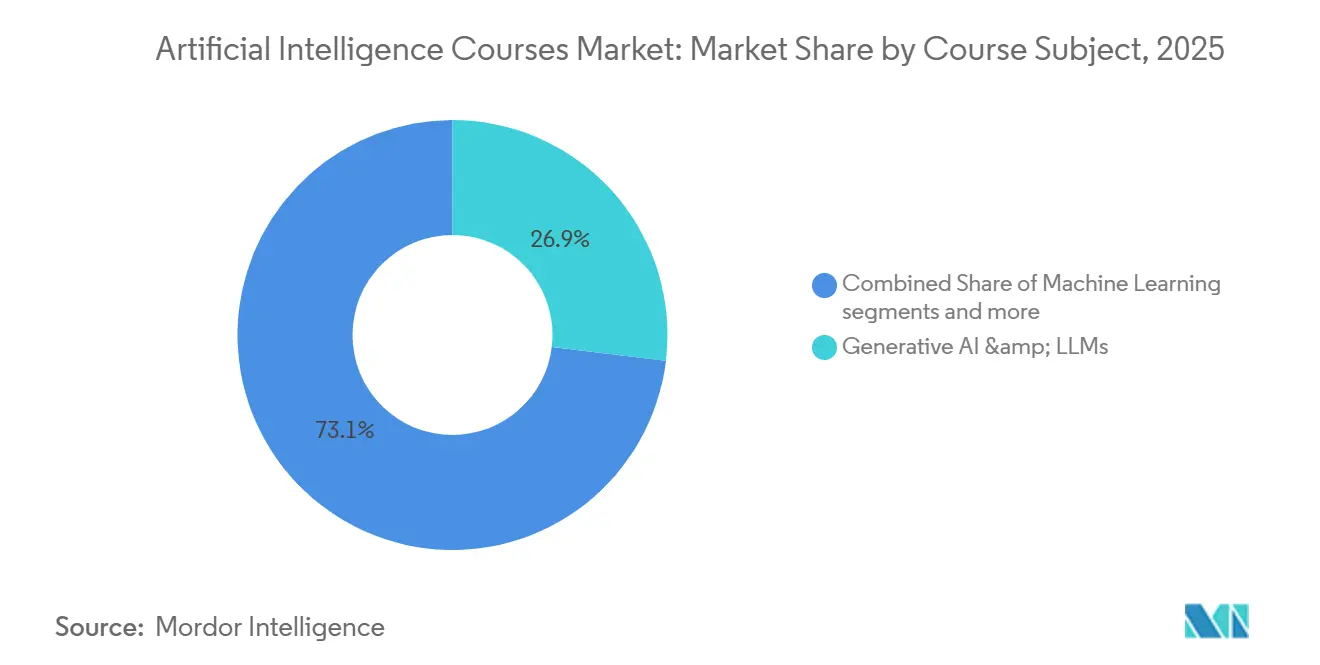
Generative AI and Large Language Models accounted for 26.91% of the artificial intelligence courses market in 2025, driven by increased platform enrollments and the adoption of foundational models. Reinforcement Learning and Agentic AI are expected to grow at a 16.20% CAGR through 2031, reflecting demand for systems capable of multi-step workflows. upGrad identified agentic AI as its most popular course category in early 2026, aligning with enterprise interest in operational autonomy. MLOps and AI Engineering are gaining traction as businesses focus on production reliability, cost management, and deployment governance.
AI for Business and Functional Leaders is receiving more budget allocation as nontechnical teams require AI skills in finance, marketing, customer support, and operations. NLP remains essential for search, service automation, and enterprise knowledge applications. Deep Learning and Neural Networks continue to serve as foundational topics but are increasingly integrated into broader GenAI and applied engineering tracks. DataCamp’s March 2026 AI Engineering track with LangChain reflects this shift by combining workflows, application development, and real-time feedback. The Others category, including Responsible AI, AI Governance, Computer Vision, and vertical use cases, is growing as the market addresses compliance and domain-specific needs.

By Learning Mode: Structured Cohorts Are Growing Faster Than Catalog Learning
Self-paced online courses accounted for 45.83% of the learning mode segment in 2025, maintaining the highest revenue share in the artificial intelligence courses market. Their popularity stems from convenience, affordability, and accessibility for individual learners seeking flexible schedules. Cohort-based bootcamps are projected to grow at a 16.26% CAGR through 2031, driven by employer demand for structured progression, peer accountability, and clear completion outcomes. Pluralsight introduced AI Academy in March 2026, offering a three-level enterprise learning solution for cohorts of 500 to 100,000 participants, reflecting the shift toward structured, large-scale delivery. This trend is steering the market toward contracts focused on measurable skill development rather than enrollment volume.
Instructor-led online delivery remains significant for advanced technical subjects requiring guided problem-solving and live explanations. In-person workshops and executive education address topics such as leadership, governance, and enterprise transformation, which benefit from private discussions and expert access. Simplilearn's 2026 partnerships with Oxford Saïd Business School, Virginia Tech, and UC Santa Barbara highlight the expansion of branded formats in the artificial intelligence courses market. Hybrid and blended formats are gaining traction in Asia-Pacific, where local support enhances retention for learners struggling with fully digital programs. upGrad plans to establish 50 offline learning support centers by FY2027, demonstrating the market's focus on integrating physical touchpoints to improve completion rates in online-first models.
By End User: Corporate Enterprises Are Becoming the Highest-Value Buyer Group
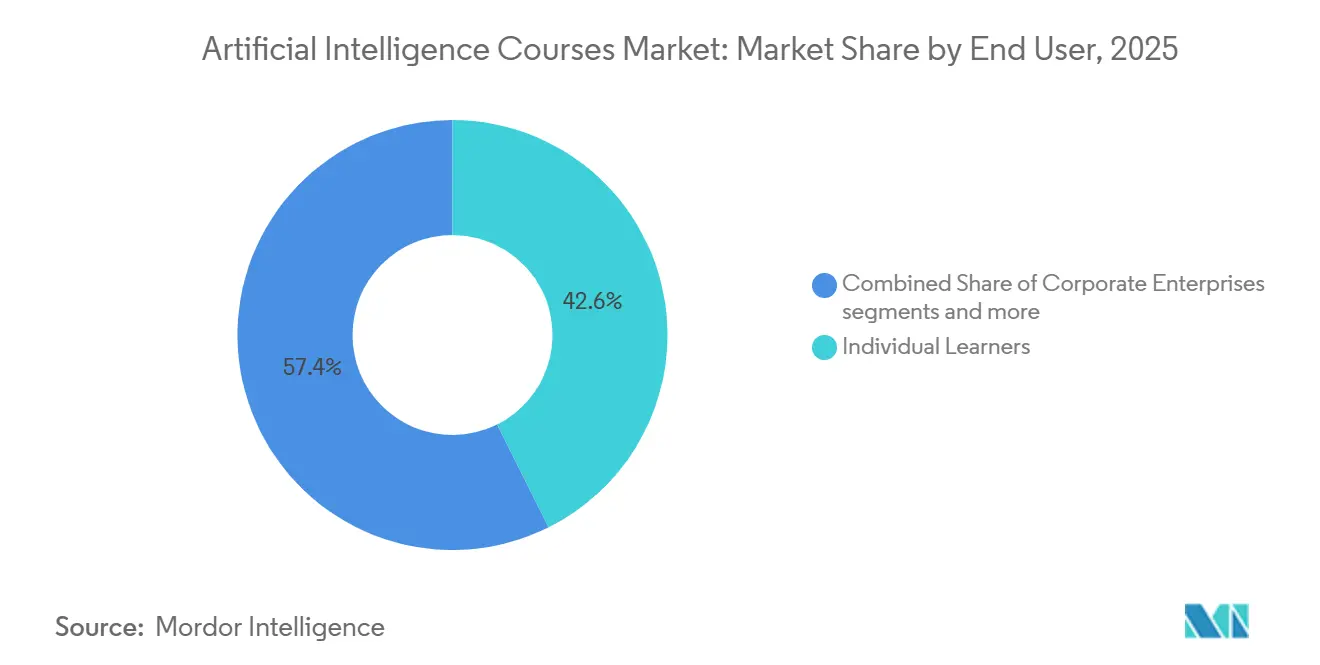
Individual learners accounted for 42.62% of the end-user segment in 2025, making them the largest buyer group in the artificial intelligence courses market. This reflects the significant number of professionals seeking career changes, wage growth, and practical AI training through online platforms. A July 2025 report revealed that 46.9 million workers globally planned to upskill in AI within six months, highlighting strong learner demand. Corporate enterprises are projected to grow at a 15.46% CAGR through 2031 as companies formalize workforce reskilling alongside AI adoption. Coursera's enterprise channel reported a 234% year-over-year increase in GenAI enrollments in 2025, indicating rapid growth in employer-driven demand.
Higher education institutions are increasing AI course adoption for faculty development, curriculum integration, and stackable credentials. The number of United States institutions offering AI bachelor's degrees rose from 4 in 2020 to 23 in 2024, while AI master's programs increased from 19 to 60 during the same period. Government and public sector demand is growing, particularly where national upskilling programs align with labor market needs and digital policies. Training institutes and workforce programs are enhancing local delivery capacity, especially in regions with limited platform access, English-language options, or employer procurement structures. Over time, institutional contracts are expected to gain prominence due to their larger seat volumes, better renewal predictability, and stronger links to measurable workforce outcomes.
By Credential Type: Vendor Preparation Tracks Are Gaining Ground Against Generic Certificates
Professional Certificates and Specializations accounted for 31.94% of the credential segment in the artificial intelligence courses market in 2025, making them the largest format. Their popularity stems from a multi-course structure, clearer progression, and stronger employer recognition compared to single-course completions. Vendor Certification Preparation is expected to grow at a 15.06% CAGR through 2031, driven by cloud platform credential ecosystems and employer demand for stack-specific skills. AWS expanded its certification path in 2026, and Google Cloud introduced its Generative AI Leader certification in May 2025, targeting both technical and business audiences. This shift is steering credential demand toward programs aligned with hiring filters, project deployment, and cloud ecosystem adoption.
Single-course certificates are losing pricing power as employers prioritize evidence of practical skills. Nanodegrees and bootcamp certificates remain relevant for learners seeking portfolio work, career transition support, and intensive formats. Executive education certificates and degree-linked programs are less affected by price pressures due to their brand value, synchronous access, and signaling for leadership and regulated roles. This creates a layered credential structure in the artificial intelligence courses industry, where generic badges address volume demand, while structured programs generate higher revenue per learner. The market is moving toward fewer low-value credentials and more comprehensive programs that integrate assessment, projects, and institutional branding.
By Provider Type: Vendor Academies Are Expanding Within a MOOC-Led Market
MOOC platforms accounted for 34.03% of the provider segment in 2025, dominating the artificial intelligence courses market. Their global reach, extensive course catalog, and partnerships with universities and enterprises drive demand from individuals and institutions. The Coursera-Udemy merger in May 2026 created a platform with 290 million learners and 18,000 enterprise clients. However, volume alone does not ensure growth, as buyers increasingly prioritize delivery quality, rigorous assessments, and alignment with workplace tools. This shift creates opportunities for providers that integrate learning with deployment, certification, and practical skill application.
Cloud and technology vendor academies are projected to grow at a 15.39% CAGR through 2031, driven by employer demand for specialized credentials and subsidized learning paths. Google Cloud’s April 2026 investment of USD 750 million in agentic AI development included upskilling credits and technical enablement, showcasing how vendor ecosystems use training to drive platform adoption. AWS expanded its AI certification pathways in 2026, reinforcing the role of vendor academies in technical training. In high-growth APAC markets like India, this model reduces training friction by combining certification preparation, cloud tool exposure, and workforce enablement in a single procurement cycle. As a result, the artificial intelligence courses market is expected to shift toward ecosystems that integrate content, credentials, and technology relevance.
Geography Analysis
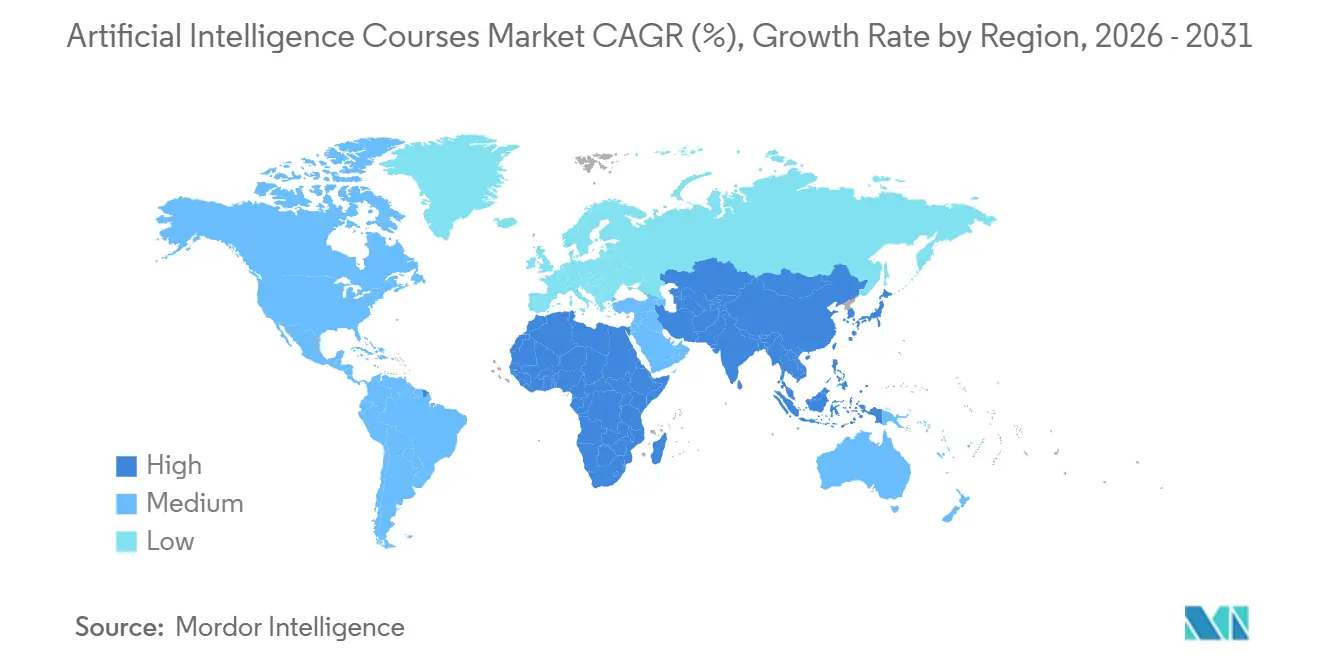
North America accounted for 36.4% of the global artificial intelligence courses market share in 2025, making it the largest regional contributor. The United States drives revenue with a high concentration of enterprise AI adopters and a robust ecosystem of universities, MOOC platforms, cloud academies, and AI training vendors. Enterprise spending remains strong, with USD 280 billion in private-firm AI investments projected for 2026. Google expanded its AI Professional Certificate through partnerships with the United States Chamber of Commerce Foundation and Small Business Development Centers, increasing accessibility. Canada and Mexico contribute through enterprise licensing, workforce programs, and growing demand in technology and services sectors.
Asia-Pacific is projected to grow at a 15.93% CAGR through 2031, positioning it as a key growth region. India recorded 3.6 million GenAI enrollments in 2025, the highest globally, with Simplilearn reporting a 470% year-over-year increase in enrollments. Japan is enhancing AI coursework through institutional efforts and policy support, while China focuses on adult and vocational learning to support enterprise AI training. South Korea, Australia, and Southeast Asia drive growth through enterprise procurement and mobile-first learning models.
Europe shows compliance-driven demand as AI literacy and governance become operational priorities. In Germany, AI training participation among companies rose from 12% in 2024 to 27% in 2026, with 56% using generative AI in daily operations. The United Kingdom expanded its presence with Multiverse raising USD 70 million in primary funding in May 2026 at a USD 2.1 billion valuation, following its acquisition of StackFuel earlier that year. South America, the Middle East, and Africa are emerging markets, with Brazil, the United Arab Emirates, Saudi Arabia, Nigeria, and South Africa advancing through enterprise training and mobile course delivery.
Competitive Landscape
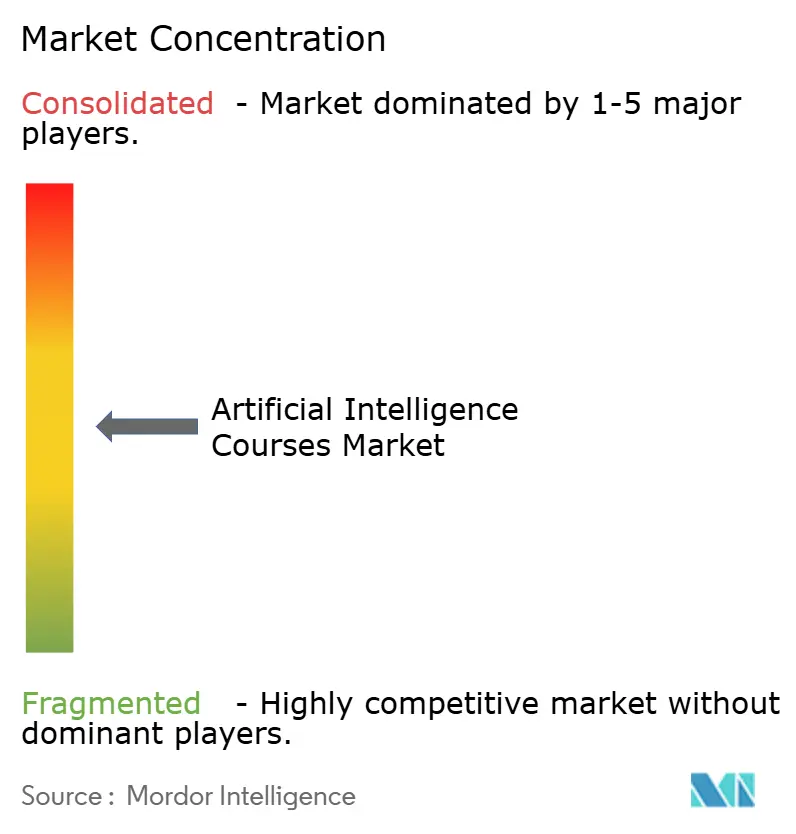
The global artificial intelligence courses market is moderately fragmented, with a significant share held by the top providers. Coursera strengthened its position by merging with Udemy in 2026, creating a platform with a vast learner base, numerous enterprise clients, and substantial combined revenue. This merger enhances competitiveness by enabling broader curriculum investments, improved skills data utilization, and expanded enterprise sales. LinkedIn Learning remains competitive through its integration with Microsoft workplace tools, simplifying distribution within enterprise accounts. Employers now prioritize rigorous assessments, hands-on learning, and training pathways aligned with workflow outcomes over course variety.
Vendor academies are altering pricing dynamics by focusing on ecosystem adoption rather than training revenue. Platforms such as Google Cloud Skills Boost, AWS Skill Builder, and Microsoft Learn subsidize preparation costs, increasing pressure on independent providers in technical certification areas were content overlaps with vendor exam requirements. However, specialized providers maintain relevance by offering employer-verified microcredentials, industry-specific programs, and hybrid delivery models combining live support with portfolio development. Simplilearn collaborates with institutions to deliver structured AI programs, showcasing how independent brands adapt to market demands.
Competitive strategies are shifting toward platforms connecting skills training with practical application and hiring relevance. Pluralsight introduced AI Academy and AI Sandbox in 2026, emphasizing structured enterprise learning with guided labs and expert-led sessions. Google Cloud’s partner investment boosted certification demand through an ecosystem model integrating enablement, sandbox access, and incentives. upGrad enhanced its market position by integrating with OpenAI and acquiring Internshala, linking skill development to hiring pathways. These developments indicate that competitive advantages increasingly depend on ecosystem positioning, skill validation, and distribution capabilities rather than low-cost course offerings.
Artificial Intelligence Courses Industry Leaders
-
Dale Carnegie & Associates
-
FranklinCovey
-
Korn Ferry
-
Center for Creative Leadership
-
Skillsoft
- *Disclaimer: Major Players sorted in no particular order
Recent Industry Developments
- May 2026: Coursera merged with Udemy in an all-stock deal worth USD 2.5 billion, forming a skills platform with 290 million learners and 18,000 enterprise clients. Announced in December 2025 and approved in April 2026, the merger targets USD 115 million in cost synergies and enhances AI-driven skills intelligence.
- May 2026: Multiverse secured USD 70 million in funding at a USD 2.1 billion valuation, led by Schroders Capital with participation from General Catalyst, Lightspeed Venture Partners, and D1 Capital Partners. Following its January 2026 acquisition of StackFuel, it plans to expand in Europe and train 100,000 German workers in AI skills.
- April 2026: Google Cloud has committed USD 750 million to advance partners' agentic AI development through upskilling credits, Gemini Enterprise practice building, and sandbox environments. The program integrates AI training incentives into partner certification pathways, driving significant Google Cloud Skills Boost certification demand via the partner ecosystem.
- April 2026: Pluralsight introduced its AI Sandbox with enhanced guided learning and integrations with Workday, Cornerstone, SuccessFactors, and Edcast. It also expanded Instructor-Led Training through the AI Builder Series and virtual AWS Authorized Training, supporting enterprises needing expert assistance for urgent AI skill development beyond self-paced learning.
Global Artificial Intelligence Courses Market Report Scope
| Generative AI and Large Language Models |
| Machine Learning |
| Deep Learning and Neural Networks |
| Natural Language Processing |
| Reinforcement Learning and Agentic AI |
| MLOps and AI Engineering |
| AI for Business and Functional Leaders |
| Others (Computer Vision, Responsible AI & AI Governance, Industry-specific AI Applications) |
| Self-paced Online |
| Instructor-led Online |
| Cohort-based Bootcamps |
| Hybrid / Blended |
| In-person Workshops and Executive Education |
| Individual Learners |
| Corporate Enterprises |
| Higher Education Institutions |
| Government and Public Sector |
| Training Institutes and Workforce Programs |
| Single-course Certificates |
| Professional Certificates and Specializations |
| Nanodegrees and Bootcamp Certificates |
| Executive Education Certificates |
| Degree-linked Programs and Academic Credits |
| Vendor Certification Preparation |
| North America | United States |
| Canada | |
| Mexico | |
| South America | Brazil |
| Peru | |
| Chile | |
| Argentina | |
| Rest of South America | |
| Europe | United Kingdom |
| Germany | |
| France | |
| Spain | |
| Italy | |
| BENELUX (Belgium, Netherlands, and Luxembourg) | |
| NORDICS (Denmark, Finland, Iceland, Norway, and Sweden) | |
| Rest of Europe | |
| Asia-Pacific | India |
| China | |
| Japan | |
| Australia | |
| South Korea | |
| South East Asia (Singapore, Malaysia, Thailand, Indonesia, Vietnam, and Philippines) | |
| Rest of Asia-Pacific | |
| Middle East And Africa | United Arab Emirates |
| Saudi Arabia | |
| South Africa | |
| Nigeria | |
| Rest of Middle East And Africa |
| By Course Subject | Generative AI and Large Language Models | |
| Machine Learning | ||
| Deep Learning and Neural Networks | ||
| Natural Language Processing | ||
| Reinforcement Learning and Agentic AI | ||
| MLOps and AI Engineering | ||
| AI for Business and Functional Leaders | ||
| Others (Computer Vision, Responsible AI & AI Governance, Industry-specific AI Applications) | ||
| By Learning Mode | Self-paced Online | |
| Instructor-led Online | ||
| Cohort-based Bootcamps | ||
| Hybrid / Blended | ||
| In-person Workshops and Executive Education | ||
| By End User | Individual Learners | |
| Corporate Enterprises | ||
| Higher Education Institutions | ||
| Government and Public Sector | ||
| Training Institutes and Workforce Programs | ||
| By Credential Type | Single-course Certificates | |
| Professional Certificates and Specializations | ||
| Nanodegrees and Bootcamp Certificates | ||
| Executive Education Certificates | ||
| Degree-linked Programs and Academic Credits | ||
| Vendor Certification Preparation | ||
| By Geography | North America | United States |
| Canada | ||
| Mexico | ||
| South America | Brazil | |
| Peru | ||
| Chile | ||
| Argentina | ||
| Rest of South America | ||
| Europe | United Kingdom | |
| Germany | ||
| France | ||
| Spain | ||
| Italy | ||
| BENELUX (Belgium, Netherlands, and Luxembourg) | ||
| NORDICS (Denmark, Finland, Iceland, Norway, and Sweden) | ||
| Rest of Europe | ||
| Asia-Pacific | India | |
| China | ||
| Japan | ||
| Australia | ||
| South Korea | ||
| South East Asia (Singapore, Malaysia, Thailand, Indonesia, Vietnam, and Philippines) | ||
| Rest of Asia-Pacific | ||
| Middle East And Africa | United Arab Emirates | |
| Saudi Arabia | ||
| South Africa | ||
| Nigeria | ||
| Rest of Middle East And Africa | ||
Key Questions Answered in the Report
What is the current size of the artificial intelligence courses market?
The artificial intelligence courses market was valued at USD 7.35 billion in 2025 and is expected to reach USD 8.25 billion in 2026 before rising to USD 16.57 billion by 2031.
What is driving demand for AI courses globally?
Enterprise reskilling budgets, strong demand for generative AI learning, and vendor-backed certification ecosystems are the main growth factors supporting the artificial intelligence courses market.
Which course subject leads revenue in 2025?
Generative AI and Large Language Models led the subject mix with a 26.91% share in 2025, while Reinforcement Learning and Agentic AI is expected to grow the fastest at 16.26% CAGR through 2031.
Which learning format is expanding the fastest?
Self-paced learning remains the largest format, but cohort-based bootcamps are growing the fastest at 16.26% CAGR because employers prefer structured progress and clearer completion outcomes.
Which region is growing the fastest for AI learning demand?
Asia-Pacific is projected to post the fastest growth at 15.93% CAGR through 2031, supported by high enrollment momentum in India and wider workforce skilling demand across the region.
How concentrated is competition among course providers?
Competition is moderate rather than highly consolidated. The top 5 providers held 52% of the market in 2025, and the Coursera-Udemy combination has increased scale at the top without removing room for specialist providers.