
Nursing Education Market Size and Share
Market Overview
| Study Period | 2021 - 2031 |
|---|---|
| Market Size (2026) | USD 18.68 Billion |
| Market Size (2031) | USD 22.98 Billion |
| Growth Rate (2026 - 2031) | 4.23 % |
| Fastest Growing Market | Asia-Pacific |
| Largest Market | North America |
| Market Concentration | Low |
Major Players *Disclaimer: Major Players sorted in no particular order Image © Mordor Intelligence. Reuse requires attribution under CC BY 4.0. | |
Nursing Education Market Analysis by Mordor Intelligence
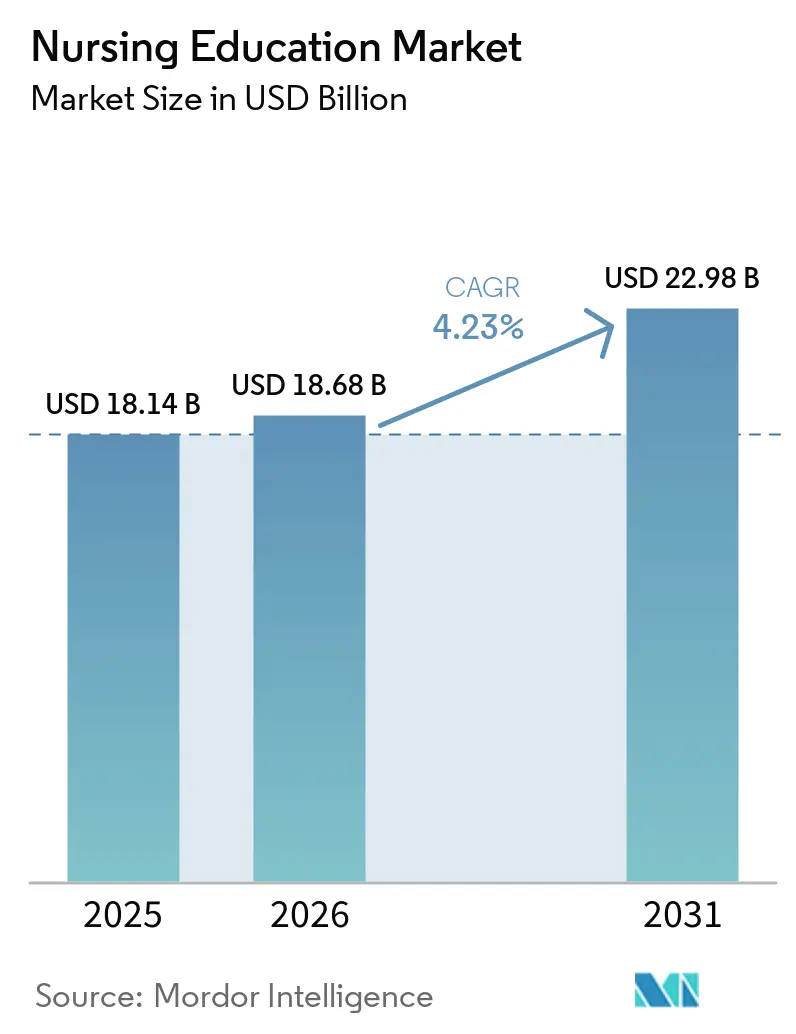
The Global Nursing Education Market was valued at USD 18.14 billion in 2025 and estimated to grow from USD 18.68 billion in 2026 to reach USD 22.98 billion by 2031, at a CAGR of 4.23% during the forecast period (2026 - 2031). Workforce shortages continue to drive demand, as the global nursing shortage, estimated at 5.8 million in 2023, is expected to narrow to 4.1 million by 2030. This sustains the need for registered nurse training and certification programs across various care settings. Capacity constraints significantly impact the market, with demand exceeding institutional capacity[1]. In 2025, 821,491 applications were submitted to United States baccalaureate and higher degree nursing programs, but 93,176 qualified applications were rejected due to faculty and clinical site shortages. Advanced practice roles are also driving growth, as employment for nurse practitioners, nurse anesthetists, and nurse midwives is projected to increase by 40% from 2024 to 2034, boosting demand for postgraduate pathways and credentials. The shrinking educator pipeline remains a critical challenge. The United States nursing faculty vacancy rate reached 7.2% in 2025, and the average age of doctorally prepared full professors was 60.2 years. These factors limit the ability of institutions to expand capacity, despite strong student interest in nursing education.
Key Report Takeaways
- By program type, undergraduate nursing programs commanded a 51.83% share of the Global Nursing Education Market in 2025, while postgraduate and advanced nursing programs are projected to grow at the highest CAGR of 5.62% by 2031.
- By delivery mode, traditional classroom delivery held a 67.94% share of the Global Nursing Education Market in 2025, while online nursing degrees are projected to grow at the highest CAGR of 5.94% by 2031.
- By end user, individual students accounted for a 71.31% share of the Global Nursing Education Market in 2025, while healthcare organizations and employers are projected to expand at the highest CAGR of 4.98% by 2031.
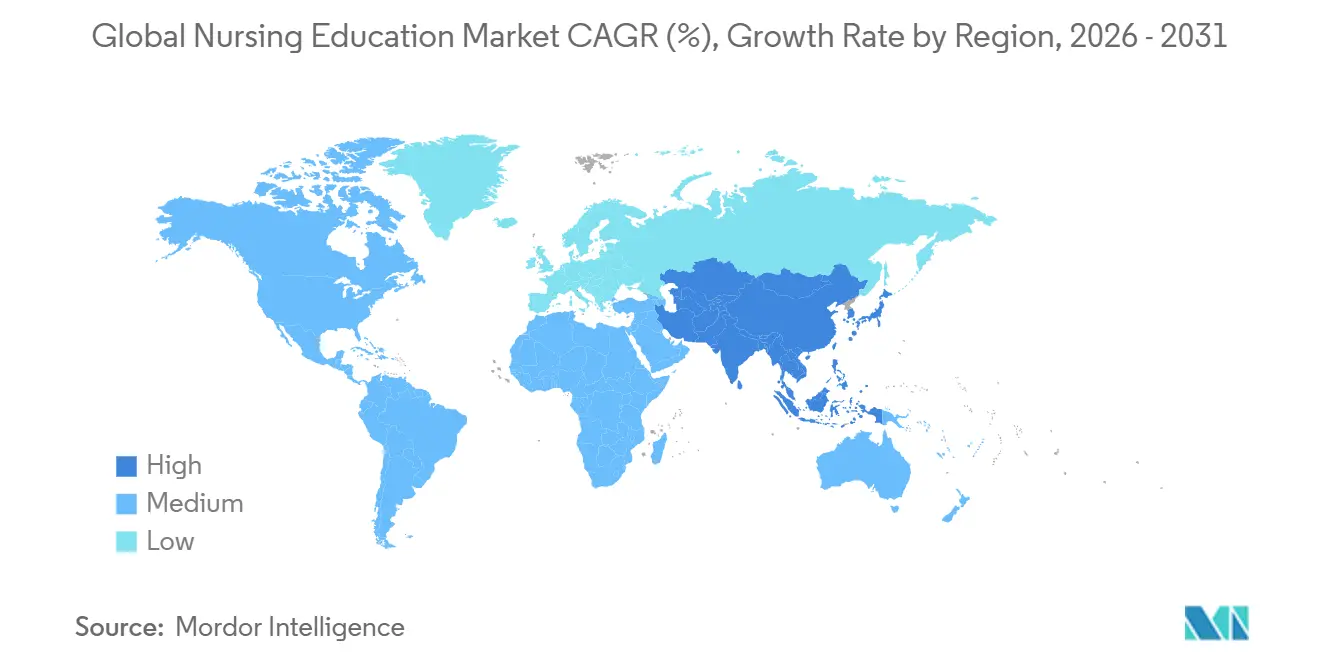
- By geography, North America held a 35.72% share of the Global Nursing Education Market in 2025, while Asia Pacific is projected to grow at the highest CAGR of 5.83% by 2031.
Note: Market size and forecast figures in this report are generated using Mordor Intelligence’s proprietary estimation framework, updated with the latest available data and insights as of January 2026.
Global Nursing Education Market Trends and Insights
Drivers Impact Analysis*
| Driver | (~) % Impact on CAGR Forecast | Geographic Relevance | Impact Timeline |
|---|---|---|---|
| Rising Global Shortage of Qualified Nurses | +1.2% | Global | Long term (≥ 4 years) |
| Expansion of Online and Hybrid Nursing Programs | +0.9% | North America, Asia-Pacific, Europe | Medium term (2-4 years) |
| Growing Demand for Advanced Practice and Specialized Nursing Skills | +0.7% | North America, Europe, Oceania | Medium term (2-4 years) |
| Expansion of Nursing Simulation, Virtual Labs, and Digital Assessment Tools | +0.5% | Global, concentrated in North America and Asia-Pacific | Short term (≤ 2 years) |
| Government Funding, Scholarships, and Workforce Pipeline Programs | +0.5% | Middle East and Africa, South America, Asia-Pacific core | Medium term (2-4 years) |
| Rising Cross-Border Mobility and International Curriculum Alignment | +0.3% | Global, spill-over to Middle East and Africa and Southeast Asia | Long term (≥ 4 years) |
| Source: Mordor Intelligence | |||
Rising Global Shortage of Qualified Nurses
The Global Nursing Education Market is driven by a persistent workforce deficit across regions. A significant nursing shortage has been reported globally, with a large proportion of nurses concentrated in countries representing less than half of the world’s population. This imbalance continues to elevate training demand in underserved areas while sustaining replacement needs in developed systems with high retirement rates. In the United States, employment for registered nurses is expected to grow steadily over the next decade, with workforce replacement alone supporting consistent enrollment demand. The market remains closely tied to policy and supply constraints rather than discretionary factors, ensuring resilience even during periods of reduced education spending[2].
Expansion of Online and Hybrid Nursing Programs
The growth of online and hybrid formats remains a key factor in the expansion of the Global Nursing Education Market. These formats allow institutions to address physical capacity limitations while upholding clinical standards. Enrollment in nursing schools has shown consistent growth, reflecting the increasing adoption of models that improve access and streamline pathways to licensure. Hybrid structures are particularly effective, as they enable theoretical learning to be conducted online while practical training is supported through simulations and partner facilities[3]. This approach is especially advantageous for working professionals and career changers, as flexible schedules reduce barriers to continuing education and sustain demand in the market. The competitiveness of programs now depends more on clinical partnerships, learner support, and ensuring accessible completion pathways rather than solely focusing on campus-based offerings.
Growing Demand for Advanced Practice and Specialized Nursing Skills
The demand for advanced practice roles is broadening the focus of the Global Nursing Education Market beyond prelicensure training. Enrollment in Doctor of Nursing Practice (DNP) programs in the United States has shown consistent annual growth, extending for over two decades. Projections from the United States Bureau of Labor Statistics indicate significant employment growth for nurse practitioners, nurse anesthetists, and nurse midwives over the next decade, supporting the ongoing need for graduate and doctoral pathways. Programs like Penn Nursing’s Johnson & Johnson Nurse Innovation Fellowship emphasize the increasing importance of leadership and system management development in nursing education, alongside traditional clinical training. This shift reflects a growing preference for programs that combine clinical specialization, leadership skills, and career advancement opportunities, driving the evolution of the Global Nursing Education Market.
Expansion of Nursing Simulation, Virtual Labs, and Digital Assessment Tools
Simulation-based learning is increasingly central to the Global Nursing Education Market due to ongoing limitations in clinical placement capacity. A survey by Wolters Kluwer and the National League for Nursing highlighted a significant rise in virtual reality usage in nursing schools, with adoption nearly doubling over four years. More than half of respondents indicated plans to implement VR soon. Western Governors University emphasized this shift by establishing the DeLuca WGU Clinical Learning and Simulation Center in Orlando, which supports thousands of experiential sessions annually. This followed the earlier opening of a simulation center in Indianapolis, further demonstrating the growing importance of simulation as core infrastructure. Institutions with dedicated simulation facilities gain advantages in student recruitment, academic support, and clinical readiness, reflecting the increasing reliance on these resources in nursing education.
Restraints Impact Analysis*
| Restraint | (~) % Impact on CAGR Forecast | Geographic Relevance | Impact Timeline |
|---|---|---|---|
| High Tuition Costs and Learner Financing Constraints | -0.7% | North America, Europe | Medium term (2-4 years) |
| Faculty Shortages and Aging Nurse Educator Workforce | -0.8% | North America, Oceania, spill-over to Asia-Pacific | Long term (≥ 4 years) |
| Limited Clinical Placement Capacity and Hospital Partnership Bottlenecks | -0.5% | Global, concentrated in high-density urban markets | Medium term (2-4 years) |
| Accreditation Complexity and Cross-Jurisdiction Curriculum Compliance Burden | -0.3% | North America and European Union, with early-stage impact in Asia-Pacific | Long term (≥ 4 years) |
| Source: Mordor Intelligence | |||
High Tuition Costs and Learner Financing Constraints
Challenges related to tuition and financing continue to affect the Global Nursing Education Market, particularly in postgraduate and advanced practice programs, where program costs are higher. A decline in the percentage of young individuals aspiring to become nurses has been observed, reflecting concerns about the return on investment in nursing education. Educational institutions are addressing these issues by offering financing support instead of waiting for policy changes. For instance, Western Governors University’s ReNEW Fund highlights how affordability has shifted from being solely a social policy concern to a competitive factor. The market is expected to favor providers that offer flexible program delivery while minimizing financial barriers, especially for learners sensitive to costs[4].
Faculty Shortages and Aging Nurse Educator Workforce
Faculty shortages remain a critical structural challenge in the Global Nursing Education Market, as they restrict seat availability even when student demand is high. Reports indicate a significant number of full-time faculty vacancies across member schools, resulting in a notable national vacancy rate in the United States. The issue is compounded by the age profile of educators, with doctorally prepared full professors nearing retirement age, and most vacant positions requiring a doctoral degree. Furthermore, enrollment in PhD nursing programs has continued to decline, extending a long-term trend and reducing the future pool of qualified academic professionals. These factors highlight that the market is constrained not only by student interest but also by the limited capacity to replenish qualified educators.
*Our forecasts treat driver/restraint impacts as directional, not additive. The impact forecasts reflect baseline growth, mix effects, and variable interactions.
Segment Analysis
By Program Type: Undergraduate Enrollment Anchors the Market, Postgraduate Defines Its Growth
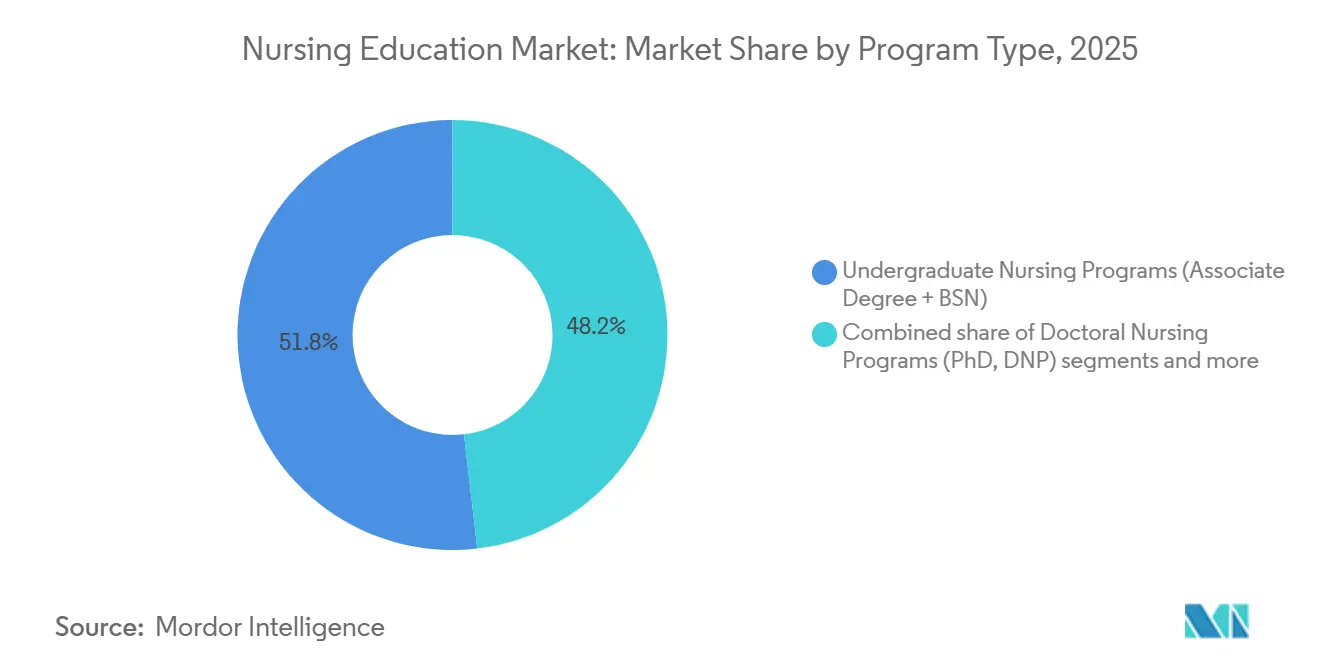
Undergraduate nursing programs accounted for 51.83% of the Global Nursing Market size in 2025, highlighting the importance of entry-level education. Entry-level Bachelor of Science in Nursing (BSN) enrollment in the United States rose to 267,889 students in 2025, a 4.9% increase from the previous year, marking three consecutive years of growth after a decline in 2022. The BSN pathway continues to grow as hospitals in 23 United States either required or strongly preferred this credential for initial hiring, reducing the role of associate degree programs. Diploma and certificate programs remain relevant in lower-income regions where four-year degree requirements are not yet standard, sustaining undergraduate program scale while addressing cost-sensitive systems.
Postgraduate and advanced nursing programs are the fastest-growing segment in the Global Nursing Education Market, projected to grow at a 5.62% compound annual growth rate (CAGR) through 2031. Doctor of Nursing Practice (DNP) enrollment increased to 44,976 in 2025, a 5.9% year-over-year rise, while master’s program enrollment grew by 4.8% to 146,718 students. Practice-focused DNP pathways are expanding, while research-focused PhD enrollment continues to decline, reflecting a preference for credentials aligned with workforce roles, clinical autonomy, and leadership opportunities. Postgraduate program growth is reshaping the market’s future composition, though undergraduate programs remain the largest revenue contributor.

By Delivery Mode: Traditional Delivery Holds Scale, Online Captures the Growth
Traditional classroom-based delivery accounted for 67.94% of the Global Nursing Education Market size in 2025, reflecting the reliance of prelicensure programs on supervised labs and clinical instruction. Campus-led and hybrid models remain essential, as nursing education cannot fully transition to asynchronous learning without compromising clinical readiness. Grand Canyon University expanded its accelerated BSN capacity by opening a site in Miramar, Florida, in May 2026, highlighting the continued demand for physical and hybrid facilities. Blended learning also plays a strategic role, allowing institutions to scale theoretical instruction while maintaining local clinical engagement. Traditional delivery methods continue to dominate, even as newer formats enhance flexibility.
Online nursing degrees are projected to grow at a 5.94% compound annual growth rate (CAGR) from 2026 to 2031, making them the fastest-growing segment in the Global Nursing Education Market. Growth is strongest in post-licensure programs, including RN to BSN, graduate, and continuing education formats, where working nurses benefit from scheduling flexibility and reduced geographic barriers. Grand Canyon University introduced a fully online Associate of Science in Pre-Nursing degree in May 2026, extending digital models to earlier stages of education. However, online growth relies on strong clinical partnerships and credible assessment infrastructure. The industry is moving toward digitally enabled models that address access challenges while maintaining clinical standards.
By End User: Individual Students Lead Demand, Institutional Procurement Accelerates
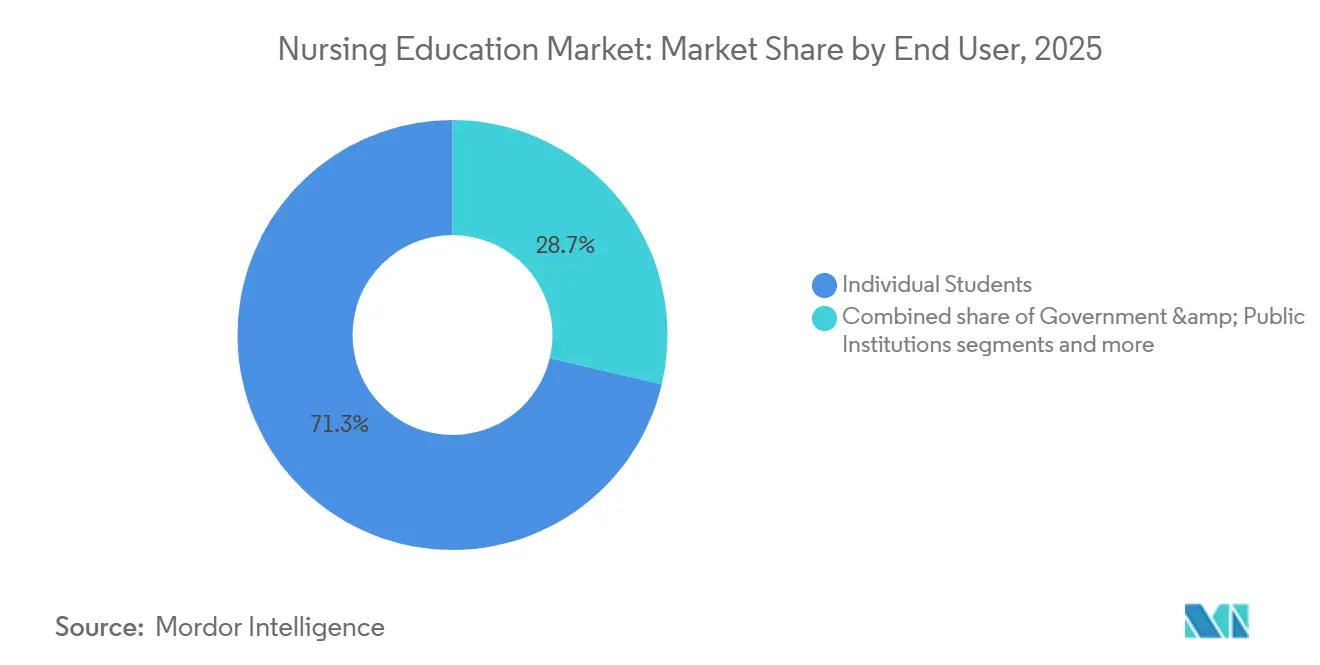
Individual students represented 71.31% of the Global Nursing Education Market share in 2025, confirming that direct learner demand is the primary revenue driver. In the United States, 821,491 individuals applied to baccalaureate and higher degree nursing programs in 2025, the highest figure recorded in the provided data. Tuition design, financing support, scheduling flexibility, and progression pathways remain critical for provider competition. Workforce shortages sustain demand for both entry-level programs and return-to-study pathways for licensed nurses. This broad learner base stabilizes the market, even amid uneven institutional procurement cycles.
Healthcare organizations and employers are projected to grow at a 4.98% CAGR through 2031, reflecting increased employer-linked demand. Hospitals and health systems are investing in workforce development due to the rising costs and challenges of replacing bedside nurses and filling specialty roles. Government and public institutions, though smaller contributors, play a key role in lower-income and reforming systems where public funding supports capacity building. For example, the Asian Development Bank approved USD 77 million in 2025 for nursing education reform in Turkmenistan, supporting curriculum modernization and workforce expansion. The market is expected to remain learner-driven while gradually incorporating more employer and public sector funding.
Geography Analysis
North America accounted for 35.72% of the Global Nursing Education Market in 2025, driven by the United States' large nursing workforce, extensive university infrastructure, and consistent replacement demand. Registered nurse employment in the United States is projected to grow 5% from 2024 to 2034, with 189,100 annual job openings expected. Capacity challenges persist, as shown by record application volumes and the rejection of qualified applicants due to faculty and clinical resource constraints. Canada supports stable enrollment through public healthcare demand and established university systems.
Europe remains a mature market, with growth driven by workforce replacement needs and regulatory requirements. The United Kingdom is a key market, with King’s College London ranked among the top 2 globally in nursing in 2026. Germany, France, Spain, and Italy face medium-term replacement demand due to aging healthcare workforces, while stricter accreditation and public funding limit private sector expansion. BENELUX and Nordic countries prioritize stable institutional investment through national competency frameworks.
Asia Pacific is the fastest-growing region, with a projected 5.83% CAGR through 2031. Growth is driven by large populations, workforce shortages, and interest in internationally benchmarked training. Penn Nursing’s Vietnam partnership established the first ACEN-accredited nursing program in the country, aligning curricula with global standards. Africa faces educational deficits, creating demand for new nursing programs. This aligns with World Health Organization findings on uneven nurse distribution and underserved populations. The Global Nursing Education Market relies on capacity creation, regulatory alignment, and access-focused delivery models rather than demand generation alone.
Competitive Landscape
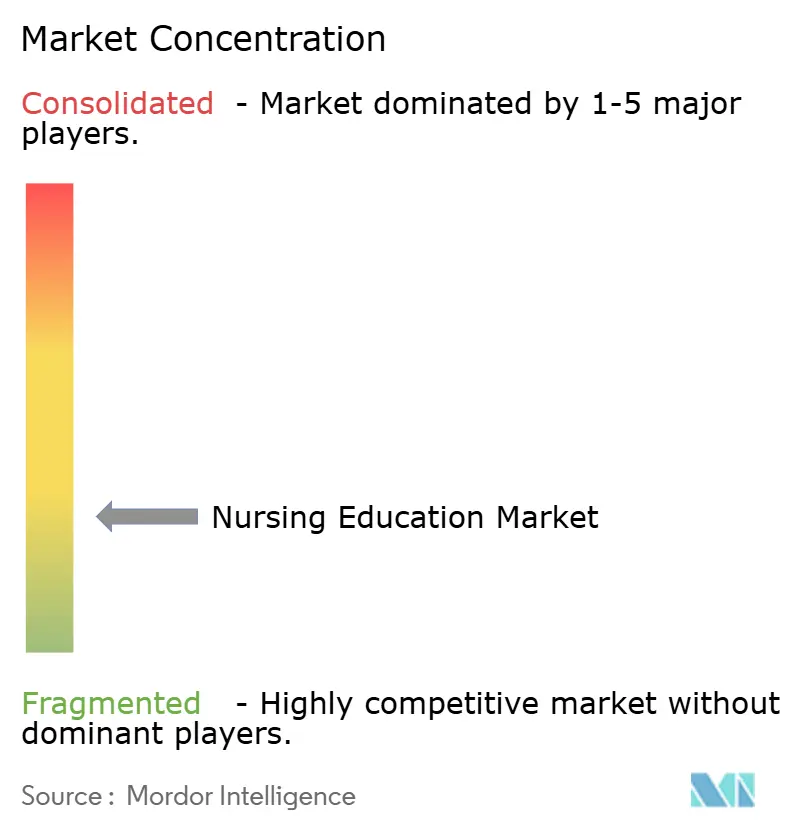
The Global Nursing Education Market is fragmented, with the top institutions holding a significant combined market share. Key institutions include Chamberlain University, Walden University, Western Governors University, Grand Canyon University, and Purdue University Global. Frontier Nursing University and Capella University strengthen the online and advanced pathway segment. Other notable institutions include Johns Hopkins University, University of Pennsylvania, University of California, Los Angeles, University of Michigan School of Nursing, University of Toronto, University of Sydney, University of North Carolina at Chapel Hill, University of Washington, Emory University, Monash University, Duke University School of Nursing, King’s College London, and the University of Edinburgh School of Nursing. The market balances scale operators, academic institutions, and specialized providers.
A key strategy in the market is expanding physical and simulation-based training capacity. Western Governors University expanded its simulation facilities with centers in Indianapolis and Orlando, addressing clinical placement constraints. Grand Canyon University opened an accelerated BSN site in Miramar and launched an online pre-nursing feeder program, focusing on controlled pathways from entry to clinical readiness. Another strategy involves research and accreditation-driven growth. Penn Nursing helped establish the first ACEN-accredited nursing program in Vietnam, showcasing curriculum export and quality assurance. Johns Hopkins School of Nursing ranked highly for DNP and master’s programs. King’s College London retained a top global nursing ranking. Opportunities remain in employer-sponsored upskilling, simulation delivery, and internationally aligned credential pathways.
Nursing Education Industry Leaders
-
Chamberlain University
-
Walden University
-
Western Governors University
-
Grand Canyon University
-
Purdue University Global
- *Disclaimer: Major Players sorted in no particular order
Recent Industry Developments
- May 2026: Grand Canyon University expanded its Florida presence by opening a new accelerated BSN site in Miramar, welcoming its first cohort of ABSN students. The university now operates 12 ABSN sites across eight states and graduated over 4,100 undergraduate nursing students in the 2025-26 academic year.
- May 2026: Grand Canyon University launched its first associate-level program, the Associate of Science in Pre-Nursing. This 60-credit, fully online degree is designed to transition students into the university's accelerated Bachelor of Science in Nursing (BSN) track.
- April 2026: Penn Nursing partnered with VinUniversity in Vietnam to achieve initial ACEN accreditation, making it the first nursing program in Vietnam to meet United States standards. The first cohort graduated in 2025 with a 100% completion rate.
- January 2026: Western Governors University opened the DeLuca WGU Clinical Learning and Simulation Center in Orlando, developed as part of a USD 15.5 million philanthropic investment from DeLuca Philanthropy (with USD 5.5 million directly funding the center and USD 10 million allocated to the ReNEW student loan fund). The facility hosts approximately 3,000 experiential sessions annually.
Global Nursing Education Market Report Scope
| Diploma & Certificate Nursing Programs |
| Undergraduate Nursing Programs (Associate Degree + BSN) |
| Postgraduate & Advanced Nursing Programs |
| Doctoral Nursing Programs (PhD, DNP) |
| Traditional Classroom-Based |
| Online Nursing Education |
| Blended Learning |
| Individual Students |
| Healthcare Organizations & Employers |
| Government & Public Institutions |
| North America | United States |
| Canada | |
| Mexico | |
| South America | Brazil |
| Peru | |
| Chile | |
| Argentina | |
| Rest of South America | |
| Europe | United Kingdom |
| Germany | |
| France | |
| Spain | |
| Italy | |
| BENELUX (Belgium, Netherlands, and Luxembourg) | |
| NORDICS (Denmark, Finland, Iceland, Norway, and Sweden) | |
| Rest of Europe | |
| Asia-Pacific | India |
| China | |
| Japan | |
| Australia | |
| South Korea | |
| South East Asia (Singapore, Malaysia, Thailand, Indonesia, Vietnam, and Philippines) | |
| Rest of Asia-Pacific | |
| Middle East and Africa | United Arab Emirates |
| Saudi Arabia | |
| South Africa | |
| Nigeria | |
| Rest of Middle East and Africa |
| By Program Type | Diploma & Certificate Nursing Programs | |
| Undergraduate Nursing Programs (Associate Degree + BSN) | ||
| Postgraduate & Advanced Nursing Programs | ||
| Doctoral Nursing Programs (PhD, DNP) | ||
| By Delivery Mode | Traditional Classroom-Based | |
| Online Nursing Education | ||
| Blended Learning | ||
| By End User | Individual Students | |
| Healthcare Organizations & Employers | ||
| Government & Public Institutions | ||
| By Geography | North America | United States |
| Canada | ||
| Mexico | ||
| South America | Brazil | |
| Peru | ||
| Chile | ||
| Argentina | ||
| Rest of South America | ||
| Europe | United Kingdom | |
| Germany | ||
| France | ||
| Spain | ||
| Italy | ||
| BENELUX (Belgium, Netherlands, and Luxembourg) | ||
| NORDICS (Denmark, Finland, Iceland, Norway, and Sweden) | ||
| Rest of Europe | ||
| Asia-Pacific | India | |
| China | ||
| Japan | ||
| Australia | ||
| South Korea | ||
| South East Asia (Singapore, Malaysia, Thailand, Indonesia, Vietnam, and Philippines) | ||
| Rest of Asia-Pacific | ||
| Middle East and Africa | United Arab Emirates | |
| Saudi Arabia | ||
| South Africa | ||
| Nigeria | ||
| Rest of Middle East and Africa | ||
Key Questions Answered in the Report
What is the 2031 outlook for global nursing education revenue?
The Global Nursing Education Market is forecast to reach USD 22.98 billion by 2031 from USD 18.14 billion in 2025, at a 4.23% CAGR over 2026 to 2031.
Which program type contributes the most revenue today?
Undergraduate programs are the largest segment and accounted for 51.83% share in 2025, supported by their role as the main entry route into the nursing workforce.
Which delivery format is expanding the fastest?
Online nursing degrees are the fastest growing delivery mode, with a projected 5.94% CAGR through 2031, although traditional delivery still held 67.9% share in 2025.
Why is student demand staying strong despite capacity issues?
Global nurse shortages, replacement hiring, and rising demand for advanced practice roles continue to support enrollment demand, even though faculty and clinical site bottlenecks limit seat growth.
Which region leads to global demand, and which one is growing the fastest?
North America led with 35.72% share in 2025, while Asia Pacific is expected to grow the fastest at a 5.83% CAGR through 2031.
How concentrated is competition among providers?
The top 5 institutions held a combined 36% share in 2025, which indicates a fragmented structure rather than a winner take all environment.