
Intrathecal Pumps Market Size and Share
Market Overview
| Study Period | 2020 - 2031 |
|---|---|
| Market Size (2026) | USD 403.96 Million |
| Market Size (2031) | USD 542.43 Million |
| Growth Rate (2026 - 2031) | 6.07 % |
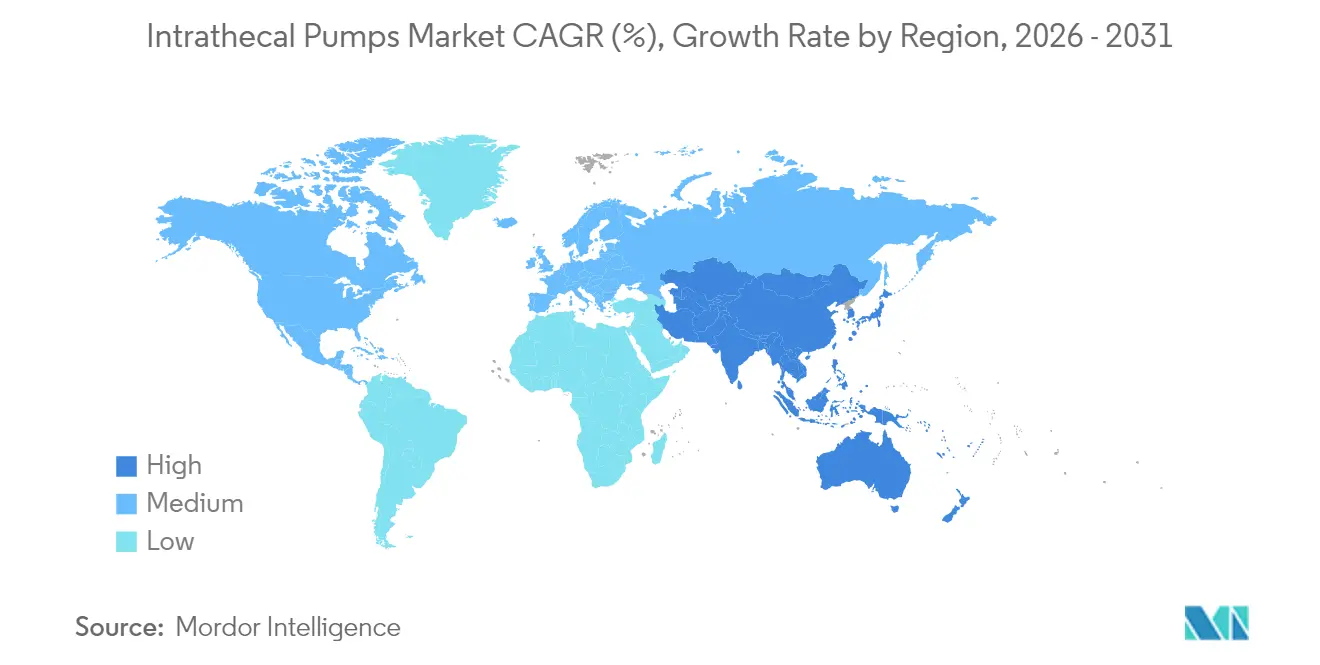
| Fastest Growing Market | Asia-Pacific |
| Largest Market | North America |
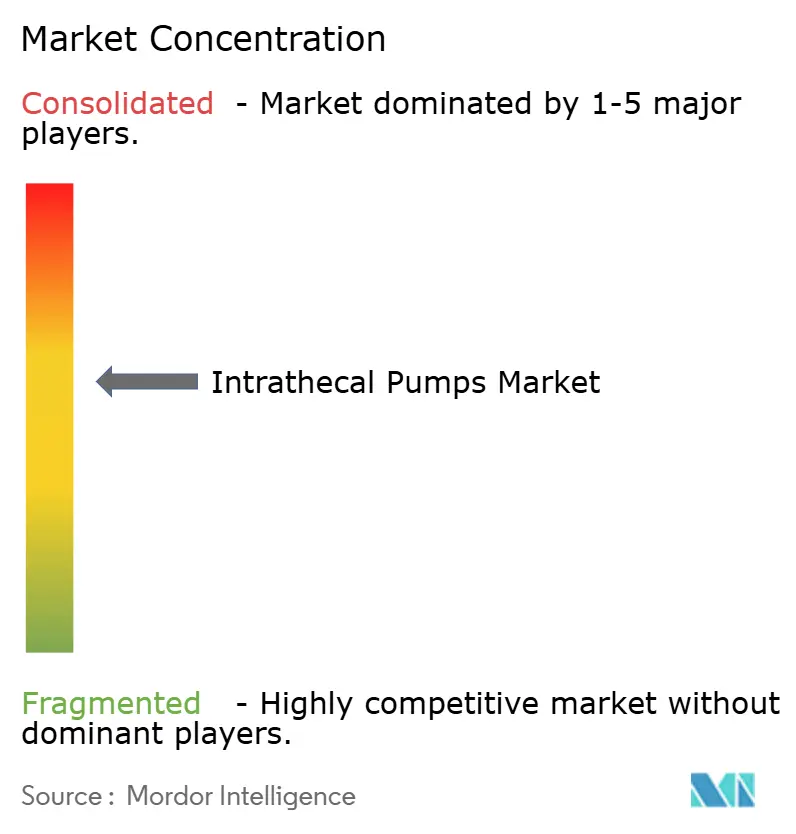
| Market Concentration | Medium |
Major Players *Disclaimer: Major Players sorted in no particular order Image © Mordor Intelligence. Reuse requires attribution under CC BY 4.0. | |
Intrathecal Pumps Market Analysis by Mordor Intelligence
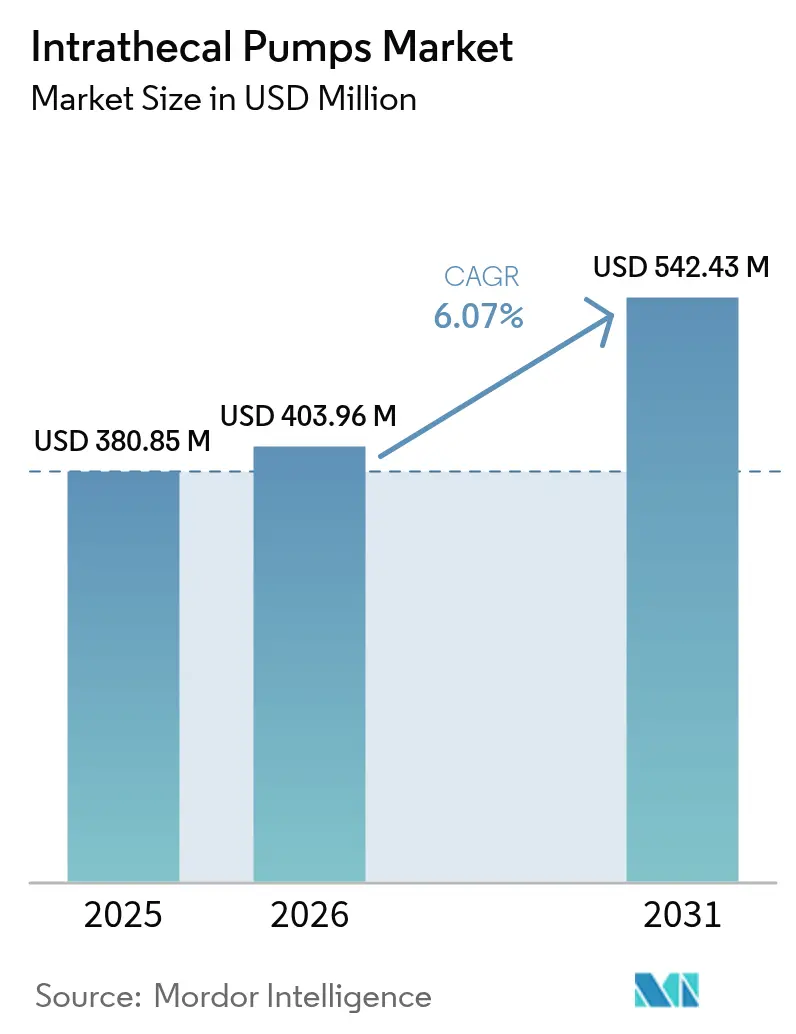
Intrathecal pumps market size in 2026 is estimated at USD 403.96 million, growing from 2025 value of USD 380.85 million with 2031 projections showing USD 542.43 million, growing at 6.07% CAGR over 2026-2031. Steady demand springs from the clinical shift toward targeted drug delivery that limits systemic opioid exposure while improving therapeutic precision. Hospitals increasingly favor programmable pumps that allow dose titration aligned with circadian rhythms, and payers expand coverage as economic models prove cost savings within three years of implantation. Programmed variable-rate devices dominate the intrathecal pumps market with 77.55% 2024 share, reflecting physician preference for sophisticated control algorithms. Baclofen remains the leading drug class by revenue, yet ziconotide registers the fastest uptake on the strength of evidence in opioid-refractory pain. North America retains nearly half of global revenue thanks to robust reimbursement and a deep specialist base, whereas Asia-Pacific leads growth as health systems upgrade chronic pain and spasticity services. Moderate competitive intensity persists: Medtronic defends leadership through SynchroMed III upgrades and extensive clinical data, while Boston Scientific and Flowonix Medical push MRI-conditional or closed-loop functionality to capture unmet needs.
Key Report Takeaways
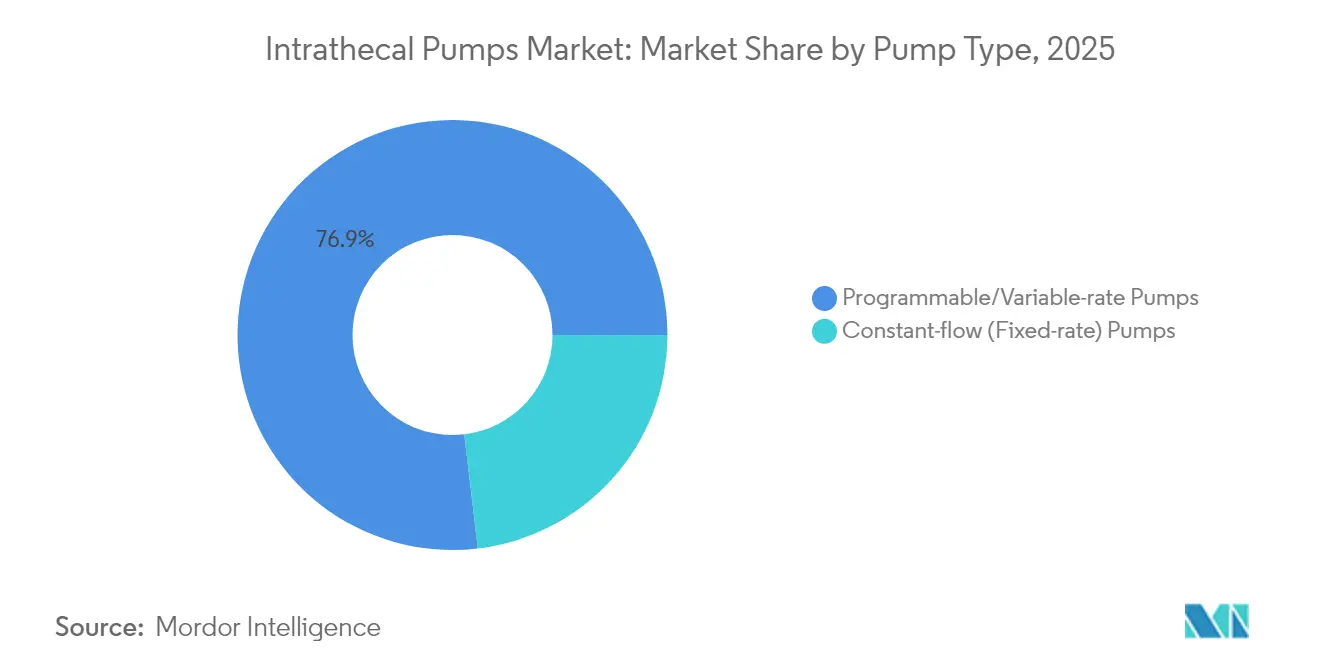
- By pump type, programmable and variable-rate systems commanded 76.88% of intrathecal pumps market share in 2025; constant-flow pumps are expected to trail while programmable units expand at a 9.94% CAGR through 2031.
- By product class, baclofen accounted for a 41.10% share of intrathecal pumps market size in 2025; ziconotide is forecast to grow at an 11.38% CAGR to 2031.
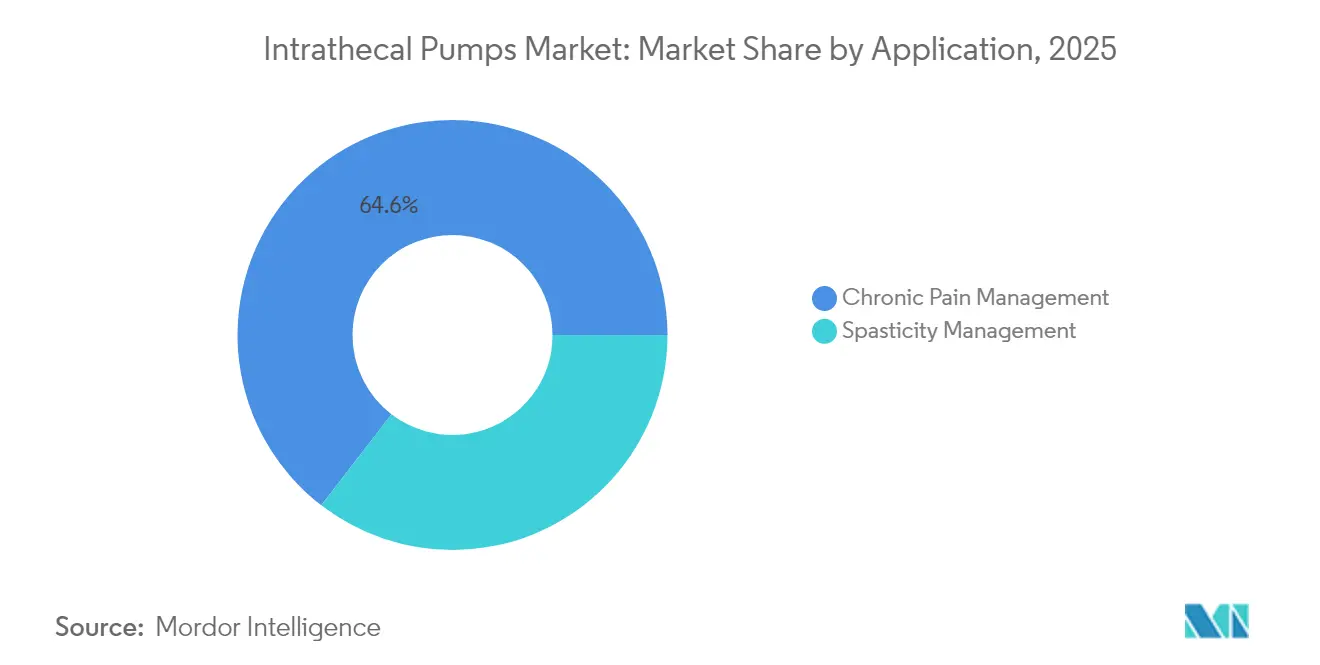
- By application, chronic pain management held 64.55% of intrathecal pumps market share in 2025; spasticity management is moving ahead at a 9.12% CAGR through 2031.
- By end user, hospitals and clinics held 60.10% share of the market in 2025, while home-care & long-term care settings posts the strongest CAGR at 10.44% through 2031.
- By geography, North America led with 48.10% revenue share in 2025; Asia-Pacific is on track for a 10.44% CAGR to 2031.
Note: Market size and forecast figures in this report are generated using Mordor Intelligence’s proprietary estimation framework, updated with the latest available data and insights as of 2026.
Market Trends and Insights
Drivers Impact Analysis of Intrathecal Pumps Market*
| Driver | (~) % Impact on CAGR Forecast | Geographic Relevance | Impact Timeline |
|---|---|---|---|
| Growing prevalence of chronic back pain & spasticity | +1.2% | Global with concentration in North America & Europe | Long term (≥ 4 years) |
| Rising demand for targeted drug-delivery alternatives to systemic opioids | +1.5% | North America & Europe primary, expanding to APAC | Medium term (2-4 years) |
| Rapid technology upgrades (programmable / MRI-conditional pumps) | +0.8% | Global, led by developed markets | Short term (≤ 2 years) |
| Payer-driven opioid-stewardship programs boosting pump adoption | +1.1% | North America primary, Europe secondary | Medium term (2-4 years) |
| AI-guided refill-dose algorithms improving clinic throughput | +0.6% | North America & Europe, selective APAC markets | Long term (≥ 4 years) |
| Expansion into neuro-oncology enabled by MRI-safe designs | +0.7% | Global, early adoption in developed markets | Medium term (2-4 years) |
| Source: Mordor Intelligence | |||
Growing Prevalence Of Chronic Back Pain & Spasticity
An aging population and sedentary lifestyles keep the addressable pool for intrathecal therapy expanding, with 50 million adults in the United States alone reporting chronic pain[1]. Rising survival after spinal cord injury and multiple sclerosis enlarges the spasticity segment, and studies show intrathecal baclofen cuts spasticity scores by 40.25% and lifts motor function by 9.62% in cerebral palsy. Better outcomes spur referrals from primary care to specialist centers that house pump surgery programs. Hospitals treat pumps as long-term value propositions that reduce readmissions and bolster patient-reported quality of life. The intrathecal pumps market therefore penetrates deeper into neurology clinics and rehabilitation facilities.
Rising Demand For Targeted Drug-Delivery Alternatives To Systemic Opioids
Health systems confronting opioid misuse pivot toward modalities requiring minimal systemic dosing: intrathecal morphine uses roughly 1/300th of the oral amount yet sustains analgesia. The 2025 NOPAIN Act gives non-opioid devices a separate Medicare payment, nudging hospitals to adopt pump therapy[2]. Half of implanted patients discontinue systemic opioids within 12 months, supporting payer initiatives that link reimbursement to opioid-sparing outcomes. The intrathecal pumps market rides these stewardship programs as formularies explicitly list pumps as preferred non-opioid interventions.
Rapid Technology Upgrades (Programmable / MRI-Conditional Pumps)
FDA clearance of closed-loop systems such as Inceptiv enables real-time physiologic feedback, with 88% of users preferring automated adjustments. Equal importance lies in MRI compliance: 80% of candidates need at least one MRI inside five years. Newly launched variable-rate pumps allow wireless, cloud-based dosing schedules that match activity patterns, though hospitals invest in cybersecurity layers to mitigate hacking risk. Superior clinical outcomes and streamlined workflows sustain premium pricing, steering budget committees to allocate capital. Consequently, programmable platforms remain the main revenue engine of the intrathecal pumps market.
Payer-Driven Opioid-Stewardship Programs Boosting Pump Adoption
Policies such as Wisconsin Medicaid’s 2025 update now cover pumps for spasticity and pain under clearer prior-authorization rules. Economic models show pumps reach cost neutrality within three years by slashing drug expenditures and emergency visits. Payers mandate objective screening protocols that boost clinician confidence, and bundled payments reward facilities that demonstrate quality improvements. The intrathecal pumps market experiences accelerated procedure volumes as institutions align with value-based metrics.
Restraints Impact Analysis of Intrathecal Pumps Market*
| Restraint | (~) % Impact on CAGR Forecast | Geographic Relevance | Impact Timeline |
|---|---|---|---|
| High upfront device & implantation cost | -1.8% | Global, more pronounced in emerging markets | Short term (≤ 2 years) |
| Low clinical-staff awareness in emerging markets | -1.2% | APAC, Latin America, MEA | Medium term (2-4 years) |
| Hospital cybersecurity concerns over wireless programmers | -0.4% | North America & Europe primarily | Short term (≤ 2 years) |
| Titanium-alloy supply-chain bottlenecks post-2024 | -0.3% | Global manufacturing hubs | Medium term (2-4 years) |
| Source: Mordor Intelligence | |||
High Upfront Device & Implantation Cost
Acquisition of an implantable pump exceeds USD 20,000, and surgical fees, programmer hardware, and follow-up push the initial bundle higher[3]. The multi-disciplinary expertise needed for implantation raises operational overhead, making return-on-investment math difficult for smaller hospitals. Insurers demand exhaustive documentation of previous conservative failures, delaying therapy onset. Budget-strained health systems in Latin America and parts of APAC allocate funds to primary care rather than advanced devices, slowing market entry even though total three-year cost is favorable versus systemic opioids.
Low Clinical-Staff Awareness In Emerging Markets
Physician familiarity remains concentrated in tertiary centers, leaving district hospitals without trained implanters. Language barriers reduce uptake of latest English-language guidelines, and lack of standardized certification limits clinician confidence. Consequently, referral pathways are fragmented, and eligible patients often receive oral narcotics instead. Manufacturers respond with virtual training platforms, yet time-zone alignment and bandwidth constraints hamper reach.
*Our forecasts treat driver/restraint impacts as directional, not additive. The impact forecasts reflect baseline growth, mix effects, and variable interactions.
Intrathecal Pumps Market Segment Analysis
By Pump Type:
Programmable Systems Drive InnovationProgrammable pumps delivered 76.88% revenue in 2025 and are on a 9.94% growth slope, confirming their status as the mainstay of the intrathecal pumps market. Advanced models integrate wireless charging and 99% five-year survival, minimizing replacement surgeries. Constant-flow pumps retain a contingent niche for straightforward regimens and lower capital outlay. Hospitals adopt dual-inventory strategies, reserving variable-rate devices for complex neuralgia or multi-drug cocktails while allocating constant-flow units to end-of-life cancer pain. Surveys show neurologists value fine-grain programming that mirrors circadian patterns, especially for dystonia and spasticity.
AI modules analyze dosing history, automatically proposing flow adjustments that physicians review. Long-term data indicate reduced side effects and fewer emergency titrations compared with fixed-rate systems, reinforcing the premium footprint of programmable technology. The intrathecal pumps industry continues to funnel R&D toward battery chemistry, miniaturization, and Bluetooth-Low-Energy modules that meet hospital network standards.

By Product Class:
Baclofen Dominance with Ziconotide MomentumBaclofen remained the anchor drug, holding 41.10% of intrathecal pumps market size in 2025 and continuing steady adoption thanks to a well-documented safety profile in spasticity bmcneurol.biomedcentral.com.
Ziconotide’s 11.38% CAGR underlines growing confidence following updated PACC titration protocols that mitigate neuropsychiatric events. Morphine and hydromorphone persist for palliative cancer indications, while bupivacaine serves mixed neuropathic pain. Combination reservoirs deliver synergistic effects at lower individual doses, lowering adverse events. Pipeline nanoparticle formulations aim for extended stability, which could shrink refill frequency and expand indications. The intrathecal pumps market therefore balances entrenched baclofen demand with agile ziconotide growth.
By Application:
Pain Management Leadership with Spasticity GrowthChronic pain management contributed 64.55% of intrathecal pumps market share in 2025, helped by broadened indications such as complex regional pain syndrome. Cancer pain registries show 85% of patients gained at least 20% pain relief after pump implantation, and palliative care teams increasingly consider pumps earlier. Spasticity management climbs at a 9.12% CAGR as neurologists view severe tone disorders as controllable rather than inevitable. Cerebral palsy cohorts demonstrate functional gains that support school participation. Dual-symptom protocols are tested, combining baclofen for tone and low-dose opioids for pain. Future adoption in neuro-oncology will further blur application lines, raising the intrathecal pumps market ceiling.
By End-user:
Hospital Dominance with Home Care GrowthHospitals and clinics produced 60.10% revenue in 2025, reflecting surgical expertise concentration and the need for sterile refill suites. Ambulatory surgery centers capture minor but growing volumes by offering outpatient implantation packages under regional anesthesia. Home care shows 10.44% CAGR, propelled by remote programming and telehealth follow-up. Cloud dashboards enable clinicians to adjust doses without clinic visits, which benefits rural populations. Long-term care facilities integrate pumps for elderly residents to avoid polypharmacy and cognitive decline. Pandemic-driven modernization of home monitoring infrastructure should push community penetration higher, granting the intrathecal pumps market wider geographic reach.
Geography Analysis
North America Intrathecal Pumps Market
North America commanded 48.10% of global revenue in 2025 due to clear reimbursement, an extensive specialist base, and strong manufacturer presence. Medicare’s consistent coding structure shortens billing cycles, while private insurers align with opioid-reduction targets. Research investments nurture continuous device upgrades and feed rapid clinical adoption.
Europe Intrathecal Pumps Market
Europe follows a structured pathway emphasizing evidence-based funding schemes such as Germany’s NUB program that annually supports novel pump technologies. The British Pain Society’s 2024 guideline update clarifies patient selection and standardizes dosing, leading to harmonized referrals across the region. Aging demographics and chronic disease burdens guarantee sustained volume.
APAC Intrathecal Pumps Market
Asia-Pacific represents the fastest-expanding segment at 10.44% CAGR, fueled by Japan’s universal coverage, China’s ongoing health-system reforms, and India’s private-sector hospital boom. Academic centers in Seoul and Singapore run collaborative pump registries that build localized evidence. Cost remains the foremost barrier, but public–private partnerships and medical tourism increasingly bridge gaps. Consequently, the intrathecal pumps market stands to witness rapid volume growth once reimbursement pathways mature across Asian economies.
Competitive Landscape
The intrathecal pumps market features moderate concentration. Medtronic controls a sizeable installed base, exceeding 300,000 cumulative implants through 2025 with its SynchroMed line. Boston Scientific leverages MRI-compatible WaveWriter systems and hybrid electrical-drug platforms, seizing share in refractory pain segments. Flowonix Medical focuses on lower-profile titanium housings and customizable software to appeal to neuro-oncology specialists.
Strategic emphasis has migrated toward integrated care ecosystems: vendors couple hardware with cloud dashboards, AI analytics, and catheter monitoring. Regulatory recalls of competitive external infusion pumps in 2024 opened a credibility gap that incumbents swiftly filled with reliability campaigns. Partnerships emerge between device makers and pharma companies to develop proprietary intrathecal formulations, locking customers into closed supply chains. Start-ups gain FDA STeP support for flexible control modules, but scaling remains constrained by capital needs. Over the forecast horizon, competition will revolve around cybersecurity robustness, MRI depth rating, and service packages that reduce provider workload.
Intrathecal Pumps Industry Leaders
-
Tricumed Medizintechnik GmbH
-
Teleflex, Inc.
-
Flowonix Medical, Inc.
-
Medtronic plc
-
Johnson & Johnson (Codman/Cerenovus)
- *Disclaimer: Major Players sorted in no particular order
Intrathecal Pumps Market Companies Covered in this Report
- Medtronic
- Flowonix Medical Inc.
- Tricumed Medizintechnik
- Johnson & Johnson (Codman/Cerenovus)
- Teleflex
- Smiths Group
- Baxter
- B. Braun
- Fresenius
- Terumo Corp.
- Abbott Laboratories
- Boston Scientific
- Nevro
- Durect Corp.
- Advanced Bionics
- Avanos Medical
- InfuTronix Solutions
Market Opportunities and Future Outlook
Opportunities cluster around pump platform upgrades that reduce hospital workflow friction and address long-dwell implant concerns. Medtronic positions SynchroMed III around a refill-only clinician workflow, post-implant firmware updates, and enhanced cybersecurity protocols, which fits provider priorities around programmable dosing and device-lifecycle management. With programmable and variable-rate devices already representing the dominant installed base, vendors that bundle programming software, performance reporting, and cyber hardening can compete on services as well as hardware, while helping hospitals operationalize opioid-stewardship pathways.
Further whitespace opens as MRI-safe designs and broader provider adoption remove referral friction, including in home-care and long-term care settings that are building remote follow-up. The 2025 NOPAIN Act and payer opioid-stewardship programs give hospitals and pain centers a basis to standardize targeted drug-delivery pathways, including patient selection, titration protocols, and follow-up. Additional opportunity also comes from adjacent infusion categories and supplier ecosystems, where new entrants add capacity through U.S. regulatory clearances. For instance, FDA 510(k) clearance in April 2026 for Epic Medical Pte., Ltd. for the SMARTeZ Elastomeric Infusion Pump can expand availability of components and manufacturing capacity, which feeds reliability and human-factors learning relevant to pump platforms.
Recent Industry Developments in Intrathecal Pumps Market
- April 2026: Teleflex initiated a multi-year restructuring program tied to its planned portfolio actions, including steps to align supply chain and organizational infrastructure. The program prioritizes cost and footprint rationalization through mid-2028, which can influence how the company allocates investment across pain-management and infusion-related categories.
- February 2025: Teleflex announced an intent to separate into two independent, publicly traded companies, targeting completion by mid-2026. The plan includes the Anesthesia and Respiratory categories and the companys disposable pain-pump portfolio, signaling portfolio refocusing that can reshape competitive emphasis across pain-therapy delivery modalities.
- November 2024: Avanos Medical secured separate Medicare payment for its ON-Q and ambIT infusion pumps under the NOPAIN Act. The reimbursement change reinforced payer and hospital attention on device-based, opioid-sparing pain pathways, supporting broader procedural adoption and contracting activity around targeted drug-delivery programs.
Intrathecal Pumps Market Report Scope and Research Methodology
Market Definition and Coverage
We size the intrathecal pumps market as revenues from implantable pump systems that deliver medication into the intrathecal space through a catheter, along with associated device components sold for ongoing therapy use across care settings.
Scope exclusions: External drug sales and general infusion pump categories that do not deliver intrathecally are not counted.
Segments Covered in This Report
- By Pump Type
- Programmable/Variable-rate Pumps
- Constant-flow (Fixed-rate) Pumps
- By Product Class
- Baclofen
- Morphine
- Hydromorphone
- Bupivacaine
- Ziconotide
- Other APIs (Clonidine, Prialt combinations)
- By Application
- Chronic Pain Management
- Spasticity Management
- By End-user
- Hospitals & Clinics
- Ambulatory Surgery Centers
- Home-care & Long-term Care Settings
- Geography
- North America
- United States
- Canada
- Mexico
- Europe
- Germany
- United Kingdom
- France
- Italy
- Spain
- Rest of Europe
- Asia-Pacific
- China
- Japan
- India
- South Korea
- Australia
- Rest of Asia-Pacific
- Middle East and Africa
- GCC
- South Africa
- Rest of Middle East and Africa
- South America
- Brazil
- Argentina
- Rest of South America
- North America
Data Sources, Market Sizing, and Validation
Desk Research
Desk work starts by clarifying where demand is created and how it shows up in public data, since procedure volumes and implant uptake often move slower than headline healthcare spending. We used sources such as the US FDA device databases, the US National Library of Medicine clinical trial registry, CDC health statistics, and OECD health data to ground the background demand pool and care setting mix.
Next, pricing and adoption assumptions were shaped using manufacturer public disclosures (annual reports, investor presentations, and press releases), reputable medical journals that discuss intrathecal therapy use, and association or hospital system publications that signal practice patterns. Where available, we also referenced paid subscriptions for company financials and patent databases to cross-check product activity and the timing of technology upgrades. These desk sources are illustrative, and many other public references were reviewed for data collection, validation, and clarification.
Primary Interviews and Surveys
Primary work was used to pressure-test what desk signals cannot fully explain, mainly average selling price ranges, replacement and refill behavior, and where programmable versus fixed-rate systems are realistically used. We spoke with a mix of clinical users, distributors, and device-side experts across major regions so our assumptions on adoption pace, setting shifts (hospital, ASC, and long-term care), and patient selection stayed practical.
Distribution of primary research fieldwork respondents
| Company type | Respondent position | Region |
|---|---|---|
| Top tier: 26% | CXOs: 12% | APAC: 42% |
| Mid tier: 56% | Functional/Unit leaders: 35% | EMEA: 34% |
| Smaller Players: 18% | Managers: 53% | Americas: 24% |
Market-Sizing & Forecasting
Our main build uses a top-down approach where the treated patient pool and procedure activity are reconstructed by region, and then converted into device demand using adoption and replacement logic. To keep the model tied to real-world use, we rely on a few repeatable inputs, such as chronic pain and severe spasticity treatment patterns, the share of cases that move to intrathecal therapy after conservative management, and the mix of programmable versus constant-flow implants.
Totals are then corroborated with selective bottom-up approximations, such as sampled ASP by geography and care setting, distributor channel checks on annual unit movement, and sanity checks using public company revenue cues where they are available. When gaps exist (for example, limited visibility on smaller-country implant volumes), the estimate is bridged using proxy indicators like hospital capacity trends and regional procedure intensity patterns, and then adjusted after expert feedback.
Forecasts were built using scenario analysis supported by short lists of demand drivers that respondents consistently pointed to, including opioid-sparing pain protocols, neurosurgery and pain clinic access, reimbursement stability, and implant revision rates. Assumptions were kept transparent so that changes in procedure volumes or ASP progression can be re-run quickly without needing hard-to-source private datasets.
Data Validation & Update Cycle
We run multi-step validation before finalizing values, starting with cross-checks between modeled revenue, implied unit volumes, and expected therapy adoption by region. Outliers are flagged when growth rates break away from linked signals, such as procedure trends, care setting shifts, or sharp ASP jumps that are not supported by interview feedback.
A second analyst review is completed before sign-off, and follow-up outreach is triggered when new regulatory events, product updates, or reimbursement changes can materially move adoption. Reports are refreshed annually, with interim updates for material events, and a final pre-delivery pass is done so clients receive the latest updated view.
Mordor Intelligence's Global Intrathecal Pumps Market Size Measured Against Other Published Estimates
Published market values for intrathecal pumps can vary even when the topic looks identical, because different studies do not always count the same device components, base year, or care settings. We also see differences when one model leans more on shipment-led assumptions while another starts from a therapy demand pool.
The main gap comes from whether adjacent infusion technologies and non-intrathecal accessories are grouped into the same number, where Mordor Intelligence counts only intrathecal pump systems and their core device-related revenues that are directly tied to implanted therapy demand.
Benchmark comparison
| Source | Market Size | Gaps in Research Methodology |
|---|---|---|
| Mordor Intelligence | USD 403.96 M (2026) | |
| Healthcare Publisher A | USD 330.00 M (2023) | Uses an earlier base year and a slower expansion path, and the published summary does not clarify how programmable versus fixed-rate mix and ASP progression were validated across regions. |
| Industry Report B | USD 292.90 M (2025) | Anchors sizing to a 2025 base and emphasizes output and pricing tables, which can understate demand where procedure activity rises faster than reported production or where channel inventory timing distorts year comparisons. |
The spread in published values is largely explained by what is counted inside the market number, which year is used as the anchor, and how price and mix are carried forward in the forecast. By keeping the scope tied to implanted intrathecal therapy demand and checking implied units against practical adoption signals, we end up with a market view that can be traced back to clear steps and re-tested when assumptions change.
Key Questions Answered in the Report
What is the current value of the intrathecal pumps market?
The market is valued at USD 403.96 million in 2026 and is forecast to climb to USD 542.43 million by 2031.
Which pump type holds the largest share of the intrathecal pumps market?
Programmable and variable-rate systems account for 76.88% of 2025 revenue and show the fastest growth trajectory.
Which drug class leads sales in intrathecal therapy?
Baclofen leads with 41.10% share, while ziconotide records the quickest CAGR at 11.38%.
Which region grows the fastest in the intrathecal pumps market outlook?
Asia-Pacific advances at a 10.44% CAGR through 2031, buoyed by expanding healthcare infrastructure and chronic disease prevalence.
How do intrathecal pumps lower systemic opioid use?
Typical intrathecal morphine doses are about 1/300th of oral equivalents, and 51% of implanted patients discontinue other opioids within one year, supporting stewardship goals.