
Fashion Retail Market Size and Share
Market Overview
| Study Period | 2022 - 2031 |
|---|---|
| Market Size (2026) | USD 2.98 Trillion |
| Market Size (2031) | USD 3.76 Trillion |
| Growth Rate (2026 - 2031) | 4.77 % |
| Fastest Growing Market | Asia-Pacific |
| Largest Market | Asia-Pacific |
| Market Concentration | Low |
Major Players *Disclaimer: Major Players sorted in no particular order Image © Mordor Intelligence. Reuse requires attribution under CC BY 4.0. | |
Fashion Retail Market Analysis by Mordor Intelligence
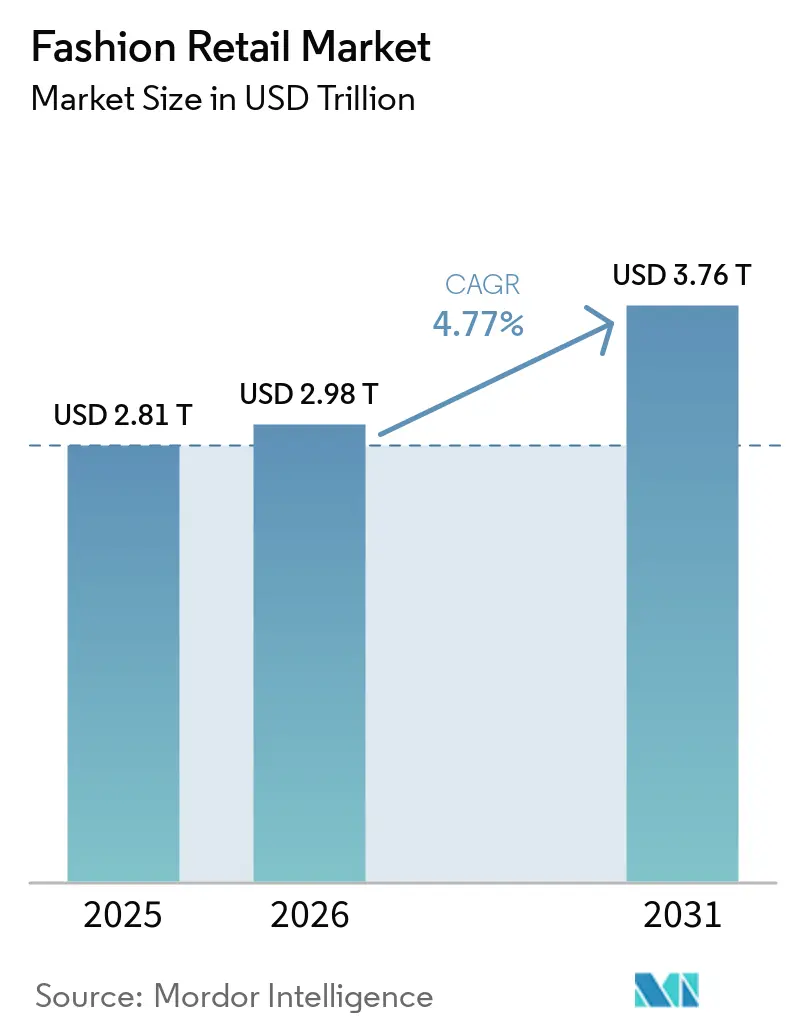
The Fashion Retail Market size is projected to expand from USD 2.81 trillion in 2025 and USD 2.98 trillion in 2026 to USD 3.76 trillion by 2031, registering a CAGR of 4.77% between 2026 to 2031.
The global fashion retail market is expanding steadily, although growth remains uneven as freight disruptions, cost pressures, and cautious consumer sentiment in several mature economies offset demand strength. Durable demand from younger shoppers, urban expansion in emerging economies, and the continued shift toward organized retail and digital channels continue to support the market, keeping its long-term outlook constructive. From an India-focused research perspective, Asia-Pacific offers the strongest structural upside, with India standing out as a high-growth apparel economy within the broader global fashion retail market. Retailers are also changing their competitive strategies by increasing investments in inventory visibility, omnichannel execution, fulfillment efficiency, and selective international expansion. At the same time, the fragmented structure of the global fashion retail market creates opportunities for consolidation in weaker tiers while rewarding players that protect margins through improved sourcing, stronger brand identity, and tighter control over returns and replenishment.[1]
Key Report Takeaways
- By product type, Apparel led with 52.11% revenue share in 2025, while Sportswear & Activewear is projected to expand at a 5.99% CAGR through 2031.
- By price segment, Mass Market & Fast Fashion held 58.83% of the global fashion retail market share in 2025, while Mid-Range & Premium recorded the highest projected CAGR at 5.52% through 2031.
- By distribution channel, Offline accounted for 68.72% of the global fashion retail market size in 2025, while Online is advancing at a 5.88% CAGR through 2031.
- By end user, Womenswear held 46.62% share in 2025, while Menswear is forecast to post the fastest CAGR of 6.29% through 2031.
- By geography, Asia-Pacific captured 37.46% share in 2025 and is also expected to register the fastest regional CAGR at 5.16% through 2031.
Note: Market size and forecast figures in this report are generated using Mordor Intelligence’s proprietary estimation framework, updated with the latest available data and insights as of January 2026.
Global Fashion Retail Market Trends and Insights
Drivers Impact Analysis*
| Drivers | (~) % Impact on CAGR Forecast | Geographic Relevance | Impact Timeline |
|---|---|---|---|
| E-Commerce Penetration and Omnichannel Conversion | +1.5% | Global, with APAC core and North America and Europe spill-over | Short term (≤ 2 years) |
| AI-Enabled Demand Planning and Personalization | +0.8% | Global, with North America and Western Europe as early adopters | Medium term (2-4 years) |
| Resale and Circular Commerce Expansion | +0.6% | North America, Europe, APAC, including Japan, South Korea, and Australia | Medium term (2-4 years) |
| Social Commerce and Creator-Led Product Discovery | +0.7% | APAC core, North America, spill-over to MEA | Short term (≤ 2 years) |
| Sustainability-Led Product and Packaging Redesign | +0.4% | Europe primary, global secondary | Long term (≥ 4 years) |
| Store Networks Repositioned as Fulfillment and Experience Nodes | +0.5% | North America and Europe, spill-over to APAC | Medium term (2-4 years) |
| Source: Mordor Intelligence | |||
E-Commerce Penetration and Omnichannel Conversion
E-commerce continues to reshape the global fashion retail market because digital demand is no longer a separate channel story and is now part of the operating model. Online channels accounted for 35% to 40% of global fashion revenue in 2025, while offline networks remained important, as stores increasingly support fulfillment, returns handling, and brand interaction. That shift matters because the value of a store now depends on both sales productivity and logistics usefulness within the global fashion retail market. 59% of fashion retailers were either shipping from stores in 2026 or had completed rollout plans, indicating how quickly omnichannel execution has moved from the pilot stage to standard practice. Retailers that still run separate inventory pools across channels are likely to face more routing inefficiencies, weaker stock visibility, and slower response times as the global fashion retail market becomes more integrated.
AI-Enabled Demand Planning and Personalization
AI is gaining relevance in the global fashion retail market as retailers use it to improve planning decisions, not just customer engagement. Forecasting models are helping reduce excess inventory and stockouts, directly supporting margins in a business where markdowns can quickly erode profitability. It also states that, in June 2026, Fusemachines announced that a global apparel brand with more than 2,000 retail locations selected its predictive and agentic AI platform to improve SKU-level demand planning across retail, wholesale, and direct-to-consumer operations. In May 2026, OTB Group and Google Cloud launched AI-powered, hyper-personalized shopping experiences and virtual try-on tools, linking personalization more directly to fit confidence and conversion quality. Over time, the global fashion retail market is likely to reward companies that build stronger demand-sensing and product-matching systems, as these tools improve sell-through and help control returns.
Resale and Circular Commerce Expansion
Resale is becoming a larger part of the global fashion retail market as secondhand apparel is growing faster than new apparel in several key markets. ThredUp’s 2026 resale report said the United States' secondhand apparel segment grew nearly 4 times faster than the broader retail clothing market in 2025, confirming that the category is moving into a more structural position rather than a temporary value-driven cycle. This trend matters for the global fashion retail market because resale is now influencing brand discovery, shopper retention, and pricing behavior across premium and mid-tier categories. Brands that do not build a resale response are at risk of losing customer attention to platforms that now sit earlier in the purchase journey.
Social Commerce and Creator-Led Product Discovery
Social commerce is influencing the global fashion retail market by enabling discovery and conversion within a single interface. Creator-led selling is already compressing the traditional decision path, especially in categories where styling, fit, and trend signaling shape impulse purchase behavior. This matters more in Asia-Pacific, where live commerce formats have matured faster and where brands now have a tested model for turning content into direct transactions. The same approach is spreading into Western fashion retail as platforms make product seeding, affiliate links, and creator storefronts easier to scale. In the global fashion retail market, brands that still treat social platforms only as marketing channels may lose ground to competitors that connect creator content more directly with stock, checkout, and fulfillment.
Restraints Impact Analysis*
| Restraints | (~) % Impact on CAGR Forecast | Geographic Relevance | Impact Timeline |
|---|---|---|---|
| High Return Rates and Reverse Logistics Cost Pressure | -0.7% | Global, most acute in North America and Europe online markets | Short term (≤ 2 years) |
| Textile Waste, Traceability, and Green Claims Compliance Burden | -0.4% | Europe primary scaling globally as jurisdictions adopt analogous frameworks | Long term (≥ 4 years) |
| Margin Compression from Fast Fashion Price Competition | -0.5% | Global, concentrated in mass and mid-market segments | Short term (≤ 2 years) |
| Supply Chain Volatility, Lead-Time Risk, and Inventory Obsolescence | -0.6% | Global, most disruptive for South Asia and Middle East sourcing corridors | Short term (≤ 2 years) |
| Source: Mordor Intelligence | |||
High Return Rates and Reverse Logistics Cost Pressure
Returns remain one of the clearest constraints on the global fashion retail market because apparel has a high mismatch risk in terms of fit, style expectations, and discretionary purchase behavior. U.S. retailers expected USD 849.9 billion in merchandise returns in 2025, equal to 15.8% of annual sales, and fashion online return rates average 30% to 40%, compared with 8% to 10% for physical-store purchases. The full cost of handling a returned apparel item reached USD 30 in 2026, placing heavy pressure on lower-ticket categories.[2] That burden worsens when products cannot be resold at full price, since the operating loss includes processing costs, markdown risk, and tied-up working capital. For the global fashion retail market, retailers that improve size guidance, virtual try-on, and in-store return recapture are likely to defend margins better than those that continue to treat returns as a back-end problem.
Textile Waste, Traceability, and Green Claims Compliance Burden
Compliance pressure is rising in the global fashion retail market as regulations move beyond broad sustainability statements toward product-level proof. Intertek’s 2026 note on digital product passport readiness shows that textile and apparel companies are now expected to strengthen material traceability, documentation quality, and data management across the supply chain. This raises the fixed compliance burden for exporters, contract manufacturers, and brands that operate across multiple markets but do not yet have uniform data systems. In the global fashion retail market, the impact is likely to be heavier on smaller brands and fragmented suppliers that lack the capital and process discipline of larger multinational groups.
*Our forecasts treat driver/restraint impacts as directional, not additive. The impact forecasts reflect baseline growth, mix effects, and variable interactions.
Segment Analysis
By Product Type: Sportswear Leads Growth as Apparel Anchors Share
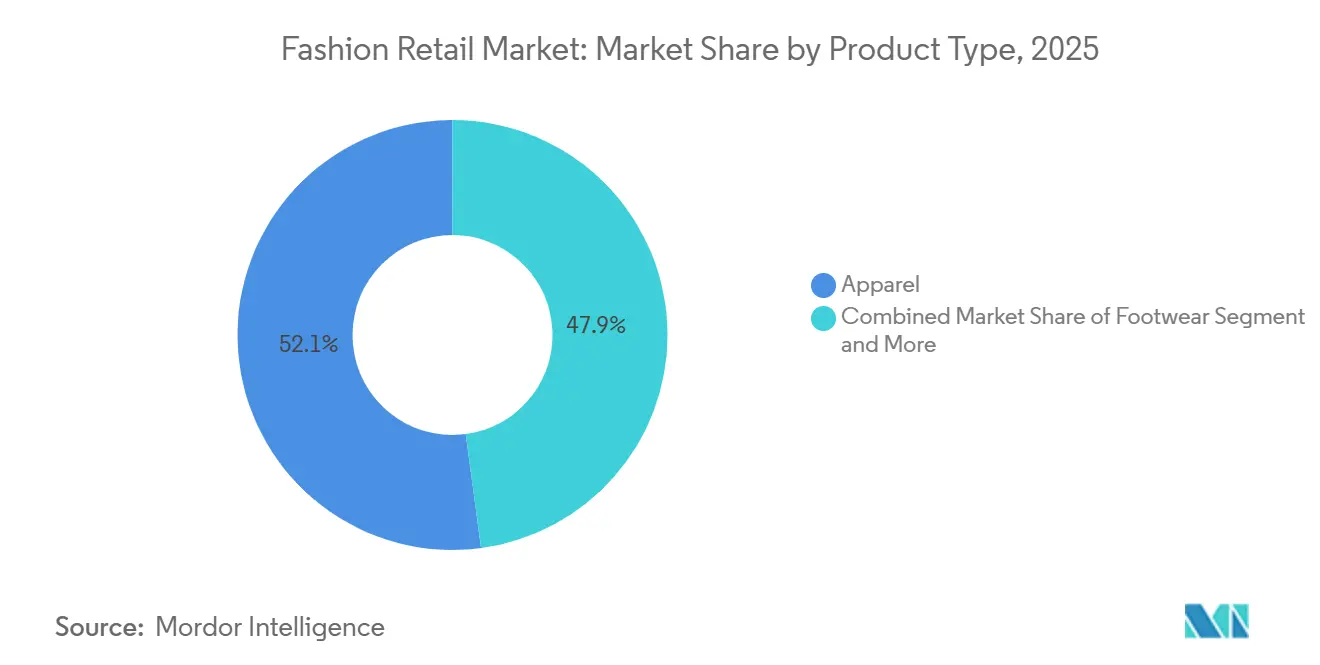
Apparel accounted for 52.11% of the global fashion retail market in 2025, making it the largest product category by a wide margin. This leading position reflects the everyday nature of the category, its broad reach across income groups, and its importance in both organized and informal retail formats. Footwear, fashion accessories, and luxury fashion remain meaningful parts of the product mix, but their demand patterns are more sensitive to price positioning, discretionary spending, and brand loyalty. Sportswear and activewear are the fastest-growing product segments in the global fashion retail market, with a projected CAGR of 5.99% through 2031. That growth shows that consumers are continuing to blend performance wear, casual dressing, and comfort-led fashion into a single purchase habit, which supports stronger volume and repeat buying in this category.
Sportswear demand is increasingly tied to fabric performance, fit, and use-case design rather than only logo appeal. A 2025 Springer Nature study on demand prediction in fashion reinforces this point by showing that visual and product attributes, such as material, fit geometry, and occasion relevance, are becoming stronger signals in new product decisions. That product logic helps explain why sportswear continues to expand its role in the global fashion retail market, even as other apparel categories face softer conversion rates. Luxury fashion remains important, the category is operating through a more difficult cycle, marked by a creative reset and slower volume momentum. As a result, the global fashion retail market is seeing a clearer split between functional growth categories, such as sportswear, and premium categories that still rely more heavily on brand renewal and emotional relevance.

By Price Segment: Mass Market Retains Scale as Mid-Range Accelerates
Mass Market and Fast Fashion accounted for 58.83% of the global fashion retail market share in 2025, indicating that value-led shopping continues to drive the majority of category demand. This scale is rooted in the broad consumer base of price-sensitive households, the reach of accessible formats, and the role of fashion as a frequent purchase in emerging markets. The category also remains relevant in developed markets because it often complements higher-value purchases rather than serving as a full substitute. At the same time, Mid-Range and Premium are the fastest-growing price tiers in the global fashion retail market, with a projected CAGR of 5.52% through 2031. This suggests that many shoppers are willing to move up selectively when they see better quality, stronger styling, or more reliable brand value without paying full luxury prices.
A gradual normalization in the ultra-low-price space as tariff shifts erode the earlier pricing edge of some cross-border fast-fashion flows. That change may create more room for domestic value players, but it does not remove the underlying intensity of price competition in the global fashion retail market. Luxury and couture remain relevant at the top end, yet the current cycle appears less volume-driven and more dependent on brand execution, store experience, and scarcity discipline. The most exposed position sits in the middle, where brands often lack both the operating efficiency of fast fashion and the pricing strength of luxury. Within the global fashion retail market, this makes the mid-range success story more selective, with stronger outcomes likely for brands that combine sharper product identity with better digital distribution and cleaner pricing architecture.
By Distribution Channel: Offline Holds Majority as Online Reshapes Unit Economics
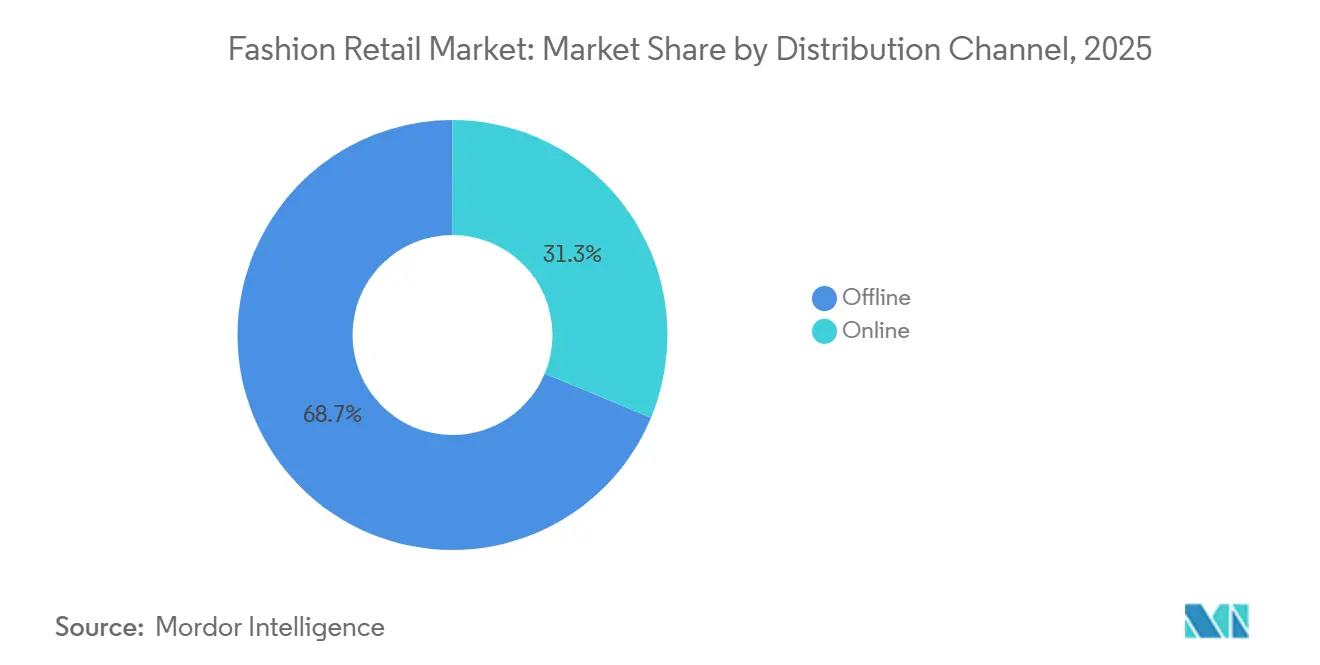
Offline retained 68.72% of the global fashion retail market share in 2025, confirming that physical retail still accounts for most fashion spending. This is important because the global fashion retail market is not moving toward a simple replacement of stores by online channels. Instead, the market is moving toward integration, where stores, websites, apps, social interfaces, and marketplace listings work as connected access points. Online remains the fastest-growing channel, with a forecast CAGR of 5.88% through 2031, indicating where incremental expansion is likely to come from. The result is a channel structure where physical scale remains large, but digital execution increasingly determines how quickly retailers can capture demand and manage stock.
The economics of the channel mix are changing, since stores are now being used for fulfillment, returns, and local stock balancing in addition to walk-in sales. The World Economic Forum’s 2026 discussion of AI-led replenishment and computer vision in retail supports the view that stores are becoming operational nodes rather than fixed-cost liabilities. This shift is especially relevant in the global fashion retail market because same-day or quick-turn delivery expectations continue to rise while reverse logistics costs remain elevated. Social commerce is also adding a third layer to distribution by combining discovery, recommendation, and purchase in a single path. For the global fashion retail market, the strongest players will be those that can turn channel complexity into better inventory productivity rather than simply expanding touchpoints without coordination.[3]
By End User: Menswear’s Fastest Growth Signals a Category Rebalancing
Womenswear held 46.62% of end-user demand in 2025, making it the largest consumer segment in the global fashion retail market. That scale reflects the category’s historical depth, frequent style rotation, and strong presence across mass, mid-range, and premium fashion. Kidswear remains the smallest end-user segment, but it benefits from the long-term retail formalization taking place in South and Southeast Asia. Menswear is the fastest-growing end-user category in the global fashion retail market, with a projected CAGR of 6.29% through 2031. This indicates a broader shift in spending behavior as more male consumers participate in activewear, casual formal dressing, and appearance-led discretionary purchases.
Menswear growth is being reinforced by brand expansion and more focused product development. Lululemon announced in December 2025 that it would enter 5 new international markets in 2026 through franchise agreements, in addition to its previously announced entry into India through a partnership with Tata CLiQ. The move was tied to a broader push into high-growth demand clusters across its assortment. The global fashion retail market is therefore becoming less dependent on womenswear for incremental growth, even though womenswear remains the largest segment by value. Menswear still converts better in offline settings than online in many cases, which means store strategy remains especially important for this segment. For the global fashion retail market, brands that map men’s shopping behavior separately rather than copying women’s channel tactics are likely to be better positioned as the category gains weight.
Geography Analysis
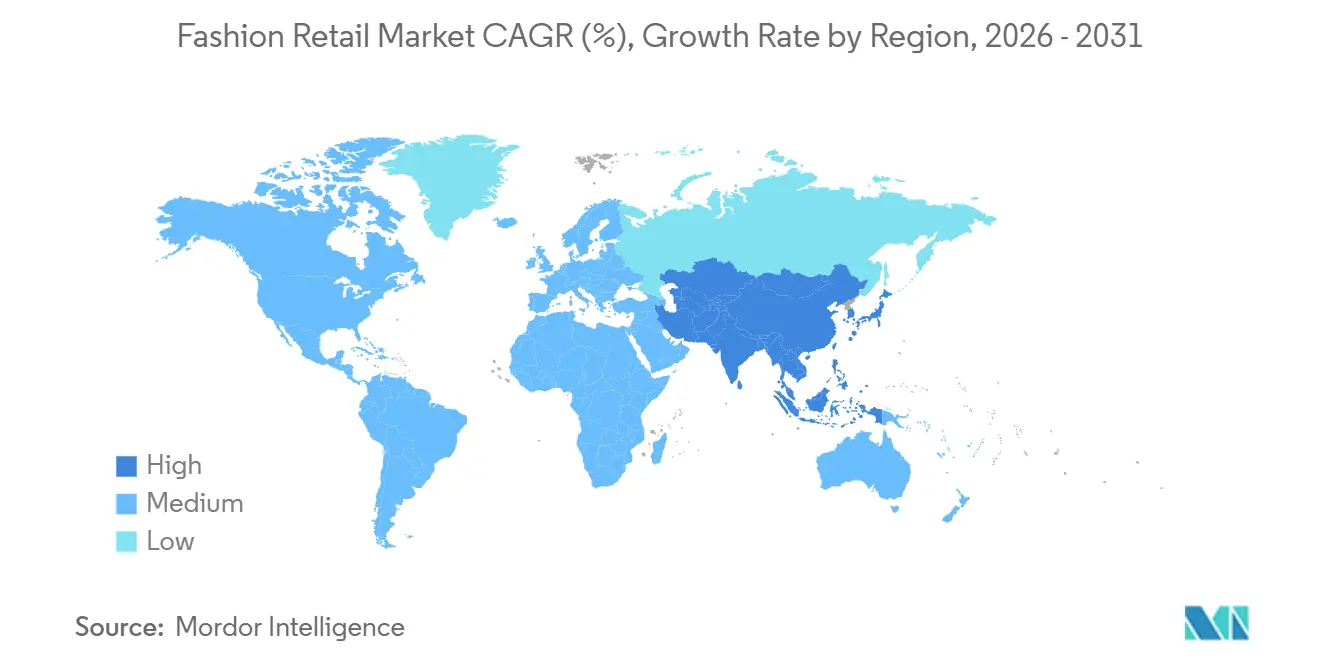
Asia-Pacific accounted for 37.46% of the global fashion retail market in 2025 and is also the fastest-growing region, with a projected CAGR of 5.16% through 2031. This makes the region both the largest revenue anchor and the main expansion engine for the global fashion retail market. From an India-specific industry perspective, this regional picture is especially important because India is one of the clearest structural growth pockets in Asia-Pacific, supported by expanding organized retail, rising adoption of branded apparel, and stronger digital participation. India’s apparel retail market closed 2025 at USD 115.5 billion, and organized retail accounted for 41% of the market, underscoring why India continues to draw global brand attention. China remains central because of its large digital ecosystem and advanced creator-commerce infrastructure, while Southeast Asia adds growth through mobile-first buying and widening access in tier-2 and tier-3 cities.
North America remains an important part of the global fashion retail market. The region continues to lead in omnichannel use cases such as buy online, pick up in store, and ship-from-store, which helps offset margin pressure through better fulfillment design. South America adds a different profile, with Brazil remaining the largest single-country contributor in the region and international brands continuing to test expansion moves in faster-growing urban markets. In the global fashion retail market, these two regions show differences in operating maturity and demand acceleration, with North America offering greater process depth and South America offering more selective volume opportunities.
Europe is growing more slowly, and the market remains mature, highly competitive, and more exposed to mid-market pressure than some other regions. At the same time, Europe is shaping standards for traceability, product claims, and packaging compliance, giving the region an outsized role in setting future operating expectations. Intertek’s 2026 guidance on digital product passport readiness in textile apparel supports the view that compliance and supply chain data quality are becoming more important across cross-border fashion trade. The Middle East and Africa remain smaller in value terms. Asia-Pacific continues to drive the global fashion retail market in terms of scale and growth. At the same time, other regions matter more for profitability, regulation, sourcing relevance, and channel innovation.
Competitive Landscape
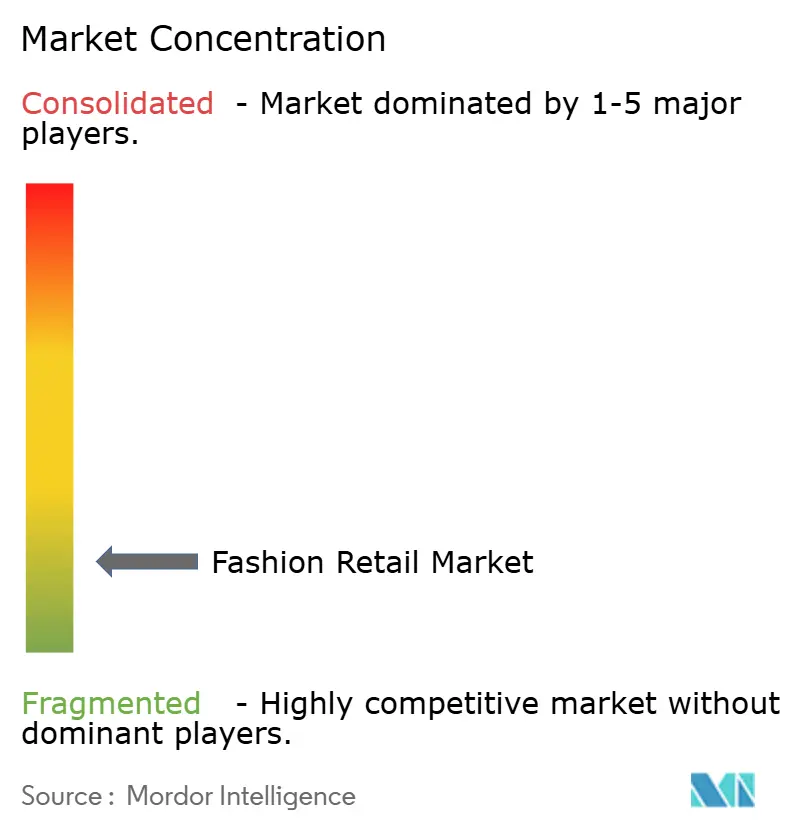
The global fashion retail market remains highly fragmented, with no single player accounting for more than a mid-single-digit share of total demand. Even so, a small group of large brands and retail groups still exerts disproportionate influence through scale, sourcing control, brand power, and technology investment. The major names include Inditex, LVMH, Kering, H&M, Nike, Adidas, and Fast Retailing, each with strength in different product and price bands. This creates a competitive structure where the global fashion retail market looks dispersed at the headline level but remains strategically shaped by a concentrated top tier. In practical terms, smaller players can still grow, but they face a harder task in logistics, inventory discipline, digital capability, and international reach.
Strategic moves in 2025 and 2026 show where leading companies are placing their capital. Adidas reported record revenues for 2025 and launched a EUR 1 billion share buyback in 2026, which signaled confidence in cash flow strength and brand momentum after clearing earlier inventory issues. OTB Group partnered with Google Cloud in May 2026 to launch AI-powered hyper-personalized shopping experiences, showing that premium groups are also using technology to improve fit confidence and customer engagement. Fusemachines also announced in June 2026 that a global apparel brand with over 2,000 stores had selected its AI platform for demand planning transformation, which shows that planning intelligence is moving into core retail infrastructure.
The competitive split inside the global fashion retail market is therefore becoming clearer. The strongest players are building advantage through better fulfillment design, deeper data use, sharper category focus, and more selective expansion into high-potential markets such as India and other Asia-Pacific economies. Lululemon’s planned entry into India and 5 other new markets in 2026 shows how brands are using capital-light models to accelerate geographic reach where demand conditions remain favorable. At the same time, resale platforms are increasingly influencing customer acquisition and product circulation, adding another competitive layer around attention, discovery, and lifetime value. For the global fashion retail market, this means competition is no longer defined only by brand image or store count, but also by how well each player can connect product, data, inventory, and consumer touchpoints into a more resilient operating model.
Fashion Retail Industry Leaders
-
Inditex, S.A.
-
H and M Hennes and Mauritz AB
-
NIKE, Inc.
-
Adidas AG
-
Fast Retailing Co., Ltd.
- *Disclaimer: Major Players sorted in no particular order
Recent Industry Developments
- June 2026: Fusemachines Inc. was selected by a globally recognized apparel brand operating more than 2,000 retail locations for an AI demand planning transformation, combining predictive and agentic AI to optimize SKU-level inventory decisions across owned retail, wholesale, and direct-to-consumer channels.
- May 2026: OTB Group and Google Cloud announced a strategic collaboration to launch AI-powered hyper-personalized shopping experiences using Google Cloud’s Virtual Try-On API on the Gemini Enterprise Agent Platform.
- April 2026: ThredUp released its 14th Annual Resale Report confirming that the U.S. secondhand apparel segment grew nearly 4 times faster than the broader retail clothing market in 2025 and reiterated a global resale target of USD 393 billion by 2030.
- February 2026: Adidas reported record revenues for FY2025 and announced a EUR 1 billion share buyback to be executed in 2026, financed through anticipated strong cash flow generation.
Global Fashion Retail Market Report Scope
| Apparel |
| Footwear |
| Fashion Accessories |
| Luxury Fashion |
| Sportswear & Activewear |
| Mass Market & Fast Fashion |
| Mid-Range & Premium |
| Luxury & Haute Couture |
| Offline |
| Online |
| Womenswear |
| Menswear |
| Kidswear |
| North America | United States |
| Canada | |
| Mexico | |
| South America | Brazil |
| Peru | |
| Chile | |
| Argentina | |
| Rest of South America | |
| Europe | United Kingdom |
| Germany | |
| France | |
| Spain | |
| Italy | |
| BENELUX (Belgium, Netherlands, and Luxembourg) | |
| NORDICS (Denmark, Finland, Iceland, Norway, and Sweden) | |
| Russia | |
| Rest of Europe | |
| Asia-Pacific | India |
| China | |
| Japan | |
| Australia | |
| South Korea | |
| South East Asia (Singapore, Malaysia, Thailand, Indonesia, Vietnam, and Philippines) | |
| Rest of Asia-Pacific | |
| Middle East and Africa | United Arab Emirates |
| Saudi Arabia | |
| South Africa | |
| Nigeria | |
| Rest of Middle East and Africa |
| By Product Type | Apparel | |
| Footwear | ||
| Fashion Accessories | ||
| Luxury Fashion | ||
| Sportswear & Activewear | ||
| By Price Segment | Mass Market & Fast Fashion | |
| Mid-Range & Premium | ||
| Luxury & Haute Couture | ||
| By Distribution Channel | Offline | |
| Online | ||
| By End User | Womenswear | |
| Menswear | ||
| Kidswear | ||
| By Geography | North America | United States |
| Canada | ||
| Mexico | ||
| South America | Brazil | |
| Peru | ||
| Chile | ||
| Argentina | ||
| Rest of South America | ||
| Europe | United Kingdom | |
| Germany | ||
| France | ||
| Spain | ||
| Italy | ||
| BENELUX (Belgium, Netherlands, and Luxembourg) | ||
| NORDICS (Denmark, Finland, Iceland, Norway, and Sweden) | ||
| Russia | ||
| Rest of Europe | ||
| Asia-Pacific | India | |
| China | ||
| Japan | ||
| Australia | ||
| South Korea | ||
| South East Asia (Singapore, Malaysia, Thailand, Indonesia, Vietnam, and Philippines) | ||
| Rest of Asia-Pacific | ||
| Middle East and Africa | United Arab Emirates | |
| Saudi Arabia | ||
| South Africa | ||
| Nigeria | ||
| Rest of Middle East and Africa | ||
Key Questions Answered in the Report
What is the 2031 outlook for global fashion retail sales?
The global fashion retail market is projected to reach USD 3.76 trillion by 2031 from USD 2.98 trillion in 2026, with a 4.77% CAGR over 2026-2031.
Which region leads worldwide fashion retail growth?
Asia-Pacific leads both on scale and growth, with 37.46% share in 2025 and the fastest projected CAGR of 5.16% through 2031.
Why is India important in this space?
India stands out because its 2025 apparel retail value at USD 115.5 billion and notes rising organized retail penetration and stronger branded apparel demand.
Which product category is expanding the fastest?
Sportswear and activewear is the fastest-growing product segment, with a projected 5.99% CAGR through 2031, supported by everyday adoption of comfort and performance wear.
What is the biggest operational challenge for apparel retailers?
Returns remain a major issue, online apparel return rates of 30% to 40% and a 2026 handling cost of USD 30 per returned item.
How are leading companies responding to competition?
Leading companies are investing in AI planning, virtual try-on, omnichannel fulfillment, and international expansion, as shown by recent moves from Adidas, OTB Group, Fusemachines, ThredUp, and Lululemon.