
Bipolar Power Transistor Market Size and Share
Market Overview
| Study Period | 2020 - 2031 |
|---|---|
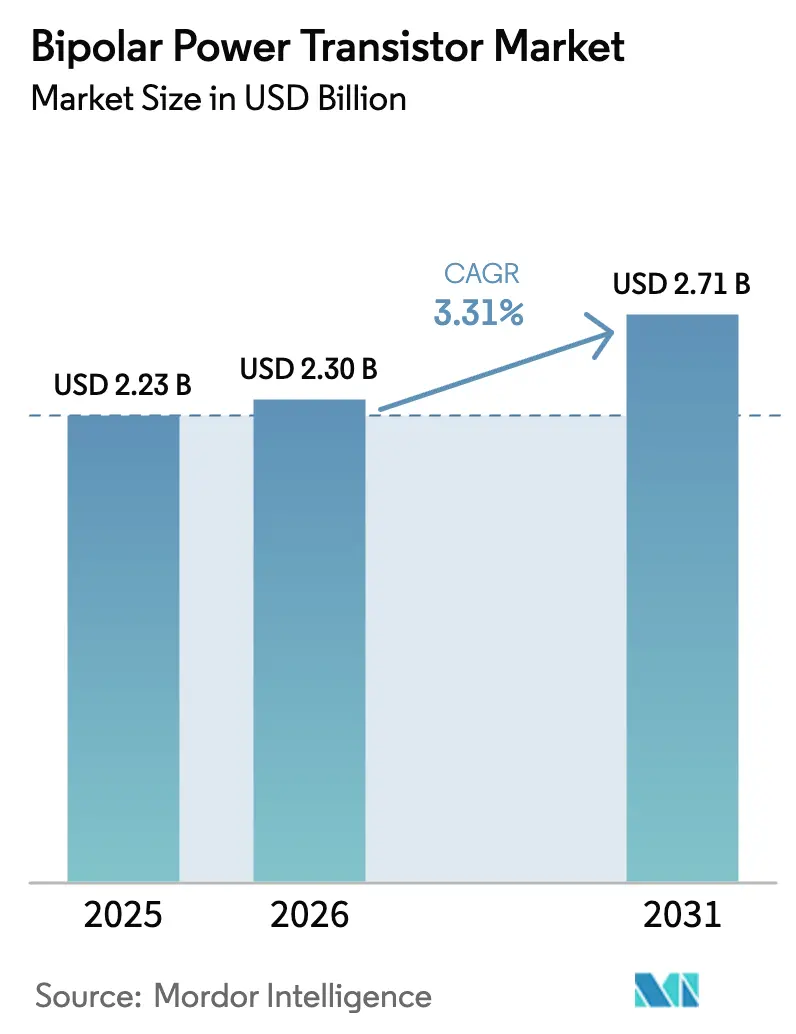
| Market Size (2026) | USD 2.3 Billion |
| Market Size (2031) | USD 2.71 Billion |
| Growth Rate (2026 - 2031) | 3.31 % |
| Fastest Growing Market | Middle East and Africa |
| Largest Market | Asia Pacific |
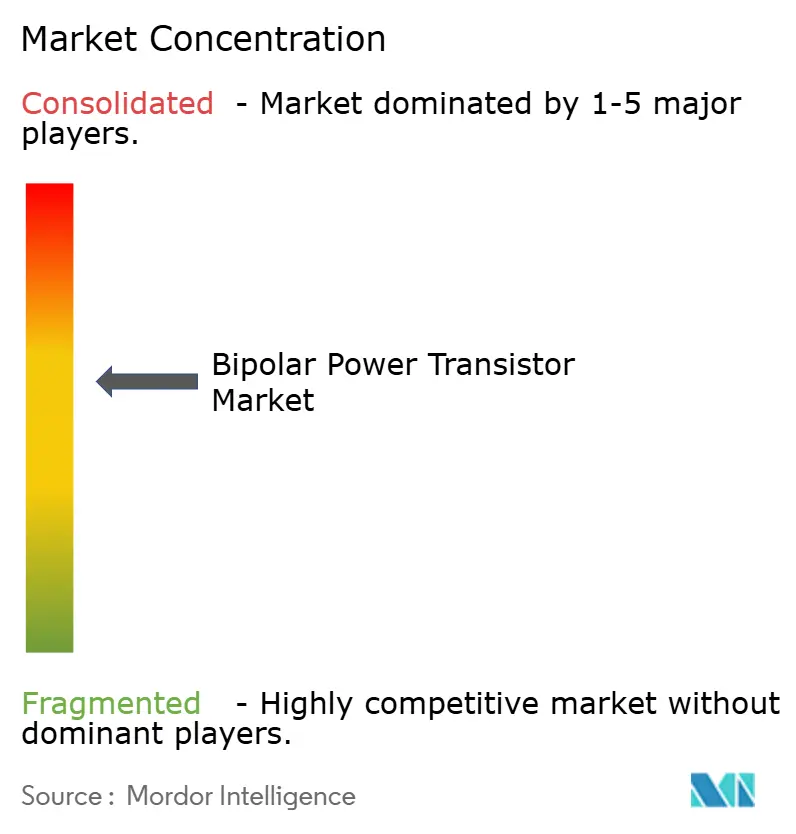
| Market Concentration | Medium |
Major Players
*Disclaimer: Major Players sorted in no particular order Image © Mordor Intelligence. Reuse requires attribution under CC BY 4.0. |
|
Bipolar Power Transistor Market Analysis by Mordor Intelligence
The bipolar power transistor market size in 2026 is estimated at USD 2.3 billion, growing from 2025 value of USD 2.23 billion with 2031 projections showing USD 2.71 billion, growing at 3.31% CAGR over 2026-2031. Steady revenue expansion masks the disruptive shift from legacy silicon toward silicon carbide as automotive electrification, renewable energy, and 5G infrastructure raise performance requirements. Silicon keeps volume leadership through mature fabrication lines and cost advantages, yet wide-bandgap materials capture critical design wins where thermal headroom, switching speed, and power density outweigh price sensitivities. Asia-Pacific leads shipments on the strength of China’s scale and Japan’s precision manufacturing, while Europe’s stringent efficiency rules and North America’s high-reliability niches shape differentiated demand. End-use focus migrates from consumer electronics toward renewable energy, EV powertrains, and industrial automation, steering suppliers to higher value applications as discrete device volumes plateau.
Key Report Takeaways
- By type, NPN devices held 67.12% of the bipolar power transistor market share in 2025, while silicon carbide BJTs register the fastest 4.71% CAGR to 2031.
- By material, silicon dominated revenue with 80.76% in 2025, and silicon carbide is set for the highest 4.71% CAGR through 2031.
- By package, surface-mount formats accounted for 61.75% of the bipolar power transistor market size in 2025, and power modules plus hybrid ICs are growing at a 5.11% CAGR.
- By power rating, medium-power (1–10 A) devices led with 46.85% share in 2025, while high-power (>10 A) units expand at 4.02% CAGR.
- By end-user, consumer electronics generated 28.94% revenue in 2025, and renewable energy registers the quickest 3.55% CAGR to 2031.
- By region, Asia-Pacific captured 50.65% revenue in 2025; the Middle East and Africa show the highest 3.63% CAGR through 2031.
Note: Market size and forecast figures in this report are generated using Mordor Intelligence’s proprietary estimation framework, updated with the latest available data and insights as of 2026.
Market Trends and Insights
Drivers Impact Analysis of Bipolar Power Transistor Market*
| Driver | ( ~ ) % Impact on CAGR Forecast | Geographic Relevance | Impact Timeline |
|---|---|---|---|
| Electrification of 48 V mild-hybrid powertrains in European vehicles | +0.8% | Europe, spillover to North America | Medium term (2-4 years) |
| Proliferation of silicon carbide BJTs in solar micro-inverters across Asia | +0.6% | Asia-Pacific core, expanding to MEA | Long term (≥ 4 years) |
| Demand for cost-optimised discrete switches in low-power IoT wearables | +0.4% | Global, Asia-Pacific concentration | Short term (≤ 2 years) |
| High-reliability needs for avionics power control units in North America | +0.3% | North America, global defence | Long term (≥ 4 years) |
| Roll-out of mmWave 5G macro base-stations in South Korea and Japan | +0.5% | Asia-Pacific, developed markets | Medium term (2-4 years) |
| Retrofit of legacy industrial motor drives in South America mining | +0.2% | South America, other emerging markets | Medium term (2-4 years) |
| Source: Mordor Intelligence | |||
Electrification of 48 V Mild-Hybrid Powertrains in European Vehicles
European OEMs are scaling 48 V systems to meet emissions rules and lower electrification bills. Belt starter generators, integrated starter generators, and electric turbochargers rely on efficient bipolar switching to handle 10–20 kW bursts while maintaining compatibility with 12 V architectures. Molex indicates connector redesign tackles electromagnetic interference at elevated voltages. Onsemi’s APM21 module combines multiple switches and thermal enhancements for compact layouts.[1]Onsemi, “48-Volt Systems for Mild Hybrid Electric Vehicles and Beyond,” onsemi.comReliability and low BOM cost keep bipolar devices central to these subsystems, supporting a +0.8% uplift in the bipolar power transistor market CAGR through 2030.
Proliferation of Silicon Carbide BJTs in Solar Micro-Inverters across Asia
Asia-Pacific utility-scale and rooftop solar additions drive micro-inverter uptake, and SiC BJTs cut switching losses up to 50% versus silicon. ROHM and Semikron Danfoss integrated 2 kV SiC MOSFETs into SMA systems for 1500 V DC links that raise yield.[2]ROHM Semiconductor, “Semikron Danfoss' Module with ROHM's latest 2kV SiC MOSFETs,” rohm.com China’s economies of scale and Japan’s quality focus underpin cost and reliability improvements, giving SiC a long-term tailwind and adding +0.6% to growth prospects for the bipolar power transistor market.
Demand for Cost-Optimised Discrete Switches in Low-Power IoT Wearables
Smartwatches, health bands, and sensor tags need sub-1A switches that maximise battery life and fit small footprints. Research on hetero-dielectric gate-all-around devices shows better subthreshold swings that lift efficiency for wearable nodes.[3]MDPI, “Low-Power Energy-Efficient Hetero-Dielectric Gate-All-Around MOSFETs,” mdpi.comAsia-Pacific fabrication hubs deliver cost structures aligned with high-volume consumer pricing. Packaging miniaturisation ensures discrete bipolar transistors remain favoured for size-constrained boards, contributing +0.4% to sector growth.
High-Reliability Requirements for Avionics Power Control Units in North America
Mission-critical avionics demand transistors qualified for radiation and temperature extremes. Microchip’s BJTs meet Joint Army-Navy specifications after enhanced low-dose-rate sensitivity testing. Wide-bandgap devices promise future density gains, yet adoption lags in defence contracts due to lengthy validation cycles. Premium pricing offsets lower volumes, lifting the bipolar power transistor market via a +0.3% CAGR boost.
Restraints Impact Analysis of Bipolar Power Transistor Market*
| Restraint | ( ~ ) % Impact on CAGR Forecast | Geographic Relevance | Impact Timeline |
|---|---|---|---|
| Share loss to power MOSFETs in high-frequency DC-DC converters | -0.7% | Global, developed markets | Short term (≤ 2 years) |
| Thermal runaway risk above 150°C in EV traction inverters | -0.5% | Global automotive | Medium term (2-4 years) |
| Tightened EU ecodesign regulations on standby losses | -0.3% | Europe, global spillover | Long term (≥ 4 years) |
| Supply instability of high-purity germanium for SiGe BJTs | -0.4% | Global high-performance segments | Short term (≤ 2 years) |
| Source: Mordor Intelligence | |||
Share Loss to Power MOSFETs in High-Frequency DC-DC Converters
Efficient MOSFET gate control enhances switching above 300 kHz, making them preferred within data centre and telecom converters. Infineon’s CoolGaN integrates Schottky diodes, trimming deadtime losses and shrinking designs.[4]Infineon Technologies AG, “Infineon launches world's first industrial gallium nitride transistor family,” infineon.comBipolar suppliers focus on cost-sensitive or lower frequency grids, facing a -0.7% drag on market CAGR.
Thermal Runaway Risk above 150°C Limits Adoption in EV Traction Inverters
IGBT and SiC modules with double-sided cooling mitigate heat better than bipolar counterparts. MDPI research underlines advanced junction temperature estimation for safe operation. EV charging heat flux has already risen tenfold since 2024. The thermal ceiling subtracts -0.5% from growth.
*Our forecasts treat driver/restraint impacts as directional, not additive. The impact forecasts reflect baseline growth, mix effects, and variable interactions.
Bipolar Power Transistor Market Segment Analysis
By Type:
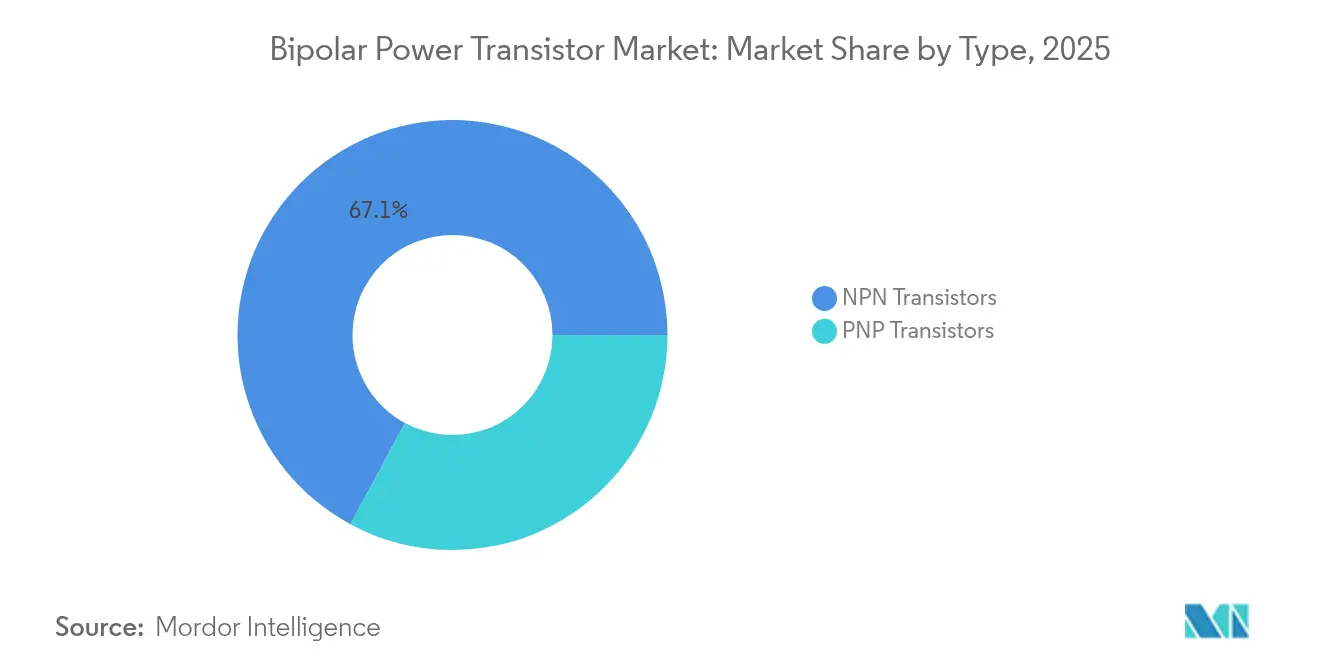
NPN Dominance Drives Circuit StandardizationNPN transistors controlled 67.12% revenue in 2025, and the bipolar power transistor market size for this category is forecast to expand at 3.33% CAGR to 2031. Positive-rail system designs in automotive ECUs, industrial drives, and consumer power supplies favour NPN polarity, anchoring demand even as new materials emerge. PNP units retain complementary roles in push-pull stages and negative-rail circuits, yet economies of scale keep NPN cost leadership intact. Continuous library reuse shortens design cycles, making NPN the default choice when engineers weigh part sourcing and validation schedules.
Migration to silicon carbide preserves NPN conventions. STMicroelectronics maps familiar pin-outs onto SiC structures, easing qualification and widening the bipolar power transistor market footprint in EV charging, renewable inverters, and 5 G power boards. This coherence ensures sustained revenue even if overall discrete volumes moderate.



By Material:
Silicon Carbide Emerges Despite Silicon LeadershipSilicon delivered 80.76% revenue in 2025 due to high wafer throughput and decades-old fab lines. Yet, silicon carbide devices book a 4.71% CAGR and increasingly crowd high-voltage sockets, capturing a rising slice of the bipolar power transistor market share. SiC’s wider bandgap shrinks conduction losses and allows 175 °C junctions, cutting heat-sink mass in EVs and string inverters. Infineon’s 200 mm wafer ramp at Kulim underwrites future supply and narrows cost gaps.
Silicon’s entrenched ecosystem shields high-volume consumer and IoT segments, but multi-kilowatt designs pivot toward SiC for range and efficiency gains. Hybrid boards blending both materials blossom, allowing designers to match the right die to each stress zone, which lifts overall bipolar power transistor market flexibility.
By Power Rating:
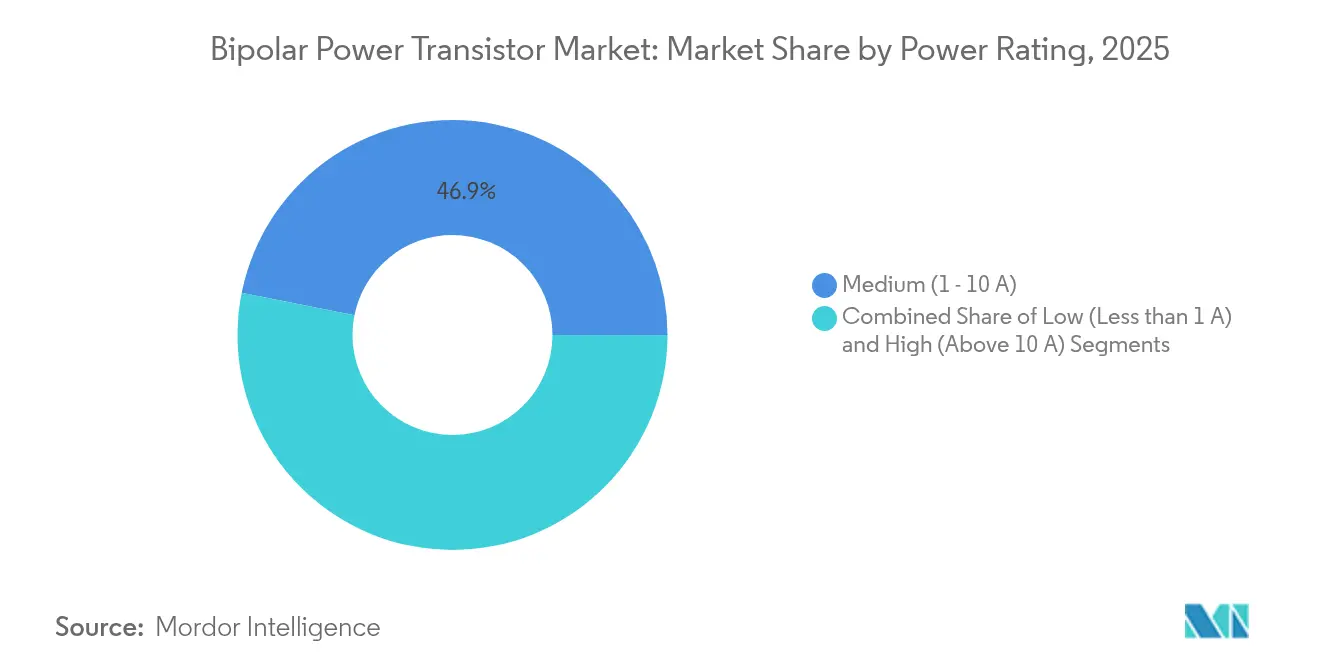
High Current Designs Propel Premium MixMedium-power (1-10 A) parts held a 46.85% share in 2025, feeding automotive auxiliaries, appliance motors, and broad industrial use. The bipolar power transistor market size for high-power (>10 A) devices posts a 4.02% CAGR to 2031 as EV chargers, solar string inverters, and factory robotics standardise on higher bus currents to curb conductor bulk. Low-power (<1 A) switches remain staples in wearables and IoT remotes, but their dollar value plateaus as consumer devices consolidate functions into SOCs.
High-current designs demand tighter thermal paths and advanced packaging. ROHM’s molded SiC modules in HSDIP20 deliver triple the power density of older frames, proving that packaging innovation, not die size, governs performance at 20 A+ levels. As system voltages climb from 400 V to 800 V in fast-charge EV stacks, current per device still swells, channelling fresh revenue into the high-power end of the bipolar power transistor market.
By Frequency Range:
RF Upswing Challenges Low-Frequency Comfort ZoneApplications below 300 kHz still command 64.65% revenue in 2025, spanning motor drives, UPS units, and conventional switch-mode supplies. Radio-frequency and microwave tiers between 300 kHz and 6 GHz notch a 3.74% CAGR as 5 G macro sites, phased-array radar,s and V2X links proliferate. mmWave cells push gain, linearity, and ruggedness requirements that favour specialised bipolar topologies.
NXP and other RF houses pair SiGe front ends with GaN power stages, yet driver and pre-driver slots often retain silicon BJTs for predictable biasing. Certification for telecom adds complexity, but premium ASPs lift revenue density inside the bipolar power transistor market. Legacy low-frequency categories remain durable as grid-tied assets age slowly, preserving a wide base that funds R&D for RF growth.
By Package Type:
Integration Drives Surface-Mount and ModulesSurface-mount packages such as SOT-223 and DPAK represented 61.75% shipments in 2025 because automated pick-and-place lines cut labour cost and boost board reliability. Power modules and hybrid ICs outpace at 5.11% CAGR, combining multiple dies, drivers and sometimes passive layers in a single enclosure that trims footprint while boosting thermal conduction. Through-hole cans like TO-220 persist where heat spread and bolt-down force outweigh solderability, for example in industrial welders and locomotive drives.
Rising EV voltages and server power densities fuel module growth. Onsemi’s Czech plant will vertically integrate boule to finished module, illustrating how supply control underpins cost and delivery surety. Thermal interface materials, direct-bonded copper substrates and leadframe alloy tweaks become differentiators, steering buyers to vendors that package innovation into bipolar power transistor market offerings.

By End-User Industry:
Renewable Infrastructure Outspeeds Consumer VolumesConsumer electronics accounted for 28.94% 2025 revenue, but shipments inch forward as smartphones and TVs saturate. Renewable-energy systems expand at 3.55% CAGR to 2031, lifting the bipolar power transistor market as governments chase decarbonisation goals. Data-intensive 5 G and edge servers keep ICT spending robust, whereas industrial automation gains momentum from retrofits and smart factory rollouts.
EV powertrains and on-board chargers are the showpiece growth engines. Silicon carbide BJTs in traction inverters add range while curbing cooling mass, making them integral to regulatory compliance and customer acceptance. Aerospace and defence remain a steady yet limited slice, characterised by decade-long lifecycles and tight qualification rules that stabilise cash flow inside the bipolar power transistor market.
Geography Analysis
APAC Bipolar Power Transistor Market
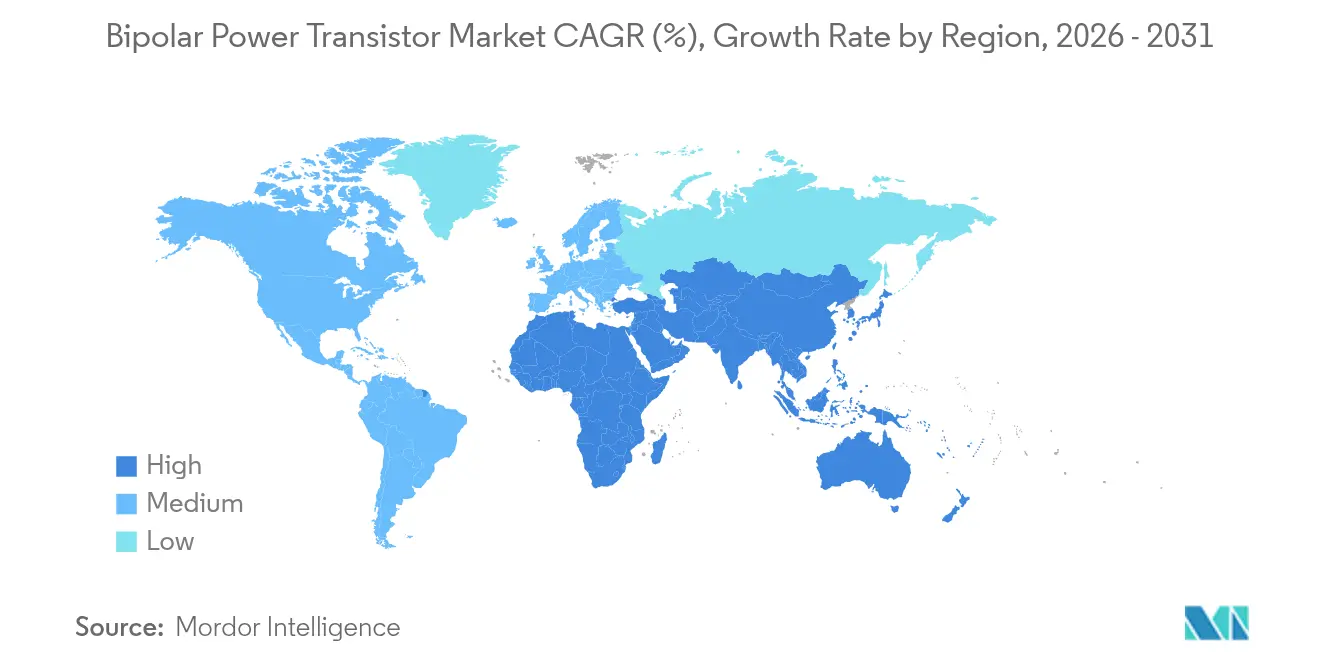
Asia-Pacific generated 50.65% of 2025 revenue, and the bipolar power transistor market size in the region is forecast to widen as China channels subsidies into renewables and EVs, Japan pushes precision IC packaging, and South Korea scales 5G macro sites. Domestic material policies, including China’s gallium and germanium export controls, raise input volatility and spur localization projects, influencing sourcing and pricing strategies.
Europe Bipolar Power Transistor Market
Europe’s OEMs enforce 48 V mild-hybrid penetration and adhere to EU eco-design rules that penalize standby losses, directing R&D toward efficiency upgrades. STMicroelectronics’ planned Sicily SiC fab, backed by EUR 5 billion (USD 5.88 billion) in aid, exemplifies reshoring momentum. Regional alignment around clean mobility and industrial decarbonization sustains demand for advanced bipolar power devices.
The Americas and MEA Bipolar Power Transistor Market
North America relies on aviation, defense, and industrial automation, where lifetime reliability offsets low shipment counts. Long qualification cycles stabilize revenue streams and favor entrenched suppliers. Middle East and Africa post the swiftest 3.63% CAGR as utility-scale solar farms and grid-expansion projects dominate capex. South America’s mines refit motor drives, creating niche demand pockets underpinned by commodity export cashflows.

Regulatory Landscape
Environmental compliance and market-access rules are tightening for discrete components used in power conversion, which is pushing bipolar power transistor suppliers to document materials and lifecycle impacts more rigorously. In China, the Ministry of Industry and Information Technology published the 2026 Edition of the Compliance Management Catalogue for Restricted Use of Hazardous Substances in Electrical and Electronic Products (China RoHS), expanding covered electrical and electronic product categories and reinforcing supplier expectations on substance disclosure for components embedded in finished goods.
Technical conformity requirements are also being refreshed in key manufacturing hubs. China issued updated national standards for bipolar transistors, including GB/T 7576-2026 (high power bipolar transistors) and GB/T 6217-2026 (low power bipolar transistors), with an effective date of October 1, 2026, which can affect qualification plans and test documentation for suppliers serving domestic OEMs and EMS providers. On the trade side, the United States issued a January 2026 proclamation introducing a 25% ad valorem tariff on specified semiconductor categories, increasing the need to manage country-of-origin, classification, and exemption documentation for cross-border shipments of semiconductor devices and derivative products.
Value Chain Analysis
The bipolar power transistor value chain covers raw materials and specialty chemicals (silicon, SiC substrates for adjacent wide-bandgap lines, and high-purity process gases), wafer fabrication, assembly and packaging (leadframes, clip-bond and mold compounds, power module substrates), test and qualification, and then distribution through franchised and independent channels to OEMs and contract manufacturers. Integrated device manufacturers such as STMicroelectronics, Infineon Technologies, and onsemi run more vertically integrated models across design, wafer processing, and backend steps, while other suppliers rely more on outsourced assembly and test to manage costs and flexibility.
Two structural pressures are shaping supply continuity and lead times. First, OECD mapping and industry supply-chain discussions point to ongoing concentration risks in materials and upstream inputs, with meaningful reliance on imports for key chemicals and raw materials that increases exposure to trade frictions and export controls. Second, capacity allocation across foundries and backend providers remains a bottleneck for legacy-node discrete power devices, because industry investment and tool availability prioritize advanced nodes for high-growth compute applications. This raises the value of secured backend capacity and packaging differentiation, particularly surface-mount power packages and module or hybrid integration, for automotive, industrial, and renewable-energy customers.
Competitive Landscape
Market concentration is moderate. STMicroelectronics owns 32.6% of silicon carbide revenue after early capacity bets, while Infineon, onsemi, and Wolfspeed expand through acquisitions and greenfield fabs. Onsemi secured Qorvo’s SiC JFET assets for USD 115 million, targeting AI data center power stages. Infineon added GaN Systems for USD 830 million to deepen wide-bandgap coverage. Capital intensity is rising, illustrated by onsemi’s USD 2 billion Czech SiC project that achieves vertical integration from boule to module.
Technology rivalry focuses on thermal interfaces, module integration, and material purity. Supply-chain control provides cost savings and resilience amid critical mineral restrictions. Specialists carve niches in extreme environments, such as Microchip’s radiation-hardened BJTs. Overall, top suppliers balance scale and specialty portfolios to address divergent cost and performance criteria across the bipolar power transistor market.
Bipolar Power Transistor Industry Leaders
-
STMicroelectronics
-
TT Electronics
-
Nexperia
-
Sanken Electric Co., Ltd.
-
ON Semiconductor (onsemi)
- *Disclaimer: Major Players sorted in no particular order
Bipolar Power Transistor Market Companies Covered in this Report
- STMicroelectronics
- Infineon Technologies AG
- ON Semiconductor (onsemi)
- Nexperia
- Renesas Electronics Corporation
- Toshiba Electronic Devices and Storage
- ROHM Co., Ltd.
- Vishay Intertechnology
- Texas Instruments Incorporated
- Microchip Technology Inc.
- Fuji Electric Co., Ltd.
- Semikron Danfoss
- Hitachi Power Semiconductor Device, Ltd.
- TT Electronics plc
- Diodes Incorporated
- Sanken Electric Co., Ltd.
- Solitron Devices, Inc.
- Littelfuse, Inc.
- Advanced Semiconductor, Inc.
- Alpha and Omega Semiconductor

Market Opportunities and Future Outlook
Opportunities are opening around device and package innovation that narrows efficiency and thermal gaps in applications where BJTs still offer cost or robustness advantages. Advanced trench bipolar architectures are showing measurable performance gains in recent peer-reviewed work, including a reverse-blocking carrier stored trench bipolar transistor (RB-CSTBT) reporting improved forward and reverse blocking voltages, and an orthogonal dual-trench CSTBT structure reporting a large reduction in switching loss. These results outline a development pathway for higher-efficiency switching devices that can be evaluated for motor drives, UPS, and grid-edge converters operating below high-frequency MOSFET-dominated regimes.
A second whitespace sits at the intersection of high-frequency requirements and extreme-environment reliability. SiGe heterojunction bipolar transistor research continues to push performance within mainstream CMOS/SOI-compatible flows and to characterize behavior across wide temperature ranges. This supports continued use of bipolar-based solutions in RF and mixed-signal front ends, and in defense and aerospace power control, where qualification cycles and predictable biasing are valued. On the commercial side, packaging-led portfolio moves by suppliers, including compact DFN and clip-bonded power BJT formats for automotive and industrial use, indicate that PCB footprint reduction and thermal improvements remain near-term levers for differentiation, even in high-volume discrete designs where silicon still dominates.
Recent Industry Developments in Bipolar Power Transistor Market
- May 2026: STMicroelectronics released a new series of 700 V enhancement-mode PowerGaN transistors with current ratings spanning 6 A to 29 A, targeting power-dense platforms such as AI servers and robotics. The launch underscores the competitive pull of wide-bandgap switching in high-efficiency power stages, raising substitution pressure on legacy discrete solutions in fast-switching segments while changing adjacent gate-drive and power-module design choices.
- July 2025: Nexperia introduced the MJPE series of 12 BJTs in the clip-bonded FlatPower (CFP15B) package with 50 V to 100 V VCEO options for automotive and industrial designs. The update highlights how advanced packaging is being used to improve thermal performance and reduce PCB area in power discrete portfolios, lifting customer expectations for footprint-efficient BJTs in cost- and space-constrained designs.
- August 2024: Nexperia released a set of power BJT products, including automotive-qualified options, in the DFN2020D-3 package with 50 V and 80 V ratings and 1 A to 3 A collector-current coverage. This broadened availability of compact leadless packages for BJTs supports higher assembly automation and improved board-level power density, which can accelerate design refreshes in industrial controls and automotive subsystems that still rely on bipolar switching.


Bipolar Power Transistor Market Report Scope and Research Methodology
Market Definition and Coverage
For this study, the market covers revenue generated from bipolar power transistors sold globally, counted at the device level across common power control and switching uses in electronics, automotive, industrial, and energy equipment.
Scope exclusions: We exclude small-signal bipolar transistors and any broader power semiconductor totals where bipolar power transistors are not separable.
Segments Covered in This Report
-
By Type
- NPN Transistors
- PNP Transistors
-
By Material
- Silicon (Si)
- Silicon-Germanium (SiGe)
- Silicon Carbide (SiC)
- Gallium Arsenide (GaAs)
-
By Power Rating
- Low (Less than 1 A)
- Medium (1 - 10 A)
- High (Above 10 A)
-
By Frequency Range
- Low-Frequency (Less than 300 kHz)
- Radio-Frequency and Microwave (300 kHz - 6 GHz)
-
By Package Type
- Through-Hole (TO-220, TO-3)
- Surface-Mount (SOT-223, DPAK)
- Power Modules and Hybrid ICs
-
By End-User Industry
- Consumer Electronics
- ICT and 5G Infrastructure
- Automotive and EV Powertrain
- Industrial Motor Drives and Automation
- Renewable Energy and Power (Solar, Wind)
- Aerospace and Defense
-
By Geography
-
North America
- United States
- Canada
- Mexico
-
Europe
- Germany
- United Kingdom
- France
- Italy
- Spain
- Nordics (Denmark, Sweden, Norway, Finland)
- Rest of Europe
-
Asia-Pacific
- China
- Japan
- South Korea
- India
- Southeast Asia
- Australia
- Rest of Asia-Pacific
-
South America
- Brazil
- Argentina
- Rest of South America
-
Middle East
- Gulf Cooperation Council Countries
- Turkey
- Rest of Middle East
-
Africa
- South Africa
- Nigeria
- Rest of Africa
-
North America
Data Sources, Market Sizing, and Validation
Desk Research
Desk work starts by building the demand context for bipolar power transistors, and then mapping it to a practical supply chain view. We lean on public, non-paywalled references such as semiconductor trade statistics from UN Comtrade, industry production and outlook notes from the OECD, technical standards and reference documents from IEC, and application and reliability literature from IEEE publications.
Next, we use company filings, investor decks, and credible press releases to understand product positioning, end-use exposure, and capacity or expansion signals that can move supply. Where helpful, we also cross-check corporate financials and patent activity through a paid subscription database used for company intelligence and patent lookups. The specific sources named here are illustrative, and many other public and paid references were also used to collect, validate, and clarify the data.
Primary Interviews and Surveys
Primary work is used to confirm what desk research cannot reliably show, especially typical pricing ranges by power rating and package, where demand is shifting by end use, and what portion of shipments is still handled as discrete devices versus module-type formats. We spoke with manufacturers, distributors, and engineers or procurement contacts at OEMs across APAC, EMEA, and the Americas, and the respondent input was used to close gaps and to pressure-test assumptions before finalizing the model.
Distribution of primary research fieldwork respondents
| Company type | Respondent position | Region |
|---|---|---|
| Top tier: 32% | CXOs: 12% | APAC: 42% |
| Mid tier: 52% | Functional/Unit leaders: 39% | EMEA: 32% |
| Smaller Players: 16% | Managers: 49% | Americas: 26% |
Market-Sizing & Forecasting
Sizing begins with a top-down approach where the overall power semiconductor demand pool is reconstructed by end-use electronics output and equipment build indicators, and then filtered to the bipolar power transistor portion using adoption signals by application. To keep the numbers grounded, we corroborate totals with selective bottom-up approximations such as sampled average selling price by power rating and package, and supplier and channel checks that indicate shipment direction.
Inputs that materially affect the model include the mix shift across low, medium, and high power ratings, the split between through-hole and surface-mount formats, and demand tied to industrial motor drives, automotive electrification, and renewable energy inverters. Frequency use cases (low-frequency versus RF and microwave) are tracked separately when pricing and demand patterns differ, and material direction is monitored because movement toward silicon carbide and other alternatives can change what is substituted versus what stays in bipolar technology.
For forecasting, scenario analysis is used so that different paths for EV build rates, industrial automation spending, and electronics cycle recovery can be reflected without forcing one single aggressive outcome. When bottom-up inputs are missing for smaller geographies or niche applications, we fill gaps using proxy ratios from validated regions and then re-check the implied pricing and share against interview feedback.
Data Validation & Update Cycle
Outputs are checked in more than one way before sign-off. We look for internal consistency across end uses, regions, and price-volume relationships, and then flag spikes that do not match known demand timing for automotive and industrial cycles. Variances are reviewed by another analyst, and follow-up calls are triggered when a key assumption, such as ASP progression for a package type or an application mix shift, is driving the result.
The report is refreshed annually, and interim updates are made when material events occur, such as major capacity changes or demand shocks in automotive and industrial markets. Before delivery, we do a final pass across recent public updates and interview notes so the numbers reflect the latest market reality.
Mordor Intelligence's Global Bipolar Power Transistor Market Size Compared With Other Published Estimates
Different published market sizes for bipolar power transistors can look far apart because scope is not always aligned, and because pricing and end-use cutoffs vary by publisher. The biggest drivers usually come from what is counted as a bipolar power transistor product, which end-user equipment is included, and what year and currency timing are used.
The main gap comes from whether RF and microwave bipolar devices and module-style formats are counted inside the same total as discrete power switching transistors, and how quickly average selling prices are assumed to fall as the mix shifts. Some publishers also extend the market into wider BJT totals or blend adjacent power transistor families, and they may assume a more aggressive demand path for EVs and renewables without re-checking it against shipment and application signals that show substitution behavior. In Mordor Intelligence, substitution is treated more narrowly, with the scope anchored to identifiable bipolar power transistor use cases.
Benchmark comparison
| Source | Market Size | Gaps in Research Methodology |
|---|---|---|
| Mordor Intelligence | USD 2.30 B (2026) | |
| Trade Journal A | USD 1.00 B (2025) | Uses a tighter product interpretation that appears closer to discrete-only power bipolar transistors, and it likely excludes RF and microwave ranges plus module or hybrid formats, which lowers the counted revenue base. |
| Industry Publisher B | USD 11.44 B (2025) | Looks closer to a broadened definition that can blend general BJT value and adjacent transistor families, and it may assume higher ASP and faster EV-led demand build without separating substitution into IGBTs, MOSFETs, or wide-bandgap devices. |
The spread in the table is mainly explained by what gets included as product scope and how pricing is handled as applications shift. By keeping the included device families and use cases traceable to clear application checks, and then validating the implied ASP and volume direction through interviews, the estimate stays easier to reproduce and to explain on a simple set of inputs.


Key Questions Answered in the Report
What is the current size of the bipolar power transistor market?
The bipolar power transistor market is valued at USD 2.3 billion in 2026.
How fast will the bipolar power transistor market grow through 2031?
Revenue is forecast to increase at a 3.31% CAGR, reaching USD 2.71 billion by 2031.
Which region leads demand for bipolar power transistors?
Asia-Pacific holds 50.65% revenue share, driven by China’s manufacturing ecosystems and Japan’s precision electronics sector.
Why are silicon carbide devices important for future growth?
Silicon carbide offers higher voltage tolerance and lower switching losses, enabling efficiency gains in EV powertrains and solar inverters and therefore delivers the fastest 4.71% CAGR.
Which end-user segment shows the quickest growth?
Renewable energy and power applications record the highest 3.55% CAGR as solar and wind installations expand.
Page last updated on:





