
Artificial Intelligence Certification Courses Market Size and Share
Market Overview
| Study Period | 2022 - 2031 |
|---|---|
| Market Size (2026) | USD 4.72 Billion |
| Market Size (2031) | USD 12.36 Billion |
| Growth Rate (2026 - 2031) | 21.23 % |
| Fastest Growing Market | Asia-Pacific |
| Largest Market | North America |
| Market Concentration | Medium |
Major Players *Disclaimer: Major Players sorted in no particular order Image © Mordor Intelligence. Reuse requires attribution under CC BY 4.0. | |
Artificial Intelligence Certification Courses Market Analysis by Mordor Intelligence
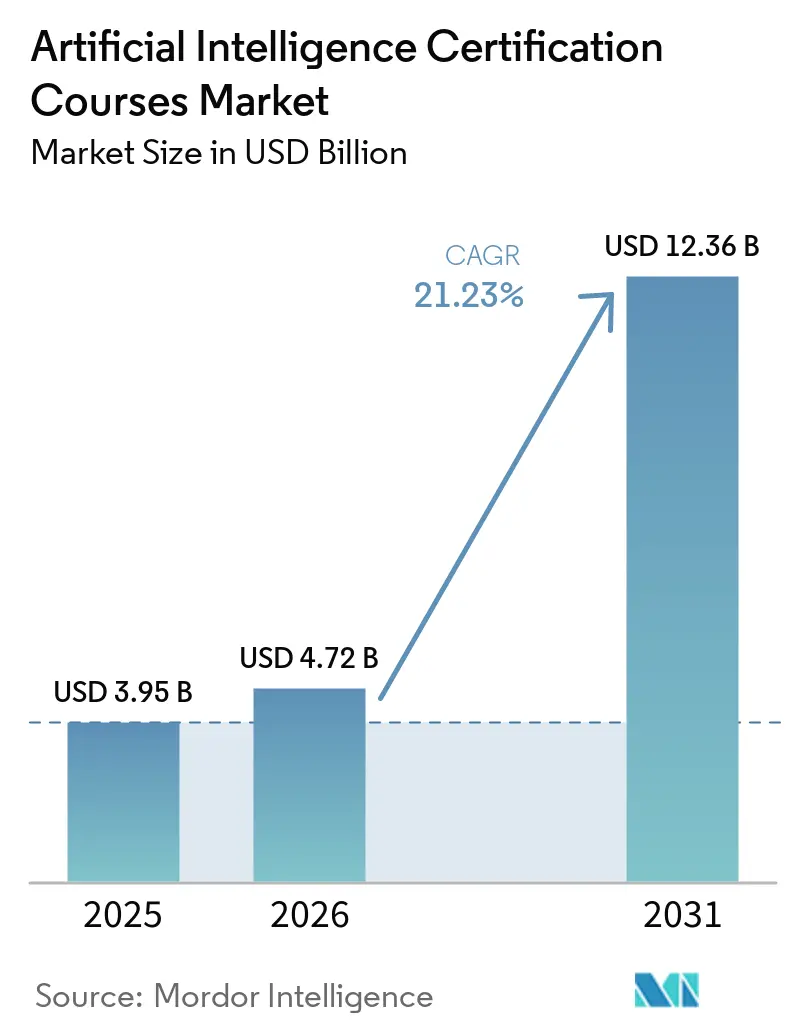
The Artificial Intelligence Certification Courses Market size is expected to grow from USD 3.95 billion in 2025 to USD 4.72 billion in 2026 and is forecast to reach USD 12.36 billion by 2031 at 21.23% CAGR over 2026-2031.
The Artificial Intelligence Certification Courses Market is expanding because enterprise AI deployment has outpaced workforce readiness, pushing certification from optional learning to an operational requirement. In 2025, approximately 25% of the workforce met a baseline for AI proficiency, while nearly 50% of companies had integrated AI use policies, widening the gap between software adoption and usable skills. The Artificial Intelligence Certification Courses Market is also being reshaped by hyperscale vendors such as Google, Microsoft, and AWS, which now use certifications as part of broader enterprise engagement rather than as stand-alone training products. The Linux Foundation reported in 2025 that 68% of organizations prioritized upskilling over external hiring, up from 52% in 2024, and 71% considered certifications important in recruiting, which supports continued demand for employer-recognized credentials. The shift toward audit-ready, job-linked certification models is likely to favor providers that can demonstrate skill validation, enterprise integration, and regular curriculum refresh cycles.
Key Report Takeaways
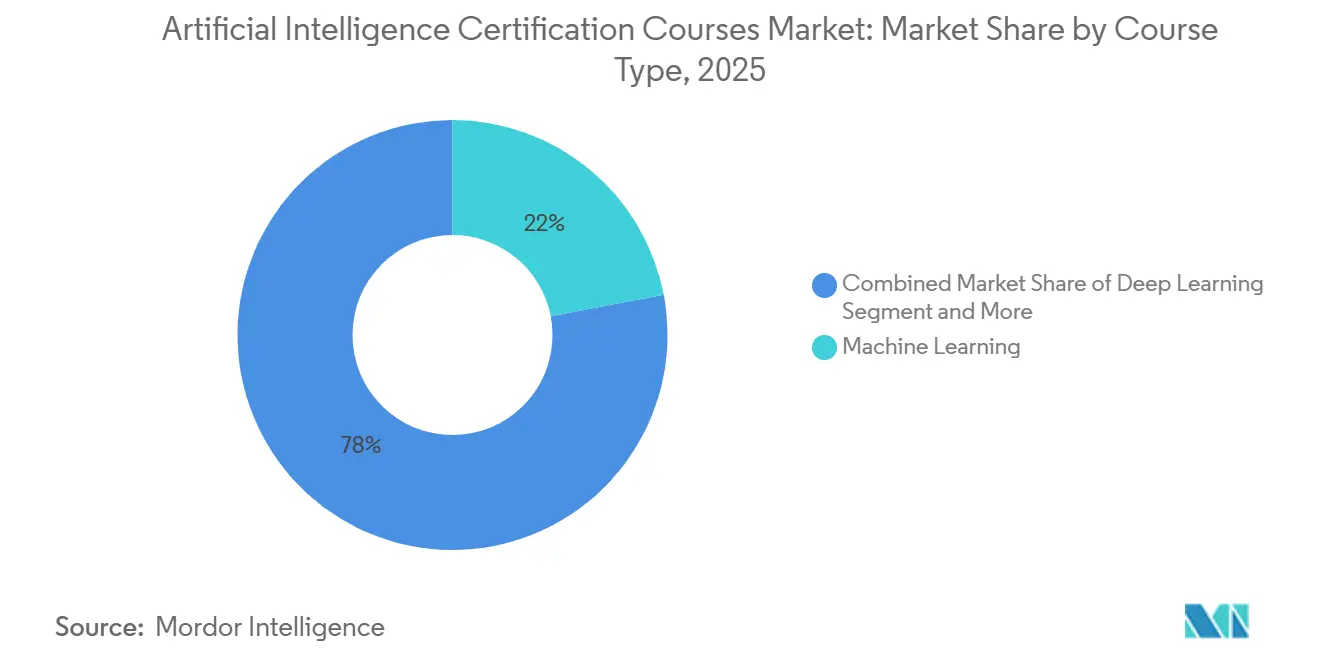
- By course type, Machine Learning held 22.0% of the Artificial Intelligence Certification Courses market size in 2025, while Generative AI is projected to grow at a 33.10% CAGR through 2031.
- By certification level, Beginner accounted for 48.0% of the Artificial Intelligence Certification Courses market share in 2025 and is also the fastest-growing level at a 23.5% CAGR through 2031.
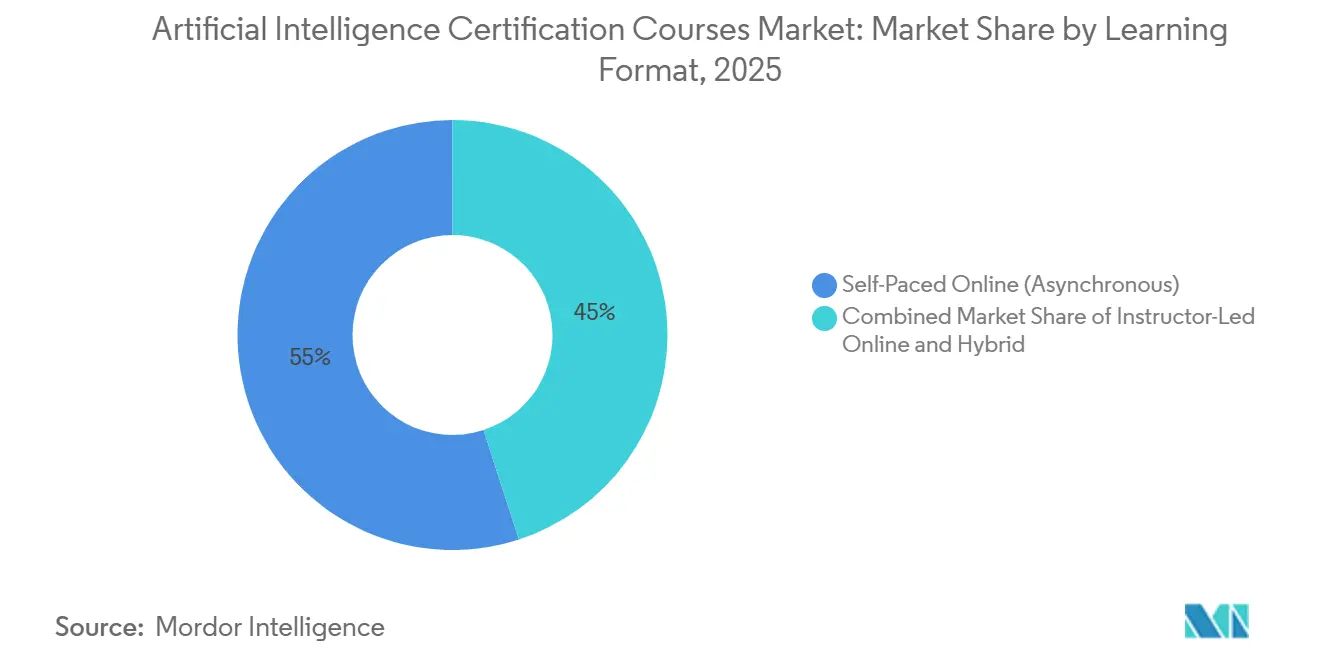
- By learning format, Self-Paced Online captured 55.0% of the Artificial Intelligence Certification Courses market size in 2025, while Instructor-Led Online is projected to expand at a 24.3% CAGR through 2031.
- By end use, Individual Learners accounted for 44.8% of the Artificial Intelligence Certification Courses market share in 2025, while the Government and Public Sector is forecast to grow at a 26.20% CAGR through 2031.
- By geography, North America led with 32.4% share in 2025, while Asia-Pacific is projected to advance at a 30.5% CAGR through 2031.
Note: Market size and forecast figures in this report are generated using Mordor Intelligence’s proprietary estimation framework, updated with the latest available data and insights as of January 2026.
Global Artificial Intelligence Certification Courses Market Trends and Insights
Drivers Impact Analysis*
| Drivers | (~) % Impact on CAGR Forecast | Geographic Relevance | Impact Timeline |
|---|---|---|---|
| Rising Enterprise AI Upskilling Demand | +5.2% | Global, concentrated in North America and Western Europe | Short term (≤ 2 years) |
| Growing Need for Role-Based AI Credentialing | +3.8% | Global, early gains in North America and APAC core, spill over to MEA | Medium term (2-4 years) |
| Rapid Adoption of Generative AI Certification Paths | +4.5% | Global, Southeast Asia, India, and the EU driving incremental demand | Short term (≤ 2 years) |
| Expansion of Hybrid and Micro-Credential Learning Models | +2.1% | APAC, Latin America, spill-over to MEA | Medium term (2-4 years) |
| Increasing Demand for AI Governance and Responsible AI Training | +2.5% | EU, UK, Singapore, with spill-over to North America | Short term (≤ 2 years) to medium term (2-4 years) |
| Public Sector and Higher Education AI Literacy Programs | +1.8% | National programs in the US, UK, India, Singapore, and UAE | Medium term (2-4 years) |
| Source: Mordor Intelligence | |||
Rising Enterprise AI Upskilling Demand
The Artificial Intelligence Certification Courses Market is benefiting from a clear shift in corporate learning budgets toward internal capability building. The Linux Foundation stated in 2025 that 72% of organizations prioritized upskilling existing staff over external hiring, up from 48% in 2024, and technical training programs were rated 91% more effective at improving retention. This demand is not uniform: larger enterprises are moving toward multi-year platform relationships, while smaller firms are choosing shorter, more modular credentials. That split is creating volume opportunities in entry-level programs and better pricing conditions in credentials tied to direct work outcomes. Providers that can connect certifications to measurable job readiness are in a stronger position than vendors competing only on catalog breadth.
Growing Need for Role-Based AI Credentialing
The Artificial Intelligence Certification Courses Market is also expanding because buyers increasingly want credentials that map to specific job roles rather than broad AI awareness. Google Cloud launched the Generative AI Leader certification in 2025 as a role-based credential for business leaders, demonstrating that non-technical decision-makers have become a recognized training cohort. AWS added a Certified Generative AI Developer path focused on foundation models, RAG architectures, vector databases, and responsible deployment, reflecting the same move toward job-mapped validation. This trend supports provider strategies built around clearer skill ladders for engineers, analysts, managers, and governance teams. It also makes enterprise procurement easier because employers can align training spend with internal role definitions and deployment priorities.
Rapid Adoption of Generative AI Certification Paths
The Artificial Intelligence Certification Courses Market is seeing unusually rapid demand for generative AI training paths. Coursera reported in 2025 that learners were enrolling in GenAI courses at a rate of 12 enrollments per minute, up from 8 per minute in 2024, across 700 dedicated programs. Google Cloud, AWS, and other platform vendors have responded by launching new credentials that focus on strategy, development, deployment, and practical use cases in production environments. The speed of adoption matters because training demand is now driven by real software deployments, not by interest alone. Providers that can update course content more frequently are more likely to hold learners' attention and retain enterprise accounts.
Expansion of Hybrid and Micro-Credential Learning Models
The Artificial Intelligence Certification Courses Market is widening through delivery models that combine flexible access with clearer evidence of skill attainment. A 2025 Springer study on hybrid-flexible AI training found that blended delivery improved AI competency outcomes across learners from different educational backgrounds. The Lumina Foundation reported in 2025 that 96% of employers said micro-credentials strengthen a candidate’s job application, supporting employers' interest in shorter, stackable learning units. Simplilearn’s 2026 launches with Virginia Tech and other global institutions also showed how premium providers are combining live instruction, structured projects, and modular course design within a single offering. This model helps providers serve both price-sensitive learners who want flexibility and enterprise buyers who still need stronger completion signals.
Restraints Impact Analysis*
| Restraints | (~) % Impact on CAGR Forecast | Geographic Relevance | Impact Timeline |
|---|---|---|---|
| Lack of Certification Standardization Across Providers | -1.4% | Global, most acute in North America and Europe | Medium term (2-4 years) |
| Rapid Curriculum Obsolescence Due to Fast-Moving AI Toolchains | -1.2% | Global, concentrated in AI for Cloud and MLOps and Generative AI segments | Short term (≤ 2 years) |
| Weak Immediate ROI for Price-Sensitive Learners | -0.8% | South America, MEA, and tier 2 and tier 3 cities in APAC | Medium term (2-4 years) |
| Employer Skepticism Toward Low-Rigor Online Certificates | -1.1% | North America and Europe, concentrated in the B2C segment | Short term (≤ 2 years) to medium term (2-4 years) |
| Source: Mordor Intelligence | |||
Lack of Certification Standardization Across Providers
The Artificial Intelligence Certification Courses Market still faces friction because employers must compare credentials built on very different curricula, assessment methods, and renewal cycles. Google Cloud, AWS, university-led programs, and specialist providers all use different role definitions and exam structures, which makes direct equivalence difficult for enterprise buyers. This creates more effort in procurement and slows the adoption of certifications as a universal hiring signal. The problem is more visible in fast-growing categories such as governance and generative AI, where new offerings are still setting their quality thresholds. Until a clearer market-wide quality baseline emerges, providers with stronger brand trust will hold an advantage over smaller generalist vendors.
Rapid Curriculum Obsolescence Due to Fast-Moving AI Toolchains
The Artificial Intelligence Certification Courses Market is constrained by the rapid pace of change in AI tools, model stacks, and deployment methods. AWS expanded its AI certification portfolio between late 2025 and 2026, while also updating the content to include newer services such as AgentCore, demonstrating how quickly providers must revise their programs. Google Cloud’s move into business-leader credentials and DeepLearning.AI’s 2026 course with Red Hat on LLM inference optimization point to the same issue: new application layers are emerging faster than traditional course revision cycles. This pace raises development costs for providers and creates relevance risk for learners who expect current content. It also favors platforms that can refresh modules quickly over institutions using longer approval and accreditation cycles.
*Our forecasts treat driver/restraint impacts as directional, not additive. The impact forecasts reflect baseline growth, mix effects, and variable interactions.
Segment Analysis
By Course Type: Machine Learning Anchors Enterprise Demand While Generative AI Reshapes Growth Priorities
Machine Learning held the largest segment share at 22.0% in 2025, reflecting the continued need for predictive modeling, data pipeline design, and production deployment across enterprise use cases. Generative AI is the fastest-growing course type, with a projected 33.10% CAGR for 2026-2031, underscoring how quickly the Artificial Intelligence Certification Courses Market is responding to large language model adoption across business software stacks. AWS opened beta registration for its Certified Generative AI Developer certification in November 2025 and launched the standard exam in March 2026, covering foundation models, RAG, responsible AI, and vector databases. Google Cloud introduced the Generative AI Leader credential in 2025 to validate non-technical AI strategy capabilities, thereby widening the addressable learner base beyond engineers. This mix shows that enterprise demand still values established technical skills while rapidly adding new learning paths around applied generative AI.
Deep Learning continues to play a specialized, high-value role in the Artificial Intelligence Certification Courses Market because it serves advanced practitioners working on custom model architectures and more complex optimization tasks. AI for Cloud and MLOps remains smaller in terms of enrollment volume. Still, it has a higher revenue profile because employers need production-grade skills in deployment, scaling, and lifecycle management. DeepLearning.AI’s June 2026 course with Red Hat on fast and efficient LLM inference showed how even advanced performance topics are being packaged for broader professional Learning. AI for Business and Strategy and AI Ethics and Governance are expanding as non-technical professionals enter certification pathways through role-based and standards-linked programs. Foundational and introductory courses remain the main entry point for volume, but they face the sharpest pricing pressure as public and institutional options increase.

By Certification Level: Beginner Segment Commands Volume and Growth While Advanced Credentials Generate Asymmetric Revenue
Beginner certifications captured 48.0% of the market in 2025 and are forecast to expand at a 23.5% CAGR through 2031, indicating that first-time adoption still defines the current stage of the Artificial Intelligence Certification Courses Market. Indiana University’s GenAI 101 course drew more than 114,000 enrollments after its August 2025 launch, before being opened more broadly, signaling very strong entry-level demand for structured AI literacy. Beginner demand is also supported by government-led literacy efforts in the US, UK, and India, where national programs are widening access to early-stage AI learning. This pattern explains why entry-level certifications are producing both the largest installed base and the fastest future expansion. It also indicates that many organizations are still building AI awareness at scale before moving teams into narrower specializations.
Intermediate certifications are becoming increasingly important as companies shift from broad literacy programs to more structured, role-based capability-building within departments and business functions. The Artificial Intelligence Certification Courses market size for this level benefits when employers design staged pathways that move learners from foundational knowledge into function-specific validation. Advanced credentials remain the smallest segment by enrollment, but they generate higher per-credential revenue because they target MLOps engineers, solution architects, and governance leads working on harder implementation problems. The Lumina Foundation reported that 96% of employers agree that micro-credentials strengthen a candidate’s job application, supporting the value of multi-stage progression models rather than stand-alone completions. Over time, this structure should help providers maintain margins in higher tiers even if entry-level learning becomes more accessible and price-competitive.[1]
By Learning Format: Self-Paced Platforms Lead Volume While Instructor-Led Models Improve Enterprise Outcomes
Self-Paced Online formats accounted for 55.0% of revenue in 2025, which reflects the global spread of working professionals who need flexible schedules and lower-cost access. Instructor-Led Online is the fastest-growing format, with a 24.3% CAGR through 2031, indicating that the Artificial Intelligence Certification Courses Market is placing greater value on guided delivery and higher completion rates. LinkedIn Learning reported in 2025 that organizations with advanced career development programs were 32% more likely to provide AI training, suggesting rising interest in formats that support more measurable outcomes. Self-paced learning will likely remain the largest format because it scales well across geographies and learner budgets. Even so, enterprise buyers are increasingly favoring guided formats when the goal is a work application rather than simple participation.
Hybrid and blended formats are gaining traction because they bring together the convenience of asynchronous modules with the accountability of live sessions and applied assignments. A 2025 Springer study found that hybrid-flexible AI training improved competency outcomes, especially for learners from varied educational settings. Simplilearn’s 2026 Applied Agentic AI program with Virginia Tech and its Oxford partnership both show how premium providers are packaging live instruction, institutional branding, and modular design in the same product tier. This is where the Artificial Intelligence Certification Courses industry is building a stronger premium segment because buyers are paying for mentorship, live feedback, and stronger signaling. The model is especially relevant for advanced technical training and leadership programs where project work and instructor interaction matter more.
By End Use: B2C Learners Lead Volume While Government and Institutional Buyers Add Stability
Individual Learners captured 44.8% of end-user revenue in 2025, confirming that personal career mobility still drives a large share of demand. The Artificial Intelligence Certification Courses market size remains heavily supported by B2C demand because professionals continue to seek recognizable proof of AI capability even outside formal employer-sponsored pathways. Enterprise and corporate buyers form the next major cohort, and Coursera’s learning agent within Microsoft 365 Copilot shows how providers are trying to embed credentialed learning inside daily workflows rather than outside them. The government and public sector are the fastest-growing end-use segments, with a 26.20% CAGR through 2031, as national AI literacy initiatives become more institutionalized. This shift gives the market a broader mix of demand drivers and makes growth less dependent on discretionary consumer spending alone.
Academic institutions remain a durable end-use group because universities are using AI certifications both as stand-alone credentials and as add-ons to degree pathways. Public and university-backed programs also create pressure on basic commercial offerings, especially when foundational content is provided free or at subsidized prices. That puts more weight on outcomes, brand recognition, and employer validation in the premium part of the Artificial Intelligence Certification Courses Market. The Lumina Foundation found that more than 8 in 10 employers globally were at least moderately familiar with micro-credentials, which supports growing acceptance of modular, skill-based training models. Over the forecast period, providers that can serve both individual learners and institutional buyers with differentiated offerings are likely to remain better positioned.[2]
Geography Analysis
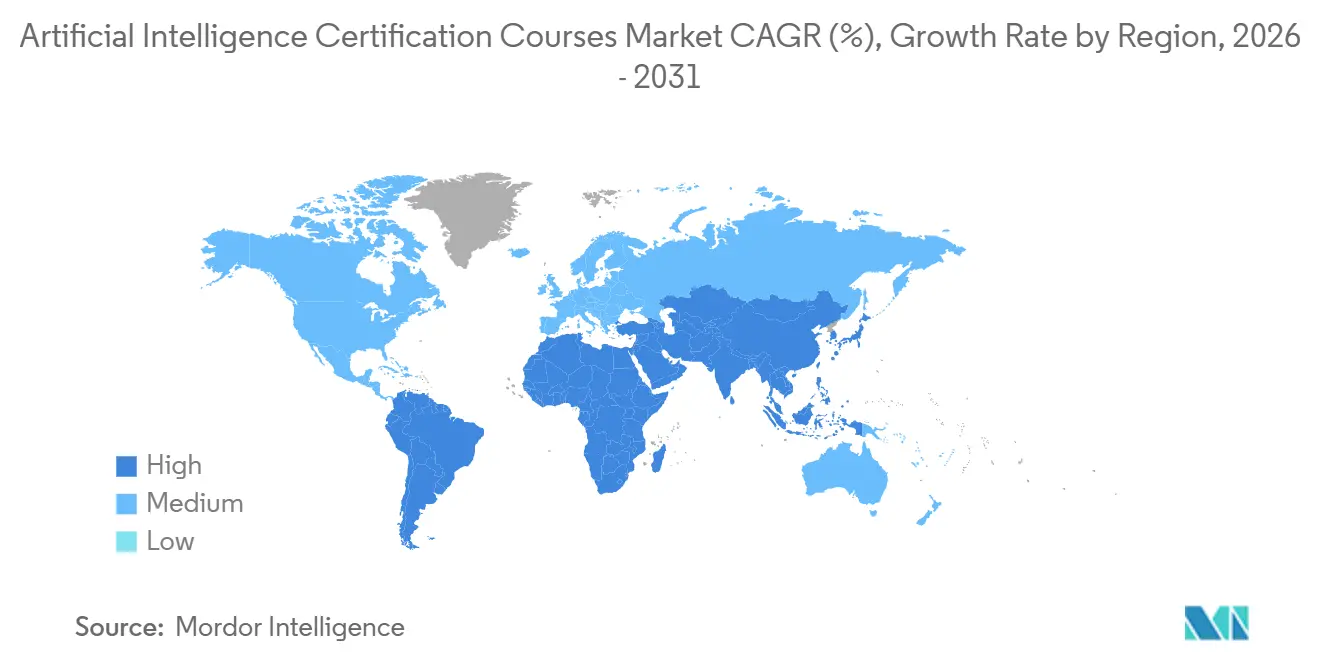
North America held a 32.4% share in 2025, making it the largest regional contributor to the Artificial Intelligence Certification Courses Market. The region remains anchored by the US, where enterprise technology spending, cloud platform adoption, and mature EdTech distribution support strong demand for recognized AI credentials. The Coursera and Udemy combination completed in May 2026 created a platform with over USD 1.8 billion in combined 2025 revenue, 290 million learners, and 18,000 enterprise customers, which reinforces North America’s role as the main commercial center for scaled platform competition. Public policy also supports regional momentum, as the White House’s 2025 executive order formalized federal support for AI education partnerships. Canada and Mexico add demand through technology sector expansion and workforce upgrading, but the US remains the region’s primary source of both product development and large enterprise contracts.
Asia-Pacific is the fastest-growing geography, with a projected 30.5% CAGR for 2026-2031, giving the region the strongest forward growth profile in the Artificial Intelligence Certification Courses Market. India stands out because large-scale public programs and private platform partnerships are rapidly expanding the learner base, including the YUVA AI for ALL course hosted through the IndiaAI Mission on Simplilearn’s platform. Japan also demonstrates a more institutionalized certification environment through active association-led testing and growing uptake of formal AI credentials. Southeast Asian economies continue to expand from smaller bases as governments and enterprises respond to skills shortages through structured training pathways. This regional mix gives Asia-Pacific both strong entry-level volume potential and rising demand for role-specific and governance-focused credentials.
Europe is the third-largest region, and governance, compliance, and professional standards increasingly shape its position in the Artificial Intelligence Certification Courses Market. The UK government’s TechFirst program, backed by GBP 187 million and partnerships with major technology firms, shows that public funding is becoming a visible demand driver in the region. Standards-linked offerings from EXIN and IEEE are also relevant in Europe, as enterprises are placing greater value on documented, trustworthy AI practices. The Middle East and Africa remain an emerging opportunity set, where institutional demand and digital transformation agendas are expanding the need for AI capability-building. South America is still in earlier stages of development, but UNESCO IESALC’s work on a regional micro-credentials quality framework could gradually reduce fragmentation and support broader credential adoption.[3]
Competitive Landscape
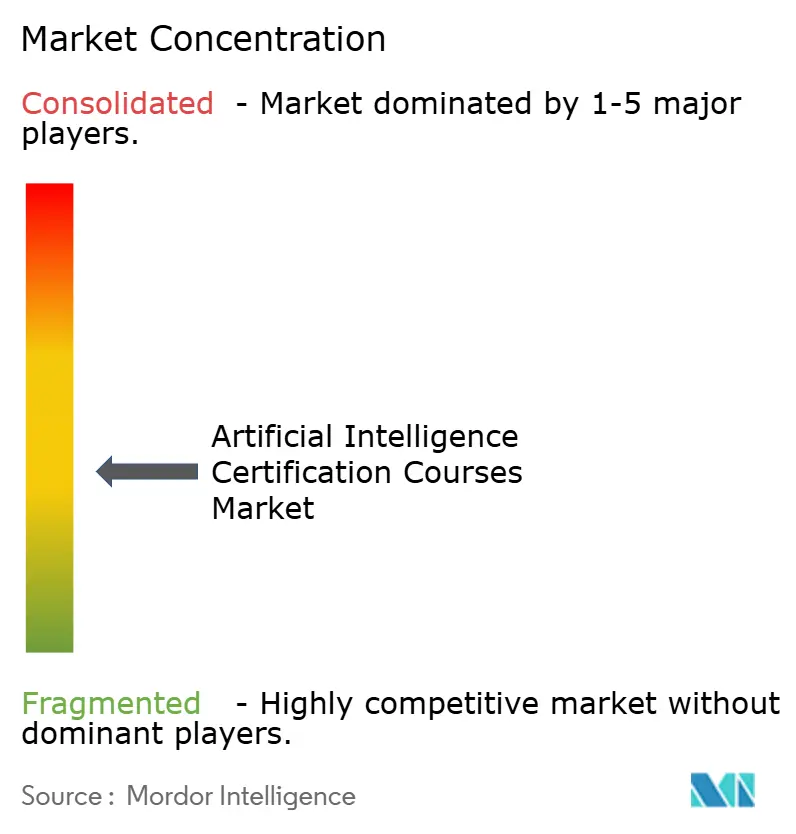
The Artificial Intelligence Certification Courses Market remains moderately fragmented overall, but scale is becoming more important in enterprise contracting. Hyperscale vendors such as Google, AWS, and Microsoft benefit because their certifications align closely with the tools enterprises already use in production, making training part of the software relationship. On the platform side, the Coursera and Udemy merger created a much larger challenger with 290 million learners and 18,000 enterprise customers, signaling that size now matters more for sales reach and account coverage. This is changing the basis of competition from catalog breadth alone to enterprise integration, recognized brand equity, and the ability to serve different buyer types with consistent delivery. As a result, pure-play training providers need either stronger partnerships or a clearer specialization to defend their position.
Role-based and standards-linked programs are becoming a sharper basis for competition in the Artificial Intelligence Certification Courses Market. Google Cloud’s Generative AI Leader credential and AWS’s Certified Generative AI Developer path are examples of providers moving quickly to serve both strategic and technical job categories. EXIN and IEEE occupy different but important positions because they address governance and trustworthy AI needs that general platforms have been slower to formalize. This gives the market a layered competitive structure, with hyperscalers strong in tool-linked skills, platforms strong in distribution, and specialist bodies strong in compliance credibility. Providers that cannot show either platform scale or clear expertise are more exposed to margin pressure.
Premium partnerships and workflow integration are likely to remain the main routes for differentiation over the next few years. Simplilearn expanded its premium portfolio in 2026 through partnerships with Virginia Tech and Oxford, which strengthened its position in live and executive-oriented programs. Coursera’s learning agent inside Microsoft 365 Copilot reflects another strategic move, because it places training inside the user’s daily work environment rather than in a separate learning destination. IBM’s expanded collaboration with NVIDIA in 2026 also points to closer ties among infrastructure, enterprise AI deployment, and training services. Competition is therefore moving toward integrated ecosystems where content, platform access, enterprise software, and workforce deployment increasingly reinforce one another.
Artificial Intelligence Certification Courses Industry Leaders
-
Coursera, Inc.
-
Udemy, Inc.
-
Microsoft Corporation
-
Google LLC
-
Amazon Web Services, Inc.
- *Disclaimer: Major Players sorted in no particular order
Recent Industry Developments
- May 2026: Coursera completed its combination with Udemy to create the world’s largest skills platform, with USD 1.5 billion in combined 2025 revenue, 290 million learners, and 18,000 enterprise customers.
- April 2026: Simplilearn launched the Applied Agentic AI Systems, Design and Impact program in partnership with Virginia Tech Continuing and Professional Education, targeting product managers and senior technology leaders in multi-agent AI system design and orchestration.
- March 2026: Simplilearn partnered with Saïd Business School, University of Oxford, to launch 3 AI-focused executive programs covering AI and Business Analytics, Strategic Analysis and Decision-Making with AI, and Cyber-Resilient Digital Transformation.
- March 2026: IBM announced an expanded collaboration with NVIDIA, including plans to offer NVIDIA Blackwell Ultra GPUs on IBM Cloud in early Q2 2026 for large-scale AI training and high-throughput inferencing.
Global Artificial Intelligence Certification Courses Market Report Scope
| Foundational & Introductory AI |
| Machine Learning |
| Deep Learning |
| Generative AI |
| AI for Business & Strategy |
| AI Ethics & Governance |
| AI for Cloud & MLOps |
| Beginner |
| Intermediate |
| Advanced |
| Self-Paced Online (Asynchronous) |
| Instructor-Led Online (Synchronous) |
| Hybrid / Blended Learning |
| Individual Learners (B2C) |
| Enterprise / Corporate (B2B) |
| Academic Institutions |
| Government & Public Sector |
| North America | United States |
| Canada | |
| Mexico | |
| South America | Brazil |
| Peru | |
| Chile | |
| Argentina | |
| Rest of South America | |
| Europe | United Kingdom |
| Germany | |
| France | |
| Spain | |
| Italy | |
| BENELUX (Belgium, Netherlands, and Luxembourg) | |
| NORDICS (Denmark, Finland, Iceland, Norway, and Sweden) | |
| Rest of Europe | |
| Asia Pacific | India |
| China | |
| Japan | |
| Australia | |
| South Korea | |
| South East Asia (Singapore, Malaysia, Thailand, Indonesia, Vietnam, and Philippines) | |
| Rest of Asia-Pacific | |
| Middle East and Africa | United Arab Emirates |
| Saudi Arabia | |
| South Africa | |
| Nigeria | |
| Rest of Middle East and Africa |
| By Course Type | Foundational & Introductory AI | |
| Machine Learning | ||
| Deep Learning | ||
| Generative AI | ||
| AI for Business & Strategy | ||
| AI Ethics & Governance | ||
| AI for Cloud & MLOps | ||
| By Certification Level | Beginner | |
| Intermediate | ||
| Advanced | ||
| By Learning Format | Self-Paced Online (Asynchronous) | |
| Instructor-Led Online (Synchronous) | ||
| Hybrid / Blended Learning | ||
| By End Use | Individual Learners (B2C) | |
| Enterprise / Corporate (B2B) | ||
| Academic Institutions | ||
| Government & Public Sector | ||
| By Geography | North America | United States |
| Canada | ||
| Mexico | ||
| South America | Brazil | |
| Peru | ||
| Chile | ||
| Argentina | ||
| Rest of South America | ||
| Europe | United Kingdom | |
| Germany | ||
| France | ||
| Spain | ||
| Italy | ||
| BENELUX (Belgium, Netherlands, and Luxembourg) | ||
| NORDICS (Denmark, Finland, Iceland, Norway, and Sweden) | ||
| Rest of Europe | ||
| Asia Pacific | India | |
| China | ||
| Japan | ||
| Australia | ||
| South Korea | ||
| South East Asia (Singapore, Malaysia, Thailand, Indonesia, Vietnam, and Philippines) | ||
| Rest of Asia-Pacific | ||
| Middle East and Africa | United Arab Emirates | |
| Saudi Arabia | ||
| South Africa | ||
| Nigeria | ||
| Rest of Middle East and Africa | ||
Key Questions Answered in the Report
What is the current value of artificial intelligence certification courses worldwide?
The sector was valued at USD 3.95 billion in 2025 and stands at USD 4.72 billion in 2026, with forecasts reaching USD 12.36 billion by 2031.
How fast is demand expected to grow through 2031?
Growth is projected at a 21.23% CAGR over 2026-2031, supported by enterprise upskilling, public AI literacy programs, and rising demand for role-based credentials.
Which course category leads today, and which one is growing fastest?
Machine Learning held the largest share at 22.0% in 2025, while Generative AI is forecast to expand fastest at a 33.10% CAGR through 2031.
Which learning format is most used by professionals?
Self-Paced Online accounted for 55.0% of revenue in 2025, though Instructor-Led Online is growing faster at 24.3% as employers seek better completion and work application outcomes.
Which buyer group is creating the strongest growth opportunity?
Government and Public Sector is the fastest-growing end-use segment with a 26.20% CAGR, while Individual Learners remained the largest at 44.8% in 2025.
Which region offers the strongest long-term expansion potential?
Asia-Pacific has the strongest growth outlook at a 30.5% CAGR through 2031, supported by national AI literacy initiatives and broad talent development needs, especially in India.