
Germany Pharmaceutical Cold Chain Air Logistics Market Size and Share
Market Overview
| Study Period | 2020 - 2031 |
|---|---|
| Forecast Data Period | 2026 - 2031 |
| Base Year Market Size (2025) | USD 1.46 Billion |
| Market Size (2026) | USD 1.57 Billion |
| Market Size (2031) | USD 2.23 Billion |
| Growth Rate (2026 - 2031) | 7.26 % |
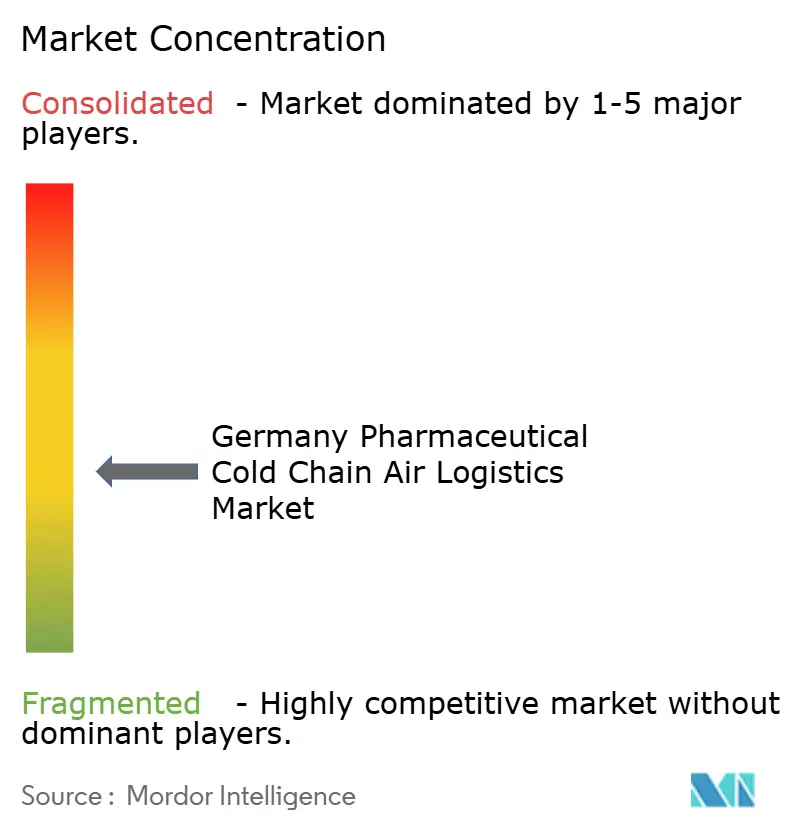
| Market Concentration | Medium |
Major Players *Disclaimer: Major Players sorted in no particular order Image © Mordor Intelligence. Reuse requires attribution under CC BY 4.0. | |
Germany Pharmaceutical Cold Chain Air Logistics Market Analysis by Mordor Intelligence
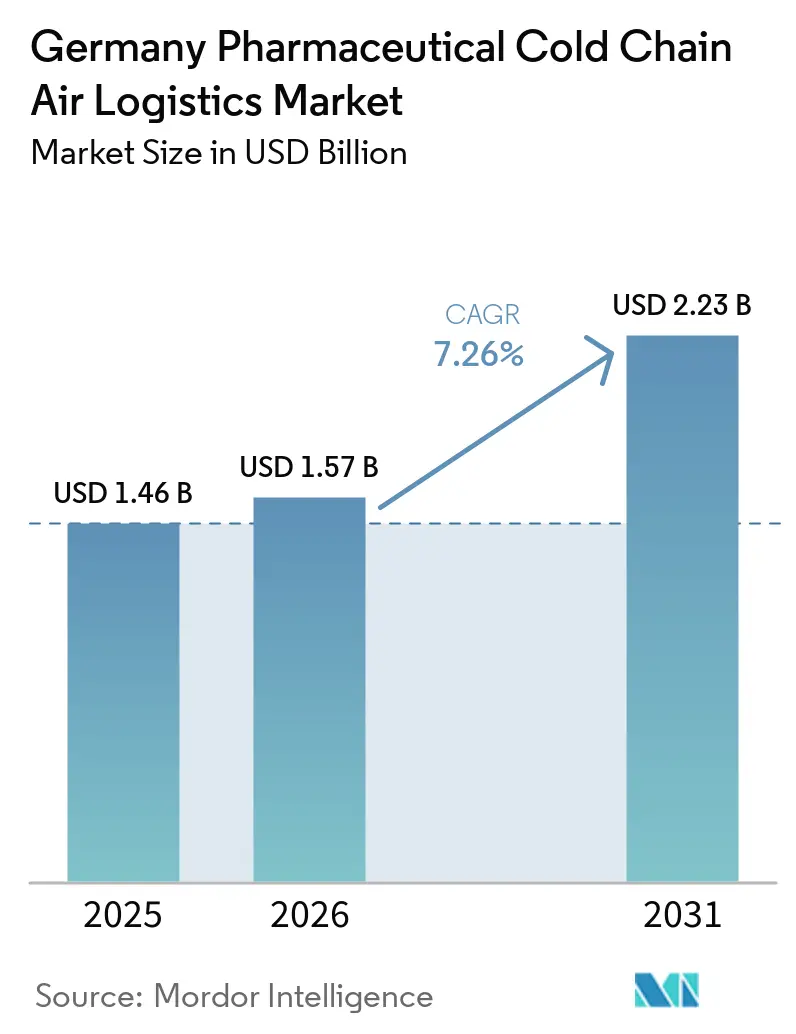
The Germany pharmaceutical cold chain air logistics market size was valued at USD 1.46 billion in 2025 and is projected to expand from USD 1.57 billion in 2026 to USD 2.23 billion by 2031, registering a CAGR of 7.26% between 2026 and 2031.
Biologics, biosimilars, vaccines, and advanced therapies require validated temperature control throughout transit, which supports demand for specialized air services. Frankfurt is central to this activity because it handles 200,000 tons of pharmaceutical and healthcare freight each year and connects 275 destinations in 91 countries. The concentration of 10 of the world’s 20 largest pharmaceutical producers near the Frankfurt Rhine-Main region strengthens the density of high-value shipment lanes. The Germany pharmaceutical cold chain air logistics market also benefits from the conversion of clinical-stage advanced therapies into recurring commercial distribution requirements. DHL’s planned EUR 2 billion (USD 2.35 billion) healthcare investment and Lufthansa Cargo’s EUR 600 million (USD 705.78 billion) Frankfurt hub modernization show that leading providers are expanding capacity for this specialized demand.
Key Report Takeaways
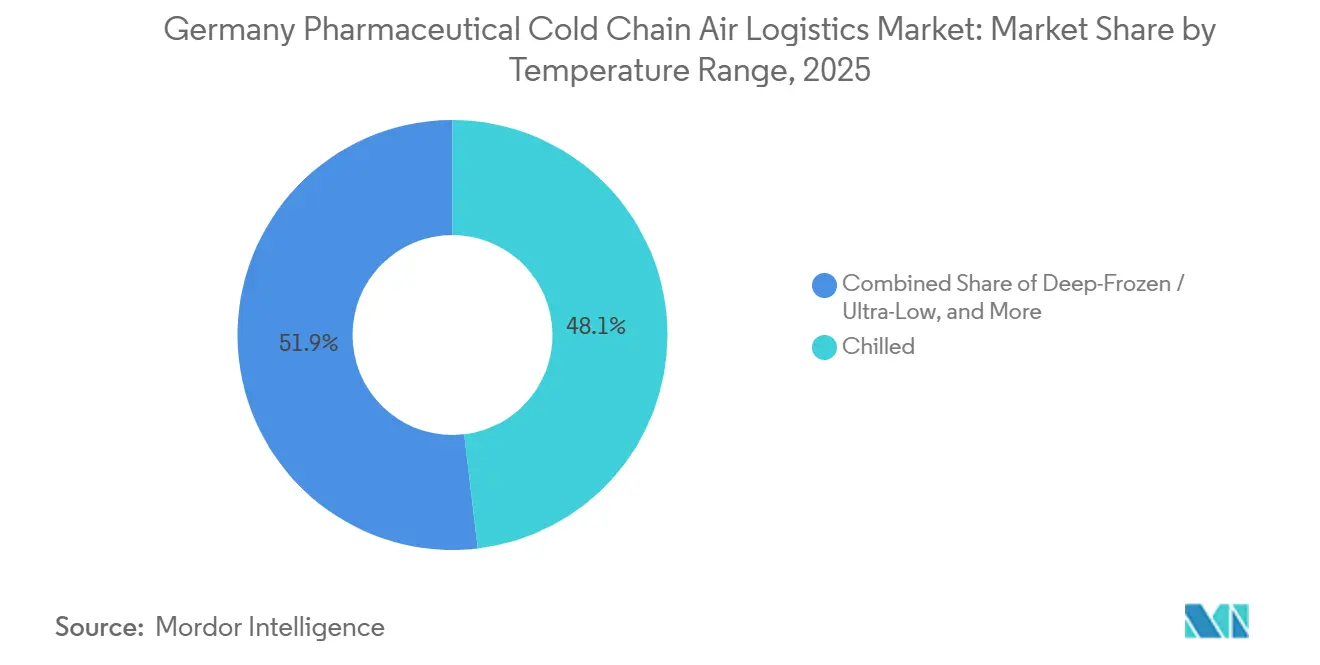
- By temperature range, chilled shipments held 48.12% of Germany pharmaceutical cold chain air logistics market share in 2025, while deep-frozen and ultra-low shipments are forecast to grow at a 11.24% CAGR through 2031.
- By pharmaceutical product type, biological pharmaceuticals held 41.23% of Germany pharmaceutical cold chain air logistics market size in 2025, while cell and gene therapies are projected to expand at a 13.38% CAGR through 2031.
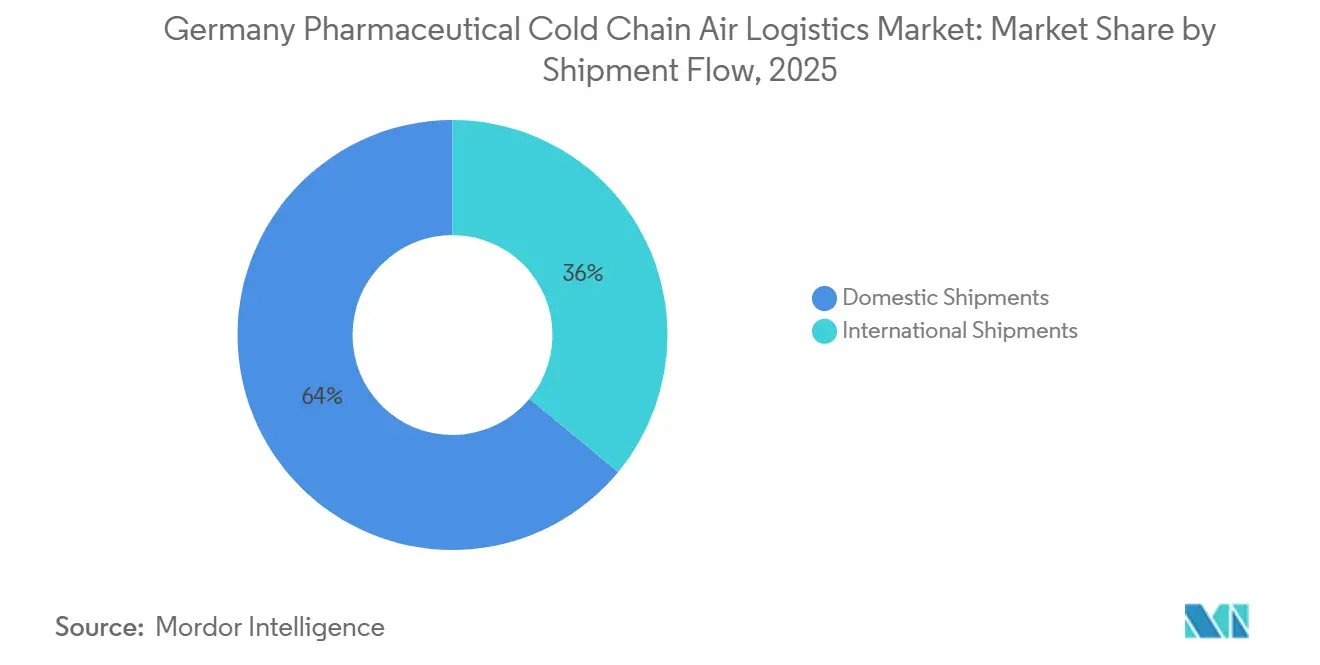
- By shipment flow, domestic shipments held 64.01% of Germany pharmaceutical cold chain air logistics market share in 2025, while international shipments are forecast to advance at a 8.53% CAGR through 2031.
- By region, North Rhine-Westphalia held 34.29% of Germany pharmaceutical cold chain air logistics market size in 2025, while Bavaria is forecast to grow at a 8.62% CAGR through 2031.
Note: Market size and forecast figures in this report are generated using Mordor Intelligence’s proprietary estimation framework, updated with the latest available data and insights as of January 2026.
Germany Pharmaceutical Cold Chain Air Logistics Market Trends and Insights
Drivers Impact Analysis*
| Driver | (~) % Impact on CAGR Forecast | Geographic Relevance | Impact Timeline |
|---|---|---|---|
| Biologics and Biosimilars Adoption | +2.0% | National, with the highest density in North Rhine-Westphalia, Bavaria, and Hesse | Short term (≤ 2 years) |
| Germany as a Central European Pharmaceutical Distribution Hub | +1.7% | National, centered on the Frankfurt Rhine-Main infrastructure | Medium term (2-4 years) |
| Cell and Gene Therapy Clinical-Trial Activity | +1.3% | National, with activity in Munich, Berlin, and Cologne | Short term (≤ 2 years) |
| Direct-to-Patient Delivery of Complex Biologics | +1.0% | National, with early density gains in North Rhine-Westphalia and Bavaria | Medium term (2-4 years) |
| Rising mRNA and Advanced-Therapy Production | +0.8% | Hesse, Halle, Bavaria, and Heidelberg | Medium term (2-4 years) |
| Air-Cargo Network Investment and Pharmaceutical Hub Expansion | +0.5% | Frankfurt, Munich, and Dusseldorf | Long term (≥ 4 years) |
| Source: Mordor Intelligence | |||
Biologics and Biosimilars Adoption
Germany’s pharmacy-level biosimilar substitution framework expanded from 2025 and shifted established biologics into retail pharmacy channels.[1]European Medicines Agency, “Guidelines on Good Distribution Practice of Medicinal Products for Human Use,” EMA Scientific Guidelines, ema.europa.eu This change created additional GDP-compliant delivery routes that smaller operators might not be able to manage internally. Germany’s statutory health insurance network included 19,000 pharmacies, each representing a potential destination when biologics move into outpatient dispensing. Manufacturers increased inbound shipments through Frankfurt ahead of substitution-related demand, favoring providers with dedicated pharmaceutical capacity. Monoclonal antibodies, growth factors, and insulin analogs need continuous 2-8 °C handling even when biosimilar entry reduces unit prices. The Germany pharmaceutical cold chain air logistics market therefore, gains demand at both the import stage and the pharmacy delivery stage.
Germany as a Central European Pharmaceutical Distribution Hub
Frankfurt Airport handled 200,000 tons of pharmaceutical and healthcare freight annually through 22,000 m² of temperature-controlled cargo space in 2025. Of this area, 14,000 m² was specifically configured for pharmaceutical handling. The site was served by 83 airlines and connected 275 destinations across 91 countries. Its location near BioNTech, Merck, and Boehringer Ingelheim supports daily cold-chain departures instead of weekly consolidation schedules. Frankfurt joined Pharma.Aero as a full member in December 2025, which formalized its participation in pharmaceutical air cargo standards. Munich and Dusseldorf provide additional pharmaceutical gateways, giving Bavaria and North Rhine-Westphalia parallel access to export routes
Cell and Gene Therapy Clinical-Trial Activity
Cell and gene therapy trials in Germany require cryogenic transport, chain-of-identity records, and delivery windows of less than 24 hours[2]European Medicines Agency, “Multidisciplinary Guidelines: Gene Therapy,” EMA Scientific Guidelines, ema.europa.eu. These requirements apply to autologous CAR-T preparations, lentiviral vector batches, and hematopoietic stem-cell products. The Paul Ehrlich Institut applies qualified-person batch-release and lot-level traceability requirements to advanced therapy medicinal products. These conditions differentiate advanced therapy shipments from conventional pharmaceutical air freight. The G-BA benefit assessment for exagamglogene autotemcel in July 2025 established commercial reimbursement, moving some cryogenic logistics demand from trials into commercial use. Germany’s clinical-trial base supports recurring demand for the premium end of the Germany pharmaceutical cold chain air logistics market.
Direct-to-Patient Delivery of Complex Biologics
Direct-to-patient programs for hemophilia treatments, multiple sclerosis medicines, and oncology biologics require traceable cold-chain movement from import through delivery. Germany’s digital prescription infrastructure expanded under the Digitalisierungsgesetz für Gesundheit in 2025, strengthening the connection between prescribers and specialty pharmacies. The service model requires a validated 2-8 °C chain from specialty pharmacy to the point of administration. Standard parcel networks cannot meet this requirement. Delivery windows are narrow, and operators must maintain contingency air capacity for inbound products. These demands favor providers that combine international air freight with certified local delivery.
Restraints Impact Analysis*
| Restraint | (~) % Impact on CAGR Forecast | Geographic Relevance | Impact Timeline |
|---|---|---|---|
| High Energy Costs for Refrigerated Facilities and Equipment | -1.5% | National, especially North Rhine-Westphalia, Hesse, and Bavaria industrial clusters | Short term (≤ 2 years) |
| Shortage of GDP-Certified Drivers and Cold-Chain Technicians | -1.2% | National, especially Frankfurt, Munich, and Dusseldorf corridors | Medium term (2-4 years) |
| Cross-Border Price Competition from Eastern European Providers | -0.8% | Eastern Germany and DACH corridor, especially standard-chilled segments | Medium term (2-4 years) |
| Limited Medical-Grade Drone Corridors for Time-Critical Deliveries | -0.4% | National, with the greatest effect in rural and peri-urban areas | Long term (≥ 4 years) |
| Source: Mordor Intelligence | |||
High Energy Costs for Refrigerated Facilities and Equipment
Germany remained among the European Union’s highest-priced industrial electricity markets through 2025.[3]Eurostat, “Electricity Prices for Non-Household Consumers,” European Commission Statistical Office, ec.europa.eu Energy spending at cold-storage sites represented 25-40% of operating costs, compared with less than 5% for ambient warehouses. The revised EU F-Gas Regulation requires a phase-down in high-global-warming-potential refrigerants. This increases investment needs for carbon dioxide and ammonia cascade systems. Separate equipment, redundancy, and calibration are needed for 2-8 °C, -20 °C, and -70 °C zones. These costs place pressure on mid-sized operators that cannot spread energy hedging and compliance upgrades across large national networks.
Shortage of GDP-Certified Drivers and Cold-Chain Technicians
Pharmaceutical cold-chain roles require compliance with the EU Guidelines on Good Distribution Practice, which adds qualifications beyond standard freight licensing. The IRU reported 2.9 million unfilled truck driver positions across 18 markets in 2025. Europe had a 13% shortage rate, equal to 502,000 unfilled positions.[4]International Road Transport Union, “Global Driver Shortage Report 2025,” IRU Intelligence Briefing, iru.org GDP certification, ADR credentials, and advanced-therapy handling documents extend preparation from weeks to months beyond general freight licensing. Germany’s driver workforce is older, and projected retirements exceed the training pipeline through the end of the decade. Wage growth and training programs offer limited near-term relief in the Frankfurt, Munich, and Dusseldorf corridors.
*Our forecasts treat driver/restraint impacts as directional, not additive. The impact forecasts reflect baseline growth, mix effects, and variable interactions.
Segment Analysis
By Temperature Range: Chilled Shipments Provide the Revenue Base While Cryogenic Cargo Expands
Chilled shipments held 48.12% of temperature-range revenue in 2025, making this the largest part of the Germany pharmaceutical cold chain air logistics market share by temperature range. Monoclonal antibodies, biosimilars, and conventional vaccines support this position because they move under standard cold-chain conditions through Frankfurt air lanes. Cell and gene therapies and mRNA-based products need cryogenic handling, which supports demand for deep-frozen and ultra-low services. DHL expanded its Florstadt campus in May 2025 with a fourth warehouse, taking total capacity to 100,000 m² and adding capability down to -70 °C. The investment positioned the site for commercial advanced-therapy volumes. Carriers also expanded active and passive 2-8 °C packaging on frequent routes, supporting the chilled segment’s role as the revenue base.
Deep-frozen and ultra-low shipments are forecast to record a 11.24% CAGR from 2026 to 2031, the fastest growth rate among the temperature ranges. Frozen shipments serve vaccines, insulin products, and biologic medicines with mid-range stability requirements. These products support an established share because their handling procedures are already well defined. Ambient shipments remain a smaller part of pharmaceutical air freight. They mainly include time-critical branded medicines where speed supports the cost of air transportation even without active cooling. The temperature mix is expected to move toward colder requirements through 2031. This change follows the movement of advanced therapies from clinical trials into routine dispensing. Frozen and ambient shipments are expected to lose share gradually as deeper cold chain needs grow. The Germany pharmaceutical cold chain air logistics market requires providers to maintain several validated temperature zones rather than rely on a single chilled offering.



By Pharmaceutical Product Type: Biologics Hold Revenue While Cell and Gene Therapies Grow Fastest
Biological pharmaceuticals held 41.23% of product-type revenue in 2025, accounting for the largest share of the Germany pharmaceutical cold chain air logistics market size by pharmaceutical product type. This category includes biologics, biosimilars, vaccines, and blood-derived products. Pharmacy-level substitution requirements since 2025 expanded GDP-qualified routes for established biologics. These products may no longer receive innovator pricing, but their validated temperature requirements remain unchanged. The G-BA assessment of exagamglogene autotemcel in July 2025 supported commercial reimbursement pathways for cell and gene therapies. This converts clinical logistics needs into permanent commercial air freight demand. EMA guidance requires cryogenic handling, chain-of-identity controls, and qualified-person oversight for advanced therapies.
Cell and gene therapies are forecast to grow at a 13.38% CAGR from 2026 to 2031, the highest rate among pharmaceutical product types. Specialty pharmaceuticals retain an important role through oncology biologics and rare-disease medicines entering Germany under named-patient import programs. These flows use international air freight because they must reach patients within controlled delivery conditions. Small-molecule pharmaceuticals include branded, generic, and over-the-counter products. They represent high unit volumes but have lower revenue per shipment and face competition from road options. Veterinary pharmaceuticals are a smaller regulated category, with biologics for livestock increasingly requiring temperature control. The product mix is expected to tilt toward advanced therapies and specialty biologics through 2031. This supports a higher revenue per kilogram of air freight. The Germany pharmaceutical cold chain air logistics industry depends on the ability to serve both high-volume biologics and smaller, highly controlled advanced-therapy shipments.
By Shipment Flow: Domestic Distribution Holds Scale While International Cargo Supports Growth
Domestic shipments held 64.01% of total revenue in 2025, representing the largest part of the Germany pharmaceutical cold chain air logistics market size by shipment flow. Air-imported biologics are distributed through certified wholesalers, specialty pharmacies, and hospital logistics providers in all 16 federal states. The segment has a broad volume base because imported medicines must move from airport gateways to healthcare destinations across the country. GDP-compliant road carriers compete on standard chilled lanes, which limit margin growth. Domestic operators remain important where validated last-mile delivery is necessary. The Germany pharmaceutical cold chain air logistics market, therefore, combines air-based inbound supply with certified domestic distribution. High domestic volume provides a stable revenue foundation. It also supports providers that can coordinate airport handling and local delivery under one quality system.
International shipments are forecast to grow at a 8.53% CAGR from 2026 to 2031. German manufacturers are expanding export routes for biologics and mRNA products to North America, Asia, and the Middle East through Frankfurt. Kuehne+Nagel added a Frankfurt-Atlanta route to its Cool Corridor network using a Boeing 747-8 freighter. International lanes carry lower volumes than domestic distribution but produce higher margins. Dedicated air capacity and the limited alternatives for time-critical biologics and advanced therapies support those margins. Providers that combine global air freight, pharmaceutical airport handling, and domestic certified delivery can participate in both flows. Domestic-only providers and air-only providers face exposure as higher-value growth moves toward export lanes. The Germany pharmaceutical cold chain air logistics industry consequently rewards integrated service networks.
Geography Analysis
North Rhine-Westphalia’s 34.29% share of 2025 revenue made it the leading regional component of the Germany pharmaceutical cold chain air logistics market. Imported biologics cleared at Frankfurt or Dusseldorf move into a dense network of wholesalers and specialty pharmacies in the state. Dusseldorf International Airport serves as a secondary gateway for North Rhine-Westphalia shipments. Its role lowers operational dependence on Frankfurt for the state’s import and export traffic. The Rhine-Ruhr corridor has many GDP-qualified wholesale operators with multi-temperature warehouses and dedicated cold-chain fleets. This infrastructure supports certified last-mile delivery for air-imported medicines. University hospital systems in Cologne, Dusseldorf, and Aachen also support regular healthcare procurement volumes. These factors preserve the state’s leading position even as other regions expand faster.
Bavaria is forecast to grow at a 8.62% CAGR through 2031, the highest regional rate in the Germany pharmaceutical cold chain air logistics market. Munich’s life sciences cluster and biopharmaceutical CDMO activity create outbound cryogenic freight requirements. Wacker Chemie’s mRNA production capability supports this regional specialization. Munich Airport has certified pharmaceutical handling through Lufthansa Cargo’s CEIV Pharma network. This gives Bavaria-based manufacturers certified access to global air freight without a mandatory Frankfurt transfer. Baden-Wurttemberg supports steady regional demand through pharmaceutical activity around Heidelberg, Mannheim, and Stuttgart. The state also has early approvals for medical drone logistics trials for inter-facility sample transport.
The rest of the states include Hesse, where Frankfurt Rhine-Main provides the country’s main pharmaceutical air cargo connection. Frankfurt processed 200,000 tons of pharmaceutical freight in 2025, making the region essential to national distribution and export lanes. Hesse links manufacturing centers in Germany with pharmaceutical routes across global markets. Saxony and Berlin are emerging locations as biotechnology investment extends into eastern federal states. Federal infrastructure programs also support pharmaceutical logistics development in these areas. These regions do not match the established volumes of North Rhine-Westphalia. They add geographic diversification as new production capacity develops. This mix of established hubs and emerging centers supports demand across the Germany pharmaceutical cold chain air logistics market.
Competitive Landscape
The Germany pharmaceutical cold chain air logistics market is moderately fragmented. A small group of global operators controls validated multi-temperature capacity for pharmaceutical air freight. A broader group of mid-tier companies competes on cost for standard-chilled shipments and domestic distribution. IATA CEIV Pharma certification, GDP audit systems, and multi-zone warehousing require investments that smaller operators cannot easily replicate. This creates a structural advantage for operators with national and international networks. Real-time temperature alerts, track-and-trace systems, and automated warehouse management support differentiation on high-value biologic lanes. These systems strengthen client retention where quality records and temperature evidence are required. Competition remains more fragmented for commodity chilled lanes.
Leading providers are pursuing vertical integration through specialty courier acquisitions, expanded certified hub capacity, and dedicated pharmaceutical air lanes. DHL acquired CRYOPDP in March 2025, adding a specialty courier that handled more than 600,000 annual shipments for clinical trials, biopharma, and cell and gene therapies across 15 countries. DHL then agreed to acquire SDS Rx in September 2025 to add specialty delivery capability for pharmaceutical, consumer health, animal health, and medical technology customers. UPS completed its acquisition of Frigo-Trans and B.P.L. GmbH in January 2025, adding a six-temperature-zone warehouse with cryopreservation capability to -196 °C and GDP-compliant forwarding from Dusseldorf. These moves show how the Germany pharmaceutical cold chain air logistics market is moving toward integrated services from airport freight to specialized delivery. They also extend the ability of large operators to manage advanced therapies and clinical-trial shipments.
Lufthansa Cargo began operating the ALPHA phase of its EUR 600 million (USD 705.78 million) LCCevo project at Frankfurt Airport in June 2026. The 80,000 m² phase operates around the clock and adds automated cargo flows and pharmaceutical handling improvements. DHL Global Forwarding opened a 24,500 m² Frankfurt air freight hub in June 2025 with 54 cross-docks and an annual handling capacity of 300,000 tons. Providers retain an opportunity in cryogenic last-mile advanced-therapy delivery outside major urban centers. Integrated direct-to-patient logistics for chronic biologics also remains an area of unmet service need. Certification and compliance frameworks remain practical barriers to entry on the highest-value lanes.
Germany Pharmaceutical Cold Chain Air Logistics Industry Leaders
DHL Group
Kuehne+Nagel International AG
DSV A/S
GEODIS
Lufthansa Cargo AG
- *Disclaimer: Major Players sorted in no particular order

Recent Industry Developments
- June 2026: Lufthansa Cargo commissioned the ALPHA construction phase of its EUR 600 million (USD 705.78 million) LCCevo infrastructure project at Frankfurt Airport, the first and most critical section of a program to transform the Lufthansa Cargo Center into Europe’s most modern air cargo hub by 2030. The ALPHA phase spans 80,000 m² and entered 24/7 operational service with automated cargo flows and pharmaceutical handling enhancements.
- February 2026: DHL Group launched an expanded dedicated Airfreight Cold Chain Network connecting more than 30 GDP-compliant aviation hubs globally. The inaugural Brussels-Cincinnati route operates on a dedicated Boeing 777 freighter, with further European, Middle Eastern, Asian, and Latin American routes planned for biologics, vaccines, and cell and gene therapies.
- September 2025: DHL Group agreed to acquire SDS Rx, a specialty provider serving pharmaceutical, consumer health, animal health, and medical technology logistics, following its earlier CRYOPDP acquisition.
- January 2025: UPS completed the acquisition of Germany-based Frigo-Trans and B.P.L. GmbH, adding a six-temperature-zone warehouse that includes cryopreservation at -196 °C and GDP-compliant biopharma freight forwarding from Dusseldorf.


Germany Pharmaceutical Cold Chain Air Logistics Market Report Scope
| Chilled (0–5 °C) |
| Frozen (-18–0 °C) |
| Ambient |
| Deep-Frozen / Ultra-Low (More than -20 °C) |
| Small-Molecule Pharmaceuticals | Branded Pharmaceuticals |
| Over-the-Counter (OTC) Pharmaceuticals | |
| Generic Pharmaceuticals | |
| Biological Pharmaceuticals (Biologics, Biosimilars, Vaccines, and Blood-Derived Medicinal Products) | |
| Specialty Pharmaceuticals | |
| Cell and Gene Therapies | |
| Veterinary Pharmaceuticals | |
| Other Pharmaceutical Products |
| Domestic Shipments |
| International Shipments |
| North Rhine-Westphalia |
| Bavaria (Bayern) |
| Baden-Wurttemberg |
| Rest of States |
| By Temperature Range | Chilled (0–5 °C) | |
| Frozen (-18–0 °C) | ||
| Ambient | ||
| Deep-Frozen / Ultra-Low (More than -20 °C) | ||
| By Pharmaceutical Product Type | Small-Molecule Pharmaceuticals | Branded Pharmaceuticals |
| Over-the-Counter (OTC) Pharmaceuticals | ||
| Generic Pharmaceuticals | ||
| Biological Pharmaceuticals (Biologics, Biosimilars, Vaccines, and Blood-Derived Medicinal Products) | ||
| Specialty Pharmaceuticals | ||
| Cell and Gene Therapies | ||
| Veterinary Pharmaceuticals | ||
| Other Pharmaceutical Products | ||
| By Shipment Flow | Domestic Shipments | |
| International Shipments | ||
| By Region | North Rhine-Westphalia | |
| Bavaria (Bayern) | ||
| Baden-Wurttemberg | ||
| Rest of States | ||


Key Questions Answered in the Report
What is the projected value of pharmaceutical cold-chain air logistics in Germany by 2031?
The sector is forecast to reach USD 2.23 billion by 2031, from USD 1.57 billion in 2026, at a 7.26% CAGR.
Which temperature requirement has the largest role in Germany’s pharmaceutical air freight?
Chilled shipments held 48.12% of temperature-range revenue in 2025, supported by biologics, biosimilars, and conventional vaccines.
Which pharmaceutical products are creating the fastest demand for specialized air transport?
Cell and gene therapies are forecast to grow at a 13.38% CAGR through 2031 because they require cryogenic handling and chain-of-identity controls.
Why is Frankfurt important for pharmaceutical cold-chain logistics?
Frankfurt handled 200,000 tons of pharmaceutical and healthcare freight annually and connected 275 destinations in 91 countries in 2025.
Which shipment flow generates the largest revenue base in Germany?
Domestic shipments held 64.01% of revenue in 2025, as imported biologics require certified distribution through wholesalers, pharmacies, and hospitals.
What operational constraints affect providers of temperature-controlled pharmaceutical air freight?
High energy use, shortages of GDP-certified personnel, price competition on standard chilled routes, and limited medical drone corridors restrict service expansion.
Page last updated on:





