
Germany Mountain and Ski Resort Market Size and Share
Market Overview
| Study Period | 2021 - 2031 |
|---|---|
| Forecast Data Period | 2026 - 2031 |
| Base Year Market Size (2025) | USD 3.21 Billion |
| Market Size (2026) | USD 3.36 Billion |
| Market Size (2031) | USD 4.67 Billion |
| Growth Rate (2026 - 2031) | 6.81 % |
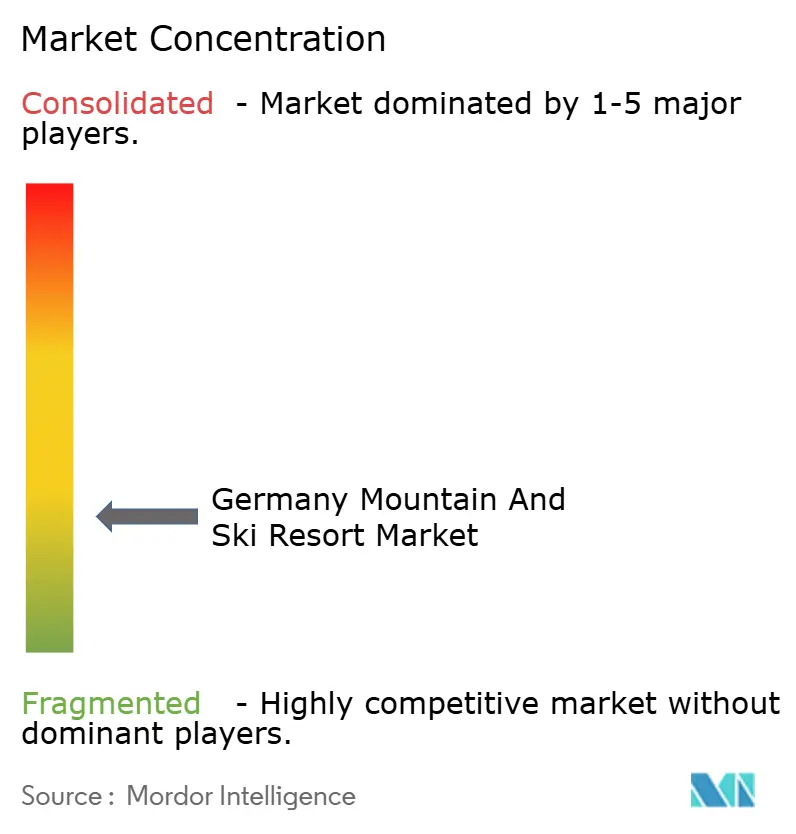
| Market Concentration | Low |
Major Players *Disclaimer: Major Players sorted in no particular order Image © Mordor Intelligence. Reuse requires attribution under CC BY 4.0. | |
Germany Mountain and Ski Resort Market Analysis by Mordor Intelligence
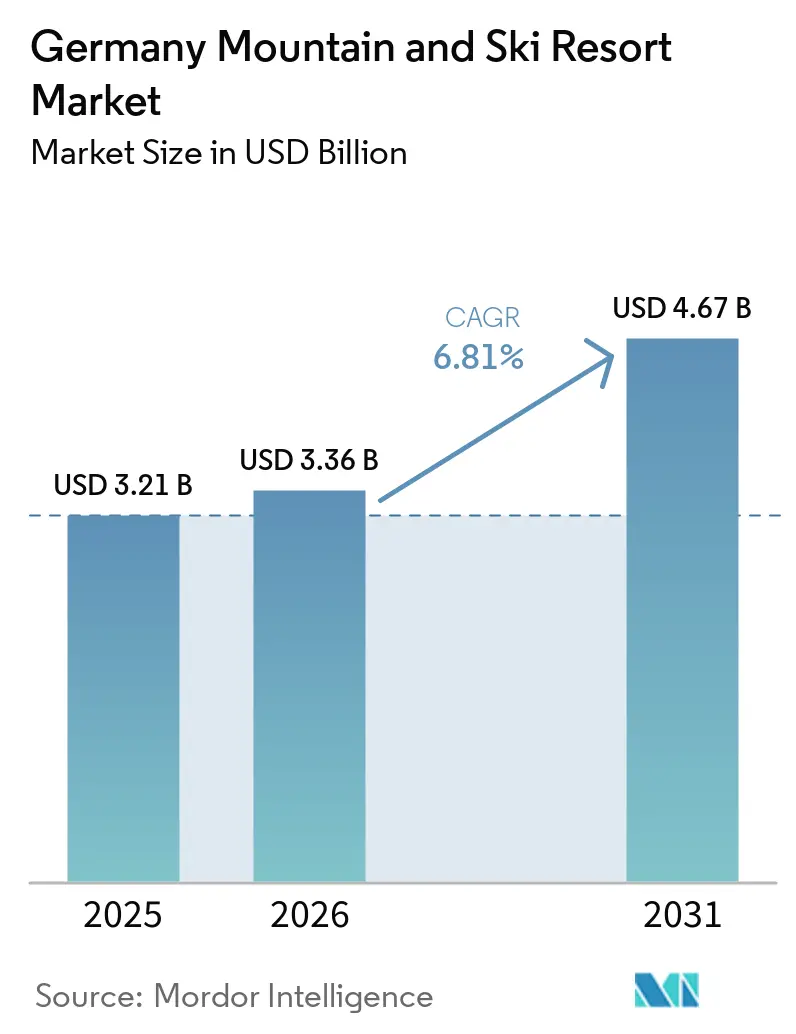
The Germany Mountain and Ski Resort Market was valued at USD 3.21 billion in 2025 and estimated to grow from USD 3.36 billion in 2026 to reach USD 4.67 billion by 2031, at a CAGR of 6.81% during the forecast period (2026-2031). Ski resorts in Germany serve over 11 million guests annually. Winter 2024/25 cableway net traffic revenue reached EUR 152.7 million (USD 179.62 million), the highest level recorded in the past five years. Data indicates that every EUR 1,000 (USD 1,176.3) earned at a cable car turnstile generates approximately EUR 5,300 (USD 6,234.44) in surrounding economic activities, highlighting the importance of mountain tourism for local communities. Summer demand is also rising, with summer 2025 cableway revenue increasing by 4.2% year-on-year to EUR 118 million (USD 138.81). For the first time in the past five years, summer first entries exceeded winter first entries, signaling a shift toward year-round monetization rather than reliance on winter skier traffic. The fragmented operator base limits capital depth for many facilities but enables adaptation through selective lift upgrades, year-round product diversification, and targeted investments in higher-yield resort formats. This structural change reflects the market's evolution to meet changing consumer preferences and economic conditions[1].
Key Report Takeaways
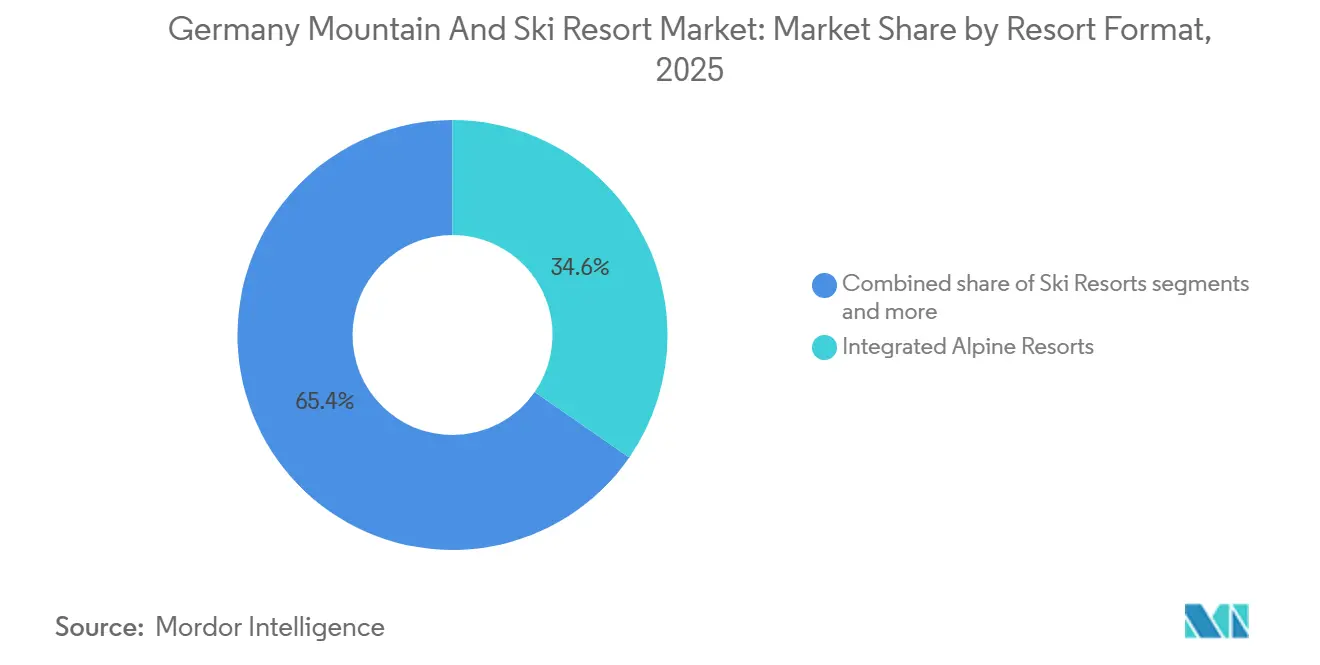
- By resort format, Integrated Alpine Resorts commanded a 34.64% share of the Germany Mountain and Ski Resort Market in 2025, while Wellness & Spa Mountain Resorts are projected to grow at the highest CAGR of 7.84% in the Germany Mountain and Ski Resort Market by 2031.
- By visitor type, Domestic Visitors commanded a 64.53% share of the Germany Mountain and Ski Resort Market in 2025, while Intra-European International Visitors are projected to grow at the highest CAGR of 7.32% in the Germany Mountain and Ski Resort Market by 2031.
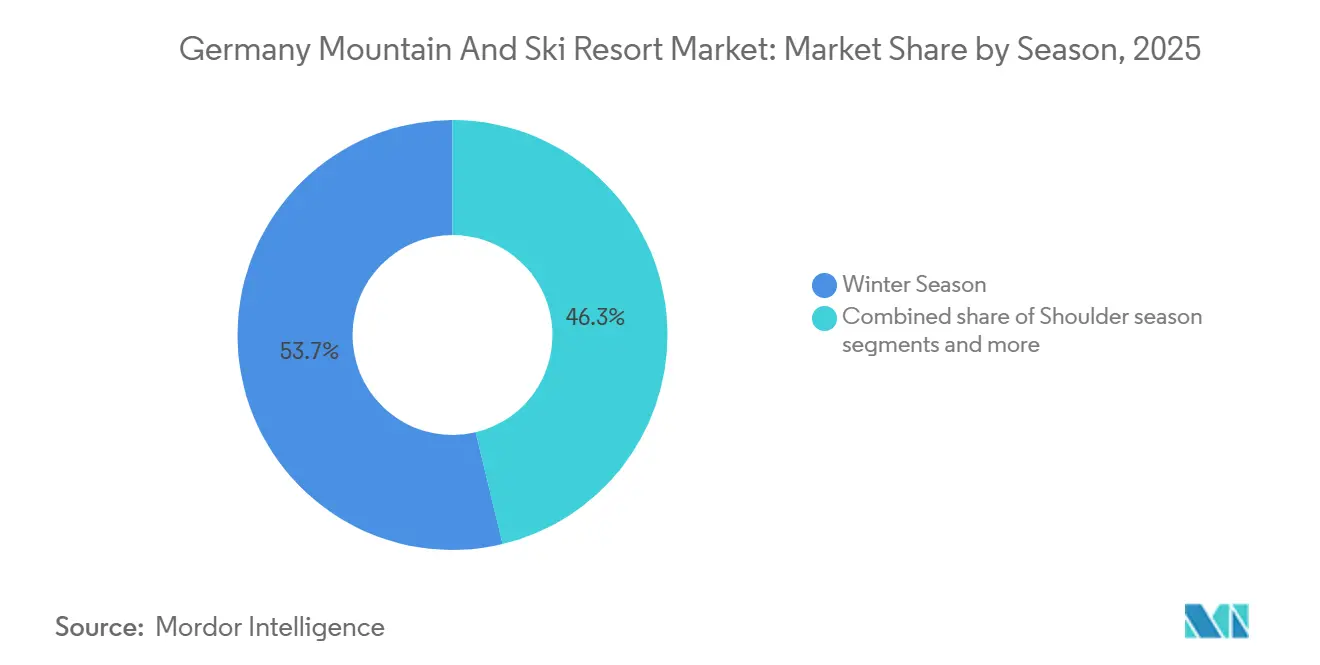
- By season, Winter commanded a 53.74% share of the Germany Mountain and Ski Resort Market in 2025, while Summer is projected to grow at the highest CAGR of 7.19% in the Germany Mountain and Ski Resort Market by 2031.
- By revenue source, Accommodation commanded a 35.91% share of the Germany Mountain and Ski Resort Market in 2025, while Adventure & Recreational Activities are projected to grow at the highest CAGR of 7.98% in the Germany Mountain and Ski Resort Market by 2031.
- By geography, Bavaria commanded a 53.67% share of the Germany Mountain and Ski Resort Market in 2025, while Baden-Württemberg is projected to grow at the highest CAGR of 7.46% in the Germany Mountain and Ski Resort Market by 2031.
Note: Market size and forecast figures in this report are generated using Mordor Intelligence’s proprietary estimation framework, updated with the latest available data and insights as of January 2026.
Germany Mountain and Ski Resort Market Trends and Insights
Drivers Impact Analysis*
| Driver | (~) % Impact on CAGR Forecast | Geographic Relevance | Impact Timeline |
|---|---|---|---|
| Four-season mountain monetization | +2.4% | Bavaria, Baden-Württemberg, Sauerland | Medium term (2-4 years) |
| Lift modernization and digital ticketing | +1.4% | Bavaria, Saxony, Harz | Short term (≤ 2 years) |
| Domestic short-break family demand | +1.1% | North Rhine-Westphalia, Harz, Black Forest | Short term (≤ 2 years) |
| Demand migration to snow-surer hubs | +0.8% | Bavaria, especially Zugspitze and Oberstdorf corridors | Medium term (2-4 years) |
| Vacation-rental bed supply around alpine nodes | +0.5% | Garmisch-Partenkirchen, Oberstdorf, Tegernsee | Short term (≤ 2 years) |
| Wellness-led alpine repositioning | +0.6% | Bavaria, Berchtesgaden, Tegernsee | Medium term (2-4 years) |
| Source: Mordor Intelligence | |||
Four-season mountain monetization
Germany Mountain and ski resort market is experiencing growth driven by a shift from ski-focused to experience-based spending. Cableway revenues in summer 2025 exceeded the five-year average, reflecting increased participation in activities such as hiking, biking, and gravity-based attractions. Official data highlights that a significant portion of winter cable car users are non-skiers, showcasing how operators are generating revenue from guests seeking mountain access, dining, and leisure options during the snow season. Skizentrum Mitterdorf responded to this trend by combining new chairlifts with a fly-line attraction, which expanded its summer offerings and commercial calendar. This development aligns with the broader industry movement to strengthen summer revenues, reducing reliance on winter seasons. By diversifying income streams, the market is becoming less susceptible to challenges posed by inconsistent snow conditions and fixed-cost pressures during weaker winters.
Lift modernization and digital ticketing
Aging lift infrastructure is limiting revenue in Germany's mountain and ski resort market, especially during peak demand when long queues reduce ticket sales and on-mountain spending[2]. Bayerische Zugspitzbahn Bergbahn AG recently opened a new chairlift and is implementing a multiyear capital program to modernize rolling stock, depots, and stations. In Sauerland, Skiwelt Winterberg introduced online pre-booking and keycard loading, which streamlined payments and improved operations. Research published in 2025 revealed that digital snow measurement enhances snowmaking efficiency by up to 20%, highlighting the importance of technology investments for guest management and cost control. Operators with updated and certified infrastructure are better positioned to maintain pricing and increase the value of each visit in the market.
Domestic short-break family demand
Domestic demand continues to stabilize Germany's mountain and ski resort market, as families favor short, accessible mountain trips over longer, costlier international ski vacations. Resident travel spending remained strong, supporting domestic trips despite budgets being spread across various travel formats[3]. In Bavaria, Landkreis Miesbach recorded its highest guest arrivals and overnight stays, reflecting growing demand near Munich. The Sauerland corridor similarly supports the Rhine-Ruhr area, offering convenient access, shorter trip durations, and family-friendly options, which encourage repeat visits even with inconsistent snow conditions. This domestic demand provides mid-mountain operators with a reliable buffer, sustaining room bookings, food services, equipment rentals, and local transportation across the market.
Demand migration to snow-surer hubs
Visitor spending in Germany's mountain and ski resort market is shifting toward higher-altitude and more reliable locations. Germany's alpine ski areas have fewer slopes with snowmaking compared to Austria and Switzerland, leaving them more vulnerable to rising temperatures and shorter snowfall periods. This trend is driving investments into areas like the Zugspitze corridor and the Oberstdorf-Kleinwalsertal system, which offer more dependable conditions due to their altitude and terrain. In March 2026, OBERSTDORF KLEINWALSERTAL Bergbahnen began replacing the Walmendingerhornbahn, reflecting efforts by operators in snow-reliable regions to meet increasing demand. This shift is creating a more polarized market, with higher-altitude operators strengthening their positions while lower-altitude sites face challenges in adapting to shorter operational windows.
Restraints Impact Analysis*
| Restraint | (~) % Impact on CAGR Forecast | Geographic Relevance | Impact Timeline |
|---|---|---|---|
| Climate volatility and shorter snow windows | -1.8% | All regions, most acute below 1,200 m | Long term (≥ 4 years) |
| Snowmaking energy-water capex burden | -1.0% | Bavaria, Black Forest, Erzgebirge | Medium term (2-4 years) |
| Bavarian subsidy rollback for snow cannons | -0.5% | Bavaria, with signal effects for Baden-Württemberg | Short term (≤ 2 years) |
| Fragmented ownership limits capital capacity | -0.6% | Nationwide, especially mid-size and smaller resorts | Medium term (2-4 years) |
| Source: Mordor Intelligence | |||
Climate volatility and shorter snow windows
Climate volatility significantly challenges Germany's mountain and ski resort market by affecting operating days, snow reliability, pricing confidence, and future capital expenditures. Research published in Remote Sensing projected that warming scenarios could shorten the natural ski season across European alpine NUTS-3 regions. This shift also increases water demand for snowmaking, raising adaptation costs as natural seasons grow shorter. Lower-altitude resorts are adapting by reducing ski operations, focusing on non-ski activities, or diversifying into broader mountain leisure offerings. Over time, this trend is creating a divide in the market. Operators capable of adapting to year-round activities are better positioned to manage volatility, while winter-focused resorts face greater challenges in sustaining operations[4].
Snowmaking energy-water capex burden
Snowmaking has transitioned from being a supplementary tool to a significant cost center in the German mountain and ski resort market, influencing operational models. Research indicates that technical snowmaking constitutes a substantial portion of operating expenses for resorts utilizing it. Covering a single hectare of slope requires significant water resources, and the associated storage and permitting needs further increase capital costs. Rising temperatures exacerbate these challenges, as equipment must operate longer to maintain adequate snow coverage. Mid-sized operators, often reliant on limited summer revenue, face heightened financial strain. This growing pressure is expected to widen performance disparities within the market.
*Our forecasts treat driver/restraint impacts as directional, not additive. The impact forecasts reflect baseline growth, mix effects, and variable interactions.
Segment Analysis
By Resort Format: Integrated Models Capture Yield, Wellness Formats Accelerate
Integrated Alpine Resorts accounted for 34.64% of revenue in 2025, dominating Germany's mountain and ski resort market. Their bundled offerings of accommodation, lift access, and dining increase guest spending per trip. This model appeals to German visitors who value convenience and predictable costs, particularly for short alpine trips. A single reservation simplifies planning and helps operators retain more visitor spending within the resort ecosystem. The integrated format converts high location demand into diverse revenue streams, including lodging, meals, and activities. It remains resilient even with limited skier growth, focusing on total holiday spending rather than just lift tickets.
Wellness & Spa Mountain Resorts are the fastest-growing segment, with a 7.84% CAGR projected through 2031. This reflects a shift in how Germany's mountain and ski resorts monetize alpine demand. The format attracts older domestic travelers, urban short-break visitors, and those seeking restorative outdoor stays without skiing. Watzmann Therme in Berchtesgaden welcomed nearly 272,000 visitors last year, highlighting strong spa-linked demand beyond skiing. Traditional ski and mountain resorts remain central to the industry but are increasingly adopting wellness, family leisure, and soft-adventure features from faster-growing formats. Adventure & Activity Resorts, while smaller in revenue, are gaining relevance due to climate challenges. Their year-round offerings, such as gondolas, bike trails, and aerial attractions, allow operators to optimize fixed assets without relying solely on winter snow.

By Visitor Type: Domestic Loyalty Stabilizes Revenue, International Diversification Accelerates Growth
Domestic visitors contributed 64.53% of 2025 revenue, forming the core demand for Germany's mountain and ski resort market. Their preference is driven by travel familiarity, accessible locations, and a variety of destinations like Bavarian, Black Forest, Sauerland, and mid-mountain areas, supporting day trips and short stays. This steady domestic base ensures consistent occupancy and predictable seasonal planning. Landkreis Miesbach’s 2.62 million overnight stays in 2025 highlight the spread of domestic demand across multiple sub-destinations rather than a focus on flagship resorts. Repeat visitors also enable cost-effective marketing of annual passes, digital tickets, and family packages.
Intra-European international visitors represent the fastest-growing segment, with a 7.32% CAGR projected through 2031, providing a secondary growth driver for the market. International visitation to Germany’s mountain resort regions increased in 2025, supported by strong demand from travelers from the Netherlands, Austria, and Switzerland. Germany’s mountain destinations benefit from cross-border visitors combining alpine activities with cultural and regional itineraries, expanding travel purposes beyond skiing. Long-haul international visitors remain a smaller group due to limited global brand recognition compared to French, Austrian, or Swiss resorts. However, destinations like Garmisch-Partenkirchen and Zugspitze are well-positioned to grow as destination marketing improves and multilingual services expand.
By Season: Winter Holds the Revenue Majority, Summer Creates the Growth Story
Winter contributed 53.74% of revenue in 2025, indicating that Germany's mountain and ski resorts still rely heavily on the snow season. This reflects the strong pricing of ski passes, higher winter accommodation rates, and concentrated visitor spending between December and March. Winter remains crucial as it drives lift usage and generates income from equipment rentals, food services, and lessons. However, its dominance is gradually decreasing as operators shift resources to non-ski seasons, altering the revenue distribution and reducing dependence on snow-critical weeks. Meanwhile, the summer season is forecast to grow at a CAGR of 7.19% through 2031, supported by increasing demand for hiking, mountain biking, wellness tourism, and other outdoor recreational activities that promote year-round resort utilization.
Summer is a key growth area for Germany's mountain resorts. Official data show that winter is still the biggest season with the most visitors. However, summer is growing very fast, showing a 4.8% increase in visitors and a 6.6% increase in revenue. In fact, 80% of German resort operators now keep their lifts open in both winter and summer. Earlier summer openings, extended autumn operations, and expanded offerings like hiking, biking, events, and panoramic access are driving this growth. Shoulder periods are also gaining importance, with rail-connected wellness trips and soft-adventure events filling the calendar outside peak ski months. Resorts utilizing late spring and early autumn as bookable seasons are improving asset use and achieving steadier cash flow compared to winter-focused counterparts.
By Revenue Source: Accommodation Leads, Adventure Activities Command Fastest Growth
Accommodations accounted for 35.91% of 2025 revenue, making them the largest income source in Germany's mountain and ski resort market. This highlights the importance of bundled resort stays, short-break travel, and the spending patterns of overnight guests across multiple categories. VDS multiplier analysis shows that only a small portion of visitor spending goes to cable car tickets, while most is directed toward lodging, food services, retail, and related services. For operators and local ecosystems, room capacity and occupancy quality are as critical as lift volume. Resorts with better lodging integration capture more value per guest, even without significant increases in skier numbers.
Adventure and recreational activities are projected to grow at an 7.98% CAGR through 2031, becoming the fastest-growing revenue stream in Germany's mountain and ski resort sector. Operators are leveraging summer lift capacities with offerings like bike parks, zip-lines, and guided tours, which do not depend on snow-based demand. Ettelsberg Seilbahn markets bike infrastructure alongside panoramic mountain access, demonstrating how existing lift systems can support summer products with minimal infrastructure investment. Core categories such as lift passes, equipment rentals, and food services remain vital but are more influenced by skier volume and family visitors' price sensitivity. The revenue mix in Germany's mountain and ski resort industry is shifting from a winter pass model to a diversified mountain leisure approach.
Geography Analysis
Bavaria accounted for 53.67% of Germany's mountain and ski resort market revenue in 2025, supported by assets like the Zugspitze cable car and resort clusters in Garmisch and Sudelfeld. With 124 cableways and 542 drag lifts, it offers significant capacity and variety. Subsidies for cableway modernization remain active through 2029, though snowmaking equipment is excluded from 2026, shifting investments to safety and efficiency. Landkreis Miesbach recorded over 800,000 guest arrivals and 2.62 million overnight stays in 2025, reinforcing Bavaria’s market dominance.
Baden-Württemberg is projected to grow at a 7.46% CAGR through 2031. The Black Forest’s lower elevation increases weather sensitivity but drives diversification into summer products and annual passes. Feldbergbahnen operated 114 winter days in 2025/26 and began summer operations on May 1, 2026, balancing revenue streams. Proximity to France and Switzerland attracts short-stay European visitors combining mountain leisure with regional trips.
Saxony and Thuringia serve eastern German cities with established winter tourism nodes. Saxony’s Oberwiesenthal and Fichtelberg complex, under new private ownership since autumn 2025, have seen chairlift investments and hotel renovation plans. Thuringia’s smaller, snow-sensitive family ski areas benefit from proximity to population centers, sustaining weekend demand. Sauerland, Harz, and Rhön focus on accessibility, family use, and year-round leisure, avoiding direct competition with alpine destinations.
Competitive Landscape
Germany's mountain and ski resort market remains fragmented, with the top operators collectively holding a small share of projected revenue. Official data includes numerous cableway and ski-lift companies, ensuring no single operator controls pricing or capacity strategies. Competition remains localized and asset specific. Bayerische Zugspitzbahn Bergbahn AG stands out due to its control of access to Germany’s highest mountain and significant investments in infrastructure upgrades. OBERSTDORF KLEINWALSERTAL Bergbahnen also holds a strong position with its extensive piste network and ongoing replacement projects. These developments highlight a focus on infrastructure renewal and year-round quality over consolidation.
The Alpen Plus consortium adopts a collaborative model, integrating marketing, digital access, and season-pass systems across separate resorts. This approach enhances visibility and guest access, with initiatives like new lift openings and improved mobility support. Such coordination allows mid-sized resorts to compete on convenience and network value, even without the financial capacity of larger operators.
Smaller, lower-altitude facilities are gradually exiting or repositioning due to challenges in sustaining winter-only models. As a result, skier traffic and non-ski demand are shifting toward operators with better resources, higher altitudes, and year-round offerings. Compliance is becoming a key differentiator, as certified infrastructure aligns with financing, marketing, and public support requirements. While the market remains fragmented, factors like capital quality, modernization, and year-round relevance are increasingly important, surpassing the traditional focus on lift counts.
Germany Mountain and Ski Resort Industry Leaders
-
Bayerische Zugspitzbahn Bergbahn AG
-
OBERSTDORF KLEINWALSERTAL Bergbahnen
-
Feldbergbahnen GmbH
-
Brauneck- und Wallbergbahnen GmbH
-
Bergbahnen Sudelfeld GmbH & Co. KG
- *Disclaimer: Major Players sorted in no particular order
Recent Industry Developments
- April 2026: Bayerische Zugspitzbahn Bergbahn AG upgraded the Gletscherbahn’s control system and drive motors, enhancing key components of the cable car. The company also introduced an 8-seat Kreuzwankl chairlift in December 2025, attracting strong visitor demand. These efforts are part of its multiyear EUR 120 million (USD 141.16 million) investment program.
- March 2026: OBERSTDORF KLEINWALSERTAL Bergbahnen has started replacing the Walmendingerhornbahn gondola at the Walmendinger Horn summit. The new pendulum cable car is expected to be ready by December 2026, improving lift capacity and accessibility at one of Germany’s largest ski networks.
- January 2026: Fichtelberghaus in Oberwiesenthal is renovating rooms and adding a spa area to align with the owner’s strategy of expanding the hotel’s focus from winter sports to year-round wellness offerings.
- December 2025: FSB GmbH, under new ownership after acquiring a resort complex in Fichtelberg, began work on a six-seat chairlift at the Himmelsleiter piste in Oberwiesenthal. The project, involving significant investment in infrastructure, received planning approval from Landesdirektion Sachsen, signaling notable capital renewal in eastern Germany’s ski economy.
Germany Mountain and Ski Resort Market Report Scope
| Ski Resorts |
| Mountain Resorts |
| Integrated Alpine Resorts |
| Wellness & Spa Mountain Resorts |
| Adventure & Activity Resorts |
| Domestic visitors |
| Intra-European international visitors |
| Long-haul international visitors |
| Winter season |
| Summer season |
| Shoulder season |
| Accommodation |
| Lift Pass & Ski Services |
| Food & Beverage |
| Equipment Rental |
| Wellness & Spa Services |
| Adventure & Recreational Activities |
| Others |
| Bavaria |
| Baden-Württemberg |
| Saxony |
| Thuringia |
| Other Germany Regions |
| By Resort Format | Ski Resorts |
| Mountain Resorts | |
| Integrated Alpine Resorts | |
| Wellness & Spa Mountain Resorts | |
| Adventure & Activity Resorts | |
| By Visitor Type | Domestic visitors |
| Intra-European international visitors | |
| Long-haul international visitors | |
| By Season | Winter season |
| Summer season | |
| Shoulder season | |
| By Revenue Source | Accommodation |
| Lift Pass & Ski Services | |
| Food & Beverage | |
| Equipment Rental | |
| Wellness & Spa Services | |
| Adventure & Recreational Activities | |
| Others | |
| By Federal State | Bavaria |
| Baden-Württemberg | |
| Saxony | |
| Thuringia | |
| Other Germany Regions |
Key Questions Answered in the Report
What is the forecast size of Germany’s mountain and ski resort sector by 2031?
The Germany mountain and ski resort market is forecast to reach USD 4.67 billion by 2031 from USD 3.36 billion in 2026, with a 6.81% CAGR over 2026-2031.
Which resort format leads revenue in Germany?
Integrated Alpine Resorts led in 2025 with 34.64% of revenue because bundled lodging, lift access, and dining raise value per guest visit.
Which visitor group is growing the fastest in Germany’s alpine travel segment?
Intra-European International visitors are the fastest-growing group, with a projected 7.32% CAGR through 2031.
Is winter still the largest earning season for German ski resorts?
Yes. Winter held 53.74% of revenue in 2025, although summer is growing faster at a 7.19% CAGR through 2031.
Which German state dominates mountain and ski resort revenue?
Bavaria led with 53.67% of 2025 revenue, supported by the largest cableway and drag-lift base in the country.
What is the biggest structural challenge for German ski resorts?
Climate volatility is the main challenge because it shortens natural snow seasons, raises snowmaking costs, and increases pressure on lower-altitude resorts to diversify.