
Germany Electric Vehicle Battery Electrolyte Market Size and Share
| Study Period | 2019 - 2030 |
| Forecast Data Period | 2025 - 2030 |
| Historical Data Period | 2019 - 2023 |
| Market Size (2025) | USD 0.18 Billion |
| Market Size (2030) | USD 0.41 Billion |
| CAGR (2025 - 2030) | 18.17% |
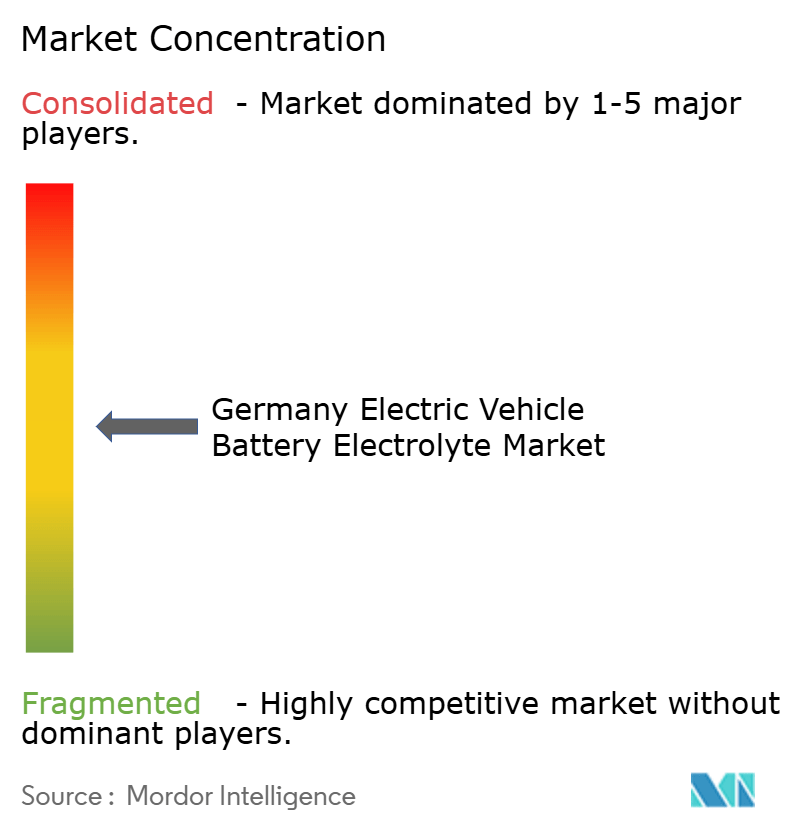
| Market Concentration | Medium |
Major Players *Disclaimer: Major Players sorted in no particular order |
Germany Electric Vehicle Battery Electrolyte Market Analysis by Mordor Intelligence
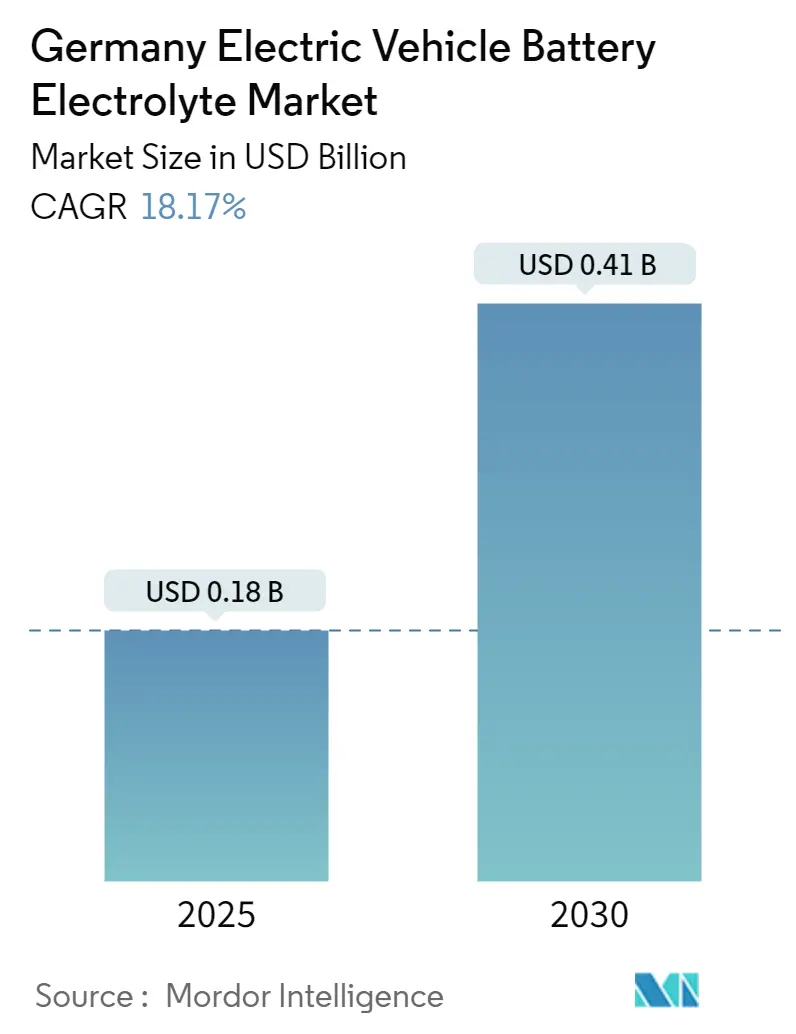
The Germany Electric Vehicle Battery Electrolyte Market size is estimated at USD 0.18 billion in 2025, and is expected to reach USD 0.41 billion by 2030, at a CAGR of 18.17% during the forecast period (2025-2030).
- Over the medium term, the growing adoption of electric vehicles and supportive government policies and investments towards battery manufacturing across the region are expected to drive the demand for the Germany electric vehicle battery electrolyte market during the forecast period.
- On the other hand, the dependence on other countries for key raw materials used in the production of electrolytes is expected to restrain the growth of the Germany electric vehicle battery electrolyte market.
- Nevertheless, the innovation in electrolyte formulations that improve battery performance, safety, and lifespan, particularly for high-performance or long-range EVs, creates significant growth opportunities in the Germany electric vehicle battery electrolyte market in the near future.
Germany holds a defined position within a broader international distribution. The electric vehicle battery electrolyte market share data by Mordor Intelligence maps that allocation across all contributing countries and regions, globally.
Germany Electric Vehicle Battery Electrolyte Market Trends and Insights
Lithium-ion Battery is Expected to Have a Major Share
- Germany stands as one of Europe's foremost markets for electric vehicles (EVs). The nation's push towards electric mobility is bolstered by government initiatives, including subsidies, tax incentives, and stringent regulations like emission reduction targets. As the fleet of EVs expands, so does the demand for lithium-ion batteries, and by extension, the electrolytes integral to their function.
- Moreover, as the prices of materials for lithium-ion batteries decline, manufacturers are ramping up investments in EV battery production. This uptick in production naturally amplifies the demand for essential battery components, notably electrolytes.
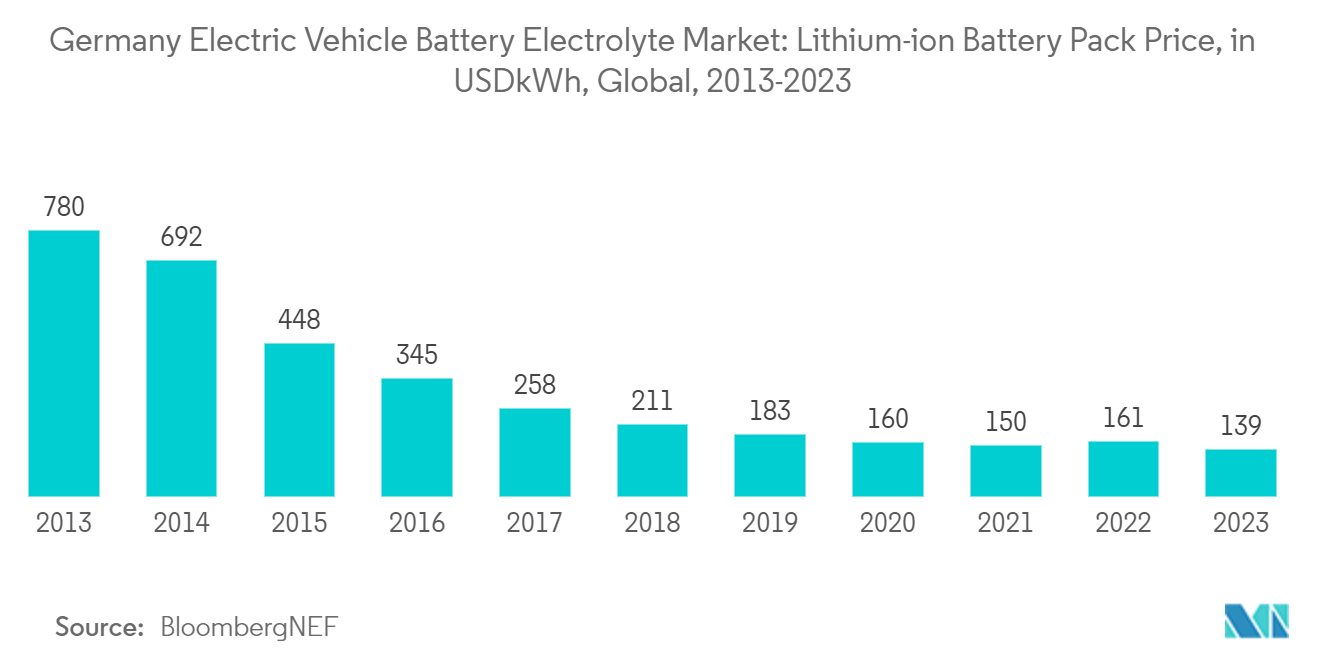
- For example, in 2023, the cost of lithium-ion battery packs saw a 14% drop from the previous year, settling at USD 139/kWh. This decline in battery prices translates to more affordable EVs, spurring adoption and expanding the market share for electric vehicles. Such heightened demand not only signals increased consumption of battery components, especially electrolytes but also propels technological advancements aimed at enhancing battery performance.
- Additionally, Germany is actively working to bridge supply chain gaps, aiming to lessen its dependence on imported materials for lithium-ion batteries, including cathodes, anodes, and electrolytes. With ambitious investment plans on the horizon for both EV battery manufacturing and lithium production, a pronounced demand for lithium-ion battery components, particularly electrolytes, is anticipated.
- For instance, in May 2024, Rock Tech Lithium Inc. secured approval to set up a lithium refinery in Guben, Germany. This refinery is projected to boast a capacity of approximately 24,000 tonnes of lithium-hydroxide, a crucial ingredient for electric car batteries and energy storage systems.
- In another move, February 2024 saw Automotive Cells Company (ACC) amass USD 4.7 billion in funding to establish three lithium-ion battery gigafactories spread across France, Germany, and Italy. ACC projects that by 2030, its production will exceed 2 million lithium-ion batteries. Such strategic investments are poised to amplify the demand for lithium-ion battery electrolytes in the coming years.
- Given these dynamics, the lithium-ion battery electrolyte segment is set for a significant upswing in the forecast period.
Investments Towards Battery Manufacturing is Expected to Drive the Market
- Germany, home to automotive titans like Volkswagen, BMW, and Daimler (Mercedes-Benz), is witnessing these giants make substantial strides in electric vehicle (EV) development. With plans to electrify a significant portion of their fleets, these manufacturers are fueling a burgeoning demand for EV batteries and their essential electrolytes.
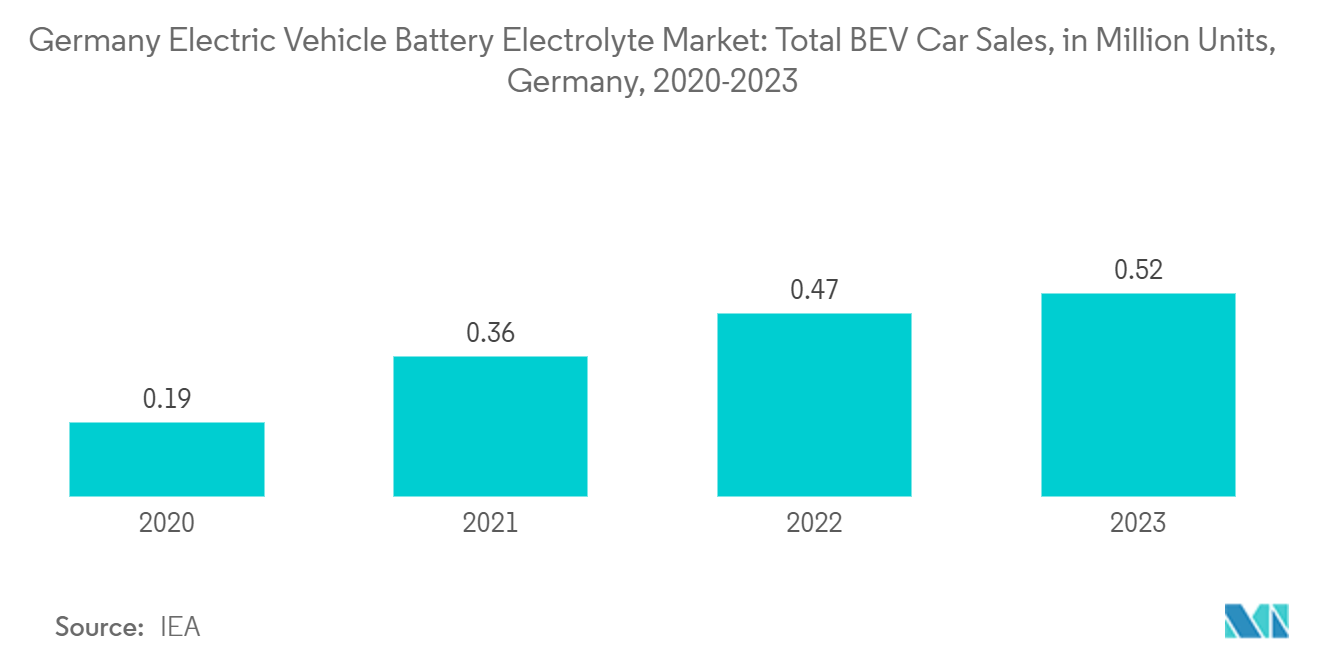
- To bolster investments in the EV sector, the German government has rolled out a suite of incentives and subsidies. As electric vehicle sales continue to rise, it's anticipated that the government will unveil additional policies to further bolster domestic battery manufacturing. Data from the International Energy Agency highlights this trend: in 2023, Germany's battery electric vehicle (BEV) sales reached 0.52 million units, a notable increase from 0.47 million in 2022.
- In tandem, several battery manufacturers are forging partnerships in Germany, aiming to produce EV batteries that are not only more efficient but also enhance overall performance. At the heart of these advancements are advanced battery electrolyte formulations. These cutting-edge formulations not only extend battery life and safety but also elevate energy density, marking them as key players in the industry's future innovations.
- Highlighting the collaborative spirit, in May 2024, VARTA, a prominent battery manufacturer, spearheaded a consortium of 15 companies and universities. This alliance, centered around the project ENTISE, is dedicated to crafting high-performance, eco-friendly cells for industrial applications, harnessing the potential of sodium-ion technology. With a financial backing of approximately EUR 7.5 million in grants from Germany's Federal Ministry of Research and Education, the consortium aims to wrap up the project's final phase by mid-2027.
- As the industry pivots towards solid-state batteries, heralded for their superior energy density and safety, there's an anticipation of a shift in electrolyte requirements. Recent years have seen a flurry of agreements among companies, underscoring the industry's commitment to meeting the surging demand for solid-state batteries in the automotive realm.
- For instance, in July 2024, Volkswagen Group's battery arm, Powerco, inked a deal with QuantumScape to bring QuantumScape's pioneering solid-state lithium-metal battery technology to the industrial forefront. Such collaborations not only signal a rising demand for solid-state batteries but also underscore the need for a consistent supply of electrolytes in EV battery production.
- Given these developments and the influx of funding, the anticipated investments aimed at bolstering EV battery production capacity are set to invigorate the market.
Mordor Intelligence delivers a comprehensive view of the electric vehicle battery electrolyte market across all major regions such as Europe, South America, and Asia, alongside country-level analysis for United Kingdom, Italy, China, India, United States, and France, each offering a view of the local market realities.
Competitive Landscape
The Germany electric vehicle battery electrolyte market is moderate. Some of the major players in the market (in no particular order) include Evonik Industries AG, BASF SE, Solvay SA, Umicore SA, and Mitsubishi Chemical Group.
Germany Electric Vehicle Battery Electrolyte Industry Leaders
-
Evonik Industries AG
-
BASF SE
-
Solvay SA
-
Umicore SA
-
Mitsubishi Chemical Group
- *Disclaimer: Major Players sorted in no particular order
Recent Industry Developments
- January 2024: Northvolt, a Swedish manufacturer of lithium-ion batteries, secured EU approval for a substantial investment of EUR 902 million (equivalent to USD 986.43 million). This funding is earmarked for establishing an electric vehicle (EV) battery production facility in Heide, Germany. Given these developments, we anticipate a significant uptick in demand for lithium-ion battery electrolytes in the coming years.
- September 2023: Gotion High Tech has commenced operations at its first electric vehicle battery facility located in Goettingen, Germany. The facility's initial goal was to achieve an annual production capacity of 5GWh by mid-2024. However, with all investments projected to conclude by the decade's end, the capacity is set to surge to 20 GWh. As production ramps up, these projects are anticipated to drive a heightened demand for EV battery electrolytes.
Germany Electric Vehicle Battery Electrolyte Market Report Scope
An EV battery electrolyte is a chemical medium that allows the flow of electrical charge between the cathode and anode within an electric vehicle (EV) battery. The electrolyte facilitates the movement of ions, which are essential for the charge and discharge processes of the battery.
The Germany electric vehicle battery electrolyte market is Segmented by electrolyte type and battery type. By battery type, the market is segmented into lithium-ion batteries, lead-acid batteries, and others. By electrolyte type, the market is segmented into liquid electrolyte, solid electrolyte, and gel electrolyte.
For each segment, the market sizing and forecasts have been done on the basis of revenue (USD).
| Lithium-ion |
| Lead-Acid |
| Other Battery Types |
| Liquid Electrolyte |
| Gel Electrolyte |
| Solid Electrolyte |
| Battery Type | Lithium-ion |
| Lead-Acid | |
| Other Battery Types | |
| Electrolyte Type | Liquid Electrolyte |
| Gel Electrolyte | |
| Solid Electrolyte |
Key Questions Answered in the Report
How big is the Germany Electric Vehicle Battery Electrolyte Market?
The Germany Electric Vehicle Battery Electrolyte Market size is expected to reach USD 0.18 billion in 2025 and grow at a CAGR of 18.17% to reach USD 0.41 billion by 2030.
What is the current Germany Electric Vehicle Battery Electrolyte Market size?
In 2025, the Germany Electric Vehicle Battery Electrolyte Market size is expected to reach USD 0.18 billion.
Who are the key players in Germany Electric Vehicle Battery Electrolyte Market?
Evonik Industries AG, BASF SE, Solvay SA, Umicore SA and Mitsubishi Chemical Group are the major companies operating in the Germany Electric Vehicle Battery Electrolyte Market.
What years does this Germany Electric Vehicle Battery Electrolyte Market cover, and what was the market size in 2024?
In 2024, the Germany Electric Vehicle Battery Electrolyte Market size was estimated at USD 0.15 billion. The report covers the Germany Electric Vehicle Battery Electrolyte Market historical market size for years: 2019, 2020, 2021, 2022, 2023 and 2024. The report also forecasts the Germany Electric Vehicle Battery Electrolyte Market size for years: 2025, 2026, 2027, 2028, 2029 and 2030.
Germany Electric Vehicle Battery Electrolyte Market Report
Statistics for the 2025 Germany Electric Vehicle Battery Electrolyte market share, size and revenue growth rate, created by Mordor Intelligence™ Industry Reports. Germany Electric Vehicle Battery Electrolyte analysis includes a market forecast outlook for 2025 to 2030 and historical overview. Get a sample of this industry analysis as a free report PDF download.