
United States Electric Vehicle Battery Electrolyte Market Size and Share
| Study Period | 2019 - 2030 |
| Forecast Data Period | 2025 - 2030 |
| Historical Data Period | 2019 - 2023 |
| Market Size (2025) | USD 0.19 Billion |
| Market Size (2030) | USD 0.48 Billion |
| CAGR (2025 - 2030) | 20.19% |
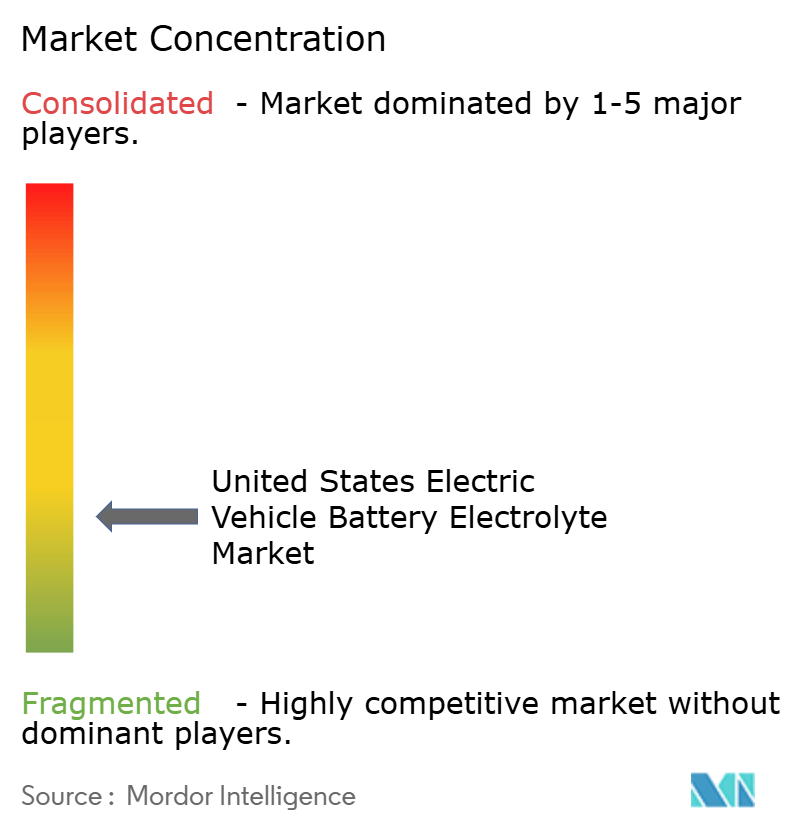
| Market Concentration | Low |
Major Players *Disclaimer: Major Players sorted in no particular order |
United States Electric Vehicle Battery Electrolyte Market Analysis by Mordor Intelligence
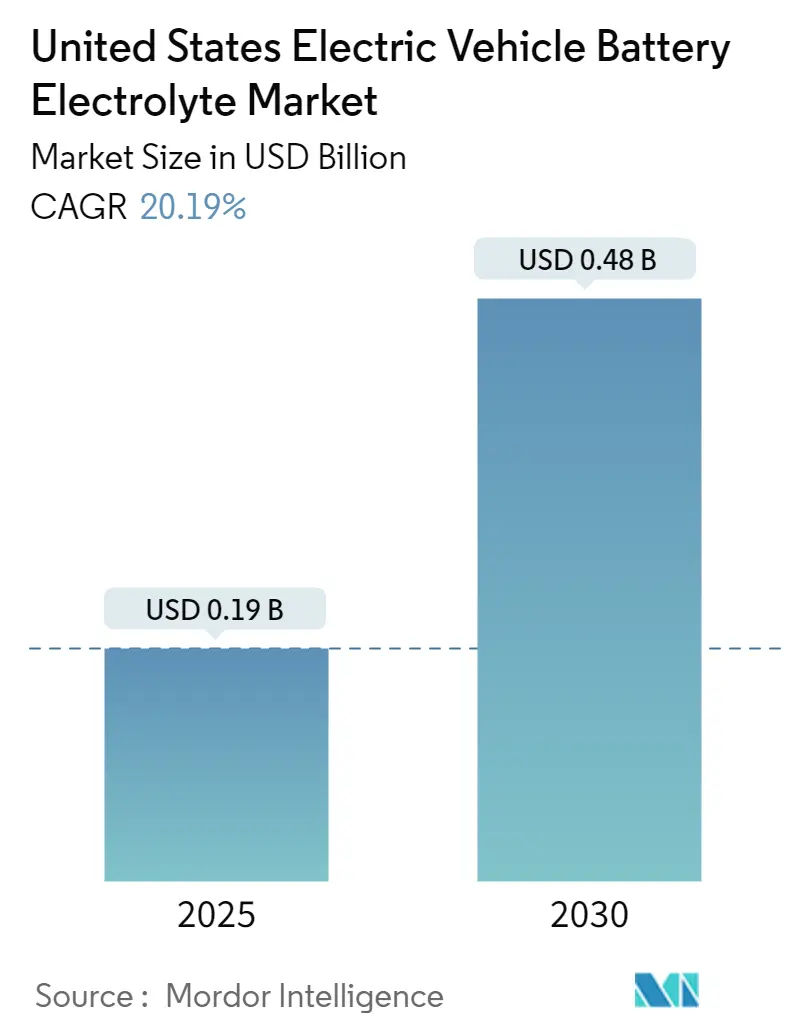
The United States Electric Vehicle Battery Electrolyte Market size is estimated at USD 0.19 billion in 2025, and is expected to reach USD 0.48 billion by 2030, at a CAGR of 20.19% during the forecast period (2025-2030).
- Over the long term, the increasing usage of electric vehicles, including BEVs, PHEVs, and HEVs, and favorable government policies to promote the usage of electric vehicles in the United States are expected to drive the market's growth.
- On the other hand, the supply chain gap in battery materials created by the monopoly of some countries like China is expected to restrain market growth in the future.
- Nevertheless, the ongoing research and advancement in electrolyte material and efficient electrolytes may offer opportunities for market growth.
Figures recorded within United states feed into a worldwide estimate while studying the global industry. Mordor Intelligence's electric vehicle battery electrolyte market size captures this aggregation.
United States Electric Vehicle Battery Electrolyte Market Trends and Insights
Lithium-ion Battery is Expected to Dominate the Market
- Lithium-ion batteries, pivotal for powering electric vehicles (EVs), extend the lifespan of these vehicles, thereby minimizing the frequency of battery replacements. Unlike some other battery types, lithium-ion batteries are deemed environmentally friendly, as they lack toxic materials such as lead or cadmium, making them a cleaner and safer option. Furthermore, their high power output is essential for EVs, which demand swift acceleration and elevated speeds.
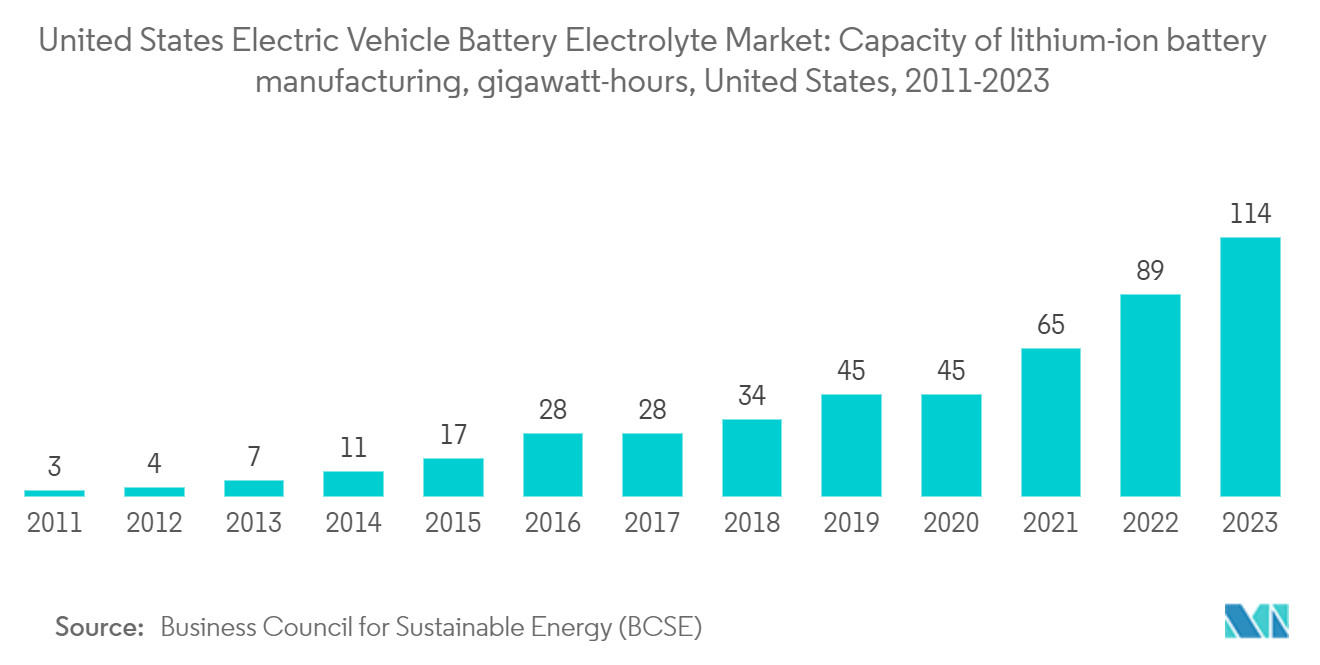
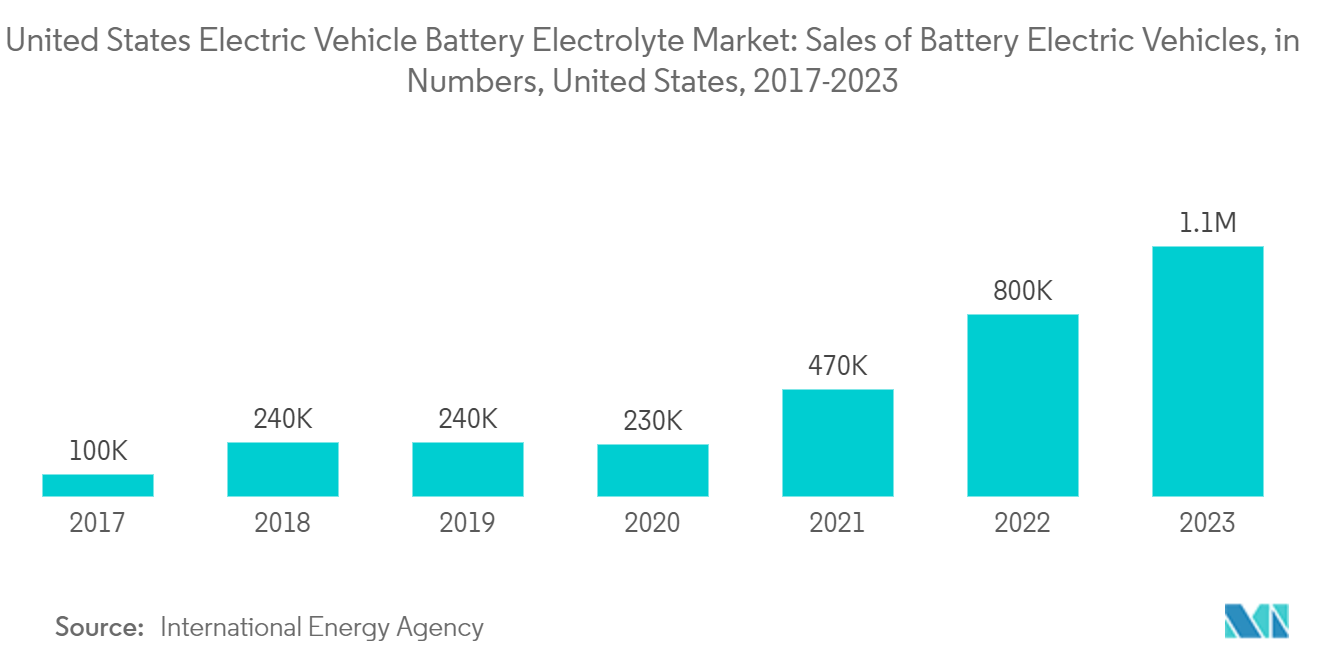
- As of 2023, the United States boasts a lithium-ion battery manufacturing capacity of 114 GWh, according to the Business Council for Sustainable Energy (BCSE). With rising electric vehicle sales, the automotive sector's demand for lithium-ion batteries is poised for significant growth in the coming years. For example, the International Energy Agency reports that electric vehicle sales in the United States and Canada surged over 54% from 2021 to 2023. This uptick in lithium-ion battery usage will subsequently boost the demand for penetration electrolyte solutions, vital for transporting positive lithium ions between the cathode and anode.
- In 2023, Huntsman Corporation, a leading American chemical manufacturer, unveiled plans to boost production of the electrolyte solvent ethylene carbonate in Texas. Additionally, in collaboration with Capchem, they are establishing a plant in the United States, further bolstering the country's electric vehicle battery electrolyte solution market.
- Moreover, in March 2023, the White House unveiled the "National Blueprint for Lithium Batteries," charting the industry's course from 2021 to 2030. The blueprint emphasizes enhancing raw material sourcing and bolstering domestic lithium processing, underscoring the anticipated surge in lithium-ion battery demand in the United States driven by the electric vehicle boom.
- Given the rising adoption of lithium-ion batteries in electric vehicles and their declining prices, the segment is set for substantial growth in the coming years.
Increasing Adoption of Electric Vehicles is expected to Drive the Market
- Driven by rising consumer interest and supportive government policies, the United States is witnessing a rapid expansion in its electric vehicle (EV) battery electrolyte market.
- Technological advancements, particularly in high-nickel and electrolyte solutions, are boosting battery performance and cost-effectiveness. Concurrently, the U.S. is bolstering its domestic supply chain for critical materials such as lithium, nickel, and cobalt, aiming to reduce import reliance and ensure stability.
- In January 2024, MIT researchers unveiled a groundbreaking battery material set to transform electric vehicle power sources. This lithium-ion battery, featuring an innovative organic material-based cathode and electrolyte solution, marks a shift from the traditional cobalt or nickel usage. Such advancements are poised to amplify the nation's demand for battery electrolyte materials.
- As electric vehicle adoption surges, the United States is prioritizing the fortification of its battery manufacturing supply chain. This momentum is likely to spur domestic production of electric vehicle battery components, including electrolytes.
- In June 2023, Capchem, a China-based R&D-centric company, unveiled plans for a USD 120 million electrolyte plant in southern Ohio. Simultaneously, Dongwha Electrolyte commenced a USD 70 million facility in Tennessee, targeting an annual production of over 70,000 metric tons of electrolytes. Additionally, Soulbrain is establishing a USD 75 million electrolyte plant in Indiana, strategically located to cater to a nearby battery factory.
- Looking ahead, as EV adoption continues its upward trajectory, the United States's R&D focus on battery technology—aimed at boosting energy density, cutting costs, and extending EV range—will likely invigorate the battery cathode market.
- Data from the International Energy Agency highlights a significant jump in United States EV car sales, soaring to 1.39 million units in 2023 from 0.99 million in 2022.
- With projections of 26 million electric vehicles by 2030, the United States anticipates a need for 12.9 million charging ports, paving the way for a burgeoning electric vehicle battery cathode market.
- Given the accelerating adoption of EVs and technological strides, the United States is poised to lead the market during the forecast period.
Mordor Intelligence evaluates the electric vehicle battery electrolyte market across all key regional markets, including Asia, Middle East and Africa, and North America, with deeper country-level insights covering Canada, India, Italy, China, Germany, and France.
Competitive Landscape
The United States Electric Vehicle Battery Electrolyte Market is semi-fragmented. Some of the major companies operating in the market (in no particular order) include Advanced Electrolyte Technologies LLC, Mitsubishi Chemical Holdings, Shenzhen Capchem Technology Co., Ltd, Nohms Technologies Inc., and Ohara Corporation.
United States Electric Vehicle Battery Electrolyte Industry Leaders
-
Advanced Electrolyte Technologies LLC
-
Mitsubishi Chemical Holdings
-
Shenzhen Capchem Technology Co., Ltd
-
Nohms Technologies Inc
-
Ohara Corporation
- *Disclaimer: Major Players sorted in no particular order
Recent Industry Developments
- May 2024: Solidion Technology Inc., based in the United States, is set to introduce sodium-based electrolytes as a substitute for traditional lithium-ion batteries. Sodium is gaining traction as a suitable material for solid-state batteries, targeting the same energy storage applications that predominantly rely on lithium-ion systems.
- September 2023: The University of Texas at Dallas has secured a USD 30 million funding from the Department of Defence (DOD) over the next three years. The funding aims to advance the development and commercialization of innovative battery technologies and manufacturing processes. Additionally, it seeks to bolster the domestic availability of essential raw materials, notably the battery electrolyte solution.
United States Electric Vehicle Battery Electrolyte Market Report Scope
The electric vehicle battery electrolyte is a mixture of a widely available salt (lithium hexafluorophosphate) and carbonate solvents such as ethylene carbonate. The solvents dissolve the salt to form a liquid. The electrolyte plays a crucial role in determining the battery's performance characteristics, including energy density, power density, cycle life, and safety.
The United States Electric Vehicle Battery Electrolyte Market Report is Segmented by Battery Type and Electrolyte type. By battery type, the market is segmented by Lithium-Ion Batteries, Lead-Acid Batteries, and Others. By electrolyte type, the market is segmented by Liquid Electrolyte, Gel Electrolyte, and Solid Electrolyte. The report also covers the market size and forecasts for the United States electric vehicle battery electrolyte market across major countries.
For each segment, the market sizing and forecasts were made based on revenue (USD).
| Lithium-Ion Batteries |
| Lead-Acid Batteries |
| Other type of Batteries |
| Liquid Electrolyte |
| Gel Electrolyte |
| Solid Electrolyte |
| Battery Type | Lithium-Ion Batteries |
| Lead-Acid Batteries | |
| Other type of Batteries | |
| Electrolyte Type | Liquid Electrolyte |
| Gel Electrolyte | |
| Solid Electrolyte |
Key Questions Answered in the Report
How big is the United States Electric Vehicle Battery Electrolyte Market?
The United States Electric Vehicle Battery Electrolyte Market size is expected to reach USD 0.19 billion in 2025 and grow at a CAGR of 20.19% to reach USD 0.48 billion by 2030.
What is the current United States Electric Vehicle Battery Electrolyte Market size?
In 2025, the United States Electric Vehicle Battery Electrolyte Market size is expected to reach USD 0.19 billion.
Who are the key players in United States Electric Vehicle Battery Electrolyte Market?
Advanced Electrolyte Technologies LLC, Mitsubishi Chemical Holdings, Shenzhen Capchem Technology Co., Ltd, Nohms Technologies Inc and Ohara Corporation are the major companies operating in the United States Electric Vehicle Battery Electrolyte Market.
What years does this United States Electric Vehicle Battery Electrolyte Market cover, and what was the market size in 2024?
In 2024, the United States Electric Vehicle Battery Electrolyte Market size was estimated at USD 0.15 billion. The report covers the United States Electric Vehicle Battery Electrolyte Market historical market size for years: 2019, 2020, 2021, 2022, 2023 and 2024. The report also forecasts the United States Electric Vehicle Battery Electrolyte Market size for years: 2025, 2026, 2027, 2028, 2029 and 2030.
United States Electric Vehicle Battery Electrolyte Market Report
Statistics for the 2025 United States Electric Vehicle Battery Electrolyte market share, size and revenue growth rate, created by Mordor Intelligence™ Industry Reports. United States Electric Vehicle Battery Electrolyte analysis includes a market forecast outlook for 2025 to 2030 and historical overview. Get a sample of this industry analysis as a free report PDF download.