
Market Overview
| Study Period | 2020 - 2031 |
|---|---|
| Forecast Data Period | 2026 - 2031 |
| Base Year Market Size (2025) | 274.26 Million liters |
| Market Volume (2026) | 271.22 Million liters |
| Market Volume (2031) | 256.53 Million liters |
| Growth Rate (2026 - 2031) | -1.11 % |
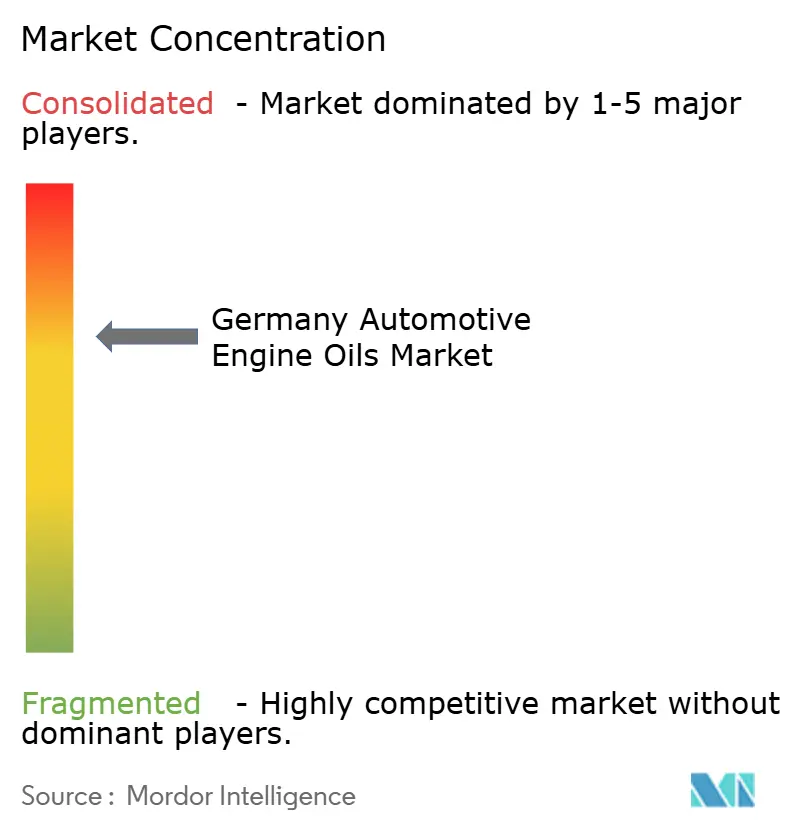
| Market Concentration | Medium |
Major Players *Disclaimer: Major Players sorted in no particular order Image © Mordor Intelligence. Reuse requires attribution under CC BY 4.0. | |
Germany Automotive Engine Oils Market Analysis by Mordor Intelligence
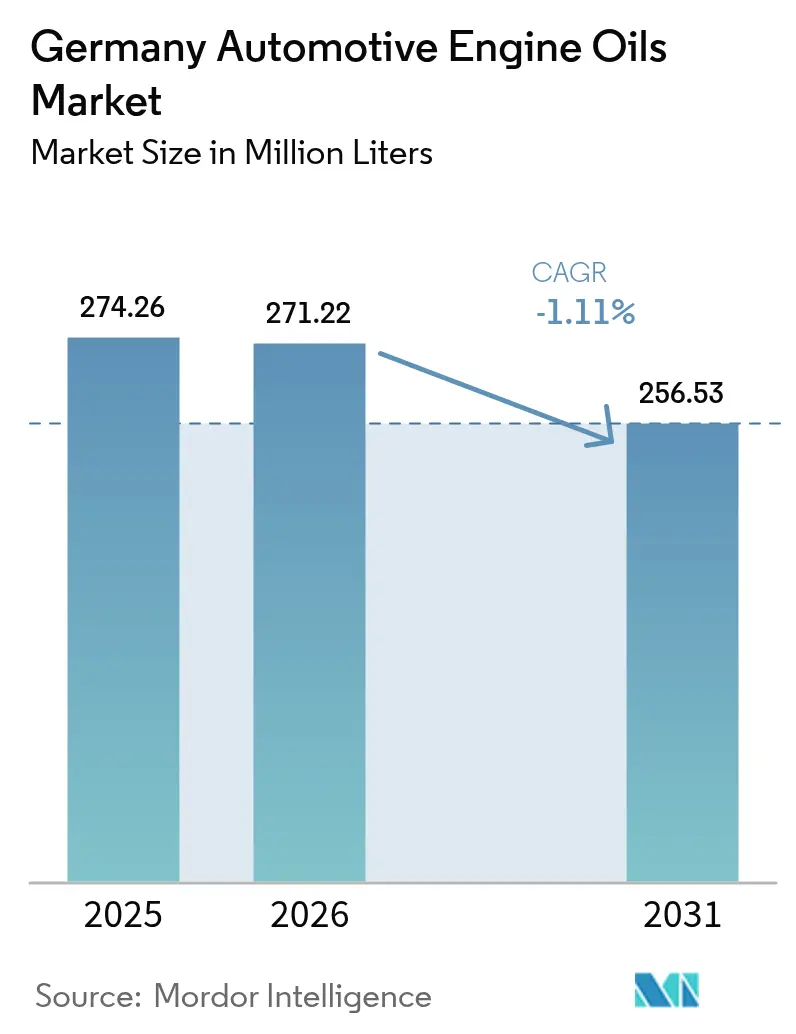
The Germany Automotive Engine Oils Market size was valued at 274.26 Million liters in 2025 and estimated to decline from 271.22 Million liters in 2026 to reach 256.53 Million liters by 2031, at a CAGR of -1.11% during the forecast period (2026-2031). The German automotive engine oil market continues to face headwinds from rapid electrification, tighter Euro-7 emission rules, and a service-network shake-up that together curb lubricant consumption in mass-volume grades. However, hybrid powertrains, long-drain OEM approvals, and sustainability mandates are redirecting value toward premium low-viscosity synthetics and bio-based blends, which trade at noticeably higher margins even as aggregate volumes fall. Competitive positioning increasingly hinges on technical validation, a secure Group III base-oil supply, and the ability to deliver verified Scope 3 carbon savings that align with Germany’s climate policy. Domestic champions capitalize on “Made in Germany” trust, while multinational majors deploy vertical integration and refinery upgrades to defend their share in the German automotive engine oils market.
Key Report Takeaways
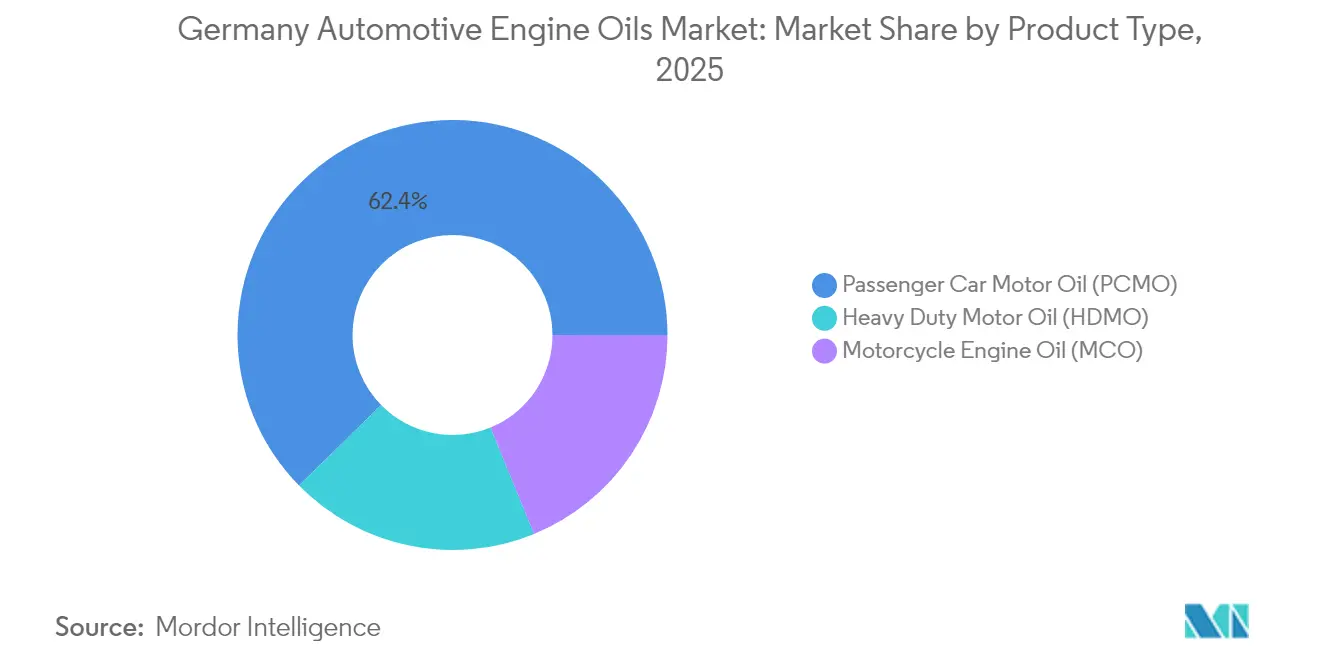
- By product type, Passenger Car Motor Oil led with a 62.35% share of the German automotive engine oils market in 2025, whereas Motorcycle Engine Oil showed the mildest retreat at a -0.95% CAGR through 2031.
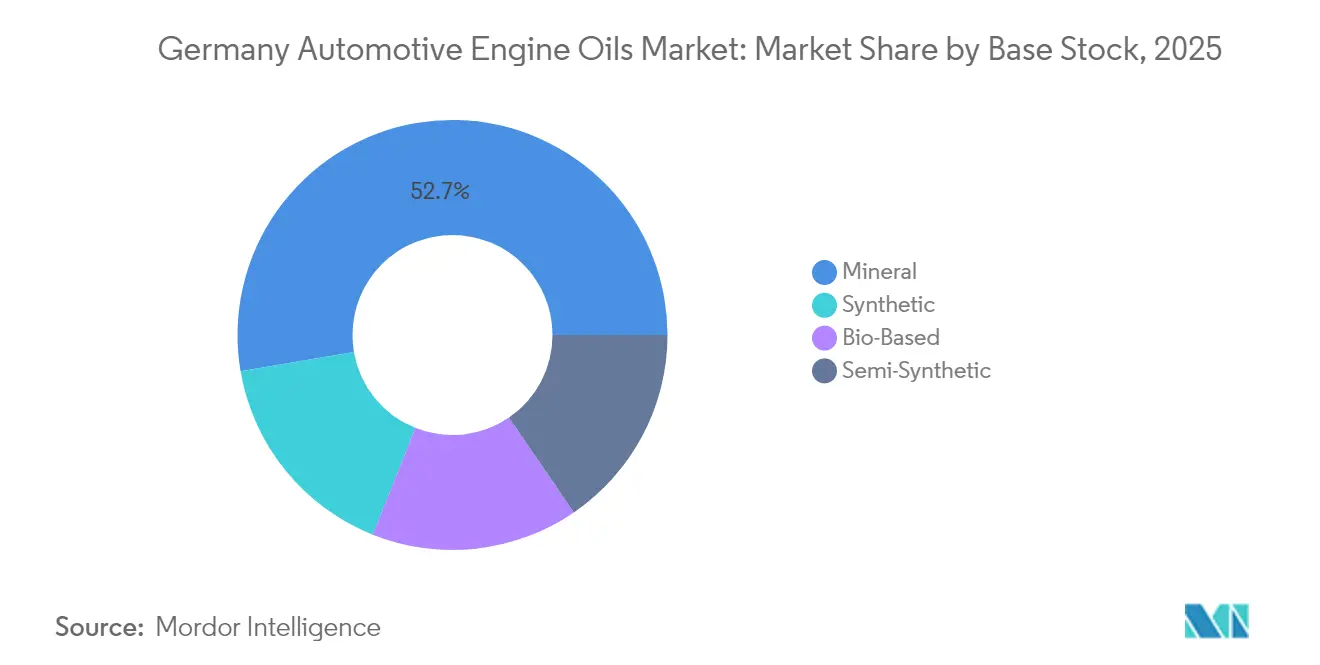
- By base stock, mineral grades captured 52.70% of the German automotive engine oil market size in 2025, while full synthetics are forecast to narrow the gap by declining at a rate of -0.83% CAGR to 2031.
Note: Market size and forecast figures in this report are generated using Mordor Intelligence’s proprietary estimation framework, updated with the latest available data and insights as of 2026.
Germany Automotive Engine Oils Market Trends and Insights
Drivers Impact Analysis*
| Drivers | (~) % Impact on CAGR Forecast | Geographic Relevance | Impact Timeline |
|---|---|---|---|
| Euro-7 fuel-economy push accelerates low-viscosity synthetic adoption | +0.3% | Germany, EU core markets | Medium term (2-4 years) |
| Ageing German car parc lifts maintenance and top-up demand | +0.2% | Germany national | Long term (≥4 years) |
| OEM long-drain approvals stimulate premium oil upgrades | +0.2% | Germany, spillover to EU | Medium term (2-4 years) |
| Bio-based and re-refined oils gain traction post-VerpackG 2025 amendment | +0.1% | Germany national | Long term (≥4 years) |
| B2B2C e-commerce platforms reshape workshop procurement | +0.1% | Germany, EU expansion | Short term (≤2 years) |
| Source: Mordor Intelligence | |||
Euro-7 Fuel-Economy Push Accelerates Low-Viscosity Synthetic Adoption
Euro-7 tailpipe standards reduce particulate and NOx emissions, prompting OEMs to prescribe 0W-20 and even 0W-16 lubricants that minimize internal friction and meet on-road emissions verification requirements[1]. New ACEA sequences aligned with these limits ensure that the German automotive engine oil market remains anchored to synthetic chemistries, despite a decline in unit volume. Mercedes-Benz MB 229.71 and BMW Longlife-22FE++ are now mandatory for post-2025 hybrid gasoline models, each requiring ultra-stable low-SAPS formulations. Lubricant blenders that already hold these approvals can charge a premium because replicating the testing protocol costs several million euros and takes 18 months. Euro-7 thus converts regulation into a margin growth lever inside the Germany automotive engine oils market, reinforcing a shift from selling liters to selling lifecycle performance credentials. The upside is most visible in dealership channels, where OEM-specific oils already account for more than two-thirds of synthetic PCMO throughput.
Ageing German Car Parc Lifts Maintenance and Top-Up Demand
Germany’s average light-vehicle age reached 9.5 years in 2025, a full year higher than in 2020, lengthening ownership cycles and expanding aftermarket opportunities[2]. Older engines typically experience higher blow-by and gasket seepage, which raises mid-interval top-up requirements and necessitates the use of viscosity grades such as 5W-30, which are suited to legacy Euro-5 fleets. Workshops report that cars older than eight years require an additional 0.4 liters of make-up oil between scheduled services, which partially compensates for the volume dip induced by the uptake of battery-electric vehicles. Commercial vans and rigid trucks exhibit a similar pattern, with fleet managers extending replacement timelines to hedge against uncertainty in residual value. This demography underpins steady demand in the German automotive engine oils market for high-mileage formulations featuring seal conditioners and detergency boosters. Suppliers with bundled filter-and-oil service kits have leveraged the trend, raising per-visit revenue even as visit frequency stabilizes.
OEM Long-Drain Approvals Stimulate Premium Oil Upgrades
Volkswagen’s VW 508 00/509 00 (Longlife IV) and Porsche C20 approvals extend service windows to 30,000 km or two years, reducing waste streams while increasing the per-liter value captured by suppliers. Long-drain compliance requires Group III + base oils blended with advanced antioxidants, which elevates additive treat rates. For blenders in the German automotive engine oils market, these specifications have doubled gross margin per liter relative to legacy 10W-40 mineral oils. FUCHS secured exclusive first-fill status for several Mercedes-Benz hybrid drivetrains in 2024, underscoring how technical co-development locks in aftermarket pull-through. Competitive barriers are high because each failed engine-test run incurs additional costs, discouraging late entrants. Long-drain programs, therefore, pivot the German automotive engine oils market toward a value-over-volume configuration that rewards research and development depth and OEM intimacy.
Bio-Based and Re-Refined Oils Gain Traction Post-VerpackG 2025 Amendment
Germany’s amended Packaging Act requires lubricant marketers to increase the recycled content in containers and disclose product carbon footprints, sparking interest in re-refined and bio-based base stocks. TotalEnergies amplified the signal by acquiring Tecoil’s 50,000 t/y re-refinery in 2024, adding forward-integrated feedstock to support German customers. End-user surveys indicate that fleet managers are willing to pay a premium for verified low-carbon PCMO, particularly when corporate ESG targets are linked to supplier selection. The integration of digital product passports, which will be mandatory from 2030, further differentiates compliant brands within the German automotive engine oils market and underwrites resilient pricing for circular formulations.
Restraints Impact Analysis*
| Restraints | (~) % Impact on CAGR Forecast | Geographic Relevance | Impact Timeline |
|---|---|---|---|
| EU refinery rationalisation swings base-oil availability and price | –0.4% | Germany, broader EU | Short term (≤2 years) |
| 2025 German Chemicals Tax lifts additive costs | –0.2% | Germany national | Short term (≤2 years) |
| Counterfeit oils on online marketplaces erode brand trust | –0.1% | Germany, EU spillover | Medium term (2-4 years) |
| Source: Mordor Intelligence | |||
EU Refinery Rationalisation Swings Base-Oil Availability and Price
Shell will repurpose its Wesseling site to focus on Group III production from late 2025, trimming Group I and tightening short-chain supply. BP is reducing Gelsenkirchen crude runs to lower carbon intensity, thereby shrinking local vacuum gas-oil streams that feed base-oil hydrotreaters. Spot Group III prices dipped in early 2025; however, smaller blenders report difficulty in locking multi-year contracts, thereby elevating supply-chain risk. Import reliance has risen to of German base-oil demand, exposing buyers to freight volatility through ARA hubs. Large integrated majors preserve margins by using internal transfer pricing, while independent lubricators face a cost pass-through lag that compresses EBITDA. Capacity shifts, therefore, act as a structural drag on the German automotive engine oils market during the forecast horizon.
Counterfeit Oils on Online Marketplaces Erode Brand Trust
Fake 5W-30 drums often mimic OEM approval codes but fail density and viscosity checks, resulting in knock-on engine wear and warranty disputes. Brand owners must now deploy serialized QR seals and blockchain registries, which add to packaging costs. Persistent counterfeiting risk deters some garages from trading up to premium synthetics, thereby slowing value-mix improvement in the German automotive engine oils market, particularly in price-sensitive rural areas.
*Our forecasts treat driver/restraint impacts as directional, not additive. The impact forecasts reflect baseline growth, mix effects, and variable interactions.
Segment Analysis
By Product Type: PCMO Dominance Faces Electrification Pressure
Passenger Car Motor Oil accounted for 62.35% of the German automotive engine oil market in 2025, reflecting Germany’s historic car-centric mobility infrastructure and well-developed dealership maintenance network. EV uptake, led by premium brands, is starting to erode aggregate PCMO demand; yet, the sub-segment still secures a share of the German automotive engine oils market, particularly for high-temperature, turbocharged gasoline engines that require low-SAPS 0W-20 formulations. Motorcycle Engine Oil, though much smaller in volume, will post the mildest volume decline at a –0.95% CAGR because leisure riding culture, particularly in Bavaria and Baden-Württemberg, sustains ICE two-wheelers well into the 2030s. Heavy-duty motor oil demand remains linked to freight-corridor activity on Germany’s Autobahn network, where fleet telematics favor extended-drain 10W-30 CK-4 formulations with mild HTHS retention for Euro VI diesel engines. The German automotive engine oil market, therefore, exhibits a two-speed profile: conventional PCMO grades in older sedans contract sharply, while OEM-specific synthetics for luxury hybrids capture a resilient wallet share.
Fleet managers prioritize fuel economy and downtime reduction, prompting HDMO suppliers to adopt FA-4 5W-30 blends that deliver fuel savings in long-haul operations. Meanwhile, MCO marketers utilize extended shelf-life monoesters to increase average selling prices at retail. OEM-filled hybrid models, such as the Mercedes-Benz GLC 400e, require dual-purpose formulations that control LSPI and maintain catalyzer protection, giving German integrators early-mover leverage. Across every product bracket, the German automotive engine oils market rewards chemistry capable of meeting both Euro-7 after-treatment durability and customer perception of premium brand value.

By Base Stock: Synthetic Grades Outperform in Declining Market
Mineral oils still accounted for 52.70% of the German automotive engine oil market in 2025, yet their volume declined faster than the overall trend as OEMs reinforced 0W and 5W indices that cannot be met with Group I stocks alone. Full synthetics, in contrast, shrink by only –0.83% CAGR because Euro-7 and OEM long-drain mandates require higher oxidative stability, which pushes average treat-rate costs up but also boosts the margin pool as price differentials widen. Semi-synthetic hybrids lose strategic relevance, caught between low-cost mineral loyalty and true high-performance synthetics that secure dealership recommendation.
Shell’s Wesseling expansion to 300 kt/y Group III output offers domestic blenders a proximity advantage, mitigating logistics risk once Russian base-oil imports ceased during the 2024 geopolitical realignments. Suppliers differentiate themselves through pour-point depressant technology, with ester-enriched 0W-16 meeting the cold-start demands of plug-in hybrid duty cycles. The German automotive engine oils market, therefore, migrates toward a barbell structure: low-income users cling to low-additive 15W-40, while fleet and premium-car owners adopt high-end synthetics enlivened by renewable content claims. This polarization shapes research and development pipelines, guiding capital expenditures toward hydrocracker upgrades rather than traditional solvent refining.
Geography Analysis
Regional demand remains concentrated in North Rhine-Westphalia, Baden-Württemberg, and Bavaria, thanks to high vehicle registrations and thriving industrial fleets. Urban electrification initiatives in Berlin and Hamburg are beginning to reduce PCMO throughput in dealership quick-lube bays, yet suburban commuter belts still favor ICE vehicles for their range flexibility, thereby preserving lubricant demand diversity. Southern federal states exhibit the highest motorcycle penetration, which cushions the MCO decline and supports a vibrant aftermarket for performance esters and specialty two-stroke injector cleaners.
Eastern regions such as Saxony and Thuringia offer cost-competitive warehouse space, attracting e-commerce-driven lubricant distribution hubs that shorten lead times to Poland and the Czech Republic. Despite electrification, the Munich–Stuttgart premium car corridor sustains per-vehicle oil consumption because OEM specifications dictate dealership loyalty. Conversely, rural Schleswig-Holstein exhibits a notable shift toward private-label 10W-40 purchased through discount retailers, illustrating divergent price elasticities within a single national boundary.
Upcoming EU TEN-T corridor extensions will increase long-haul freight volume through Rhineland logistics hubs, indirectly supporting HDMO sales even when passenger-car lubricants become less competitive. Concurrently, planned low-emission zones restrict older diesel vehicles from operating inside city centers, prompting fleet operators to modernize, which temporarily reduces the first-fill volume. These offsetting currents confirm that local policy heterogeneity is a vital layer of due diligence when mapping channel strategy inside the Germany automotive engine oils market.
Regulatory Landscape
Germany’s automotive engine oils market sits within a combined vehicle compliance and chemicals-management framework. Vehicle type approval and market surveillance are anchored by Regulation (EU) 2018/858 and implemented nationally through the Kraftfahrt-Bundesamt (KBA), which reinforces the need for OEM-approved, low-SAPS formulations aligned with tighter tailpipe and on-road compliance requirements.
On the chemicals side, EU REACH continues to shape additive selection and SDS maintenance, with new Candidate List (SVHC) updates in February 2026 triggering downstream SDS refresh needs for affected mixtures. The European Chemicals Agency (ECHA) advanced the universal PFAS restriction process in 2026, with RAC agreeing a draft opinion and a public consultation running from March 26, 2026 to May 25, 2026. The process increases scrutiny on fluorinated chemistries sometimes used in performance additives. Separately, Germany’s circularity and environmental oversight affects used-oil handling, as the Federal Environment Agency (UBA) reviews the Waste Oil Ordinance (AltoelV), and it also maintains evaluation criteria for organic materials (including lubricants) in contact with drinking water, updated as of October 27, 2025.
Value Chain Analysis
The Germany automotive engine oils value chain starts with base oil and additive sourcing, then blending, packaging, distribution, and end-use through OEM and dealership networks, as well as independent workshops. Feedstock access is influenced by EU refinery shifts and domestic linkages to large chemical and refining sites. Additive packages and approvals-driven testing create a technical barrier that tends to favor established blenders. German producers such as FUCHS and LIQUI MOLY focus R&D, blending, and quality control domestically to support traceability (batch documentation) and to meet stringent OEM homologation requirements that govern many premium PCMO grades.
Downstream, distribution is split across dealer channels (OEM-specified oils), independent workshops, and increasingly platform-based procurement, with counterfeiting risks pushing more authentication and packaging-control measures. A notable coordination step occurred in June 2025 when member companies of UNITI Bundesverband EnergieMittelstand e.V. and Verband Schmierstoff-Industrie e.V. voted to merge into a single association representing about 95% of the German lubricants market. The stated aim was to strengthen industry coordination on regulation and sustainability. Circular supply loops also matter: AVISTA OIL Deutschland GmbH collects used oil and re-refines it into base oils, supporting domestic supply resilience and enabling recycled-content narratives that increasingly influence tendering and fleet procurement.
Competitive Landscape
The German automotive engine oil market features a moderately consolidated competitive landscape. FUCHS, headquartered in Mannheim, continued to deepen OEM alignment, securing factory-fill status for Mercedes hybrid drivelines and rolling out an in-house e-fluids suite for gearboxes and thermal-management loops. Competitive intensity is sharpening as aggregate liters fall. Majors invest in lab capabilities that shorten homologation cycles, a move that independents cannot easily replicate. Digital subscription platforms that pair lubricant analytics with telematics data now differentiate service models, shifting emphasis from product sales to uptime assurance. Innovation gravity tilts toward circular economy offerings. Medium-sized German blenders respond by co-investing in regional re-refineries to backstop feedstock and hedge volatility in virgin Group III prices. Advances in free-standing detergent booster packs enable on-site customization, allowing distributors to carry fewer finished SKUs.
Germany Automotive Engine Oils Industry Leaders
-
Shell plc
-
LIQUI MOLY
-
BP Plc
-
FUCHS
-
Exxon Mobil Corporation
- *Disclaimer: Major Players sorted in no particular order
Market Opportunities and Future Outlook
Premiumization through OEM-specific, low-viscosity approvals remains a primary whitespace as Euro-7-aligned performance requirements and long-drain specifications move workshops away from legacy mineral grades. A clear enabler is additive technology validated to meet these OEM standards, including Infineum P6188 (announced February 2026), which was approved against Volkswagen VW 508.00/509.00. That helps support extended-drain and efficiency-oriented formulations that compete on credentials rather than liters. Competitive advantage therefore shifts toward suppliers that can secure approvals and deliver consistent quality across both dealership and independent workshop channels.
Supply-chain localization and circular inputs also open room for differentiation as buyers seek stable Group III supply and lower-carbon claims. Shell’s Rheinland (Wesseling) conversion into a Group III base oil production facility, reported as active construction progress, targets 300,000 tonnes per annum capacity with start-up slated for 2028, creating an in-country anchor for blenders and private-label distributors once available. In parallel, used-oil collection and re-refining models, such as AVISTA OIL’s domestic loop, and anti-counterfeit measures including LIQUI MOLY’s 2026 authenticity scan mechanism can support higher-retention value propositions in the aftermarket, where trust, traceability, and documented sustainability attributes increasingly influence purchasing decisions.
Recent Industry Developments
- June 2026: LIQUI MOLY introduced a scan-based quality assurance mechanism to help verify product authenticity for its lubricants. The mechanism directly addresses counterfeit risks in workshop and online channels, supporting brand trust for premium, OEM-approval-driven engine oils.
- April 2026: European Chemicals Agency RAC published a draft opinion on PFAS restrictions affecting fluorinated lubricant additives, triggering a public consultation running from March 26, 2026 to May 25, 2026. The development increases scrutiny on fluorinated chemistries used in performance additives and will feed into downstream SDS updates and supplier risk management in Germany.
- June 2025: BP Plc initiated a review of its Castrol lubricants unit as part of a wider divestment program running through 2027. Any change in ownership or strategic priorities has implications for Castrol’s positioning in Germany, particularly across premium PCMO distribution and marketing.
Research Methodology Framework and Report Scope
Market Definition and Coverage
For this methodology, the market covers automotive engine oils consumed in Germany for on-road vehicles, measured as finished lubricant demand that flows through OEM fill and the aftermarket.
Scope exclusions: We exclude non-engine automotive fluids (such as transmission fluids, brake fluids, coolants, greases) and non-automotive engine oil uses.
Segmentation Overview
- By Product Type
- Passenger Car Motor Oil (PCMO)
- 0W-XX
- 5W-XX
- 10W-XX
- 15W-XX
- Monogrades
- Other Grades
- Heavy Duty Motor Oil (HDMO)
- 0W-XX
- 5W-XX
- 10W-XX
- 15W-XX
- Monogrades
- Other Grades
- Motorcycle Engine Oil (MCO)
- 0W-XX
- 5W-XX
- 10W-XX
- 15W-XX
- Monogrades
- Other Grades
- Passenger Car Motor Oil (PCMO)
- By Base Stock
- Mineral
- Synthetic
- Semi-Synthetic
- Bio-Based
Data Sources, Market Sizing, and Validation
Desk Research
Desk work starts by building the demand pool that engine oils can realistically serve in Germany, and then it is shaped using public vehicle and trade signals. We typically refer to sources such as the German Federal Motor Transport Authority (KBA) for vehicle parc and registrations, the Federal Statistical Office (Destatis) for mobility and industry indicators, and Eurostat for harmonized energy and transport series.
To keep the lubricant side grounded, we also review sources such as ACEA for vehicle stock and powertrain shifts, and BAFA incentive data to understand how quickly electrified vehicles are entering the parc and how that reduces oil change frequency over time. Import and export direction is checked using customs trade statistics, and company filings, investor presentations, and reputable press are used to validate product mix moves such as synthetic share. Where needed, we also use paid subscriptions for company financials and a lubricants-specific market information database to sense-check volume-to-value assumptions. These examples are not exhaustive, and many other sources are referenced for data collection, validation, and clarification.
Primary Interviews and Surveys
Primary work is used to pressure-test what desk sources cannot show clearly, especially drain intervals, packaging mix, and the split between workshop-led and DIY purchases. We speak with a mix of lubricant suppliers, distributors, service workshops, and informed industry experts across Germany, so assumptions on volumes and pricing can be corrected before finalization.
Distribution of primary research fieldwork respondents
| Company type | Respondent position |
|---|---|
| Top tier: 26% | CXOs: 14% |
| Mid tier: 60% | Functional/Unit leaders: 30% |
| Smaller Players: 14% | Managers: 56% |
Market-Sizing & Forecasting
Sizing is built using top-down and bottom-up logic, and the two views are reconciled until the totals make practical sense. From the top-down side, we reconstruct demand by linking the in-use vehicle parc to oil consumption intensity, then adjust for average annual mileage and drain intervals that differ by vehicle age and service behavior.
On the validation side, we use selective bottom-up approximations, such as sampled average selling prices by pack size combined with estimated channel volumes, then validate through distributor and workshop checks to correct gaps. Inputs that matter most here include the Germany ICE parc trend versus electrified vehicles, average oil sump sizes, service interval extensions, the share of synthetic versus conventional formulations, and seasonality in workshop visits, which typically shifts volumes across quarters.
For forecasting, we apply scenario analysis around two main levers, parc evolution and drain interval behavior, and then cross-check with what interviewees expect on pricing and product upgrades. If a channel or sub-cohort lacks clear signals, we use conservative ranges and then narrow them through follow-up calls so outliers do not drive the final curve.
Data Validation & Update Cycle
Outputs are checked against independent signals, and the model is reviewed in steps before sign-off. We compare implied liters per vehicle against workshop realities, trade movements, and visible product mix shifts, then investigate variance that looks too large for a single assumption.
If an anomaly is seen, assumptions are revisited and, when needed, respondents are re-contacted to confirm what changed (for example, a step change in drain intervals or a sharp pricing move). The report is refreshed annually, with interim updates when material events affect demand or pricing, and a final pre-delivery pass is completed so clients receive the most current view.
Mordor Intelligence's Germany Automotive Engine Oils Market Estimate Compared With Other Published Estimates
Published market sizes for Germany automotive engine oils can differ quite a bit, and this usually happens because the scope and unit of measurement are not aligned. Some sources report value, others report volume, and a few also blend adjacent automotive lubricant categories into the same total.
Key gaps tend to come from whether only engine oils are counted or broader automotive lubricants are included, how quickly electrification and longer service intervals are assumed to reduce demand, and how pricing is converted from liters to USD (especially when pack size and channel mix are not modeled). The table also shows how using a volume-anchored demand pool, and only then converting to value with checked price bands, narrows the spread, which is the approach applied by Mordor Intelligence.
Benchmark comparison
| Source | Market Size | Gaps in Research Methodology |
|---|---|---|
| Mordor Intelligence | USD 274.26 M (2025) | |
| Trade Journal A | USD 280.14 M (2024) | This estimate appears to treat the market mainly as a value total without clearly separating engine oils from adjacent automotive lubricant lines, and it does not show how drain interval changes are mapped to the in-use parc. |
| Press Release B | USD 8.16 B (2024) | This number is for the wider Germany automotive lubricants market, so engine oils are only one component, which inflates the figure versus an engine-oils-only definition. |
Across the three figures, the biggest driver of variance is scope, followed by how volumes are converted into USD through pack mix and channel pricing. By keeping the demand pool tied to the German vehicle parc and service behavior, and by excluding non-engine lubricant categories, the market size becomes easier to trace back to a repeatable set of inputs.
Key Questions Answered in the Report
How much engine oil volume will Germany consume by 2031?
Demand is projected to slip to 256.53 million liters, reflecting a -1.11% CAGR from 2026.
Which lubricant category still claims the largest share in German vehicles?
Passenger Car Motor Oil leads with 62.35% of national consumption in 2025.
What keeps synthetic formulations more resilient than mineral grades?
Euro-7 emission rules and OEM long-drain approvals require low-viscosity Group III blends, limiting their decline to –0.83% CAGR.
How does Euro-7 influence the specifications workshops must stock?
The standard drives adoption of 0W-20 and 0W-16 oils that meet tighter particulate and NOx limits and carry OEM approvals such as VW 508 00/509 00.