
Market Overview
| Study Period | 2020 - 2031 |
|---|---|
| Forecast Data Period | 2026 - 2031 |
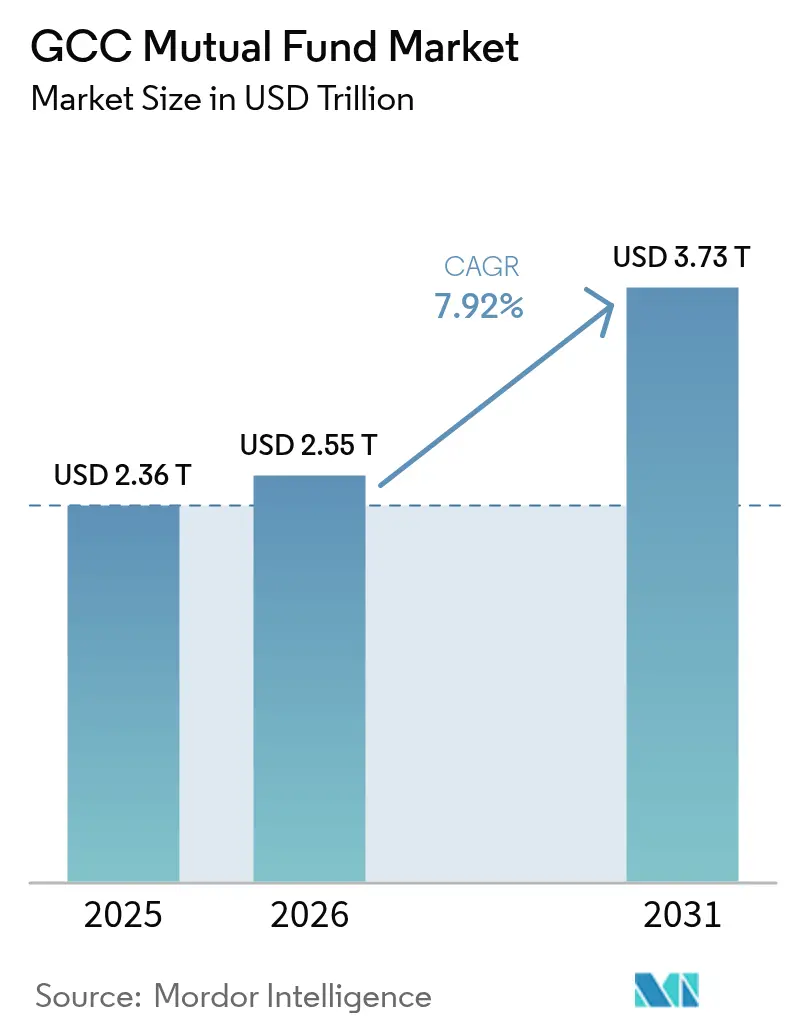
| Base Year Market Size (2025) | USD 2.36 Trillion |
| Market Size (2026) | USD 2.55 Trillion |
| Market Size (2031) | USD 3.73 Trillion |
| Growth Rate (2026 - 2031) | 7.92 % |
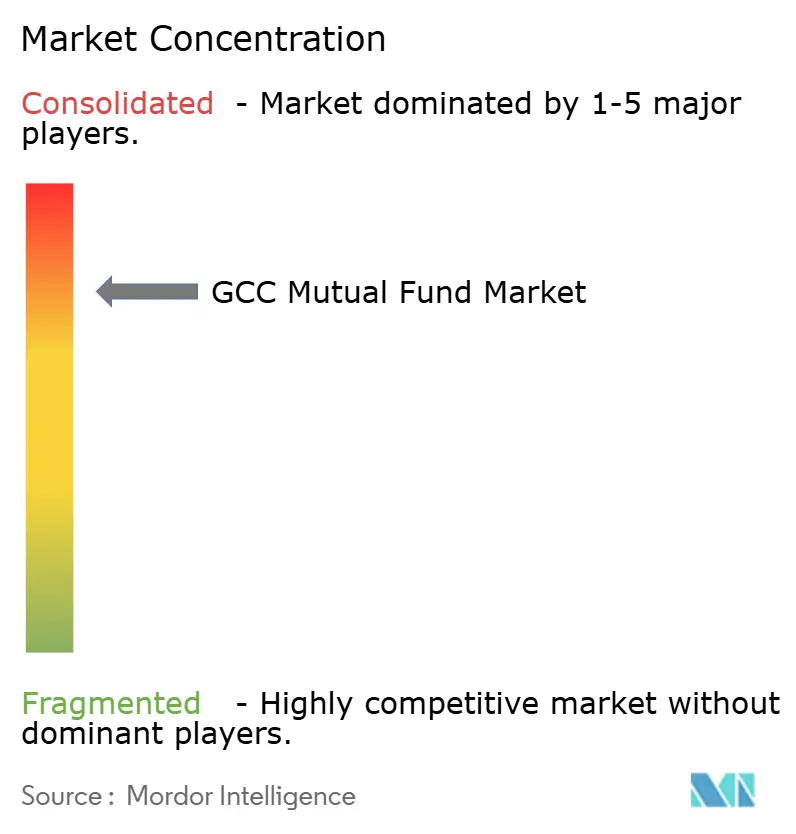
| Market Concentration | High |
Major Players *Disclaimer: Major Players sorted in no particular order Image © Mordor Intelligence. Reuse requires attribution under CC BY 4.0. | |
GCC Mutual Fund Market Analysis by Mordor Intelligence
The GCC mutual fund market size was valued at USD 2.36 trillion in 2025 and estimated to grow from USD 2.55 trillion in 2026 to reach USD 3.73 trillion by 2031, at a CAGR of 7.92% during the forecast period (2026-2031). Robust oil-revenue buffers accelerated economic diversification, and an expanding IPO pipeline are unlocking larger investable universes, while sovereign wealth funds seed local managers to deepen liquidity across public and private asset classes. Retail adoption is climbing as open-banking mandates and digital platforms lower onboarding frictions, and Sharia-compliant innovations align with regional investor preferences. Competitive intensity is rising as global firms establish onshore entities, prompting incumbents to invest in artificial-intelligence portfolio tools and fee-efficient share classes. The interplay of regulatory harmonization, cross-border settlement systems, and rising ESG mandates is expected to keep the GCC mutual fund market on a steady growth trajectory.
Key Report Takeaways
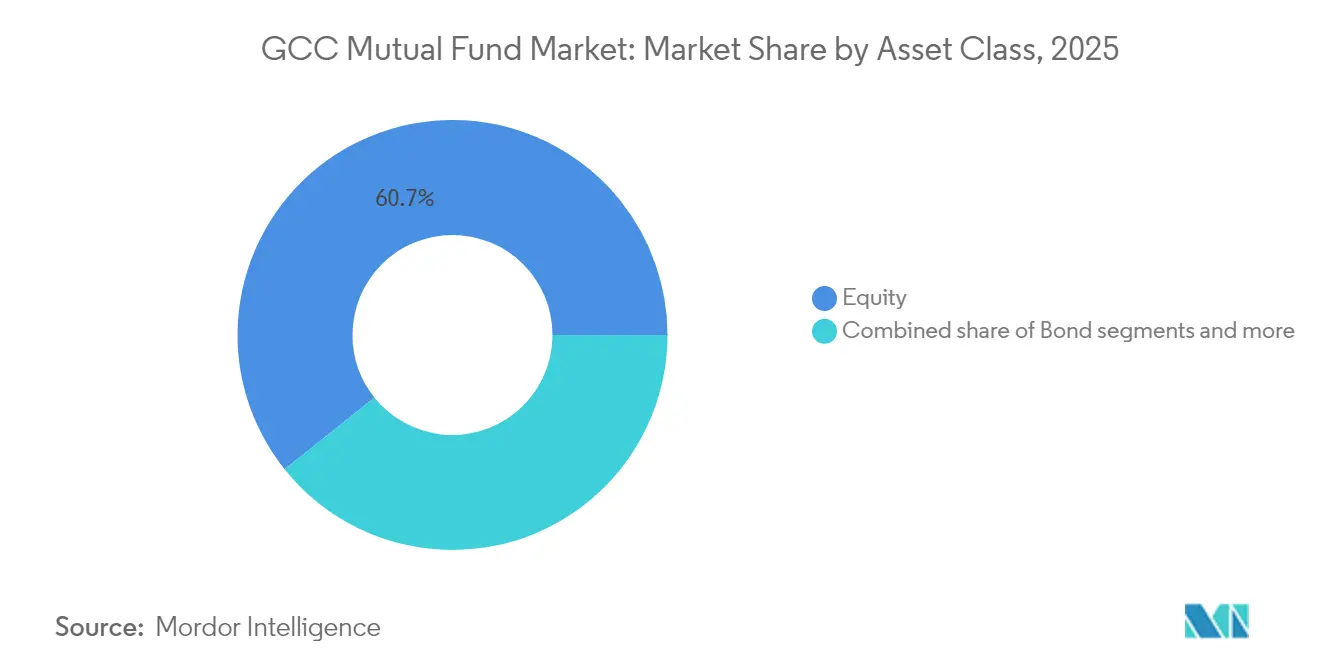
- By asset class, equity funds led with 60.73% of GCC mutual fund market share in 2025; bond and sukuk funds are forecast to expand at a 9.55% CAGR through 2031.
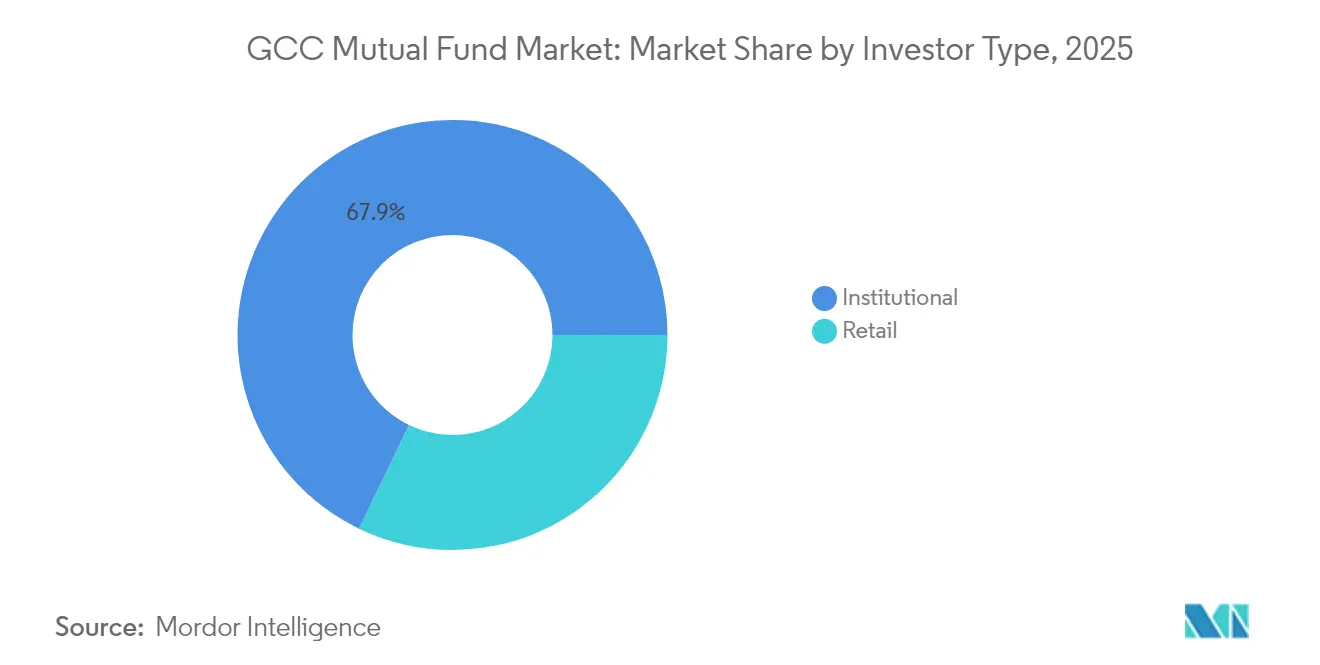
- By investor type, institutional investors held 67.85% of the GCC mutual fund market size in 2025, while the retail segment is advancing at an 8.62% CAGR to 2031.
- By distribution channel, banks captured 75.62% of the GCC mutual fund market share in 2025, whereas online platforms recorded the highest projected CAGR at 13.25% until 2031.
- By geography, Saudi Arabia commanded 75.10% of the GCC mutual fund market size in 2025; the UAE is growing fastest at 9.6% CAGR through 2031
Note: Market size and forecast figures in this report are generated using Mordor Intelligence’s proprietary estimation framework, updated with the latest available data and insights as of 2026.
GCC Mutual Fund Market Trends and Insights
Drivers Impact Analysis*
| Driver | (~) % Impact on CAGR Forecast | Geographic Relevance | Impact Timeline |
|---|---|---|---|
| Rising IPO pipeline expanding investable universe | +1.2% | Saudi Arabia, UAE core with spillover to Qatar, Kuwait | Medium term (2-4 years) |
| Surge in Sharia-compliant savings products | +1.8% | GCC-wide, strongest in Saudi Arabia, UAE | Long term (≥ 4 years) |
| Sovereign debt issuance boosting fixed-income AUM | +1.5% | Saudi Arabia, UAE, Qatar primary markets | Medium term (2-4 years) |
| Open-banking rules widening retail access | +1.1% | UAE, Saudi Arabia early adoption, regional rollout | Short term (≤ 2 years) |
| SWF seeding of local fund managers | +0.9% | Saudi Arabia, UAE, Qatar sovereign-led initiatives | Long term (≥ 4 years) |
| High net-worth migration into GCC | +0.8% | UAE, Saudi Arabia primary destinations | Medium term (2-4 years) |
| Source: Mordor Intelligence | |||
Rising IPO Pipeline Expanding Investable Universe
Saudi Arabia's Tadawul exchange processed 32 new listings in 2024, while the UAE's exchanges added 18 companies, creating expanded opportunity sets for equity-focused mutual funds[1]Reuters Staff, “Saudi Aramco unit plans IPO to raise up to $2 bln,” reuters.com. . This pipeline expansion directly correlates with mutual fund AUM growth as managers gain access to previously unavailable sectors, including renewable energy, healthcare technology, and logistics infrastructure. The strategic implication extends beyond asset availability—new listings often carry higher volatility and information asymmetries that favor active management strategies over passive indexing. Regional exchanges are implementing fast-track listing procedures for qualifying companies, reducing time-to-market from 18 months to 8-12 months. Saudi Aramco's subsidiary IPO plans and similar large-scale listings create anchor opportunities for institutional fund strategies while providing retail funds with diversification beyond traditional banking and petrochemical exposures.
Surge in Sharia-Compliant Savings Products
Islamic finance assets in the GCC reached USD 1.8 trillion in 2024, with mutual fund products representing the fastest-growing segment within this universe[2]Islamic Financial Services Board, “Islamic Financial Services Industry Stability Report 2024,” ifsb.org. . Regulatory bodies, including Saudi Arabia's CMA and the UAE's SCA, have streamlined Sharia-compliant fund approval processes, reducing certification timelines from 6 months to 3 months while expanding eligible investment categories. The competitive advantage lies in demographic alignment—over 85% of GCC retail investors express preference for Sharia-compliant investment options, yet traditional product offerings have historically underserved this demand. Technology integration through platforms like Alpaca's partnership with ZAD enables automated Sharia screening and real-time compliance monitoring, reducing operational costs while improving investor confidence. Fund managers are developing hybrid structures that combine conventional investment strategies with Islamic principles, accessing broader institutional capital while maintaining religious compliance.
Sovereign Debt Issuance Boosting Fixed-Income AUM
GCC governments issued USD 89 billion in sovereign bonds and sukuk during 2024, with Saudi Arabia accounting for USD 31 billion and the UAE contributing USD 22 billion. This issuance expansion creates primary market opportunities for fixed-income mutual funds while establishing benchmark yield curves that support secondary market development. The strategic shift reflects fiscal diversification beyond oil revenues, with debt-to-GDP ratios remaining manageable across major GCC economies. Kuwait's recent debt law permitting KWD 30 billion (USD 97 billion) in borrowing over 50 years signals sustained issuance activity that will benefit bond fund strategies. Fixed-income funds are positioning for duration management opportunities as central banks navigate inflation pressures while maintaining currency pegs to the US dollar.
Open-Banking Rules Widening Retail Access
The UAE's Central Bank implemented comprehensive open banking regulations in 2024, requiring banks to provide API access for licensed fintech platforms, directly reducing customer acquisition costs for mutual fund distributors[3]Central Bank of the UAE, “Open Banking Regulations 2024,” centralbank.ae.. Saudi Arabia's SAMA followed with similar requirements, creating standardized data-sharing protocols that enable seamless account aggregation and investment onboarding. This regulatory shift eliminates traditional banking intermediation advantages, allowing specialized wealth management platforms to access customer financial data with consent. The competitive implication favors technology-enabled distributors over traditional branch networks, as customer onboarding times decrease from weeks to hours. Regulatory compliance frameworks ensure data security while promoting innovation, with successful implementations reducing distribution costs by 40-60% for digital-first fund platforms.
Restraints Impact Analysis*
| Restraint | (~) % Impact on CAGR Forecast | Geographic Relevance | Impact Timeline |
|---|---|---|---|
| Fee compression from passive & robo advice | -1.4% | GCC-wide, strongest in UAE & Saudi Arabia | Short term (≤ 2 years) |
| Limited bond-market liquidity | -0.8% | Smaller GCC bond markets | Medium term (2-4 years) |
| Foreign-ownership caps on listed equities | -1.1% | Varies by country; most restrictive in Kuwait, Saudi Arabia | Medium term (2–4 years) |
| Compliance costs under evolving regulations | -0.9% | GCC-wide; particularly relevant in UAE and Bahrain | Short term (≤ 2 years) |
| Source: Mordor Intelligence | |||
Fee Compression from Passive & Robo Advisers
Global ETF assets reached USD 14.64 trillion in Q1 2025, with expense ratios averaging 0.15% compared to 0.85% for actively managed mutual funds, creating sustained pressure on traditional fund management fee structures[4]Investment Company Institute, “Worldwide Regulated Open-End Fund Assets Q1 2025,” ici.org. . GCC-based robo-advisory platforms including Sarwa and Wahed Invest, are expanding automated portfolio management services with fees below 0.50%, forcing traditional managers to justify premium pricing through alpha generation or specialized services. The strategic response involves product differentiation through alternative asset classes, private market access, and enhanced advisory services that justify higher fee structures. Deloitte's 2025 Investment Management Outlook identifies actively managed ETFs as a growing compromise solution, combining cost efficiency with active management strategies. Regional fund managers are exploring outcome-based fee structures and performance-linked pricing to maintain margins while competing with passive alternatives.
Limited Secondary-Market Liquidity in GCC Bonds
GCC corporate bond markets exhibit average daily trading volumes below USD 50 million compared to USD 2 billion in developed markets, constraining active management strategies and increasing tracking error risks for bond funds. This liquidity constraint particularly affects smaller GCC states where government bond issuance remains sporadic and corporate credit markets lack depth. Fund managers face elevated bid-ask spreads and position-sizing limitations that reduce portfolio optimization capabilities while increasing transaction costs. The regulatory response includes market-making incentive programs and electronic trading platform development, though implementation timelines extend beyond 2027 for meaningful impact. Bahrain's debt-to-GDP ratio exceeding 130% creates additional credit risk considerations that compound liquidity challenges for funds with significant Bahraini exposure.
*Our forecasts treat driver/restraint impacts as directional, not additive. The impact forecasts reflect baseline growth, mix effects, and variable interactions.
Segment Analysis
By Asset Class: Equity Dominance Faces Sukuk Momentum
Equity funds held 60.73% of % GCC mutual fund market share in 2025 as buoyant IPO activity and index inclusions propelled allocations. Bond and sukuk vehicles, however, are growing fastest at a 9.55% CAGR, lifting their slice of the GCC mutual fund market size alongside sovereign issuance growth. In the near term, money-market strategies provide liquidity management tools for institutions, while hybrid balanced funds capture risk-averse retail inflows. Over the outlook horizon, alternative structures such as REITs and private-credit funds should diversify revenue streams for asset managers eager to escape fee compression threats. Premia Partners’ BOCHK Saudi Government Sukuk ETF launch in July 2025 offered passive access to local sovereign Islamic bonds. Goldman Sachs followed with sector-specific GCC ETFs targeting healthcare and technology exposures. Regulatory reforms in Saudi Arabia shortened approval processes, unlocking innovative structures that blend passive baskets with Islamic screens. Collectively, these dynamics support asset-class breadth, enhancing portfolio-construction flexibilities for the GCC mutual fund market.



By Investor Type: Institutional Command With Retail Acceleration
Institutional investors controlled 67.85% of the GCC mutual fund market size in 2025, benefiting from pension, insurance, and sovereign allocations. Retail segments are expanding at an 8.62% CAGR, fueled by digital onboarding and wealth-migration inflows. Family offices increasingly blend direct investments with commingled funds to fine-tune tactical exposures while preserving governance control. Regulators in Saudi Arabia have refined investor-classification rules, widening access to sophisticated funds without compromising suitability safeguards. High-net-worth migration, supported by the UAE golden visa and Saudi Premium Residency programs, injects fresh capital into regional wealth-management channels. Digital advisors capitalize on this trend by delivering curated portfolios through multi-language interfaces and automated compliance checks. The resulting demographic diversification amplifies product-development opportunities and sustains demand resilience across the GCC mutual fund market.
By Distribution Channel: Bank Supremacy Meets Digital Disruption
Banks distributed 75.62% of GCC mutual fund market share in 2025, relying on entrenched client relationships and integrated financial-planning services. Yet online platforms are on track for 13.25% CAGR, compressing acquisition costs and democratizing access. Financial advisors retain a niche among affluent clients seeking personalized guidance. Direct-to-customer channels remain embryonic but show promise as managers develop proprietary portals to sidestep intermediary fees and deliver richer investor analytics. Kristal. AI’s 2024 UAE entry demonstrates how algorithm-driven allocation and fractional investing can erode traditional bank moats. Major banks counter with omnichannel experiences that integrate robo modules alongside human advice. Regulators enforce uniform suitability and disclosure standards, leveling the competitive field while protecting investors within the GCC mutual fund market.
Geography Analysis
Saudi Arabia dominates with 75.10% market share in 2025, supported by the Kingdom's Vision 2030 economic diversification initiatives and expanding capital market depth. The Saudi stock exchange's inclusion in MSCI and FTSE indices has attracted international institutional flows that benefit local fund management companies through increased assets under management and fee generation. The UAE captures the fastest growth at 9.6% CAGR through 2031, driven by Abu Dhabi Global Market's regulatory innovations and Dubai International Financial Centre's expanding fund management ecosystem. Qatar, Kuwait, Oman, and Bahrain collectively represent approximately 15% market share, with varying growth trajectories based on regulatory development and economic diversification progress.
JPMorgan's reclassification of Qatar and Kuwait as developed markets in February 2025 signals institutional recognition of regulatory and market infrastructure improvements that should attract additional international fund flows. Kuwait's recent political and regulatory reforms, including the dissolution of parliament and implementation of comprehensive legal frameworks, have driven stock market gains exceeding 10% year-to-date while positioning the country for expanded mutual fund activity. The AFAQ payment system's implementation across GCC countries is reducing cross-border transaction costs and settlement times, facilitating regional fund distribution and portfolio diversification strategies.
Regulatory Landscape
Regulation of mutual funds across the GCC is being tightened and standardized through a mix of national rule updates and regional coordination. In Saudi Arabia, the Capital Market Authority (CMA) amended the Investment Funds Regulations in May 2025 to streamline approvals and broaden permissible distribution channels, building on the July 2025 reforms already referenced in the report context around faster time-to-market for innovative structures. At a GCC level, the GCC Fund Passporting Regime was published on 4 May 2025, providing a framework intended to support cross-border promotion of funds among member states under harmonized rules.
In the UAE, Federal Decree-Laws No. 32 and No. 33 of 2025 took effect on 1 January 2026, replacing the Securities and Commodities Authority (SCA) with a new federal Capital Market Authority (CMA) and establishing an updated statutory framework for onshore capital markets and fund oversight. These changes introduce transition and re-licensing or regularization workstreams for market participants during the implementation window, alongside ongoing supervisory expectations on disclosures, suitability, and operational controls that shape product design and distribution models.
Value Chain Analysis
The GCC mutual fund value chain starts with product structuring and governance (fund sponsor or manager, Sharia boards for Islamic strategies, legal advisers, auditors), then moves into fund operations (administrator and registrar, valuation, risk and compliance), asset servicing (custody and settlement), and finally distribution and after-sales servicing (banks, online platforms, advisers, and direct channels). Oversight is multi-layered, with national regulators such as the Saudi CMA, the UAE CMA (onshore), and the Dubai Financial Services Authority (DFSA) in DIFC setting conduct and fund rules. Central banks and payment and data frameworks, including open-banking initiatives referenced in the report context, also influence onboarding and cash management.
Regional infrastructure is becoming more interconnected through initiatives such as the GCC fund passporting framework, with implementation in member states beginning from January 2025, and coordination across market authorities via bodies such as the Gulf Capital Market Association (GCMA). This integration affects how managers source assets (greater use of GCC equities and sukuk benchmarks) and how distributors reach clients (more cross-border promotion, plus a larger role for licensed digital platforms where regulations permit). The operating model still relies on local custody, disclosures, and jurisdiction-specific licensing for managers and intermediaries.
Competitive Landscape
The GCC mutual fund market is characterized by a high level of concentration, where a small group of players controls most assets under management. This concentration creates an oligopolistic environment that benefits firms with greater scale, stronger compliance infrastructure, and extensive distribution networks. Leading Saudi-based asset managers such as SNB Capital, Riyad Capital, and Al Rajhi Capital leverage their affiliations with major banks to maintain dominant positions. In the UAE, players like Emirates NBD Asset Management and SHUAA Capital have adopted regional growth strategies and cross-border offerings to remain competitive. Across the market, firms are focusing on Sharia-compliant product innovation, expanding into alternative asset classes, and enhancing digital distribution capabilities. These efforts help justify higher fee models and provide differentiation from low-cost passive investment options.
Technology is becoming the central axis of competition, as asset managers increasingly adopt AI tools and automation to optimize operations. Advanced systems for portfolio construction, compliance oversight, and investor engagement are being deployed to reduce costs while enhancing service quality. This tech-driven shift is essential to staying competitive in a market where investor expectations around speed, transparency, and customization continue to rise. At the same time, regulatory changes are easing regional expansion, creating openings for cross-border fund distribution and the launch of niche investment strategies. Areas like private credit and ESG-themed products offer new growth avenues for firms willing to innovate. The market is also seeing movement toward blockchain integration, as demonstrated by the ADGM-Chainlink collaboration to develop tokenization frameworks for fund operations.
A new wave of disruptors is gaining traction by offering digital-first, Sharia-compliant investment services that appeal to retail investors. Fintech platforms like Sarwa and Wahed Invest are combining robo-advisory models with religiously aligned investment strategies to deliver affordable and accessible wealth management solutions. These platforms are successfully targeting younger, tech-savvy demographics through strong mobile interfaces, low fees, and transparent offerings. Their rise signals a shift in market dynamics, where traditional players must evolve to retain relevance among a diversifying investor base. The increasing sophistication of these challengers is also driving incumbents to accelerate their own digital transformation agendas. As the market evolves, firms with both technological agility and deep regulatory understanding will be best positioned to lead.
GCC Mutual Fund Industry Leaders
SNB Capital
Riyad Capital
Al Rajhi Capital
Emirates NBD Asset Management
SHUAA Capital
- *Disclaimer: Major Players sorted in no particular order

Market Opportunities and Future Outlook
Regulatory simplification and broader distribution permissions are creating room for faster product iteration and channel-led propositions. Saudi Arabia's CMA issued the Instructions of Simplified Investment Funds in March 2026 (Board Resolution No. 1-26-2026), introducing a notification-based process for certain institutional private funds and reducing administrative friction for launches. That provides a practical lever for managers to roll out differentiated mandates, including alternatives, on a more frequent cadence. Alongside this, the May 2025 amendments to Saudi CMA Investment Funds Regulations and the July 2025 reforms already captured in the report context support quicker approvals and a wider set of routes to market, complementing the report-stated shift toward online platforms and digital onboarding.
Cross-border scaling is also being shaped by two GCC-wide building blocks that are visible in the market: (i) the GCC Fund Passporting Regime, published on 4 May 2025, which provides a framework for regional fund promotion, and (ii) the UAE transition to a new federal Capital Market Authority effective 1 January 2026 under Federal Decree-Laws No. 32 and 33 of 2025, which resets onshore supervisory architecture for funds and intermediaries. Diversification into specialized strategies is being operationalized by incumbent managers through partnerships in private-market adjacencies. For example, SHUAA Capital is moving into venture capital secondaries via a May 2026 partnership, aligning with the report context of incumbents seeking alternatives and fee-efficient structures to address fee compression and broaden the investable opportunity set beyond traditional listed exposures.
Recent Industry Developments
- May 2026: SHUAA Capital signed a strategic partnership with Key Capital to pursue opportunities in the MENA venture capital secondaries segment. The partnership broadens SHUAA Capital's alternatives toolkit beyond traditional public-market funds and creates a pathway for more specialized private-market allocations within regional wealth and asset management offerings.
- July 2025: Saudi Arabia's Capital Market Authority updated the Investment Funds Regulations to streamline approvals and support faster rollout of newer fund structures. The change reduces time-to-market for managers and strengthens the enabling conditions for a wider range of products, including alternative and ESG-oriented strategies, within the Kingdom.
- November 2024: GCC financial market authorities approved a regional fund passporting framework with implementation scheduled, providing the blueprint for cross-border fund promotion across member states. This step supports a more integrated distribution environment and encourages managers and distributors to design offerings that can be scaled across multiple GCC jurisdictions.


Research Methodology Framework and Report Scope
Market Definition and Coverage
For this methodology, the GCC mutual fund market is measured as the total value of assets managed inside mutual fund structures that are domiciled and regulated across GCC countries, reported in USD for a consistent view across markets.
Scope exclusions: We exclude private funds, discretionary portfolio management mandates, direct equity or bond holdings outside fund wrappers, and informal pooled savings schemes that are not regulated as mutual funds.
Segmentation Overview
- By Asset Class
- Equity
- Bond
- Hybrid
- Money Market
- Others
- By Investor Type
- Retail
- Institutional
- By Distribution Channel
- Banks
- Online Platforms
- Financial Advisors
- Direct
- By Geography
- Saudi Arabia
- United Arab Emirates
- Qatar
- Kuwait
- Oman
- Bahrain
Data Sources, Market Sizing, and Validation
Desk Research
Desk research starts with regulatory and market-statistics releases so our definition stays aligned with what is officially counted as a mutual fund. Sources used include public datasets and publications such as GCC central banks and capital market regulators (including fund registration and AUM series), the IMF and World Bank for macro indicators and FX context, and BIS statistics where relevant to rates and liquidity trends.
To connect the fund universe with measurable demand signals, we also review stock-exchange disclosures, fund fact sheets and prospectuses posted publicly, and audited annual reports where available. Broader context is taken from association publications and reputable press, and we also use paid subscriptions for company financials and intelligence. In addition, a patent database is used when product innovation themes need confirmation. These are illustrative examples, and many other public documents were used for data collection, cross-checking, clarification, and validation.
Primary Interviews and Surveys
Primary work is used to pressure-test how AUM is reported locally and how fund categories map across countries, especially when labeling differs between jurisdictions. We spoke with a mix of asset managers, distributors, and market intermediaries across the GCC, and the respondent input was then used to validate growth drivers like subscriptions, redemptions, product mix changes, and fee-related behavior.
Distribution of primary research fieldwork respondents
| Company type | Respondent position |
|---|---|
| Top tier: 36% | CXOs: 16% |
| Mid tier: 43% | Functional/Unit leaders: 29% |
| Smaller Players: 21% | Managers: 55% |
Market-Sizing & Forecasting
The market value is first rebuilt using a top-down approach where reported mutual fund AUM series by country and fund category are aligned to a single GCC view, and then converted into USD using consistent timing for FX. Once the total is formed, it is broken out using observable splits from regulator releases, publicly available fund disclosures, and confirmed local-market practices from interviews.
To make sure totals are realistic, we corroborate them with selective bottom-up approximations, such as rolling up a sample of large funds and management companies. We then check the implied coverage against the known fund universe. The main inputs that guide the model include mutual fund net asset values and AUM by category, net inflows and outflows where disclosed, interest rate direction and liquidity preferences that influence money market allocations, equity-market performance that affects valuation-driven AUM moves, and the pace of new fund launches and closures. Where country-level category splits are missing for a year, we fill gaps using nearest-year disclosed proportions and then adjust based on interview guidance on product mix changes.
For forecasting, scenario analysis is used because AUM is sensitive to both market returns and flow behavior, which can shift with sentiment and policy updates. Assumptions for key drivers are set with a simple set of forward indicators, and then reviewed with primary respondents so the final path reflects how fund managers and distributors expect subscriptions, redemptions, and mix to evolve.
Data Validation & Update Cycle
Validation is done in layers so the final series does not rely on one dataset or one viewpoint. We compare model outputs against independent signals like published AUM totals by regulator, the count of active funds, and broad market performance markers that should explain AUM moves directionally. If any sharp variances appear, they are re-checked back to the source document.
Before sign-off, the model is reviewed for currency conversion consistency, year-to-year continuity, and category math so totals reconcile after splits. If a material event shows up, such as a regulation update that affects fund classification or a step-change in flows, we re-contact relevant experts and update the assumptions. Reports are refreshed annually, with interim updates for major market events, and a final pre-delivery review is completed so clients receive the most current view.
Mordor Intelligence's Gcc Mutual Fund Market Size Compared With Other Published Estimates
Published market sizes for GCC mutual funds can look far apart because the word market is not always used the same way across studies. Differences usually come from what is counted as a mutual fund, whether AUM is taken at year-end or averaged, and how local-currency AUM is translated into USD.
The table also points to a recurring gap driver in this space, where some figures mix mutual funds with adjacent pooled vehicles or fold in discretionary mandates, and then present the sum as one AUM market. Under Mordor Intelligence's scope, only regulated mutual fund AUM across GCC jurisdictions is counted, and category splits are reconciled to local regulator definitions before USD conversion is applied.
Benchmark comparison
| Source | Market Size | Gaps in Research Methodology |
|---|---|---|
| Mordor Intelligence | USD 2.36 T (2025) | |
| Industry Association A | USD 2.60 T (2025) | Often presented as a broader pooled-assets figure, which can include adjacent fund-like vehicles alongside mutual funds, and may apply year-end FX rates without standardizing timing across countries. |
| Regional Consultancy B | USD 2.10 T (2025) | May undercount by relying on partial country coverage or a narrower fund registry snapshot, and it can apply conservative assumptions on category availability when published regulator splits are incomplete. |
Taken together, the spread is mainly explained by how tightly the fund wrapper is defined, how consistently GCC-wide category data is reconciled, and the FX timing used in translation to USD. By keeping inputs traceable to public regulator series and then checking assumptions with local practitioners, we get a practical estimate that can be repeated and updated with clear steps.


Key Questions Answered in the Report
How large is the GCC mutual fund market in 2026?
It is valued at USD 2.55 trillion and is expected to reach USD 3.73 trillion by 2031, reflecting a 7.92% CAGR.
Which asset class holds the biggest slice of mutual fund assets in the Gulf?
Equity funds lead with 60.73% GCC mutual fund market share in 2025.
Which Gulf country grows fastest for mutual fund assets?
The UAE posts the highest forecast growth at a 9.6% CAGR through 2031.
What is driving retail participation in GCC mutual funds?
Open-banking regulations and digital platforms that cut onboarding times and minimum investment thresholds.
What new regulations are easing fund launches in Saudi Arabia?
July 2025 CMA reforms trimmed approval timelines for innovative structures to three months, fostering faster product rollouts.
Page last updated on:


 Your data is secure and never sold or shared.


