
Functional Food Ingredient Market Size and Share
Market Overview
| Study Period | 2021 - 2031 |
|---|---|
| Market Size (2026) | USD 20.46 Billion |
| Market Size (2031) | USD 23.18 Billion |
| Growth Rate (2026 - 2031) | 2.52 % |
| Fastest Growing Market | Asia-Pacific |
| Largest Market | North America |
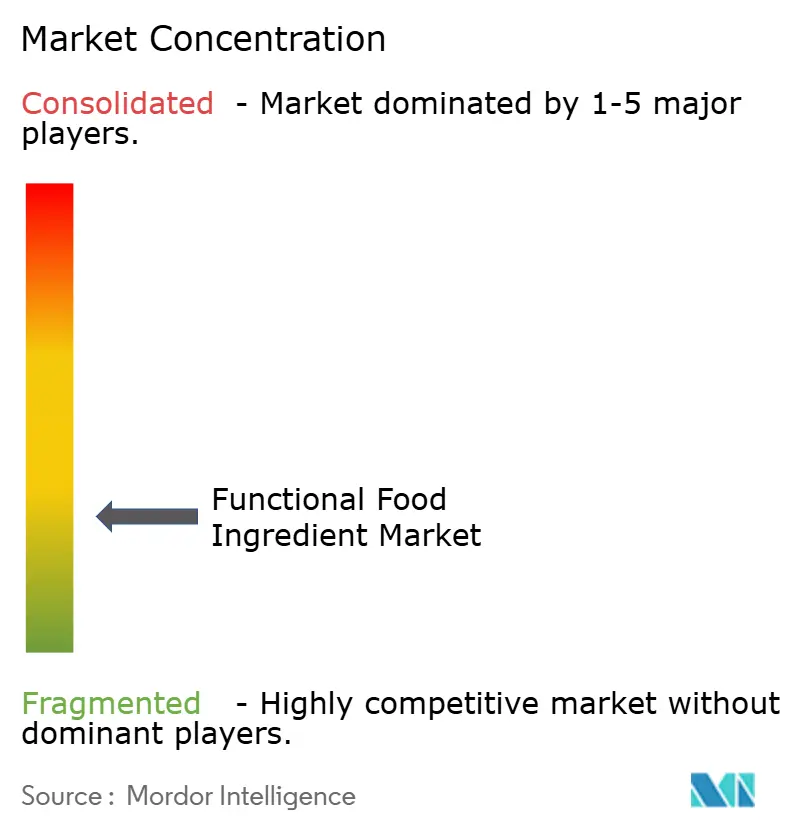
| Market Concentration | Low |
Major Players
*Disclaimer: Major Players sorted in no particular order Image © Mordor Intelligence. Reuse requires attribution under CC BY 4.0. |
|
Functional Food Ingredient Market Analysis by Mordor Intelligence
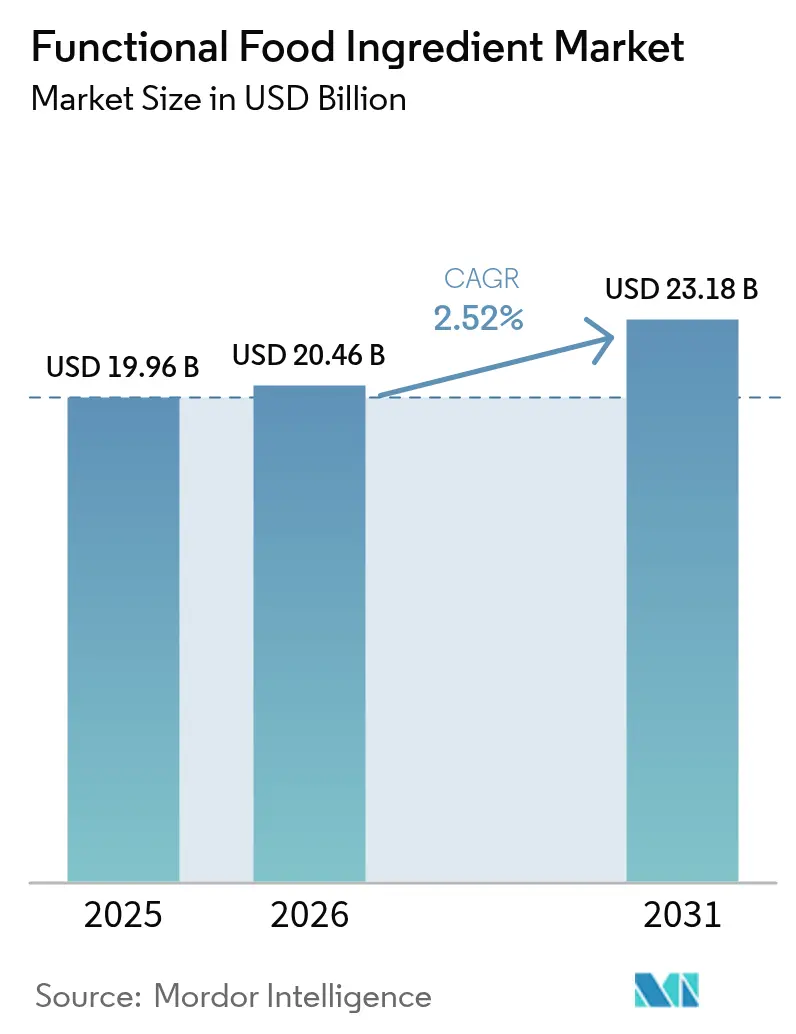
The functional food ingredient market size in 2026 is estimated at USD 20.46 billion, growing from 2025 value of USD 19.96 billion with 2031 projections showing USD 23.18 billion, growing at 2.52% CAGR over 2026-2031. This measured growth trajectory reflects the sector's maturation as consumer awareness of health benefits drives sustained demand for fortified and enhanced food products. Functional food ingredients in functional food are targeted to offer specific functions that are more than just basic nutrition. These ingredients play a vital role in protecting against acute and chronic diseases. Functional foods contain natural or synthetic ingredients that promote optimal health and provide energy-boosting benefits. Prebiotics are one such ingredient that promotes the growth of bacteria in the large intestine that are beneficial to intestinal health while inhibiting the growth of bacteria that are potentially harmful to intestinal health.
Key Report Takeaways
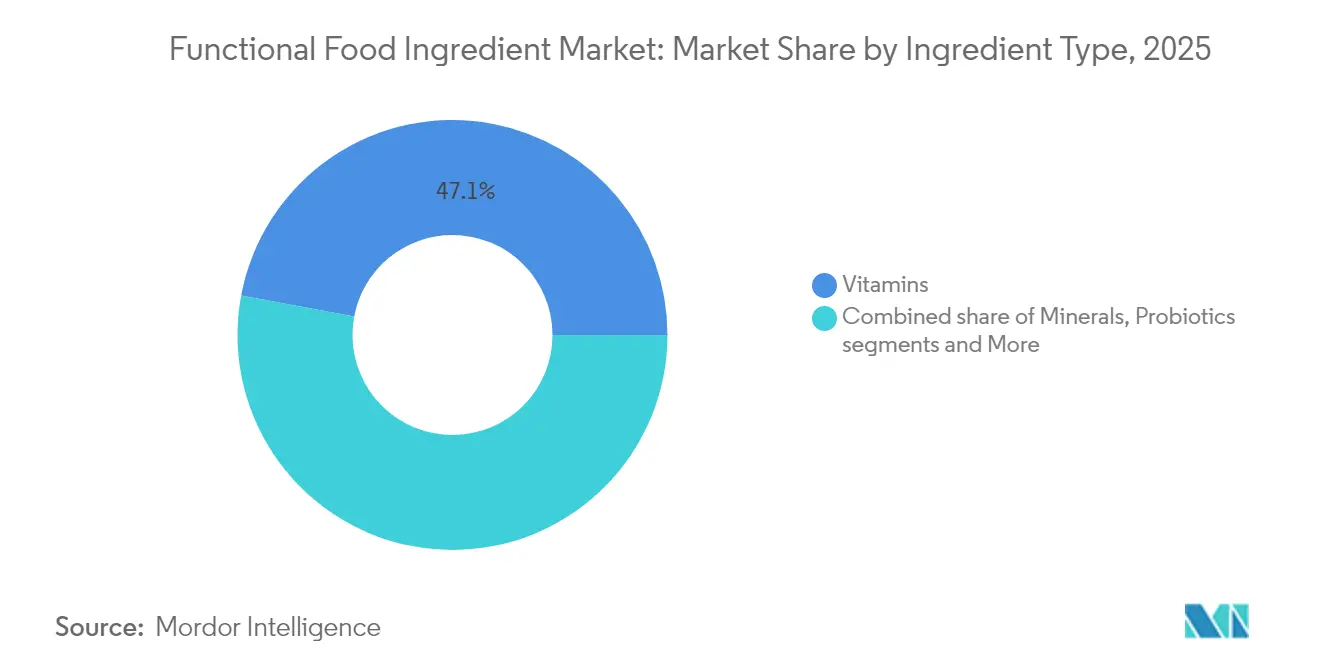
- By ingredient type, vitamins led with 47.05% of functional food ingredients market share in 2025, whereas probiotics are forecast to expand at 3.29% CAGR from 2026-2031.
- By form, powders accounted for 48.42% of the functional food ingredients market size in 2025, while liquid concentrates and other innovative formats are projected to grow at 4.11% CAGR to 2031.
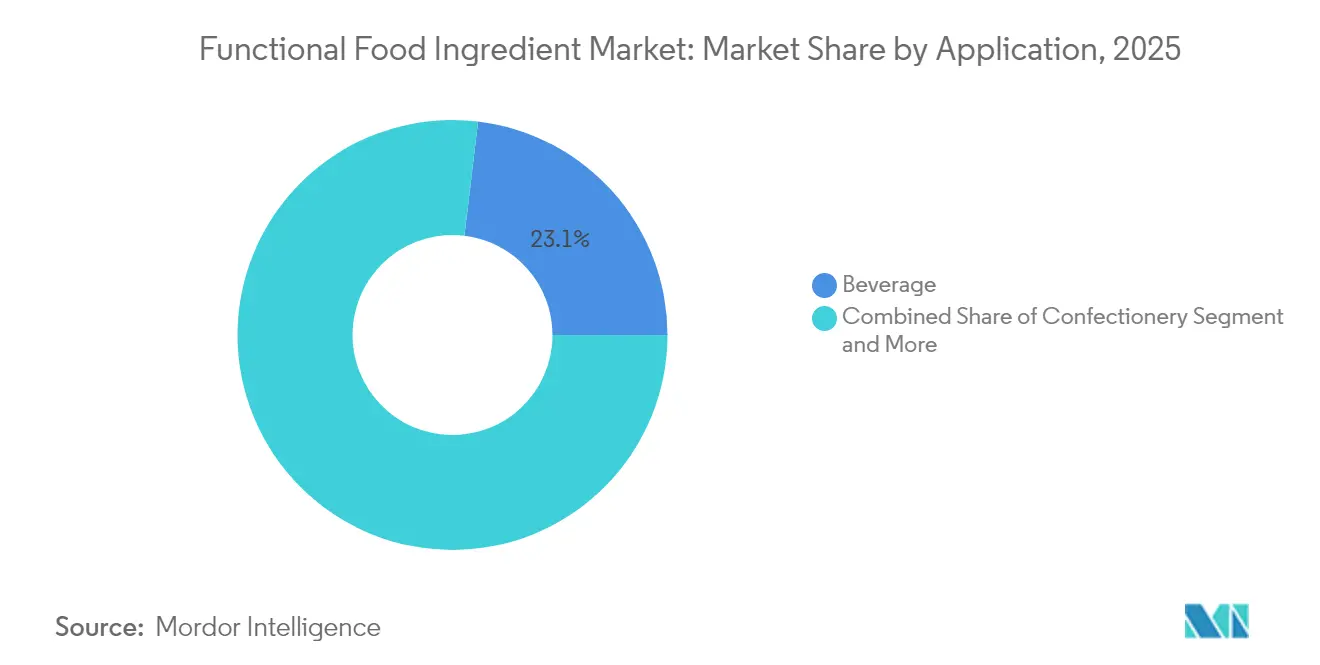
- By application, beverages contributed 23.10% revenue in 2025, and other emerging food categories are set to rise at a 3.86% CAGR over the forecast period.
- By geography, North America commanded 33.12% of the functional food ingredients market share in 2025, while Asia-Pacific is expected to post the highest regional CAGR of 3.78% through 2031.
Note: Market size and forecast figures in this report are generated using Mordor Intelligence’s proprietary estimation framework, updated with the latest available data and insights as of 2026.
Market Trends and Insights
Drivers Impact Analysis of Functional Food Ingredient Market*
| DRIVER | (~) % IMPACT ON CAGR FORECAST | GEOGRAPHIC RELEVANCE | IMPACT TIMELINE |
|---|---|---|---|
| Rising demand for nutritious, convenient, and fortified food products | +0.8% | Global, with strongest growth in Asia-Pacific and North America | Medium term (2-4 years) |
| Botanical fortification of functional beverage to enhance health benefits | +0.5% | Global, concentrated in developed markets | Long term (≥ 4 years) |
| Technological advancement in encapsulation and delivery system | +0.4% | North America and Europe leading, Asia-Pacific adoption accelerating | Medium term (2-4 years) |
| Premiumization of functional products in developed markets | +0.3% | North America, Europe, Japan, Australia | Short term (≤ 2 years) |
| Growing prevalence of chronic diseases fueling demand for healthy food products | +0.6% | Global, acute in aging populations of developed markets | Long term (≥ 4 years) |
| Regulatory harmonization and GRAS pathway reforms | +0.2% | North America leading, Europe following, Asia-Pacific selective adoption | Medium term (2-4 years) |
| Source: Mordor Intelligence | |||
Rising demand for nutritious, convenient, and fortified food products
Changes in consumer behavior drive market growth as health-conscious consumers prioritize functional benefits over taste and convenience. The increasing focus on health and wellness has led to a significant transformation in purchasing patterns, with consumers actively seeking products that offer specific nutritional advantages. This shift reflects increased nutritional awareness in mainstream food choices and creates sustained demand for fortified products that address specific health needs, from cognitive enhancement to immune support. DSM-Firmenich's launch of dry vitamin A palmitate in June 2024 for flour fortification, targeting 800 million people, demonstrates how ingredient innovation addresses global malnutrition challenges. The combination of convenience and nutritional requirements creates market opportunities for ingredients that deliver health benefits while maintaining product appeal and manufacturing efficiency. This trend has encouraged manufacturers to develop innovative solutions that balance nutritional content with practical considerations, leading to the emergence of new product categories and formulation techniques.
Botanical fortification of functional beverage to enhance health benefits
Plant-based fortification has become important as consumers increasingly prefer natural compounds over synthetic additives in their food and beverages. This shift reflects a broader trend toward healthier, more natural dietary choices and growing awareness of ingredient sourcing. Beverages are particularly well-suited for botanical fortification since liquid forms allow easier ingredient incorporation while maintaining optimal taste, texture, and nutritional properties. The integration process in beverages also enables better bioavailability and absorption of functional compounds. The growing preference for plant-derived functional ingredients supports environmental sustainability goals and clean-label demands, creating opportunities for companies that develop innovative botanical extraction and processing methods. The rising consumption of functional beverages continues to drive ingredient demand across global markets, with consumers seeking products that offer both refreshment and health benefits. According to UNESDA[1]UNESDA, "Annual consumption of non-alcoholic beverages in the United Kingdom", www.unesda.org data from 2023, the United Kingdom's annual beverage consumption reached 15,095.2 million liters, demonstrating significant market potential for functional ingredients and highlighting the scale of opportunity for manufacturers in this segment.
Technological advancement in encapsulation and delivery system
Sophisticated delivery mechanisms transform ingredient functionality by addressing traditional challenges of stability, bioavailability, and sensory integration in food matrices. Recent advances in microencapsulation techniques enhance probiotic survival rates while masking flavors and improving bioactive compound accessibility, enabling broader application across food categories previously unsuitable for functional fortification. Innovation extends beyond traditional encapsulation to include time-released gummy formats for melatonin and sustained-release vitamin C, providing 24-hour immune protection, demonstrating how delivery technology creates new product categories. These technological capabilities enable manufacturers to differentiate products through enhanced efficacy claims while addressing consumer preferences for convenient, effective functional foods.
Regulatory harmonization and GRAS pathway reforms
The evolution of regulations toward greater transparency and safety oversight affects functional ingredient innovation and market access. While compliance costs may increase, these regulations enhance consumer confidence in ingredient safety. The FAO/WHO Codex[2]Food and Agriculture Organization, "Harmonized Probiotic guidelines for use in Food and Supplements", www.fao.org. guidelines for probiotics establish comprehensive minimum safety criteria, including strain identification, safety assessment protocols, and specific labeling requirements. These guidelines support international trade standardization while ensuring consumer protection through rigorous quality controls. Companies with established safety documentation capabilities and regulatory compliance infrastructure benefit from these regulatory changes. However, smaller companies with limited regulatory expertise and financial resources face significant market entry challenges, including extensive documentation requirements, testing protocols, and compliance monitoring systems. The regulatory landscape continues to shape market dynamics, influencing product development strategies and competitive positioning across the functional ingredients industry.
Restraints Impact Analysis of Functional Food Ingredient Market*
| RESTRAINT | (~) % IMPACT ON CAGR FORECAST | GEOGRAPHIC RELEVANCE | IMPACT TIMELINE |
|---|---|---|---|
| High cost associated with functional ingredients products limiting widespread adoption | -0.7% | Global, acute in price-sensitive emerging markets | Short term (≤ 2 years) |
| Rising cases of food allergies and ingredient intolerances | -0.3% | Developed markets with higher allergy prevalence | Medium term (2-4 years) |
| Integration and quality control challenges in functional food production | -0.2% | Global, concentrated in complex manufacturing operations | Medium term (2-4 years) |
| Limited consumer awareness and misconceptions | -0.4% | Global, particularly acute in emerging markets and rural areas | Long term (≥ 4 years) |
| Source: Mordor Intelligence | |||
High cost associated with functional ingredients products limiting widespread adoption
High prices of functional ingredients create significant barriers to market entry, especially in price-sensitive segments and emerging economies where consumers prioritize cost over health benefits. The substantial gap between price and perceived value restricts market growth as consumers carefully evaluate product benefits against costs. The complex manufacturing processes required for incorporating functional ingredients, including specialized equipment, rigorous quality control measures, and advanced processing techniques, increase production costs that manufacturers must often transfer to consumers. This challenge intensifies as new ingredient technologies demand substantial research and development investments, specialized expertise, and continuous innovation efforts while companies strive to maintain competitive pricing in an increasingly cost-conscious market.
Rising cases of food allergies and ingredient intolerances
The rising prevalence of food allergies and intolerances restricts ingredient selection and formulation options, which affects market opportunities for functional compounds and increases regulatory compliance costs. Food manufacturers must carefully evaluate and validate each ingredient for potential allergen risks before incorporation into products. Managing allergens requires dedicated production lines, comprehensive testing protocols, and strict cleaning procedures between production runs, which raise operational expenses. Cross-contamination prevention measures, employee training programs, and documentation systems further add to manufacturing complexity. Beyond common allergens, new functional ingredients present unknown allergy risks, necessitating thorough safety testing and monitoring after market release. Companies must invest in extensive clinical trials, toxicology studies, and allergenicity assessments for novel ingredients. Enhanced labeling requirements and allergen disclosure regulations create compliance challenges, particularly for small ingredient suppliers without established regulatory systems.
*Our forecasts treat driver/restraint impacts as directional, not additive. The impact forecasts reflect baseline growth, mix effects, and variable interactions.
Functional Food Ingredient Market Segment Analysis
By Type:
Vitamins Lead While Probiotics Drive InnovationVitamins held a dominant 47.05% market share in 2025, supported by widespread consumer acceptance and established regulatory frameworks across global markets. Probiotics recorded the highest growth rate at 3.29% CAGR through 2031, supported by increasing scientific evidence of gut-brain axis benefits and the International Probiotics Association's efforts to improve FDA post-market assessment processes. Minerals and proteins maintained stable demand in their mature market segments, while omega-3 ingredients benefited from technical innovations, as demonstrated by Infusd Nutrition's water-soluble formulations that doubled the bioavailability compared to conventional emulsions.
Prebiotics demonstrated growth potential due to advances in microbiome research, despite having less regulatory framework compared to probiotics. The market segments reflect an industry shift toward functional ingredients with proven health benefits. Companies developing innovative delivery systems and evidence-based health claims gain competitive advantages, while traditional vitamin manufacturers experience margin pressure from generic competition.



By Form:
Powder Dominance Challenged by InnovationPowder formulations held a 48.42% market share in 2025, due to their manufacturing convenience, cost efficiency, and established supply chain infrastructure in food processing operations. Other forms are growing at a 4.11% CAGR through 2031, supported by developments in liquid concentrates, encapsulated systems, and new delivery mechanisms that meet specific application needs. Liquid forms are gaining prominence in beverage applications where they offer better homogeneous mixing and sensory integration compared to powder alternatives, especially for heat-sensitive functional compounds.
Form development creates opportunities for market differentiation as manufacturers address traditional powder limitations in dust control, dissolution rates, and sensory impact. The market reflects increased sophistication as functional ingredient suppliers develop specialized solutions for specific food applications instead of universal approaches. Companies that focus on form innovation strengthen their market position as food manufacturers seek application-specific functional ingredient solutions.
By Application:
Beverages Lead Diversification TrendsBeverage applications held the largest market share at 23.10% in 2025, due to the liquid format's advantages in incorporating functional ingredients and consumer preference for health-focused drinks. The other applications category is projected to grow at a 3.86% CAGR through 2031, driven by the expansion of functional ingredients into new food categories, including snacks, condiments, and prepared foods. Dairy and dairy alternative products continue to present substantial growth potential.
The meat and seafood segment shows growth potential through clean-label trends and protein fortification opportunities, despite facing stricter regulatory requirements for ingredient use compared to other categories. The expanding range of applications demonstrates how ingredient manufacturers have developed specialized solutions that overcome formulation challenges while maintaining product quality and consumer appeal.
Geography Analysis
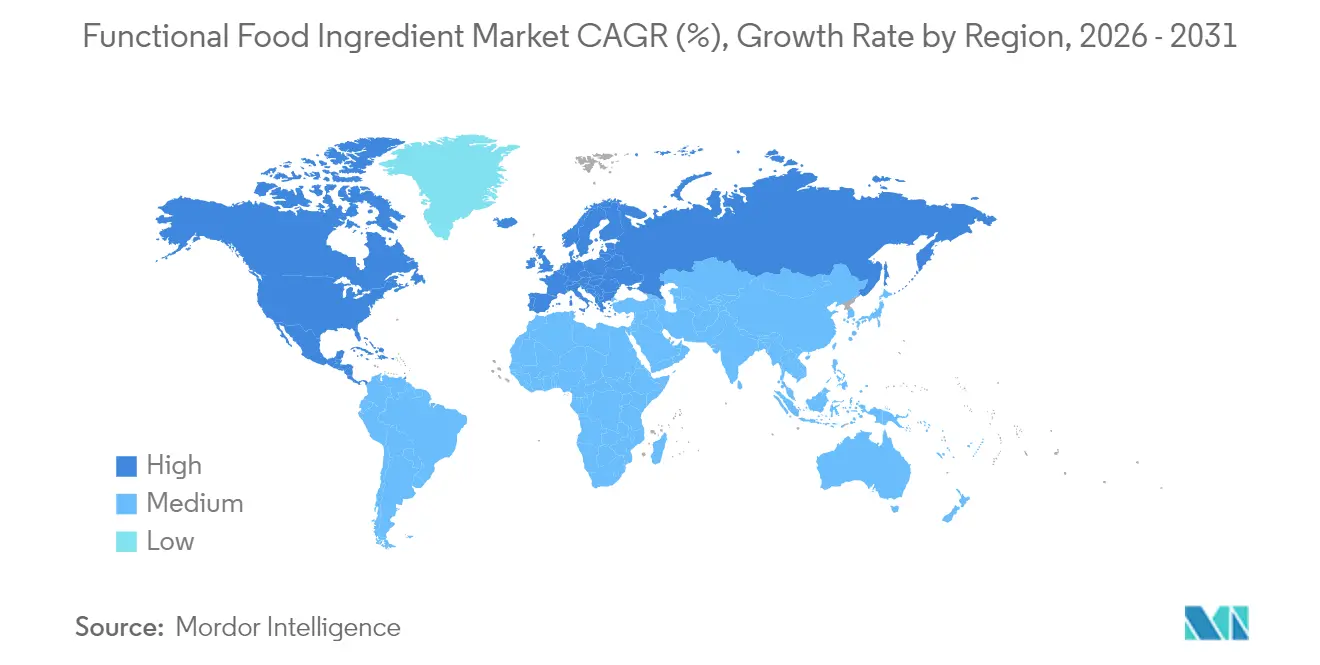
North America and APAC Functional Food Ingredient Market
North America holds the dominant market position with a 33.12% share in 2025, supported by robust regulatory frameworks, high consumer awareness, and well-developed functional food infrastructure. Asia-Pacific is experiencing the highest growth rate at 3.78% CAGR through 2031, driven by increasing disposable incomes, growing health consciousness, and regulatory improvements in China, India, and Japan.
EMEA, APAC and South America Functional Food Ingredient Market
Europe maintains a significant market presence through strict quality standards and consumer demand for natural, scientifically validated functional ingredients, though complex regulations limit growth. China's recent approval of 24 nutrient supplements and 10 functional raw materials under new health food regulations highlights the regulatory advancement in Asia-Pacific. South America and the Middle East and Africa show growth potential due to expanding middle-class populations and increasing functional food awareness, but face constraints from infrastructure gaps and regulatory uncertainties.
Japan Functional Food Ingredient Market
Regional market dynamics vary based on consumer preferences, regulatory environments, and economic development stages. Japan's established functional food regulations, including FOSHU and FFC frameworks, serve as benchmarks for other Asia-Pacific markets balancing innovation and consumer protection. Market expansion success depends on companies' ability to understand regulatory requirements and cultural nuances while maintaining operational efficiency across regions.

Regulatory Landscape
Functional food ingredients typically sit across food additive, novel food, and health-claim rules, which affects time-to-market and what types of functions can be marketed by region. In the European Union, Regulation (EU) 2015/2283 defines the authorization route for novel foods, and EFSA updated administrative guidance for novel food applications with requirements entering into force on 1 January 2026. The update tightens dossier structure and process expectations for applicants.
In 2026, regulators and international bodies also continued advancing oversight and harmonization efforts that affect global trade and compliance. In the U.S., the FDA identified strengthening oversight of Generally Recognized as Safe (GRAS) substances among its Human Foods Program 2026 priority deliverables, pointing to a more scrutinized pathway for functional ingredients and supporting substantiation. At the global standard-setting level, the Codex Alimentarius Commission held its 49th session from 6 to 10 July 2026 and adopted new food safety and quality standards, while JECFA continued evaluations of widely used additive and botanical-related inputs (for example, rosemary extract), underscoring the need for robust safety files and traceable specifications.
Value Chain Analysis
The functional food ingredient value chain starts with upstream agricultural and marine raw materials (for fibers, proteins, and omega-3 sources) and chemical or fermentation inputs (for vitamins, amino acids, and enzymes). It then moves through processing steps such as extraction, purification, fermentation, and stabilization, including microencapsulation and other delivery systems. After formulation, ingredient suppliers sell via direct B2B channels to large food and beverage manufacturers, and through specialized distributors and contract manufacturers that provide blending, premix, and application support, especially where beverage and dairy applications require consistent dispersion and sensory performance.
Regulatory gating and concentration in key inputs are recurring constraints. EFSA-facing novel food approvals can add time and cost burdens for some innovative compounds, and industry bodies have pushed for process reform (for example, the European Specialty Food Ingredients federation calling for changes to EFSA risk assessment processes in February 2025). Supply vulnerabilities in vitamins and carotenoids have also appeared in availability dynamics, including disruption linked to the 2024 BASF Ludwigshafen incident that carried into 2025, which has supported multi-sourcing, additional quality testing, and greater use of regional warehousing to maintain formulation continuity.
Competitive Landscape
Market concentration reflects a fragmented competitive structure with opportunities for both established multinational corporations and specialized ingredient suppliers to capture value through differentiated positioning. Leading players, including DSM-Firmenich AG, Kerry Group plc, Ingredion Incorporated, Arla Foods amba, and Corbion N.V., leverage scale advantages in research and development investment and global distribution, while emerging companies focus on novel ingredients and innovative delivery systems addressing specific market niches.
Strategic patterns emphasize vertical integration, with companies expanding across the value chain from raw material sourcing through finished product development to capture higher margins and ensure quality control. Technology deployment drives competitive differentiation as companies invest in advanced processing capabilities, analytical testing, and ingredient informatics platforms to accelerate product development cycles.
White-space opportunities exist in personalized nutrition, sustainable ingredient sourcing, and regulatory-compliant novel compounds addressing emerging health concerns. The competitive landscape favors companies balancing innovation investment with operational excellence while maintaining regulatory compliance across multiple jurisdictions.
Functional Food Ingredient Industry Leaders
-
DSM-Firmenich AG
-
Kerry Group plc
-
Arla Foods amba
-
Corbion N.V.
-
Ingredion Incorporated
- *Disclaimer: Major Players sorted in no particular order
Functional Food Ingredient Market Companies Covered in this Report
- DSM-Firmenich AG
- Kerry Group plc
- Arla Foods amba
- Corbion N.V.
- Ingredion Incorporated
- Tate & Lyle PLC
- Glanbia PLC
- Lonza Group
- Cargill, Incoporated
- Novozymes A/S
- Taiyo Kagaku Co., Ltd.
- Wilmar International
- BASF SE
- Givaudan SA
- International Flavors and Fragrances Inc.
- Sabinsa Corp.
- Beneo GmbH
- Foodchem International
- Roquette Freres
- Archer Daniels Midland Company

Market Opportunities and Future Outlook
Innovation is shifting from single-ingredient fortification toward higher-barrier platforms that combine ingredient science, manufacturing controls, and regulatory readiness. AI-enabled discovery and screening is taking hold as a route to identify novel functional proteins and improve performance, as reflected in the March 2026 R&D collaboration between Ingredion and Shiru using Shiru's Flourish AI platform. On commercialization and compliance, the FDA emphasis on GRAS oversight in its 2026 Human Foods Program priorities increases the value of suppliers that can package safety evidence, specifications, and post-market monitoring into customer-ready dossiers.
Capacity build-outs in specialized functional ingredients are also creating openings for application-led launches across beverages, dairy, and other nutrition formats. FrieslandCampina Ingredients completed a strategic expansion of its Borculo facility in March 2026, doubling capacity for whey protein isolate and milk fat globule membrane, and later announced a EUR 90 million investment in May 2026 to expand and upgrade whey protein capacity across Bedum, Veghel, and Workum. That expansion is aimed at supporting scale-up for bioactive and performance nutrition formulations. Fermentation-derived and gut-health adjacent inputs are attracting investment as well, including Galam commissioning additional GOFOS production capacity for FOS fiber in January 2026, and Vidya opening a 28,750 square foot probiotic manufacturing facility in Florida in April 2026 with separated zones for spore-forming and non-spore-forming strains, reflecting tighter quality-by-design approaches for strain stability and contamination control.
Recent Industry Developments in Functional Food Ingredient Market
- April 2026: Kerry Group opened an expanded biotechnology manufacturing hub in Carrigaline, Co. Cork, Ireland, increasing its capacity to produce lactase enzymes. The expansion strengthens supply for lactose reduction and digestive-wellness positioning in dairy and dairy-alternative formulations, while improving in-house biotechnology scale for ingredient customers.
- May 2025: Bunge Limited announced a EUR 484 million investment in a soy protein plant to produce soy protein concentrates, including advanced quality testing laboratories. The project adds industrial-scale capability for plant protein ingredients used in fortified foods and supports tighter specification control for functional formulation performance.
- June 2024: Brevel, Ltd. launched a 27,000 square foot commercial facility to manufacture microalgae protein powder. The move expands the set of alternative, non-GMO protein inputs available for functional foods, improving the ability of brands to combine sustainability narratives with protein fortification.


Functional Food Ingredient Market Report Scope and Research Methodology
Market Definition and Coverage
This market covers ingredients added into everyday foods and beverages to support a specific health benefit beyond basic nutrition, and it is sized on the value of these ingredients sold into food manufacturing.
Scope exclusions: It excludes finished functional foods sold to consumers, and it also excludes pharma-grade therapeutic products that are regulated as medicines.
Segments Covered in This Report
-
By Type
- Vitamins
- Minerals
- Proteins and Amino Acids
- Omega-3 Ingredients
- Prebiotics
- Probiotic
- Other Functional Food Ingredients
-
By Form
- Powder
- Liquid
- Others
-
By Application
- Bakery
- Dairy and Dairy Alternative Products
- Meat and Seafood
- Confectionery
- Beverage
- Other Applications
-
By Geography
-
North America
- United States
- Canada
- Mexico
- Rest of North America
-
Europe
- United Kingdom
- Germany
- Spain
- France
- Italy
- Russia
- Rest of Europe
-
Asia-Pacific
- China
- India
- Japan
- Australia
- Rest of Asia-Pacific
-
South America
- Brazil
- Argentina
- Rest of South America
-
Middle East and Africa
- Saudi Arabia
- South Africa
- Rest of Middle East and Africa
-
North America
Data Sources, Market Sizing, and Validation
Desk Research
Desk research was used to build the basic demand and supply picture for functional food ingredients and to keep the assumptions grounded in public signals. We referenced sources such as the US Department of Agriculture for nutrition and food category context, the US Food and Drug Administration for claims and labeling direction, and EFSA publications for how ingredient health statements are evaluated in Europe.
We also reviewed materials from global bodies such as FAO and WHO, along with peer-reviewed journals that discuss topics like probiotics, fibers, and omega-3 ingredients in food applications. Company annual reports, investor decks, product catalogs, and reputable press were used to understand ingredient positioning and broad pricing movement. For cross-checking company-level revenue splits and patent activity in relevant ingredient areas, we selectively used paid subscriptions for company financials and patent databases. The desk sources listed above are illustrative only, and additional public and proprietary references were used for data collection, validation, and clarification.
Primary Interviews and Surveys
Primary work focused on expert interviews and structured surveys across ingredient suppliers, food and beverage manufacturers, and distribution-side specialists, so the final model reflects how ingredients are sold and specified for food formulations. Since this is a global market, inputs were checked across APAC, EMEA, and the Americas to validate pricing ranges, adoption by application (for example, beverages and dairy), and the practical split between powders and liquid concentrates.
Distribution of primary research fieldwork respondents
| Company type | Respondent position | Region |
|---|---|---|
| Top tier: 36% | CXOs: 15% | APAC: 43% |
| Mid tier: 49% | Functional/Unit leaders: 34% | EMEA: 34% |
| Smaller Players: 15% | Managers: 51% | Americas: 23% |
Market-Sizing & Forecasting
Sizing starts with a top-down build where the food ingredient value pool is narrowed using application-level demand for functional formulations, followed by penetration-rate checks for key ingredient groups that commonly drive fortification. Once that demand pool is formed, selective bottom-up approximations were used to keep totals realistic, including sampled supplier revenue splits, channel checks, and volume-by-typical-ASP math for common ingredient formats.
Key inputs in the model include the share of functional claims within packaged foods, category growth in fortified beverages and dairy and dairy alternatives, typical dosage and inclusion rates for probiotics and fibers, form mix (powders versus liquid concentrates), and regional pricing ranges for vitamins and omega-3 and 6 fatty acids. Where a bottom-up check had missing coverage in smaller geographies or niche applications, gaps were handled through ratio-based allocation tied to food output indicators, and validated with interview feedback.
For forecasting, we used scenario analysis supported by short-cycle trend indicators, where drivers like health-awareness led demand, regulatory and labeling signals, and application growth are translated into base, conservative, and upside cases. The final path is chosen after primary experts review how quickly adoption and pricing can move in each region and application.
Data Validation & Update Cycle
Validation is handled through step-by-step triangulation across independent signals, then through internal review before final sign-off. Outputs are checked against related metrics like functional food growth, ingredient mix shifts, and regional consistency in form and application shares, and any unusual jumps are investigated before they are accepted.
If a major variance shows up, such as a sharp regional price change or an unexpected shift in probiotics demand, analysts re-contact relevant experts and re-check the underlying assumptions. Reports are refreshed annually, and interim updates are made when material events occur. Before delivery, a final analyst pass is completed so clients receive the most current market view available at that time.
Mordor Intelligence's Functional Food Ingredient Market Size Compared Against Other Published Estimates
Published market numbers for functional food ingredients can look far apart, even when they sound like they are talking about the same space, and that usually comes down to what is being counted and how it is valued. Differences also come from the year used for sizing, how pricing is converted into USD, and whether figures are tied back to real food manufacturing demand signals.
Finished functional foods sold at retail sit outside Mordor Intelligence's scope here, which is why some larger published totals do not line up with an ingredient-only view. Another common gap comes from mixing dietary supplements and pharma-like uses into the same pool, or from using aggressive price growth assumptions for vitamins, probiotics, and fibers without enough checks against form mix and application reality. We also see spreads caused by refresh cadence, where older inputs on category growth and regional pricing still get carried forward.
Benchmark comparison
| Source | Market Size | Gaps in Research Methodology |
|---|---|---|
| Mordor Intelligence | USD 20.46 B (2026) | |
| Global Research Publisher A | USD 128.12 B (2025) | This figure appears to use a much broader basket that can blend ingredient revenues with wider functional food-related product value, and it also applies a different base year that shifts the USD level. |
| Industry Research Publisher B | USD 74.13 B (2024) | The estimate is reported on an earlier base year and it can include adjacent categories such as supplements and other end uses, which increases the addressable pool versus an ingredient-sales-into-food-manufacturing model. |
Overall, the spread is mainly explained by what is included in the counted revenue pool and how tightly the demand is tied back to food applications like beverages, bakery, and dairy. By keeping the model traceable to ingredient categories, form mix, and regional pricing checks, the estimate remains easier to reproduce and audit when new data points emerge.


Key Questions Answered in the Report
What is the current Functional Food Ingredient Market size?
The market generated USD 20.46 billion in 2026 and is projected to reach USD 23.18 billion by 2031, rising at a 2.52% CAGR.
Which ingredient type holds the largest share?
Vitamins commanded 47.05% revenue in 2025 due to consumer familiarity and broad regulatory acceptance.
Why are probiotics growing faster than other segments?
Harmonized Codex guidelines, scientific evidence on gut-brain benefits, and advanced encapsulation that improves shelf life support a 3.29% CAGR for probiotics through 2031.
Which region is expanding the quickest?
Asia-Pacific is expected to post a 3.78% CAGR as China, India, and Japan update health-food regulations and middle-class incomes rise.
Page last updated on:


 Your data is secure and never sold or shared.


