
Market Overview
| Study Period | 2020 - 2031 |
|---|---|
| Forecast Data Period | 2026 - 2031 |
| Base Year Market Size (2025) | USD 81.85 Billion |
| Market Size (2026) | USD 84.22 Billion |
| Market Size (2031) | USD 97.14 Billion |
| Growth Rate (2026 - 2031) | 2.89 % |
| Market Concentration | Medium |
Major Players *Disclaimer: Major Players sorted in no particular order Image © Mordor Intelligence. Reuse requires attribution under CC BY 4.0. | |
France Office Real Estate Market Analysis by Mordor Intelligence
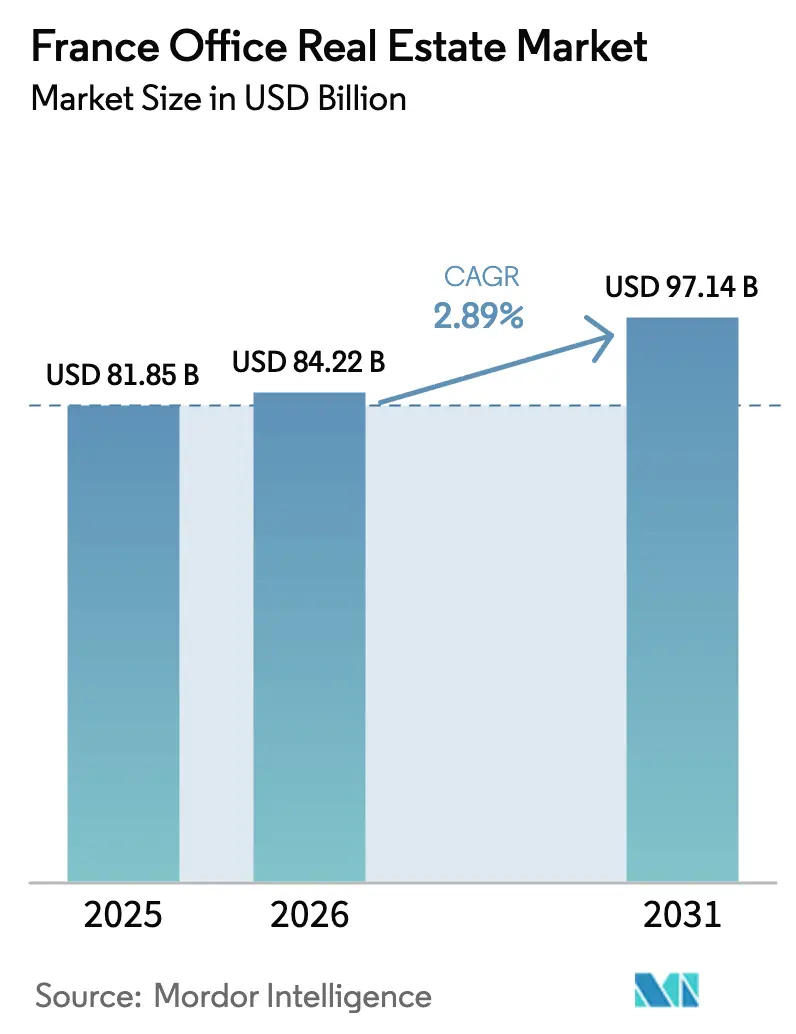
France office real estate market size in 2026 is estimated at USD 84.22 billion, growing from 2025 value of USD 81.85 billion with 2031 projections showing USD 97.14 billion, growing at 2.89% CAGR over 2026-2031. The measured pace shows how landlords and investors are recalibrating portfolios for hybrid work, tighter energy-performance rules and a widening gap between prime and secondary assets. Flexible work patterns, the Paris 2024 legacy infrastructure spend of USD 550 million and rising capital allocations toward ESG-certified buildings are anchoring demand in core sub-markets. Institutional investors injected USD 3.74 billion in Q1 2025 alone as compressed yields in the Paris CBD fueled renewed confidence. A 50% surge in construction costs since 2019 supports rental growth for in-place Grade A stock but restricts new supply, while AI-powered space-optimization tools are reshaping tenant requirements and elevating retrofit economics. Leasing remains dominant, yet faster growth in direct acquisitions signals an ownership pivot toward buildings that already satisfy EU taxonomy thresholds.
Key Report Takeaways
- By building grade, Grade A offices captured 50.68% of the France office real estate market share in 2025; Grade B/C combined is forecast to grow at a 3.31% CAGR through 2031.
- By transaction type, rental agreements held 74.66% of 2025 activity, while sales transactions are projected to advance at a 3.39% CAGR to 2031.
- By end use, the Information Technology segment commanded 26.74% share of the France office real estate market size in 2025 and is projected to expand at 3.58% CAGR through 2031.
- By city, Paris retained 73.65% share of the France office real estate market size in 2025; Lyon is the fastest-growing locality at a 3.76% CAGR to 2031.
Note: Market size and forecast figures in this report are generated using Mordor Intelligence’s proprietary estimation framework, updated with the latest available data and insights as of 2026.
France Office Real Estate Market Trends and Insights
Drivers Impact Analysis*
| Driver | (~) % Impact on CAGR Forecast | Geographic Relevance | Impact Timeline |
|---|---|---|---|
| Flexible and hybrid workspace demand | +0.8% | Nationwide; highest in Paris, Lyon, Marseille | Medium term (2-4 years) |
| Corporate ESG and green-leasing mandates | +0.6% | Strongest in Île-de-France and business districts | Long term (≥ 4 years) |
| Paris 2024 Olympic legacy refurbishments | +0.4% | Île-de-France with spillover to connected metro areas | Short term (≤ 2 years) |
| AI-enabled space-optimization analytics | +0.3% | Major tech hubs | Medium term (2-4 years) |
| Source: Mordor Intelligence | |||
Surge in Flexible & Hybrid Workspace Demand
Hybrid work is firmly embedded across corporate France as 87% of employers now require partial in-office attendance, with employees clocking 3.5 days per week on-site.[1] The preference for collaborative, technology-ready environments has already driven 42% of total floor space refurbishments toward flexible layouts. Prime CBD buildings therefore record declining vacancy even as peripheral stock exceeds 10%. Lease renegotiations favor shorter terms and built-in expansion clauses that match fluid staffing levels. Portfolio consolidation is accelerating, funneling capital expenditure into fewer yet higher-quality assets. The resulting bifurcation underscores why the France office real estate market continues to polarize around energy-efficient Grade A towers located near multimodal transport.
Heightened Corporate ESG & Green-Leasing Mandates
The EU taxonomy and France’s Décret Tertiaire require a 40% energy-consumption cut by 2030, pressuring landlords to decarbonize assets or accept a “brown discount”. Certified buildings already command rent premiums and enjoy lower vacancy, while lenders increasingly restrict financing for non-compliant stock. Fifty-seven percent of occupiers target net-zero footprints by 2030, channeling capex toward photovoltaic retrofits and smart-metering solutions. The regulatory push has created a refurbishment boom, with specialized contractors and PropTech vendors capitalizing on demand. Early-mover owners that attain green labels are locking in blue-chip tenants at higher headline rents, reinforcing a “flight to green” dynamic inside the France office real estate market.
Paris 2024 Olympic Legacy Boosting Grade-A Refurbishments
The Games acted as a catalyst for USD 550 million of transport and urban upgrades.[2] The Grand Paris Express has added new stations that extend the CBD footprint into Seine-Saint-Denis, prompting landlords to reposition older buildings as Grade A inventory. Reduced commute times broaden tenant catchments, while global visibility from the Olympics pulled fresh foreign capital into French real assets. Development pipelines that were paused during the pandemic have resumed, targeting delivery dates aligned with new metro line openings. Short-term momentum continues to benefit refurbishment specialists able to pivot assets quickly toward prime sustainability ratings.
AI-Enabled Space-Optimization & Utilization Analytics
Nine in ten large companies plan to embed AI tools for workplace management within five years. Investments range from real-time desk-occupancy sensors to predictive maintenance engines that lower operating costs. France’s PropTech ecosystem attracted sizable funding in 2024, with firms such as Accenta delivering decarbonization platforms that integrate IAQ monitoring and energy controls. Early adopters report measurable operating-expense savings, justifying rent premiums while supporting tenants’ ESG disclosures. Data-security and interoperability concerns remain, yet pilot successes are convincing more institutional owners to deploy building-operating systems across portfolios.
Restraints Impact Analysis*
| Restraint | (~) % Impact on CAGR Forecast | Geographic Relevance | Impact Timeline |
|---|---|---|---|
| Remote-work headcount dilution | -0.7% | Nationwide; deepest in peripheral sub-markets | Long term (≥ 4 years) |
| Elevated construction and financing costs | -0.5% | Nationwide; severe for speculative projects | Medium term (2-4 years) |
| Stricter capital-allocation hurdles | -0.3% | Legacy stock in all regions | Long term (≥ 4 years) |
| Source: Mordor Intelligence | |||
Prolonged Remote-Work Headcount Dilution
Telework participation stabilizes at 22% of the French workforce and averages 1.9 days at home weekly. Peripheral sub-markets therefore register rising vacancy as occupiers downsize legacy footprints. Finance and ICT sectors post telework penetration of 75% and 60% respectively, amplifying space surrender in La Défense and western suburbs. Landlords are reassessing conversion prospects—turning obsolete floorplates into residential or mixed-use schemes—to mitigate unleased inventory. Over the long term, the France office real estate market must reconcile lower per-employee area ratios with persistent preference for prime, well-amenitized hubs.
Elevated Construction & Financing Costs Amid Inflation
The construction industry continues to face significant challenges as inflationary pressures persist. Input prices jumped 50% from 2019, while the Construction PMI sat at 43.8 in March 2025, signalling contraction Savills Construction Briefing. Higher interest rates drive lenders to demand greater pre-leasing, elongating project timelines and raising required returns. Speculative ground-up projects outside Paris CBD struggle to pencil out, reinforcing scarcity of Grade A supply. Developers with strong balance sheets and ESG-ready pipelines retain bargaining power with both tenants and financiers, but smaller players face exit or recapitalization. As the market evolves, stakeholders must adapt to these shifting dynamics to navigate the road ahead successfully.
*Our forecasts treat driver/restraint impacts as directional, not additive. The impact forecasts reflect baseline growth, mix effects, and variable interactions.
Segment Analysis
By Building Grade: Premium Assets Drive Market Polarization
Grade A premises held 50.68% France office real estate market share in 2025. Tenants value energy efficiency and wellness features that facilitate hybrid protocols, supporting a 3.05% CAGR for this cohort through 2031. Grade B and Grade C face accelerated depreciation unless refurbished; many owners evaluate conversions to residential or life-science laboratories where zoning allows. Paris CBD Grade A asking rents hit USD 1,320 per square meter in 2024, up 12% year-on-year, whereas suburban Grade C stock sees double-digit vacancy. Leasing spreads illustrate the growing bifurcation inside the France office real estate market.
Hybrid work magnifies this divide because firms require fewer desks yet demand richer amenities—from acoustically treated collaboration zones to smart-building dashboards that track carbon emissions. Developers of new towers integrate photovoltaic façades, low-carbon concrete and AI-driven HVAC, surpassing Décret Tertiaire thresholds years ahead of schedule. Retrofits also accelerate: Gecina earmarked USD 915 million for deep-energy upgrades, betting on the incoming “green premium.” The trend implies ongoing capital flows into Grade A pipelines even as secondary stock flirts with obsolescence, reinforcing quality polarization throughout the France office real estate market.


By Transaction Type: Sales Growth Outpaces Rental Dominance
Rental contracts accounted for 74.66% of 2025 activity, reflecting occupiers’ desire for operational flexibility. Nevertheless, sales deals are forecast to climb 3.39% annually, faster than the overall France office real estate market. The USD 1.07 billion purchase of the Majunga Tower by Unibail-Rodamco-Westfield typifies renewed appetite for trophy assets, Batinfo. Prime yields compressed from 4.5% to 4.0% in Paris CBD during 2024-2025, enticing pension funds and sovereign entities.
Leases themselves evolve: average term now sits at 6.4 years versus 9 years pre-pandemic, with frequent break options. Portfolio-sale structures allow investors to absorb inventory requiring phased retrofits, capturing upside once energy targets are met. Meanwhile, cross-border investors from North America tripled allocations to France in 2024, and many are scouting JV structures to navigate local regulations. The France office real estate market, therefore, observes a dual mechanism: leasing remains volume leader, yet equity inflows tilt toward direct ownership of green assets with solid rent reversion potential.
By End Use: Technology Sector Leadership Drives Innovation Adoption
Information Technology firms held 26.74% France office real estate market share in 2025 and topped the growth league at 3.58% CAGR to 2031. AI start-ups and cloud providers favor flexible floorplates wired with 5G and a redundant fiber backbone, often clustered around Paris Station F or Lyon Part-Dieu. Banks follow, yet they rationalize branch networks, shifting headquarters into fewer, high-spec floors to reinforce employer branding. Consulting and professional services occupy premium CBD suites to maintain client proximity; their footprint stabilizes as hybrid staffing optimizes desk ratios.
Tech occupiers integrate IoT sensors that track energy and occupancy, feeding corporate ESG dashboards. J.P. Morgan’s lease of CBRE IM’s Marché Saint-Honoré underscores demand for brand-defining addresses in the capital’s historic core. Life-science corporates in Marseille’s Euroméditerranée district need floor-loading and lab ventilation, nudging landlords to re-engineer existing assets. Across categories, the unifying theme is digital enablement: any building lacking robust connectivity risks prolonged vacancy, highlighting why technology leadership propels overall absorption in the France office real estate market.

Geography Analysis
Paris continues to command 73.65% of the 2025 transaction value, backed by its concentration of global headquarters and government agencies. Take-up in Central Paris reached 388,000 square meters in Q1 2025, even though total deals slipped 6% year on year; CBD sub-markets alone saw a 13% bounce, proving the appeal of core micro-locations. Supply is constrained by landmark preservation and lengthy permitting, which upholds rent inflation yet limits headline volume growth. Prime net effective rents have outpaced wage inflation, sparking corporate interest in alternative hubs.
Lyon records the quickest growth trajectory at 3.76% CAGR to 2031. Annual office take-up is forecast to surpass 320,000 square meters as companies capitalize on lower occupancy costs and a vibrant innovation ecosystem clustered in the Part-Dieu and Confluence districts. Vacancy at 5.6% signals balanced conditions, and municipal authorities incentivize green refurbishments via tax rebates, strengthening the investment thesis for value-add strategies.
Marseille, together with smaller regional cities, forms an emerging set of opportunities aligned with government decentralization policy. Programs under Provence Promotion highlight improved international schools and digital hubs that appeal to expatriate staff. France Stratégie observes that telework increases demand for well-amenitized urban nodes, implying steady if modest office absorption in secondary municipalities.Investors, however, assess each locale for transport connectivity and sector specialization before committing capital.
Regulatory Landscape
France office real estate is shaped by tighter energy-performance obligations and evolving commercial-lease rules. The EU taxonomy and France's Décret Tertiaire set a decarbonization pathway for tertiary buildings, including an energy-consumption reduction target of 40% by 2030. This raises the compliance bar for older Grade B/C stock and affects lender and investor underwriting.
In May 2026, the Economic Simplification Act (Law No. 2026-403) introduced changes affecting French commercial leases and transactions. These include capping guarantees at one-quarter of a quarter's rent for new or renewed leases, and excluding exclusively office and warehouse premises from the tenant's statutory right of first refusal if the property is sold. The law also validated cap-and-collar clauses for ILC-based rent reviews and simplified certain ERP compliance procedures for sites under 300 sqm, which can reduce friction in smaller office fit-outs and repositioning programs.
Value Chain Analysis
The France office real estate value chain covers land and asset sourcing, development and refurbishment, leasing and transactions, and long-term asset and facilities management. Upstream participants including developers, contractors, architects, and engineering firms now operate in a retrofit-heavy workflow, focused on energy upgrades, HVAC modernization, envelope improvements, and reconfiguration for hybrid use. This shift reflects the 50% rise in construction input costs since 2019 and tighter financing conditions for speculative projects.
Downstream, brokerage and advisory firms (including JLL, CBRE, and BNP Paribas Real Estate) support occupiers and investors with site search, valuation, technical due diligence, space planning, project management, and sustainable regeneration. PropTech and building-operations providers increasingly sit alongside traditional FM, supplying occupancy and energy analytics that support green-leasing requirements and Decret Tertiaire reporting. At the same time, specialist conversion and redevelopment partners are more frequently used as office-to-alternative-use programs and mixed-use repositioning broaden.
Competitive Landscape
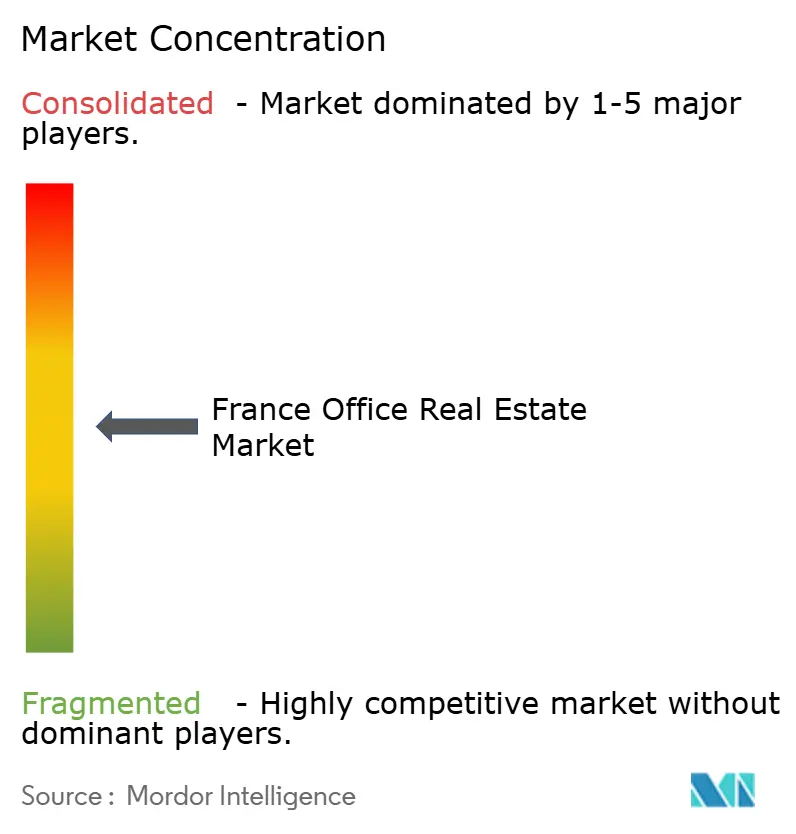
The France office real estate market is moderately concentrated. Competition centers on a cluster of dominant REITs that control most CBD towers, while new foreign entrants chase ESG-qualified assets. Gecina’s USD 19.14 billion portfolio is 87% Paris-centric and 97% green-certified, delivering a 5.4-year average lease maturity. Covivio allocates USD 26.4 billion across Europe, yet channels two-thirds of new capex into Paris offices, where it booked 176,200 square meters of leasing in 2024. Icade concentrates on future-proofing Seine-Saint-Denis inventory, recently re-letting the 29,000 square-meter Pulse building to the Departmental Council.
International capital is intensifying the rivalry. North American investors raised allocations to USD 3.4 billion in 2024, lured by Eurozone stability and green-premium upside. Joint-venture structures such as PGIM Real Estate with Pithos Capital target alternative niches like self-storage, signaling diversification beyond offices. PropTech disruptors provide data-driven leasing platforms and net-zero retrofitting solutions, creating service partnerships with incumbent landlords rather than outright displacement.
Strategic moves increasingly focus on refurbishment excellence rather than land-bank accumulation. Covivio’s USD 1.1 billion annual investment pipeline is skewed to deep-energy retrofits, while Gecina rotates out of mature residential units to fund student-housing and co-living projects that enhance overall portfolio agility. Asset managers embed AI-enabled building-management systems to quantify carbon savings and pass these metrics through to occupiers’ reporting obligations. Competitive advantage thus hinges on the ability to blend technology, sustainability, and tenant-experience services efficiently within the France office real estate market.
France Office Real Estate Industry Leaders
-
Jones Lang LaSalle IP, Inc.
-
Knight Frank
-
CBRE
-
BNP Paribas Real Estate
-
Cushman & Wakefield
- *Disclaimer: Major Players sorted in no particular order
Market Opportunities and Future Outlook
A key opportunity is value creation through repositioning and conversion of challenged office assets, particularly in the Paris region where hybrid work has increased vacancy in non-prime submarkets. In Île-de-France, an Appel à manifestation d'interet (AMI) dedicated to transforming offices into housing had selected 61 projects by April 9, 2026, targeting more than 8,000 homes, including 4,467 social units. The program is backed by identified public support, including EUR 35 million in funding, EUR 15 million in exceptional bonuses, and EUR 4.9 million from the friches fund, which gives owners a concrete route to exit or redeploy obsolete office stock.
Another opportunity lies in scaling deep-energy retrofits and data-driven operations to meet Decret Tertiaire thresholds and occupier green-leasing mandates. Demand is concentrating into compliant Grade A buildings, and owners that combine refurbishment execution (envelope, electrification, metering, and building controls) with workplace-analytics platforms can strengthen leasing outcomes. This can also help protect liquidity in sales processes where EU-taxonomy alignment is increasingly scrutinized.
Recent Industry Developments
- July 2026: JLL reports that the immediate office space supply in Ile-de-France reached 6.57 million m2 at the end of Q2 2026, up 10 percent year over year. The development highlights inventory dynamics in the Paris region and possible pricing power in the core market.
- July 2026: JLL notes major office investment transactions in France in H1 2026, including the THALES portfolio being acquired by BLUE OWL and the sale of 39 rue du Colisée from BNP AM to DWS for €140 million, as well as BATIPART and SOFIDY selling Magnetik for €128 million. These deals point to growing large-scale international investor interest and valuation for prime assets.
- April 2026: BNP Paribas Real Estate reports Île-de-France office take-up totaled 367,400 m2 in Q1 2026, down 15 percent year over year. The figure suggests softer leasing momentum, alongside ongoing demand for core assets in a hybrid-work environment.
Research Methodology Framework and Report Scope
Market Definition and Coverage
For this methodology, the France office real estate market is defined as the value tied to office property activity in France, covering leasing and ownership transactions that relate to office buildings and office space demand.
Scope exclusions: Residential assets, retail, industrial and logistics, hotels, and pure land-only transactions are excluded unless they are part of an office-led deal value.
Segmentation Overview
- By Building Grade
- Grade A
- Grade B
- Grade C
- By Transaction Type
- Rental
- Sales
- By End Use
- Information Technology (IT & ITES)
- BFSI (Banking, Financial Services and Insurance)
- Business Consulting & Professional Services
- Other Services (Retail, Lifesciences, Energy, Legal)
- By City
- Paris
- Lyon
- Marseille
- Rest of France
Data Sources, Market Sizing, and Validation
Desk Research
Desk research starts by building a fact base on office stock, leasing activity, and pricing direction in France, which is later used as structured inputs and cross-checks in the market model. We typically rely on public or official sources such as INSEE for macro and business counts, Banque de France for rates and financing signals, Eurostat for construction and cost indicators, and the French Ministry for Ecological Transition for energy rules that affect office upgrades.
To keep the sizing grounded in market behavior, we also review company filings and investor presentations from listed property owners and managers, along with association and market-statistics releases such as GIE ImmoStat for take-up and vacancy, and reputed press for transaction context. Where ownership structures or selected financial line items are unclear, paid subscriptions for company financials and intelligence, news and financials, and an import-export shipment-level database are used selectively to verify entities and cross-check major market moves. The sources listed here are illustrative and not exhaustive, and many other public documents and datasets are referenced during data collection, validation, and clarification.
Primary Interviews and Surveys
Primary interviews and surveys are used to test assumptions that public datasets cannot fully capture, especially how incentives, lease terms, and flight-to-quality behavior are changing effective pricing and absorption. We speak with a mix of landlords, developers, brokers, asset managers, and large office occupiers across major French office hubs so rent, vacancy normalization, and new supply timing can be challenged and refined.
Since one stakeholder group can overweight either prime CBD conditions or secondary stock realities, follow-ups are done across roles to close gaps on refurbishment pipelines, tenant demand shifts, and transaction pricing behavior.
Distribution of primary research fieldwork respondents
| Company type | Respondent position |
|---|---|
| Top tier: 25% | CXOs: 19% |
| Mid tier: 55% | Functional/Unit leaders: 28% |
| Smaller Players: 20% | Managers: 53% |
Market-Sizing & Forecasting
Sizing starts with a top-down build that links office value to the occupied demand pool and price realization, and then it is adjusted for vacancy and supply changes observed across France. The main inputs are office stock and completions, take-up and net absorption direction, vacancy rate movements, headline rent versus incentive pressure (to infer effective rent direction), and investment deal volumes as a cycle check.
After that, results are corroborated with selective bottom-up approximations, such as sampling rents by city and building quality and multiplying by occupied or transacted area, followed by channel checks on typical lease terms and refurb-to-let timelines. When a sub-market has limited visible data, the gap is handled by anchoring it to comparable city benchmarks and then adjusting for local vacancy and rent spreads discussed in interviews.
For forecasting, scenario analysis is used, with relationships tracked between office demand, services employment, financing conditions, and observed vacancy levels, and then the final path is aligned to what primary respondents expect for leasing momentum and capital-market liquidity.
Data Validation & Update Cycle
Model outputs are validated through several passes that compare results with independent signals such as published take-up and vacancy totals, observed rent ranges, and the direction of investment volumes. If a city-level result looks out of line, drivers are reopened and the assumption that is causing the variance (such as incentives, absorption, or completions timing) is rechecked through follow-up conversations before sign-off.
A second analyst review is used to catch unit errors, currency timing mismatches, and unusual year-to-year jumps that are not supported by known market events. Reports are refreshed annually, and interim updates are triggered when material shifts occur, such as sharp rate changes, regulatory milestones affecting retrofits, or a step-change in leasing. Before delivery, an analyst performs a fresh pass so clients receive the latest updated view.
Mordor Intelligence's France Office Real Estate Market Size Compared With Other Published Estimates
Different published market values can vary because the scope is not always consistent, and office real estate can be counted through rents, transactions, or a broader commercial property lens. In day-to-day use, the biggest gaps tend to come from what gets counted as office value, which geographies are weighted most, and whether incentives and vacancy effects are reflected in pricing.
In France, one recurring split is between estimates built from occupier-led signals (space, vacancy, and rent) and those built mainly from capital-market deal flow, which can swing sharply by year. The spread can widen further when mixed-use assets are blended in without separating the office component, and when effective rent is assumed from headline figures without being tested through local market checks.
Benchmark comparison
| Source | Market Size | Gaps in Research Methodology |
|---|---|---|
| Mordor Intelligence | USD 81.85 B (2025) | |
| Trade Journal A | USD 68.40 B (2025) | Often centers on Greater Paris leasing indicators and applies conservative effective-rent haircuts, which can undercount secondary-city office value and stabilized provincial occupancy. |
| Global Consultancy B | USD 92.10 B (2025) | Tends to broaden the total by blending office-heavy mixed-use assets and using transaction-led value proxies in years with higher investment liquidity, which can lift the office-only number. |
The table suggests most differences come from whether value is tied to occupied space and effective rent realization or to investment deal cycles, and also from how mixed-use assets are treated. When the model is kept anchored to vacancy-adjusted demand signals and then checked against take-up and rent evidence before totals are finalized, mixed-use is included only when the office component is clearly separable, which is how it is handled at Mordor Intelligence.
Key Questions Answered in the Report
What is the current size of the France office real estate market?
The France office real estate market size reached USD 84.22 billion in 2026 and is projected to climb to USD 97.14 billion by 2031.
How fast will the market grow between 2026 and 2031?
It is expected to expand at a 2.89% compound annual growth rate, driven by hybrid-work adaptation and ESG retrofits.
Which building grade captures the largest share?
Grade A properties hold 50.68% of 2025 value and are favored for their energy performance and central locations.
Why is Lyon considered the fastest-growing city for offices?
Lyon benefits from 25-30% lower occupancy costs than Paris, robust infrastructure upgrades and a forecast 3.76% CAGR through 2031.
How are ESG regulations impacting asset values?
EU taxonomy and Décret Tertiaire rules create a “green premium” for compliant buildings and a “brown discount” for inefficient stock, reshaping capital allocation.
What risks could dampen future growth?
Prolonged remote-work trends, 50% construction-cost inflation since 2019 and tight financing conditions may restrain new supply and transaction velocity within the France office real estate market.