
Market Overview
| Study Period | 2020 - 2031 |
|---|---|
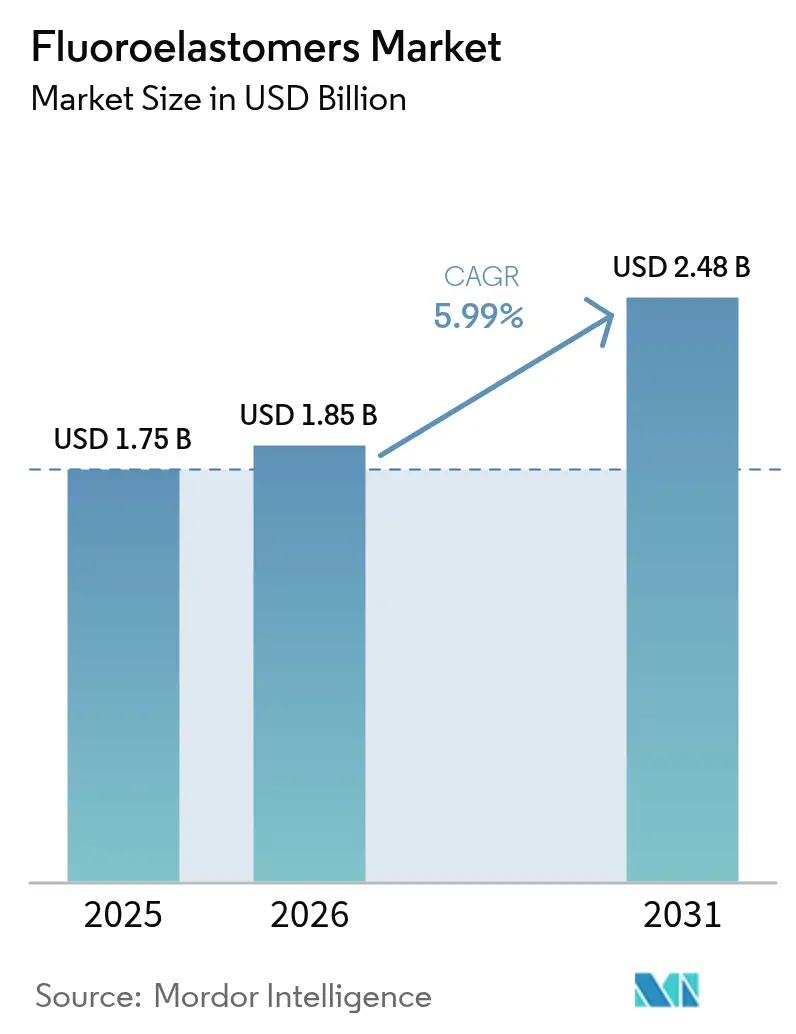
| Market Size (2026) | USD 1.85 Billion |
| Market Size (2031) | USD 2.48 Billion |
| Growth Rate (2026 - 2031) | 5.99 % |
| Fastest Growing Market | Asia-Pacific |
| Largest Market | Asia-Pacific |
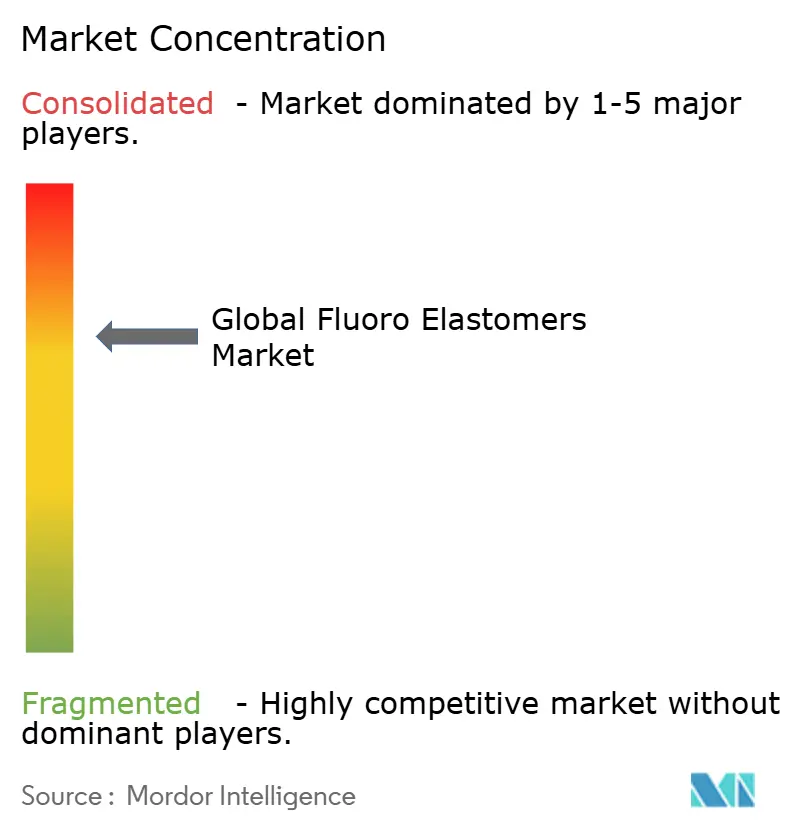
| Market Concentration | Medium |
Major Players *Disclaimer: Major Players sorted in no particular order Image © Mordor Intelligence. Reuse requires attribution under CC BY 4.0. | |
Fluoroelastomers Market Analysis by Mordor Intelligence
Fluoroelastomers Market size in 2026 is estimated at USD 1.85 billion, growing from 2025 value of USD 1.75 billion with 2031 projections showing USD 2.48 billion, growing at 5.99% CAGR over 2026-2031. A sustained shift toward battery-electric vehicles, the proliferation of small-satellite constellations, and relentless scaling in semiconductor fabrication keep demand for high-performance seals on an upward trajectory. Because carbon–fluorine bonds resist extreme temperatures, aggressive chemicals, and rapid thermal cycling, fluoroelastomers remain the default choice where failure is not an option. Automakers now specify Viton and Kalrez compounds in battery-coolant circuits to prevent dielectric fluid leakage, while chip manufacturers rely on low-outgassing perfluoroelastomers to protect 3 nm process nodes. At the same time, exploration of hotter, deeper oil reservoirs expands high-temperature sealing needs in energy operations. Proposed PFAS restrictions in Europe inject regulatory uncertainty, yet they also accelerate investment in non-fluorosurfactant production technologies that preserve performance advantages without legacy chemistries.
Key Report Takeaways
- By product type, Fluorocarbon elastomers led with 61.02% of the fluoroelastomers market share in 2025; perfluoroelastomers are projected to advance at a 6.98% CAGR through 2031.
- By application, O-rings and seals accounted for 44.02% of the fluoroelastomers market size in 2025, while the “other applications” category is poised for a 7.67% CAGR to 2031.
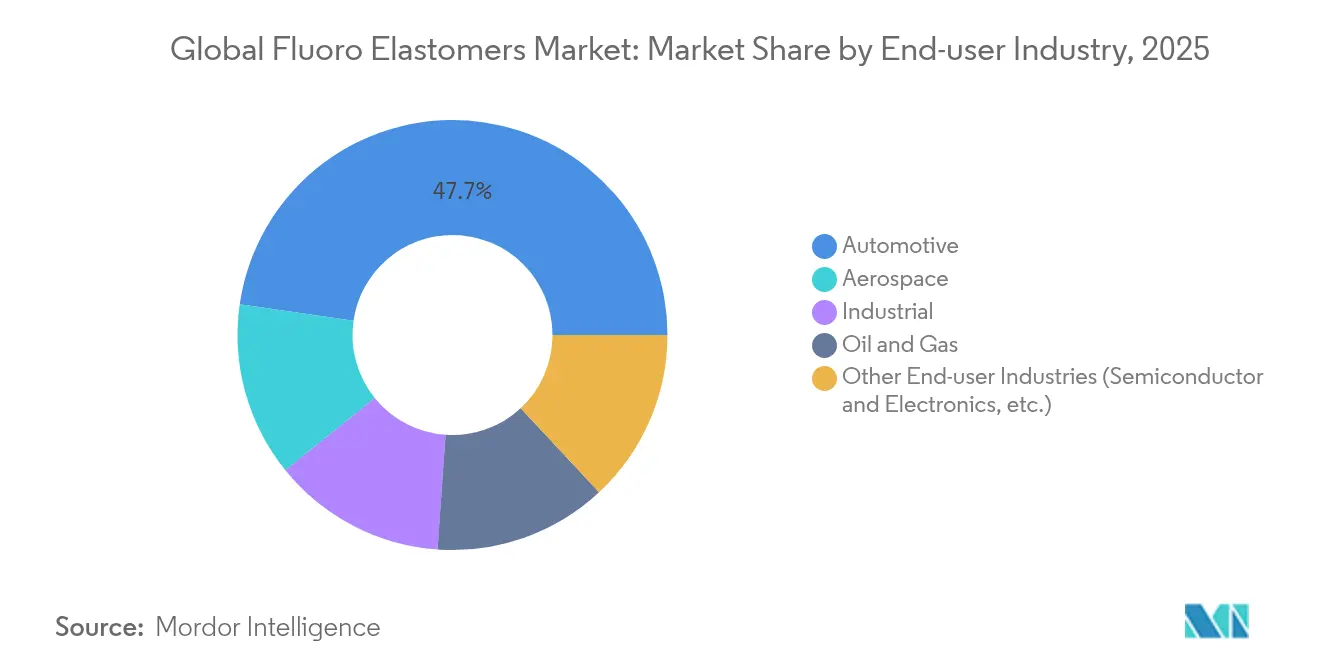
- By end-user industry, Automotive & transportation held 47.72% revenue share of the fluoroelastomers market in 2025; other end-user industries show the fastest growth at 7.42% CAGR.
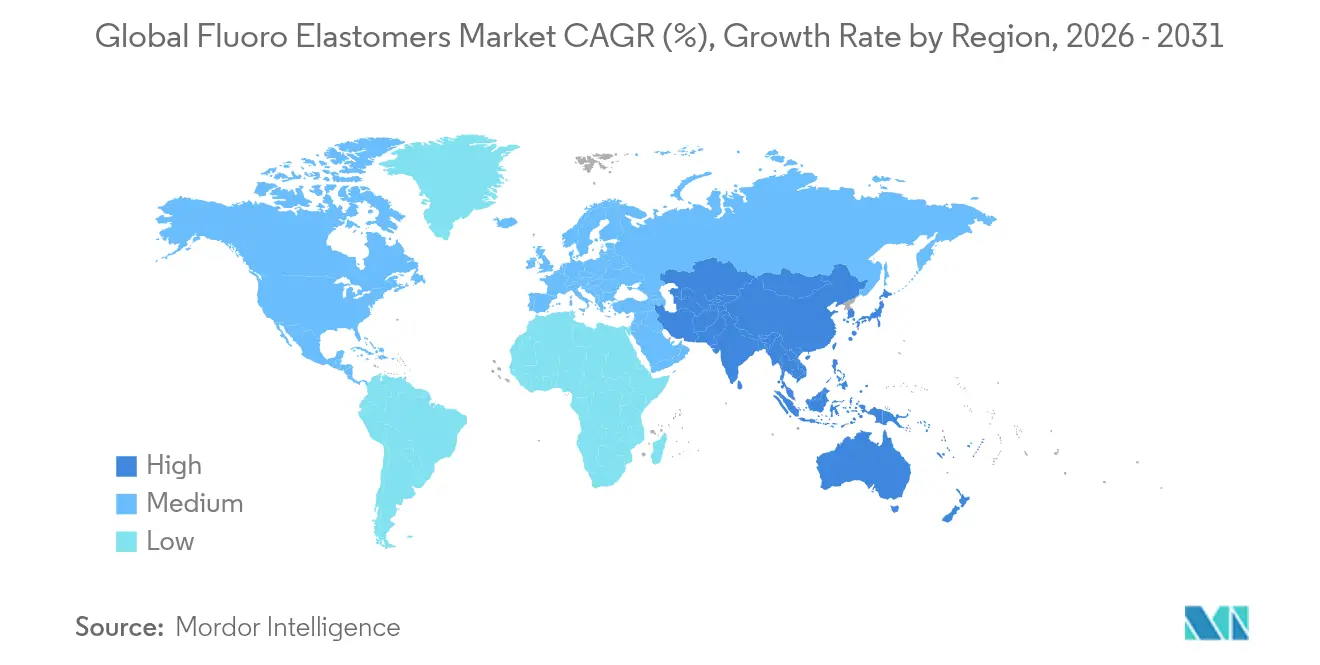
- By geography, Asia-Pacific commanded 45.63% of the global fluoroelastomers market in 2025 and is expanding at a 7.02% CAGR through 2031.
Note: Market size and forecast figures in this report are generated using Mordor Intelligence’s proprietary estimation framework, updated with the latest available data and insights as of 2026.
Market Trends and Insights
Drivers Impact Analysis of Fluoroelastomers Market*
| Driver | (~) % Impact on CAGR Forecast | Geographic Relevance | Impact Timeline |
|---|---|---|---|
| EV thermal-management seal demand surge | +1.8% | Global, early gains in China, Europe, North America | Medium term (2-4 years) |
| Growing demand for aerospace & new space propulsion seals | +1.2% | North America & Europe core, spill-over to APAC | Long term (≥ 4 years) |
| Increasing requirement for semiconductor process seals | +1.5% | APAC core, spill-over to North America | Short term (≤ 2 years) |
| Growing utilization in the oil and gas industry | +0.8% | Global, focus in Middle East & North America | Medium term (2-4 years) |
| Expansion in renewable energy infrastructure | +0.7% | Global, with early gains in Europe, China | Long term (≥ 4 years) |
| Source: Mordor Intelligence | |||
EV Thermal-Management Seal Demand Surge
Electric-vehicle battery packs rely on sophisticated liquid-cooling loops that circulate dielectric fluids able to dissipate heat without risking short circuits. Seals made from Viton and similar compounds limit swelling to less than 5% after 1 000 hours in polyalphaolefin-based coolants, outperforming silicone and EPDM alternatives. Prestone’s low-conductivity coolant formulated under China’s GB29743.2 standard illustrates how chemistry updates push sealing specifications to new thresholds, Automakers have extended battery warranties to 10 years, so perfluoroelastomers that maintain tensile strength below −30 °C and above 150 °C become essential. As global EV production climbs past 25 million units in 2025, OEM sourcing teams lock in multiyear supply contracts for high-purity perfluoroelastomer compounds, anchoring a key growth pillar for the fluoroelastomers market.
Growing Demand for Aerospace & New Space Propulsion Seals
Commercial launch providers, satellite manufacturers, and defense primes specify perfluoroelastomer seals that survive propellants such as hydrazine or liquid oxygen while cycling from −200 °C to +300 °C. DuPont’s Kalrez grades now guarantee chemical compatibility with more than 1 800 fluids, reducing mission-critical leak paths in spacecraft life-support lines and cryogenic feed systems [1]DuPont, “Kalrez High-Performance Perfluoroelastomers,” dupont.com. In aviation, lightweight turbochargers and sustainable-aviation-fuel delivery modules increasingly rely on Viton to curb maintenance frequency. Each reusable launch vehicle can contain over 1 200 individual O-rings, multiplying material demand as launch cadence accelerates. Consequently, aerospace programs amplify the long-run pull on the fluoroelastomers market.
Increasing Requirement for Semiconductor Process Seals
Sub-5 nm node production uses aggressive fluorine and chlorine plasma chemistries inside extreme-vacuum chambers. Even trace outgassing contaminates photoresist patterns, so fabs qualify Kalrez Spectrum 7375 parts for 300 °C continuous operation and <20 ppm total mass loss. Greene Tweed’s new South Korean plant shortens lead times for local fabs while diversifying away from single-region supply risk. As AI accelerators and advanced packaging lines proliferate, perfluoroelastomer seal demand scales with every added etch, deposition, or CMP step, reinforcing a steady growth channel for the fluoroelastomers market.
Growing Utilization in the Oil and Gas Industry
Extended-reach wells routinely exceed 200 °C downhole, subjecting elastomers to sour gas and supercritical brines. Field data show Kalrez perfluoroelastomers achieving zero seal failures across 50 000 V-ring deployments in high-pressure, high-temperature completions. James Walker’s compound formulations address rapid gas decompression by balancing cross-link density with fluorine content, mitigating blistering risk in 15 k psi service. As operators tap deeper reservoirs and employ enhanced-oil-recovery chemistries, the fluoroelastomers market gains a durable customer base in energy production.
Restraints Impact Analysis of Fluoroelastomers Market*
| Restraint | (~) % Impact on CAGR Forecast | Geographic Relevance | Impact Timeline |
|---|---|---|---|
| High material & compounding cost | -0.9% | Global, acute in price-sensitive markets | Short term (≤ 2 years) |
| Feedstock supply volatility | -0.6% | Global, concentrated in APAC manufacturing | Medium term (2-4 years) |
| Circular economy recycling mandates | -0.4% | Europe core, expanding to North America | Long term (≥ 4 years) |
| Source: Mordor Intelligence | |||
High Material & Compounding Cost
Fluoroelastomer production relies on fluorinated monomers that trade at premiums standard petrochemical feedstocks. Tight process control and proprietary curing packages push conversion costs further, limiting uptake in low-margin components. Global natural rubber shortages extend price pressures across the wider elastomer landscape, reinforcing cost sensitivity even where performance benefits are clear-cut. To counterbalance, suppliers emphasize life-cycle savings: one gearbox seal rated for 10 000 operating hours often replaces two or three NBR equivalents. Halogen-free ethylene-acrylic alternatives such as Vamac creep into mid-temperature applications, compressing potential volume growth for the fluoroelastomers market.
Feedstock Supply Volatility
Production of hexafluoropropylene oxide dimer acid and related intermediates remains geographically concentrated. Any trade friction, force majeure, or pandemic-era shutdown cascades through inventories, sparking spot-price spikes of 20–30%. Regulatory scrutiny of PFAS processing aids intensifies sourcing risk, compelling firms like Greene Tweed to dual-qualify supply chains and build regional buffer stocks. Ongoing efforts to deploy non-fluorosurfactant polymerization platforms are promising but not yet at full capacity, leaving the fluoroelastomers market exposed to intermittent raw-material shocks.
*Our forecasts treat driver/restraint impacts as directional, not additive. The impact forecasts reflect baseline growth, mix effects, and variable interactions.
Fluoroelastomers Market Segment Analysis
By Product Type:
Perfluoroelastomers Drive InnovationFluorocarbon elastomers retained 61.02% of the fluoroelastomers market share in 2025, buoyed by entrenched use in automotive fuel-line connectors, refinery gaskets, and general industrial equipment. Their broad processing window helps component suppliers meet mass-production takt times without resorting to exotic tooling. Volume leadership, however, does not equate to highest growth. Perfluoroelastomers expand at a 6.98% CAGR through 2031, catalyzed by semiconductor cleanrooms and reusable launch vehicles that push sealing specifications past traditional fluorocarbon limits. This growth vector translates to a perfluoroelastomer segment contribution of roughly USD 613 million to the overall fluoroelastomers market size by the end of the decade.
Demand acceleration also stems from novel manufacturing methods. Solvay’s Tecnoflon NFS process eliminates PFAS surfactants yet delivers identical compression-set retention, addressing European policy uncertainty without sacrificing performance . As large fabs simulate chemical permeation down to parts-per-trillion thresholds, non-contaminating perfluoroelastomers gain value over lower-cost counterparts. Meanwhile, fluorosilicone elastomers hold a smaller niche but remain indispensable in aerospace environmental control systems where −60 °C flexibility meets jet-fuel resistance. Suppliers continue tailoring bisphenol-cure systems to enhance modulus at altitude pressures, protecting a steady revenue stream inside the broader fluoroelastomers market.




By Application:
Specialized Components Gain MomentumO-rings and standard profile seals accounted for 44.02% of the fluoroelastomers market size in 2025, making them the dominant application category. Tier-one molders achieve economies of scale by running multi-cavity tools that spawn millions of identical rings each month. Although unit prices are low, cumulative value remains high because critical operations—semiconductor vacuum doors, EV battery plates, refinery pump shafts—can require dozens of seals per assembly. Over the forecast horizon, standardized components will continue to underpin base demand for the fluoroelastomers market.
Yet the fastest momentum lies in the “other applications” bucket, which is tracking a 7.67% CAGR to 2031 as designers seek custom shapes for renewable-energy and advanced-manufacturing duties. Labyrinth seals in offshore wind gearboxes now combine PTFE inserts with perfluoroelastomer energizers, enabling 25-year maintenance intervals in saline atmospheres. In solar-thermal plants, fluoroelastomer bellows isolate molten-salt loops from control actuators while surviving daily thermal cycles exceeding 350 °C. The rapid prototyping of flow-battery gaskets—by blending glass micro-fibers into FKM matrices for improved compressive modulus—expands the addressable market beyond traditional fluid-sealing niches, keeping innovation churn high across the fluoroelastomers market.
By End-User Industry:
Diversification Beyond AutomotiveAutomotive & transportation held 47.72% of the fluoroelastomers market revenue in 2025, anchored by legacy ICE fuel-system seals and rising EV coolant connectors. Although platform cost-control efforts are relentless, regulatory mandates for zero leakage drive persistent specification of premium compounds. Growth, however, is stronger elsewhere. “Other end-user industries” are climbing at a 7.42% CAGR, reflecting the spread of clean-room manufacturing, precision medical devices, and grid-scale storage solutions. Semiconductor fabs alone can consume more than 3 kg of perfluoroelastomer seals per 300 mm tool set, contributing meaningful incremental volume to the fluoroelastomers market.
Aerospace, while smaller in share, brings above-average unit margins. Energy infrastructure remains a durable customer set, from LNG liquefaction trains that need peroxide-cure fluorocarbon elastomer expansion joints to offshore production vessels where compound blends fight explosive decompression. Together, these verticals widen the revenue base and lower cyclical risk for the fluoroelastomers market.
Geography Analysis
APAC Fluoroelastomers Market
Asia-Pacific dominated the fluoroelastomers market in 2025 with 45.63% revenue share, and regional demand is projected to rise at a 7.02% CAGR through 2031. China’s push for semiconductor self-sufficiency drives sustained investment in 12-inch fabs, each requiring thousands of high-purity O-rings with single-digit ppm outgassing specifications. India’s automotive reforms, including PLI incentives for local battery manufacturing, encourage domestic production of EV-grade coolant seals. Gujarat Fluorochemicals has committed USD 6 billion over the next four years to expand battery-chemical capacity, signalling long-term regional integration of fluoropolymer supply chains.
The Americas, Europe and Middle East Fluoroelastomers Market
North America ranks second, buoyed by mature aerospace programs, shale-oil activity, and onshoring of advanced logic foundries. The CHIPS and Science Act accelerates regional wafer capacity, translating into near-term spikes in perfluoroelastomer consumption. Additionally, US deepwater developments in the Gulf of Mexico reinforce demand for HPHT-rated sealing solutions. Europe’s share faces pressure from prospective PFAS bans that could restrict certain fluorinated intermediates. Manufacturers such as James Walker publicly advocate for application-based exemptions while simultaneously piloting PFAS-free compounds for moderate-duty services. Smaller regional clusters add incremental growth. South America’s pre-salt exploration programs necessitate high-performance fluoroelastomer isolation valves, whereas the Middle East targets hydrogen and ammonia export infrastructure that benefits from chemical-resistant sealing materials. Although these regions combined account for less than 10% of current fluoroelastomers market revenue, their multiyear capital-project pipelines suggest a notable contribution to volume upside by 2030.

Value Chain Analysis
The fluoroelastomers value chain begins upstream with fluorspar conversion into hydrofluoric acid, followed by synthesis of fluorinated monomers such as vinylidene fluoride (VDF), hexafluoropropylene (HFP), and tetrafluoroethylene (TFE). Polymerization is capital-intensive and tightly controlled, and base-polymer producers often integrate monomer supply to maintain purity and continuity for high-performance grades. Compounding then adds curatives, fillers, and proprietary processing aids to tune compression set, chemical resistance, and outgassing performance for semiconductor process tools, aerospace propulsion hardware, and EV thermal-management systems.
Downstream, compounders and precision molders convert materials into O-rings, seals, gaskets, diaphragms, and custom profiles, and then supply OEMs and tier suppliers across automotive, energy, industrial, and electronics. Qualification and validation drive long-term lock-in, since automotive PPAP-style approvals and semiconductor tool OEM qualification cycles typically keep approved compounds on-platform. That structure supports multi-year supply agreements, and it also raises the bar for resilience through dual-qualification. In 2026, investments such as Daikin Industries' plan to add a perfluoroelastomer (FFKM) facility at the Kashima Plant underscore how high-purity FFKM demand and surfactant-free production requirements are shaping capacity decisions and how suppliers engage technically for semiconductors and aerospace, rather than relying on broadline distribution for critical applications.
Competitive Landscape
The fluoro elastomers market is moderately consolidated, with DuPont, Chemours, Daikin Industries, and 3M dominating through vertically integrated value chains and extensive patent portfolios exceeding 800 active families each. These leaders are shifting towards non-fluorosurfactant production in 2024–2025 to address regulatory risks, exemplified by Chemours’ partnership with Navin Fluorine to integrate Opteon dielectric fluids into India’s advanced manufacturing. Second-tier players like Solvay, LANXESS, and Gujarat Fluorochemicals leverage regional advantages and cost-efficient feedstocks, while niche firms such as Eagle Elastomer and Trp Polymer Solutions focus on custom pharmaceutical applications. The race for semiconductor qualification remains intense, offering multi-year revenue opportunities. Supply-chain resilience is a priority, with Greene Tweed expanding in South Korea and James Walker enhancing rapid prototyping capabilities. Companies increasingly use digital twins and finite-element modeling to optimize performance and reduce costs. Despite high entry barriers, Asia’s incremental capacity additions indicate growing geographical diversity in the market.
Fluoroelastomers Industry Leaders
3M
DAIKIN INDUSTRIES, Ltd.
AGC Chemicals Americas
The Chemours Company
Syensqo
- *Disclaimer: Major Players sorted in no particular order
Fluoroelastomers Market Companies Covered in this Report
- 3M
- AGC Chemicals Americas
- DAIKIN INDUSTRIES, Ltd.
- DuPont
- Eagle Elastomer Inc.
- Freudenberg Sealing Technologies
- GARLOCK, AN ENPRO COMPANY.
- Gujarat Fluorochemicals Limited
- HaloPolymer
- James Walker
- KUREHA CORPORATION
- LANXESS
- NOK CORPORATION
- Syensqo
- The Chemours Company
- Trp Polymer Solutions

Market Opportunities and Future Outlook
The key opportunity sits between semiconductor-grade sealing needs, supply security, and PFAS-related process changes. Chipmaking increasingly pressures suppliers on tighter outgassing and contamination limits, and buyers are screening manufacturing routes for fluorinated surfactants and solvents. As a result, suppliers that can document low-contaminant chemistries and provide stable regional delivery have an advantage. This shift is already evident in Daikin Industries' April 2026 announcement to build a new FFKM production facility at its Kashima Plant using techniques that do not require fluorinated surfactants, and in AGC Chemicals Americas' May 2026 launch of AFLAS SF-FFKM grades engineered without surfactants or fluorinated solvents for semiconductor equipment seals.
Localization also remains a practical route to capacity access, particularly in Asia where electronics and EV supply chains are expanding. Chemours and SRF Limited's August 2025 strategic partnership to manufacture fluoropolymers and fluoroelastomers in India, alongside SRF's capex earmarks for Chemours-linked products, shows how licensors and local manufacturers are coordinating capacity and lead times for automotive, aerospace, and semiconductor customers. At the same time, Europe-focused product and portfolio decisions increasingly track REACH PFAS restriction workstreams at the European Chemicals Agency (ECHA); the May 2026 status of the universal PFAS restriction proposal, including its tiered transition and derogation structure, is pushing suppliers to segment offerings for critical uses (semiconductor, aerospace) versus standard sealing applications and to accelerate qualification of alternatives where transition windows are shorter.
Recent Industry Developments in Fluoroelastomers Market
- May 2026: AGC Inc. completed third-party verification under UL 2809 for fluorine raw materials used in AFLAS FFKM, allocating 100% of the fluorine content to recycled circular fluorite. The verification strengthens traceability and sustainability claims for high-end seals, an increasingly important procurement filter for semiconductor and electronics supply chains.
- July 2025: AGC launched an innovative fluoroelastomer developed without the use of surfactants or fluorinated polymerization solvents. The new formulation supports customers seeking lower-risk chemistries while retaining performance attributes associated with fluorinated elastomers for demanding sealing environments.
- May 2024: Solvay advanced its Tecnoflon NFS approach for fluoroelastomers, highlighting surfactant-free manufacturing pathways aligned with tightening PFAS scrutiny. This reinforced a broader shift toward process innovations that reduce reliance on regulated processing aids while maintaining specification-critical sealing performance.


Fluoroelastomers Market Report Scope and Research Methodology
Market Definition and Coverage
This market covers fluoroelastomer materials sold for industrial use where high heat and chemical resistance are required, and sizing is expressed in value terms (USD) across the covered geographies.
Scope exclusions: Excludes non-fluorinated elastomers and rubber products that do not meet fluoroelastomer chemistry definitions.
Segments Covered in This Report
- By Product Type
- Fluorocarbon Elastomers
- Fluorosilicone Elastomers
- Perfluoroelastomers
- By Application
- O-Rings, Seals and Sealants
- Diaphragms
- Valves
- Other Applications (Hoses and Tubes, etc.)
- By End-user Industry
- Automotive
- Aerospace
- Oil and Gas
- Industrial
- Other End-user Industries (Semiconductor and Electronics, etc.)
- By Geography
- Asia-Pacific
- China
- Japan
- India
- South Korea
- Rest of Asia-Pacific
- North America
- United States
- Canada
- Mexico
- Europe
- Germany
- United Kingdom
- France
- Italy
- Rest of Europe
- South America
- Brazil
- Argentina
- Rest of South America
- Middle East and Africa
- SaudI Arabia
- South Africa
- Rest of Middle East and Africa
- Asia-Pacific
Data Sources, Market Sizing, and Validation
Desk Research
Desk research was used to set the market boundaries and to anchor the model to signals that can be checked in public data. We reviewed sources such as UN Comtrade, the US International Trade Commission tariff database, Eurostat, and national customs trade statistics to understand material movement patterns and how they change over time.
For industry context, we also referred to sources such as the US EPA for relevant chemicals guidance, patents and technical publications in peer reviewed polymer and materials journals, and selected trade association pages where definitions and application notes are publicly available. Company annual reports, investor presentations, and trusted press were used to validate end-use exposure and capacity commentary, and a paid subscription that supports company financials and patent lookups was used for cross-checking. The sources listed here are illustrative only, and additional references were used during data collection, validation, and clarification.
Primary Interviews and Surveys
Primary interviews and structured surveys were completed with manufacturers, compounders, distributors, and large end users to confirm application mix, and to sanity-check the pricing and volume factors that move the market. Fieldwork coverage was balanced across APAC, EMEA, and the Americas so regional demand differences across automotive, oil and gas, aerospace, and industrial sealing could be tested, then carried into assumptions.
Distribution of primary research fieldwork respondents
| Company type | Respondent position | Region |
|---|---|---|
| Top tier: 27% | CXOs: 15% | APAC: 44% |
| Mid tier: 54% | Functional/Unit leaders: 27% | EMEA: 35% |
| Smaller Players: 19% | Managers: 58% | Americas: 21% |
Market-Sizing & Forecasting
Sizing starts with a top-down build where production and trade signals are used to reconstruct an addressable demand pool for fluoroelastomers by region, then split into common use areas like seals, O-rings, hoses, gaskets, and related sealing parts. Once that structure was stable, we corroborated totals with selective bottom-up approximations such as sampled supplier revenue alignment and ASP multiplied by estimated volume for a few high-visibility application clusters.
In the model, a short list of market fingerprints is tracked so results stay tied to real drivers. Inputs include industrial production direction in key consuming regions, trade movement trends for relevant chemical materials, the end-use mix shift across automotive, oil and gas, and aerospace, typical operating temperature and chemical resistance requirements that drive substitution, and observed price movement by grade and contract cadence. Forecasting uses scenario analysis so growth can flex with changes in manufacturing activity, PFAS-related regulation impacts, and capacity changes discussed by industry participants. When granular splits were missing, gaps were filled using ratio-based allocation informed by validated interview ranges, then checked again so no single assumption created an unrealistic jump.
Data Validation & Update Cycle
Outputs are validated through cross-checks, starting with reconciliation against independent signals such as trade movements, end-use demand direction, and observed price ranges, and then moving to variance checks at country and regional levels. When an outlier appears, the drivers are reopened and follow-up outreach is triggered so assumptions can be corrected before sign-off.
A multi-step internal review is completed so unit conversions, currency treatments, and time-series continuity remain consistent. Reports refresh annually, and interim updates are completed when material events occur, such as major capacity additions, feedstock swings, or regulation changes that affect application eligibility. Before delivery, one more pass is done so clients receive the most current view available at that time.
Mordor Intelligence's Fluoroelastomers Market Sizing Compared With Other Published Estimates
Published market values for fluoroelastomers can differ even when the topic looks similar, because firms may count different product baskets, anchor to different base years, and apply different pricing timing when converting volumes into USD. Variations also show up when one estimate leans mainly on broad macro indicators, and another puts more weight on application-level consumption signals.
Thermoplastic elastomers and non-fluorinated high performance rubbers are sometimes bundled into wider sealing materials totals, and those adjacent materials sit outside Mordor Intelligence's scope here, which is limited to fluoroelastomer chemistries mapped to defined high resistance applications. The spread can further widen when one publisher uses 2024 or 2025 as the reference year, while this report presents the current value for 2026 and then projects forward using scenario-based demand drivers. Currency conversion timing and assumed ASP progression (spot-led versus contract-led) also influence the reported number when raw material costs move quickly.
Benchmark comparison
| Source | Market Size | Gaps in Research Methodology |
|---|---|---|
| Mordor Intelligence | USD 1.85 B (2026) | |
| Global Consultancy A | USD 1.69 B (2024) | Anchors the value build to an earlier year and can reflect a different pricing window, which shifts the USD total when grade mix and contract timing are not aligned to the same period. |
| Industry Publisher B | USD 1.77 B (2025) | Uses a different year anchor and may report a broader materials basket tied to sealing solutions, which can lift totals when adjacent elastomer families are grouped together. |
Overall, most of the difference comes from product inclusion and base-year alignment, followed by how pricing is timed in the conversion from volume to value. With a clearly defined chemistry-only scope and practical cross-checks against end-use demand signals and price bands, the result remains explainable and repeatable.


Key Questions Answered in the Report
What is the projected value of the fluoro elastomers market by 2031?
The fluoro elastomers market is forecast to reach USD 2.48 billion by 2031.
Which product type is growing fastest?
Perfluoroelastomers are expanding at a 6.98% CAGR through 2031 due to semiconductor and space-propulsion applications.
Why are fluoro elastomers critical for electric-vehicle batteries?
They withstand new dielectric coolants, maintain flexibility at sub-zero temperatures, and prevent leakage that could trigger thermal runaway.
How will European PFAS regulations affect the market?
Proposed restrictions could tighten supply of certain grades, accelerating development of non-fluorosurfactant manufacturing methods and alternative chemistries.
Which region leads current demand?
Asia-Pacific commands 45.63% of global revenue and is growing at a 7.02% CAGR, driven by semiconductor and EV investments.
Page last updated on:


 Your data is secure and never sold or shared.


