
Flame Retardants For Engineering Resins Market Size and Share
Market Overview
| Study Period | 2022 - 2032 |
|---|---|
| Market Size (2027) | USD 3.07 Billion |
| Market Size (2032) | USD 4.44 Billion |
| Growth Rate (2027 - 2032) | 7.68 % |
| Fastest Growing Market | Asia-Pacific |
| Largest Market | Asia-Pacific |
| Market Concentration | Low |
Major Players *Disclaimer: Major Players sorted in no particular order Image © Mordor Intelligence. Reuse requires attribution under CC BY 4.0. | |
Flame Retardants For Engineering Resins Market Analysis by Mordor Intelligence
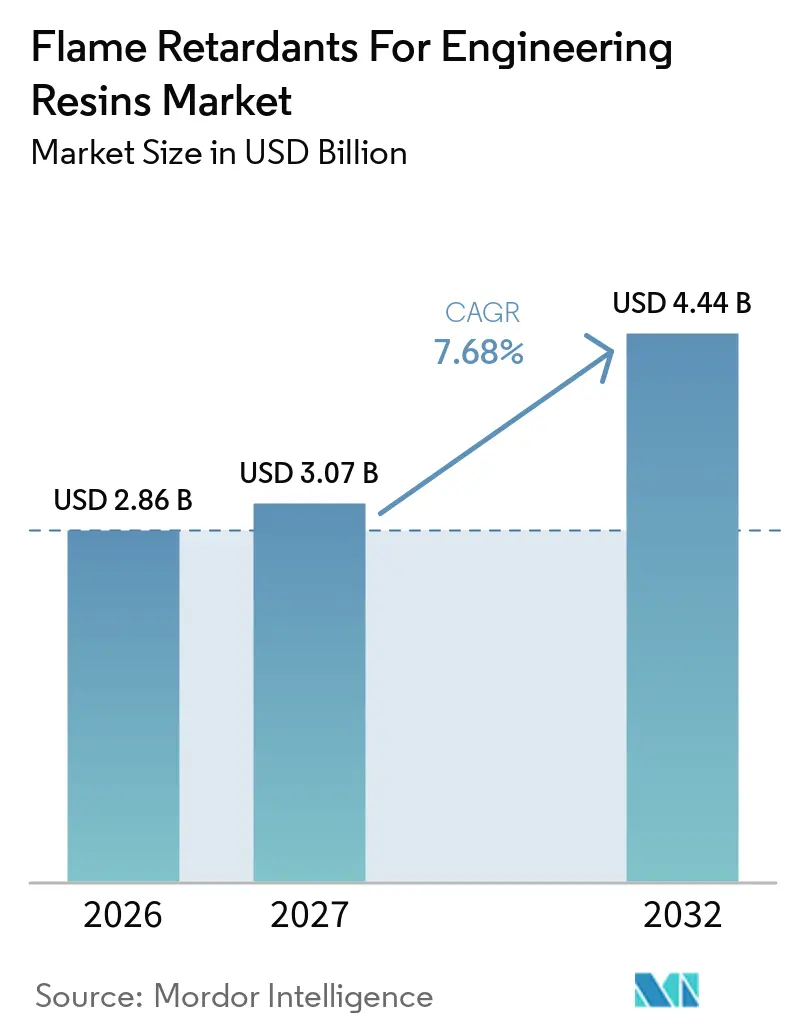
The Flame Retardants for Engineering Resins Market size was valued at USD 2.86 billion in 2026 and is estimated to grow from USD 3.07 billion in 2027 to reach USD 4.44 billion by 2032, at a CAGR of 7.68% during the forecast period (2027-2032). Demand is supported by the wider use of engineering plastics in products that must meet fire-safety requirements while also responding to sustainability requirements. Electrical equipment, vehicle electrification, battery storage, and data-center infrastructure all require polymer components that can meet demanding fire and electrical performance standards. Material qualification has become more important because a formulation must often comply with more than 1 regional standard before an original equipment manufacturer approves it. This favors suppliers with established regulatory documentation, technical support, and validated product grades. The flame retardants for engineering resins market is also shifting as limits on some brominated substances and pressure on antimony trioxide supplies change the cost and availability of established formulations.
Key Report Takeaways
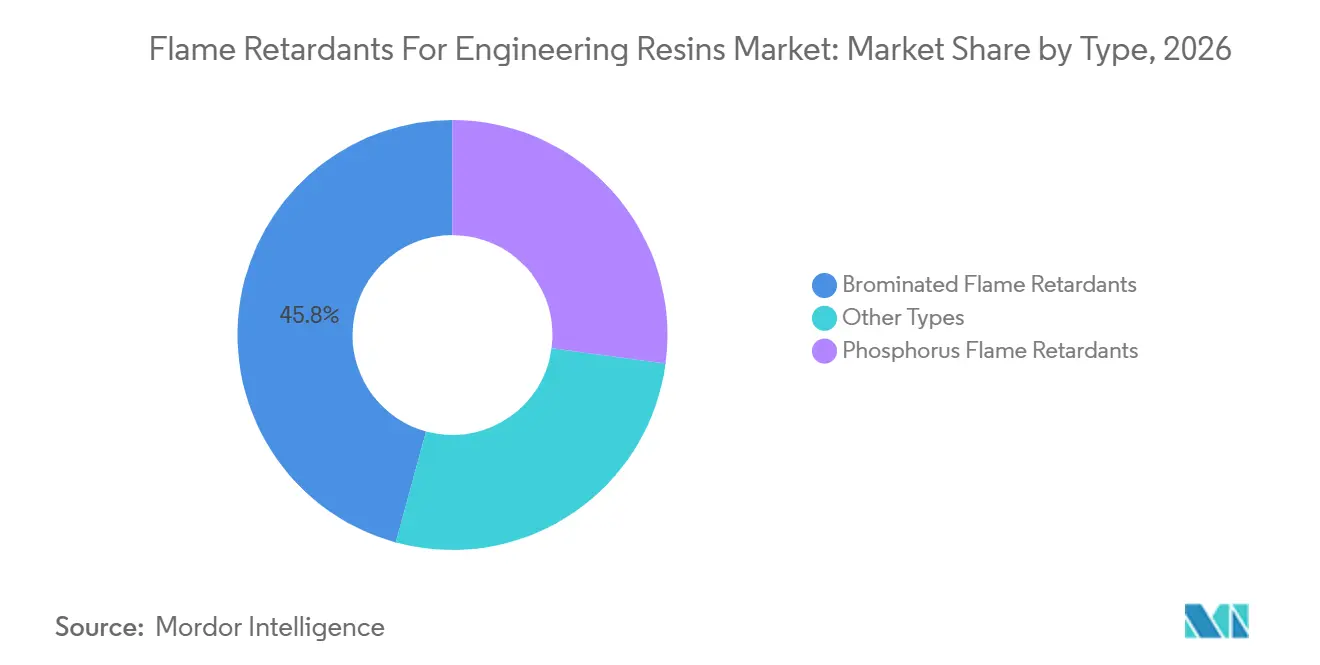
- By type, brominated flame retardants held 45.75% of the flame retardants for engineering resins market share in 2026, while phosphorus flame retardants are forecast to advance at an 8.06% CAGR through 2032.
- By application, acrylonitrile butadiene styrene (ABS) held 30.11% of the flame retardants for engineering resins market share in 2026, while polyamide is forecast to advance at an 8.21% CAGR through 2032.
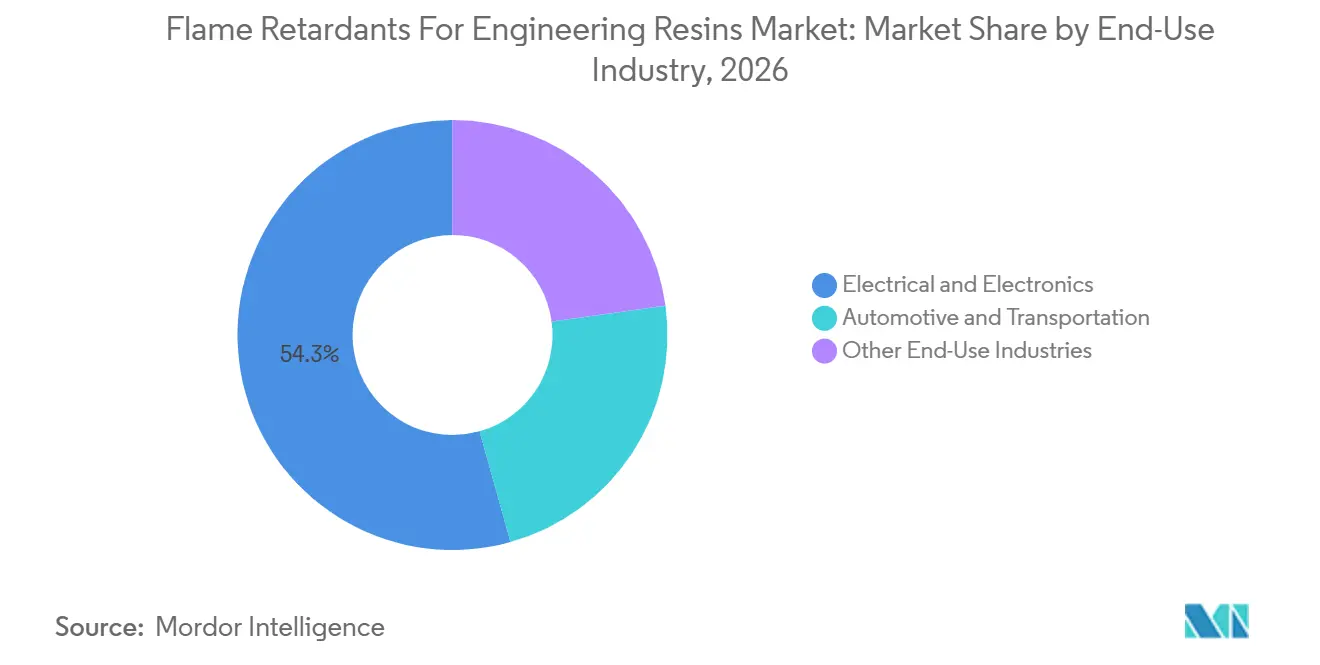
- By end-use industry, electrical and electronics held 54.34% of the flame retardants for engineering resins market share in 2026, while automotive and transportation are forecast to advance at an 8.75% CAGR through 2032.
- By geography, Asia-Pacific held 46.27% of the flame retardants for engineering resins market share in 2026 and is forecast to advance at an 8.43% CAGR through 2032.
Note: Market numbers in this report are based on Mordor Intelligence's proprietary estimation framework, which combines nine months of actuals with Q4 projections for base year 2026.
Global Flame Retardants For Engineering Resins Market Trends and Insights
Drivers Impact Analysis*
| Driver | (~) % Impact on CAGR Forecast | Geographic Relevance | Impact Timeline |
|---|---|---|---|
| Electrification of Vehicles and High-Voltage Components | +2.5% | Global, with concentrated gains in China, Germany, South Korea, and the United States | Short term (≤ 2 years) |
| Stringent Fire-Safety Standards for Electrical and Electronic Equipment | +1.9% | Global; compliance influence strongest in EU, North America, Japan, and South Korea | Medium term (2-4 years) |
| Growth in Consumer Electronics and Connected Devices | +1.5% | APAC core (China, South Korea, Japan), spillover to North America and EU | Short term (≤ 2 years) |
| Lightweighting and Engineering-Plastic Substitution in Transportation | +1.0% | Global, most pronounced in EU (CO₂ fleet regulations) and APAC EV markets | Medium term (2-4 years) |
| Battery Energy Storage and AI Data-Center Power Infrastructure | +0.8% | North America and APAC lead; MEA and Europe gaining | Long term (≥ 4 years) |
| Source: Mordor Intelligence | |||
Electrification of Vehicles and High-Voltage Components
Vehicle systems are moving toward 800 V battery platforms, which increase requirements for materials used in charging, battery-adjacent, and high-voltage connector applications. Halogenated additives can reduce the Comparative Tracking Index of polyamide and polybutylene terephthalate matrices, which can create a risk of dielectric failure where electrical arcing occurs above 400 V. Phosphorus-based systems, including aluminum diethylphosphinate grades, can achieve Comparative Tracking Index values above 600 V in glass-reinforced polyamide while retaining a Underwriters Laboratories (UL) 94 V-0 classification. These performance requirements are prompting original equipment manufacturers to specify halogen-free formulations for structural connectors and busbar housings. Envalior introduced Pocan BFN4232ZHR S1 in October 2025 for 800 V charging connectors, artificial intelligence data-center power housings, and 48 V hybrid-vehicle networks. The flame retardants for engineering resins market, therefore, benefits from a technical requirement that is tied to the design of high-voltage systems rather than a short-term substitution cycle.
Stringent Fire-Safety Standards for Electrical and Electronic Equipment
Electrical and electronic equipment suppliers increasingly use glow-wire and vertical-burn standards as baseline material screening requirements. IEC 60695-2-12 testing can require a Glow Wire Flammability Index of 775 °C to 850 °C or higher for unattended appliances, while UL 94 remains a widely used measure for evaluating plastic flammability. The European Union restricts polybrominated biphenyls and polybrominated diphenyl ethers in electrical and electronic equipment under the Restriction of Hazardous Substances Directive[1]. UL 746B was revised in September 2025 to clarify sample requirements for long-term evaluations of polymeric materials. Original equipment manufacturers serving Europe, the United States, and Asia often need 1 compound to satisfy partially different approval systems, which can extend qualification work by 9 to 18 months. The flame retardants for engineering resins market benefits when established formulations remain approved through long product cycles, and new suppliers face a more demanding documentation process.
Growth in Consumer Electronics and Connected Devices
Smart devices create a steady demand for materials that can meet thin-wall fire-performance requirements in housings and internal components. Each device can contain 8 grams to 12 grams of UL 94 V-0-compliant, halogen-free flame retardants, and demand rises with unit shipments of connected products. Miniaturized housings can have wall thicknesses of 0.75 mm or less, so formulators must maintain V-0 performance without undermining melt flow or dimensional stability. Outdoor 5G base-station enclosures also require ultraviolet-resistant engineering resins that meet IEC 62368-1 safety requirements. Avient Corporation launched Cesa MAX flame-retardant additives for polyethylene applications in September 2025 with ratings from UL 94 V-0 through V-2 and 5VA or 5VB. This requirement for low loading, thin-wall performance keeps the flame retardants for engineering resins market relevant even in mature electronics categories.
Battery Energy Storage and AI Data-Center Power Infrastructure
Battery energy storage systems require enclosure materials that can address thermal-runaway containment, which can exceed the needs of typical UL 94 V-0 applications. Such systems can require ceramic-forming or intumescent flame-retardant approaches in plastics used around battery modules. The US Department of Energy identifies supply-chain and safety requirements as central considerations for battery energy storage systems[2]. Artificial intelligence data centers are also increasing demand for polymers used in power distribution and server components. Covestro AG has described flame-retardant polycarbonate applications for next-generation artificial intelligence server air ducts. The flame retardants for engineering resins market gains a higher-value demand base as data-center materials need to balance fire safety, electrical reliability, durability, and performance across electrified-transport uses.
Restraints Impact Analysis*
| Restraint | (~) % Impact on CAGR Forecast | Geographic Relevance | Impact Timeline |
|---|---|---|---|
| Restrictions on Brominated and Other Hazardous Chemistries | -1.2% | EU (primary); North America and APAC (accelerating); compliance influence from RoHS, REACH Annex XV, and POPs Convention | Medium term (2-4 years) |
| High Formulation Cost and Performance Trade-Offs | -0.9% | Global, most pronounced in price-sensitive APAC Tier 2/3 compounder segments | Short term (≤ 2 years) |
| Contamination of Recycled Engineering-Plastic Streams | -0.6% | EU (driven by Ecodesign for Sustainable Products Regulation); growing in APAC and North America | Long term (≥ 4 years) |
| Source: Mordor Intelligence | |||
Restrictions on Brominated and Other Hazardous Chemistries
On November 11, 2025, the European Commission requested that the European Chemicals Agency prepare an Annex XV restriction dossier for certain non-polymeric aromatic brominated flame retardants. The request identified 3 substances that were confirmed as very persistent and very bioaccumulative under the Registration, Evaluation, Authorisation and Restriction of Chemicals framework. The European Chemicals Agency is also reviewing organophosphorus flame retardants, with a review timetable extending to December 2027. Compounders may need 12 to 24 months of work to reformulate and qualify each affected grade. Alternative phosphorus chemistries can carry 20% to 40% cost premiums over legacy brominated formulations. These conditions can pressure smaller compounders in the flame retardants for engineering resins market because they may lack the technical resources to manage several approved-vendor-list changes at the same time.
High Formulation Cost and Performance Trade-Offs
Halogen-free phosphorus systems can require loadings of 10% to 18% by weight in engineering polyamide and polycarbonate to meet UL 94 V-0 requirements. These loadings can raise material costs and can reduce impact strength or elongation at break in some substrates. Alumina trihydrate and magnesium hydroxide can require 40% to 60% by weight to achieve similar fire performance, which can compromise the mechanical properties expected from engineering resins. Huber Advanced Materials announced a global price increase for all product lines effective January 2026. Cost comparisons remain important for Tier 2 automotive supply chains in Southeast Asia, where procurement decisions can still prioritize per-kilogram cost over long-term compliance positioning. The flame retardants for the engineering resins industry must, therefore, improve performance at lower loading levels to broaden adoption in price-sensitive applications.
*Our forecasts treat driver/restraint impacts as directional, not additive. The impact forecasts reflect baseline growth, mix effects, and variable interactions.
Segment Analysis
By Type: Brominated Flame Retardants Lead, While Phosphorus Flame Retardants Expand
Brominated flame retardants held 45.75% of the market share in 2026. They retain broad use because they can be cost-effective in applications with less restrictive chemical requirements, perform at lower loading levels than many inorganic alternatives, and work with acrylonitrile butadiene styrene, high-impact polystyrene, and polycarbonate-acrylonitrile butadiene styrene blends. These resin systems are widely used in electrical and electronic equipment housings. Regulatory restrictions in Europe and sustainability requirements from global original equipment manufacturers are limiting their use in selected applications. The European Commission's request for an Annex XV restriction dossier gives compounders in the flame retardants for engineering resins market a clear reason to review non-polymeric aromatic brominated formulations. Phosphorus flame retardants are projected to advance at an 8.06% CAGR through 2032 because they can deliver high Comparative Tracking Index performance in polyamide and polyester systems.
Research published in 2025 found that organophosphorus flame retardants could achieve self-extinguishing UL 94 V-0 behavior in partially aromatic polyamide at phosphorus loadings as low as 4% by weight. Other formulations include alumina trihydrate, magnesium hydroxide, synergists, and nitrogen-based compounds. These systems can have favorable regulatory profiles but can reduce mechanical performance in precision-molded parts. Antimony trioxide supply constraints are also encouraging development across all chemistry groups. Albemarle Corporation expanded the SAYTEX ALERO platform with Fine and Optima variants in October 2025 to reduce dependence on antimony trioxide in textile, adhesive, and thermoplastic applications. ICL also described low-antimony-trioxide and antimony-trioxide-free brominated technologies in March 2026, reflecting demand in the flame retardants for engineering resins market for formulations that can reduce supply-chain exposure.

By Application: ABS Anchors Share While Polyamide Leads Growth
Acrylonitrile butadiene styrene held 30.11% of the market share in 2026 because it remains widely used in consumer-electronics housings, information technology hardware shells, and appliance enclosures. Its use is supported by the need for thin-wall flame performance in visible external parts. Polyamide is projected to advance at an 8.21% CAGR through 2032, supported by its thermal resistance, mechanical durability, and suitability for high-voltage connectors and industrial circuit protectors. Polyamide is also used in battery energy storage modules where fire resistance is a critical design condition. Avient Corporation launched Nymax FR REC in September 2026, offering recycled polyamide 6 and polyamide 66 grades that achieved UL 94 V-0 at 0.8 mm and a Glow Wire Flammability Index of 960 °C with 42% to 77% post-industrial recycled content. The flame retardants for engineering resins market is, therefore, seeing circular content become part of flame-retardant polyamide product design.
Polyethylene terephthalate and polybutylene terephthalate are important in automotive connectors and relay housings. CLARIANT's Exolit OP portfolio targets polybutylene terephthalate e-mobility applications that require high Comparative Tracking Index performance without halogen or antimony trioxide content. Polycarbonate and polycarbonate-acrylonitrile butadiene styrene blends continue to serve data-center and power-electronics applications. Covestro AG has presented material solutions for artificial intelligence data centers, including polymer components where flame resistance and transparency can be relevant. Other applications in the flame retardants for engineering resins market include polyphenylene sulfide, liquid crystal polymer, and polyetherimide. These resins are used in higher-value aerospace, semiconductor-equipment, and 5G antenna applications. IEC 62368-1 requirements influence the acceptable performance range for many of these material categories.
By End-Use Industry: Electrical and Electronics Leads While Automotive and Transportation Accelerate
Electrical and electronics held 54.34% of the market share in 2026. The segment includes connector housings, relay bodies, server-rack air ducts, and switchgear enclosures, all of which use flame-retardant polymer components. Demand in the flame retardants for engineering resins market differs between mature consumer devices and infrastructure hardware, such as artificial intelligence, data-center, switching systems, and industrial automation equipment. The latter applications can require premium non-halogenated formulations that also resist contact with dielectric cooling fluids. Glow-wire standards and IEC 62368-1 certification guide material qualification in this end-use area. BASF began commercial production of Elastollan flame-retardant thermoplastic polyurethane in Shanghai in March 2026 for electric-vehicle charging, industrial automation, and robotic cable uses across the Asia-Pacific region.
Automotive and transportation are projected to advance at an 8.75% CAGR through 2032. Growth in the flame retardants for engineering resins market is supported by lightweighting and by new fire-safety requirements for high-voltage battery enclosures and charging equipment. Plastic replacement of metal components raises material demand, while electric architectures create additional use cases that did not exist in conventional vehicles. Nabaltec AG's ACTILOX HTB blends are designed to form ceramic-like layers during thermal testing for battery-casing containment applications. This type of system addresses direct thermal-runaway conditions rather than standard vertical-burn testing alone. Construction, industrial machinery, and consumer goods remain important end uses, supported by building-code enforcement and replacement demand. Their growth is slower because product development cycles are longer and regulatory changes are less concentrated than in electronics and transportation.
Geography Analysis
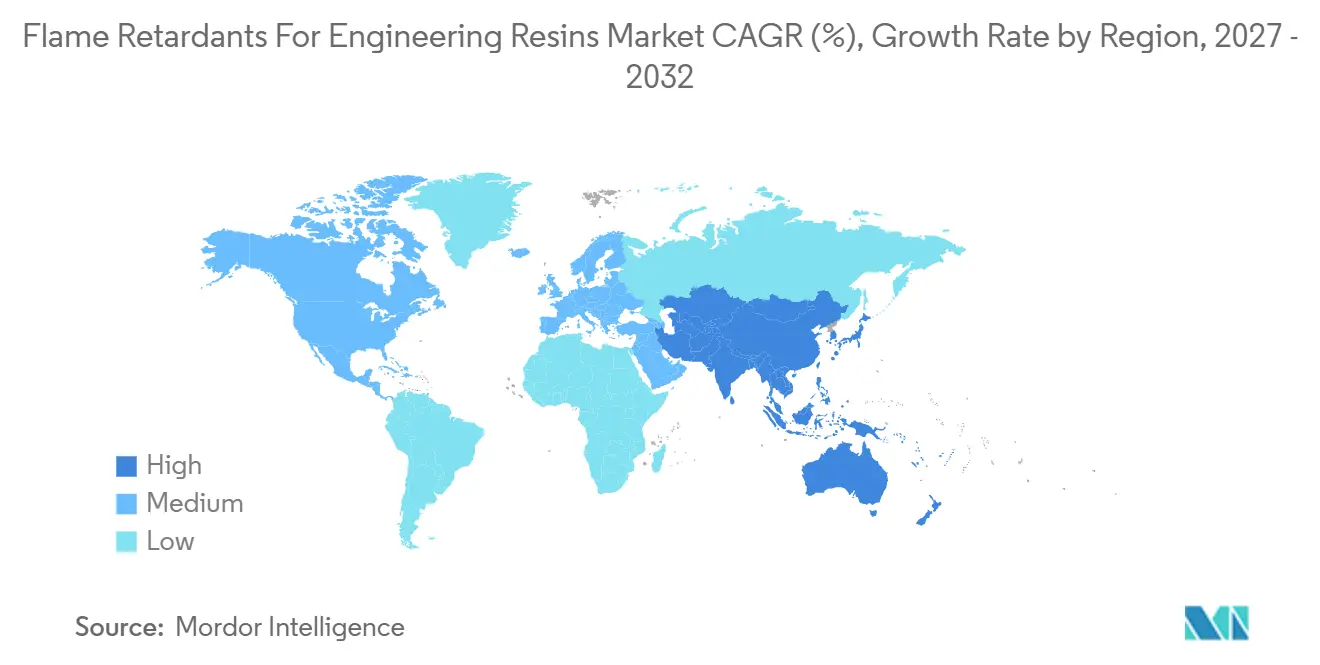
Asia-Pacific held 46.27% of the market share in 2026 and is projected to advance at an 8.43% CAGR through 2032. The region combines large engineering-resin compounding capacity with strong demand from electronics, batteries, and electric vehicles. China has a large role in flame retardants for engineering resins market demand through polyamide, acrylonitrile butadiene styrene, and polybutylene terephthalate compounding. Japan is shifting from brominated commodity chemistries toward more technical phosphorus and mineral systems. The Japan Flame Retardants Association updated its list of major flame-retardant types and suppliers in May 2025, showing continued changes in the country's supplier base.
South Korea and the Association of Southeast Asian Nations (ASEAN) countries are growing procurement centers because of battery-cell manufacturing and semiconductor-facility construction. South Korea's Chemicals Control Act adds a local compliance consideration alongside internationally applied IEC standards. North America has a mature industrial base and high compliance requirements, with demand supported by electric-vehicle manufacturing and battery storage projects. Canada and Mexico add demand through automotive supply chains that require materials qualified for several geographic markets. Europe is strongly influenced by Germany's automotive manufacturing base and by early adoption of recyclability-compatible halogen-free formulations in Nordic countries. The European Chemicals Agency's 2025 mandate is prompting flame retardants for engineering resins market participants in Europe to review qualification portfolios and allocate resources to reformulation work.
South America remains a developing demand area, with Brazil supported by electronics assembly and automotive production. Argentina and other countries in the region contribute through industrial machinery and cable-sheathing applications. The Middle East and Africa have smaller demand bases but offer opportunities where downstream plastics production, electronics assembly, and manufacturing investment are increasing. Saudi Arabia is emerging as a demand center through petrochemical-to-plastics integration and industrial development. South Africa supports regional demand through its established manufacturing base. Italmatch Chemicals S.p.A signed a supply agreement with the Saudi Water Authority in September 2026, expanding its commercial presence in the Middle East and Africa. These regional markets in the flame retardants for engineering resins market require suppliers to balance competitive pricing with the technical and compliance requirements of locally assembled products.
Competitive Landscape
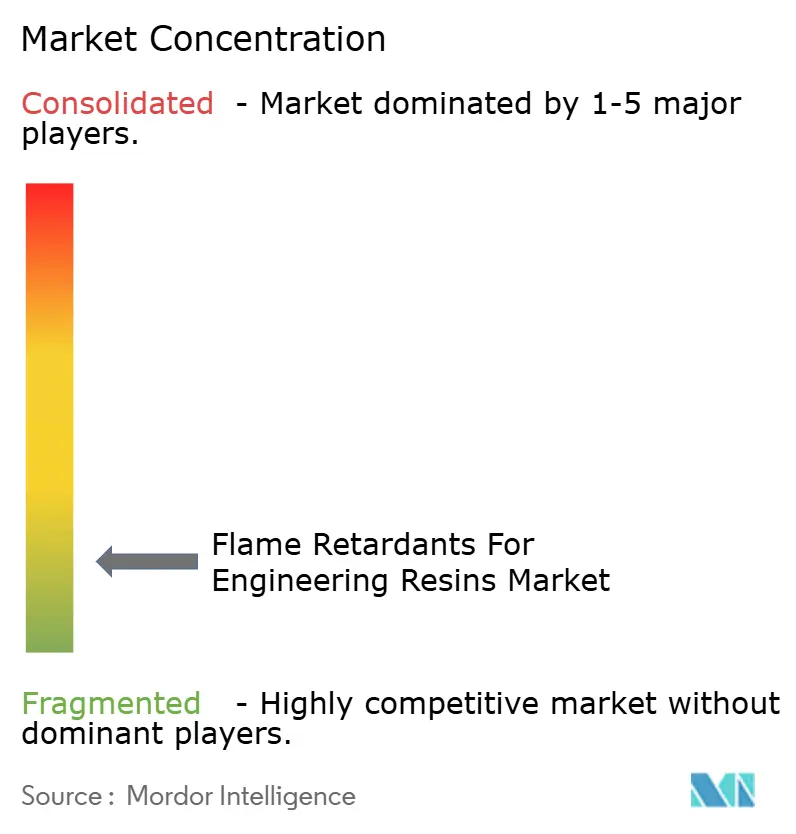
The flame retardants for engineering resins market is highly fragmented, with the top five players including Albemarle Corporation, LANXESS, ICL, BASF, and CLARIANT. Leading companies benefit from direct relationships with original equipment manufacturers, multiple manufacturing locations, and established regulatory documentation. Backward integration into bromine or phosphorus feedstocks can support supply reliability and cost control. Product approvals can create long switching cycles because compounders and original equipment manufacturers must validate a material for specific resin grades and final applications.
Capacity expansion in Asia-Pacific and antimony-trioxide-free product development are prominent strategic themes. CLARIANT completed a second production line at Daya Bay in November 2025 and announced a joint venture with FUHUA for a phosphorus-based flame-retardant facility in Sichuan Province, subject to regulatory approva. The company also opened 2 research and development laboratories in China in August 2026, including a Daya Bay laboratory for high-pressure synthesis and analytical characterization. Huber Engineered Materials acquired selected alumina trihydrate, antimony-free flame-retardant, and molybdate-based smoke-suppressant assets from The R.J. Marshall Company in May 2025. These actions strengthen material portfolios and regional supply positions without relying only on commodity-grade additives.
Opportunities in the flame retardants for engineering resins market remain in battery energy storage system compounds that form protective ceramic layers during thermal runaway. These systems sit between traditional electrical and electronic grades and construction-oriented mineral systems, leaving room for purpose-built products. Halogen-free materials that work with post-consumer recycled engineering plastics are another underdeveloped area. Fraunhofer LBF's 2025 project seeks partners for closed-loop polyamide, polyester, and acrylonitrile butadiene styrene formulations, which indicates a need for materials that preserve fire safety in recycled streams Reactive phosphorus technology can bind a flame-retardant component into the polymer matrix and may reduce migration concerns. LANXESS launched Purventis Core in September 2026 as a reactive halogen-free phosphorus product for rigid polyurethane and polyisocyanurate insulation foams, where the material bonds into the polymer matrix.
Flame Retardants For Engineering Resins Industry Leaders
-
Albemarle Corporation
-
LANXESS
-
ICL
-
BASF
-
CLARIANT
- *Disclaimer: Major Players sorted in no particular order
Recent Industry Developments
- September 2026: Avient Corporation introduced Maxxam non-halogen flame-retardant polyolefin formulations that achieve a UL 94 5VA rating at a 2.0 mm wall thickness for unmonitored household appliances, without per- and polyfluoroalkyl substances (PFAS)-containing anti-drip agents. The launch supports the flame retardants for engineering resins market by expanding fire-resistant polymer solutions that meet stringent safety requirements while addressing demand for halogen-free and PFAS-free materials.
- June 2026: CLARIANT completed an investment in its Daya Bay facility in China to expand production capacity for its Exolit OP flame retardants, including new halogen-free solutions designed for polybutylene terephthalate (PBT) used in electric mobility applications. The expansion supports the flame retardants for engineering resins market by increasing the regional supply of high-performance additives for electrical insulation and high-voltage automotive components.
Global Flame Retardants For Engineering Resins Market Report Scope
Flame retardants for engineering resins are additives incorporated into high-performance thermoplastics to reduce flammability and help meet fire-safety requirements. They are formulated to improve fire resistance while maintaining the mechanical, thermal, and electrical properties required for demanding applications.
The Flame Retardants for Engineering Resins Market is segmented by type, application, end-use industry, and geography. By type, the market is segmented into brominated flame retardants, phosphorus flame retardants, and other types. By application, the market is segmented into polyamide, ABS, PET and PBT, polycarbonate, PC/ABS blends, and other applications. By end-use industry, the market is segmented into electrical and electronics, automotive and transportation, and other end-use industries. The report also covers the market size and forecasts for flame retardants for engineering resins across 15 countries. For each segment, the market sizing and forecasts have been done on the basis of value (USD).
| Brominated Flame Retardants |
| Phosphorus Flame Retardants |
| Other Types |
| Polyamide |
| ABS |
| PET and PBT |
| Polycarbonate |
| PC/ABS Blends |
| Other Applications |
| Electrical and Electronics |
| Automotive and Transportation |
| Other End-Use Industries |
| Asia-Pacific | China |
| India | |
| Japan | |
| South Korea | |
| ASEAN Countries | |
| Rest of Asia-Pacific | |
| North America | United States |
| Canada | |
| Mexico | |
| Europe | Germany |
| United Kingdom | |
| France | |
| Italy | |
| NORDIC Countries | |
| Rest of Europe | |
| South America | Brazil |
| Argentina | |
| Rest of South America | |
| Middle East and Africa | Saudi Arabia |
| South Africa | |
| Rest of Middle East and Africa |
| By Type | Brominated Flame Retardants | |
| Phosphorus Flame Retardants | ||
| Other Types | ||
| By Application | Polyamide | |
| ABS | ||
| PET and PBT | ||
| Polycarbonate | ||
| PC/ABS Blends | ||
| Other Applications | ||
| By End-Use Industry | Electrical and Electronics | |
| Automotive and Transportation | ||
| Other End-Use Industries | ||
| By Geography | Asia-Pacific | China |
| India | ||
| Japan | ||
| South Korea | ||
| ASEAN Countries | ||
| Rest of Asia-Pacific | ||
| North America | United States | |
| Canada | ||
| Mexico | ||
| Europe | Germany | |
| United Kingdom | ||
| France | ||
| Italy | ||
| NORDIC Countries | ||
| Rest of Europe | ||
| South America | Brazil | |
| Argentina | ||
| Rest of South America | ||
| Middle East and Africa | Saudi Arabia | |
| South Africa | ||
| Rest of Middle East and Africa | ||
Key Questions Answered in the Report
What is the size of the flame retardants for engineering resins market?
The flame retardants for engineering resins market size was valued at USD 2.86 billion in 2026 and is estimated to grow from USD 3.07 billion in 2027 to reach USD 4.44 billion by 2032, at a CAGR of 7.68% during the forecast period (2027-2032).
Which type held the largest share in 2026?
Brominated flame retardants held 45.75% of the market share in 2026, supported by their cost efficiency and compatibility with several electronic resins.
Which type is projected to advance fastest through 2032?
Phosphorus flame retardants are projected to advance at an 8.06% CAGR through 2032 because of demand for high-voltage and halogen-free applications.
Which application is projected to advance fastest through 2032?
Polyamide is projected to advance at an 8.21% CAGR through 2032, supported by use in electric-vehicle connectors, circuit protection, and battery storage systems.