
Flame Retardants For Aerospace Plastics Market Size and Share
Market Overview
| Study Period | 2020 - 2031 |
|---|---|
| Market Size (2026) | USD 34.71 Million |
| Market Size (2031) | USD 40.52 Million |
| Growth Rate (2026 - 2031) | 3.14 % |
| Fastest Growing Market | Asia Pacific |
| Largest Market | North America |
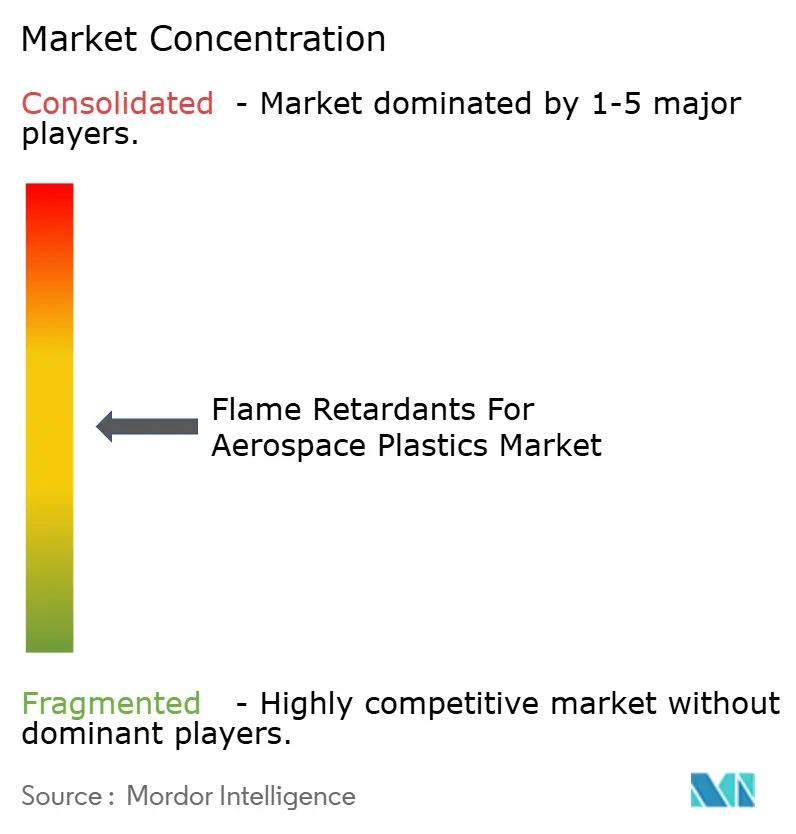
| Market Concentration | Medium |
Major Players *Disclaimer: Major Players sorted in no particular order Image © Mordor Intelligence. Reuse requires attribution under CC BY 4.0. | |
Flame Retardants For Aerospace Plastics Market Analysis by Mordor Intelligence
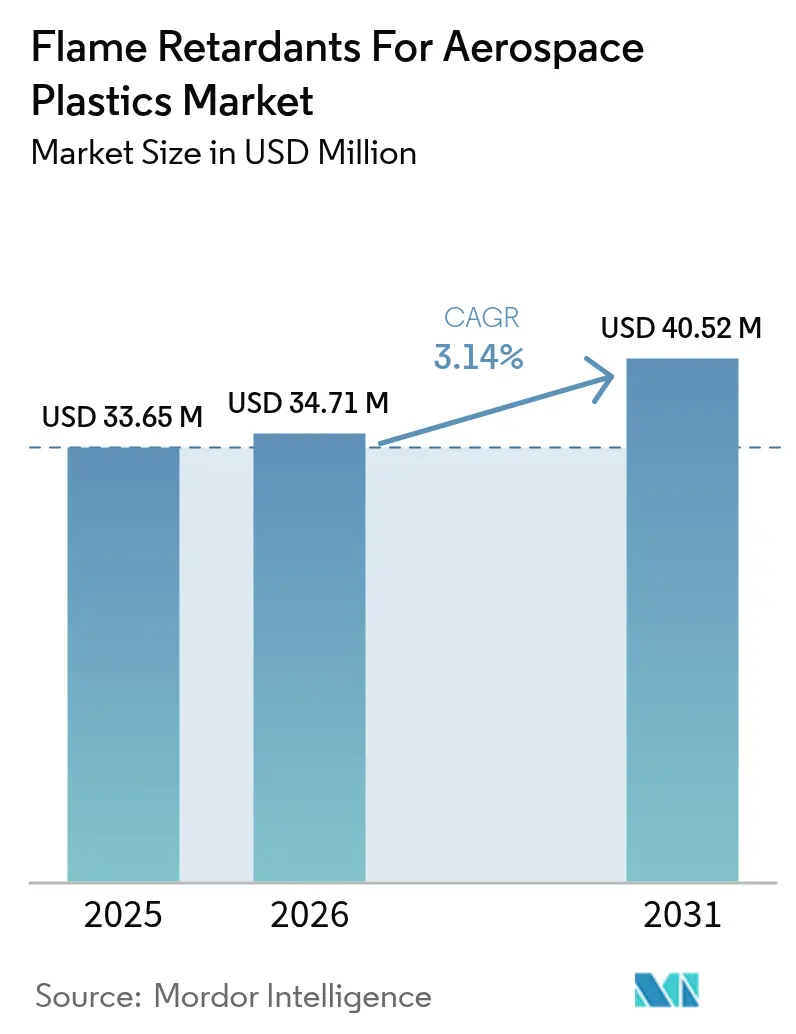
The Flame Retardants For Aerospace Plastics Market size was valued at USD 33.65 million in 2025 and estimated to grow from USD 34.71 million in 2026 to reach USD 40.52 million by 2031, at a CAGR of 3.14% during the forecast period (2026-2031). Rising aircraft build rates, the phase-out of halogenated systems, and the shift toward lightweight composite airframes underpin demand, yet each new formulation must clear 2–3-year qualification hurdles that moderate near-term volume growth. China’s September 2024 export curbs on antimony trioxide have reset raw-material risk calculations for OEMs, accelerating the search for aluminum trihydrate and phosphorus alternatives even as Boeing lifts 737 output to 38 units per month and stabilizes 787 deliveries at 5 per month. Supply-chain disruption is therefore unfolding simultaneously with production recovery, creating a delicate balance between availability and compliance for the flame retardants for aerospace plastics market. Competitive focus has moved sharply toward halogen-free innovation, with suppliers emphasizing PFAS-free portfolios and closed-loop recycling solutions rather than price concessions.
Key Report Takeaways
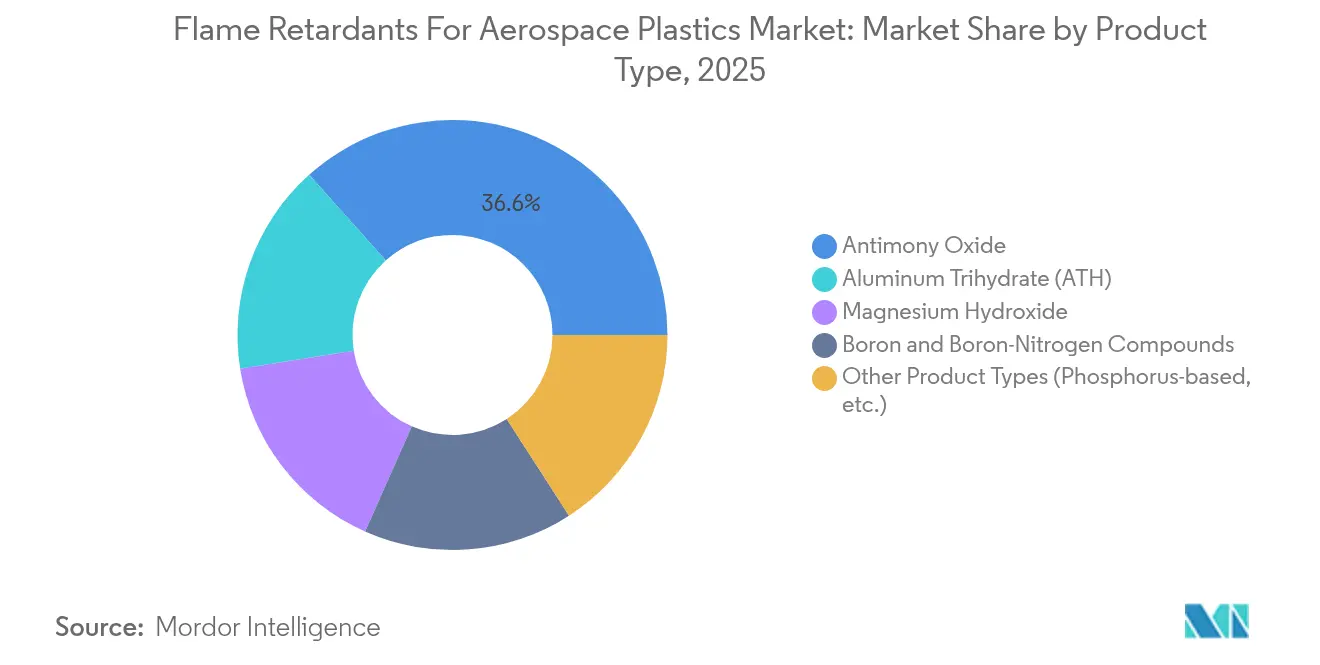
- By product type, antimony oxide led with 36.62% of flame retardants for aerospace plastics market share in 2025, while “other product types,” headed by phosphorus chemistries, are projected to post the fastest 3.99% CAGR to 2031.
- By polymer type, carbon-fiber-reinforced polymer accounted for 40.92% share of the flame retardants for aerospace plastics market size in 2025 and polyether-ether-ketone is advancing at a 4.08% CAGR through 2031.
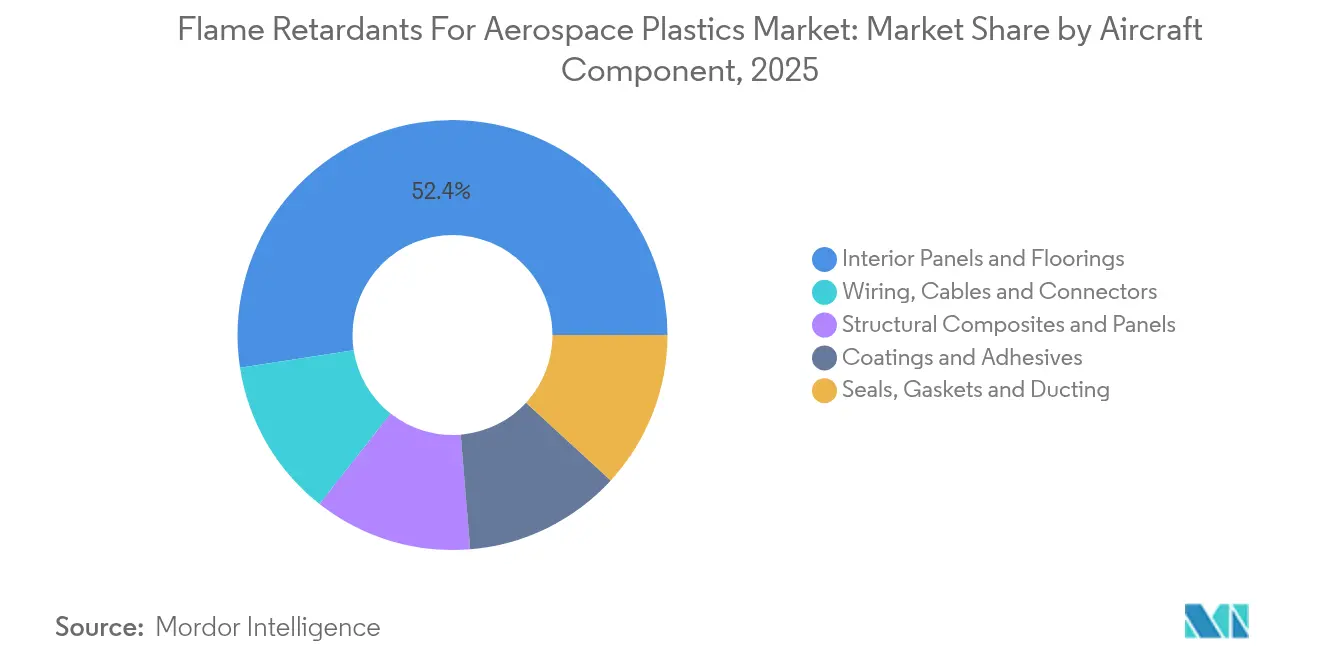
- By aircraft component, interior panels and floorings captured 52.43% of the flame retardants for the aerospace plastics market size in 2025; structural composites and panels are forecast to grow at a 4.44% CAGR to 2031.
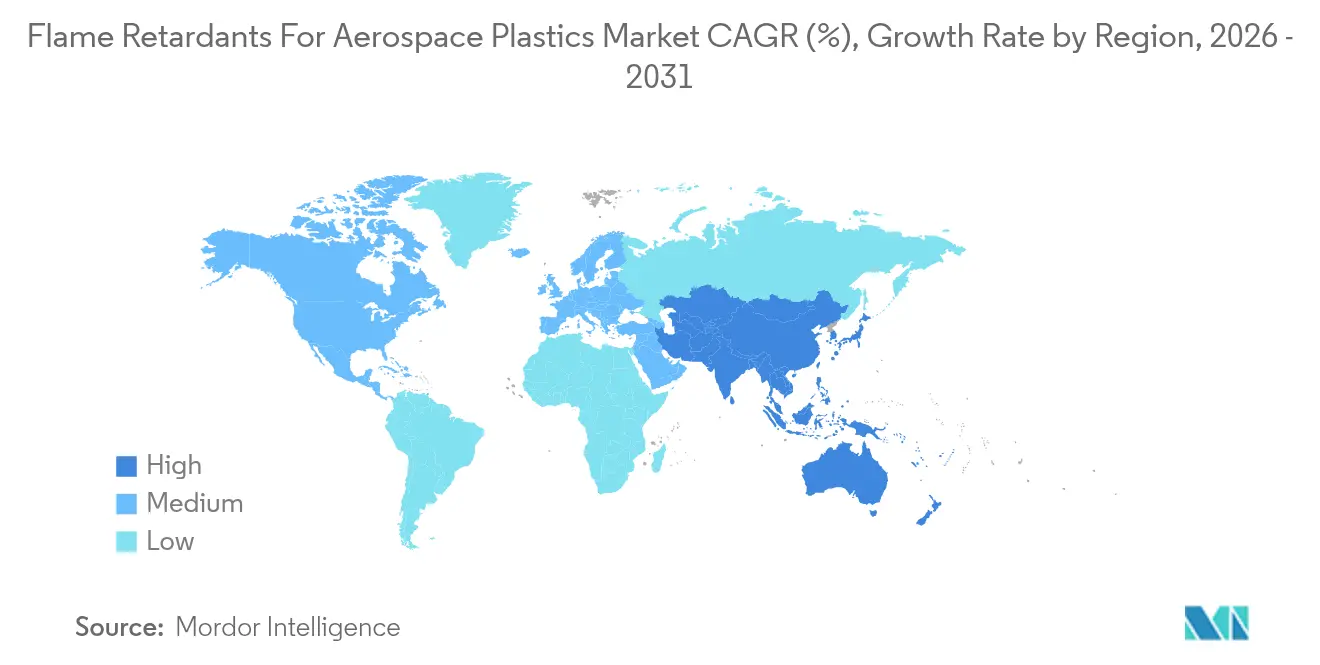
- By geography, North America held a 35.28% share of the flame retardants for the aerospace plastics market in 2025, whereas Asia-Pacific records the highest regional CAGR at 3.94% through 2031.
Note: Market size and forecast figures in this report are generated using Mordor Intelligence’s proprietary estimation framework, updated with the latest available data and insights as of 2026.
Market Trends and Insights
Drivers Impact Analysis of Flame Retardants For Aerospace Plastics Market*
| Driver | (~) % Impact on CAGR Forecast | Geographic Relevance | Impact Timeline |
|---|---|---|---|
| Stringent fire-safety regulations for cabin and structural plastics | +0.80% | Global | Long term (≥ 4 years) |
| Rising aircraft production and fleet renewal programmes | +0.70% | North America & EU, spill-over to APAC | Medium term (2-4 years) |
| Shift toward lightweight non-metallic airframes | +0.50% | Global, concentrated in North America & EU | Long term (≥ 4 years) |
| Transition to halogen-free flame retardant chemistries | +0.40% | EU & North America core, expanding to APAC | Medium term (2-4 years) |
| Expanded Use of 3D-Printed Aerospace Parts requiring flame retardants | +0.30% | North America & EU early adoption | Short term (≤ 2 years) |
| Source: Mordor Intelligence | |||
Stringent Fire-Safety Regulations for Cabin and Structural Plastics
Aviation authorities have tightened material-level tests beyond FAR 25.853. In 2024, the FAA introduced more rigorous heat-release criteria for transport-category aircraft with over 20 seats, while EASA’s 2025 halon-replacement guide requires extinguisher conversion by December 2025, indirectly raising barriers for interior plastics[1]. OEMs now design to the most demanding global rule set because regional arbitrage is vanishing. Special conditions tied to novel fuel-tank layouts on aircraft such as the A321neo XLR highlight how new designs can trigger fresh fire-protection clauses. Retrofit mandates on in-service fleets combine with forward-fit requirements, ensuring that the flame retardants for the aerospace plastics market remain buoyed by both legacy and next-generation programs.
Rising Aircraft Production and Fleet Renewal Programmes
Boeing’s backlog of more than 5,600 jets underpins a multi-year production climb, and its Q1 2025 guidance confirms 38 monthly 737 builds while projecting a step-up in 787 output to 7 per month[2]. Each incremental aircraft contains more composite content than the platform it replaces, so flame-retardant consumption grows faster than airframe counts. Fleet-renewal imperatives aimed at fuel savings advance orders for high-composite narrow-body variants, and defense modernisation programs borrow identical chemistries, further expanding addressable volumes. This production-driven pull offsets the certification drag embedded in the flame retardants for the aerospace plastics market.
Shift Toward Lightweight Non-Metallic Airframes
Composite fuselage sections offer 20–30% weight savings versus aluminum, yet demand sophisticated fire performance to maintain cabin survivability. Tests on the 787 show composite skins can limit burn-through without triggering higher toxicity, validating phosphorus-enhanced epoxy matrices that char on exposure. Growth is no longer confined to primary structures; cabin brackets, ducts, and even seat frames are migrating to thermoplastic composites that must still pass vertical Bunsen and smoke density criteria. Suppliers able to embed flame-retardant functionality directly into the polymer backbone enjoy an adoption premium because they avoid post-processing compromises.
Transition to Halogen-Free Flame-Retardant Chemistries
Environmental scrutiny of brominated additives has accelerated EU and US market exits, pushing OEMs toward phosphorus, nitrogen, and metal-hydrate solutions. Clariant completed its PFAS-free portfolio in December 2023, illustrating the commercial value of proactive reformulation. While higher loading levels can downgrade mechanical properties, newer intumescent packages pair ammonium polyphosphate with melamine to match V-0 ratings without halogens. California’s unfolding PFAS bans in consumer markets serve as leading indicators for aerospace, prompting OEMs to lock in future-proof chemistries well ahead of regulation.
Restraints Impact Analysis of Flame Retardants For Aerospace Plastics Market*
| Restraint | (~) % Impact on CAGR Forecast | Geographic Relevance | Impact Timeline |
|---|---|---|---|
| Volatile antimony-oxide pricing and supply concentration in China | -0.60% | Global, acute impact in North America & EU | Short term (≤ 2 years) |
| Toxicological scrutiny of legacy brominated systems | -0.40% | EU & North America core, expanding globally | Medium term (2-4 years) |
| Avaiability of alternatives like phenolic composites | -0.20% | Global, concentrated in mass transit crossover applications | Long term (≥ 4 years) |
| Source: Mordor Intelligence | |||
Volatile Antimony-Oxide Pricing and Supply Concentration in China
With China supplying around two-thirds of global capacity, the September 2024 export control shattered the security of supply for antimony trioxide, the single largest product segment at 37.28% share. U.S. import dependence exceeds 60%, and replacement sources in Tajikistan or Australia face 18–24-month aerospace qualification windows. Spot prices have jumped 100–200%, compelling OEMs to fast-track aluminum trihydrate and phosphorus systems despite the exhaustive test matrix each new additive must clear. Near-term volatility therefore drags on the flame retardants for the aerospace plastics market until alternative chemistries gain full certification.
Toxicological Scrutiny of Legacy Brominated Systems
Voluntary removal of Deca BDE from North American supply chains signalled the shifting regulatory tide, and REACH continues to re-classify brominated agents as substances of very high concern. As recycling mandates loom, OEMs weigh end-of-life costs alongside fire performance, nudging them toward chemistries with cleaner toxicity profiles. Yet halogen-free packages often demand higher dosage, pressing engineers to safeguard strength-to-weight targets. The uncertain regulatory horizon can pause specification finalisation, slowing immediate uptake in the flame retardants for aerospace plastics market.
*Our forecasts treat driver/restraint impacts as directional, not additive. The impact forecasts reflect baseline growth, mix effects, and variable interactions.
Flame Retardants For Aerospace Plastics Market Segment Analysis
By Product Type:
Antimony Oxide Dominance Under Supply PressureAntimony oxide commands the largest slice of the flame retardants for the aerospace plastics market at 36.62% in 2025. However, China’s export restrictions have made this leadership fragile, sparking 2-year price swings and spurring OEMs to certify aluminum trihydrate and magnesium hydroxide blends that release water endothermically and promote char at lower smoke toxicity. Other product types, which encapsulate these alternatives plus next-generation phosphorus compounds, are expected to clock a 3.99% CAGR through 2031-the fastest among all categories. Suppliers with broad portfolios capable of bridging the qualification gap are positioned to absorb share as antimony-centric lines confront scarcity. Notably, some organophosphorus compounds that graft onto polymer chains are being adopted because they curb additive migration and therefore prolong in-service fire performance.
The substitution race reshapes procurement hierarchies as OEMs seek single-source partners that can deliver multi-chemistry coverage. Start-ups advancing boron-nitrogen hybrids aim to combine flame suppression with smoke reduction, but certification inertia means incumbent suppliers with aerospace pedigrees still own the buying centre. Consequently, the flame retardants for aerospace plastics market remains an incumbent’s game for now, albeit with clear incentive for diversification.

By Polymer Type:
CFRP Leadership Drives Advanced FormulationsCarbon-fiber-reinforced polymers sit atop polymer demand with a 40.92% share, mirroring the aerospace imperative to maximise strength-to-weight ratios. Epoxy matrices in CFRP respond well to phosphorus additives that foster insulating char without degrading interfacial bonding. Polyether-ether-ketone, while smaller in volume, is on track for the highest 4.08% CAGR due to its ability to handle 300 °C service conditions in engine nacelles and hot doors. This thermoplastic shift also dovetails with recyclability targets, prompting suppliers to create flame-retardant packages that survive multiple melt cycles.
Polycarbonate and thermoset polyimide niches keep their foothold through optics and high-temperature resistance, respectively, and each demands custom additive tuning. Because processing temperatures vary from under 200 °C in polycarbonate to more than 400 °C in some high-performance thermoplastics, universal solutions remain elusive, reinforcing the bespoke orientation of the flame retardants for aerospace plastics market.
By Aircraft Component:
Interior Applications Lead Structural GrowthCabin panels and floorings accounted for 52.43% of the 2025 volume, reflecting strict smoke density and toxicity limits in enclosed passenger spaces. Designers now favour halogen-free intumescent coatings that swell under heat, protecting underlying composite laminates while limiting harmful gas evolution. Conversely, structural composites and wing-box panels will post the swiftest 4.44% CAGR as next-gen medium-haul platforms incorporate larger monolithic barrels.
Meanwhile, wiring harnesses, seals, and ducts continue to demand low-corrosivity additives that maintain flexibility. Additive manufacturing opens fresh component classes such as custom air-diffuser grills, all of which must clear vertical flammability and smoke tests. Diversity of applications therefore propels specialist formulating skills, cushioning the flame retardants for aerospace plastics market from commoditisation.
Geography Analysis
North America Flame Retardants for Aerospace Plastics Market
North America dominates with a 35.28% 2025 share, anchored by Boeing’s Washington and South Carolina clusters and a robust supplier ecosystem capable of rapid material qualification. FAA advisory circulars offer transparent certification pathways, fostering early adoption of novel additives. Defense budgets layer incremental demand on top of commercial projects, further buttressing regional volumes. The flame retardants for the aerospace plastics market thus enjoy a dual-channel lift across civil and military build rates in the United States.
APAC Flame Retardants for Aerospace Plastics Market
Asia-Pacific, though smaller, is the quickest-rising at 3.94% CAGR out to 2031. Chinese, Indian, and Japanese OEM programs are localising material supply, incentivising Western suppliers to form joint ventures that meet identical quality thresholds at a lower cost base. Government incentives-from China’s commercial aviation development plan to India’s production-linked schemes-make the region a magnet for new flame retardant manufacturing footprints. End-market growth also stems from regional carriers expanding narrow-body fleets, which translates into higher composite content per airframe and therefore higher additive intensity.
Europe Flame Retardants for Aerospace Plastics Market
Europe brings environmental stringency to the fore. REACH registration and EASA halon-replacement deadlines are pushing OEMs toward halogen-free and even bio-based solutions, permitting suppliers to price at a premium for compliance assurance. Circular-economy pilots, especially around composite recycling, mean that any new flame retardant package must enable-not obstruct-material recovery. Consequently, European demand skews toward high-value additive systems, providing margin uplift within the global flame retardants for aerospace plastics market.
Regulatory Landscape
Certification for aerospace plastics and their flame-retardant packages is anchored in transport-category flammability and heat-release requirements, notably FAA 14 CFR 25.853 (Appendix F) and the parallel EASA CS-25.853 framework. For many cabin interior parts, qualification commonly centers on Appendix F vertical/horizontal burn methods and OSU heat-release testing (55/55). EASA guidance aligns closely with FAA compliance methods referenced in FAA Policy Statement PS-ANM-25.853-01-R2, which standardizes test expectations across jurisdictions and reduces room for regional specification arbitrage.
Alongside performance regulation, chemical compliance pressure is reshaping allowable additive choices. REACH-driven SVHC scrutiny and the widening focus on PFAS are accelerating OEM and tier-supplier requests for halogen-free and PFAS-free material declarations and traceability, which in turn raises documentation and change-control burdens for flame retardant suppliers. The March 2026 launch of Americhem's PFAS-free ColorFast SFT5500 platform, positioned to meet FAA 25.853 55/55 OSU requirements, shows how product development is being steered by both fire testing pathways and evolving substance restrictions.
Value Chain Analysis
The value chain starts with upstream feedstocks and base chemistries (antimony trioxide, metal hydrates such as ATH and magnesium hydroxide, and phosphorus-based systems), then moves to specialty flame-retardant producers and compounders that tailor packages to aerospace polymers including CFRP epoxy systems, polycarbonate, and high-temperature thermoplastics such as PEEK. Formulations are followed by resin compounders, prepreg and composite fabricators, and plastics processors supporting tier suppliers for interiors, ducts, wiring components, seals, and coatings, before reaching OEM qualification and aircraft production. Because aerospace adoption is governed by regulated flammability, smoke, toxicity, and OSU heat-release testing, laboratory validation and documentation remain in-line with manufacturing rather than a downstream afterthought.
The main bottleneck remains qualification stability. Any change in additive source, loading, or carrier resin triggers re-testing and a multi-stakeholder approval loop, which slows substitution even when supply risk is acute. China’s September 2024 export curbs on antimony trioxide have amplified this constraint, pushing OEMs and tier suppliers to qualify antimony-free and halogen-free alternatives while managing long lead times for recertification. Recent company actions point to where value is accruing, including Americhem introducing PFAS-free thermoplastic platforms for aircraft interiors in March 2026, and major flame retardant players, such as Clariant, Albemarle, and Evonik, emphasizing non-halogenated and polymeric portfolios that align with tightening environmental declarations in aerospace procurement.
Competitive Landscape
The field is moderately fragmented yet technologically intensive. BASF, Clariant, and SABIC each lever diversified chemistries and in-house test centres that shorten OEM qualification cycles. Clariant’s PFAS-free rollout in 2023 typifies proactive compliance positioning, gaining favour among European and North American customers wary of future bans. BASF is pushing organophosphorus innovations that covalently bond to polymer matrices to curb out-gassing, while SABIC capitalises on integrated upstream resin production to ensure additive compatibility throughout the supply chain.
Chinese export controls on antimony are triggering strategic partnerships between aircraft OEMs and chemical majors to co-develop hydrates and phosphorus blends. New entrants are exploring bio-based feedstocks, but the mandatory fire, smoke, and toxicity (FST) test matrix creates an entry moat. Additive-manufacturing-compatible powders are emerging as a white-space niche; Evonik’s PA12 launch in November 2024 underscores this direction as 3D-printed air-ducts move from prototype to cabin installation. Price remains a secondary lever because flame retardant cost is marginal relative to total airframe value, leaving technical performance and regulatory assurance as primary differentiators across the flame retardants for aerospace plastics market.
Flame Retardants For Aerospace Plastics Industry Leaders
-
BASF SE
-
Clariant
-
HUBER CORPORATION
-
LANXESS
-
DuPont
- *Disclaimer: Major Players sorted in no particular order
Flame Retardants For Aerospace Plastics Market Companies Covered in this Report
- ADEKA Corporation
- BASF SE
- Clariant
- DuPont
- Evonik Industries AG
- HUBER CORPORATION
- ICL
- Italmatch Chemicals S.p.A
- LANXESS
- Marshall Additive Technologies
- Nabaltec AG
- RTP Company
- SABIC
- Solvay
Read Analysis of Flame Retardants For Aerospace Plastics Companies
Market Opportunities and Future Outlook
A clear whitespace is forming around halogen-free, PFAS-free flame-retardant solutions that can clear FAA 14 CFR 25.853 and aligned EASA requirements without forcing excessive additive loading or compromising mechanical properties in high-performance polymers. This is translating into opportunities for suppliers that can deliver pre-qualified platforms for interiors and structural applications, as indicated by Americhem's March 2026 ColorFast SFT5500 launch positioned for 55/55 OSU heat-release compliance and low smoke/toxicity needs in aircraft interior components. Demand also extends to integrated, inherent-flame-retardant resin and oligomer systems that reduce additive migration and simplify processing for composites and thermoplastics.
Innovation around sustainable and high-temperature composite systems is also opening development lanes tied to aerospace lightweighting and certification constraints. In January 2026, Sumitomo Bakelite disclosed development of a biomass-derived PFA resin-based prepreg designed to match phenolic-class flame retardancy for aircraft interiors under 14 CFR Part 25 FST requirements, pointing to a commercialization path where sustainability targets intersect with regulated fire performance. On the structural side, SABIC's May 2026 introduction of an ULTEM reactive oligomer aimed at thermoset composites with inherent flame retardance underscores the demand for multifunctional materials that combine toughness, heat resistance, and fire performance for primary and secondary structures, where qualification time and design freeze windows tend to favor suppliers that provide ready-to-test, application-specific data packages.
Recent Industry Developments in Flame Retardants For Aerospace Plastics Market
- March 2026: Americhem expanded its aircraft interior portfolio with the ColorFast SFT5500 PFAS-free thermoplastic platform engineered to meet FAA 14 CFR 25.853, Appendix F, Part IV 55/55 OSU heat-release requirements, alongside low-smoke and low-toxicity performance targets. The launch supports cabin-material changeovers away from fluorinated chemistries while maintaining a clear certification pathway for large-surface-area interior components. It also increases competitive pressure on compounders and additive suppliers to offer compliant, documentation-ready alternatives for regulated interior programs.
- November 2025: Clariant announced a joint venture with FUHUA in Leshan, Sichuan Province, focused on developing phosphorus-based, halogen-free flame retardants. The move strengthens Clariant's access to local production and development resources in China, a key region for both chemicals and aerospace supply chains. It also reflects the market shift toward halogen-free chemistries as OEMs tighten substance restrictions and seek supply resilience.
- November 2024: Evonik introduced flame-retardant PA12 and carbon black-infused powders for additive manufacturing, targeting parts that require elevated heat and light resistance, including aerospace-relevant applications. The release supports the expanding use of 3D-printed components that still must pass stringent flammability and smoke requirements for interior and ducting use cases. It broadens the addressable flame-retardant toolkit beyond traditional compounding into certified AM powder platforms.
Flame Retardants For Aerospace Plastics Market Report Scope and Research Methodology
Market Definition and Coverage
This market covers chemical additives used to help aerospace-grade plastic parts meet aircraft fire, smoke, and toxicity needs, and it counts revenues generated from supplying these additives into aerospace plastic formulations.
Scope exclusions: Excluded from this sizing are flame-retardant coatings, films, and fabrics that are applied as separate surface layers rather than being used as additives inside plastics.
Segments Covered in This Report
- By Product Type
- Antimony Oxide
- Aluminum Trihydrate (ATH)
- Magnesium Hydroxide
- Boron and Boron-Nitrogen Compounds
- Other Product Types (Phosphorus-based, etc.)
- By Polymer Type
- Carbon-Fibre-Reinforced Polymer (CFRP)
- Polycarbonate
- Thermoset Polyimides
- Polyether-ether-ketone (PEEK)
- Other Polymer Type (Polyether-ketone-ketone (PEKK), etc.)
- By Aircraft Component
- Interior Panels and Floorings
- Wiring, Cables and Connectors
- Structural Composites and Panels
- Seals, Gaskets and Ducting
- Coatings and Adhesives
- By Geography
- Asia-Pacific
- China
- Japan
- India
- South Korea
- ASEAN Countries
- Rest of Asia-Pacific
- North America
- United States
- Canada
- Mexico
- Europe
- Germany
- United Kingdom
- France
- Italy
- Spain
- Russia
- NORDIC Countries
- Rest of Europe
- South America
- Brazil
- Argentina
- Rest of South America
- Middle East and Africa
- Saudi Arabia
- South Africa
- Rest of Middle East and Africa
- Asia-Pacific
Data Sources, Market Sizing, and Validation
Desk Research
Desk work started by mapping where flame retardants are consumed inside aircraft plastic parts, and then linking that use to aircraft build activity and material substitution trends. We referenced public aerospace production and delivery statistics, such as those published by ICAO and national aviation authorities, along with trade data from sources like UN Comtrade and the US International Trade Commission to sense-check polymer and additive flows.
To ground the technical assumptions, we used open literature and standards references, such as FAA and EASA fire safety guidance summaries, SAE publications where accessible, and peer-reviewed polymer and additive studies that discuss FST performance and loading ranges. Company filings, sustainability reports, and investor decks were used to understand product mix and exposure to aerospace end uses, and a paid subscription database was used selectively for company financials and for patent lookups. The sources listed here are illustrative only, and many other public sources were reviewed for data capture, clarification, and cross-checking.
Primary Interviews and Surveys
Primary work focused on validating how often each plastic family is used in aircraft interiors and wire systems, and what typical flame-retardant loading levels look like after qualification. We spoke with a mix of additive suppliers, compounders, aerospace material distributors, and aircraft supply chain experts across major demand regions, so gaps from desk research could be filled and then reconciled back into the model.
Distribution of primary research fieldwork respondents
| Company type | Respondent position | Region |
|---|---|---|
| Top tier: 37% | CXOs: 15% | APAC: 53% |
| Mid tier: 41% | Functional/Unit leaders: 31% | EMEA: 29% |
| Smaller Players: 22% | Managers: 54% | Americas: 18% |
Market-Sizing & Forecasting
Sizing was built mainly from a top-down demand pool that reconstructs additive demand from aircraft production and retrofit activity, and then filters that pool by the share of plastic parts that require certified FST performance. After setting the demand pool, we applied typical additive loading ranges and price bands to convert implied volumes into revenues, and we reconciled the results across regions.
Key model inputs included aircraft deliveries and fleet utilization signals, the mix shift toward lightweight interior plastics and high-performance polymers, typical formulation loading rates by polymer family, qualification lead times that slow adoption, and average selling price movement for key chemistries where feedstock pressure shows up. For forecasting, scenario analysis was used around aircraft build rates and cabin refresh cycles, and the final path was aligned to what interviewed experts described as the most likely planning case. As a check, selective bottom-up approximations were run using sampled supplier revenues tied to aerospace exposure and a few volume-by-application builds, and any gaps were handled by applying conservative penetration assumptions where data remained thin.
Data Validation & Update Cycle
Validation was done through stepwise cross-checks so each output could be traced back to a real demand signal, and then reviewed for consistency across regions and years. We compared totals against independent indicators like aircraft delivery trends, material use intensity per aircraft class, and known qualification timelines, and we reworked outliers before sign-off.
Before publication, the model and assumptions go through a second analyst review, and any large variances trigger follow-up questions with industry contacts. Reports are refreshed annually, and interim updates are made when material events occur, such as sharp build-rate changes or major regulatory shifts. Right before delivery, a final pass is performed so clients receive the most current view available.
Mordor Intelligence's Flame Retardants for Aerospace Plastics Market Sizing Compared With Other Published Estimates
Published market sizes for this topic often differ even when everyone is looking at the same aircraft and polymer trends, because the calculation depends heavily on what is counted as an aerospace plastic flame-retardant sale. Differences also come from the starting year, how prices are converted into USD, and whether the forecast assumes a steady delivery ramp or a faster catch-up cycle.
Flame-retardant films and surface-applied coatings are not included here, and they sit outside Mordor Intelligence's scope for this market, which is one of the main reasons some figures look higher. Other gaps usually show up in how loading rates are assumed for different polymers, whether retrofit demand is treated as recurring or one-time, and how quickly halogen-free systems are assumed to replace legacy chemistries in certified parts.
Benchmark comparison
| Source | Market Size | Gaps in Research Methodology |
|---|---|---|
| Mordor Intelligence | USD 34.71 M (2026) | |
| Global Consultancy A | USD 36.09 M (2025) | Uses an earlier base year and a broader application list that appears to include non-aerospace polymer end uses, and it also assumes a faster price and adoption ramp into multiple resin families. |
| Industry Research Group B | USD 35.80 M (2025) | Leans on a higher near-term growth path tied to build-rate recovery and applies a stronger substitution assumption for high-performance polymers, which can lift implied additive volumes per aircraft. |
The spread across sources is mostly explained by what adjacent materials get counted, the specific base year selected, and how loading and pricing are treated during qualification-driven adoption. By tying each step back to aircraft activity, polymer usage, and realistic formulation ranges, we keep the estimate transparent enough to be repeated and checked year to year.
Key Questions Answered in the Report
What is the current size of the flame retardants for aerospace plastics market?
The market is valued at USD 34.71 million in 2026 and is projected to reach USD 40.52 million by 2031.
Which product type dominates demand?
Antimony oxide leads with 36.62% share, though its future is clouded by Chinese export controls.
Which geographic region is growing fastest?
Asia-Pacific registers the highest 3.94% CAGR through 2031 as China, India, and Japan ramp up aerospace manufacturing.
Why are halogen-free formulations gaining ground?
Stricter environmental rules, especially in Europe and North America, are phasing out brominated additives in favour of phosphorus-, nitrogen-, and metal-hydrate-based solutions.
How will 3D printing affect the flame retardants for aerospace plastics market?
Adoption of additive manufacturing for cabin and replacement parts is opening a niche for specialty flame-retardant powders, expanding demand beyond traditional injection-moulding applications.
What impact do antimony export restrictions have on the market?
China’s controls have doubled spot prices and triggered urgent qualification of aluminum trihydrate and phosphorus alternatives, injecting short-term volatility into supply and pricing.