
Finished Vehicles Logistics Market Size and Share
Market Overview
| Study Period | 2020 - 2031 |
|---|---|
| Market Size (2026) | USD 152.1 Billion |
| Market Size (2031) | USD 185.35 Billion |
| Growth Rate (2026 - 2031) | 4.04 % |
| Fastest Growing Market | Asia-Pacific |
| Largest Market | Asia Pacific |
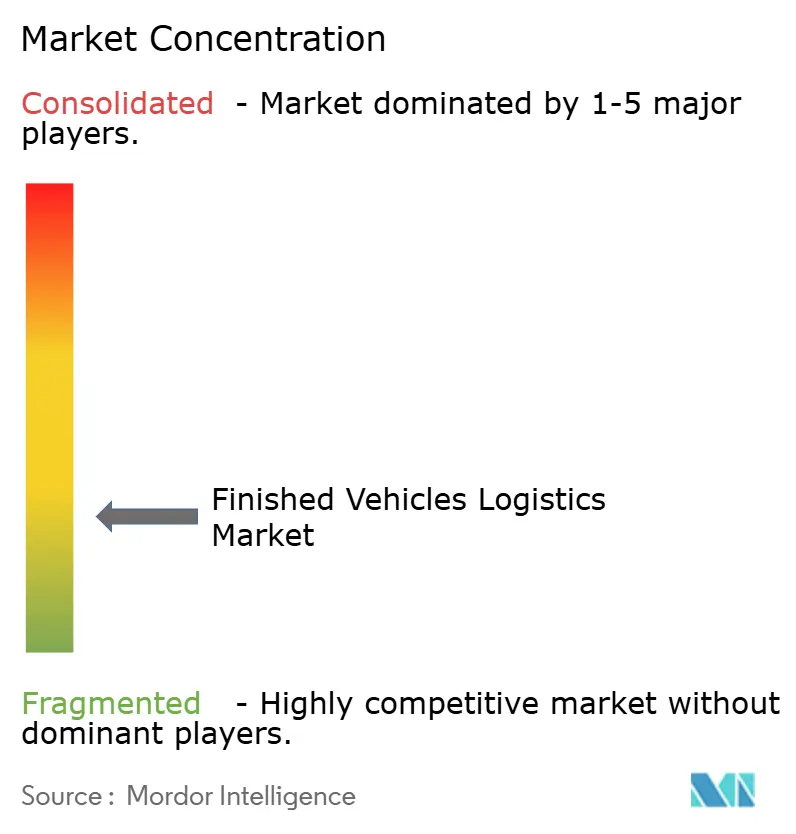
| Market Concentration | Low |
Major Players *Disclaimer: Major Players sorted in no particular order Image © Mordor Intelligence. Reuse requires attribution under CC BY 4.0. | |
Finished Vehicles Logistics Market Analysis by Mordor Intelligence
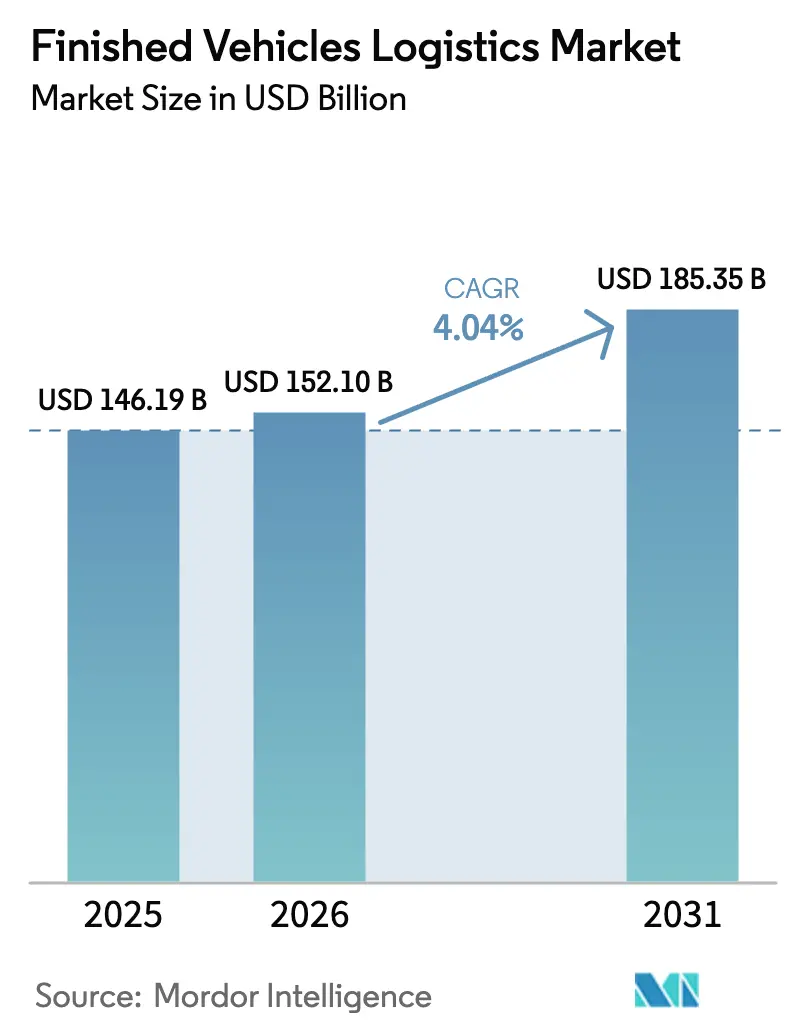
Finished Vehicles Logistics market size in 2026 is estimated at USD 152.1 billion, growing from 2025 value of USD 146.19 billion with 2031 projections showing USD 185.35 billion, growing at 4.04% CAGR over 2026-2031.
The steady trajectory reflects the transition from purely transportation-focused services to integrated, technology-enabled supply chains that accommodate rising vehicle production volumes, particularly in the Asia-Pacific region. Demand is underpinned by Chinese automotive exports that continue to reshape global trade lanes and catalyze new port, rail, and road investments. Competitive differentiation stems from digital freight-visibility platforms, value-added processing centers, and specialized handling solutions for electric vehicles. Providers able to bundle transportation, warehousing, and predictive analytics are capturing premium contracts as OEMs tighten delivery windows and seek end-to-end visibility. Cost headwinds from driver shortages and fuel price volatility are pushing the sector toward larger, well-capitalized operators that can absorb margin pressure and invest in alternative-energy fleets.
Key Report Takeaways
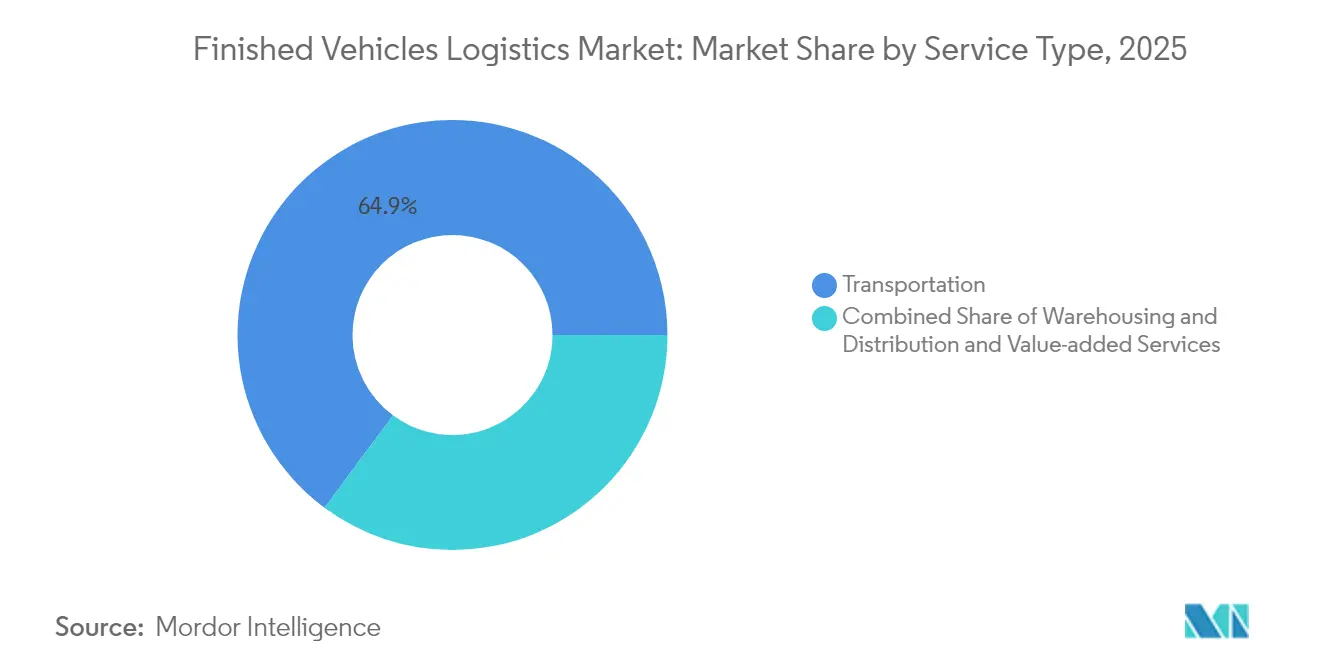
- By service type, transportation held 64.85% of the Finished Vehicles Logistics market share in 2025, while warehousing and distribution is projected to expand at a 3.84% CAGR through 2031.
- By destination, domestic logistics captured a 62.55% share of the Finished Vehicles Logistics market size in 2025; international flows are forecast to grow at a 3.52% CAGR to 2031.
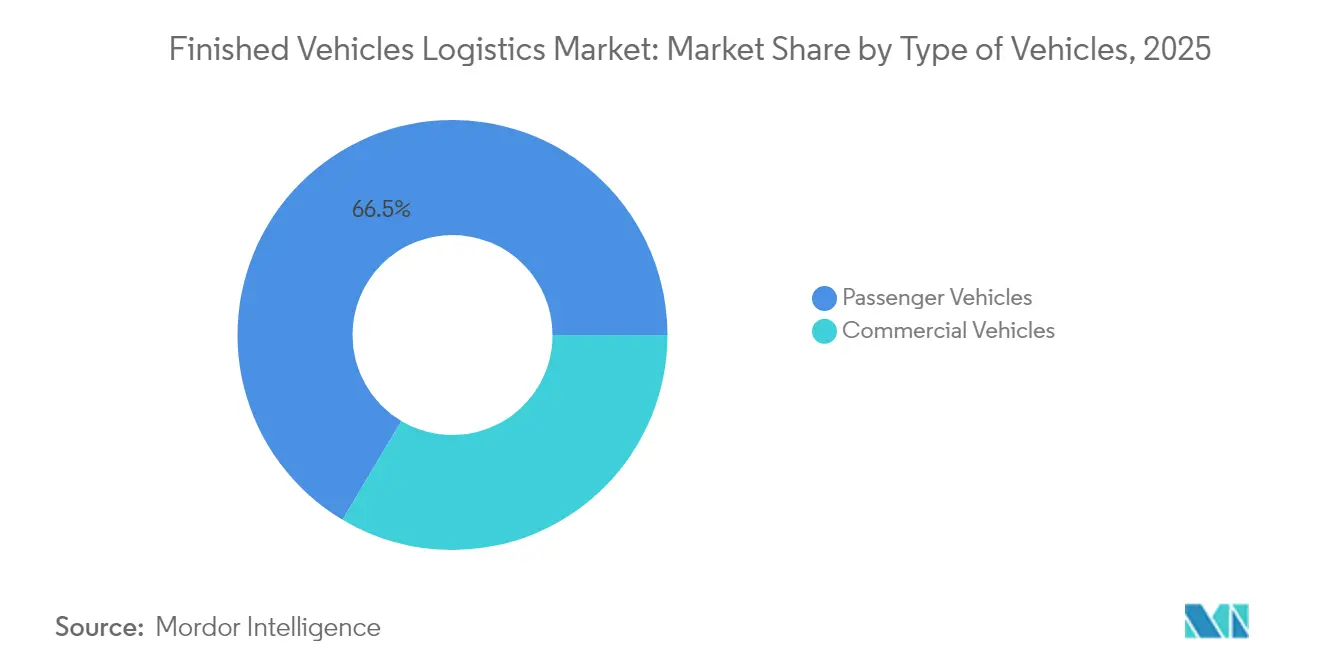
- By type of vehicles, passenger vehicles led with 66.45% share of the Finished Vehicles Logistics market in 2025 and are expected to advance at a 4.06% CAGR through 2031.
- By end-user industry, OEMs commanded 68.35% share of the Finished Vehicles Logistics market in 2025 and are expected to progress at a 4.24% CAGR to 2031.
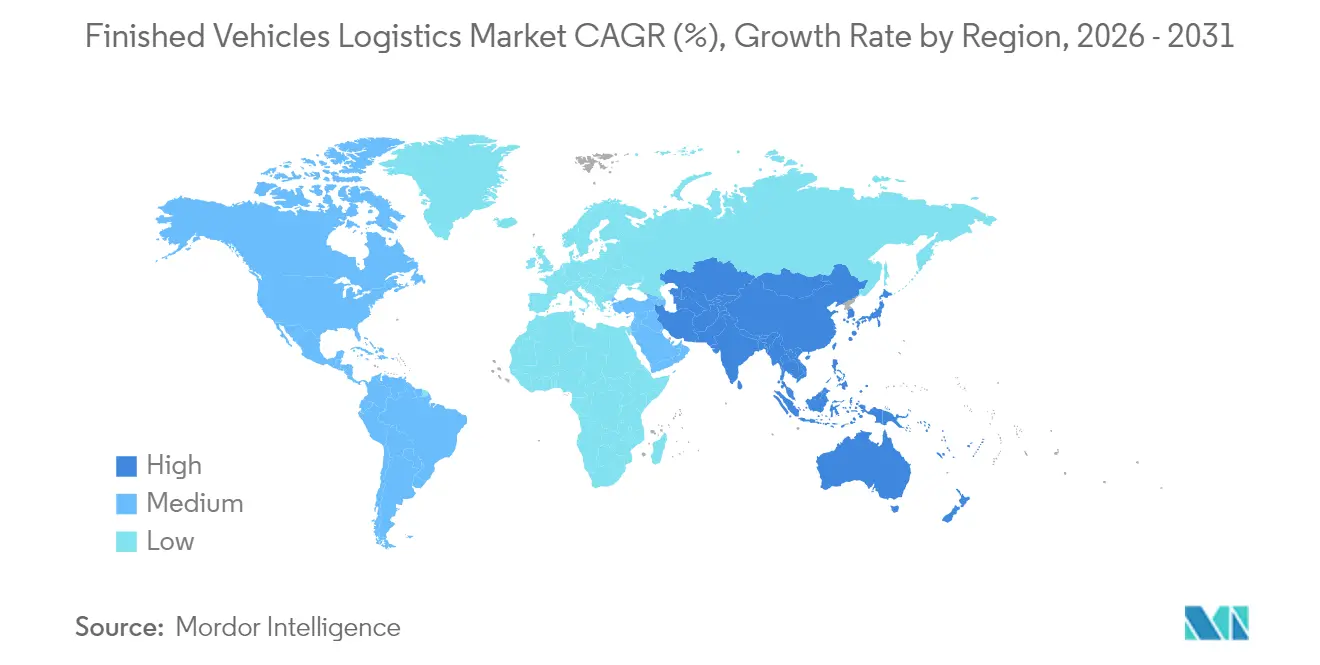
- By Geography, Asia-Pacific held a 38.70% share in 2025 and is projected to progress at a 4.43% CAGR to 2031.
Note: Market size and forecast figures in this report are generated using Mordor Intelligence’s proprietary estimation framework, updated with the latest available data and insights as of 2026.
Market Trends and Insights
Drivers Impact Analysis of Finished Vehicles Logistics Market*
| Driver | (~) % Impact on CAGR Forecast | Geographic Relevance | Impact Timeline |
|---|---|---|---|
| Growing vehicle sales in emerging markets | +1.2% | APAC core, spill-over to Latin America | Medium term (2-4 years) |
| OEM push for just-in-sequence distribution | +0.8% | Global, with early adoption in North America & EU | Short term (≤ 2 years) |
| Expansion of Chinese vehicle exports | +0.6% | Global, strongest in APAC and Europe | Medium term (2-4 years) |
| Digital freight-visibility platforms | +0.4% | Global, led by North America and Europe | Long term (≥ 4 years) |
| Thermal-controlled EV battery handling | +0.3% | Global, concentrated in EV-leading markets | Long term (≥ 4 years) |
| OEM micro-hub decarbonisation networks | +0.2% | Europe and North America primarily | Long term (≥ 4 years) |
| Source: Mordor Intelligence | |||
Growing Vehicle Sales in Emerging Markets Drive Infrastructure Expansion
Robust demand across India, Indonesia, and Vietnam is prompting the construction of new vehicle processing centers, inland depots, and last-mile networks that can serve dispersed retail outlets. Automotive production records in India are spurring port upgrades at Chennai and Mundra to handle higher Ro-Ro volumes[1]. Logistics firms are placing regional hubs in Tier-2 cities to shorten delivery lead times and comply with in-country assembly rules. Specialized facilities now integrate pre-delivery inspection and light customization, reducing dealer inventory risk while raising throughput efficiency. Providers capable of navigating divergent customs rules and tax incentives are winning long-term contracts from OEMs looking to accelerate market entry.
OEM Push for Just-in-Sequence Distribution Transforms Service Requirements
Automakers are synchronizing vehicle drops with dealer sales velocity, replacing bulk shipments with smaller, high-frequency moves. This model relies on predictive analytics that merge plant schedules with point-of-sale data to trigger dispatch orders. Logistics partners must balance load factors against strict arrival windows, often combining road, rail, and short-sea legs in a single itinerary. Providers investing in ISO 9001-compliant control towers and real-time sensor data enjoy premium pricing as OEMs embed distribution KPIs into sourcing scorecards. The shift elevates inventory visibility from optional to mandatory, favoring operators with cloud-native platforms and automated exception handling.
Expansion of Chinese Vehicle Exports Reshapes Global Logistics Capacity
Chinese shipments surpassed 5 million units in 2024, with BYD and Geely chartering or commissioning ro-ro vessels to secure outbound slots[2]. The influx is pushing European ports at Hamburg and Zeebrugge to expand berth allocations and yard acreage dedicated to Asian OEMs. Rising Asia-to-Latin America volumes are opening new direct services that bypass traditional transshipment hubs, compressing transit times and freight rates. Traditional third-party logistics providers are countering by layering value-added inspection, charging, and software update services on arrival, reinforcing relevance beyond ocean carriage.
Digital Freight-Visibility Platforms Enable Supply Chain Optimization
IoT trackers embedded in vehicle tie-downs feed telematics data to control towers that predict ETA, detect route deviations, and issue preventive maintenance alerts for railcars and car carriers. AI engines scan traffic, weather, and port congestion to re-route convoys hours before bottlenecks appear. Blockchain-based documentation accelerates customs clearance, cutting dwell times for high-value electric units that face enhanced safety checks. Providers report double-digit cuts in damage claims and fuel consumption, supporting both cost and ESG targets as carbon-pricing regimes tighten.
Restraints Impact Analysis of Finished Vehicles Logistics Market*
| Restraint | (~) % Impact on CAGR Forecast | Geographic Relevance | Impact Timeline |
|---|---|---|---|
| Driver shortages & high labour costs | -0.7% | Global, most acute in North America and Europe | Short term (≤ 2 years) |
| Rising fuel prices & emission rules | -0.5% | Global, with varying regulatory intensity | Medium term (2-4 years) |
| Port congestion & Ro-Ro berth scarcity | -0.4% | Concentrated in major shipping hubs globally | Short term (≤ 2 years) |
| Railcar (autorack) capacity bottlenecks | -0.3% | Primarily North America, some European routes | Medium term (2-4 years) |
| Source: Mordor Intelligence | |||
Driver Shortages and High Labour Costs Constrain Operational Scaling
Industry vacancies exceed 100,000 positions in North America and Europe, pushing wage inflation to 6-8% annually and eroding margins for carriers locked into multiyear rate agreements[3]. Specialized car-carrier drivers require extra training and certifications, lengthening onboarding timelines and raising insurance premiums. Aging workforces compound attrition, while hours-of-service limits restrict daily mileage, forcing fleets to add headcount just to maintain capacity. Automation pilots, including autonomous yard tractors and platooning on long-haul routes, remain nascent and capital-intensive, offering only gradual relief.
Rising Fuel Prices and Emission Rules Increase Operational Complexity
Fuel constitutes roughly 30% of operating costs, and volatility since 2024 has started to outpace contractual surcharge mechanisms. Concurrently, the European Union’s Euro VII proposal and expanding low-emission zones oblige operators to retrofit engines or procure alternative-fuel trucks. Capital outlays strain smaller carriers, accelerating consolidation. Disparate regional standards complicate fleet deployment strategies, elevating administrative spend on compliance monitoring. Modal shifts to rail and short-sea can cap emissions but introduce transloading costs and schedule rigidity, requiring sophisticated network design to avoid service degradation.
*Our forecasts treat driver/restraint impacts as directional, not additive. The impact forecasts reflect baseline growth, mix effects, and variable interactions.
Finished Vehicles Logistics Market Segment Analysis
By Service Type:
Integrated Solutions Elevate Non-Transportation GrowthTransportation services contributed 64.85% to the Finished Vehicles Logistics market size in 2025, yet warehousing and distribution, while smaller, is projected to deliver the fastest incremental revenue at 3.84% CAGR (2026-2031). Consolidated vehicle processing centers now combine storage, customization, and charging operations, eliminating redundant handoffs and trimming dwell times. Transportation players are embedding API-enabled tracking tools that feed into OEM dashboards, creating new monetization streams from data services. Warehousing operators, in turn, deploy automated storage and retrieval cranes to stack vehicles vertically, expanding capacity without land acquisition. The convergence is blurring traditional service boundaries, leading clients to award multi-year, multi-service contracts to providers that can manage end-to-end distribution within a single SLA.
Despite transportation’s dominant Finished Vehicles Logistics market share, its margin profile is under pressure from driver shortages and fluctuating diesel costs. Conversely, value-added services, although contributing the smallest top-line share, secure double-digit gross margins by bundling software updates, light accessory installation, and OEM-branded pre-delivery detailing. Providers capable of scaling these offerings across international networks are positioned to defend pricing and win renewals. Digital twins of yards and vessels enable scenario planning that optimizes loading sequences and minimizes damage, an innovation increasingly factored into tender evaluations by procurement teams.

By Destination:
International Growth Outpaces Domestic BaseDomestic operations accounted for 62.55% of 2025 revenue, but international volumes are accelerating as vehicle exports from China, Mexico, and Southeast Asia proliferate. Enhanced customs brokerage, multi-currency billing, and bonded storage capabilities are prerequisites for capturing this flow. Infrastructure bottlenecks, such as Ro-Ro berth constraints at Hamburg and Long Beach, heighten dwell charges and spark schedule variability. Providers that pre-book priority berths or operate dedicated feeder services mitigate these risks and command loyalty premiums.
International services also gain from the electric vehicle trade, as dedicated battery certifications and hazard-class documentation become mandatory. The Finished Vehicles Logistics market size for cross-border movements is projected to grow at a 3.52% CAGR (2026-2031). To hedge capacity risks, several Chinese OEMs are chartering vessels, squeezing space for spot shipments and prompting third-party providers to sign longer charter parties. These dynamics privilege financially robust operators able to lock in multi-year tonnage commitments.
By Type of Vehicles:
Passenger Dominance Faces Commercial UpswingPassenger units accounted for 66.45% of the Finished Vehicles Logistics market share in 2025, supported by predictable demand cycles and standardized handling processes. Moreover, passenger vehicle logistics is projected to outpace commercial vehicle logistics with a 4.06% CAGR (2026-2031) as e-commerce fleets and municipal electrification projects surge. Electric buses and delivery vans introduce unique height and weight profiles that require custom trailer fixtures and higher-capacity hoists.
OEMs adopt direct-to-consumer models in the passenger segment, cutting dealer lots and increasing demand for home delivery services that rely on flexible micro-hub networks. Commercial vehicle consignments often include telemetry calibration and fleet livery application, expanding time on site but generating higher ancillary revenue. Providers skilled in both segments leverage asset pooling to balance seasonality—passenger peaks align with model-year changeovers, while commercial surges occur around infrastructure funding cycles.
By End-user Industry:
OEM Control Redefines Partnership ModelsOEMs controlled 68.35% of demand in 2025 and are amplifying their influence as they pivot to omnichannel sales. Strategic collaborations feature joint control towers where visibility data is shared in real time, shrinking buffer inventories, and elevating partner accountability. Dealers, historically logistics gatekeepers, now rely on OEM-driven allocations that favor providers with proven on-time delivery metrics. Fleet leasing firms, classified under “Others,” are expanding orders for electric units, creating niche opportunities for thermal-controlled transport and on-site charging yard management.
The OEM segment’s 4.24% CAGR through 2031 highlights supplier rationalization: automakers consolidate from ten or more logistics vendors per region to three or fewer, favoring those able to guarantee performance across transportation, warehousing, and value-added services. Contract durations lengthen, but penalty clauses intensify, compelling providers to invest in redundancy and back-up capacity to avoid SLA breaches.
Geography Analysis
APAC Finished Vehicles Logistics Market
Asia-Pacific retained 38.70% of the Finished Vehicles Logistics market in 2025 and leads growth at a 4.43% CAGR to 2031. Chinese OEMs such as BYD are vertically integrating ocean freight with six Ro-Ro vessels, guaranteeing lift for export programs and reducing reliance on third-party charterers. Indian output strength is pressuring inland rail corridors, prompting investment in dedicated freight corridors and expanded storage at Chennai and Kandla. Southeast Asian assembly hubs are emerging as secondary export nodes, driving feeder services into regional transshipment centers like Singapore and Tanjung Pelepas.
North America Finished Vehicles Logistics Market
North America remains structurally important, supported by strong replacement demand and the near-shoring of electric vehicle production into Mexico. Cross-border traffic via Laredo and El Paso is growing faster than U.S. domestic moves, requiring specialized customs clearance and security protocols. Driver shortages remain most acute in the United States, elevating rail’s modal share for long-haul vehicle moves despite autorack capacity bottlenecks. Battery-ready storage yards near California ports cater to rising EV imports while aligning with state zero-emission mandates.
Europe Finished Vehicles Logistics Market
Europe faces capacity pressures at key ro-ro gateways. Hamburg and Antwerp have launched multi-phase berth expansions to accommodate Asian import surges and outbound premium brands. Strict emission limits spur modal shifts to electrified rail and short-sea links, while urban micro-hubs support last-mile deliveries inside low-emission zones. Providers capable of executing cross-border rail-truck combinations gain share, especially on Central European corridors constrained by driver availability and toll increases.
Regulatory Landscape
Finished vehicle logistics operates within a layered compliance stack covering road transport safety, emissions, and the cybersecurity and data-governance requirements tied to connected vehicles and digital visibility platforms. In the United States, the Department of Transportation issued its 2026 Unified Rulemaking Agenda (July 2026), which elevates autonomous-vehicle related rulemaking and modernization actions that can shift carrier operating procedures and equipment requirements over time.
In parallel, industry-led standards influence operating discipline and shipper audits. AIAG guidelines (notably M-22 for vehicle transportation damage handling and M-26 for handling battery electric vehicles) and the Odette and ECG finished vehicle logistics message standards (EDIFACT and XML) reinforce expectations around damage reporting, handover traceability, and electronic data exchange between OEMs, compounds, and carriers, raising the baseline for process compliance in tenders.
Value Chain Analysis
The finished vehicles logistics value chain starts at OEM plants and outbound yards and then moves through vehicle processing compounds, including PDI, accessory fitment, labeling, software-related tasks where applicable, and charging-ready staging for EVs. From there, multimodal linehaul links road car-carriers, rail autoracks, and ro-ro or short-sea services for export flows. Specialized LSPs manage routing, capacity booking, and exception handling across ports (including ro-ro terminals), rail ramps, and inland depots, while compound operators concentrate on storage, sequencing, and damage-prevention steps that protect OEM residual values.
Standards and data increasingly connect partners across the chain end-to-end. Odette and ECG standardized finished vehicle logistics communication processes (EDIFACT and XML) support VIN-level milestone tracking and KPI reporting, and AIAG guidance informs damage and EV-handling procedures used in shipper audits. OEMs are also engaging more directly with railway undertakings and asset providers on select corridors, shifting some traditional LSP activities toward control-tower orchestration, compound management, and value-added services rather than arranging capacity alone.
Competitive Landscape
The Finished Vehicles Logistics market exhibits moderate fragmentation. The 2025 DSV acquisition of DB Schenker for EUR 14.3 billion (USD 14.9 billion) instantly created a top-tier provider with pan-regional rail, road, and ocean assets, signaling that scale is vital to absorb rising compliance and technology costs. Larger firms leverage balanced portfolios to cross-subsidize early-stage EV handling infrastructure, including battery-temperature monitoring and charging stations. Technology investment is the other competitive pillar: AI-driven route optimizers, blockchain documentation, and yard digital twins reduce claims and enhance utilization, quantifiable benefits valued in OEM tenders.
Vertical integration by OEMs introduces a disruptive vector. BYD’s self-owned ro-ro fleet compresses third-party ocean margins and forces logistics providers to focus on high-value services such as pre-delivery inspection, software flashing, and last-mile handover. To counter, providers are forming joint ventures with port authorities to secure long-term berth access and embed value-added services onsite. Mid-tier firms, squeezed between capex requirements and rate pressure, are ripe acquisition targets for strategics seeking infill capacity.
Environmental regulations shape competition as well. Firms operating LNG-fueled or battery-electric trucks differentiate on ESG compliance, winning business from automakers with stringent scope-3 emissions targets. Certification depth—ISO 14001, IATF 16949 logistics extensions, and ADR battery handling—now features prominently in RFP scorecards, raising entry barriers for new entrants.
Finished Vehicles Logistics Industry Leaders
-
Deutsche Post DHL Group
-
DSV
-
CEVA Logistics
-
UPS Supply Chain Solutions
-
Logisteed Ltd
- *Disclaimer: Major Players sorted in no particular order
Finished Vehicles Logistics Market Companies Covered in this Report
- Deutsche Post DHL Group
- DSV
- CEVA Logistics
- UPS Supply Chain Solutions
- Logisteed Ltd
- CJ Logistics
- Nippon Express Co. Ltd
- Toll Group
- Yusen Logistics Co. Ltd
- Kuehne + Nagel
- Kerry Logistics Network Ltd
- Hellmann Worldwide Logistics
- Rhenus Logistics
- Geodis
- GAC
- Silk Contract Logistics
- Linc Group
- Rohlig Logistics
- Allcargo Logistics Ltd
- Broekman Logistics
Market Opportunities and Future Outlook
EV-driven operating complexity is widening the addressable scope for providers that can run finished vehicle flows with battery-aware handling, compliant storage, and aftersales-adjacent support. A clear near-term signal is CEVA Logistics signing a 3-year MOU with BYD in June 2026 to support BYD global manufacturing and finished vehicle logistics, which points to demand for scalable, standardized processes across multiple geographies and for partners that can bundle transport, yard operations, and value-added services under unified performance management.
Port and compound capacity additions, together with digital and standards alignment, also create room for operators to cut dwell time at constrained ro-ro gateways and improve VIN-level traceability across modes. CEVA Logistics expanded finished vehicle capabilities at Spain's Port of Tarragona in March 2026 with a EUR 9 million investment and 94,000 square meters of additional space, reflecting where incremental yard capacity and processing are being placed near key European trade lanes. At the same time, the DOT 2026 agenda on autonomous-vehicle related rulemaking highlights a compliance-led need for carriers and LSPs to strengthen data capture, safety processes, and documentation governance as technology-enabled distribution models spread.
Recent Industry Developments in Finished Vehicles Logistics Market
- June 2026: DSV breaks ground on a new facility in Portland, Oregon. The expansion increases logistics capacity in high-value finished vehicle segments. The project strengthens cross-border and tech-enabled finished vehicle logistics operations across multimodal routes.
- March 2026: CEVA Logistics grows finished vehicle capabilities at Spain’s Port of Tarragona with €9 million investment. The upgrade expands capacity at a key Mediterranean hub and improves EV handling capabilities. It enhances regional throughput and supports the integration of value-added services at the port.
- April 2025: CEVA Logistics announced a binding agreement to acquire Borusan Tedarik, boosting Turkish finished vehicle logistics operations. The expansion strengthens CEVA’s domestic finished vehicle footprint in Turkey and positions the company as a top-3 player in the market. The deal accelerates regional scale and capacity to support OEMs with end-to-end service.
Finished Vehicles Logistics Market Report Scope and Research Methodology
Market Definition and Coverage
For this study, the finished vehicles logistics market is defined as the value of logistics services used to move, store, and distribute completed vehicles from factories and ports to final delivery points, including domestic and cross-border flows.
Scope exclusions: It excludes inbound parts logistics and raw material movements, and it also excludes passenger transport services that do not involve moving finished vehicles as cargo.
Segments Covered in This Report
- By Service Type
- Transportation
- Road
- Rail
- Air
- Sea
- Warehousing & Distribution
- Value-added Services (Assembly, Labelling, Kitting)
- Transportation
- By Destination
- Domestic
- International
- By Type of Vehicles
- Passenger Vehicles
- Commercial Vehicles
- By End-user Industry
- OEMs
- Dealers
- Others (Rental Companies, Fleet leasing companies)
- By Geography
- North America
- United States
- Canada
- Mexico
- South America
- Brazil
- Peru
- Chile
- Argentina
- Rest of South America
- Asia-Pacific
- India
- China
- Japan
- Australia
- South Korea
- South East Asia (Singapore, Malaysia, Thailand, Indonesia, Vietnam, and Philippines)
- Rest of Asia-Pacific
- Europe
- United Kingdom
- Germany
- France
- Spain
- Italy
- BENELUX (Belgium, Netherlands, and Luxembourg)
- NORDICS (Denmark, Finland, Iceland, Norway, and Sweden)
- Rest of Europe
- Middle East and Africa
- United Arab of Emirates
- Saudi Arabia
- South Africa
- Nigeria
- Rest of Middle East And Africa
- North America
Data Sources, Market Sizing, and Validation
Desk Research
Desk research helped us set the demand pool boundaries and the basic activity levels for finished-vehicle movements by region. Public and official sources were used heavily, such as OICA for production context, national transport statistics agencies for freight and mode indicators, customs and trade portals for cross-border vehicle flows, port authority throughput releases for ro-ro related signals, and central bank or government inflation series for price normalization.
To keep counting consistent, the secondary inputs were organized to separate finished-vehicle handling from broader automotive logistics and general freight, and then reconciled with company annual reports, investor presentations, and reputable logistics and automotive press coverage. Paid database subscriptions were also used selectively for company financials and intelligence, patent databases where relevant for handling and tracking themes, and import and export shipment-level databases to sanity-check key corridor directionality. The sources mentioned here are illustrative only, and many other references were also used for data collection, validation, and clarification.
Primary Interviews and Surveys
Primary interviews and surveys were used to confirm assumptions that are not consistently visible in public data, especially lane mix shifts, capacity tightness around ports and inland compounds, and service-level pricing changes for multimodal moves. Inputs were collected from logistics providers, finished-vehicle handlers, and downstream commercial roles across major producing and consuming regions, and then used to re-check utilization, mode split, and revenue-per-vehicle logic.
Distribution of primary research fieldwork respondents
| Company type | Respondent position | Region |
|---|---|---|
| Top tier: 38% | CXOs: 14% | APAC: 43% |
| Mid tier: 48% | Functional/Unit leaders: 41% | EMEA: 32% |
| Smaller Players: 14% | Managers: 45% | Americas: 25% |
Market-Sizing & Forecasting
Market sizing is built mainly through a top-down reconstruction that starts from finished-vehicle production and sales flows, which are then translated into transport and handling demand by route type and typical touchpoints (plant yard, port, compound, and dealer delivery). To keep the output realistic, we corroborate the totals using selective bottom-up checks such as sampled price per vehicle moved, lane-based volume builds, and service revenue reasonableness checks drawn from operator disclosures and channel feedback.
A few inputs that matter most in this market include light vehicle and commercial vehicle output, export and import volumes by major corridors, port throughput and car carrier activity signals, mode split between road, rail, and sea legs, and average revenue per unit moved across domestic and international moves. Where country-level detail is uneven, gaps are handled by applying peer-market benchmarks that are adjusted for local trade intensity and distance patterns, and only retained after interview validation.
For forecasting, we mainly use scenario analysis supported by trend smoothing on key drivers, since volumes and pricing can shift with production cycles, model launches, and inventory corrections. The forward view is shaped by expected vehicle output, trade friction risk, capacity additions in ro-ro and rail, and pricing direction indicated by respondents, and then checked so the growth path stays consistent with observed logistics constraints.
Data Validation & Update Cycle
Validation is done through several checks so outliers do not quietly pass through the model. We compare outputs against independent signals such as vehicle production totals, trade flow direction, and known throughput constraints around ports and inland compounds, and then investigate any large variance before sign-off.
A second analyst review is applied to calculations, assumptions, and year-over-year movements, and follow-up outreach is triggered when a parameter shifts beyond what interview feedback supports. The report is refreshed annually, with interim updates when material events occur such as sharp production swings or freight capacity disruptions. Before delivery, a final review pass is completed so clients receive the most current view available at the time of release.
Mordor Intelligence's Finished Vehicles Logistics Market Size Compared Against Other Published Estimates
Published market sizes for finished vehicles logistics can look far apart because the same label is often used for different service bundles and different counting rules. Some estimates focus mainly on core transport legs, and others also include storage, yard, and distribution activities tied to vehicle delivery.
Vehicle production totals, port ro-ro throughput releases, and trade lane direction checks are the evidence used to keep Mordor Intelligence's figure centered on finished-vehicle handling and delivery services, instead of folding in wider automotive freight that moves parts or general cargo. Differences also come from the anchor year used, how multimodal revenue is attributed across legs, and whether pricing is updated with corridor-level tightness signals or held as a blended average.
Benchmark comparison
| Source | Market Size | Gaps in Research Methodology |
|---|---|---|
| Mordor Intelligence | USD 152.1 B (2026) | |
| Global Data Publisher A | USD 103.2 B (2024) | Uses an earlier base year and appears to apply a narrower service scope that leans toward core transport revenue, with less coverage of storage, compounds, and distribution linked to finished vehicles. |
| Industry Report Outlet B | USD 94.61 B (2024) | Likely treats the market closer to a limited shipment and delivery view, and the pricing build reads like a blended average that does not fully reflect corridor distance mix and handling touchpoints. |
Overall, the spread across figures is mainly explained by how far the service chain is extended beyond transport and how pricing is refreshed for constrained corridors. With clear demand signals and repeatable checks, the model stays easy to revisit when new production, trade, or port data is released.
Key Questions Answered in the Report
What is the current value of the Finished Vehicles Logistics market?
The market stands at USD 152.1 billion in 2026 and is projected to reach USD 185.35 billion by 2031.
Which service type generates the highest revenue?
Transportation services account for 64.85% of 2025 revenue, driven by the essential need to move vehicles between plants, ports, and dealers.
Why is Asia-Pacific growing the fastest in vehicle logistics?
Chinese exports and Indian production gains are expanding regional volumes, lifting Asia-Pacific to a 4.43% CAGR through 2031.
How are electric vehicles changing logistics requirements?
EVs need thermal-controlled handling and charging-enabled storage, prompting investment in specialized equipment and yard infrastructure.
What are the main challenges facing providers?
Acute driver shortages, volatile fuel costs, and tightening emission standards are compressing margins and raising compliance complexity.
How is technology improving logistics performance?
IoT sensors, AI route planners, and blockchain documentation are shortening transit times, reducing damage, and enhancing end-to-end visibility.