
FIDO2 Security Key Market Size and Share
Market Overview
| Study Period | 2021 - 2032 |
|---|---|
| Market Size (2027) | USD 1.39 Billion |
| Market Size (2032) | USD 2.58 Billion |
| Growth Rate (2027 - 2032) | 13.17 % |
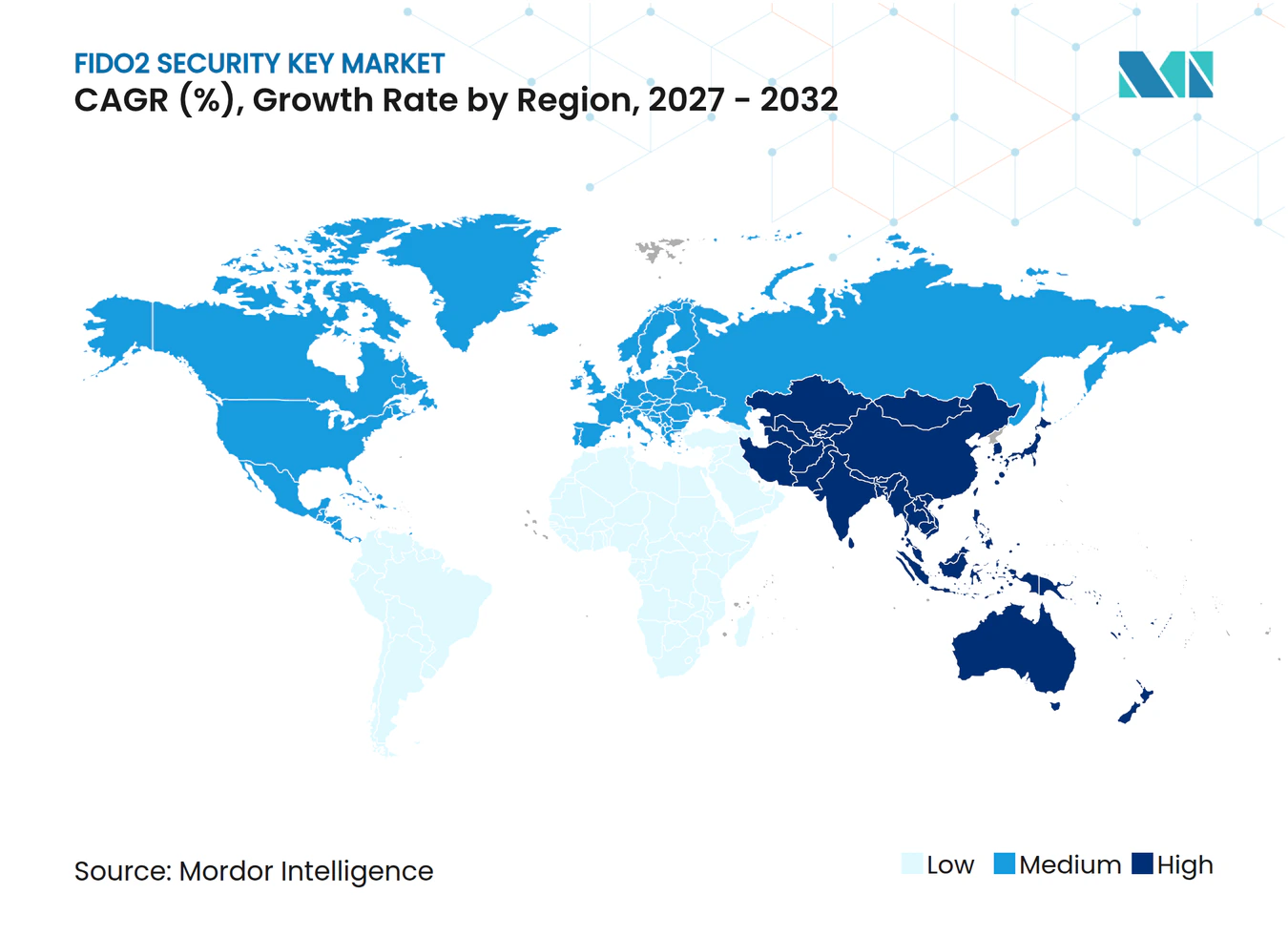
| Fastest Growing Market | Asia-Pacific |
| Largest Market | North America |
| Market Concentration | Medium |
Major Players *Disclaimer: Major Players sorted in no particular order Image © Mordor Intelligence. Reuse requires attribution under CC BY 4.0. | |
FIDO2 Security Key Market Analysis by Mordor Intelligence
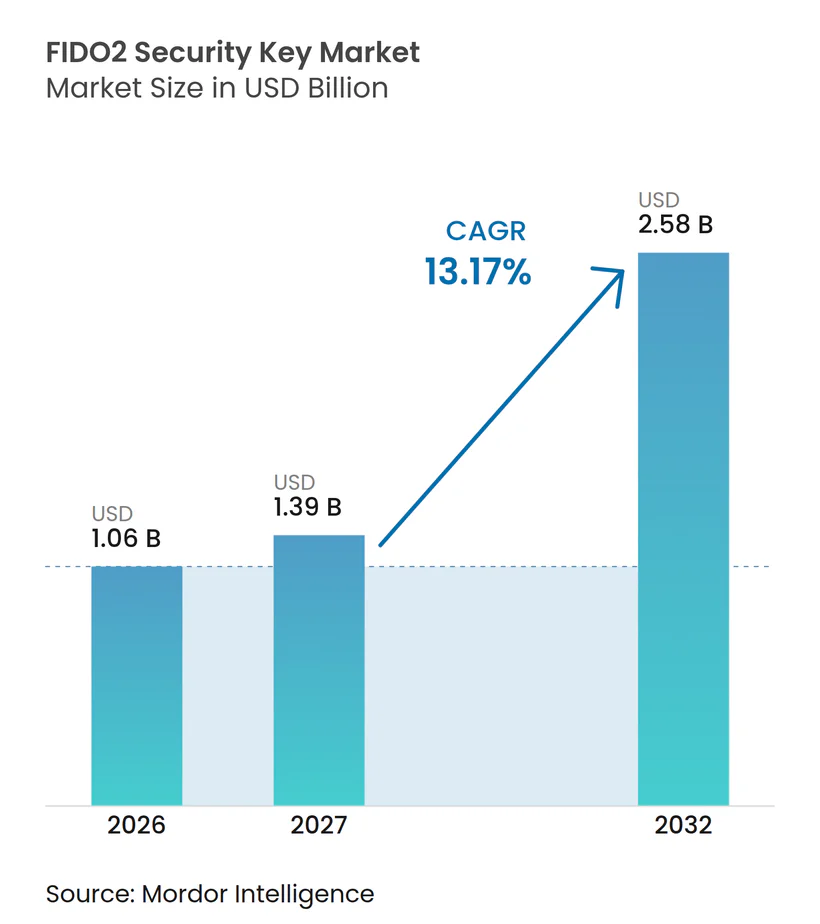
The FIDO2 security key market size is expected to increase from USD 1.06 billion in 2026 to USD 1.39 billion in 2027 and reach USD 2.58 billion by 2032, growing at a CAGR of 13.17% over 2027-2032. Hardware-backed keys store the private cryptographic key in a secure element, preventing reusable credentials from being exposed during sign-in. This design addresses phishing, credential stuffing, and man-in-the-middle attacks without relying on passwords, helping organizations reduce reliance on sign-in methods that can be compromised by deceptive messages, reused credentials, or redirected authentication prompts. It also provides a tangible, widely understood control for security teams and users. The FIDO2 security key market also benefits from enterprise moves toward passkeys, although many organizations still need a device-bound option for privileged users, shared workstations, and isolated systems. Platform passkeys lower barriers to routine employee access, but they do not eliminate the need for physical credentials in environments that require attestation, recovery controls, or high assurance. Vendor strategies, therefore, center on lifecycle management, certification, post-quantum readiness, and credentials that support several protocols.
Key Report Takeaways
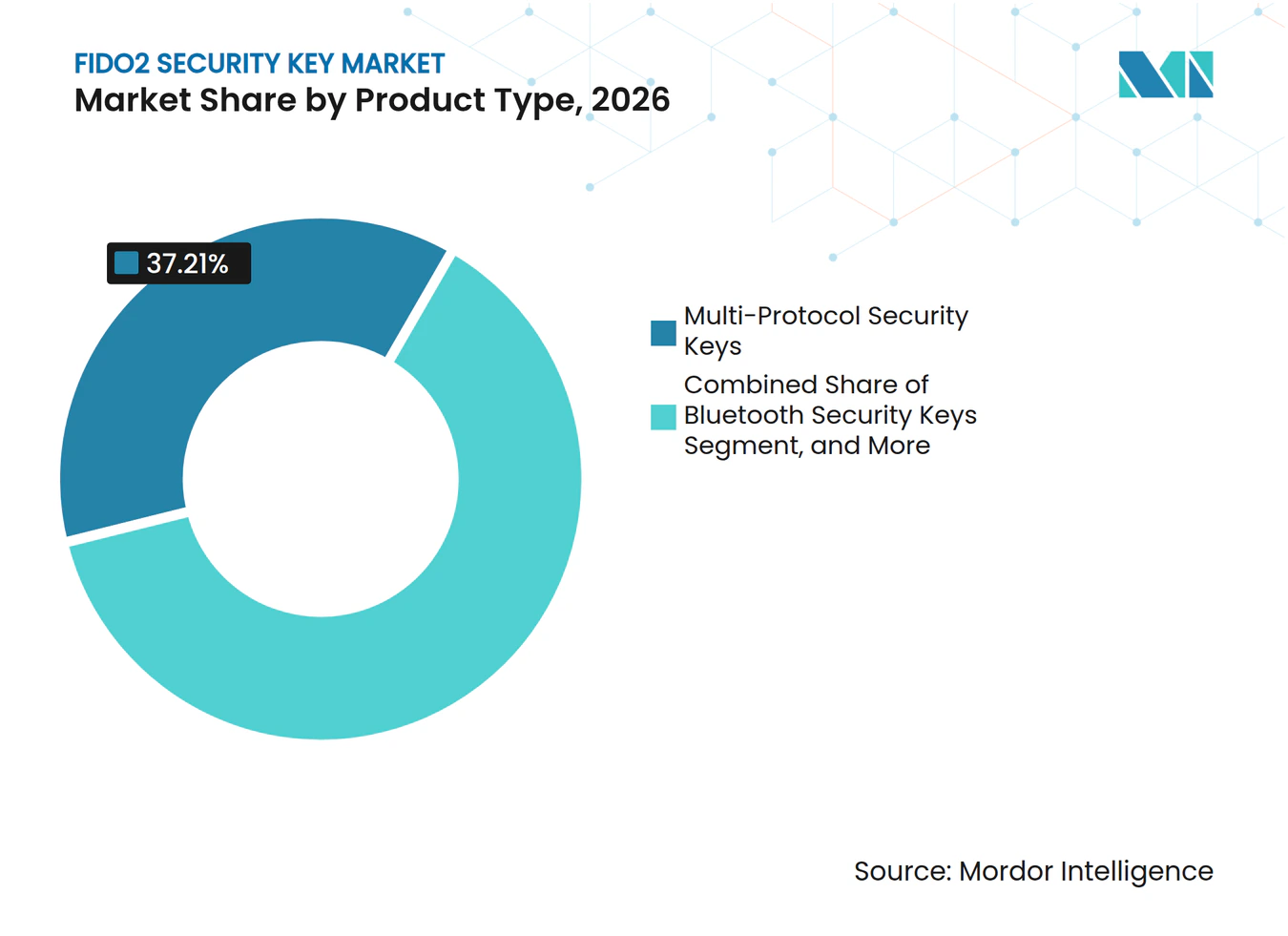
- By product type, multi-protocol security keys held 37.21% of the FIDO2 security key market share in 2026, while biometric security keys are projected to expand at a CAGR of 13.66% through 2032.
- By form factor, USB stick keys held 56.82% market share in 2026, while desktop biometric readers are projected to expand at a CAGR of 13.68% through 2032.
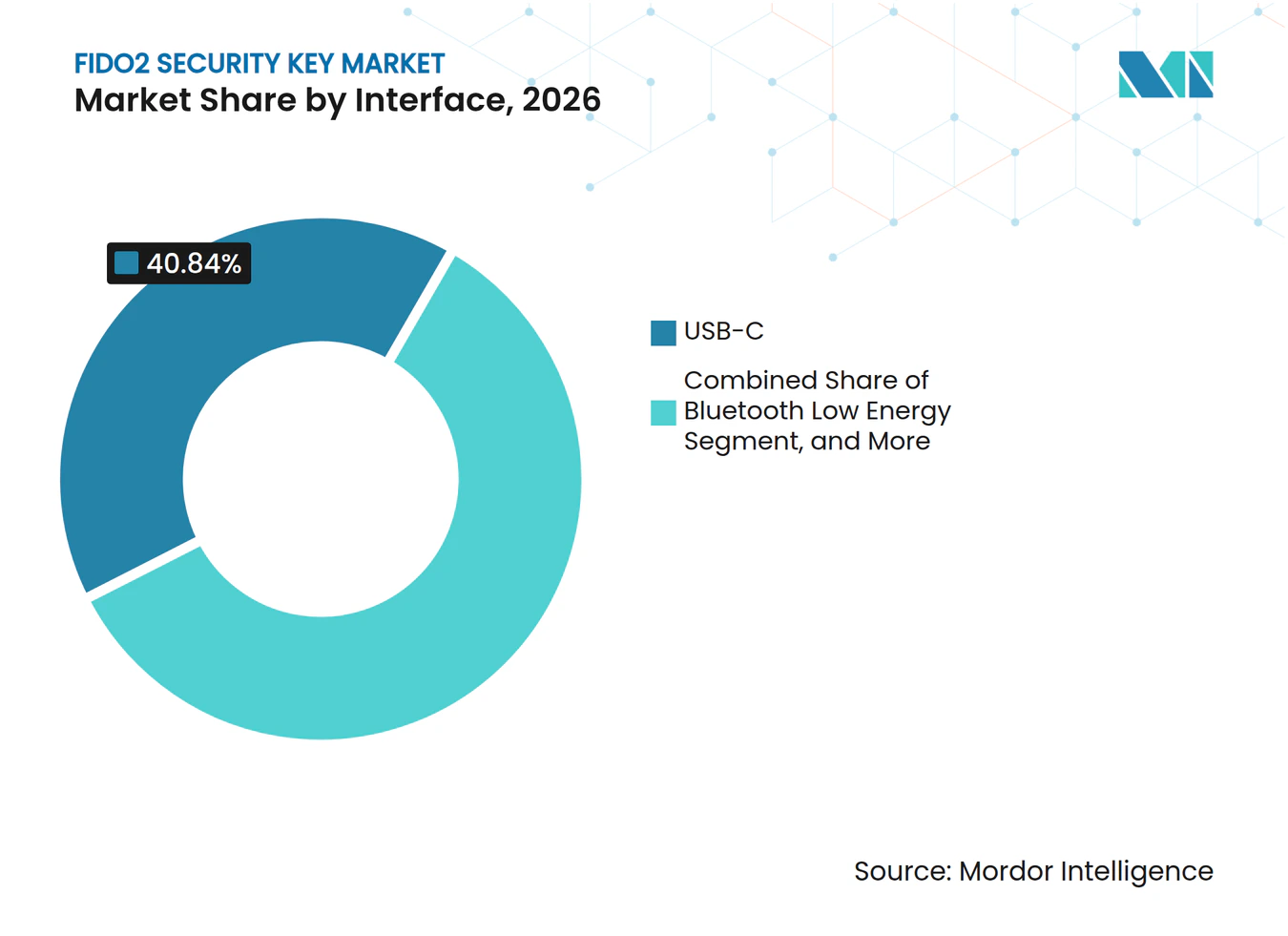
- By interface, USB-C held 40.84% market share in 2026, while multi-interface keys are projected to expand at a CAGR of 13.79% through 2032.
- By authentication method, FIDO2 passwordless authentication held 33.62% market share in 2026, while FIDO2/PIV or PKI hybrid authentication is projected to expand at a CAGR of 13.88% through 2032.
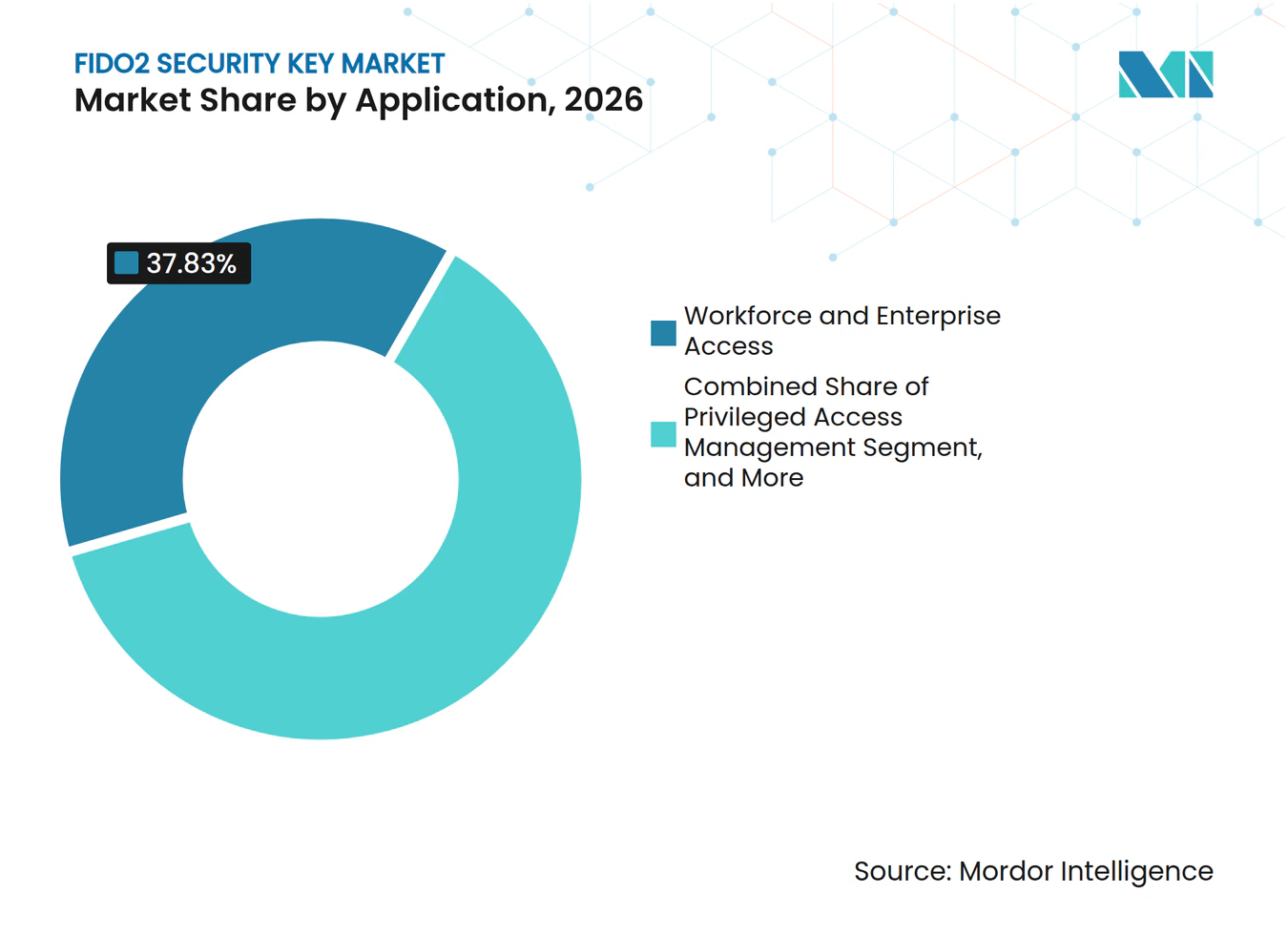
- By application, workforce and enterprise access held 37.83% market share in 2026, while government and defense access is projected to expand at a CAGR of 13.47% through 2032.
- By distribution channel, direct enterprise sales held 36.88% market share in 2026, while identity and security integrators are projected to expand at a CAGR of 13.96% through 2032.
- By geography, North America held 41.88% market share in 2026, while Asia-Pacific is projected to expand at a CAGR of 13.96% through 2032.
Note: Market numbers in this report are based on Mordor Intelligence's proprietary estimation framework, which combines nine months of actuals with Q4 projections for base year 2026.
Market Trends and Insights
Drivers Impact Analysis of FIDO2 Security Key Market*
| Driver | (~) % Impact on CAGR Forecast | Geographic Relevance | Impact Timeline |
|---|---|---|---|
| Rising Phishing and Credential-Theft Incidents | +3.5% | Global | Short term (≤ 2 years) |
| Enterprise Migration to Phishing-Resistant Passwordless Authentication | +3.2% | North America and Europe | Medium term (2-4 years) |
| Zero-Trust and Regulatory Authentication Requirements | +2.8% | North America, Europe, and Asia-Pacific core markets | Medium term (2-4 years) |
| Hardware Keys as High-Assurance Recovery Credentials for Synced Passkeys | +1.5% | Global | Medium term (2-4 years) |
| Device-Bound Credentials for Shared Workstations and Air-Gapped Environments | +1.2% | North America, Europe, and government-heavy markets | Long term (≥ 4 years) |
| Attestation and Supply-Chain Traceability Requirements for Privileged Users | +0.8% | North America and Europe | Long term (≥ 4 years) |
| Source: Mordor Intelligence | |||
Rising Phishing and Credential-Theft Incidents
Phishing threats are increasing the value placed on authentication methods that do not expose reusable credentials. A FIDO2 key keeps the private key in its secure element and binds authentication to the intended domain. This makes the FIDO2 security key market relevant for organizations that need controls against replay and credential theft. The FIDO Alliance reported that 5 billion passkeys were in active use by May 2026, showing that passwordless authentication has entered mainstream deployment. Its research also found that 68% of organizations had deployed or were deploying passkeys, while 28% had fully adopted passwordless authentication.[1] Physical keys remain useful where a hardware-bound credential is required for recovery, administration, or regulated access, especially when a security policy separates high-risk roles from standard employee sign-in and requires the organization to retain direct control over credential issuance.
Enterprise Migration to Phishing-Resistant Passwordless Authentication
Enterprise programs in the FIDO2 security key market are moving from limited passkey trials toward wider production use. In a 2025 FIDO Alliance survey, 87% of organizations in the United States and the United Kingdom had deployed or were deploying passkeys. The same research found that 47% used a mix of device-bound physical security keys and synced passkeys. Organizations first issued physical keys for users with access to intellectual property and administrator accounts, at 39% for each group. HID introduced Enterprise Passkey Management in August 2025 to enable remote credential provisioning, revocation, and audit-trail management[2]. Such services reduce administrative friction and support broader deployments across the FIDO2 security key market because remote provisioning and structured lifecycle processes can reduce the burden placed on local IT teams during enrollment, replacement, and withdrawal of credentials.
Zero-Trust and Regulatory Authentication Requirements
Government and regulated buyers in the FIDO2 security key market increasingly require phishing-resistant authentication for sensitive systems. The FIDO Alliance published NIS2 technical implementation guidance in December 2025, describing how FIDO and WebAuthn specifications can support compliance programs for critical infrastructure. Germany also issued draft passkey server guidance during 2025 for public administration and critical infrastructure settings[3]. These measures place greater emphasis on trustworthy credential configuration and deployment, including clear enrollment practices, well-defined authenticator policies, and a practical approach to managing credentials used by employees, contractors, administrators, and other users with access to essential systems. Hardware keys are particularly suited to privileged users because their credentials can remain device-bound and non-exportable. The FIDO2 security key market gains from demand for higher certification levels, managed issuance, and clear audit trails. These requirements also make long product support and supply-chain controls important in procurement decisions, as public-sector and critical-infrastructure buyers need assurance that deployed credentials can be maintained, replaced, and audited under consistent security procedures over time.
Hardware Keys as High-Assurance Recovery Credentials for Synced Passkeys
Synced passkeys simplify sign-in across devices but introduce recovery considerations when a user loses access to the device ecosystem. A separate hardware key can provide a device-bound recovery credential without restoring password-based access. This role is additive to demand in the FIDO2 security key market and to initial passwordless adoption because it supports continuity during device loss or account recovery. The FIDO2 security key market can therefore benefit even when synced passkeys are adopted as the primary credential for routine workflows. Recovery keys can later become regular authentication devices for users who handle privileged work. The approach is most relevant where organizations require controlled recovery, attestation, or clear separation from cloud-synced credentials, including environments with shared devices, restricted networks, high-value administrative accounts, and policies that require a direct record of credential ownership and issuance.
Restraints Impact Analysis of FIDO2 Security Key Market*
| Restraint | (~) % Impact on CAGR Forecast | Geographic Relevance | Impact Timeline |
|---|---|---|---|
| Deployment Complexity and Identity-Platform Integration Costs | -1.8% | Global | Short term (≤ 2 years) |
| Competition From Built-In Platform Passkeys and Mobile Authenticators | -1.4% | Global | Medium term (2-4 years) |
| USB Port and NFC Policy Restrictions in Government and Regulated Environments | -0.6% | North America and Europe | Short term (≤ 2 years) |
| Credential PIN Reset and Physical-Key Loss Recovery Gaps | -0.5% | Global | Medium term (2-4 years) |
| Source: Mordor Intelligence | |||
Deployment Complexity and Identity-Platform Integration Costs
Deploying hardware keys across the FIDO2 security key market and a mixed enterprise environment requires coordination among identity providers, directory services, and endpoint management tools. This work can delay purchases, especially for organizations without a dedicated identity and access management team. Legacy application compatibility also makes it difficult to use a consistent sign-in process across every workforce group. PIN reset and lost-key recovery procedures create further operational requirements. Managed provisioning can reduce some of this burden by supporting pre-registration and remote issuance. Even so, integration cost remains a constraint on the pace of adoption in the FIDO2 security key market, particularly where applications have inconsistent sign-in methods and the organization must coordinate policy, device support, help-desk procedures, and user communications.
Competition From Built-In Platform Passkeys and Mobile Authenticators
Apple iCloud Keychain, Google Password Manager, and Windows Hello provide competition in the FIDO2 security key market through passkeys without separate hardware purchases. These choices can satisfy standard employee sign-in requirements where high-assurance attestation is not necessary. Enterprise-managed smartphones can also serve as FIDO authenticators for some workforce populations. Physical keys retain an advantage in the FIDO2 security key market for privileged users, shared terminals, air-gapped systems, and settings with strict credential assurance rules. Vendors are responding through lifecycle management, certified secure elements, and post-quantum cryptography plans. These differences keep specialized demand in the FIDO2 security key market, even as mainstream workers increasingly use platform-native credentials, because a single access strategy does not always meet the assurance, recovery, portability, and accountability needs of every job role.
*Our forecasts treat driver/restraint impacts as directional, not additive. The impact forecasts reflect baseline growth, mix effects, and variable interactions.
FIDO2 Security Key Market Segment Analysis
By Product Type:
Multi-Protocol Keys Support Complex Enterprise EnvironmentsMulti-protocol security keys held 37.21% of the FIDO2 security key market share in 2026. Enterprises value a single token that can support FIDO2, PIV, OATH, and OpenPGP across varied identity environments. This reduces the need to issue separate credentials for different security workflows, which can simplify issuance, user education, replacement, and policy enforcement when departments still operate systems with different authentication requirements. The category is well placed in organizations that are modernizing authentication without removing established certificate or smart-card processes. It is also useful where administrators and contractors use more than one system. This combination of compatibility and consolidation supports continued enterprise demand, particularly where security teams must introduce passwordless access without disrupting established workflows for certificates, secure email, administration, or regulated data access.
Biometric security keys are projected to expand at a CAGR of 13.66% through 2032. Token introduced the BioKey series in June 2025 with USB, Bluetooth, and NFC connectivity, along with an EAL5+ certified secure element. SecuGen's Unity 20 received FIDO Alliance certification in October 2026. USB keys remain important for mid-market deployment because they do not require batteries, are easy to issue through standard equipment processes, and can cover routine workforce use without requiring a separate charging or pairing process. NFC and Bluetooth models support mobile and remote work settings. Smart-card and badge-form credentials address government and defense programs that combine physical and logical access, helping agencies align building-entry processes with digital identity controls while limiting the number of credentials carried by each user.



By Form Factor:
USB Stick Keys Lead While Desktop Readers Serve Shared DevicesUSB stick keys accounted for 56.82% of the FIDO2 security key market size in 2026. Their established thumb-drive format and competitive unit cost make them practical for large employee deployments. They are simple to distribute and familiar to users. The format also fits many standard notebook and workstation workflows, allowing security teams to introduce a physical authenticator without requiring a major change in how employees connect devices or begin their workday. USB stick keys are likely to remain the volume form factor for organizations that want a dedicated, portable credential. This position supports use in the general workforce, contractor, and administrator access programs, where consistent issuance practices and familiar device handling can reduce training needs during large deployments across multiple offices or workforce groups.
Desktop biometric readers are projected to expand at a CAGR of 13.68% through 2032. Kensington launched VeriMark Desktop 2.0 in April 2026 for shared workstations using Windows Hello for Business and Entra ID single sign-on. This format is useful where several authorized users access a fixed terminal during a shift. Credit-card and badge form factors support combined physical access and digital authentication programs, which are relevant when organizations want to reduce credential duplication and create a more consistent experience for employees entering secure facilities. HID launched Crescendo Cards in August 2025 as part of its expanded FIDO portfolio. Key fobs remain relevant for professionals who carry credentials on lanyards, while embedded authenticators bring FIDO2 functions into laptops and access readers, giving organizations several ways to fit authentication into the working conditions of field staff, clinical personnel, and fixed-site employees.
By Interface:
USB-C Leads Device Connectivity and Multi-Interface Models Add FlexibilityUSB-C held 40.84% share in 2026. Its lead reflects notebook refresh cycles and the broad adoption of USB-C ports in commercial devices. The interface gives organizations a direct option for workforce authentication without adding software complexity. USB-C is particularly relevant for new device fleets and hybrid work arrangements. The format also provides a clear upgrade path from older USB-A equipment. Its continued role depends on compatibility across the installed base of business devices, because many organizations operate a mix of recently purchased notebooks, older workstations, specialized equipment, and mobile endpoints that do not share the same connector standard.
Multi-interface keys are projected to expand at a CAGR of 13.79% through 2032. These devices combine USB-A, USB-C, and NFC to reduce compatibility issues across mixed-device fleets. Token2 introduced the Bio3 in June 2025 with dual USB-A and USB-C connectivity and native iOS fingerprint management. USB-A remains relevant in government and industrial environments with long hardware replacement cycles, where security programs must account for equipment that stays in service for several years and cannot be replaced solely to support a newer interface. NFC supports authentication from mobile endpoints and cross-device workflows. Kensington's VeriMark NFC+ keys achieved FIDO2 Level 2 certification with CTAP 2.1, supporting USB and NFC use cases.

By Authentication Method:
Passwordless Access Leads and Hybrid Credentials Expand in Regulated SettingsFIDO2 passwordless authentication held 33.62% share in 2026. Organizations use it to remove passwords from routine employee sign-in flows. The method supports a more direct path toward phishing-resistant access for standard enterprise users. It also aligns with the broader deployment of passkeys across identity platforms. Physical FIDO2 keys provide a dedicated credential when organizations do not want authentication dependent on a personal device. This maintains the method's relevance across workforce access and privileged use cases because security leaders can apply the same basic standard while setting stricter rules for administrators, contractors, and users handling sensitive applications, financial records, or production systems.
FIDO2/PIV or PKI hybrid authentication is projected to expand at a CAGR of 13.88% through 2032. The approach serves agencies that must maintain PKI certificate chains while adopting FIDO2-based workflows. It is particularly important in defense and federal civilian settings with established credential requirements, where organizations must preserve trusted certificate chains and meet existing identity rules while transitioning to more phishing-resistant sign-in processes. Hybrid keys allow buyers to modernize authentication while retaining existing public key infrastructure. FIDO2 two-factor authentication remains a transitional option for organizations moving away from password and one-time password systems. PIN and biometric multi-factor configurations address cases where user verification is required by regulation or insurance policies, providing additional evidence of user presence for access to sensitive records, systems, accounts, and administrative functions.
By Application:
Workforce Access Leads While Government and Defense Requires Higher AssuranceWorkforce and enterprise access accounted for 37.83% of 2026 revenue in the FIDO2 security key market. Technology, financial services, and professional services firms use keys to improve employee protection against phishing. Large deployments can cover workforce access, administrator access, and contractor access through one identity program, allowing security teams to set distinct rules for riskier roles while maintaining a common credential model for the broader organization. Privileged access management remains especially important because administrators can reach production systems and cloud consoles. Healthcare and life sciences organizations also use hardware credentials for shared clinical workstations, where several authorized employees may use the same terminal and need a direct way to establish individual accountability at sign-in. Retail, e-commerce, and consumer account applications are expanding from a smaller base.
Government and defense access is projected to expand at a CAGR of 13.47% through 2032. These environments require strong controls for classified networks and other sensitive systems, which raises the importance of credentials with clear issuance records, reliable recovery procedures, certified components, and demonstrable resistance to credential theft. Device-bound credentials are suited to use cases where synced passkeys do not meet assurance requirements. Rakuten Securities deployed FIDO2 passkey authentication across its trading channels in October 2025. The deployment illustrates the use of phishing-resistant authentication in financial services, where customer-facing systems must balance security expectations, broad device access, recovery requirements, and a straightforward sign-in experience across desktop and mobile channels. OpenAI and Yubico partnered in August 2026 to offer custom YubiKeys through OpenAI's Advanced Account Security program.
By Distribution Channel:
Direct Sales Serve Large Fleets While Integrators Coordinate Wider ProgramsDirect enterprise sales accounted for 36.88% of the FIDO2 security key market in 2026. Large fleet deployments often require customized firmware, key pre-registration, and volume-based pricing. Direct relationships also help customers coordinate delivery with changes to identity policy. This channel is suited to major corporations and government buyers that need controlled credential issuance. Vendors can support specific security profiles and lifecycle needs through direct engagement. These requirements explain the channel's leading position, because vendors can work directly with buyers on quantities, delivery schedules, configuration choices, replacement processes, and other practical elements that influence the success of a large credential rollout.
Identity and security integrators are projected to expand at a CAGR of 13.96% through 2032. Buyers increasingly procure hardware, identity provider integration, deployment automation, and lifecycle management as a single program. Infinigate and Swissbit announced a distribution partnership for Germany and Austria in June 2025 to support NIS2 and DORA programs. Value-added resellers remain important for mid-market customers who need configuration support. Online and physical retail channels have a role as consumer platforms that introduce hardware-key choices. Retail distribution remains limited outside enterprise-adjacent electronics channels, since most purchases still require guidance on compatible systems, intended use, credential enrollment, and the operational policies that shape how a physical key is managed after delivery.
Geography Analysis
North America FIDO2 Security Key Market
North America held 41.88% share in 2026. Federal procurement and regulated-sector requirements support demand for phishing-resistant authentication. The region has a large base of enterprises with established identity and access management programs, giving many buyers a clearer foundation for integrating phishing-resistant credentials with existing directories, endpoint controls, and application access policies. Those organizations can move beyond trials when hardware keys are needed for privileged accounts. The FIDO2 security key market also benefits from the concentration of cloud, technology, financial services, and defense buyers in the region.
APAC FIDO2 Security Key Market
Asia-Pacific is projected to expand at a CAGR of 13.96% through 2032. Japan is an early adopter of FIDO2 authentication in financial services. Rakuten Securities introduced FIDO2 passkey authentication across all trading channels in October 2025. Sakura Internet added security-key support for Sakura Cloud accounts in August 2025. South Korea's enterprise technology sector, India's digital identity infrastructure, and China's domestic authentication hardware ecosystem also contribute to regional demand. High smartphone penetration supports NFC-interface credentials in mixed-device environments, where users may move between mobile devices, notebooks, branch-office terminals, and other endpoints that require a flexible but consistently managed method of authentication.
EMEA and South America FIDO2 Security Key Market
Europe remains a significant region, with Germany, France, and the United Kingdom serving as important demand centers. Germany's passkey server guidance has supported standardized FIDO2 configurations for public administration and critical infrastructure. France has a domestic production base through companies such as NEOWAVE. NEOWAVE launched the Winkeo2 series in November 2025 with Common Criteria EAL6+ certification and production in France. South America and the Middle East and Africa account for the remaining demand. Banking security programs and sovereign digital identity initiatives provide potential demand, while supporting identity infrastructure is still developing in several countries.
Competitive Landscape
Market Concentration
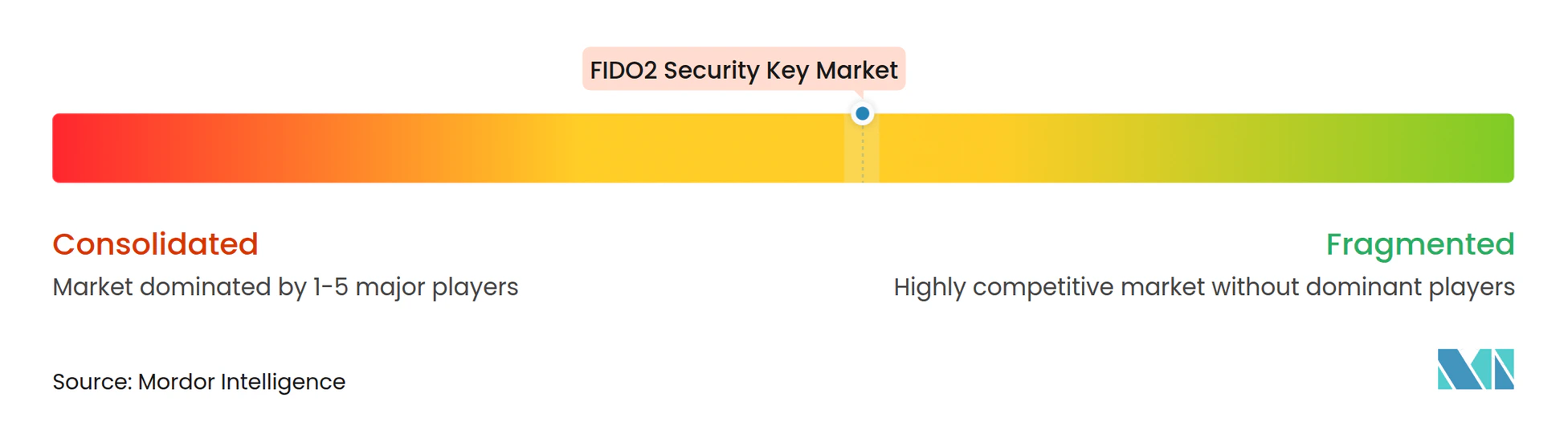
The FIDO2 security key market is moderately concentrated in enterprise fleet deployments, while mid-market and specialist segments remain fragmented. Yubico, FEITIAN Technologies, HID Global, and Thales have established positions through identity-provider relationships, distribution reach, and certified product portfolios. Competition centers on credential management, hardware certifications, biometric features, and dependable supply. Buyers in government and defense place particular value on FIPS 140-3, FIDO Level 3+, and traceable supply chains. These requirements limit substitution in high-assurance programs, because buyers must consider certification status, key management, secure-element design, supply continuity, and evidence that the credential can meet policy requirements throughout its operational life. The competitive structure leaves room for specialists that meet precise certification or regional sourcing needs, particularly when customers require local manufacturing, a narrowly defined assurance profile, biometric capability, a specified protocol combination, or hardware that fits an existing physical access program.
Yubico reported Q2 2026 net sales of SEK 543.9 million, equivalent to USD 52.8 million, and subscription revenue represented 18.0% of net sales. The company launched YubiKey 5.8 in July 2026, extending hardware-backed authorization to digital signatures, AI agent workflows, identity wallets, and secure payments. HID introduced Crescendo Keys, Crescendo Cards, and Enterprise Passkey Management in August 2025. Thales launched OneWelcome FIDO Key Lifecycle Management in February 2025 with integration to Microsoft Entra ID's FIDO2 provisioning API. These moves show that management services are becoming as important as the credential itself, as larger customers need support for provisioning, replacement, revocation, audit records, policy alignment, and controlled deployment across distributed workforces.
Product development in the FIDO2 security key market also focuses on post-quantum readiness, supply-chain assurance, and combined physical and digital access. Swissbit launched iShield Key 2 in May 2025 with support for up to 300 passkeys and FIPS 140-3 Level 3 certified variants. NEOWAVE expanded its FIDO2 and qualified-signature credential range with AET Europe in March 2025. Fingerprint sensor suppliers are enabling original equipment manufacturers to develop customized biometric authenticators, which increases competition in standard product categories. High-assurance certifications remain important safeguards against price-based competition in government and defense applications, where purchasing decisions place weight on validated security properties, long-term support, verifiable sourcing, and compatibility with tightly governed identity environments. This pattern supports differentiation around assurance, lifecycle controls, and deployment service quality.
FIDO2 Security Key Industry Leaders
-
Yubico AB
-
FEITIAN Technologies Co., Ltd.
-
Thales Group
-
HID Global Corporation
-
Google LLC
- *Disclaimer: Major Players sorted in no particular order
FIDO2 Security Key Market Companies Covered in this Report
- Yubico AB
- FEITIAN Technologies Co., Ltd.
- Thales Group
- HID Global Corporation
- Google LLC
- Entrust Corporation
- OneSpan Inc.
- Token2 Switzerland
- Identiv, Inc.
- Swissbit AG
- GoTrustID Inc.
- AuthenTrend Technology Inc.
- SoloKeys, Inc.
- Nitrokey GmbH
- Kensington Computer Products Group
- TrustKey Solutions Inc.
- Hypersecu Information Systems, Inc.
- Thetis International Co., Ltd.
- Excelsecu Data Technology Co., Ltd.
- Microchip Technology Incorporated
- IDEMIA Public Security
- NXP Semiconductors N.V.
- OnlyKey by CryptoTrust LLC
- Nok Nok Labs, Inc.
- Cisco Systems, Inc.
Recent Industry Developments in FIDO2 Security Key Market
- October 2026: The FIDO Alliance certified SecuGen's Unity 20 FIDO2 fingerprint security key to CTAP 2.1 and Authenticator Security Assurance Level 1 with an enterprise security profile. The key stores up to 255 passkeys and uses SecuGen's FBI-certified U20-A optical sensor, with volume availability through global resellers planned for Q4 2026.
- August 2026: Yubico and OpenAI partnered to offer a custom 2-pack YubiKey set under OpenAI's Advanced Account Security program for ChatGPT users. The collaboration introduced device-bound hardware passkeys to a mainstream consumer AI platform for the first time.
- July 2026: Yubico launched YubiKey 5.8 with CTAP 2.3 firmware, extending hardware-backed security to verified authorization for digital signatures, AI agent workflows, identity wallets, and secure payments, repositioning the physical key as a transactional authorization device beyond authentication.
- June 2026: Fingerprint Cards AB and JISA Softech launched CryptoBind BioKey and CryptoBind BioToken, FIDO-compliant biometric security tokens powered by FPC fingerprint sensors, targeting enterprise and consumer passwordless authentication globally.
Global FIDO2 Security Key Market Report Scope
The FIDO2 Security Key Market comprises hardware authenticators (USB, NFC, Bluetooth security keys) that enable passwordless, phishing-resistant authentication using FIDO2/WebAuthn and CTAP standards based on public-key cryptography.
The FIDO2 Security Key Market Report is Segmented by Product Type (USB Security Keys, NFC Security Keys, Bluetooth Security Keys, Biometric Security Keys, Multi-Protocol Security Keys, and Smart Card and Badge-Form FIDO2 Keys), Form Factor (USB Stick Keys, Credit-Card and Badge-Form Keys, Key-Fob Keys, Desktop Biometric Readers, and Embedded and Converged Authentication Devices), Interface (USB-A, USB-C, NFC, Bluetooth Low Energy, Lightning, and Multi-Interface), Authentication Method (FIDO2 Passwordless Authentication, FIDO2 Two-Factor Authentication, FIDO2 Multi-Factor Authentication With PIN, FIDO2 Multi-Factor Authentication With Biometrics, and FIDO2 and PIV or PKI Hybrid Authentication), Application (Workforce and Enterprise Access, Privileged Access Management, Government and Defense Access, Banking, Financial Services, and Insurance, Healthcare and Life Sciences, Retail, E-Commerce, and Consumer Accounts, and Other Applications), Distribution Channel (Direct Enterprise Sales, Identity and Security Integrators, Value-Added Resellers, Online Retail, and Physical Retail), and Geography (North America, South America, Europe, Asia-Pacific, and Middle East and Africa). The Market Forecasts Are Provided in Terms of Value (USD).
Segmentation Overview
| USB Security Keys |
| NFC Security Keys |
| Bluetooth Security Keys |
| Biometric Security Keys |
| Multi-Protocol Security Keys |
| Smart Card and Badge-Form FIDO2 Keys |
| USB Stick Keys |
| Credit-Card and Badge-Form Keys |
| Key-Fob Keys |
| Desktop Biometric Readers |
| Embedded and Converged Authentication Devices |
| USB-A |
| USB-C |
| NFC |
| Bluetooth Low Energy |
| Lightning |
| Multi-Interface |
| FIDO2 Passwordless Authentication |
| FIDO2 Two-Factor Authentication |
| FIDO2 Multi-Factor Authentication With PIN |
| FIDO2 Multi-Factor Authentication With Biometrics |
| FIDO2 and PIV or PKI Hybrid Authentication |
| Workforce and Enterprise Access |
| Privileged Access Management |
| Government and Defense Access |
| Banking, Financial Services, and Insurance |
| Healthcare and Life Sciences |
| Retail, E-Commerce, and Consumer Accounts |
| Other Applications |
| Direct Enterprise Sales |
| Identity and Security Integrators |
| Value-Added Resellers |
| Online Retail |
| Physical Retail |
| North America | United States |
| Canada | |
| Mexico | |
| South America | Brazil |
| Argentina | |
| Rest of South America | |
| Europe | Germany |
| United Kingdom | |
| France | |
| Italy | |
| Rest of Europe | |
| Asia-Pacific | China |
| Japan | |
| India | |
| South Korea | |
| Australia | |
| Rest of Asia-Pacific | |
| Middle East and Africa | Saudi Arabia |
| United Arab Emirates | |
| South Africa | |
| Egypt | |
| Rest of Middle East and Africa |
| By Product Type | USB Security Keys | |
| NFC Security Keys | ||
| Bluetooth Security Keys | ||
| Biometric Security Keys | ||
| Multi-Protocol Security Keys | ||
| Smart Card and Badge-Form FIDO2 Keys | ||
| By Form Factor | USB Stick Keys | |
| Credit-Card and Badge-Form Keys | ||
| Key-Fob Keys | ||
| Desktop Biometric Readers | ||
| Embedded and Converged Authentication Devices | ||
| By Interface | USB-A | |
| USB-C | ||
| NFC | ||
| Bluetooth Low Energy | ||
| Lightning | ||
| Multi-Interface | ||
| By Authentication Method | FIDO2 Passwordless Authentication | |
| FIDO2 Two-Factor Authentication | ||
| FIDO2 Multi-Factor Authentication With PIN | ||
| FIDO2 Multi-Factor Authentication With Biometrics | ||
| FIDO2 and PIV or PKI Hybrid Authentication | ||
| By Application | Workforce and Enterprise Access | |
| Privileged Access Management | ||
| Government and Defense Access | ||
| Banking, Financial Services, and Insurance | ||
| Healthcare and Life Sciences | ||
| Retail, E-Commerce, and Consumer Accounts | ||
| Other Applications | ||
| By Distribution Channel | Direct Enterprise Sales | |
| Identity and Security Integrators | ||
| Value-Added Resellers | ||
| Online Retail | ||
| Physical Retail | ||
| By Geography | North America | United States |
| Canada | ||
| Mexico | ||
| South America | Brazil | |
| Argentina | ||
| Rest of South America | ||
| Europe | Germany | |
| United Kingdom | ||
| France | ||
| Italy | ||
| Rest of Europe | ||
| Asia-Pacific | China | |
| Japan | ||
| India | ||
| South Korea | ||
| Australia | ||
| Rest of Asia-Pacific | ||
| Middle East and Africa | Saudi Arabia | |
| United Arab Emirates | ||
| South Africa | ||
| Egypt | ||
| Rest of Middle East and Africa | ||
Key Questions Answered in the Report
What is the size of the FIDO2 security key market?
The FIDO2 security key market is expected to rise from USD 1.06 billion in 2026 to USD 2.58 billion by 2032, at a CAGR of 13.17% from 2027 to 2032.
What is driving demand for FIDO2 security keys?
Demand is supported by phishing resistance, enterprise passkey adoption, regulatory requirements, and the need for device-bound credentials for privileged access.
Which product type leads FIDO2 security key adoption?
Multi-protocol security keys lead with 37.21% share in 2026 because they can support several enterprise authentication methods on one token.
Which FIDO2 security key format is expanding fastest?
Desktop biometric readers are projected to expand at a CAGR of 13.68% through 2032, supported by shared-workstation authentication requirements.
Which region is expanding fastest for FIDO2 security keys?
Asia-Pacific is projected to expand at a CAGR of 13.96% through 2032, supported by financial services adoption and digital identity infrastructure.
Why do organizations still buy hardware keys when passkeys are available?
Hardware keys support device-bound recovery, shared workstations, isolated systems, and high-assurance access where platform passkeys may not meet control requirements.