
Event-Based HOTP Hardware Token Market Size and Share
Market Overview
| Study Period | 2021 - 2032 |
|---|---|
| Market Size (2027) | USD 1.72 Billion |
| Market Size (2032) | USD 2.29 Billion |
| Growth Rate (2027 - 2032) | 5.89 % |
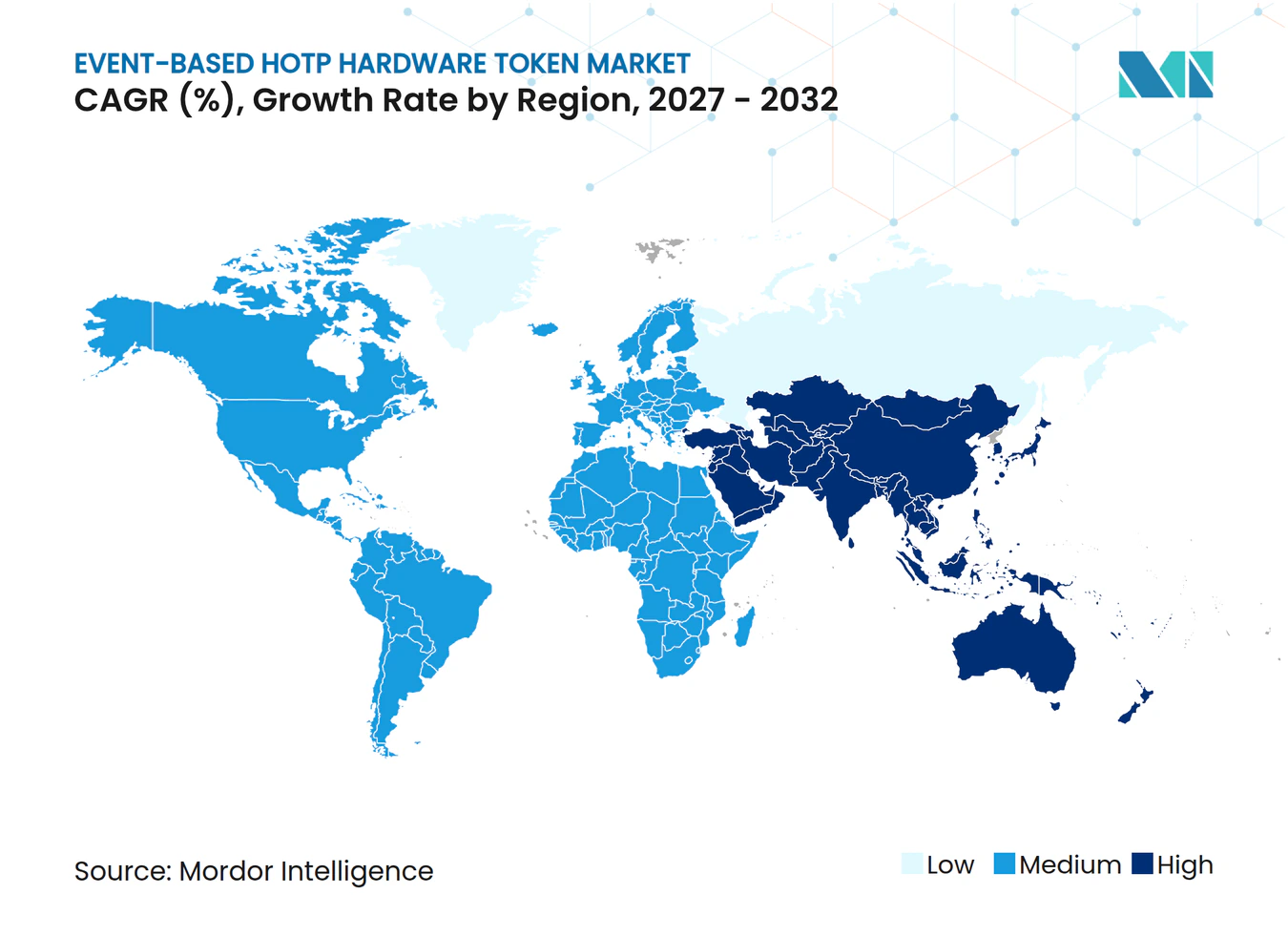
| Fastest Growing Market | Asia-Pacific |
| Largest Market | North America |
| Market Concentration | Medium |
Major Players *Disclaimer: Major Players sorted in no particular order Image © Mordor Intelligence. Reuse requires attribution under CC BY 4.0. | |
Event-Based HOTP Hardware Token Market Analysis by Mordor Intelligence
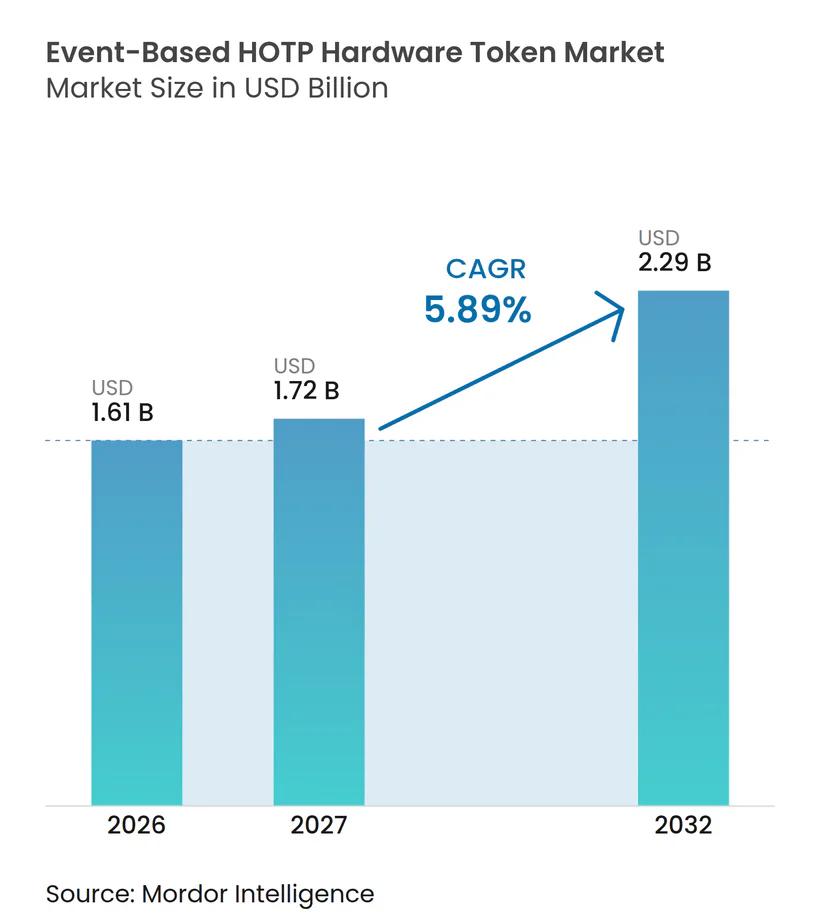
The event-based HOTP hardware token market size is projected to expand from USD 1.61 billion in 2026 and USD 1.72 billion in 2027 to USD 2.29 billion by 2032, registering a CAGR of 5.89% between 2027 to 2032. The event-based HOTP hardware token market is driven by more frequent identity attacks and rules requiring stronger authentication in regulated settings. Hardware credentials remain important where networks are isolated, data must remain within a jurisdiction, or organizations need a credential that does not depend on an active connection. Demand is also shifting toward devices that support both legacy HOTP workflows and FIDO2, allowing organizations to update their authentication programs without replacing every existing system at once. This approach gives suppliers an opportunity to combine devices with provisioning, inventory, and lifecycle services, while passkeys limit new demand in lower-assurance environments.
Key Report Takeaways
- By token architecture, standalone OATH HOTP tokens held 45.31% of the event-based HOTP hardware token market share in 2026, while hybrid HOTP and FIDO2 security keys are projected to expand at a 6.69% CAGR through 2032.
- By form factor, key fobs accounted for 48.12% share in 2026, while USB security keys are projected to expand at a 6.87% CAGR through 2032.
- By connectivity, disconnected tokens accounted for 58.34% share in 2026, while USB-connected tokens are projected to expand at a 6.64% CAGR through 2032.
- By end user, BFSI accounted for 36.09% share in 2026, while enterprise IT and privileged access management are projected to expand at a 7.08% CAGR through 2032.
- By deployment and sales model, on-premise authentication infrastructure accounted for 69.73% share in 2026, while public cloud identity platforms are projected to expand at a 6.82% CAGR through 2032.
- By geography, North America held 42.27% share in 2026, while the Asia-Pacific is projected to expand at a 6.88% CAGR through 2032.
Note: Market numbers in this report are based on Mordor Intelligence's proprietary estimation framework, which combines nine months of actuals with Q4 projections for base year 2026.
Market Trends and Insights
Drivers Impact Analysis of Event-Based HOTP Hardware Token Market*
| Driver | (~) % Impact on CAGR Forecast | Geographic Relevance | Impact Timeline |
|---|---|---|---|
| Rising Identity-Based Attacks and Regulatory MFA Mandates | +1.5% | Global | Short term (≤ 2 years) |
| Expansion of Offline and Air-Gapped MFA Requirements | +1.2% | North America, Europe, and Asia-Pacific core | Medium term (2-4 years) |
| Procurement of Phishing-Resistant Hybrid Hardware Keys | +1.0% | North America and EU, spill-over to Asia-Pacific | Medium term (2-4 years) |
| Replacement of Legacy Tokens in Banking and Government Fleets | +0.8% | Global | Medium term (2-4 years) |
| Counter-Synchronization Tolerance in Low-Connectivity Environments | +0.6% | Asia-Pacific core, spill-over to Middle East and Africa | Long term (≥ 4 years) |
| Increasing Use of Hardware MFA for Privileged and Third-Party Access | +0.5% | Global | Medium term (2-4 years) |
| Source: Mordor Intelligence | |||
Rising Identity-Based Attacks and Regulatory MFA Mandates
Microsoft reported that more than 97% of identity attacks were password-based and that identity-based attacks rose by 32% in the first half of 2025. The same report stated that phishing-resistant multifactor authentication blocks more than 99% of attacks, including cases involving valid credentials. The event-based HOTP hardware token market benefits when security teams treat hardware-backed authentication as a necessary control rather than a discretionary technology purchase. DORA became applicable in January 2025, placing operational resilience obligations on covered financial entities in the European Union. NIST SP 800-63B-4 also describes authenticator requirements for federal digital identity programs, which supports longer procurement cycles for regulated users.[1] These conditions make hardware token purchases less exposed to short-term changes in general IT budgets.
Expansion of Offline and Air-Gapped MFA Requirements
The event-based HOTP hardware token market serves environments where connectivity is unavailable, restricted, or intentionally removed. Classified networks, industrial control systems, banking back offices, and military communications may use air-gapped or partly isolated architectures. HOTP uses a counter-based method, so it does not require clock synchronization, internet access, or live network validation during authentication. Norway's Health North IKT HF issued a 2025 procurement for strong two-factor authentication aligned with eIDAS high assurance and specified FIDO2 hardware keys. Poland's Ministry of Internal Affairs also tendered a 2025 purchase for 150 hardware tokens with a 36-month authentication environment. These purchases show that infrastructure modernization can preserve demand for physical credentials rather than replace them.
Procurement of Phishing-Resistant Hybrid Hardware Keys
Organizations increasingly procure a single device that supports HOTP and FIDO2 rather than maintaining separate hardware programs. The event-based HOTP hardware token market, therefore, benefits from hybrid keys that work with older RADIUS environments and newer identity platforms. RSA's iShield Key 2 Series supports FIDO2, OATH HOTP, PKI, and PIV protocols in a FIPS 140-3 Level 3 certified device. Thales introduced OneWelcome FIDO Key Lifecycle Management in February 2025, including pre-registration of keys with Microsoft Entra ID through FIDO2 provisioning APIs. This design reduces enrollment work in large deployments and makes device lifecycle management part of the buying decision. It also allows HOTP to remain available during multi-year migrations toward phishing-resistant authentication.
Replacement of Legacy Tokens in Banking and Government Fleets
Banking institutions and government agencies operate large fleets of hardware tokens with scheduled replacement needs. The event-based HOTP hardware token market gains from devices bought between 2012 and 2018, reaching the end of their physical life and becoming less suitable for current cryptographic requirements. The 2025 Polish procurement combined the hardware refresh with a 36-month authentication environment, showing how device replacement and infrastructure work are commonly bundled. Sichuan Rural Commercial Bank issued a February 2026 notice about an OTP authentication upgrade that supports event-based, time-based, and challenge-type passwords, with domestic cryptographic support. Such specifications can limit the role of software-only alternatives in regulated banking. Replacement demand is especially durable where high-value payment approvals and privileged access require a physical authentication factor.
Restraints Impact Analysis of Event-Based HOTP Hardware Token Market*
| Restraint | (~) % Impact on CAGR Forecast | Geographic Relevance | Impact Timeline |
|---|---|---|---|
| Migration Toward Passkeys and Platform Authenticators | -0.8% | North America and Europe, spill-over to Asia-Pacific | Short term (≤ 2 years) |
| HOTP Counter Desynchronization and Recovery Friction | -0.5% | Global | Medium term (2-4 years) |
| Limited HOTP Support in Modern Cloud Identity Workflows | -0.4% | North America and EU | Medium term (2-4 years) |
| Battery Replacement, Inventory, and End-of-Life Burden | -0.3% | Global | Long term (≥ 4 years) |
| Source: Mordor Intelligence | |||
Migration Toward Passkeys and Platform Authenticators
Platform-native authentication reduces demand for standalone tokens in consumer and mid-market settings. NIST SP 800-63B-4 recognizes syncable passkeys for AAL2 use cases, which can support software-based authentication where the assurance need is lower. The FIDO Alliance reported in 2025 that 87% of surveyed enterprises were moving toward passkeys, although many had not deployed them. The event-based HOTP hardware token market faces its greatest displacement risk in AAL1 and AAL2 deployments, where a platform authenticator may meet the stated policy requirement. However, NIST does not allow syncable authenticators at AAL3 because the authenticator secret is exportable. Hardware-backed and non-exportable credentials, therefore, retain a role for classified systems, defense contractors, and high-value financial activity.
HOTP Counter Desynchronization and Recovery Friction
Counter drift remains an operational drawback for HOTP. A token can become out of sync when a user generates codes without completing an authentication attempt. Unlike time-based OTP, the token may require counter realignment rather than automatic synchronization within a time window. This creates a helpdesk workload for organizations with large, dispersed fleets. Suppliers can use wider look-ahead windows and automated detection to reduce recovery events, but those controls impose additional configuration requirements. The event-based HOTP hardware token market is therefore less attractive in settings that require seamless, repeated authentication across distributed workforces.
*Our forecasts treat driver/restraint impacts as directional, not additive. The impact forecasts reflect baseline growth, mix effects, and variable interactions.
Event-Based HOTP Hardware Token Market Segment Analysis
By Token Architecture:
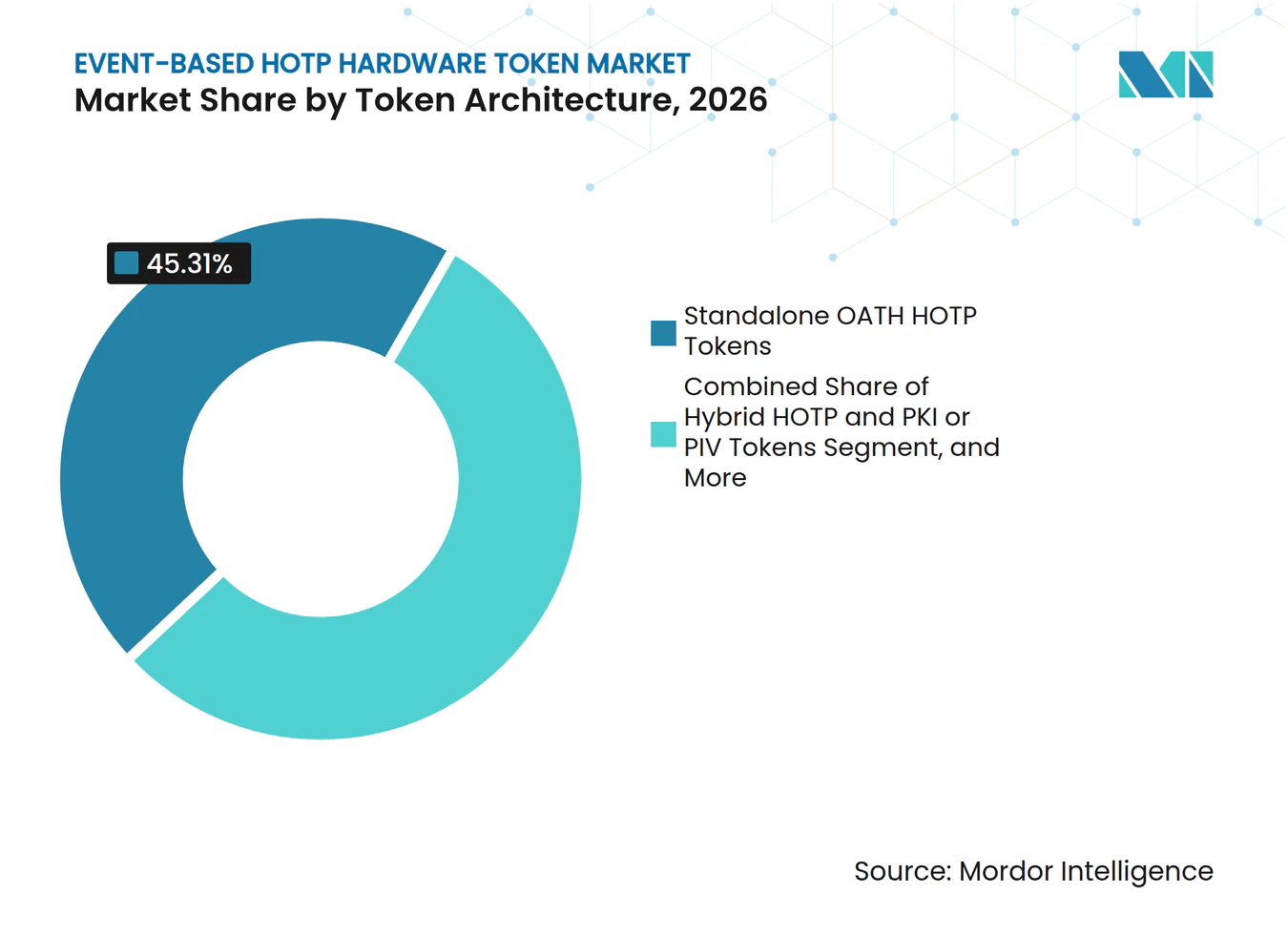
Standalone Tokens Retain Installed-Base Demand While Hybrid Keys Broaden UseStandalone OATH HOTP tokens held 45.31% share in 2026. Their position rests on substantial installed bases in banking, government, and telecommunications organizations, where token validation is embedded in long-standing identity and access systems. These users face high switching costs because a change can affect authentication servers, operational procedures, user training, and audit evidence. The devices remain suitable for air-gapped deployments and older RADIUS chains because a displayed code does not require a USB or NFC interface. The absence of firmware updates can be a deliberate security choice for organizations that tightly control device behavior and configuration.
Hybrid HOTP and FIDO2 security keys are projected to expand at a 6.69% CAGR through 2032. The event-based HOTP hardware token market size for this architecture is driven by enterprises that require legacy compatibility and a practical path to FIDO2 without parallel device purchases or disruptive system changes. Hybrid HOTP and PKI or PIV devices suit government and defense users whose physical and logical access credentials are converging on a single device. Challenge-response and transaction-signing products continue to serve high-value banking flows that need a transaction-specific security step. Yubico announced YubiKey 5.8 in July 2026 with CTAP 2.3 support and the WebAuthn signing extension for hardware-backed passkey functions. The release illustrates how a multi-protocol key can add support for identity wallets, approvals, and document signing while preserving the physical security model.



By Form Factor:
Key Fobs Hold Broad Compatibility While USB Keys Support Modern Identity ProgramsKey fobs accounted for 48.12% of the event-based HOTP hardware token market in 2026. Their use rests on low unit costs, driver-free operation, and compatibility with established authentication servers across banking and government. A key fob does not require a USB port, NFC antenna, or software installation, which makes it useful for contact centers, operations teams, and field personnel using shared or restricted workstations. Display cards also gain use in banking because a credit card-sized credential can reduce additional device inventory while supporting mobile banking and corporate treasury activities. The simple form remains valuable where organizations need a reliable, easily issued credential instead of a device dependent on a particular endpoint.
USB security keys are projected to expand at a 6.87% CAGR through 2032. Their adoption follows zero-trust programs that require cryptographic device attestation, phishing-resistant access, and support for laptop-based hybrid workforces. HID Global expanded its Crescendo portfolio in August 2025 with the Crescendo Key, Crescendo Cards, and OMNIKEY 5022 reader. The Crescendo Key supports FIDO2, PKI, and OATH, demonstrating the commercial value of a device that spans both older and newer authentication workflows. Smart cards continue to support government, defense, and healthcare deployments where physical access and logical authentication are combined, while desktop and pocket tokens remain useful where a larger display helps users verify high-value transaction codes.
By Connectivity:
Disconnected Tokens Support Isolated Networks While USB Products Gain GroundDisconnected tokens held 58.34% share in 2026. Their counter-based design produces a one-time code without a real-time connection to the authentication server at the point of use. This is a defining property in classified, air-gapped, and infrastructure-constrained environments because it avoids an active transport channel during authentication. Government networks, energy control systems, and financial back-office platforms use this model, in which data residency and compartmentalization rules can exclude cloud-managed or network-synchronized alternatives. The category is also resilient during outages because the user can generate a code even when a connection is unavailable or not permitted.
USB-connected tokens are projected to expand at a 6.64% CAGR through 2032. Enterprises use FIDO2-capable USB keys that support hardware-derived HOTP codes and WebAuthn authentication from the same physical device. Yubico's FIPS Series and FEITIAN's ePass Token have obtained FIPS 140-3 Level 3 certification, supporting procurement programs that need validated cryptographic modules. NFC products are used in consumer banking and healthcare for tap-to-authenticate workflows that reduce friction for mobile-first users. Bluetooth devices serve a narrower range of applications and mobility settings where USB ports are unavailable, although battery needs and secure pairing management constrain their use in larger fleets.
By End User:
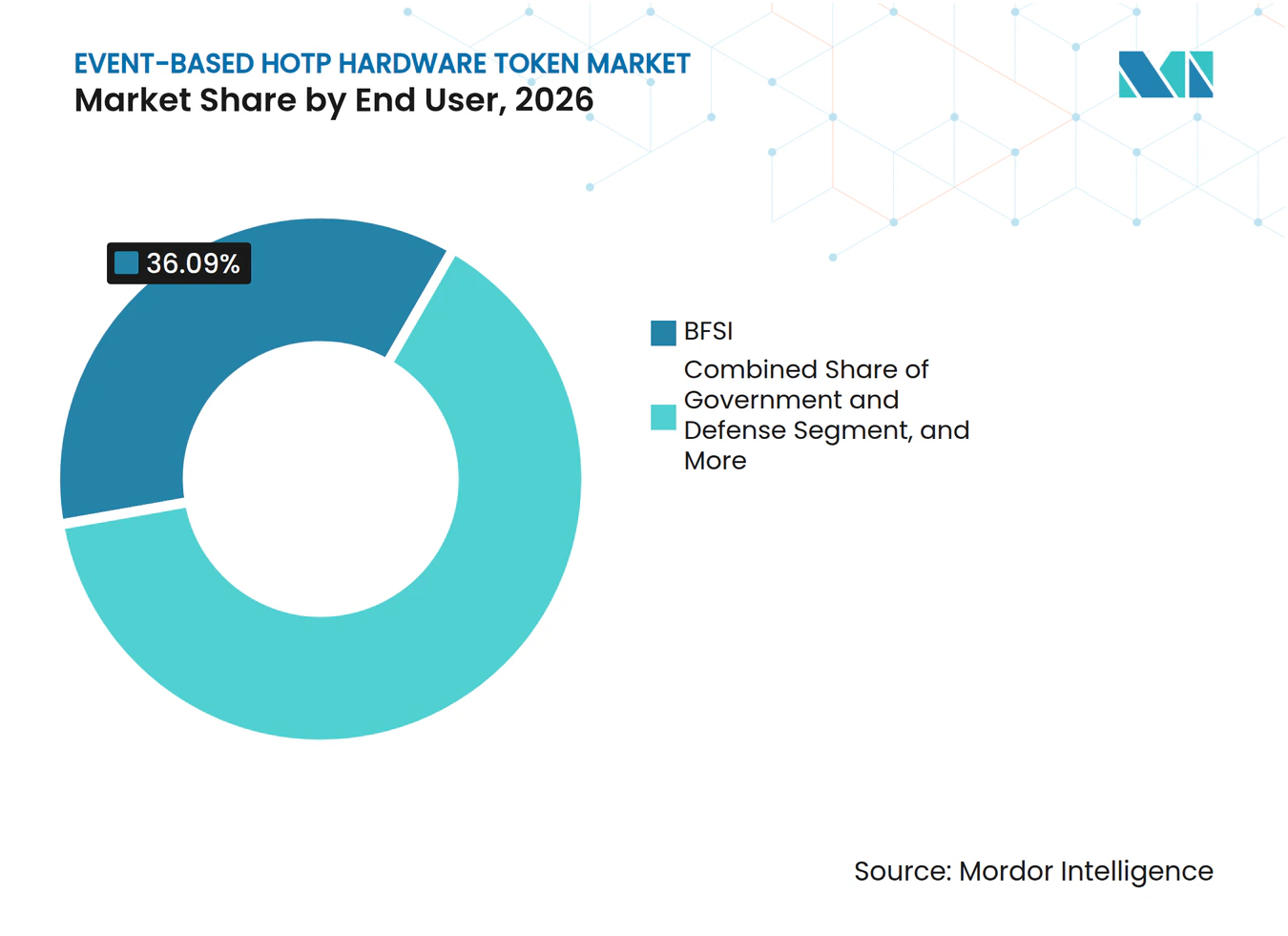
BFSI Leads Regulated Demand While Privileged Access Programs ExpandBFSI accounted for 36.09% share in 2026. Financial institutions face high transaction risk and strong requirements for authentication controls, especially for payment approvals and access to sensitive banking systems. DORA has been applied since January 2025 and reinforces resilient ICT risk management for covered financial entities. Japan's Financial Services Agency issued a public awareness campaign in April 2026 covering phishing-resistant multifactor authentication for financial institutions. Government and defense constitute another substantial user group because national MFA programs and contractor requirements often require physical credentials for sensitive systems, including those that must remain functional during network interruptions.
Enterprise IT and privileged access management are projected to expand at a 7.08% CAGR through 2032. Organizations are extending hardware MFA to third-party contractors, cloud administrators, and operational technology teams after supply chain security incidents exposed the risks posed by powerful user accounts. The event-based HOTP hardware token industry benefits when administrators need a distinct physical credential for high-privilege roles and for access to sensitive infrastructure. Healthcare organizations are deploying hardware tokens for electronic health record systems and privileged workstations amid persistent ransomware risks. Telecommunications and critical infrastructure operators use hardware MFA in network operations centers, while education and research institutions remain a smaller opportunity that is developing through government data-handling obligations.

By Deployment and Sales Model:
On-Premise Systems Lead While Cloud Management Adds FlexibilityOn-premise authentication infrastructure accounted for 69.73% of the event-based HOTP hardware token market in 2026. Banks, defense agencies, and government ministries may not route authentication traffic through commercial cloud services due to sovereignty, latency, and security classification requirements. These users often maintain RADIUS servers, LDAP directories, and identity systems designed for HOTP validation over extended deployment periods. Token suppliers gain durable accounts once management software is integrated into security operations, as replacement can disrupt established workflows, governance controls, and user populations. The event-based HOTP hardware token market, therefore, retains a substantial base in environments that require local control and predictable operation.
Public cloud identity platforms are projected to expand at a 6.82% CAGR through 2032. Cloud-native enterprises seek centralized provisioning, lifecycle management, inventory visibility, and audit trails for hardware token fleets. OneSpan introduced DigipassONE in July 2026 as a unified platform for hardware tokens, mobile authenticators, FIDO2 keys, passkeys, and software authenticators across cloud and on-premise environments. Private cloud systems remain relevant to mid-sized businesses and regulated organizations that want cloud operating models without the same data-sovereignty concessions as public cloud deployment. National sovereign cloud programs in Europe and Asia-Pacific further support this model, while suppliers that combine devices with identity platform integration can remain relevant amid broader authentication changes.
Geography Analysis
North America Event-Based HOTP Hardware Token Market
North America held 42.27% of the event-based HOTP hardware token market share in 2026. The United States supports most regional demand through defense procurement and federal authentication requirements. Procurement often depends on FIPS 140-3 validation, which narrows the list of eligible products in sensitive federal deployments. Yubico received FIPS 140-3 validation for the YubiKey 5 FIPS Series in May 2026. Canada and Mexico add demand through financial-sector modernization and cross-border defense programs.
APAC Event-Based HOTP Hardware Token Market
Asia-Pacific is projected to expand at a 6.88% CAGR through 2032. The event-based HOTP hardware token market size in the region is driven by tighter banking requirements and the expansion of digital financial services in Japan, China, India, and South Korea. The Japan Securities Dealers Association published a draft revision of guidelines in July 2025 that included phishing-resistant MFA for securities trading account activities.[2] Sichuan Rural Commercial Bank's 2026 procurement called for event-based, time-based, and challenge-type OTP capabilities with domestic cryptographic support. Bank of Communications deployed a HarmonyOS-based digital shield for large-value transfer authentication, illustrating the regional focus on locally compliant authentication technology.
EMEA and South America Event-Based HOTP Hardware Token Market
Europe has material demand due to DORA and NIS2, which impose cybersecurity obligations on financial institutions, essential entities, and digital infrastructure providers. Germany and France are important national markets, while the United Kingdom continues to require strong controls in financial services and Cyber Essentials programs. Swissbit introduced the iShield Key 2 in May 2025, a FIPS 140-3 Level 3-certified device supporting FIDO2, HOTP, TOTP, and PIV. The Middle East is emerging through national digital identity programs and financial-sector cybersecurity requirements. Africa remains early-stage, led by South Africa and Nigeria, while South America is developing from a smaller base, with Brazil as the most immediate banking opportunity.
Competitive Landscape
Market Concentration
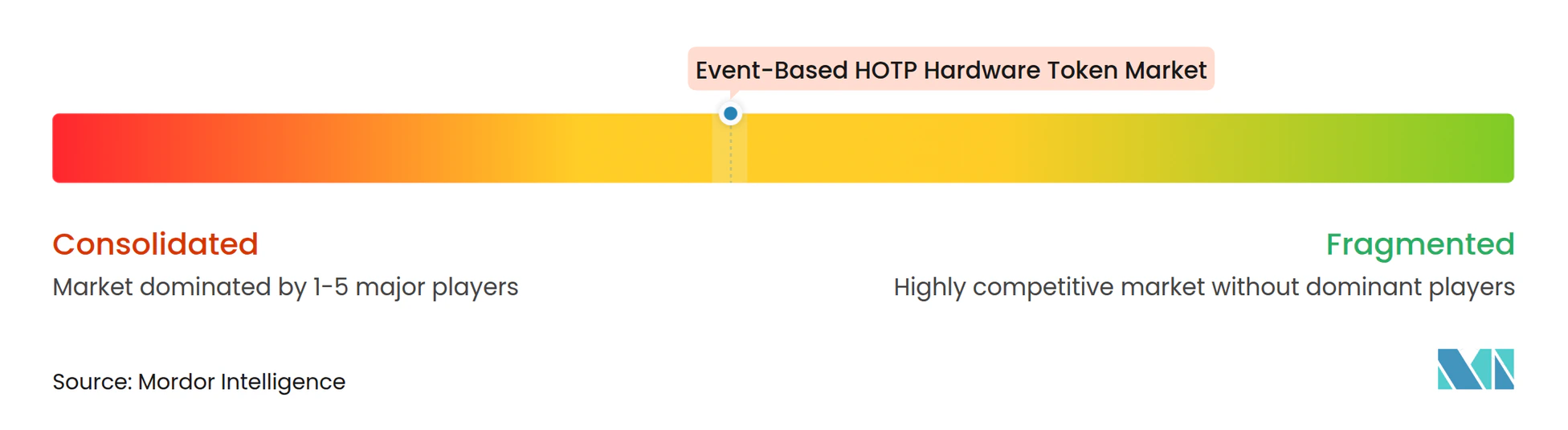
The event-based HOTP hardware token market is moderately consolidated. Thales, Yubico, RSA Security, FEITIAN, OneSpan, HID Global, and Entrust compete on certification coverage, form-factor range, and lifecycle management capabilities. Token2, Protectimus, Hypersecu, Deepnet Security, and ID Control serve cost-sensitive, open-standard, and regional demand. OTP algorithm support has become less distinctive because it is available across many products. Competition has shifted toward integration with identity platforms, alignment with compliance requirements, and the ability to manage device fleets at scale.
Certification is a central selection factor in federal, defense, and other high-assurance procurements. FEITIAN announced FIPS 140-3 Level 3 certification for its ePass Token in January 2026. Yubico announced FIPS 140-3 validation for its YubiKey 5 FIPS Series in May 2026. Thales added OneWelcome FIDO Key Lifecycle Management in February 2025 to enable pre-registration of security keys with Microsoft Entra ID[3]. These moves show that providers are pairing device sales with tools that reduce enrollment, revocation, replacement, and audit effort. The event-based HOTP hardware token market can therefore retain customers through device refresh cycles and broader authentication modernization.
Specialist suppliers are using regulatory packaging and protocol breadth to compete with larger companies. Swissbit's iShield Key 2 combines FIDO2, PIV, and HOTP functions for deployments requiring certified hardware. The mid-market remains a key opportunity because many large suppliers prioritize enterprise and government accounts. Smaller financial institutions, regional governments, and healthcare systems may need affordable programs with cloud-managed lifecycle functions. FIPS 140-3, FIDO certification, DORA, NIS2, and CMMC 2.0 create a compliance structure that favors vendors with demonstrable certification coverage. The competitive environment remains broad enough for specialists, but certification and platform integration are raising the cost of effective competition.
Event-Based HOTP Hardware Token Industry Leaders
-
Thales SA
-
RSA Security LLC
-
FEITIAN Technologies Co., Ltd.
-
OneSpan Inc.
-
Entrust Corporation
- *Disclaimer: Major Players sorted in no particular order
Event-Based HOTP Hardware Token Market Companies Covered in this Report
- Thales SA
- RSA Security LLC
- FEITIAN Technologies Co., Ltd.
- OneSpan Inc.
- Entrust Corporation
- HID Global Corporation
- Yubico AB
- Microcosm Ltd.
- Deepnet Security Ltd.
- SecureMetric Technology Sdn Bhd
- Fortinet, Inc.
- BIO-key International, Inc.
- Token2 Sàrl
- Protectimus Solutions LLP
- Hypersecu Information Systems, Inc.
- Ireth S.r.l.
- Authenex, Inc.
- SurePassID, Inc.
- Nexus Group AB
- ID Control B.V.
Recent Industry Developments in Event-Based HOTP Hardware Token Market
- July 2026: Yubico announced general availability of YubiKey 5.8 on July 21, 2026, introducing CTAP 2.3 support and the WebAuthn signing extension to extend hardware-backed passkey functionality to identity wallets, document signing, enterprise workflows, and AI-driven approvals. The YubiKey 5 FIPS Series remained on firmware 5.7.4 to preserve its FIPS 140-3 regulatory alignment, while the CCN Series continued final re-certification.
- May 2026: Yubico received FIPS 140-3 validation, Certificate #5291, for its YubiKey 5 FIPS Series, firmware 5.7.4, making it the only US Government-authorized hardware authenticator to hold both DoD PKI credentials and FIDO2 passkeys simultaneously, with expanded support for RSA-3072, RSA-4096, and Ed25519 key algorithms aligned to DoD cryptographic requirements.
- January 2026: FEITIAN Technologies announced on January 28, 2026, that its ePass Token Cryptographic Module achieved FIPS 140-3 Level 3 certification, meeting NIST SP 800-63 AAL3 requirements and establishing FedRAMP compliance for enterprise, financial, telecom, government, and education customers across more than 150 countries.
- November 2025: OneSpan deployed its cloud-based FIDO authentication solution for Sumitomo Mitsui Trust Bank, Japan's largest trust bank, on November 18, 2025, in partnership with SCSK Corporation. The deployment, the first cloud-based FIDO implementation in Japanese mobile banking, targets account takeover fraud losses approximating JPY 690 billion (USD 4.44 billion) in 2025 and aligns with Japan Financial Services Agency mandates for phishing-resistant MFA.
Global Event-Based HOTP Hardware Token Market Report Scope
The Event-Based HOTP Hardware Token Market comprises physical authentication devices that generate one-time passwords (OTPs) based on the HMAC-based One-Time Password (HOTP) algorithm, with each password generated in response to a specific event, such as a button press or authentication request. These tokens enable secure user authentication and access control by generating time-independent, event-driven passcodes that help protect digital systems, networks, applications, and sensitive information against unauthorized access and credential-based attacks.
The Event-Based HOTP Hardware Token Market Report is Segmented by Token Architecture (Standalone OATH HOTP Tokens, Hybrid HOTP and FIDO2 Security Keys, Hybrid HOTP and PKI or PIV Tokens, and Challenge-Response and Transaction-Signing Tokens), Form Factor (Key Fob Tokens, Display Cards, USB Security Keys, Smart Cards, and Desktop and Pocket Tokens), Connectivity (Disconnected, USB-Connected, NFC-Enabled, and Bluetooth-Enabled), End User (BFSI, Government and Defense, Enterprise IT and Critical Infrastructure, Healthcare, and Education and Research), Deployment Model (On-Premise, Private Cloud, and Public Cloud), and Geography (North America, South America, Europe, Asia-Pacific, Middle East, and Africa). The Market Forecasts are Provided in Terms of Value (USD).
Segmentation Overview
| Standalone OATH HOTP Tokens |
| Hybrid HOTP and FIDO2 Security Keys |
| Hybrid HOTP and PKI or PIV Tokens |
| Challenge-Response and Transaction-Signing Tokens |
| Key Fob Tokens |
| Display Cards |
| USB Security Keys |
| Smart Cards |
| Desktop and Pocket Tokens |
| Disconnected |
| USB-Connected |
| NFC-Enabled |
| Bluetooth-Enabled |
| BFSI |
| Government and Defense |
| Enterprise IT and Privileged Access |
| Healthcare |
| Telecom and Critical Infrastructure |
| Education and Research |
| On-Premise Authentication Infrastructure |
| Private Cloud Authentication |
| Public Cloud Identity Platforms |
| North America | United States |
| Canada | |
| Mexico | |
| South America | Brazil |
| Argentina | |
| Rest of South America | |
| Europe | Germany |
| United Kingdom | |
| France | |
| Spain | |
| Rest of Europe | |
| Asia-Pacific | China |
| Japan | |
| India | |
| South Korea | |
| Australia | |
| Rest of Asia-Pacific | |
| Middle East | Saudi Arabia |
| United Arab Emirates | |
| Turkey | |
| Rest of Middle East | |
| Africa | South Africa |
| Nigeria | |
| Egypt | |
| Rest of Africa |
| By Token Architecture | Standalone OATH HOTP Tokens | |
| Hybrid HOTP and FIDO2 Security Keys | ||
| Hybrid HOTP and PKI or PIV Tokens | ||
| Challenge-Response and Transaction-Signing Tokens | ||
| By Form Factor | Key Fob Tokens | |
| Display Cards | ||
| USB Security Keys | ||
| Smart Cards | ||
| Desktop and Pocket Tokens | ||
| By Connectivity | Disconnected | |
| USB-Connected | ||
| NFC-Enabled | ||
| Bluetooth-Enabled | ||
| By End User | BFSI | |
| Government and Defense | ||
| Enterprise IT and Privileged Access | ||
| Healthcare | ||
| Telecom and Critical Infrastructure | ||
| Education and Research | ||
| By Deployment and Sales Model | On-Premise Authentication Infrastructure | |
| Private Cloud Authentication | ||
| Public Cloud Identity Platforms | ||
| By Geography | North America | United States |
| Canada | ||
| Mexico | ||
| South America | Brazil | |
| Argentina | ||
| Rest of South America | ||
| Europe | Germany | |
| United Kingdom | ||
| France | ||
| Spain | ||
| Rest of Europe | ||
| Asia-Pacific | China | |
| Japan | ||
| India | ||
| South Korea | ||
| Australia | ||
| Rest of Asia-Pacific | ||
| Middle East | Saudi Arabia | |
| United Arab Emirates | ||
| Turkey | ||
| Rest of Middle East | ||
| Africa | South Africa | |
| Nigeria | ||
| Egypt | ||
| Rest of Africa | ||
Key Questions Answered in the Report
What is the event-based HOTP hardware token market size?
The event-based HOTP hardware token market is projected to increase from USD 1.61 billion in 2026 to USD 2.29 billion by 2032, at a 5.89% CAGR from 2027 to 2032.
Why are organizations still using HOTP hardware tokens?
They support authentication in air-gapped and low-connectivity settings, and they can meet high-assurance requirements where syncable passkeys are not suitable.
Which token architecture has the largest share?
Standalone OATH HOTP tokens held 45.31% share in 2026 because they remain embedded in banking, government, and telecommunications authentication systems.
Which form factor is expanding fastest?
USB security keys are projected to expand at a 6.87% CAGR through 2032, supported by phishing-resistant access and device-attestation requirements.
Which end-user group leads demand?
BFSI held 36.09% share in 2026, reflecting high transaction risk and security requirements in banking operations.
Which region is expanding fastest?
Asia-Pacific is projected to expand at a 6.88% CAGR through 2032 as financial services digitization and authentication rules advance across major economies.