
Fatty Acid Methyl Ester Market Size and Share
Market Overview
| Study Period | 2021 - 2031 |
|---|---|
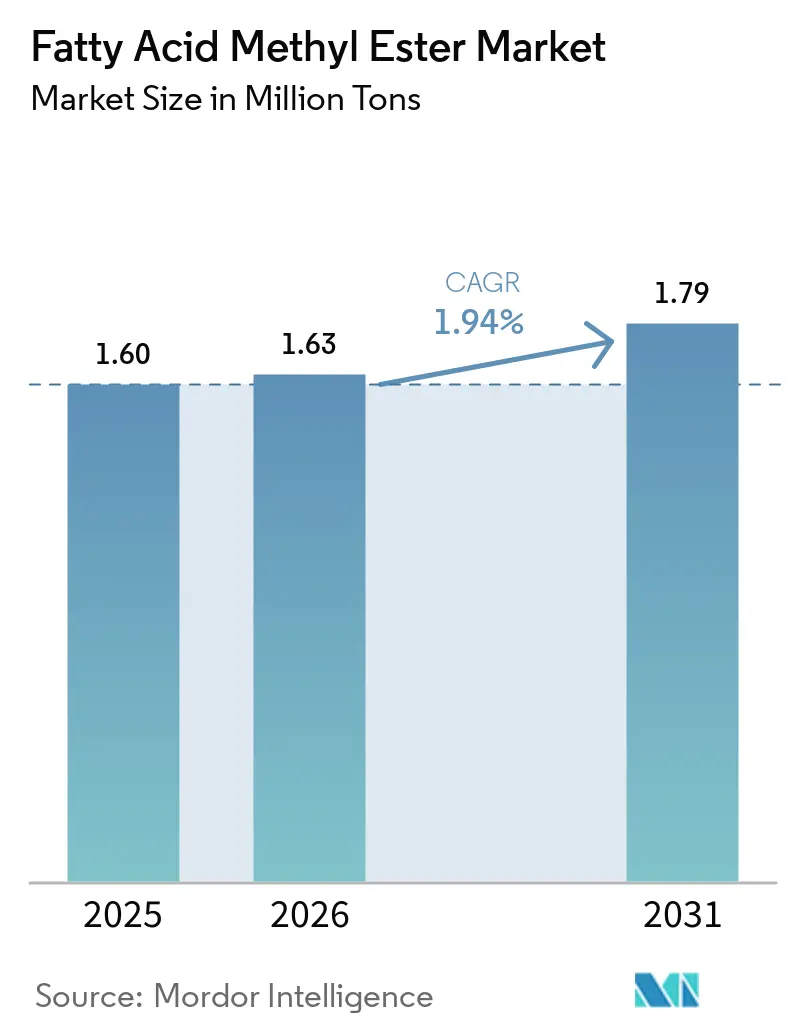
| Market Volume (2026) | 1.63 Million tons |
| Market Volume (2031) | 1.79 Million tons |
| Growth Rate (2026 - 2031) | 1.94 % |
| Fastest Growing Market | Asia Pacific |
| Largest Market | Europe |
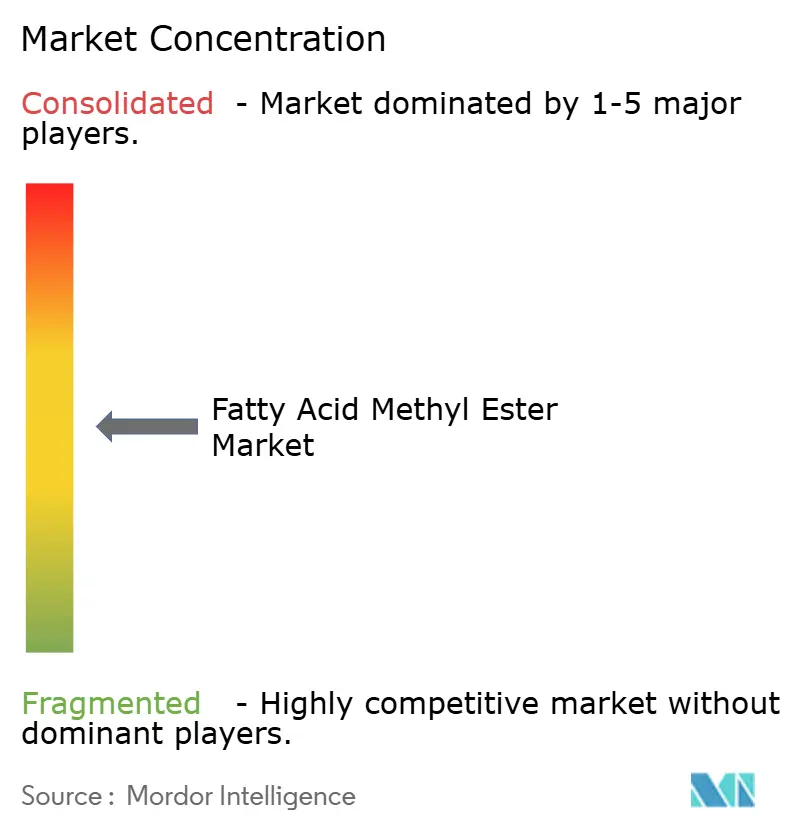
| Market Concentration | Medium |
Major Players *Disclaimer: Major Players sorted in no particular order Image © Mordor Intelligence. Reuse requires attribution under CC BY 4.0. | |
Fatty Acid Methyl Ester Market Analysis by Mordor Intelligence
The Fatty Acid Methyl Ester Market size is expected to grow from 1.60 million tons in 2025 to 1.63 million tons in 2026 and is forecast to reach 1.79 million tons by 2031 at a 1.94% CAGR over 2026-2031. Solid blend mandates in Indonesia, Brazil, and the European Union safeguard baseline consumption, but widening premiums for used cooking oil over virgin palm oil have turned feedstock arbitrage into the primary driver of producer margins. Renewable diesel investments by large energy companies are redirecting waste oils toward hydro-treating units, shortening supply for traditional trans-esterification plants. Personal-care formulators are auditing ingredient lists for biodegradability, prompting fast growth in oleochemical-grade esters that can command 60–80% price premiums over fuel grades. Against this backdrop, companies that secure long-term waste-oil contracts or pilot algal-oil cultivation gain resiliency as the Fatty Acid Methyl Ester market navigates tightening sustainability criteria under the EU Renewable Energy Directive III and similar frameworks in North America and Asia.
Key Report Takeaways
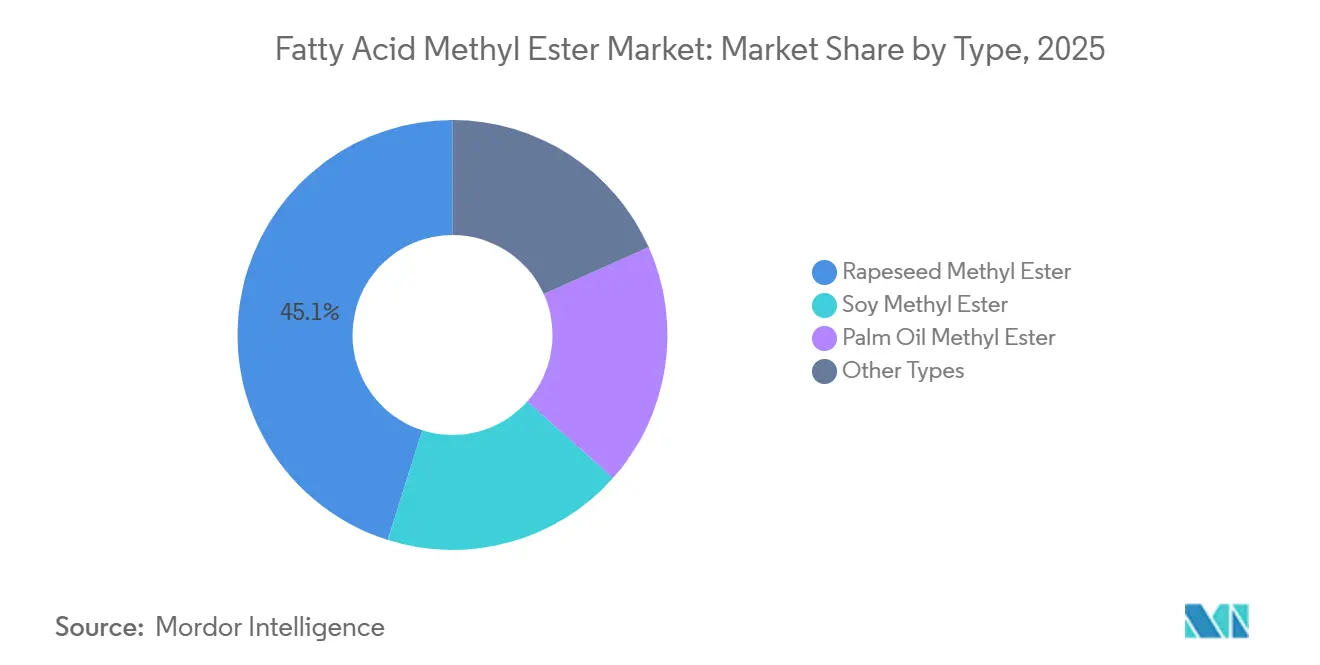
- By type, rapeseed methyl ester led with 45.12% of Fatty Acid Methyl Ester market share in 2025, while the “Other Types” segment is forecast to accelerate at a 2.76% CAGR through 2031.
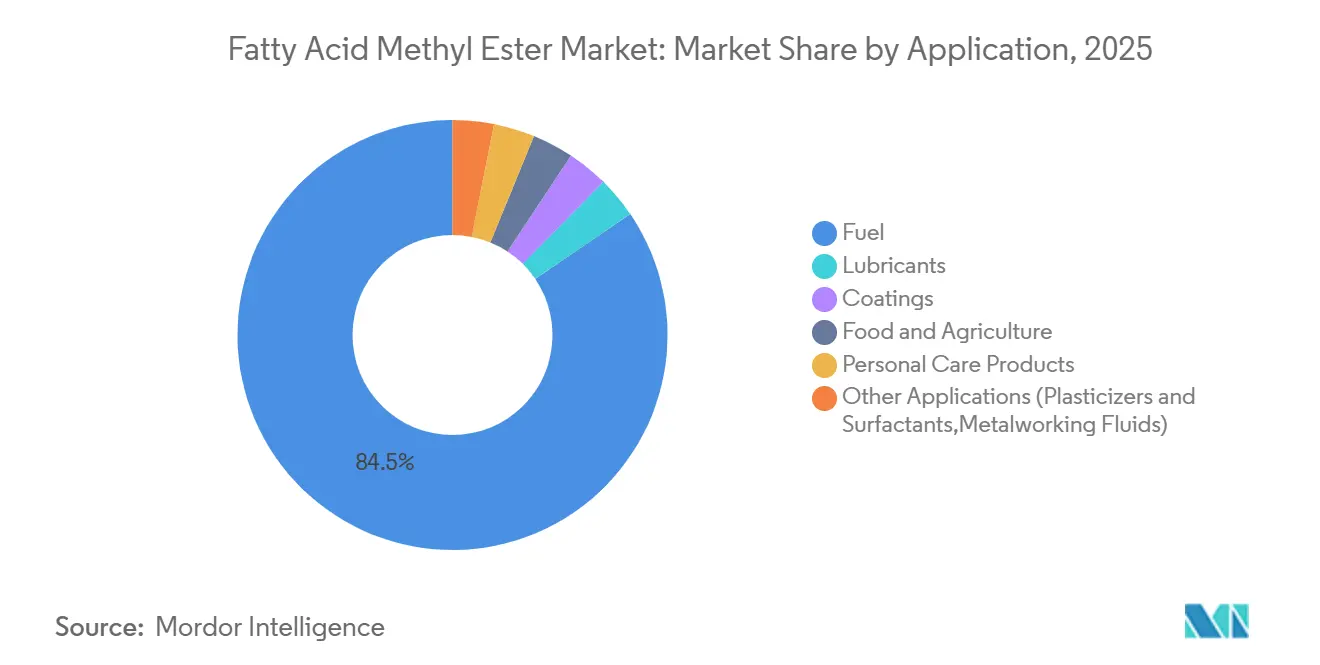
- By application, fuel maintained 84.52% share of the Fatty Acid Methyl Ester market size in 2025, yet personal care products record the fastest expansion at a 3.29% CAGR to 2031.
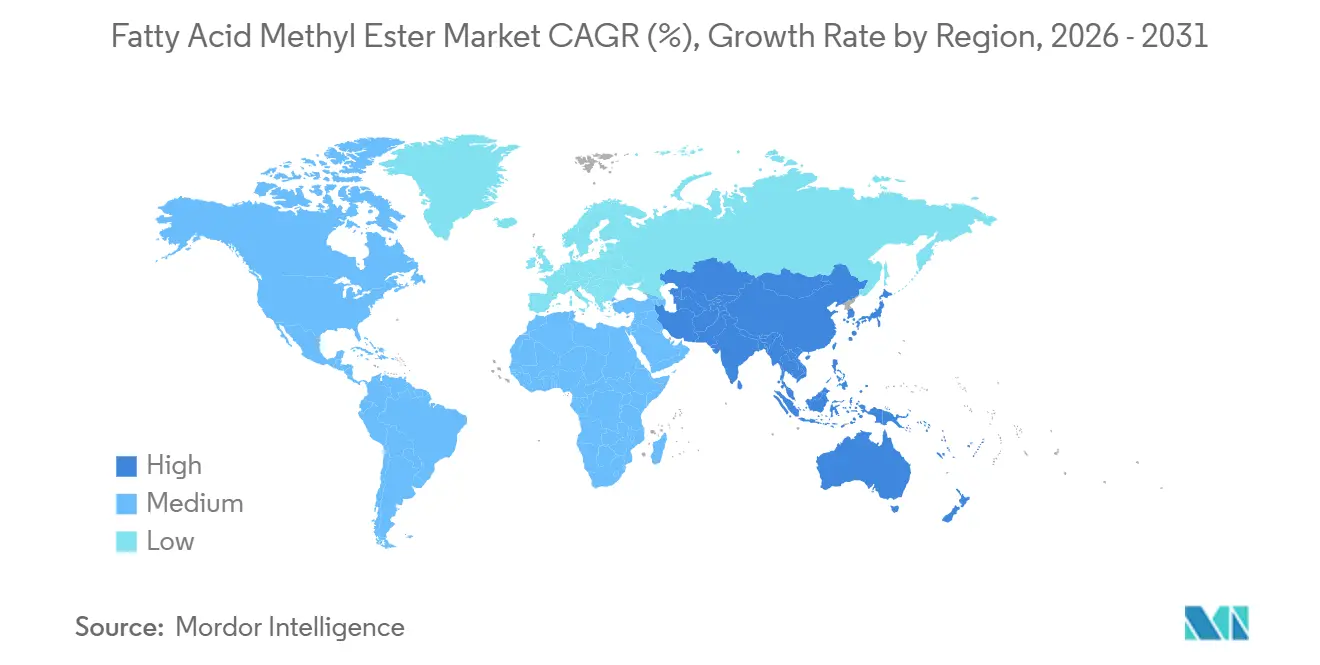
- By geography, Europe accounted for 38.92% of 2025 volume, whereas Asia-Pacific is poised for the briskest regional growth at a 3.54% CAGR through 2031.
Note: Market size and forecast figures in this report are generated using Mordor Intelligence’s proprietary estimation framework, updated with the latest available data and insights as of January 2026.
Market Trends and Insights
Drivers Impact Analysis of Fatty Acid Methyl Ester Market*
| Drivers | (~) % Impact on CAGR Forecast | Geographic Relevance | Impact Timeline |
|---|---|---|---|
| Escalating biodiesel blend mandates | +0.8% | Indonesia, Brazil, EU, India | Medium term (2–4 years) |
| Increasing feedstock availability and cost competitiveness | +0.5% | Indonesia, Malaysia, China, Brazil, Argentina | Short term (≤ 2 years) |
| Rising demand for low-sulfur renewable diesel substitutes | +0.3% | Europe, North America | Medium term (2–4 years) |
| Maritime bio-bunkering pilots adopting FAME blends | +0.2% | Singapore, Rotterdam, Hamburg | Long term (≥ 4 years) |
| Increasing demand from personal care industry | +0.3% | North America, Europe, Asia-Pacific urban centers | Medium term (2–4 years) |
| Source: Mordor Intelligence | |||
Escalating Biodiesel Blend Mandates
Indonesia will introduce a B50 requirement in 2026 that is expected to absorb about 11 million tons of palm oil annually, insulating domestic producers from export volatility[1]. Brazil’s phased move to B15 adds 1.5 billion liters of incremental demand under RenovaBio, while the United States proposes biomass-based diesel volumes of 7.12–7.50 billion RINs but intends to discount credits tied to imported feedstocks[2]. In Europe, RED III preserves a 29% transport-energy target yet caps crop-based biofuels at 7%, nudging investments toward waste-oil esters. Certification schemes such as ISCC and REDcert-EU now cover more than 15,000 sites, shaping global trade access.
Increasing Feedstock Availability and Cost Competitiveness
Municipal collection programs lifted China’s used-cooking-oil exports to the EU to 1.2 million tons in 2024, supported by ISCC approvals. Double-counting credits under RED III keeps European UCO economical despite the average 2024 prices of EUR 950 per ton. Palm oil eased to MYR 3,800–4,000 per ton by late-2024, boosting margins for Southeast Asian producers holding long-term contracts. However, weather shifts in South America or palm-export quotas in Indonesia can swiftly reverse the cost advantage, underscoring the feedstock risk embedded in the Fatty Acid Methyl Ester market.
Rising Demand for Low-Sulfur Renewable Diesel Substitutes
The International Maritime Organization’s 0.5% sulfur cap pushes shipowners to adopt low-sulfur alternatives, and B7–B20 FAME blends offer a retrofit-friendly route for vessels lacking scrubbers. Trials in Singapore validated B24 blends in harbor tugs, demonstrating stable cold-flow behavior at 10 °C. Although renewable diesel outperforms in storage life and cold-flow, its higher price keeps FAME attractive for operators prioritizing cost over performance, especially within coastal shipping corridors.
Maritime Bio-Bunkering Pilots Adopting FAME Blends
Rotterdam and Hamburg inaugurated dedicated bio-bunkering infrastructure in 2024, supplying B30 blends that cut lifecycle emissions by up to 65% when derived from certified waste oils. The EU’s FuelEU Maritime rule imposes a 2% greenhouse-gas reduction from January 2025, and penalties of EUR 2,400 per ton of CO₂-equivalent shortfall strengthen the business case for niche vessels such as ferries and offshore support craft to adopt FAME despite its lower energy density.
Restraints Impact Analysis of Fatty Acid Methyl Ester Market*
| Restraints | (~) % Impact on CAGR Forecast | Geographic Relevance | Impact Timeline |
|---|---|---|---|
| Vegetable-oil price volatility | –0.4% | Indonesia, Malaysia, Americas | Short term (≤ 2 years) |
| Competition from alternative biofuels and renewable diesel | –0.3% | North America, Europe | Medium term (2–4 years) |
| Regulatory uncertainty and policy dependence | –0.2% | Global | Long term (≥ 4 years) |
| Source: Mordor Intelligence | |||
Vegetable-Oil Price Volatility
Palm-oil futures swung from MYR 5,200 per ton in early 2023 to MYR 3,800 per ton by December 2024, slicing FAME margins by as much as 20 percentage points for producers lacking hedges. Soybean oil prices saw a similar pattern in the United States, peaking at 68 cents per pound in March 2024, then sliding to 42 cents by October as Brazilian harvests surged. With feedstock accounting for up to 85% of production cost, such volatility can erode profitability swiftly.
Competition from Alternative Biofuels and Renewable Diesel
Global hydrotreated-vegetable-oil capacity climbed to 12 million tons by end-2024, absorbing waste oils that once flowed to FAME plants. U.S. and California tax credits raise the compliance value of HVO, while RED III awards higher energy multipliers to waste-based HVO versus crop-based FAME. The resulting feedstock bidding war lifted tallow to USD 0.55 per pound by late-2024, squeezing FAME refiners that rely on the same residues.
*Our forecasts treat driver/restraint impacts as directional, not additive. The impact forecasts reflect baseline growth, mix effects, and variable interactions.
Fatty Acid Methyl Ester Market Segment Analysis
By Type:
Waste-Derived Esters Gain TractionOther Types - spanning waste-oil, animal-fat, and algal-oil methyl esters - are set to expand at a 2.76% CAGR through 2031, outpacing the overall Fatty Acid Methyl Ester market. Waste-oil ester output in China totaled 1.8 million tons in 2024, with Sinopec and COFCO exporting certified cargoes to Rotterdam and Hamburg. North American renderers such as Darling Ingredients supplied 400,000 tons of tallow-based FAME, leveraging vertically integrated collection networks.
Rapeseed methyl ester retained 45.12% global volume in 2025 due to Europe’s 8 million-ton refining base and cold-flow advantages that align with EN 14214 norms, while soy methyl ester dominated the Americas. Palm-oil esters, concentrated in Indonesia and Malaysia, face EU ILUC caps that freeze import quotas at 2019 levels. Certification under ISCC and REDcert is therefore pivotal for market access, and producers unable to document zero-deforestation supply chains risk exclusion.

By Application:
Personal Care Outpaces FuelFuel remained the largest user at 84.52% of volume in 2025, but its 1.6% CAGR reflects blend-ratio ceilings in mature markets and substitution by renewable diesel. Europe’s B7 ceiling has been unchanged since 2020, the United States broadly operates within B5–B20, and Indonesia’s upcoming B50 adds incremental but not exponential growth. In contrast, personal care products are rising at a 3.29% CAGR as biodegradable esters, including fatty acid ester ingredients, penetrate shampoos, lotions, and cleansers. Cargill’s BiOH line replaced petroleum-derived isopropyl myristate in 18 brand portfolios during 2024, illustrating the price-inelastic customer base that underpins margin stability within this slice of the fatty acid methyl ester market.
Geography Analysis
Europe Fatty Acid Methyl Ester Market
Europe commanded 38.92% of global volume in 2025, yet renewable diesel plants and advanced-biofuel quotas are siphoning feedstocks away from traditional FAME. Germany’s 2024 output slipped 4% to 2.8 million tons as UCO shortages pressed margins, while France held flat at 1.6 million tons thanks to Saipol’s integrated rapeseed assets. The United Kingdom issued 1.2 million Renewable Transport Fuel Certificates for FAME in 2024, 8% lower than the prior year as refiners pivoted toward HVO. Nordic demand remains modest but is shifting quickly to waste-based alternatives, reinforcing Europe’s structural feedstock shift.
APAC Fatty Acid Methyl Ester Market
Asia-Pacific is primed for a 3.54% CAGR through 2031. Malaysia exported surplus volumes to the Philippines and Thailand, but softer palm prices narrowed refinery spreads. China’s domestic output is centered on municipal waste-oil programs, with 80% of production exported to the EU, where double-counting incentives prevail. India lags due to ethanol-blend priorities, while Japan and South Korea import modest cargoes to deliver corporate sustainability pledges.
The Americas and MEA Fatty Acid Methyl Ester Market
North America accounted for a significant market share in 2025. The United States led with outstanding volume consumption anchored by rapidly scaled soybean-oil refining in Iowa and Illinois. Canada consumed 320,000 tons under its Clean Fuel Regulations, and Mexico relied on imports for 180,000 tons. South America supplied 3.2 million tons in 2024, with Brazil’s B12 rule absorbing 6.3 billion liters and Argentina exporting 1.2 million tons after trade disputes eased. The Middle East and Africa remain nascent but show potential as Saudi Arabia channels USD 500 million into a 300,000-ton waste-oil project slated for 2026.
Regulatory Landscape
Fatty acid methyl ester demand is anchored by blending and renewable-fuel compliance regimes that increasingly differentiate by feedstock and sustainability credentials. In the European Union, Renewable Energy Directive III (Directive (EU) 2023/2413) preserves a transport decarbonization framework while tightening treatment of crop-based biofuels and increasing the role of certified waste-based pathways. This raises the importance of schemes such as ISCC and REDcert for market access. National implementation adds further detail, including Ireland’s S.I. No. 664/2025 (Renewable Transport Fuel Obligation Regulations 2025), which sets a 60% obligation rate for renewable transport fuel for the 2026 calendar year (effective January 1, 2026), reinforcing compliance-driven blending demand.
Outside Europe, volumetric mandates and national programs continue to set offtake baselines. Indonesia confirmed a mandatory B50 biodiesel blend effective July 1, 2026, which materially increases domestic pull for palm-based FAME. In the United States, the Environmental Protection Agency finalized Renewable Fuel Standard Set 2 requirements in March 2026, including 2026 biomass-based diesel volumes at 8.86 billion gallons, supporting physical biofuel compliance and increasing the focus on traceable, qualifying feedstocks.
Value Chain Analysis
The fatty acid methyl ester value chain starts with lipid feedstocks, including virgin vegetable oils (rapeseed, soybean, palm) and waste-derived inputs such as used cooking oil and animal fats. Upstream supply is shaped by crushers and refiners for edible oils, and by specialized collection networks and aggregators for waste oils and rendering byproducts. Midstream conversion is dominated by transesterification plants that produce FAME alongside glycerin, with product quality managed to meet application-specific specifications such as EN 14214 for fuel-grade blending in Europe. Downstream demand is served through blending terminals and distributors into road-fuel pools, and through specialized channels into higher-purity oleochemical and personal-care uses.
Constraints and leverage points increasingly sit in feedstock aggregation and logistics. In Indonesia, GAPKI highlighted in July 2025 that limited FAME production capacity at biodiesel producers is a key bottleneck for scaling to the B50 program, pointing to how installed conversion capacity and utilization rates can limit mandate fulfillment. In Europe, trade-flow and policy shifts have changed sourcing patterns, making certified waste-oil logistics and documentation a differentiator as imports declined versus 2024. Across regions, trucking and tanker availability for moving CPO or waste oils to reactors and shipping FAME to blending sites remains a material cost driver, which encourages vertical integration or long-term logistics contracting to stabilize delivered cost and compliance reliability.
Competitive Landscape
The Fatty Acid Methyl Ester market remains moderately consolidated. Specialty players carve profitable niches. Leading players in the market, including KLK OLEO, are directing investments toward molecular distillation that yields ≥99.5% purity and sulfur below 5 ppm, supporting 18–22% EBITDA margins in personal-care and lubricant grades. Start-ups and waste-aggregation platforms such as Olleco and Crimson Renewable Energy disrupt the supply chain by contracting directly with municipalities, capturing up to 30% of feedstock margin, and challenging traditional crushers.
Fatty Acid Methyl Ester Industry Leaders
-
Wilmar International Ltd
-
Cargill, Incorporated.
-
Archer Daniels Midland Co.
-
BASF
-
KLK OLEO
- *Disclaimer: Major Players sorted in no particular order
Fatty Acid Methyl Ester Market Companies Covered in this Report
- Archer Daniels Midland Co.
- BASF
- Cargill, Incorporated.
- Emery Oleochemicals
- Godrej Industries Limited
- IOI Oleochemical
- KLK OLEO
- ABITEC, Larodan Research Grade Lipids
- Louis Dreyfus Company
- Mewah Group
- Chevron
- Tokyo Chemical Industry Pvt. Ltd.
- VERBIO North America LLC
- Wilmar International Ltd
Market Opportunities and Future Outlook
A clear opportunity area is process technology that broadens viable feedstocks while improving conversion economics, particularly as renewable diesel competes for the same waste oils and tallow. In Brazil, Biopower (a JBS subsidiary) announced in January 2026 an investment of R$ 140 million to modernize three biodiesel plants (Lins, Campo Verde, and Mafra) and implement enzymatic esterification, a pathway that can increase flexibility in processing higher-FFA inputs such as used cooking oil and animal fats. This supports producers trying to maintain output as waste-oil availability tightens and as carbon-intensity scoring and traceability affect realizations.
A second opportunity is capacity and integration in mandate-driven markets, alongside tighter quality and end-use specifications in non-road applications. Grupo Potencial announced in July 2026 an expansion at its Lapa (Parana) facility to raise biodiesel capacity from 900 million to 1.62 billion liters per year (completion scheduled by end-2026), illustrating how large-scale, integrated complexes target mandated offtake while managing logistics and feedstock security. On the demand side, marine and industrial users are formalizing acceptance criteria for FAME blends through standards updates, including ISO 8217 (2024 revision) accommodating higher FAME content in marine fuel blends and the continued role of EN 14214 for fuel-quality compliance. This combination creates whitespace for suppliers that can consistently meet tighter contaminant and stability requirements and provide certification documentation across jurisdictions.
Recent Industry Developments in Fatty Acid Methyl Ester Market
- June 2026: Cargill initiated a project to assess the feasibility of using beef tallow as a biodiesel feedstock at its Brazilian plants, following trade and tariff-driven shifts affecting animal fat flows. The move signals active re-optimization of feedstock slates toward residues that can improve compliance economics and reduce exposure to import-export disruptions.
- January 2025: Wilmar International inaugurated a 500,000-ton palm-oil methyl ester refinery in Dumai, Indonesia, featuring continuous reactors and a zero-liquid-discharge design. The added capacity strengthens domestic supply readiness for higher blending mandates and increases scale advantages in palm-based FAME production.
- August 2024: Cargill and Bunge created a joint venture covering 1.8 million tons of soybean-crushing and FAME capacity in Brazil to secure long-term supply for Petrobras biodiesel auctions. The structure links upstream crushing to downstream ester output, improving feedstock security and cost competitiveness in a mandate-driven market.
Fatty Acid Methyl Ester Market Report Scope and Research Methodology
Market Definition and Coverage
For this study, the market covers fatty acid methyl ester (FAME) produced through transesterification of fats and oils with methanol, and consumed across fuel and non-fuel uses at the country and regional level.
Scope exclusions: Hydrotreated vegetable oil (HVO) and other non-methyl-ester renewable diesels are excluded, even when they serve the same fuel blending programs.
Segments Covered in This Report
- By Type
- Rapeseed Methyl Ester
- Soy Methyl Ester
- Palm Oil Methyl Ester
- Other Types (Waste-Oil Methyl Ester, Animal-Fat-Derived Methyl Ester, Algal-Oil Methyl Ester)
- By Application
- Fuel
- Lubricants
- Coatings
- Food and Agriculture
- Personal Care Products
- Other Applications (Plasticizers and Surfactants,Metalworking Fluids)
- By Geography
- Asia-Pacific
- China
- India
- Japan
- South Korea
- ASEAN Countries
- Rest of Asia-Pacific
- North America
- United States
- Canada
- Mexico
- Europe
- Germany
- United Kingdom
- France
- Italy
- Spain
- NORDIC Countries
- Rest of Europe
- South America
- Brazil
- Argentina
- Rest of South America
- Middle-East and Africa
- Saudi Arabia
- United Arab Emirates
- South Africa
- Nigeria
- Rest of Middle-East and Africa
- Asia-Pacific
Data Sources, Market Sizing, and Validation
Desk Research
Desk work starts by mapping where FAME is produced and consumed, and where it is reported in public statistics, so the model can be anchored to real-world activity. We referred to public sources such as the International Energy Agency for biofuel demand context, the US Energy Information Administration for diesel and biodiesel indicators, and Eurostat for energy and industrial data series in Europe.
Trade and supply checks were supported using sources such as UN Comtrade for cross-border flows, along with publications from bodies such as the European Biodiesel Board for regional production and capacity signals. We also reviewed company annual reports, investor presentations, sustainability disclosures, and reputable press to validate feedstock availability and downstream demand linked to blending mandates and industrial use. Where needed, paid subscriptions were used only for company financials and patent lookups to sanity-check capacity additions and process focus. These examples are not exhaustive, and many other public documents and datasets were also used for data collection, validation, and research clarification.
Primary Interviews and Surveys
Primary work focused on validating where FAME volumes are actually placed, since reporting categories can vary across countries and applications. We spoke with a mix of producers, distributors, feedstock and processing specialists, and downstream users across major regions, and then used those inputs to confirm assumptions on utilization rates, trade reliance, and typical split between fuel and non-fuel applications.
Distribution of primary research fieldwork respondents
| Company type | Respondent position | Region |
|---|---|---|
| Top tier: 33% | CXOs: 17% | APAC: 45% |
| Mid tier: 45% | Functional/Unit leaders: 35% | EMEA: 35% |
| Smaller Players: 22% | Managers: 48% | Americas: 20% |
Market-Sizing & Forecasting
The core sizing is built using a top-down approach where country demand is reconstructed using biofuel blending requirements, observed diesel consumption signals, and regional supply balances, and then translated into FAME needs based on typical blend shares and substitution with other bio-based fuels. Once totals are formed, they are checked using selective bottom-up approximations, such as sampling producer capacity and utilization, reviewing reported expansions, and running volume times average price checks to confirm direction and order of magnitude.
Key inputs used in the model include biodiesel blend mandates by country, installed transesterification capacity and utilization, the mix of feedstocks (soy, rapeseed, palm, and others) that affects yield and availability, import dependence visible in trade flows, and end-use pull from fuel versus non-fuel applications like lubricants and coatings. When smaller countries have limited public visibility, gaps are handled by using nearest-neighbor comparisons on diesel pool size, policy strength, and known trade patterns, then reviewed again through expert feedback.
For forecasting, scenario analysis is applied because policy timing, feedstock pricing, and renewable diesel competition can shift demand faster than a straight trend line would suggest. Each scenario is tied back to variables that interviewees could validate, like expected blending changes, capacity ramp-ups, and the portion of waste oils moving away from FAME pathways.
Data Validation & Update Cycle
Validation is done by comparing outputs against independent signals, such as implied FAME blending volumes versus the diesel demand pool, and production plus net trade versus estimated consumption. Large variances are flagged, and the assumptions behind conversion factors, application splits, and pricing are rechecked before sign-off.
A second analyst review is used to verify formulas, unit conversions, and country rollups, and we re-contact sources when changes in mandates, tariffs, or capacity announcements create a clear mismatch. Reports are refreshed annually, with interim updates when material events occur, and a final pre-delivery pass is completed so clients receive the latest updated view.
Mordor Intelligence's Fatty Acid Methyl Ester Market Size Versus Other Published Estimates
Published market sizes for FAME often differ because the counted product set, the mix of fuel and non-fuel demand, and the year used for prices are not consistent across studies. Differences also come from how each study treats trade, local blending policy timing, and whether volumes are converted into value using spot prices or averaged annual pricing.
HVO sits outside Mordor Intelligence's scope here, which reduces the risk of blending two fuel pathways into one number when renewable diesel adoption rises. Other gaps usually come from using aggressive mandate ramp assumptions, applying a single global average price across regions, or not rechecking country totals against supply plus net trade and capacity utilization signals.
Benchmark comparison
| Source | Market Size | Gaps in Research Methodology |
|---|---|---|
| Mordor Intelligence | USD 0.00 B (2026) | |
| Trade Publisher A | USD 17.46 B (2023) | Uses a broader ester set in the type list and may blend multiple fatty-acid ester families into the same total, and the value can shift based on how 2023 prices are averaged across regions. |
| Industry Portal B | USD 22.92 B (2025) | Often applies a single revenue view without clearly separating fuel blending demand from industrial applications, and the pricing basis is not always tied to country-level trade and mandate timing. |
The spread in the table is mainly explained by product definition and value conversion choices, not just growth expectations. By keeping the counted molecule set specific to FAME and by cross-checking volumes against policy-led demand and supply balances, the estimate stays traceable to inputs that can be repeated and updated year to year.
Key Questions Answered in the Report
What volume does the Fatty Acid Methyl Ester market target by 2031?
Global demand is forecast to reach 1.79 million tons by 2031, growing at a 1.94% CAGR.
Which feedstock segment is expanding fastest?
Waste-derived esters—encompassing used cooking oil, animal fat, and algal oil—are projected to rise at a 2.76% CAGR to 2031.
Why is personal care demand increasing for these esters?
Formulators favor biodegradable, silicone-free ingredients that comply with EU and Ecocert standards, driving a 3.29% CAGR in personal-care usage.
How will Indonesia’s B50 mandate influence the market?
B50, starting 2026, will absorb about 11 million tons of palm oil per year, securing domestic offtake and supporting Asia-Pacific growth.
Which regions are poised for the highest growth rates?
Asia-Pacific leads with a projected 3.54% CAGR through 2031, supported by Indonesia’s escalating mandates and China’s UCO export infrastructure.
What strategic moves are producers making to sustain margins?
Companies are locking in long-term waste-oil contracts, investing in high-purity oleochemical lines, and pursuing process-intensification patents to cut conversion costs.