
Explosion Proof Mobile Communication Devices Market Size and Share
Market Overview
| Study Period | 2019 - 2030 |
|---|---|
| Market Size (2025) | USD 0.71 Billion |
| Market Size (2030) | USD 1.07 Billion |
| Growth Rate (2025 - 2030) | 8.56 % |
| Fastest Growing Market | Middle East |
| Largest Market | North America |
| Market Concentration | Medium |
Major Players *Disclaimer: Major Players sorted in no particular order Image © Mordor Intelligence. Reuse requires attribution under CC BY 4.0. | |

Explosion Proof Mobile Communication Devices Market Analysis by Mordor Intelligence
The explosion-proof mobile communication devices market size stands at USD 0.71 billion in 2025 and is projected to reach USD 1.07 billion by 2030, advancing at an 8.56% CAGR. Robust demand springs from digitization programs in hazardous facilities, the installation of private 5G networks, and widening adoption of intrinsically safe designs that let workers exchange high-resolution imagery, voice, and sensor data in real time. Intensifying safety regulations, tighter maintenance windows, and the push for predictive analytics further amplify investment in certified devices. Competitive differentiation now revolves around seamless integration with edge computing and IoT platforms, while satellite links, Wi-Fi 6/6E, and 4G LTE provide layered connectivity that keeps operations online during emergencies. Partnerships pairing device makers with automation software providers have accelerated, creating turnkey ecosystems that extend far beyond legacy push-to-talk services.
Key Report Takeaways
- By product, smartphones and cellphones captured 66.72% of the explosion-proof mobile communication devices market share in 2024, and tablets are expected to expand at an 8.66% CAGR through 2030.
- By end-user industry, the oil and gas segment held 39.87% of the explosion-proof mobile communication devices market size in 2024, whereas mining is forecast to post the fastest 8.76% CAGR to 2030.
- By connectivity technology, 4G LTE commanded 51.87% of the explosion-proof mobile communication devices market size in 2024, and satellite/non-terrestrial networks are poised for the highest 8.89% CAGR to 2030.
- By hazard zone classification, Zone 1 equipment accounted for 45.34% of the explosion-proof mobile communication devices market share in 2024 and is projected to rise at an 8.59% CAGR through 2030.
- By geography, North America led with 29.83% revenue share in 2024, while the Middle East is on track for a 6.11% CAGR between 2025 and 2030.
Note: Market size and forecast figures in this report are generated using Mordor Intelligence’s proprietary estimation framework, updated with the latest available data and insights as of January 2026.
Market Trends and Insights
Drivers Impact Analysis of Explosion Proof Mobile Communication Devices Market*
| Driver | (~) % Impact on CAGR Forecast | Geographic Relevance | Impact Timeline |
|---|---|---|---|
| Fast and seamless voice, image and data transfer | +1.8% | North America, Europe | Medium term (2-4 years) |
| Government rules and regulations on safe equipment | +2.1% | North America, EU | Long term (≥ 4 years) |
| Rising digitalization and IIoT integration | +2.3% | Asia-Pacific core, MEA spill-over | Medium term (2-4 years) |
| Expansion of private 5G networks in oil and gas | +1.4% | Middle East, North America, Asia-Pacific | Short term (≤ 2 years) |
| Growing demand for Zone 0 certified devices | +0.7% | Australia, China, Chile, Brazil | Long term (≥ 4 years) |
| Surge in asset-tracking and AR applications | +0.9% | North America, Europe | Medium term (2-4 years) |
| Source: Mordor Intelligence | |||
Need for Fast and Seamless Voice, Image, and Data Transfer in Industries
Industries handling volatile materials require instant, high-fidelity information exchange to uphold safety margins. Certified smartphones now stream 4K video from inspection sites, letting control-room teams diagnose issues without dispatching additional personnel. Voice-over-LTE and push-to-video combine to shorten emergency response cycles from minutes to seconds. The same devices collect temperature, vibration, and gas-sensor readings that feed edge algorithms, prompting automatic shutdowns before hazardous thresholds arise. Demand is strongest in North American and European refineries where downtime costs exceed USD 1 million per hour. [1]Pepperl+Fuchs SE, “Mobile Computing Solutions for Hazardous Areas,” Pepperl+Fuchs, pepperl-fuchs.com Continued rollouts of Wi-Fi 6E access points inside process halls bolster this driver through 2027.
Government Rules and Regulations on the Use of Safe Equipment
OSHA, ATEX, and IECEx frameworks mandate intrinsically safe hardware across petrochemical, mining, and pharmaceutical facilities. Manufacturers must present exhaustive test dossiers covering spark ignition, thermal profiles, and electromagnetic emissions. Policy tightening in 2025 raised fines for non-compliance by up to 70%, prompting plant operators to replace legacy radios with modern smart devices that carry multi-regional certifications. [2]International Electrotechnical Commission, “IEC 60079 Series – Explosive Atmospheres Standards,” IEC, iec.ch Long-term influence stems from regulators synchronizing standards, which lowers approval redundancies yet broadens the scope of covered equipment to include wearables and IoT nodes.
Rising Digitalization and IIoT Integration in Hazardous Industries
Asian chemical complexes accelerate connected-worker programs that interlink thousands of sensors with cloud dashboards. In 2024, facilities adopting intrinsically safe smartphones recorded 31% gains in process efficiency as acoustic analytics flagged bearing faults weeks early. [3]Pharmaceutical Technology Magazine, “Digital Transformation in Pharmaceutical Manufacturing,” Pharmaceutical Technology, pharmaceutical-technology.com Edge AI resident on devices filters anomaly data locally, sending only critical events upstream, which trims bandwidth costs by 40%. As 5G Standalone cores permeate Asia-Pacific, factories will extend IIoT to autonomous mobile robots, magnifying this driver through 2028.
Expansion of Private 5G Networks in Oil and Gas Facilities
Operators poured USD 2.3 billion into private 5G during 2024, deploying licensed spectrum cells across wellheads and pipelines. These networks deliver sub-10 ms latency vital for automated drilling. Saudi Aramco’s Ghawar deployment cut unplanned downtime by 23% using predictive analytics that consume nonstop telemetry from Zone 1 tablets. Millimeter-wave support on new handsets enables gigabit links to drones inspecting flare stacks, shrinking survey cycles from days to hours. The short-term boost remains potent until public 5G coverage catches up in remote basins.
Restraints Impact Analysis of Explosion Proof Mobile Communication Devices Market*
| Restraint | (~) % Impact on CAGR Forecast | Geographic Relevance | Impact Timeline |
|---|---|---|---|
| Safety regulations vary across regions | –1.2% | Global; pronounced US/EU vs Asia-Pacific | Long term (≥ 4 years) |
| High device and certification costs | –1.6% | Emerging Asia-Pacific, South America, Africa | Medium term (2-4 years) |
| Limited battery performance in extreme temperatures | –0.8% | Middle East, Arctic, mines | Short term (≤ 2 years) |
| Fragmented aftermarket service ecosystem | –0.5% | Emerging Asia-Pacific, Africa, South America | Medium term (2-4 years) |
| Source: Mordor Intelligence | |||
Safety Regulations Vary Across Different Regions
Manufacturers juggle IECEx, ATEX, NEC, and GB requirements, incurring 35% higher compliance costs when aiming for multi-market releases. Divergent documentation and re-testing extend launch timelines by up to 12 months, creating inventory drag and slowing pricing declines for end users. Design teams often build multiple SKUs to satisfy both Zone and Division nomenclatures, amplifying R&D overhead. The variance discourages smaller entrants from reaching a global scale, constraining competition and delaying innovation diffusion across developing regions.
High Device and Certification Costs
An intrinsically safe handset ranges between USD 3,000 and USD 8,000, a stark premium over rugged consumer models priced below USD 500. Certification fees, specialized components, and limited supplier pools elevate capital outlays, particularly painful for mines and chemical plants in emerging economies. Material inflation lifted component costs by 28% in 2024, while the standard 12-18 month approval window locks engineering resources. As ROI models hinge on productivity gains, some operators defer upgrades, dampening near-term volume growth even as long-range safety benefits remain clear.
*Our forecasts treat driver/restraint impacts as directional, not additive. The impact forecasts reflect baseline growth, mix effects, and variable interactions.
Explosion Proof Mobile Communication Devices Market Segment Analysis
By Product:
Tablets Scale Visualization NeedsTablets represent the quickest-rising slice of the explosion-proof mobile communication devices market, charting an 8.66% CAGR as engineers favor 10-inch displays for SCADA dashboards and augmented-reality overlays. The larger canvas supports split-screen views of P&IDs, live camera feeds, and maintenance checklists, essential in oil and gas control rooms. In contrast, smartphones held 66.72% of the explosion-proof mobile communication devices market share in 2024 and continue to dominate daily voice, messaging, and push-to-talk workflows. Two-way radios persist in areas where cellular links falter, while handheld PCs fulfill Windows-based inspection software demands.
Advances in sensor fusion blur product boundaries; headsets integrate microphones, thermal imagers, and gas detectors, enabling hands-free hazard mapping. Across every form factor, makers embed edge AI that discerns mechanical anomalies from raw vibration data, lowering bandwidth use by 35%. As battery chemistries improve, tablets achieve 18-hour duty cycles, matching shift lengths without swaps, a milestone reached by the latest Zone 0 models launched in 2024. The explosion-proof mobile communication devices market, therefore, gravitates toward multipurpose platforms rather than single-function tools.




By End-User Industry:
Mining Accelerates Digital UndergroundMining registers the fastest 8.76% CAGR through 2030, galvanized by mandates for continuous tracking of personnel and equipment 1 km below surface. Zone 0 smartphones equipped with ultra-wideband deliver sub-30 cm location accuracy, aiding collision avoidance between loaders and haul trucks. Oil and gas nonetheless retained the lion’s 39.87% share of the explosion-proof mobile communication devices market size in 2024, as sprawling refineries demand hundreds of certified devices per unit. Chemical and pharmaceutical plants pursue precision environmental monitoring, deploying tablets that log humidity to 0.1 °C variance for batch integrity.
Defense agencies specify encryption suites and MIL-STD-810H ruggedness, a niche yet influential segment that pushes the envelope on temperature tolerance. Manufacturing and processing lines connect headsets to digital twin platforms, letting operators visualize motor temperatures without opening enclosures. Cross-industry uptake demonstrates that explosion-proof mobile communication devices industry solutions now underpin not only safety compliance but strategic efficiency programs.
By Connectivity Technology:
Satellite Networks Bridge Remote GapsSatellite and non-terrestrial links will climb at an 8.89% CAGR, equipping offshore rigs, desert pipelines, and Andean mines where terrestrial builds are uneconomic. Equipment leverages low-Earth-orbit constellations for 100 ms latency, enabling videoconference troubleshooting from headquarters. 4G LTE nevertheless delivered 51.87% of the explosion-proof mobile communication devices market size in 2024, favored for its mature device ecosystem and manageable power draw. Wi-Fi 6/6E meshes blanket factory floors, supporting bandwidth-heavy AR work instructions, while Bluetooth and NFC aid proximity alarms that mute radios when a worker nears a hydrogen vent.
Dual-SIM and tri-radio designs guarantee continuity; handsets switch from private 5G to satellite within 200 ms if the cell signal drops. Edge caching keeps anomaly-detection models on the device, ensuring sub-second alerts even over 2 Mbps satellite backhaul. As orbital capacity expands, subscription costs fall, unlocking adoption among midsize miners that previously relied on manual data runs.

By Hazard Zone Classification:
Zone 1 Balances Safety and FunctionalityZone 1 retained 45.34% of the explosion-proof mobile communication devices market share in 2024 and is forecast to grow at an 8.59% CAGR as most plants face occasional but predictable ignition risks. Device designers exploit less stringent energy limits versus Zone 0 to add brighter screens and faster processors, enhancing user experience without compromising safety. Zone 0 remains critical for underground mines and paint-mixing lines where explosive atmospheres persist continuously; here, unique circuit topologies curtail peak currents to microamp levels, trimming compute budgets by 40%.
Zone 2 and dust classifications appeal to grain terminals and woodworking shops seeking cost-effective compliance. Recent standards updates cover Wi-Fi 6E and 5G radios, offering clear pathways for high-bandwidth functions once confined to safe areas. As factories migrate toward modular production, demand for multi-zone certified devices rises, allowing staff to cross boundaries without swapping equipment.
Geography Analysis
North America Explosion Proof Mobile Communication Devices Market
North America commanded 29.83% revenue share in 2024, underpinned by OSHA enforcement and widespread petrochemical capacity. Buyers here prioritize multi-agency approvals and backward compatibility with legacy PTT systems, driving stable replacement cycles every five years. Federal grants supporting digital pipeline safety have unlocked funding for Zone 1 tablets that integrate directly with SCADA alarms.
Europe Explosion Proof Mobile Communication Devices Market
Europe follows with solid growth as ATEX harmonization across member states simplifies cross-border procurement. German chemical parks and Dutch LNG terminals deploy Wi-Fi 6E meshes coupled to explosion-proof headsets, empowering real-time collaboration between control rooms and field technicians. The region’s Industry 4.0 agenda accelerates convergence of certified devices with MES and ERP platforms, cementing demand through 2030.
MEA, APAC and South America Explosion Proof Mobile Communication Devices Market
The Middle East exhibits the fastest 6.11% CAGR, fueled by USD 200 billion hydrocarbon expansion programs aligned with Saudi Vision 2030. Operators retrofit existing wells with private 5G, selecting millimeter-wave-enabled smartphones capable of operating in 55 °C deserts. Asia-Pacific offers parallel momentum; Chinese refineries amplify IIoT rollouts, and Australian miners invest heavily in Zone 0 satellite phones to gain continuous tracking compliance. South America and Africa remain emerging, yet Brazil’s pre-salt fields and South Africa’s platinum mines increasingly allocate capex toward certified communication, setting a foundation for steady future uptake.


Competitive Landscape
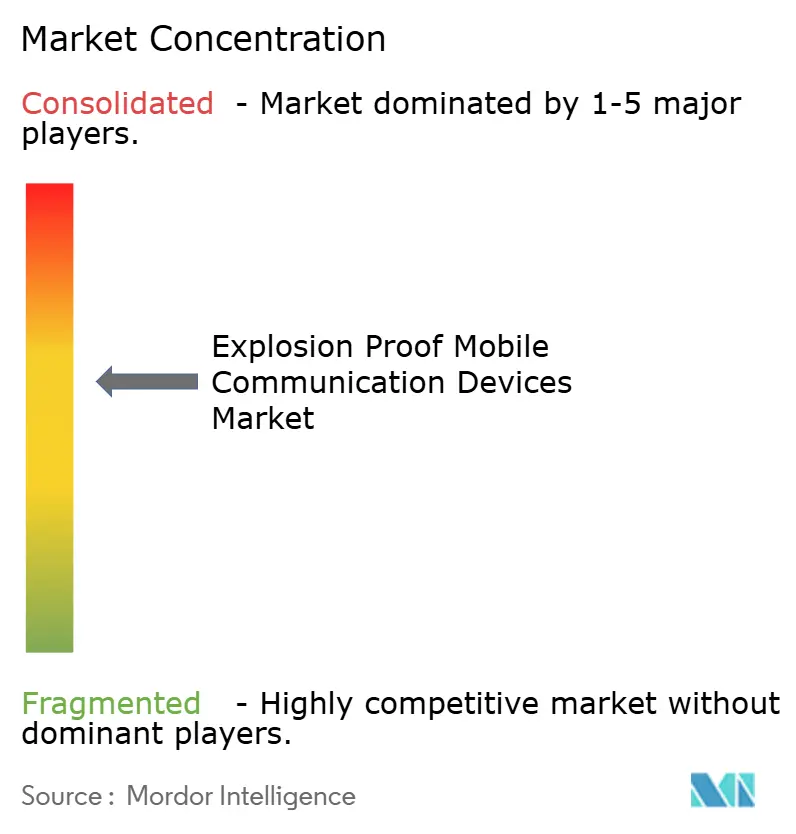
The explosion-proof mobile communication devices market remains moderately fragmented, with the top five vendors holding roughly 47% combined share. ECOM Instruments and BARTEC dominate Zone 0 niches through extensive patent portfolios and dedicated test labs. Panasonic, Zebra Technologies, and Motorola Solutions leverage global manufacturing scale to price aggressively in Zone 2 and Wi-Fi-intensive use-cases. Recent tie-ups pair handset suppliers with automation suites; BARTEC aligned with an analytics firm in 2024 to deliver dashboards that overlay vibration heatmaps directly onto tablet cameras, streamlining root-cause analysis.
Strategic acquisitions accelerate portfolio depth. Panasonic’s 2024 purchase of European IP added ATEX expertise, shortening its approval cycles by six months. Meanwhile, Zebra introduced Wi-Fi 6E handhelds integrating barcode scanners for pharma clients demanding sub-second batch tracing. Edge AI continues as a battleground: i.safe MOBILE released a SDK enabling on-device inference for acoustic anomaly detection while maintaining intrinsic safety budgets. As vendors court mining and oil majors, long-term service contracts covering firmware updates and battery replacements become decisive differentiators, particularly in regions where aftermarket networks are immature.
White-space opportunities persist in Africa and parts of Southeast Asia, where local testing agencies can fast-track domestic manufacturers versed in GB or IECEx hybrids. Still, global contenders target these geographies through joint ventures with telecom operators, ensuring certified hardware ships bundled with managed connectivity, device management, and predictive-maintenance analytics. The competitive landscape thus tilts toward integrated offerings that wrap hardware, software, and service into a single subscription, locking customers for entire asset lifecycles.
Explosion Proof Mobile Communication Devices Industry Leaders
i.safe MOBILE GmbH
BARTEC GmbH
Sonim Technologies, Inc.
Aegex Technologies, LLC
Getac Technology Corporation
- *Disclaimer: Major Players sorted in no particular order
Explosion Proof Mobile Communication Devices Market Companies Covered in this Report
- i.safe MOBILE GmbH
- ECOM Instruments GmbH
- BARTEC GmbH
- Sonim Technologies, Inc.
- Aegex Technologies, LLC
- Getac Technology Corporation
- Panasonic Holdings Corporation
- Zebra Technologies Corporation
- RugGear GmbH
- Kyocera Corporation
- Caterpillar Inc.
- Xciel Inc.
- Motorola Solutions, Inc.
- Hytera Communications Corporation Limited
- R. Stahl AG
- Honeywell International Inc.
- Extronics Ltd.
- JFE Engineering Corporation
- Pepperl+Fuchs SE
- Dorland System Control Technology Co., Ltd.
- Shenzhen Phonemax Technology Co., Ltd.
Read Analysis of Explosion Proof Mobile Communication Devices Companies

Recent Industry Developments in Explosion Proof Mobile Communication Devices Market
- September 2025: ECOM Instruments introduced the Smart-Ex 03 DZ1 smartphone, a Zone 0/1 certified device that pairs upgraded 5G radios with on-board edge processors. Its AI software studies vibration and acoustic data in real time and alerts technicians to emerging faults before downtime occurs.
- July 2025: BARTEC secured a EUR 78 million (USD 85.2 million) multi-year order from a consortium of European chemical producers to supply explosion-proof tablets and communications equipment to more than 200 facilities. The package includes full IoT integration and represents the largest single contract for hazardous-area mobile devices in the firm’s history.
- May 2025: Sonim Technologies received ATEX and IECEx approvals for its XP10 smartphone designed for deep-mine work. The Zone 0 model carries extended-temperature batteries and integrated gas sensors, giving miners continuous connectivity and environmental monitoring where earlier tools were unreliable.
- March 2025: Zebra Technologies formed a partnership with Microsoft to embed Azure IoT Edge into its explosion-proof mobile computers. The collaboration lets oil and gas operators run predictive-maintenance analytics inside hazardous zones while meeting intrinsic-safety requirements.


Global Explosion Proof Mobile Communication Devices Market Report Scope
Explosion-proof mobile communication devices are robust devices made to resist challenging environments. Employees in sectors including oil and gas, chemicals, pharmaceuticals, mining, etc. often use these gadgets.
The Explosion Proof Mobile Communication Devices Market is segmented by product (smartphones and cellphones, two way radios, handheld PC, headset, tablets), industry (oil and gas, defense, mining, manufacturing, and processing, chemical, and pharmaceutical), and geography (North America, Europe, Asia-Pacific, Latin America, Middle East and Africa). The market sizes and forecasts are provided in terms of value (USD) for all the above segments.
| Smartphones and Cellphones |
| Two-way Radios |
| Handheld PCs |
| Tablets |
| Headsets |
| Other Products |
| Oil and Gas |
| Mining |
| Manufacturing and Processing |
| Chemical and Pharmaceutical |
| Defense |
| Other End-user Industries |
| 4G LTE |
| 5G |
| Wi-Fi 6/6E |
| Bluetooth / NFC |
| Satellite / NTN |
| Zone 0 |
| Zone 1 |
| Zone 2 |
| Zone 20 |
| Zone 21 |
| Zone 22 |
| North America | United States | |
| Canada | ||
| Mexico | ||
| Europe | Germany | |
| United Kingdom | ||
| France | ||
| Russia | ||
| Rest of Europe | ||
| Asia-Pacific | China | |
| Japan | ||
| India | ||
| South Korea | ||
| Australia | ||
| Rest of Asia-Pacific | ||
| Middle East and Africa | Middle East | Saudi Arabia |
| United Arab Emirates | ||
| Rest of Middle East | ||
| Africa | South Africa | |
| Egypt | ||
| Rest of Africa | ||
| South America | Brazil | |
| Argentina | ||
| Rest of South America | ||
| By Product | Smartphones and Cellphones | ||
| Two-way Radios | |||
| Handheld PCs | |||
| Tablets | |||
| Headsets | |||
| Other Products | |||
| By End-User Industry | Oil and Gas | ||
| Mining | |||
| Manufacturing and Processing | |||
| Chemical and Pharmaceutical | |||
| Defense | |||
| Other End-user Industries | |||
| By Connectivity Technology | 4G LTE | ||
| 5G | |||
| Wi-Fi 6/6E | |||
| Bluetooth / NFC | |||
| Satellite / NTN | |||
| By Hazard Zone Classification | Zone 0 | ||
| Zone 1 | |||
| Zone 2 | |||
| Zone 20 | |||
| Zone 21 | |||
| Zone 22 | |||
| By Geography | North America | United States | |
| Canada | |||
| Mexico | |||
| Europe | Germany | ||
| United Kingdom | |||
| France | |||
| Russia | |||
| Rest of Europe | |||
| Asia-Pacific | China | ||
| Japan | |||
| India | |||
| South Korea | |||
| Australia | |||
| Rest of Asia-Pacific | |||
| Middle East and Africa | Middle East | Saudi Arabia | |
| United Arab Emirates | |||
| Rest of Middle East | |||
| Africa | South Africa | ||
| Egypt | |||
| Rest of Africa | |||
| South America | Brazil | ||
| Argentina | |||
| Rest of South America | |||


Key Questions Answered in the Report
What is the forecast value of the explosion proof mobile communication devices market in 2030?
It is expected to reach USD 1.07 billion, up from USD 0.71 billion in 2025, reflecting an 8.56% CAGR.
Which product category is growing fastest inside hazardous facilities?
Tablets, advancing at an 8.66% CAGR thanks to their larger displays for AR and multi-parameter dashboards.
Why are private 5G networks important for hazardous-area communications?
They deliver ultra-low latency and high device density, enabling real-time monitoring and predictive maintenance on certified mobile devices.
How do varying regional safety standards affect device availability?
Divergent ATEX, IECEx and NEC rules raise certification costs and extend launch timelines, limiting choice in some emerging markets.
Which region shows the highest growth rate through 2030?
The Middle East, projected at a 6.11% CAGR due to large-scale oil capacity expansions and smart-city investments.
Page last updated on:





