
Europe Roads and Highways Infrastructure Construction Market Size and Share
Market Overview
| Study Period | 2020 - 2031 |
|---|---|
| Forecast Data Period | 2026 - 2031 |
| Base Year Market Size (2025) | USD 394.20 Billion |
| Market Size (2026) | USD 419.29 Billion |
| Market Size (2031) | USD 562.77 Billion |
| Growth Rate (2026 - 2031) | 6.06% CAGR |
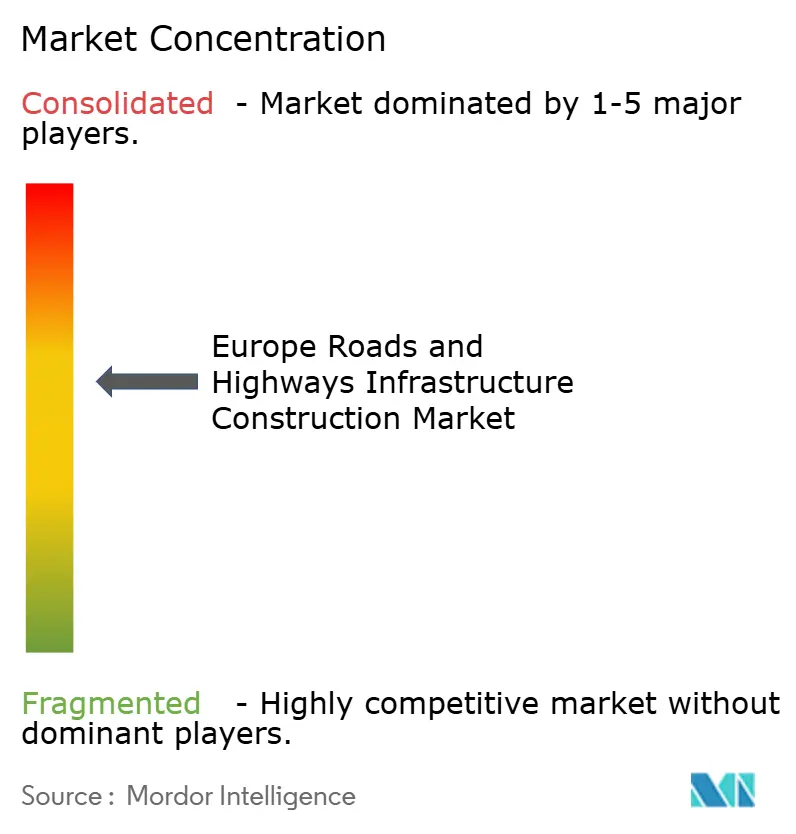
| Market Concentration | Medium |
Major Players *Disclaimer: Major Players sorted in no particular order Image © Mordor Intelligence. Reuse requires attribution under CC BY 4.0. | |
Europe Roads and Highways Infrastructure Construction Market Analysis by Mordor Intelligence
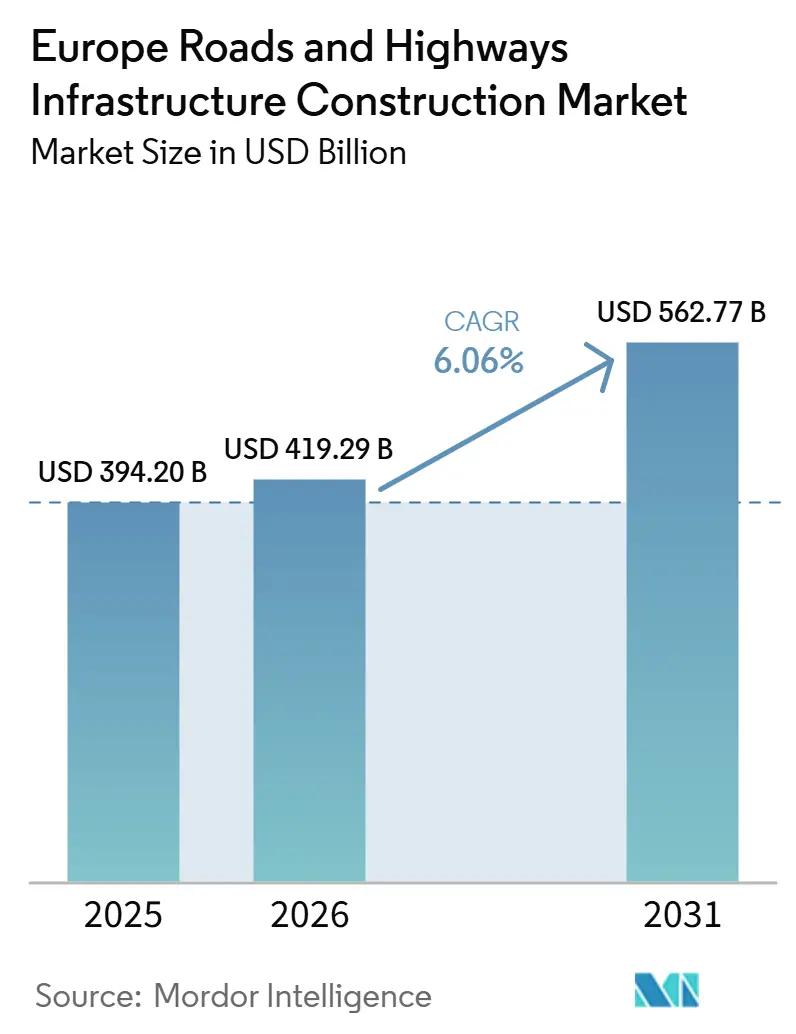
The Europe Roads And Highways Infrastructure Construction Market size is projected to be USD 394.20 billion in 2025, USD 419.29 billion in 2026, and reach USD 562.77 billion by 2031, growing at a CAGR of 6.06% from 2026 to 2031.
The Europe roads and highways infrastructure construction market is expanding on the back of large public investment programs, heavy renewal needs across aging transport networks, and continued support for cross-border transport links. Germany set out a federal trunk road investment pipeline worth USD 57.5 billion for 2025 to 2029, while the United Kingdom committed more than USD 35.1 billion to its strategic road network through 2031. European Union (EU) transport funding also continues to support a steady stream of corridor, modernization, and connectivity projects across member states. The Europe roads and highways infrastructure construction market is also seeing a gradual shift toward long-duration contract structures, which is changing how contractors compete and how revenue is earned over the life of the asset. At the same time, workforce limits, permitting delays, and higher material price exposure continue to affect how quickly projects move from policy commitment to active delivery.
Key Report Takeaways
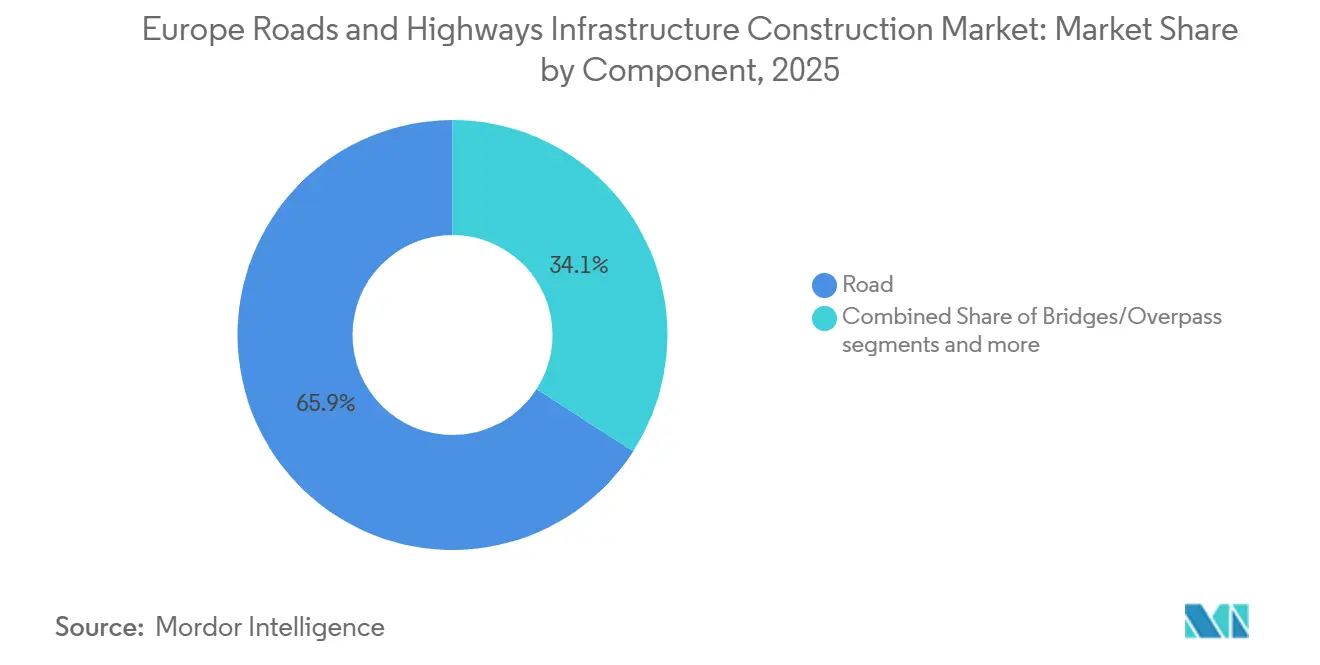
- By component, road held 65.90% of the Europe roads and highways infrastructure construction market share in 2025, while bridges/overpass is forecast to expand at a 6.80% CAGR through 2031.
- By construction type, new construction accounted for 58.40% of the Europe roads and highways infrastructure construction market size in 2025, while renovation is projected to grow at a 6.70% CAGR through 2031.
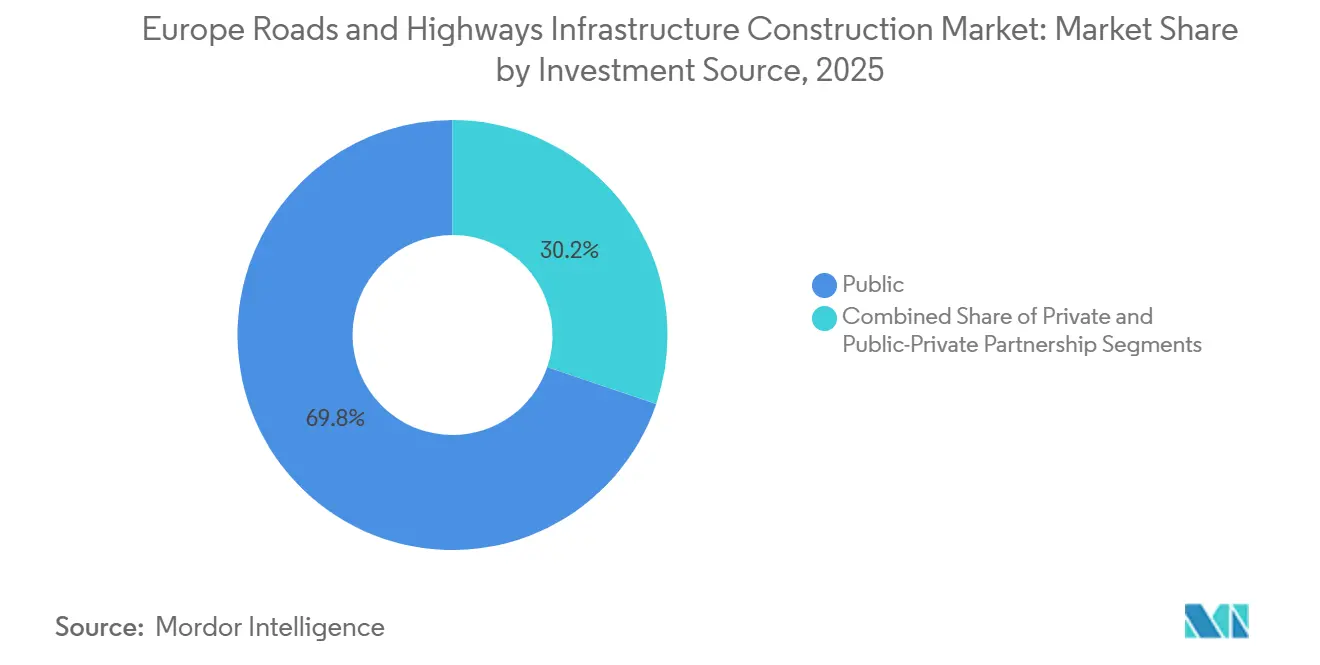
- By investment source, public funding led with 69.80% of the Europe roads and highways infrastructure construction market in 2025, while public-private partnership recorded the highest projected CAGR at 7.00% through 2031.
- By type, national roads captured 52.30% of the Europe roads and highways infrastructure construction market in 2025, while state roads are expected to advance at a 6.40% CAGR through 2031.
- By geography, Germany held 19.80% of the Europe roads and highways infrastructure construction market in 2025, while the United Kingdom is forecast to expand at a 6.80% CAGR through 2031.
Note: Market size and forecast figures in this report are generated using Mordor Intelligence’s proprietary estimation framework, updated with the latest available data and insights as of January 2026.
Europe Roads and Highways Infrastructure Construction Market Trends and Insights
Drivers Impact Analysis*
| Drivers | (~) % Impact on CAGR Forecast | Geographic Relevance | Impact Timeline |
|---|---|---|---|
| Federal and EU Highway Rehabilitation Programs Drive Infrastructure Investment | +1.8% | Europe-wide, with stronger relevance in Germany, the United Kingdom, France, Italy, and Poland | Medium term (2-4 years) |
| Bridge and Tunnel Renewal Addresses Aging Infrastructure Backlogs | +1.0% | Germany, the Netherlands, Austria, the United Kingdom, Slovenia, and Eastern Europe | Long term (≥ 4 years) |
| Cross-Border Freight Corridor Upgrades Increase Road Construction Activity | +0.8% | Central and Eastern Europe, the Baltics, and the Western Balkans | Long term (≥ 4 years) |
| Public-Private Partnership Projects Expand Highway Infrastructure Pipeline | +0.7% | The Netherlands, France, Germany, Greece, and the United Kingdom | Medium term (2-4 years) |
| Low-Carbon Road Construction Policies Support Sustainable Infrastructure Development | +0.6% | Europe-wide, with earlier gains in Germany, Spain, the United Kingdom, and Norway | Long term (≥ 4 years) |
| Digital Project Management Improves Infrastructure Delivery Efficiency | +0.4% | Europe-wide, with stronger uptake in Norway, the United Kingdom, Germany, the Czech Republic, and Austria | Short term (≤ 2 years) |
| Source: Mordor Intelligence | |||
Federal and EU Highway Rehabilitation Programs Drive Infrastructure Investment
The Europe roads and highways infrastructure construction market is being supported by rehabilitation programs that now sit at the center of transport policy in many countries. Germany planned more than USD 36.3 billion in transport investment for 2026, including USD 11.9 billion allocated to federal trunk roads in the draft budget. At the European Union (EU) level, the final 2026 Connecting Europe Facility transport call made USD 1.2 billion available for infrastructure modernization and connectivity projects. The proposed successor funding framework for 2028 to 2034 also points to continued transport support, with a planned envelope of USD 89.5 billion for the next cycle. This combination of national spending and supranational co-financing makes the Europe roads and highways infrastructure construction market less exposed to short annual budget shifts[1]European Climate, Infrastructure and Environment Executive Agency, “CEF Transport, €1.1 Billion Available for Infrastructure Projects Across the EU,” European Commission, cinea.ec.europa.eu. It also gives public agencies more room to launch projects that would be harder to fund on domestic budgets alone.
Bridge and Tunnel Renewal Addresses Aging Infrastructure Backlogs
Bridge and tunnel renewal remains one of the most durable demand drivers in the Europe roads and highways infrastructure construction market. Germany released USD 1.2 billion for Autobahn rehabilitation in 2025, confirming that structural renewal had become an active federal spending line rather than a deferred-maintenance issue[2]German Federal Ministry of Finance, “Green Light for Autobahn Construction Sites: EUR 1.1 Billion Released for Rehabilitation,” Bundesfinanzministerium, bundesfinanzministerium.de. The Netherlands also published a 2026 to 2030 pipeline for bridge, tunnel, and lock replacements, giving contractors an unusually clear view of upcoming tenders. In Austria, PORR and STRABAG won a USD 238.7 million contract to replace the Luegbrücke, demonstrating that technically complex renewal projects are advancing in core transport corridors. These projects tend to carry longer design periods, more specialized engineering requirements, and stricter traffic continuity rules during execution. That raises the value of experienced civil teams and keeps the Europe roads and highways infrastructure construction market anchored to long-cycle rehabilitation work.
Cross-Border Freight Corridor Upgrades Increase Road Construction Activity
The Europe roads and highways infrastructure construction market is also benefiting from corridor upgrades that span borders and connect freight routes more directly. The revised trans-European transport network framework set firmer delivery deadlines for core and extended corridors, making these routes a more urgent procurement priority[3]European Commission Directorate-General for Mobility and Transport, “EU-Ukraine Solidarity Lanes: Improving Road Infrastructure at Polish-Ukrainian Border,” European Commission, transport.ec.europa.eu. Completed sections of the Via Baltica in the Baltic region showed that these packages typically include not only carriageway works but also bridges, overpasses, and interchange improvements. European Union-backed improvements at the Poland-Ukraine border also included pavement renewal, road lighting, and the installation of safety barriers. This broader package structure increases the total value of corridor work and supports a wider range of contractors. It also means the Europe roads and highways infrastructure construction market benefits from linked demand across road surfaces, structures, safety systems, and traffic support assets.
Public-Private Partnership Projects Expand Highway Infrastructure Pipeline
Public-private partnership projects are becoming increasingly important as governments seek to expand infrastructure pipelines while spreading long-term asset ownership. The USD 1.3 billion ViA15 design-build-finance-maintain project in the Netherlands is a clear example of this structure. The GelreGroen consortium is responsible for designing, building, financing, and maintaining the A15-A12 connection through construction and a 20-year maintenance period. VINCI also entered exclusive negotiations for a 35-year concession covering the A154-A120 motorway link in France. Under this model, VINCI Autoroutes would finance and operate the asset while VINCI Construction would deliver 69 km of new carriageway. The European Investment Bank also approved USD 550 million in 2025 for improvements to Italy’s highway network, including bridge and tunnel modernization under a framework that combines public funding with private operator responsibility[4]European Investment Bank, “Improvement Program Italian Highway Network II,” European Investment Bank, eib.org. These arrangements favor contractors that can manage financing, construction, maintenance, and long-term performance obligations within one delivery model.
Restraints Impact Analysis*
| Restraints | (~) % Impact on CAGR Forecast | Geographic Relevance | Impact Timeline |
|---|---|---|---|
| Skilled Labor Shortages Constrain Heavy Civil Construction Capacity | -0.7% | Europe-wide, with stronger pressure in Germany, Italy, France, and Scandinavia | Long term (≥ 4 years) |
| Volatile Asphalt, Bitumen, and Aggregate Prices Increase Project Costs | -0.6% | Europe-wide, with stronger pressure in Western and Central Europe | Medium term (2-4 years) |
| Environmental Permitting Delays Slow Infrastructure Project Execution | -0.5% | Europe-wide, with stronger pressure in Ireland, the Czech Republic, Bulgaria, and Germany | Long term (≥ 4 years) |
| Traffic Management and Limited Work Windows Extend Construction Timelines | -0.3% | National, with earlier intensity in urban-adjacent corridors across the United Kingdom, France, Germany, and the Netherlands | Medium term (2-4 years) |
| Source: Mordor Intelligence | |||
Skilled Labor Shortages Constrain Heavy Civil Construction Capacity
Labor availability remains one of the clearest constraints on the delivery of the Europe roads and highways infrastructure construction market. European construction activity employed 13.8 million workers in 2024, yet sector bodies continue to show that millions of additional workers will be needed by 2030 to meet planned investment levels. In Italy alone, the projected requirement tied to planned investment by 2026 pointed to a need for 64,400 additional workers to support a pipeline worth USD 70.8 billion. The pressure is not spread evenly across trades, because specialist roles in civil supervision, concrete repair, tunneling, and digital coordination are harder to fill than general labor positions. This slows execution on the most complex packages, even when project funding has already been approved. As a result, the Europe roads and highways infrastructure construction market increasingly rewards contractors that have stable in-house skills and formal workforce development systems.
Volatile Asphalt, Bitumen, and Aggregate Prices Increase Project Costs
Material cost volatility continues to pressure fixed-price road construction contracts. Asphalt, bitumen, and aggregate prices can change quickly because of refinery capacity, supply disruptions, seasonal paving demand, transport constraints, and local availability. Bitumen is particularly difficult to manage because it is a refinery co-product, so its pricing does not always move in line with crude oil prices. Higher carbon costs under the European Union Emissions Trading System and national fuel taxes also add to contractor cost exposure. When contracts lack price adjustment mechanisms, contractors may face tighter margins or delay tender participation. Public authorities that use escalation clauses or flexible pricing frameworks are better positioned to maintain steady project delivery during periods of cost pressure.
*Our forecasts treat driver/restraint impacts as directional, not additive. The impact forecasts reflect baseline growth, mix effects, and variable interactions.
Segment Analysis
By Component: Road Dominance Masking Bridge Procurement Surge
Roads accounted for 65.90% of the total value in 2025, making it the largest component of the Europe roads and highways infrastructure construction market. This leading position reflects the continuous need for resurfacing, widening, lane rehabilitation, drainage improvements, and junction upgrades across Europe’s extensive road network. Recurring road works also absorb larger annual budgets because they cover wide sections of federal, regional, and local systems rather than isolated structures. The Europe roads and highways infrastructure construction market, therefore continues to depend on road works as the broadest source of recurring contract volume. Large-scale maintenance pipelines in national systems help sustain this dominance, even when policy attention shifts toward structural renewal. Road works are also more evenly distributed across countries, giving them a wider delivery base than highly specialized bridge and tunnel packages.
Bridges/overpasses are forecast to grow at a 6.80% CAGR through 2031, indicating where the higher-complexity pipeline is building. Structural renewal backlogs have become harder for governments to postpone, especially where bridge condition now affects freight movement, safety, and load restrictions. The Netherlands has already given contractors a structured multi-year view of bridge and tunnel renewals, while Austria has moved ahead with major replacement work on critical motorway infrastructure. Tunnel activity also remains relevant within the component mix, particularly where cross-border routes and safety compliance rules require major interventions. The Karavanke Tunnel renovation in Slovenia, supported by USD 35.4 million in European Union funding for a project valued at USD 126.3 million, shows that tunnel renewal remains tied to strategic corridor policy. In the Europe roads and highways infrastructure construction market, this means the largest volume still sits in roads, while a growing share of technical intensity and engineering value is shifting toward bridge and tunnel work. That change matters because specialist structure packages often bring longer order visibility and stronger margin support for qualified contractors. It also deepens the divide between large civil groups and smaller firms that lack the balance sheet and engineering depth required for complex transport structures.



By Construction Type: Renovation Wave Closing Gap With New Construction
New construction retained 58.40% of value in 2025, keeping it the leading construction type across the Europe roads and highways infrastructure construction market. Greenfield corridors, missing expressway links, and network extensions still play a central role in Eastern and Southern Europe, where some strategic systems remain incomplete. STRABAG secured a USD 213.4 million contract in March 2026 for the final missing section of Slovenia’s 3rd Development Axis, and Webuild won a USD 584.1 million contract in January 2026 for Lot 1 of the SS106 Jonica route in Southern Italy. These projects show that new-build activity continues to generate large, visible awards even as public priorities shift toward rehabilitation. New corridors also create associated demand for viaducts, tunnels, interchanges, and digital traffic systems, which broadens their value beyond simple lane creation. Because of that, new construction still shapes the headline order flow seen across the Europe roads and highways infrastructure construction market.
Renovation is forecast to grow at a 6.70% CAGR through 2031, indicating a steady rebalancing of procurement priorities. The United Kingdom committed USD 10.9 billion to renewals under Road Investment Strategy 3, and Germany earmarked USD 2.8 billion for bridge and tunnel rehabilitation in 2025 alone. These programs show that preserving asset condition is moving closer to the center of network planning. Renovation contracts are also becoming more advanced in technical scope, not just larger in budget. Webuild’s Mondovì bypass award in Italy included a permanent Internet of Things (IoT) sensor network for real-time structural monitoring of the main viaduct, turning a standard road package into a data-enabled asset platform. That shift means renovation is no longer limited to patching and repair, as it increasingly includes resilience, monitoring, and whole-life performance. The Europe roads and highways infrastructure construction market is therefore seeing renovation narrow the gap with new build in both value and strategic importance. Over the forecast period, this should strengthen demand for contractors that can combine civil repair capability with systems integration, inspection support, and digital asset management.
By Investment Source: Public Spending Anchors Volume, Public-Private Partnership Structures Unlock Pipeline
Public funding accounted for 69.80% of the value in 2025, keeping it the dominant source of capital in the Europe roads and highways infrastructure construction market. Roads remain a core public service asset, and much of the network does not generate private returns strong enough to support standalone financing models. National budgets, transport agencies, and European Union grants, therefore, continue to fund the largest share of renewal, resilience, and regional access works. This is especially true for secondary roads, non-toll segments, and rehabilitation programs that are essential for mobility but do not create direct user-fee revenue. Public funding also supports continuity, because maintenance-heavy road systems require recurring annual allocations rather than one-off capital injections. In practical terms, this keeps the Europe roads and highways infrastructure construction market closely tied to fiscal policy, transport planning, and the sequencing of state-backed infrastructure programs.
Public-private partnerships are forecast to grow at a 7.00% CAGR through 2031, making them the fastest-growing investment route in the market. Governments are increasingly using these structures to expand project pipelines without carrying the full near-term capital burden on the public balance sheet. The ViA15 project in the Netherlands is a clear example, with a design-build-finance-maintain model valued at USD 1.3 billion and supported by a long maintenance period after construction. In France, VINCI entered into exclusive negotiations for a 35-year concession on the A154 to A120 route, combining financing, operations, and construction into a single integrated model. These arrangements reward firms that can commit equity, manage performance obligations, and operate assets over long periods rather than only deliver civil works. That raises the barrier to entry for mid-sized firms and concentrates the most strategic bids among a smaller set of major groups. Within the European roads and highways infrastructure construction market, public-private partnerships are therefore changing both the pace of pipeline expansion and the structure of competition. It also smooths revenue profiles for companies that win these contracts, as earnings are spread across construction, maintenance, and operations.
By Type: National Corridors Lead, State Roads Accelerate
National-level roads accounted for 52.30% of the value in 2025, which made them the largest road class in the Europe roads and highways infrastructure construction market. These routes absorb the biggest packages because they carry strategic freight flows, connect major cities, and sit at the center of national transport policy. Germany’s federal programming, Italy’s national road plans, and concession-linked obligations in France all reinforce the strong role of national corridors in procurement. High-value interchange upgrades, large motorway renewals, and major corridor connections are usually procured through national agencies rather than local authorities. This gives national roads a structural advantage in average contract size and in visibility to large international contractors. As a result, the Europe roads and highways infrastructure construction market continues to be defined at the top end by national-level projects that combine heavy traffic needs with policy-backed funding.
State-level roads are forecast to grow at a 6.40% CAGR through 2031, indicating that deferred maintenance pressure is spreading deeper into regional systems. In several countries, regional governments are carrying a large share of the rehabilitation burden for roads connecting industrial clusters, local freight flows, and feeder routes into larger national networks. As funding pressure builds, these authorities are turning toward longer framework contracts and more structured maintenance programs. Local roads complete the segmentation and remain important because authorities are increasingly consolidating smaller works into multi-year delivery models. Kier’s Norfolk County Council contract, which started in April 2026 and covers up to 14 years of highway works across 9,836 km, illustrates how local road management is moving toward longer-duration service frameworks valued at USD 910 million. These contracts may be smaller than national motorway schemes on a single-award basis, but they create durable and recurring workloads for capable contractors. In the Europe roads and highways infrastructure construction market, the rise of state and local frameworks is widening the market beyond headline corridor awards. It is also creating more space for firms that can manage mixed portfolios of resurfacing, drainage, structures, routine maintenance, and road safety improvements across dispersed geographies.
Geography Analysis
Germany accounted for 19.80% of the regional total in 2025, making it the largest geography in the Europe roads and highways infrastructure construction market. Its scale reflects the size of the federal network, the urgency of structural renewal, and the value of the current federal investment framework. The 2025 to 2029 federal trunk road plan outlined USD 57.5 billion in investment, and the funding commitment for rehabilitation confirmed that bridge and motorway renewal remains a current policy priority. Germany also illustrates the contrast between strong funding ambitions and slower execution conditions, as large infrastructure programs still face lengthy planning and approval periods before construction begins. HOCHTIEF’s USD 495 million A59 expansion and A40 interchange renewal contract in Duisburg demonstrates how the country’s pipeline combines capacity upgrades with the rehabilitation of aging assets. In the Europe roads and highways infrastructure construction market, Germany remains the anchor geography because its project scale is large enough to influence regional contractor strategies, equipment deployment, and bidding priorities.
The United Kingdom is forecast to grow at a 6.80% CAGR through 2031, making it the fastest-growing major geography in the Europe roads and highways infrastructure construction market. Road Investment Strategy 3 committed more than USD 35.1 billion to England’s strategic road network from 2026 to 2031, including a record USD 10.9 billion for renewals. The program also includes resurfacing more than 9,000 km of motorways and major A-road lanes, reinforcing the shift toward large-scale network preservation. The separate Structures Fund, valued at USD 1.3 billion, provided additional support for bridge, flyover, and tunnel repairs where load restrictions have become more visible. This combination of road renewal, structural repair, and long-duration framework work gives the United Kingdom a broad and active delivery pipeline. It also makes the country one of the clearest examples of how the Europe roads and highways infrastructure construction market is moving from expansion-heavy spending toward resilience-led spending. That transition is likely to support contractors with strong maintenance, pavement, and structure management capability rather than only greenfield highway specialists.
France, Italy, Spain, and the Rest of Europe together provide the second layer of growth and diversification in the Europe roads and highways infrastructure construction market. Italy’s national road company set out an industrial plan worth USD 47.5 billion for 2026 to 2035, including USD 30.4 billion for new projects, USD 11.0 billion tied to the trans-European transport network, USD 17.2 billion for maintenance, and an immediate 2026 investment of USD 3.7 billion. France remains important through concession-led planning and integrated contractor participation, while Spain continues to support transport infrastructure spending through corridor development. The Netherlands is moving ahead with the ViA15 design-build-finance-maintain scheme, Norway is advancing major highway engineering contracts that include tunnels and bridges, and Slovenia continues to channel corridor-related renewal through European Union-backed projects. Skanska’s 2025 award for the E6 highway in Nordland County was valued at USD 0.4 billion and covered 21.5 km, including 3 tunnels and 3 bridges, underscoring the scale of technically demanding work in the Nordic region. This wider regional layer matters because it spreads project opportunities across multiple procurement systems, contract types, and funding models. It also gives the Europe roads and highways infrastructure construction market a broader growth base than one driven only by the largest Western European economies.
Competitive Landscape
The Europe roads and highways infrastructure construction market is moderately consolidated, with a group of major contractors holding strong positions in large-scale motorway projects, infrastructure renewal programs, and public-private partnership developments. Companies such as VINCI SA, ACS Group through HOCHTIEF AG, STRABAG SE, Eiffage SA, and Webuild SpA maintain competitive advantages through extensive project portfolios, financial strength, engineering capabilities, and the ability to execute complex contracts across multiple countries. While smaller national and regional contractors remain active in maintenance activities, local authority frameworks, and specialized construction packages, large contractors continue to capture a significant share of high-value infrastructure opportunities. This creates a market structure where leadership is concentrated among established players, while competition remains active across specific project categories and geographic markets.
Strategic activity among leading contractors shows that competitive differentiation is increasingly based on integrated delivery capabilities rather than project volume alone. HOCHTIEF secured the USD 1.3 billion ViA15 design-build-finance-maintain contract in the Netherlands and the USD 495 million A59 and A40 renewal project in Germany, strengthening its position across concession-based and conventional road delivery models. VINCI expanded its transport infrastructure portfolio through a USD 400.4 million motorway contract in the Czech Republic and exclusive negotiations for the future A154 and A120 concessions in France, highlighting its ability to combine construction, financing, and operational expertise. Webuild strengthened its position through the USD 584.1 million SS106 Jonica contract in Southern Italy and the USD 128.7 million Mondovì bypass project. At the same time, STRABAG expanded its regional footprint through Slovenian expressway and Polish road modernization projects. These developments demonstrate that leading contractors are competing through lifecycle capabilities, financing expertise, and technical specialization.
Digital delivery and sustainability capabilities are further strengthening the position of established contractors in the Europe roads and highways infrastructure construction market. Companies with expertise in Building Information Modeling (BIM), asset monitoring, low-carbon construction methods, and long-term maintenance frameworks are better positioned for complex tenders, particularly as European infrastructure programs increasingly focus on rehabilitation and lifecycle performance. These requirements create additional advantages for larger contractors with the resources to invest in advanced technologies and integrated service models. However, specialist firms continue to participate in bridge rehabilitation, regional road programs, and niche infrastructure packages. As a result, the Europe roads and highways infrastructure construction market remains competitive. Still, market advantage is increasingly shifting toward contractors that can combine financial capacity, engineering depth, digital capabilities, and long-term asset management expertise.
Europe Roads and Highways Infrastructure Construction Industry Leaders
VINCI SA
ACS Group
Eiffage SA
Skanska AB
Ferrovial SE
- *Disclaimer: Major Players sorted in no particular order

Recent Industry Developments
- April 2026: VINCI, through subsidiary Eurovia CZ, was awarded a USD 400.4 million contract to construct the final 20-km section of the D11 motorway in the Czech Republic between Jaromer and Trutnov, including 31 bridges and a 767-meter tunnel. Works began immediately, with completion targeted for end-2029, closing one of the country's last major motorway gaps on a TEN-T-adjacent corridor.
- March 2026: Webuild and its subsidiary, Cossi Costruzioni, were awarded a USD 128.7 million contract by ANAS for the Mondovi bypass in Piedmont, Italy. The project incorporates Internet of Things sensors on the main viaduct for real-time structural health monitoring, establishing a digital infrastructure benchmark for future ANAS procurement.
- March 2026: STRABAG, as lead in a consortium, secured a USD 213.4 million contract to build Lot A of the Velenje-Koroska expressway, the final missing section of Slovenia's 3rd Development Axis, commissioned by DARS d.d. with European Union cohesion policy support.
- February 2026: VINCI entered exclusive negotiations with the French government for the 35-year concession of the 97-km A154-A120 motorway link in Eure-et-Loir. VINCI Autoroutes will finance and operate the route, while VINCI Construction will build 69 km of new carriageway. Concession agreement signing is targeted for autumn 2026.


Europe Roads and Highways Infrastructure Construction Market Report Scope
The Europe Roads and Highways Infrastructure Construction Market Report is Segmented by Component (Road, Bridges/Overpass, Tunnels, and Others), Construction Type (New Construction and Renovation), Investment Source (Public, Private, and Public-Private Partnership), Type (National, State, and Local), and Geography (United Kingdom, Germany, France, Italy, and More). The Market Forecasts are Provided in Terms of Value (USD).
| Road |
| Bridges/Overpass |
| Tunnels |
| Others |
| New Construction |
| Renovation |
| Public |
| Private |
| Public-Private Partnership |
| National |
| State |
| Local |
| United Kingdom |
| Germany |
| France |
| Italy |
| Spain |
| Rest of Europe |
| By Component | Road |
| Bridges/Overpass | |
| Tunnels | |
| Others | |
| By Construction Type | New Construction |
| Renovation | |
| By Investment Source | Public |
| Private | |
| Public-Private Partnership | |
| By Type | National |
| State | |
| Local | |
| By Geography | United Kingdom |
| Germany | |
| France | |
| Italy | |
| Spain | |
| Rest of Europe |


Key Questions Answered in the Report
What is the outlook for roads and highways infrastructure construction in Europe?
The sector is valued at USD 419.29 billion in 2026 and is forecast to reach USD 562.77 billion by 2031, growing at a 6.06% CAGR.
Which component leads construction spending across Europe?
Road is the largest component, with 65.90% share in 2025, because resurfacing, widening, and junction upgrades create the broadest and most recurring workload.
Which construction activity is growing faster through 2031?
Renovation is growing faster, with a 6.70% CAGR, as governments shift more spending toward bridge repair, structural renewal, and network preservation.
Why is the United Kingdom expected to post the fastest growth among major countries?
The United Kingdom is projected to grow at a 6.80% CAGR, driven by RIS3 and the Structures Fund, which are fueling a large pipeline of renewal, resurfacing, and structural repair work.
How important are public-private partnership models in this space?
Public-private partnerships are the fastest-growing investment source, with a 7.00% CAGR, because governments are using them to expand pipelines and spread lifecycle obligations over longer contract terms.
What is the main delivery risk facing contractors?
Skilled labor shortages remain one of the clearest risks because specialist civil, bridge, and tunnel capabilities are harder to scale than funding commitments.
Page last updated on:






