
Market Overview
| Study Period | 2022 - 2031 |
|---|---|
| Forecast Data Period | 2026 - 2031 |
| Historical Data Period | 2022 - 2024 |
| Growth Rate | 3.28 % |
| Market Concentration | Low |
Major Players *Disclaimer: Major Players sorted in no particular order Image © Mordor Intelligence. Reuse requires attribution under CC BY 4.0. | |
Europe Liner Hanger Market Analysis by Mordor Intelligence
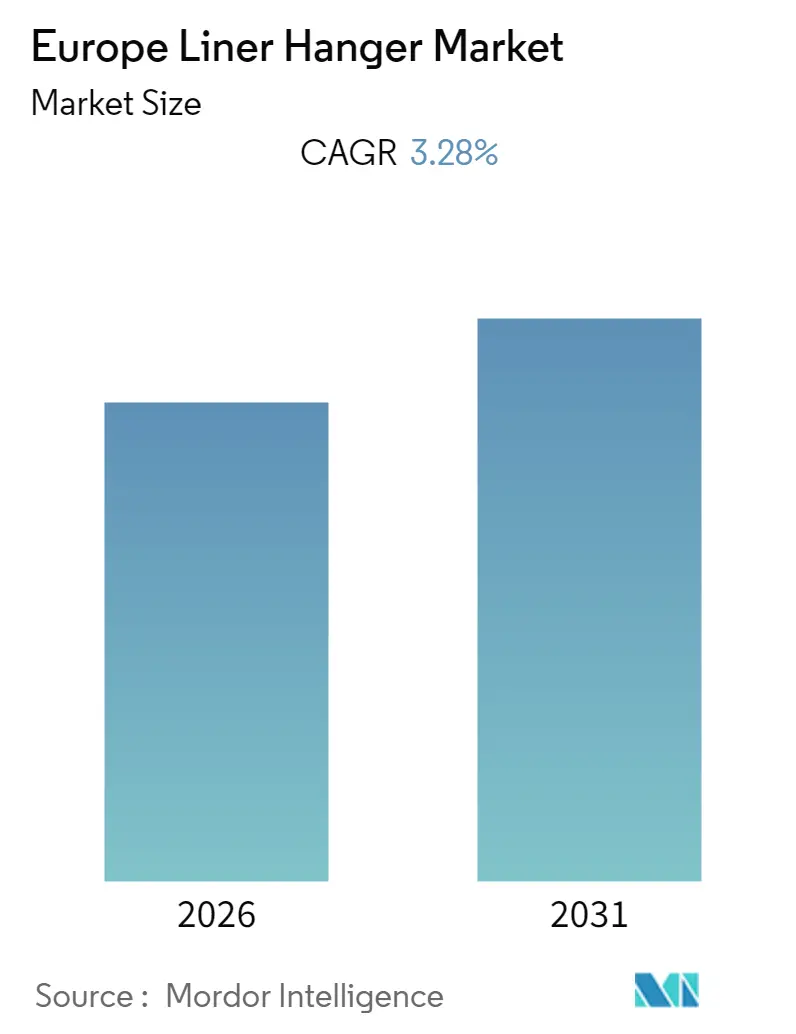
The Europe Liner Hanger Market size is expected to register a CAGR of 3.28% during the forecast period (2026-2031).
The market was negatively impacted by COVID-19 in 2020. Presently the market has now reached pre-pandemic levels.
- Over the long term, the surge in upstream activities in Russia and Norway is likely to boost the region's demand for Liner Hanger Systems (LHS).
- On the other hand, the global crude oil price decline in 2020 & 2021 has led to a halt or delay in various oil and gas projects. Also, declining production in Norway, Denmark, and Italy is expected to restrain the expected growth in the forecast period.
- The Bowland Shale in Northern England and the Midland Valley of Scotland, and the Weald Basin in Southern England are expected to create drilling and completion opportunities in the future, driving the market of the Liner Hanger System.
- Russia is one of the leading markets for Liner Hanger Systems in the region and is expected to continue its dominance in the forecast period.
Note: Market size and forecast figures in this report are generated using Mordor Intelligence’s proprietary estimation framework, updated with the latest available data and insights as of 2026.
Europe Liner Hanger Market Trends and Insights
Offshore Market is Expected to Witness the highest growth
- A Liner Hanger System consists of a liner hanger assembly, releasing tool, cementing head, packer, etc. The liner hanger system is a part of well completion and can be mechanical or hydraulic, premium or standard, rotating or non-rotating, conventional or expandable, and pocket slip.
- Liner Hanger System witnessed growth in 2021 as the high-pressure, high-temperature Culzean gas field in the central North Sea, one of the biggest start-ups comes on stream. Estimates suggest that the amount of shale gas lies between 2.8 and 39.9 trillion cubic meters (TCM). However, public opposition due to the environmental risk associated with fracking has become one of the biggest hurdles in shale gas development in the United Kingdom. This eventually restrains the possible growth of the liner hanger system.
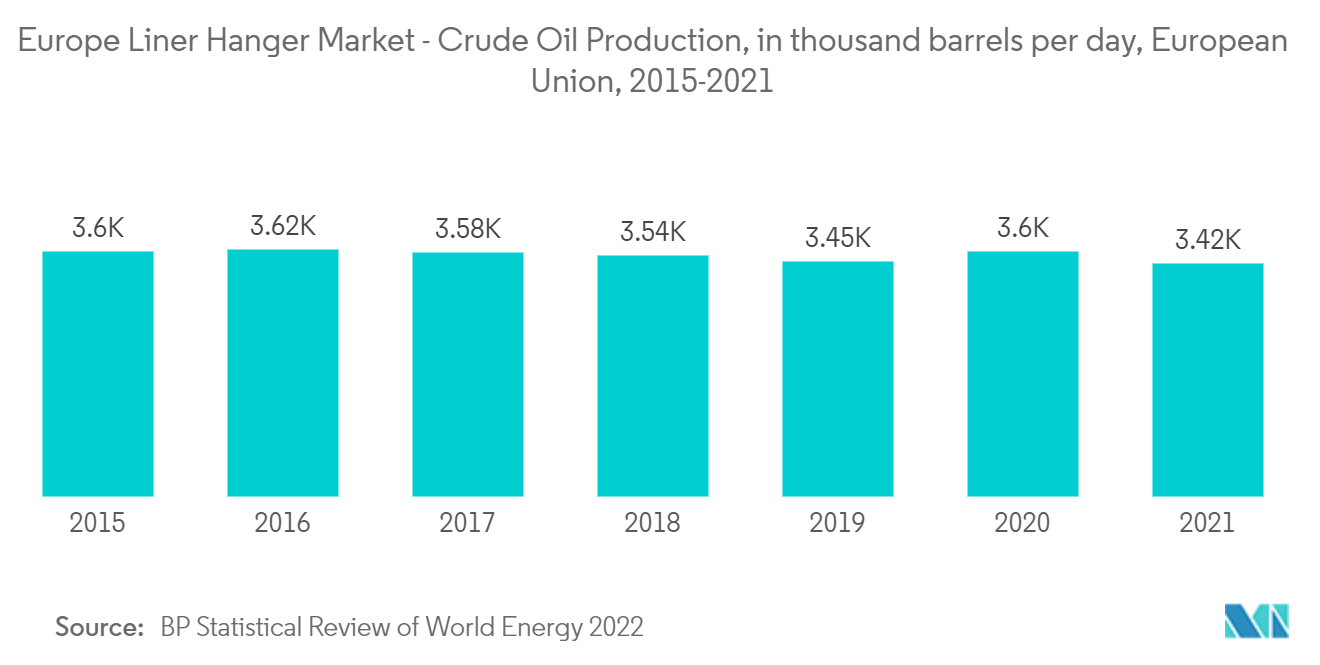
- Due to the declining crude oil production to 3,420 thousand barrels per day in 2021 in European Union, the growth of the liner hanger system is less in comparison to other global regions.
- Although most of the reserves in the North Sea area are in the declining phase, with large-scale exploration activities in Russia, the market of liner hanger in the offshore segment is expected to grow significantly.
- In February 2022, six new oil and gas fields in the North Sea almost confirmed approval from the UK government. The finance department pushed the senior authorities to fast-track the licenses for constructing the six energy areas. This, in turn, culminates in the growth of the liner hanger system across the region.
- Moreover, In January 2022, the Norwegian Ministry of Petroleum and Energy offered 28 companies ownership interests in 53 offshore oil and gas production licenses on the Norwegian Shelf in the Awards in Predefined Areas(APA) 2021. This will usher in new growth in the oilfield services markets when the reservoir development starts.
- Owing to the above points, the offshore segment is expected to dominate the market during the forecast period.


Russia to Dominate the Market
- Russia has significant shale oil and the biggest potential in shale gas reserves. Bazhenov Shale is known to be the biggest shale reserve in the world. As cheaper sites are abundant, shale gas development in Bazhenov is expected to start in 2024. In 2021, Russia held a major share of global drilling activities, followed by the United States. With this, Russia is also leading in the European region in terms of the liner hanger system market.
- As of 2021, Russia is the world's second-largest producer of natural gas, behind the United States. It also has the world's largest gas reserves and is the world's largest gas exporter. In 2021, the country produced 762 bcm of natural gas and exported approximately 210 bcm via pipeline.
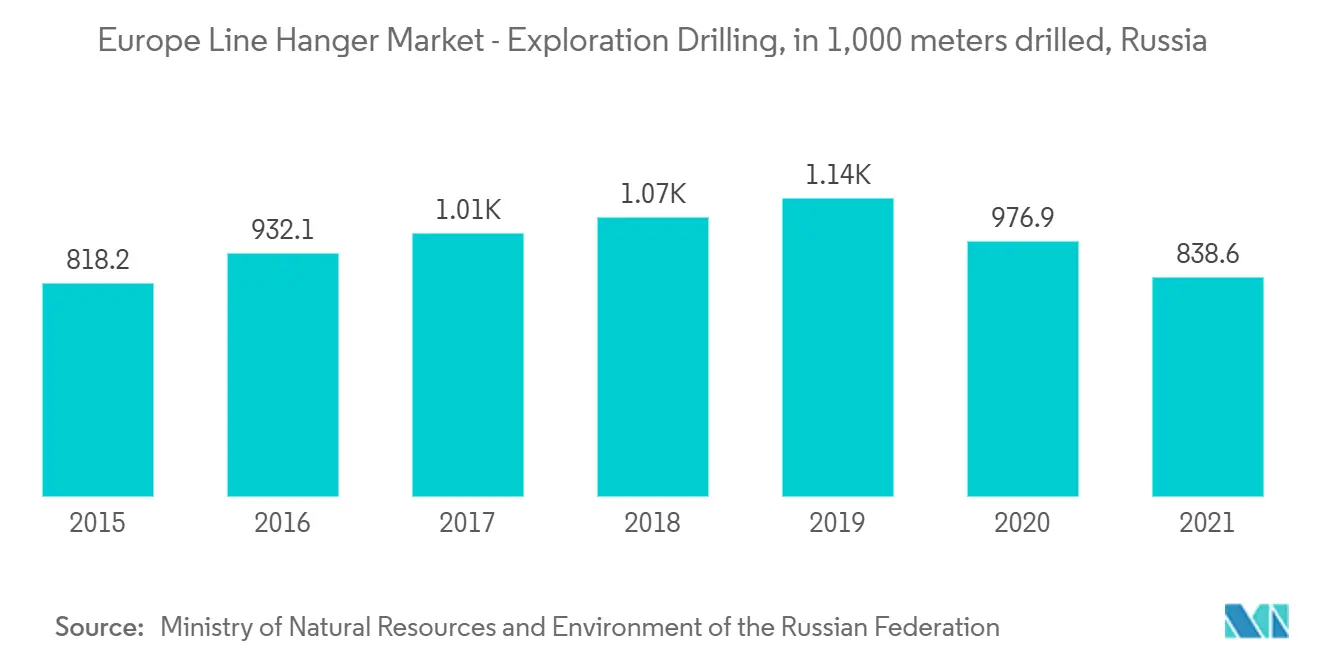
- Horizontal drilling is growing at a significant pace in the country. Nearly 839 thousand meters were drilled by mineral exploration companies in Russia in 2021. The number of meters drilled per year has decreased since 2019 when it peaked at over 1.1 million meters.
- Gazprom Neft continues to conduct studies on its Bazhenov acreage and is targeting 40,000 b/d of production from shale by 2023. With this significant demand for the liner, hangers can be expected in the forecast period.
- Demand for the liner hanger system in Russia is expected to continue to increase, in line with the drilling volume, driven by the considerable increase in the number of rigs and a higher proportion of rigs being used for horizontal drilling.
Regulatory Landscape
Offshore well construction and completion activity that supports liner hanger demand in Europe operates under the EU Offshore Safety Directive (Directive 2013/30/EU). The directive requires operators to demonstrate major accident risk control and well integrity through documented safety management measures and independent verification before commencing operations. In the United Kingdom, the Directive is implemented through the Offshore Installations (Offshore Safety Directive) (Safety Case etc.) Regulations 2015, linking equipment selection and well programs (including liner hanger and packer performance) to operator safety cases assessed by national competent authorities.
In 2026, the UK Offshore Petroleum Regulator for Environment and Decommissioning (OPRED) issued deep drilling screening directions for specific wells, including April 2026 (NEO Next + Energy Resources UK Limited, Per B Field well 15/17/B24) and June 2026 (BP Exploration Operating Company Limited, Mungo field well 22/20-A10). These actions point to ongoing permitting oversight for offshore drilling campaigns. At the EU level, Regulation (EU) 2026/261 introduced requirements around national oil diversification planning by 1 March 2026, strengthening the policy connection between supply security and upstream activity. Compliance expectations continue to emphasize documented integrity, verification, and environmental screening within national approval processes.
Value Chain Analysis
The liner hanger value chain in Europe begins with engineered materials and precision components, including high-strength alloys and corrosion-resistant materials designed for harsh or HPHT service. Design qualification and testing then follow against industry frameworks such as API Spec 19LH for liner hanger systems and API 11D1 for packer and seal elements. System manufacturing and assembly are typically handled by global oilfield service and equipment suppliers that also integrate liner hanger products with liner top packers, running tools, and cementing interfaces, along with the technical procedures and field engineering needed to execute the completion program.
On the downstream side, delivery is often bundled into drilling and well services or completions contracts, where service companies provide planning, running, and post-job support alongside the physical equipment. Logistics are staged through regional bases supporting offshore and onshore operations. Major participants offering liner hanger systems and associated services in the region include SLB, Baker Hughes, Halliburton, and NOV, with offerings spanning hydraulic-set, mechanical, and expandable systems designed for extended reach, narrow operating windows, and higher reliability requirements in offshore environments.
Competitive Landscape
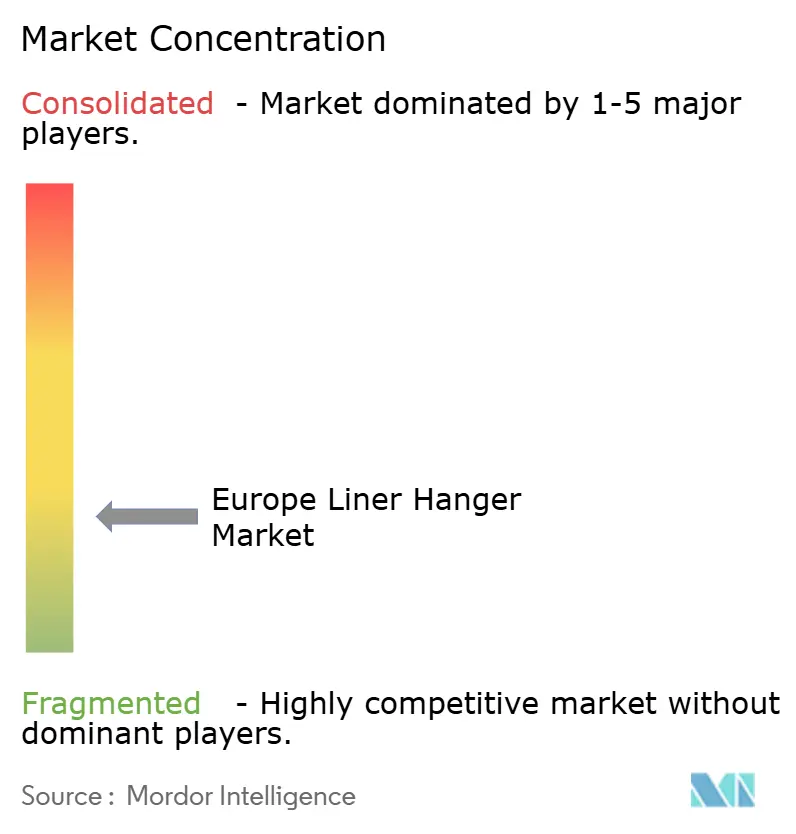
The Europe Liner Hanger Market is fragmented. The major companies (not in a particular order) include National-Oilwell Varco, Inc., Halliburton Company, Weatherford International plc, Baker Hughes, and Schlumberger Limited Ltd.
Europe Liner Hanger Industry Leaders
Halliburton Company
Weatherford International plc
Schlumberger Limited
Baker Hughes Ltd
National-Oilwell Varco, Inc
- *Disclaimer: Major Players sorted in no particular order

Market Opportunities and Future Outlook
Demand-side opportunities in Europe are concentrated in complex offshore programs where well design constraints push operators toward higher-performance liner hanger systems. Expandable and hydraulic-set solutions are particularly relevant for zonal isolation, rotation while running, and integrity management in HPHT and extended-reach wells. Recent activity provides tangible execution anchors, including Equinor beginning drilling at Rosebank in March 2026 (four production wells and three water-injection wells) and Romania's Neptun Deep moving into active drilling from 2025, both of which drive multi-well execution needs that typically include liner hanger and liner-top sealing steps within completion and well construction sequences.
Further opportunities arise from procurement structures that favor integrated service delivery across campaigns and basins. In such setups, suppliers can win multi-year drilling and well services scopes on the Norwegian Continental Shelf, then standardize liner hanger toolstrings, QA/QC, and running practices across rigs and assets. Technology differentiation remains a key selection lever, as operators and contractors choose equipment qualified to API-based performance requirements and configured for challenging environments, including metal-to-metal sealing architectures and systems designed for reliability under higher loads and temperatures. This combination supports supplier differentiation where tool performance and operational execution need to scale together.
Recent Industry Developments
- May 2026: Equinor extended multiple supplier agreements for integrated drilling and well services on the Norwegian Continental Shelf with Baker Hughes Norge, Halliburton, and SLB Norge, reported at a combined value of about NOK 17 billion (USD 1.83 billion). The extensions reinforce multi-year continuity for completions-related scopes that can include liner hanger running and associated well services across NCS drilling programs.
- May 2026: Halliburton deployed its VersaFlex expandable liner hanger system in BP's Azeri-Chirag-Gunashli offshore project in the Caspian Sea. The deployment highlights continued field adoption of expandable hanger architectures in offshore wells where sealing performance and running reliability are critical.
- January 2026: The European Parliament and Council enacted Regulation (EU) 2026/261, requiring member states to submit national oil diversification plans by 1 March 2026. The measure formalized an energy security-driven framework that can support upstream activity planning and related demand for well construction and completion equipment, including liner hanger systems, where projects progress through national permitting and safety-case requirements.


Research Methodology Framework and Report Scope
Market Definition and Coverage
This methodology covers revenue generated from liner hanger systems used in oil and gas wells across Europe, counted when the equipment is deployed for liner installation and completion work in onshore and offshore fields.
Scope exclusions: We exclude drill pipe, general casing hardware, wellhead and tree equipment, cementing services, and non-oilfield hanging tools that do not function as liner hangers.
Segmentation Overview
- Type
- Conventional
- Expandable
- Location of Deployment
- Offshore
- Onshore
- Geography
- The United Kingdom
- Norway
- Russia
- Rest of Europe
Data Sources, Market Sizing, and Validation
Desk Research
Desk research was used to map the activity drivers that typically move liner hanger demand in Europe, then set realistic bounds for volumes and pricing. We mainly referenced public oil and gas drilling and completion signals, such as monthly rig counts and well activity updates, which helps explain demand shifts between offshore and onshore programs.
We also reviewed reputable sources such as Eurostat energy statistics, the UK North Sea Transition Authority publications, Norwegian Offshore Directorate data releases, and OPEC and IEA reporting for upstream context. To translate activity into market value, we checked company annual reports and investor presentations for product mix clues, and used a paid subscription for company financials and intelligence where disclosures were limited. This list is not exhaustive, and many other sources were used to collect data, validate assumptions, and clarify gaps during the research.
Primary Interviews and Surveys
Primary work focused on confirming what gets counted as a liner hanger sale in Europe, and how pricing changes by well complexity, offshore share, and local service intensity. We spoke with a mix of manufacturers, distributors, service providers, and upstream operators across key European countries so that the desk assumptions could be corrected where contract structures and procurement timing differ.
To keep the model grounded, insights were cross-checked across respondents who cover tendering, field execution, and completion design decisions, and then we aligned the final totals to what the supply chain said was realistically deliverable over the year.
Distribution of primary research fieldwork respondents
| Company type | Respondent position |
|---|---|
| Top tier: 38% | CXOs: 19% |
| Mid tier: 41% | Functional/Unit leaders: 22% |
| Smaller Players: 21% | Managers: 59% |
Market-Sizing & Forecasting
Sizing starts from a top-down build where upstream completion activity in Europe is reconstructed through country-level well and rig indicators, and then converted into liner hanger demand using typical liner run rates by well type and offshore intensity. After the activity base is set, value is modeled by applying regionally realistic average selling prices that reflect the mix of conventional versus expandable systems and the share of complex offshore wells.
To make sure totals are practical, we corroborate the output with selective bottom-up approximations, such as supplier revenue splits where available, channel checks on shipment cadence, and sampled ASP times volume checks from interview inputs. Key inputs used in the model include offshore project start-ups in the North Sea, changes in rig utilization, well completion counts, redevelopment versus greenfield share, and observed pricing behavior for expandable systems in higher pressure environments. Where bottom-up data is incomplete for smaller country pools, gaps are handled through proxying from similar basins and adjusting with expert feedback on local sourcing and service packaging.
Forecasts are built using scenario analysis tied to expected upstream spending and drilling plans, followed by an ASP progression view that accounts for inflation, mix shifts, and procurement cycles. The final forecast is only moved after experts agree that the drivers (activity, mix, and price) are directionally consistent with how tenders are being issued and executed.
Data Validation & Update Cycle
Validation is done through repeated checks across the model, where outputs are compared against independent signals like regional drilling plans, offshore development timelines, and visible procurement activity. When an outlier shows up, the assumptions are revisited in steps, starting with activity conversion rates, then pricing, and finally the country mix.
Before sign-off, the work is reviewed by another analyst, and any large variances trigger a re-contact with interviewees for clarification. Reports are refreshed annually, and interim updates are made when major events occur, such as a sharp change in offshore project pipelines or a sudden swing in drilling economics. Right before delivery, a final pass is completed so clients receive the latest updated view.
Mordor Intelligence's Europe Liner Hanger Market Size Compared With Other Published Estimates
Published market estimates for Europe liner hangers can vary because the counted scope is not always the same, and because upstream activity and pricing are translated into revenue using different steps. Differences also show up when one estimate leans more on long-term optimism, while another uses a shorter activity window that can miss tender timing.
By tracking completion activity signals and refreshing pricing and country mix assumptions in each update cycle, Mordor Intelligence keeps the Europe liner hanger total tied to what is actually being deployed in UK, Norway, Russia, and the rest of the region, rather than extending the scope into adjacent completion hardware.
Benchmark comparison
| Source | Market Size | Gaps in Research Methodology |
|---|---|---|
| Mordor Intelligence | USD 0.00 B (2024) | |
| Trade Journal A | USD 0.71 B (2024) | Often states a single-point valuation and headline CAGR, but the scope can blend system revenue with bundled completion service elements, and the country coverage may not match the UK-Norway-Russia-plus-rest structure. |
| Industry Blog B | USD 0.96 B (2030) | Uses a forward-year endpoint and may apply uniform growth rates across the region, which can overstate value if offshore project timing and expandable mix shifts are not reconciled with near-term well completion cycles. |
The spread in values mainly comes from what is counted as a liner hanger sale and how far service and bundle revenue is included, plus whether the estimate is anchored in near-term completion activity or a longer endpoint year. Our approach stays traceable because each step is linked to Europe-specific activity, mix, and pricing checks that can be repeated when new well and project signals come in.


Key Questions Answered in the Report
What is the current Europe Liner Hanger System Market size?
The Europe Liner Hanger System Market is projected to register a CAGR of 3.28% during the forecast period (2026-2031)
Who are the key players in Europe Liner Hanger System Market?
Halliburton Company, Weatherford International plc, Schlumberger Limited, Baker Hughes Ltd and National-Oilwell Varco, Inc are the major companies operating in the Europe Liner Hanger System Market.
What years does this Europe Liner Hanger System Market cover?
The report covers the Europe Liner Hanger System Market historical market size for years: 2022, 2023, 2024 and 2025. The report also forecasts the Europe Liner Hanger System Market size for years: 2026, 2027, 2028, 2029, 2030 and 2031.
Page last updated on:





