
Europe Industrial Asset Inspection Services Market Size and Share
Market Overview
| Study Period | 2021 - 2032 |
|---|---|
| Forecast Data Period | 2027 - 2032 |
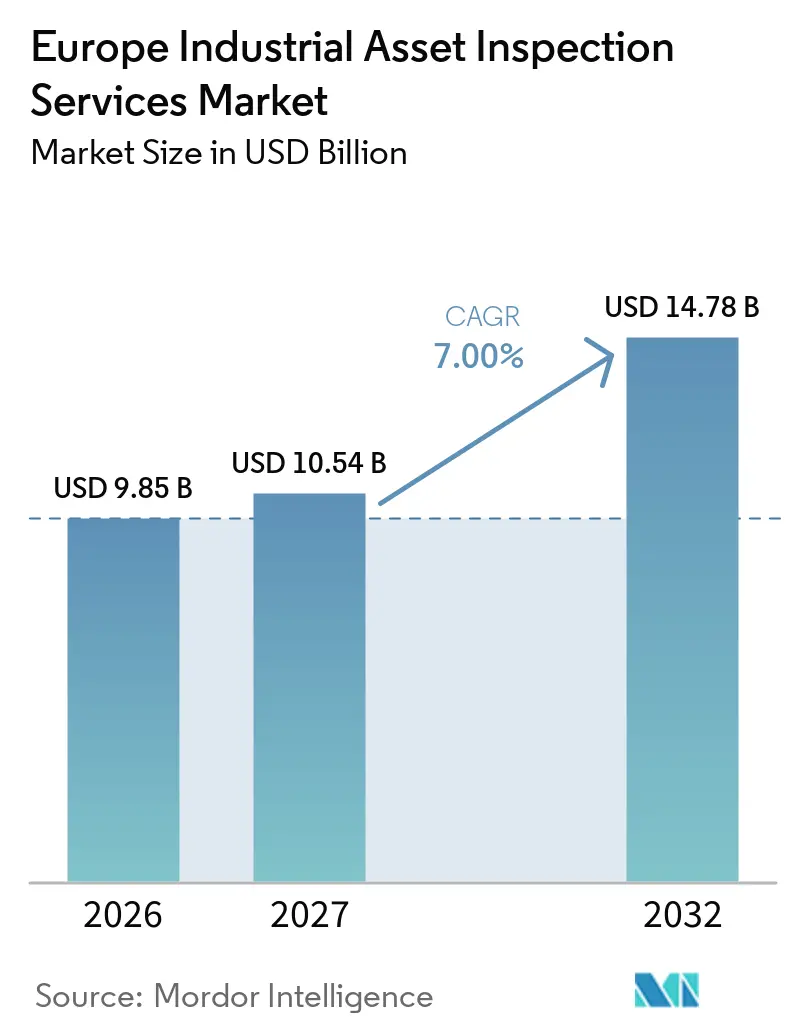
| Base Year Market Size (2026) | USD 9.85 Billion |
| Market Size (2027) | USD 10.54 Billion |
| Market Size (2032) | USD 14.78 Billion |
| Growth Rate (2027 - 2032) | 7.00 % |
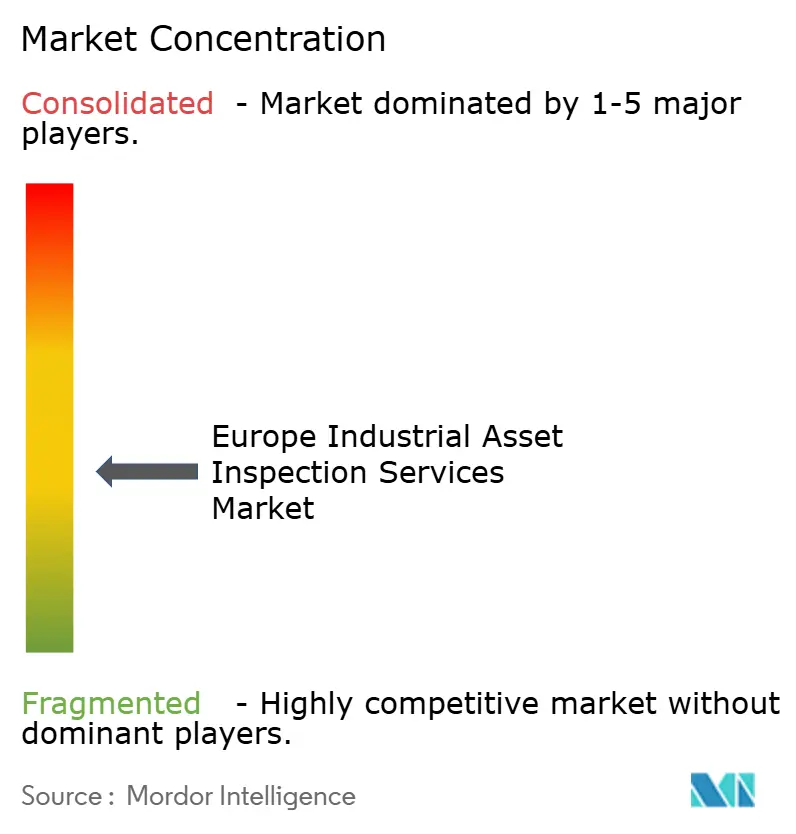
| Market Concentration | Medium |
Major Players *Disclaimer: Major Players sorted in no particular order Image © Mordor Intelligence. Reuse requires attribution under CC BY 4.0. | |
Europe Industrial Asset Inspection Services Market Analysis by Mordor Intelligence
The Europe Industrial Asset Inspection Services Market size is projected to expand from USD 9.85 billion in 2026 and USD 10.54 billion in 2027 to USD 14.78 billion by 2032, registering a CAGR of 7% between 2027 and 2032.
Formal inspection cycles across energy, process, and civil assets give the Europe industrial asset inspection services market a recurring base of demand. Aging networks need more frequent integrity work while operators prepare assets for hydrogen, carbon capture, offshore wind, and wider electrification. New infrastructure can create additional inspection work because its operating conditions and failure modes differ from those of legacy systems. Providers are responding through broader accreditation, technology investment, and acquisitions that extend their technical coverage. Regulatory compliance, preventive maintenance, and risk-based asset management further support demand, as operators seek to identify defects before they lead to equipment failures, unplanned shutdowns, or safety incidents. Inspection requirements also vary across asset types, creating opportunities for specialized providers with expertise in nondestructive testing, corrosion monitoring, structural assessment, and mechanical integrity verification. The expansion of renewable energy infrastructure and cross-border electricity networks is adding inspection requirements for offshore foundations, subsea cables, substations, and associated equipment throughout their operational life cycles. At the same time, digital inspection records, remote monitoring, drones, and automated defect-detection tools are helping providers improve data consistency and reduce the need for repeated site visits.
Key Report Takeaways
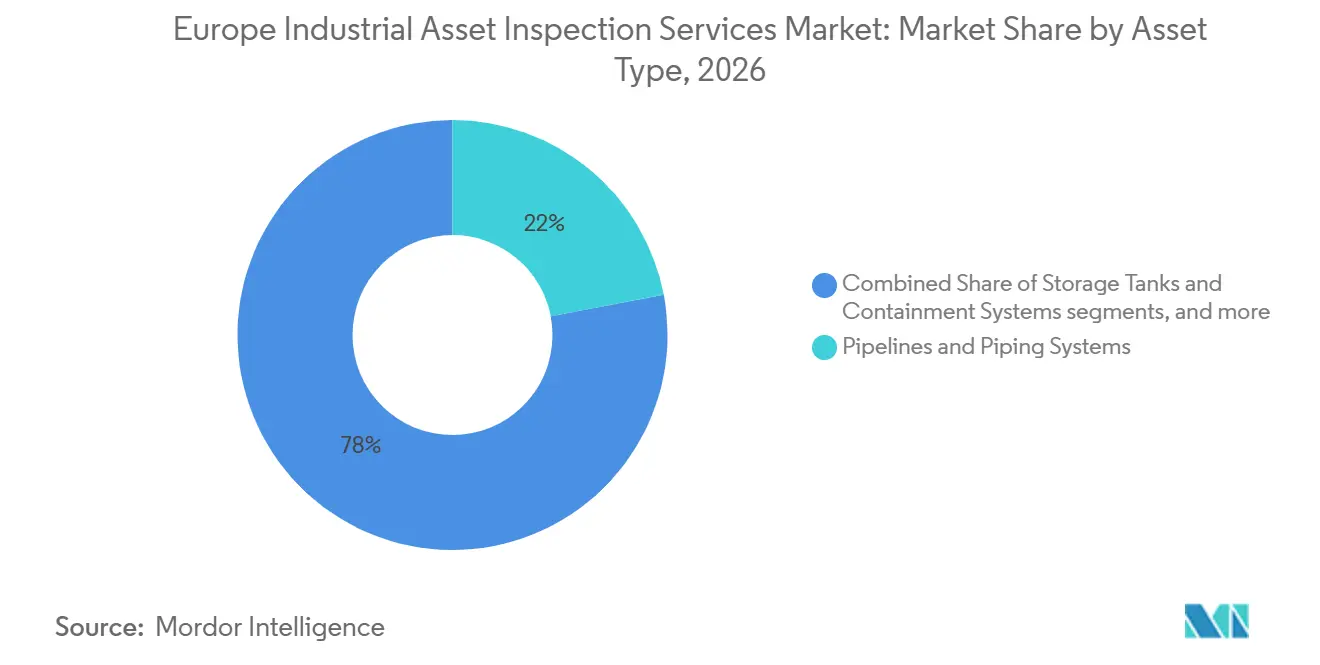
- By asset type, pipelines and piping systems held 22% of the Europe industrial asset inspection services market share in 2026, while electrical and power equipment is forecast to expand at an 8.5% CAGR through 2032.
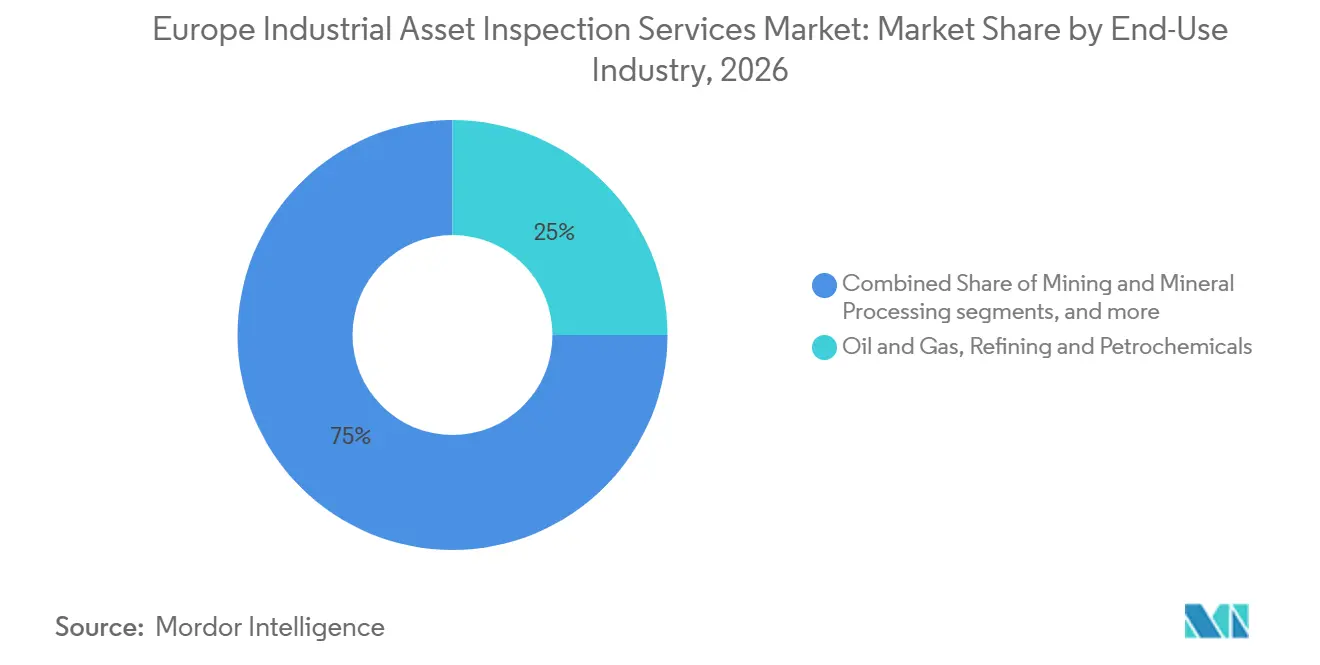
- By end-use industry, oil and gas, refining, and petrochemicals held 25% of the Europe industrial asset inspection services market size in 2026, while power generation, renewable energy, and electrical utilities are forecast to expand at a 9% CAGR through 2032.
- By geography, Germany held a 19% revenue share in 2026, while Spain is forecast to expand at an 8% CAGR through 2032.
Note: Market numbers in this report are based on Mordor Intelligence's proprietary estimation framework, which combines nine months of actuals with Q4 projections for base year 2026.
Europe Industrial Asset Inspection Services Market Trends and Insights
Drivers Impact Analysis*
| Driver | (~) % Impact on CAGR Forecast | Geographic Relevance | Impact Timeline |
|---|---|---|---|
| Aging Industrial, Nuclear, Rail, Pipeline, and Civil Infrastructure | +1.9% | Pan-European, concentrated in Germany, France, United Kingdom, and Poland | Long term (≥ 4 years) |
| EU Safety, Environmental, Pressure-Equipment, and Product-Quality Compliance | +1.7% | EU27 and United Kingdom | Medium term (2-4 years) |
| Offshore Wind, Hydrogen, Grid Modernization, and Energy-Transition Assets | +1.2% | North Sea and Spain Atlantic corridor | Long term (≥ 4 years) |
| Outsourcing of Accredited Inspection and Certified NDT Personnel | +0.9% | Europe, including Eastern Europe and Mediterranean corridors | Medium term (2-4 years) |
| Aerospace, Automotive, Semiconductor, and Advanced-Manufacturing Expansion | +0.7% | Germany, France, Netherlands, Austria, and Czech Republic | Medium term (2-4 years) |
| AI, Robotics, Drones, and Continuous Inspection Data | +0.5% | North Sea offshore, Germany, Nordics, and Southern Europe | Long term (≥ 4 years) |
| Source: Mordor Intelligence | |||
Aging Industrial, Nuclear, Rail, Pipeline, and Civil Infrastructure
Aging assets support recurring work across the Europe industrial asset inspection services market. Network Rail allocated GBP 12.6 billion (USD 17.0 billion) to maintain current assets in its 2024 to 2029 capital plan, 6% above the prior five-year cycle.[1] Its network includes 190,000 earthwork assets, with some embankments more than 150 years old, and asset faults caused 25% of rail delays. Gasunie is preparing hydrogen transmission across the Netherlands and northern Germany, creating a need for tools that can identify hydrogen-induced cracking. The Joint Research Centre states that repurposed gas pipelines need updated integrity management because hydrogen can accumulate in microscopic weld defects.[2]
EU Safety, Environmental, Pressure-Equipment, and Product-Quality Compliance
Regulatory requirements make inspection demand more predictable for the Europe industrial asset inspection services market. The European Commission’s 2025 Seveso III implementation report, published on September 19, 2025, found that the EU recorded an average of fewer than 22 major industrial accidents annually during 2019–2022. However, inspection coverage and external emergency-plan testing remained areas for improvement. The directive covers more than 11,000 industrial installations across the EU. Upper-tier establishments generally require inspections every 12 months, while lower-tier sites require inspections every 36 months, subject to risk-based inspection arrangements. The revised Industrial Emissions Directive covers approximately 37,000 industrial installations and 38,500 pig and poultry farms, with environmental inspections required at intervals of one to three years depending on risk. The Pressure Equipment Directive continues to require notified-body conformity assessments for higher-risk equipment categories. At the same time, ISO 9712 certification and national accreditation requirements influence demand for qualified inspectors, documented procedures, and traceable inspection results.[3]
Offshore Wind, Hydrogen, Grid Modernization, and Energy-Transition Assets
Energy-transition projects add inspection requirements that did not exist at comparable scale in older asset portfolios. Hydrogen-induced cracking requires integrity practices and tool specifications that exceed conventional natural gas protocols, increasing the need for specialized material testing, weld inspection, and pipeline condition assessments. The 2024 Ten-Year Network Development Plan identifies a 55 GW interconnection-capacity shortfall against the 318 GW target for 2040, highlighting the scale of transmission infrastructure development required to support Europe's evolving energy system. DNV signed quality assurance and inspection contracts for Net Zero Teesside Power and the Northern Endurance Partnership in August 2025, showing that carbon capture infrastructure is becoming a defined service category. These projects expand inspection demand across equipment manufacturing, construction, commissioning, and operational maintenance, including verification of pressure vessels, pipelines, compressors, storage facilities, and associated process systems. Offshore wind development also creates requirements for inspecting turbine foundations, subsea structures, cables, and corrosion protection systems exposed to demanding marine conditions.
Outsourcing of Accredited Inspection and Certified NDT Personnel
Asset owners outsource inspection work when they cannot maintain the required certification coverage in-house. DNV’s four-year Technical Services Management and Maintenance agreement with Gasunie covers natural gas, hydrogen, carbon dioxide, heat, LNG, and cryogenic systems in the Netherlands and northern Germany. The agreement reflects the broader use of integrated service contracts across the Europe industrial asset inspection services market. ISO 9712 requires a minimum of five years of experience for Level III certification, making it difficult for many operators to build senior expertise quickly. Advanced manufacturing operators can use certified specialists when needed rather than employ Level II and Level III staff across several methods. Aerospace, automotive, and semiconductor facilities also need documentation that aligns with quality and accreditation requirements, which supports external procurement.
Restraints Impact Analysis*
| Restraint | (~) % Impact on CAGR Forecast | Geographic Relevance | Impact Timeline |
|---|---|---|---|
| Shortage of Certified NDT, Rope-Access, Subsea, and Level III Personnel | -0.8% | Pan-European, acute in North Sea offshore and nuclear corridors | Long term (≥ 4 years) |
| High Capital and Validation Costs for Advanced Inspection Systems | -0.6% | Southern Europe and Eastern Europe, with spill-over to mid-market operators | Medium term (2-4 years) |
| Legacy-System Integration, Cybersecurity, and Cross-Border Data Governance | -0.5% | EU27-wide, especially cross-border pipeline and energy-grid operators | Medium term (2-4 years) |
| Fragmented National Procurement and Uneven SME Adoption | -0.3% | Eastern Europe, Southern Europe, and national procurement authorities | Long term (≥ 4 years) |
| Source: Mordor Intelligence | |||
Shortage of Certified NDT, Rope-Access, Subsea, and Level III Personnel
The shortage of qualified personnel limits capacity across the Europe industrial asset inspection services market. ASNT reported a global pool of 150,000 certified NDT professionals in 2025, supported by fewer than 1,200 senior Level III trainers. This balance makes it hard to replace experienced personnel at the pace required by new projects. Offshore wind campaigns need ISO 9712 credentials, client competency approvals, and maritime safety qualifications at the same time. The five-year Level III experience requirement means that training and certification cannot immediately resolve the shortage. Remote methods can reduce exposure and improve productivity, but they do not fully replace certified professional judgment.
High Capital and Validation Costs for Advanced Inspection Systems
Advanced tools can be difficult to fund and validate for smaller providers. Phased-array ultrasonic systems, robotic crawlers, ROV fleets, and continuous monitoring platforms require significant up-front investment. Safety-critical applications also require documented performance qualification before advanced methods can replace established procedures. A technology change for pressure vessels or nuclear circuits can require a formal re-qualification period of 12 to 24 months. DEKRA invested more than EUR 10 million (USD 11.28 million) in testing facilities in Arnhem in 2025 for charging solutions, grid digitalization, and cybersecurity testing. Smaller firms can face a gap between the price of advanced equipment and the day rates available in fragmented procurement markets. Legacy-system integration, cybersecurity requirements, cross-border data rules, and uneven small business adoption can further delay use of digital inspection systems.
*Our forecasts treat driver/restraint impacts as directional, not additive. The impact forecasts reflect baseline growth, mix effects, and variable interactions.
Segment Analysis
By Asset Type: Pipelines Lead Revenue While Power Equipment Marks the Growth Frontier
Pipelines and piping systems held 22% of the Europe industrial asset inspection services market share in 2026. Their position reflects the dense oil, gas, and industrial transmission network across continental Europe and the North Sea basin. The Pressure Equipment Directive supports recurring examinations of pressurized piping over the service life of an asset. Environmental inspection duties under the revised Industrial Emissions Directive add a second compliance cycle at connected process facilities. Gasunie’s hydrogen work requires in-line tools that can address hydrogen-induced cracking and seam-weld corrosion. These degradation modes are different from those considered in conventional natural gas pigging programs. Offshore pipelines, risers, and flowlines also need recurring ROV and intelligent-pigging work under operator integrity plans.
Electrical and power equipment is projected to grow at an 8.5% CAGR from 2027 to 2032. The Europe industrial asset inspection services market size for this segment benefits from offshore substations, interconnector upgrades, and large battery storage projects. New transformer, switchgear, and substation assets need commissioning checks and ongoing condition assessment. Pressure vessels, boilers, and heat exchangers retain stable demand because of notified-body cycles. Storage tanks are subject to stronger environmental scrutiny at refineries and petrochemical sites. Rotating equipment increasingly combines vibration monitoring and thermography with formal inspection. Structures such as offshore platforms, towers, and stacks are using drone and rope-access methods more often than scaffold-based access.

By End-Use Industry: Hydrocarbons Anchor Spend While Renewables Drive the Growth Premium
Oil and gas, refining, and petrochemicals held 25% of revenue in 2026, the largest end-use segment in the Europe industrial asset inspection services industry. These assets have high value density and require inspection through upstream, midstream, and downstream operations. Refinery turnarounds combine internal pressure-vessel work, heat-exchanger tube assessment, flare-system checks, and formal compliance tasks. Chemical manufacturing also requires recurring checks at Seveso III establishments. The Commission’s 2025 report reconfirmed 12-month inspections for upper-tier sites and 36-month inspections for lower-tier facilities. Pharmaceutical and bioprocessing plants require detailed GMP documentation. Metals, industrial manufacturing, water and wastewater facilities, and food processing sites have their own recurring safety and asset-integrity needs.
Power generation, renewable energy, and electrical utilities are projected to grow at a 9% CAGR through 2032. The Europe industrial asset inspection services market serves both life extension in conventional assets and growing renewable capacity. Offshore wind adds inspection work for foundations, cables, substations, and turbines. The 2025 revision of vehicle inspection rules includes enhanced periodic checks for electric vehicles and annual checks for older vehicles, creating related demand for transport and logistics infrastructure. Mining and mineral processing in Scandinavia, Poland, and the Iberian Peninsula require mechanical and structural services where operating conditions and failure consequences are demanding. This dispersion across end uses gives providers several routes to build technical specialization.
Geography Analysis
Germany held 19% of the Europe industrial asset inspection services market share in 2026. Its position reflects dense TÜV-certified infrastructure, a broad industrial base, and third-party requirements for pressurized and electrical equipment. GlobalFoundries announced a EUR 1.1 billion (USD 1.29 billion) expansion at its Dresden semiconductor facility in October 2025, targeting more than one million wafer starts annually by 2028. This adds needs for cleanroom, electrical, commissioning, and in-service inspection. The United Kingdom also requires services across North Sea offshore work, nuclear decommissioning, rail infrastructure, and emerging carbon capture projects.
France supports specialized demand through its large nuclear fleet and national safety oversight. The Netherlands is important for pipelines, storage tanks, pressure vessels, and energy transit infrastructure. Spain is projected to grow at an 8% CAGR from 2027 to 2032, the fastest country rate in the Europe industrial asset inspection services market. Its offshore wind program, solar assets entering mid-life assessment, and advanced manufacturing investment support this position. Galventus completes more than 500 drone-assisted blade inspections annually in Spain, showing that autonomous work is already operating at scale. Italy has demand from downstream petrochemicals, Adriatic offshore gas, and pharmaceutical manufacturing, while Poland is developing work through coal-to-gas conversion, district-heating upgrades, and early nuclear planning.
Turkey has demand from refinery, petrochemical, and cross-border pipeline assets linked to regional energy corridors. Russia’s participation narrowed during 2024 and 2025 because of sanctions-related constraints, shifting attention toward Poland, the Baltic states, and Ukraine-adjacent areas. Scandinavia supports offshore activity around Norwegian and Danish North Sea assets, while Belgium’s Antwerp petrochemical cluster and Austria’s pharmaceutical base require specialized non-destructive testing. The 2026 Industrial Emissions Directive transposition deadline will standardize inspection frequency requirements across member states. National asset bases, rules, and investment programs still create a varied geographic opportunity.
Competitive Landscape
The Europe industrial asset inspection services market exhibits a medium level of market concentration. SGS, Bureau Veritas, TÜV SÜD, DEKRA, DNV, and Intertek compete through accreditation, regional presence, and integrated contracts. Their scale helps them support multi-site assignments across asset categories and national borders, while smaller firms retain local strength in non-destructive testing, rope access, and subsea work. Bureau Veritas signed agreements in July 2025 to acquire Dornier Hinneburg in Germany and the Institute for Cyber Risk in Denmark, extending its nuclear decommissioning and cybersecurity coverage. SGS received OSHA approval in May 2025 to expand its NRTL network to Brussels and Puchheim, Germany.
Bureau Veritas also signed acquisition agreements for Sólida and London Building Control in October 2025. Sólida has managed nearly 2,500 renewable projects totaling more than 220 GW, expanding Bureau Veritas's adjacent transition services. DNV’s four-year Gasunie agreement covers several energy networks and is another example of an integrated contract. In the Europe industrial asset inspection services market, large providers use these arrangements to combine asset knowledge with advisory, testing, and quality assurance work. Accreditation depth remains important because operators need documented evidence that work meets the applicable requirements.
Autonomous technologies are reshaping how providers compete. Aker Solutions became the first company in Europe with unlimited BVLOS certification in September 2025, allowing offshore and onshore inspections to be managed from onshore control rooms. Providers still need accepted methods for validating AI-based outputs, accessible robotics service models, and portable credentials across borders. Larger TIC groups may be better placed to address these needs because of their wide accreditation portfolios. The Europe industrial asset inspection services market therefore has room for integrated providers and specialized technology firms.
Europe Industrial Asset Inspection Services Industry Leaders
-
SGS SA
-
Bureau Veritas SA
-
Intertek Group plc
-
TÜV SÜD AG
-
DEKRA SE
- *Disclaimer: Major Players sorted in no particular order
Recent Industry Developments
- February 2026: Intertek acquired Germany-based Aerial PV Inspection GmbH (AePVI), a specialist in drone-based and ground-based inspection of solar photovoltaic assets, to expand its quality assurance and inspection capabilities for utility-scale solar installations across Europe. This acquisition strengthens the ability to detect solar-module defects and assess asset performance, supporting the broader use of technology-enabled inspection services in the European renewable energy sector.
- October 2025: GlobalFoundries announced a EUR 1.1 billion (USD 1.29 billion) capacity expansion at its Dresden, Germany, semiconductor fab under the European Chips Act, targeting over one million wafer starts per year by 2028, generating substantial commissioning and in-service inspection demand for cleanroom and electrical assets.
- September 2025: Aker Solutions became the first company in Europe to secure unlimited BVLOS drone certification from European and national civil aviation authorities, enabling autonomous offshore and onshore inspections from onshore control rooms.
Europe Industrial Asset Inspection Services Market Report Scope
The Europe Industrial Asset Inspection Services Market Report is Segmented by Asset Type (Pipelines and Piping Systems, Pressure Vessels, Boilers and Heat Exchangers, and More), by End-Use Industry (Oil and Gas, Refining and Petrochemicals, Mining and Mineral Processing, Water and Wastewater Utilities, and More), and by Geography (Germany, France, Italy, Spain, and More). The Market Forecasts are Provided in Terms of Value (USD).
| Pipelines and Piping Systems | Oil, Gas and Industrial Transmission Pipelines |
| Process Piping and Industrial Utility Piping | |
| Pipelines, Risers and Flowlines | |
| Pressure Vessels, Boilers and Heat Exchangers | Pressure Vessels and Process Reactors |
| Industrial Boilers and Steam Systems | |
| Heat Exchangers and Pressurized Thermal Equipment | |
| Storage Tanks and Containment Systems | Aboveground and Underground Industrial Storage Tanks |
| Industrial Containment and Bulk Storage Systems | |
| Rotating and Mechanical Equipment | Pumps, Compressors and Industrial Turbines |
| Conveyors, Drives and Fixed Production Machinery | |
| Other Installed Mechanical Equipment | |
| Electrical and Power Equipment | Transformers, Switchgear and Power Distribution Equipment |
| Generators and Electrical Installations | |
| Power Transmission and Electrical Utility Assets | |
| Industrial Structures and Fixed Installations | Industrial Structural Steel and Equipment Supports |
| Offshore Platforms and Fixed Energy Installations | |
| Industrial Towers, Stacks and Supporting Structures | |
| Other Fixed Industrial Assets | Process Furnaces and Refractory Systems |
| Industrial Instrumentation and Control Installations | |
| Other Specialized Installed Industrial Assets |
| Oil and Gas, Refining and Petrochemicals |
| Power Generation, Renewable Energy and Electrical Utilities |
| Chemical Manufacturing (Excluding Petrochemicals) |
| Metals and Other Industrial Manufacturing |
| Mining and Mineral Processing |
| Water and Wastewater Utilities |
| Food and Beverage Processing |
| Pharmaceuticals and Bioprocessing |
| Transportation, Logistics and Port Operations |
| Other Industrial End Users |
| Germany |
| United Kingdom |
| France |
| Italy |
| Spain |
| Netherlands |
| Poland |
| Turkey |
| Russia |
| Rest of Europe |
| By Asset Type | Pipelines and Piping Systems | Oil, Gas and Industrial Transmission Pipelines |
| Process Piping and Industrial Utility Piping | ||
| Pipelines, Risers and Flowlines | ||
| Pressure Vessels, Boilers and Heat Exchangers | Pressure Vessels and Process Reactors | |
| Industrial Boilers and Steam Systems | ||
| Heat Exchangers and Pressurized Thermal Equipment | ||
| Storage Tanks and Containment Systems | Aboveground and Underground Industrial Storage Tanks | |
| Industrial Containment and Bulk Storage Systems | ||
| Rotating and Mechanical Equipment | Pumps, Compressors and Industrial Turbines | |
| Conveyors, Drives and Fixed Production Machinery | ||
| Other Installed Mechanical Equipment | ||
| Electrical and Power Equipment | Transformers, Switchgear and Power Distribution Equipment | |
| Generators and Electrical Installations | ||
| Power Transmission and Electrical Utility Assets | ||
| Industrial Structures and Fixed Installations | Industrial Structural Steel and Equipment Supports | |
| Offshore Platforms and Fixed Energy Installations | ||
| Industrial Towers, Stacks and Supporting Structures | ||
| Other Fixed Industrial Assets | Process Furnaces and Refractory Systems | |
| Industrial Instrumentation and Control Installations | ||
| Other Specialized Installed Industrial Assets | ||
| By End-Use Industry | Oil and Gas, Refining and Petrochemicals | |
| Power Generation, Renewable Energy and Electrical Utilities | ||
| Chemical Manufacturing (Excluding Petrochemicals) | ||
| Metals and Other Industrial Manufacturing | ||
| Mining and Mineral Processing | ||
| Water and Wastewater Utilities | ||
| Food and Beverage Processing | ||
| Pharmaceuticals and Bioprocessing | ||
| Transportation, Logistics and Port Operations | ||
| Other Industrial End Users | ||
| By Geography | Germany | |
| United Kingdom | ||
| France | ||
| Italy | ||
| Spain | ||
| Netherlands | ||
| Poland | ||
| Turkey | ||
| Russia | ||
| Rest of Europe | ||
Key Questions Answered in the Report
What is the forecast for Europe industrial asset inspection services?
The sector is projected to rise from USD 10.54 billion in 2027 to USD 14.78 billion in 2032, at a 7% CAGR. Recurring regulatory work, aging equipment, and energy-transition projects support the forecast.
Which asset type has the largest revenue position?
Pipelines and piping systems lead with 22% revenue share in 2026. Their installed base also requires integrity assessment as some systems are prepared for hydrogen service.
Which asset category is expected to grow the fastest?
Electrical and power equipment is projected to record an 8.5% CAGR through 2032. Substations, interconnectors, and battery storage create commissioning and in-service inspection needs.
Which end-use sector leads spending on inspection services?
Oil and gas, refining, and petrochemicals hold a 25% revenue share in 2026. Refinery shutdowns and statutory work create concentrated demand for several inspection methods.
Which country leads regional demand?
Germany holds 19% revenue share in 2026, supported by its industrial base and inspection infrastructure. Semiconductor, chemical, automotive, and power assets provide several demand sources.
Why are autonomous inspection tools becoming more relevant?
Drones, robotics, and remote systems can improve access to hazardous or offshore assets while supporting more frequent data collection. They can assist certified personnel but do not remove the need for accepted inspection procedures.