
Market Overview
| Study Period | 2021 - 2031 |
|---|---|
| Forecast Data Period | 2026 - 2031 |
| Base Year Market Size (2025) | USD 258.58 Million |
| Market Size (2026) | USD 277.18 Million |
| Market Size (2031) | USD 392.4 Million |
| Growth Rate (2026 - 2031) | 7.20 % |
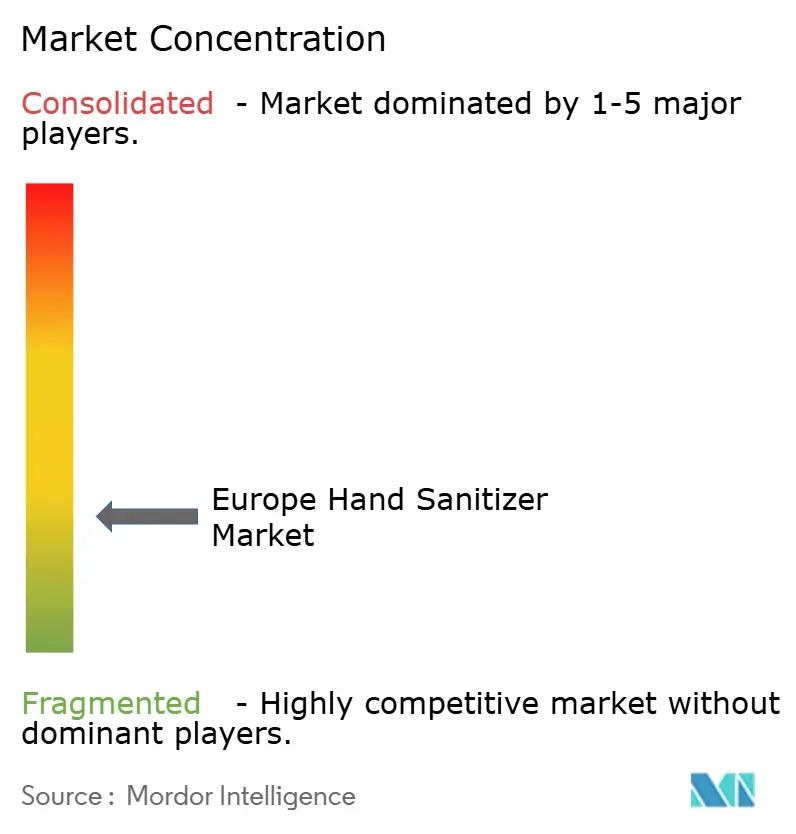
| Market Concentration | Low |
Major Players *Disclaimer: Major Players sorted in no particular order Image © Mordor Intelligence. Reuse requires attribution under CC BY 4.0. | |
Europe Hand Sanitizer Market Analysis by Mordor Intelligence
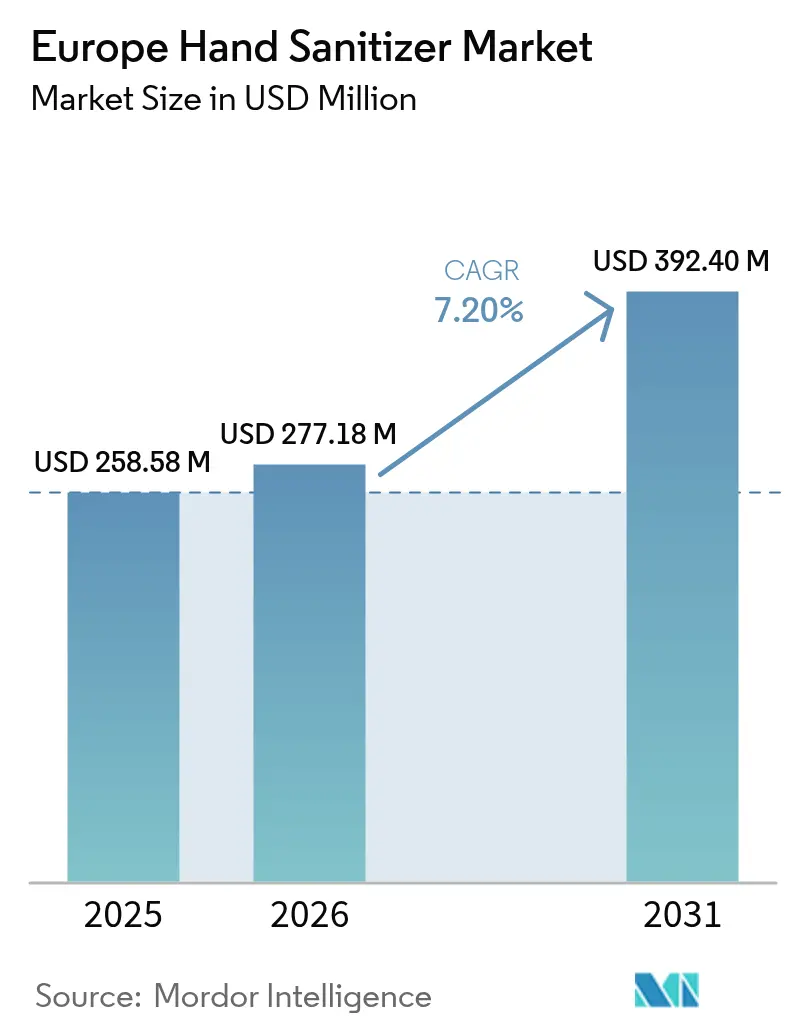
The Europe hand sanitizer market size is expected to grow from USD 258.58 million in 2025 to USD 277.18 million in 2026 and is forecast to reach USD 392.4 million by 2031 at 7.20% CAGR over 2026-2031. The market's expansion is driven by workplace hygiene requirements, changing consumer preferences, and the convenience of waterless hand cleaning solutions. The widespread availability of diverse product formats, including gels, lotions, and various dispenser types (portable bottles, sprays, and touch-free systems), has contributed to increased market penetration. Consumer preferences are shifting toward natural and sustainable ingredients such as aloe vera and essential oils, particularly among users concerned about skin sensitivity to alcohol-based products. This trend aligns with the broader movement toward organic personal care products. The market continues to benefit from heightened health awareness, initially sparked by the COVID-19 pandemic, as consumers maintain stricter personal hygiene practices to prevent infection spread. As the market matures, manufacturers are focusing on product innovation and sustainable packaging solutions to maintain competitive advantage and meet evolving consumer demands.
Key Report Takeaways
- By product type, the gel and liquid segment held 83.88% of the European hand sanitizer market share in 2025, while other product types are advancing at a 7.52% CAGR through 2031.
- By end user, adults commanded 82.96% share of the European hand sanitizer market size in 2025, and the kids and children segment is rising at a 7.78% CAGR through 2031.
- By ingredients, conventional formulations accounted for 81.74% of the European hand sanitizer market size in 2025; natural and organic variants register the fastest growth at 8.21% CAGR through 2031.
- By end use, the residential segment contributed 77.92% revenue in 2025, whereas the commercial segment expanded at an 8.72% CAGR between 2026-2031.
- By geography, France led with a 19.55% share in 2025, and Germany is forecast to post the highest 8.98% CAGR through 2031.
Note: Market size and forecast figures in this report are generated using Mordor Intelligence’s proprietary estimation framework, updated with the latest available data and insights as of 2026.
Market Trends and Insights
Drivers Impact Analysis of Europe Hand Sanitizer Market*
| Driver | (~) % Impact on CAGR Forecast | Geographic Relevance | Impact Timeline |
|---|---|---|---|
| Growing emphasis on hygiene and sanitation | +1.2% | Global, with strongest impact in Northern Europe | Medium term (2-4 years) |
| Increased health and safety regulations across workplaces, public institutions, and healthcare facilities | +0.8% | Europe, particularly Germany and France | Long term (≥ 4 years) |
| Technological advancement in product formulation | +1.1% | Western Europe core markets | Medium term (2-4 years) |
| Consumers inclination towards natural and organic sanitizers | +0.9% | Nordics and Western Europe | Long term (≥ 4 years) |
| Growth in real estate sector | +1.5% | Germany, Netherlands, Poland | Short term (≤ 2 years) |
| Social media influence and celebrity endorsements | +0.7% | United Kingdom, France, Italy | Short term (≤ 2 years) |
| Source: Mordor Intelligence | |||
Growing Emphasis on Hygiene and Sanitation
Growing health awareness has transformed hygiene practices across Europe, leading to a sustained increase in hand sanitizer usage. European health organizations and governments continue to emphasize proper hand hygiene as a crucial preventive measure. The hospitality and tourism sectors have integrated hand sanitizer stations as a standard amenity, further driving market growth. The rising adoption of hand sanitizers in public spaces and transportation hubs demonstrates the region's commitment to maintaining high hygiene standards. The organization's guidelines on hand hygiene have significantly influenced institutional and consumer purchasing patterns. With seasonal influenza affecting approximately 20% of the European population annually, according to the European Centre for Disease Prevention and Control, [1] hand sanitizers have become an essential part of daily routines for European consumers.
Increased Health and Safety Regulations Across Workplaces, Public Institutions, and Healthcare Facilities
The implementation of stringent hygiene protocols across healthcare facilities, educational institutions, and workplaces has established a consistent demand for hand sanitizers in Europe. This demand is further reinforced by alarming healthcare statistics, with the European Centre for Disease Prevention and Control reporting 4.3 million patients in EU/EEA hospitals affected by healthcare-associated infections annually. [2] The UK government's specific guidelines for schools and childcare facilities mandate the availability of alcohol-based hand gels, while also acknowledging their limitations against certain pathogens like norovirus. [3] This has led to increased adoption of multi-modal hygiene solutions incorporating both alcohol-based and non-alcohol formulations. The European Agency for Safety and Health at Work has integrated hand sanitizers as essential components of occupational health frameworks, particularly in healthcare and social work sectors. These regulatory requirements and workplace safety standards have created predictable, long-term demand patterns, enabling suppliers to confidently invest in capacity expansion and product innovation.
Technological Advancement in Product Formulation
Innovation in hand sanitizer formulations has evolved beyond basic alcohol-based solutions to include sophisticated delivery systems that address efficacy, skin health, and environmental concerns. Manufacturers are developing alcohol-free alternatives using natural ingredients and essential oils to address skin sensitivity concerns. The integration of moisturizing agents and skin-friendly compounds has improved product effectiveness while reducing skin dryness and irritation. Companies now focus on foam-based and gel-based formulations that offer better spreadability and enhanced antimicrobial properties. For instance, GOJO Industries achieved Cradle to Cradle certification for its PURELL Advanced Hand Sanitizer, demonstrating that sustainability and efficacy can coexist through advanced formulation chemistry. These innovations have created premium product categories that command higher margins while meeting regulatory requirements for safer, more sustainable formulations.
Consumers Inclination Towards Natural and Organic Sanitizers
European consumers increasingly prefer natural and organic hand sanitizers due to growing awareness about the potential adverse effects of synthetic chemicals and alcohol-based formulations. The market demonstrates strong demand for plant-based ingredients such as aloe vera, tea tree oil, and essential oils, which offer antimicrobial properties while maintaining skin health. This consumer preference reflects Europe's broader shift toward sustainable and eco-friendly personal care products. Manufacturers are adapting by reformulating their products and expanding their natural hand sanitizer offerings. According to the National Science Foundation's survey [4] findings in March 2025, 74% of consumers prioritize organic ingredients in personal care products, supporting the market's transition toward natural formulations.
Restraints Impact Analysis of Europe Hand Sanitizer Market*
| Restraint | (~) % Impact on CAGR Forecast | Geographic Relevance | Impact Timeline |
|---|---|---|---|
| Availability of counterfeit products | -0.6% | Eastern Europe and online channels | Short term (≤ 2 years) |
| Price fluctuation in raw material | -0.4% | Europe-wide, particularly affecting smaller manufacturers | Medium term (2-4 years) |
| Health concern over chemical ingredients | -0.3% | Nordic countries and Germany | Long term (≥ 4 years) |
| Strong penetration of other hand cleaning products | -0.2% | Mature markets in Western Europe | Medium term (2-4 years) |
| Source: Mordor Intelligence | |||
Health Concern Over Chemical Ingredients
Consumer awareness regarding potential health risks associated with chemical ingredients in hand sanitizers has emerged as a significant market restraint in Europe. The FDA's classification of benzalkonium chloride as a Category III ingredient, requiring additional safety and effectiveness data, has intensified regulatory scrutiny. European consumers actively examine product labels and seek formulations with minimal synthetic chemicals, a behavior amplified by social media discussions about endocrine-disrupting compounds and long-term exposure effects from frequent sanitizer use. While natural alternatives command higher prices, health-conscious consumers demonstrate willingness to pay premium costs. This shift in consumer preferences has compelled manufacturers to develop "clean chemistry" initiatives focused on eliminating chemicals of concern while maintaining antimicrobial effectiveness.
Strong Penetration of Other Hand Cleaning Products
The established presence of alternative hand cleaning products, particularly soap and antibacterial wipes, constrains the hand sanitizer market growth in mature Western European markets. Traditional soap and water remain the primary hand hygiene method according to WHO guidelines, with alcohol-based sanitizers recommended only when soap is unavailable. The effectiveness of soap against certain pathogens, including norovirus, where alcohol-based sanitizers prove ineffective, strengthens consumer preference for traditional cleaning methods. Additionally, antibacterial wipes have secured significant market share in commercial settings due to their dual cleaning and disinfecting capabilities. This market dynamic is particularly evident in countries with well-developed hygiene infrastructure and consumer education, where users understand the appropriate applications for different cleaning methods. In response, hand sanitizer manufacturers focus on convenience features like portable packaging and quick-drying formulations to maintain market competitiveness, rather than competing solely on antimicrobial efficacy.
*Our forecasts treat driver/restraint impacts as directional, not additive. The impact forecasts reflect baseline growth, mix effects, and variable interactions.
Europe Hand Sanitizer Market Segment Analysis
By Product Type:
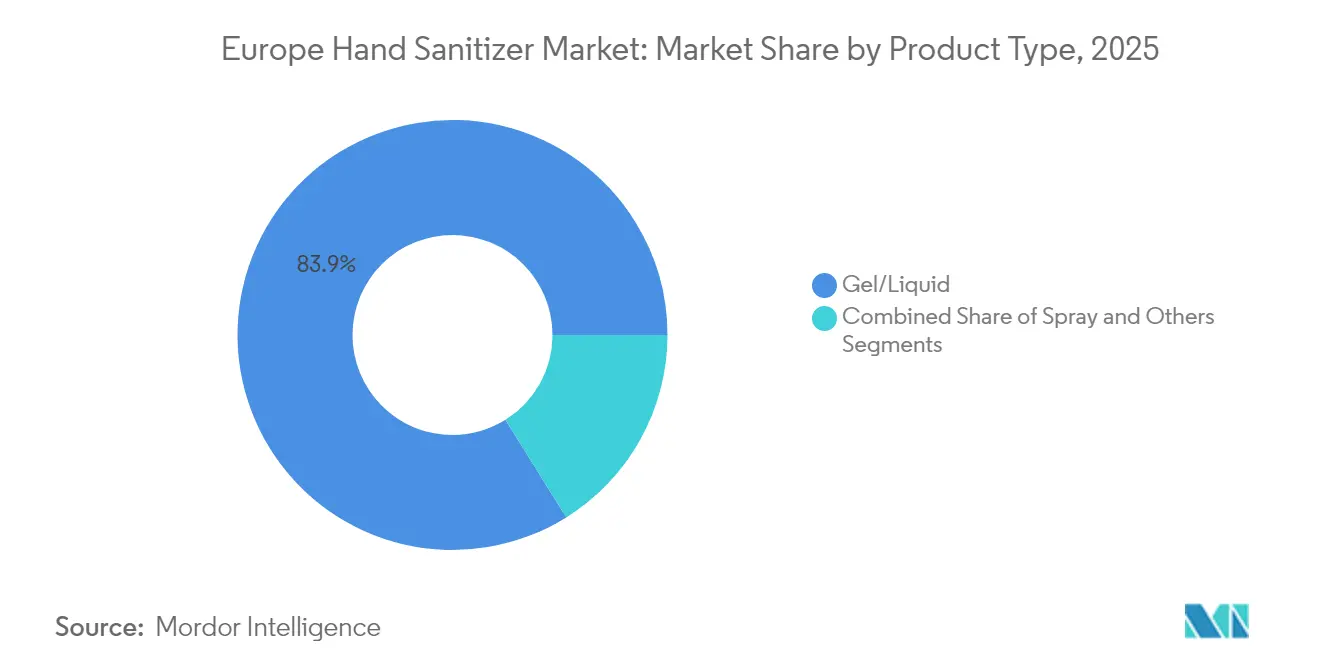
Gel Dominance Faces Innovation PressureGel and liquid formulations dominate the European hand sanitizer market with an 83.88% share in 2025, driven by widespread consumer acceptance and robust distribution networks across retail and institutional channels. While sprays maintain a moderate market position due to their contactless application benefits, they face growing competition from innovative formats. The other product types segment, including foams, wipes, and spray-dried powders, is witnessing rapid expansion at 7.52% CAGR through 2031, as manufacturers focus on product differentiation through novel delivery mechanisms to capture market share.
Innovation in alternative sanitizer formats has accelerated through scientific advancements that overcome traditional liquid sanitizer limitations. The development of solar-powered sanitization units with ultraviolet technology, supported by the European Space Agency, demonstrates the potential for non-chemical alternatives in the market. This technological progression is reshaping product segmentation as manufacturers increasingly develop hybrid solutions that integrate multiple delivery mechanisms. These innovations aim to enhance both product effectiveness and user experience, indicating a shift toward more sophisticated sanitization solutions in the European market.

By End User:
Adult Market Stability Contrasts Children's GrowthAdult hand sanitizer usage commands an 82.96% market share in 2025, driven by workplace hygiene requirements and established institutional purchasing patterns, while the kids and children segment exhibits rapid growth at 7.78% CAGR through 2031. Educational institutions are implementing permanent hygiene protocols that extend beyond pandemic measures, with UK government guidelines mandating alcohol hand gel availability in schools when hands are not visibly soiled. However, the limitations of sanitizers against certain pathogens like norovirus necessitate additional hygiene measures, prompting institutions to adopt comprehensive approaches. The institutional focus on children's hygiene has led to infrastructure adaptations, including child-height dispensers and curriculum-based education programs that establish lasting hygiene habits.
The children's segment growth reflects systematic institutional investment rather than consumer preferences alone, as schools and childcare facilities integrate hygiene education into their core operations. This institutional adoption creates sustained market expansion opportunities since hygiene habits formed during childhood typically continue into adulthood. The segment's development has catalyzed innovation in product formulations that address pediatric safety concerns, particularly regarding sensitive skin and accidental ingestion risks. Educational facilities' commitment to age-appropriate hygiene solutions has created opportunities for premium-priced specialized products that meet stringent safety standards while supporting long-term market growth through established behavioral patterns.
By Ingredients:
Natural Surge Challenges Conventional DominanceConventional formulations dominate the market with an 81.74% share in 2025, while natural and organic alternatives demonstrate robust growth at 8.21% CAGR through 2031. This market evolution reflects changing consumer preferences, as individuals increasingly examine product labels and seek formulations with minimal synthetic ingredients. The shift toward natural alternatives stems from growing awareness of ingredient transparency and sustainability concerns in personal care products, indicating a fundamental transformation in consumer purchasing behavior.
The momentum in the natural segment has strengthened due to supportive regulatory frameworks, particularly the European Commission's Clean Industrial Deal, which emphasizes circular economy principles and sustainable production methods. These regulatory developments create favorable conditions for natural product innovation while establishing additional compliance requirements for synthetic alternatives. The regulatory environment, combined with consumer demand for sustainable options, continues to reshape the market landscape and influence product development strategies across the industry.
By End Use:
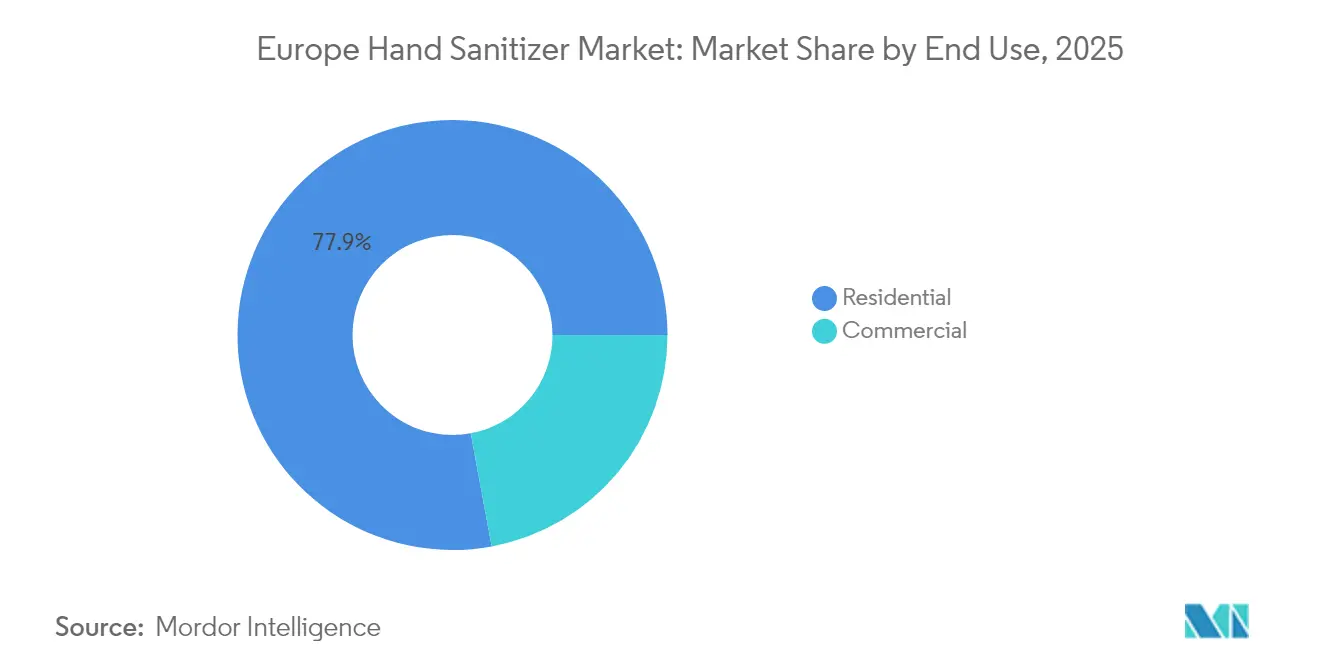
Commercial Acceleration Transforms Market DynamicsResidential applications dominate the hand sanitizer market with a 77.92% share in 2025, driven by consumer stockpiling behaviors and sustained home hygiene practices established during the pandemic period. While households continue to prioritize sanitization, the commercial segment demonstrates robust growth at 8.72% CAGR through 2031, as businesses transform temporary health measures into permanent operational protocols. This shift reflects broader changes in workplace safety regulations and employee expectations, particularly in customer-facing environments where visible sanitization infrastructure has become essential for demonstrating commitment to hygiene standards.
The commercial segment's evolution extends beyond basic compliance, with hygiene infrastructure emerging as a competitive differentiator in the European market. Property developers now incorporate permanent sanitization stations as standard amenities in real estate developments, recognizing their value in attracting tenants and justifying premium rents. This transformation aligns with the European Agency for Safety and Health at Work's emphasis on workplace safety measures, particularly in healthcare and social work sectors, where hand sanitizers have become integral components of occupational health frameworks.
Geography Analysis
France Hand Sanitizer Market
France commands the largest market share at 19.55% in 2025, driven by stringent workplace safety regulations and comprehensive hygiene protocols across public institutions. The French market benefits from centralized procurement systems that enable large-volume institutional purchases and standardized product specifications across government facilities. The country's robust healthcare infrastructure and aging population demographics drive consistent demand from medical facilities. French regulatory frameworks emphasize preventive health measures, requiring employers to provide adequate hygiene infrastructure including hand sanitization facilities. Additionally, the tourism industry's recovery has increased requirements for hospitality sector hygiene solutions.
Germany Hand Sanitizer Market
Germany emerges as the fastest-growing market at 8.98% CAGR through 2031, propelled by its position as Europe's manufacturing hub where workplace hygiene requirements are increasingly sophisticated. German industrial facilities require advanced sanitization solutions that address both worker safety and product quality assurance, driving demand for institutional-grade formulations. The country's leadership in chemical industry innovation has attracted significant investment in next-generation sanitizer technologies, including sustainable formulations and novel delivery systems. Germany's robust regulatory framework supports product innovation while maintaining high safety standards, creating an attractive environment for manufacturers developing premium products.
Broader European Markets
The remaining European markets, including the UK, Italy, Spain, Netherlands, Poland, Belgium, and Sweden, present significant growth opportunities through EU regulatory harmonization that reduces cross-border trade barriers. Italy and Spain benefit particularly from tourism industry recovery, which has increased hygiene requirements in their hospitality sectors. The Netherlands' position as a European logistics hub creates opportunities for distribution operations serving broader regional markets. The harmonization of regulations enables economies of scale in manufacturing and distribution, making these markets increasingly attractive for industry participants. These markets collectively represent substantial potential for market expansion as standardized requirements facilitate cross-border product distribution.
Regulatory Landscape
In Europe, hand sanitizers making disinfecting claims for human hygiene are regulated primarily under the EU Biocidal Products Regulation (BPR), Regulation (EU) No 528/2012, typically as Product Type 1 (PT1). Market access generally follows a two-step pathway: EU-level approval of the active substance and authorization of the finished product (including biocidal product families). Union authorization then enables placement across the EU/EEA via European Commission decisions supported by ECHA scientific opinions, while supply-chain eligibility is also tied to BPR Article 95 listing requirements for active substance and product suppliers.
This regulatory environment remained active through the study base year and current year. The European Commission started an evaluation of the BPR in December 2025, and a March 2026 Union authorization was issued through Commission Implementing Regulation (EU) 2026/750 for the ECA Disinfect skin product family 7 for non-medical hand disinfection. ECHA also maintains central resources for compliance and product authorization workflows, including active substance and product-type records in its biocides databases, which affects authorization planning, reformulation decisions, and distributor due diligence across European markets.
Competitive Landscape
The European hand sanitizer market is highly fragmented due to diverse regulatory requirements across European Union member states, rapid entry of new players during the pandemic, and varying consumer preferences across regions. Major players like Reckitt Benckiser Group, GOJO Industries Inc., 3M Company, Ecolab Inc., and Unilever PLC compete through differentiated strategies focused on brand recognition, distribution networks, and product innovation. The competitive environment has intensified through promotional activities in mature Western European markets, where established companies defend their positions against emerging competitors offering premium natural formulations and innovative delivery systems.
Companies are increasingly shifting toward sustainability and premium positioning to differentiate themselves beyond price competition. Technology adoption has become a critical competitive factor, with investments in advanced formulation chemistry, sustainable packaging solutions, and digital marketing capabilities to reach evolving consumer segments. White-space opportunities exist in specialized applications, including pediatric formulations, extended-duration products, and industrial-grade solutions for manufacturing environments.
The market's fragmented nature presents acquisition opportunities for companies aiming to expand geographic coverage or acquire specialized capabilities. Regulatory harmonization under EU frameworks enables successful regional players to scale operations across multiple countries with reduced compliance complexity. This environment supports both organic growth through product innovation and strategic expansion through mergers and acquisitions, creating multiple pathways for market development.
Europe Hand Sanitizer Industry Leaders
-
Reckitt Benckiser Group PLC
-
3M Company
-
Unilever PLC
-
GOJO Industries Inc.
-
Ecolab Inc.
- *Disclaimer: Major Players sorted in no particular order
Europe Hand Sanitizer Market Companies Covered in this Report
- Reckitt Benckiser Group PLC
- 3M Company
- Unilever PLC
- Ecolab Inc.
- GOJO Industries Inc.
- INEOS Capital Limited
- Henkel AG & co. GaA
- PZ Cussons PLC
- Saraya.Co.Ltd
- EcoHydra Technologies Ltd
- Wrimes Cosmetics Ltd.
- Clarisans
- ANTISEPTICA Dr. Hans-Joachim Molitor GmbH
- Kimberly-Clark Corporation
- The Procter & Gamble Company
- Laboratoires Anios
- ACTO GmbH
- The HARTMANN GROUP
- Beiersdorf AG
- Dr. Schumacher GmbH
Market Opportunities and Future Outlook
A key opportunity is the link between compliance and product positioning, since hand gels and related formats can sit under either the Cosmetic Products Regulation or the BPR depending on ingredients and the claims made (cleaning versus antibacterial/antiviral disinfection). This supports differentiated portfolios spanning cosmetic hand cleansing gels, biocidal hand disinfectants, and institutional-grade lines. It also raises the bar for manufacturers to tighten internal governance on claims substantiation, labeling, and channel-specific compliance, especially for cross-border distribution where Union authorization under the BPR provides a more scalable pathway.
Formulation and procurement strategies are also being shaped by ongoing EU-level regulatory work. The European Commission started its BPR evaluation in Q4 2025, and ECHA processes linked to ethanol and other actives continue to inform active-substance risk management. That backdrop reinforces room for alternative actives, skin-friendly systems, and compliant natural-leaning formulations that still meet efficacy requirements. On the supply side, continued reliance on ECHA-managed biocides systems and Article 95 listing in institutional procurement supports opportunities for suppliers that can provide traceability and authorization status across multi-country tenders in healthcare, education, and workplace channels.
Recent Industry Developments in Europe Hand Sanitizer Market
- May 2026: Ecolab highlighted continued advancement of its institutional hygiene programs, reinforcing its positioning where hand hygiene is bundled with broader infection prevention and sustainability priorities in customer operations. The communication underscored continued vendor investment in service-led hygiene outcomes rather than stand-alone consumer products, supporting premiumization in commercial and healthcare channels.
- October 2025: Unilever announced a 30 billion forint (about USD 88.7 million) investment in a new production facility in Nyirbator, Hungary, aimed at expanding personal care manufacturing capacity, with trial operations anticipated in summer 2026. The move supports regional supply capability for hygiene-adjacent personal care categories and improves responsiveness to European demand and retailer requirements.
- July 2024: Regulatory and claims compliance continued to shape product positioning in Europe as brands balanced cosmetic hand cleansing propositions with biocidal disinfecting claims under the EU Biocidal Products Regulation framework. This sustained focus supported clearer segmentation between everyday consumer hand gels and authorized disinfectants supplied into workplaces and institutions.
Europe Hand Sanitizer Market Report Scope and Research Methodology
Market Definition and Coverage
For this study, the market covers ready-to-use hand sanitizer products sold in Europe for hand hygiene, across consumer and institutional demand. The sizing is done in value terms and reflects the products that are bought for routine hand disinfection.
Scope exclusions: Hand wash soaps and general surface disinfectants are excluded, even when they are positioned for hygiene use.
Segments Covered in This Report
- By Product Type
- Gel/Liquid
- Spray
- Other Product Types
- By End User
- Adult
- Kids/Children
- By Ingredients
- Conventional
- Natural and Organic
- By End Use
- Residential
- Commercial
- By Geography
- Germany
- United Kingdom
- Italy
- France
- Spain
- Netherlands
- Poland
- Belgium
- Sweden
- Rest of Europe
Data Sources, Market Sizing, and Validation
Desk Research
Desk research was used to build the base facts that keep the model grounded, especially around hygiene rules, product claims, and country level context. We relied on public sources such as the European Centre for Disease Prevention and Control, the European Medicines Agency, the European Chemicals Agency (biocides and labeling), Eurostat trade and production statistics, and the World Health Organization guidance that influenced sanitizer use.
To convert those context signals into market math, secondary material such as company annual reports, investor presentations, retailer updates, and trusted press coverage was reviewed for pricing moves, channel shifts, and format mix changes. Where needed, paid subscriptions for company financials and intelligence, news and financials, patent databases, and shipment-level import and export data were used to cross-check trends without depending on any single disclosure. The desk research sources listed here are illustrative, and other public and paid references were also used for data collection, validation, and clarification.
Primary Interviews and Surveys
Primary work focused on confirming what actually sells in Europe and how buying behavior changes by channel, country, and use setting. We spoke with a mix of brand owners, contract manufacturers, distributors, pharmacy and retail stakeholders, and institutional buyers across major European markets, which helped us tighten pricing assumptions and remove weak volume proxies.
The interviews were also used to pressure-test assumptions that are hard to see in public data, such as post-pandemic demand normalization, the role of natural and organic claims, and the real split between gel, liquid, spray, foam, and wipes.
Distribution of primary research fieldwork respondents
| Company type | Respondent position |
|---|---|
| Top tier: 36% | CXOs: 12% |
| Mid tier: 43% | Functional/Unit leaders: 31% |
| Smaller Players: 21% | Managers: 57% |
Market-Sizing & Forecasting
Sizing starts from a top-down build where Europe level consumption is reconstructed using country demand pools and channel presence, which are then aligned with observed category turnover patterns. We then corroborate totals with selective bottom-up checks, such as sampled average selling price by format times estimated unit movement in key channels, and supplier and distributor roll-ups where disclosures were available.
A few inputs that matter a lot in this market are the share of alcohol-based versus alcohol-free products in mainstream retail, the format mix across gel, liquid, spray, foam, and wipes, the split between pharmacy and grocery led sales, country level hygiene compliance trends in workplaces, and average pack sizes that influence price per use. Where information is patchy, gaps are handled by using proxy countries with similar channel structures, followed by expert review so the assumptions stay realistic.
For forecasting, scenario analysis is used so that demand can flex based on expected normalization after health events, institutional stocking behavior, and pricing changes from raw material and packaging movements. These scenarios are kept consistent with what interviewees expect to happen in the next few years, and then the model is rebalanced to keep growth paths reasonable by country.
Data Validation & Update Cycle
Before results are finalized, the outputs are checked against independent signals such as trade flows, visible price ranges by channel, and reported category momentum in key European countries. If a country total looks out of line, the drivers are traced back to the assumptions, and the relevant contacts are rechecked so the variance is explained rather than ignored.
The model also goes through a multi-step internal review where definitions, calculations, and country roll-ups are rechecked, followed by a final consistency pass before publication. Reports are refreshed annually, and interim updates are made when there are material events such as regulation changes, major shifts in channel mix, or unusual pricing moves, so clients receive the latest updated view.
Mordor Intelligence's Europe Hand Sanitizer Market Estimate Compared With Other Published Estimates
Published values for this market can look far apart because the product list, channel coverage, and the year used for pricing can change the final number quickly. Differences also come from whether estimates treat the post-COVID demand reset as already finished, or still assume elevated hygiene buying.
Surface disinfectant sprays are often grouped into the same bucket in other summaries, but they sit outside Mordor Intelligence's scope here, which keeps the value tied to hand-only formats like gel, liquid, spray, foam, and wipes sold through defined retail and institutional channels.
Benchmark comparison
| Source | Market Size | Gaps in Research Methodology |
|---|---|---|
| Mordor Intelligence | USD 258.58 M (2025) | |
| Regional Consultancy A | USD 2.30 B (2025) | Often expands the basket to include adjacent disinfectant categories and institutional hygiene supplies, and uses broader channel definitions that can double count multi-purpose products. |
| Industry Publisher B | USD 2.50 B (2024) | Uses an earlier year with pandemic-era uplift still embedded, then applies a generalized growth rate without tight country-by-country checks on format mix and pricing normalization. |
The spread in the table is mainly explained by what gets counted as hand sanitizer and how the demand reset is treated across years. By keeping the scope anchored to hand-only products and validating pricing and channel splits through repeatable checks, we end up with a number that is easier to reconcile with on-the-ground selling patterns.
Key Questions Answered in the Report
What is the current value of the Europe hand sanitizer market?
The market is valued at USD 277.18 million in 2026.
How fast will the Europe hand sanitizer market grow by 2031?
The market is forecast to expand at a 7.20% CAGR over 2026-2031, reaching USD 392.4 million.
Which product format holds the largest Europe hand sanitizer market share?
Gel and liquid variants held 83.88% share in 2025.
Which ingredient category is growing fastest within the Europe hand sanitizer industry?
Natural and organic formulations are advancing at an 8.21% CAGR through 2031.