
Market Overview
| Study Period | 2020 - 2031 |
|---|---|
| Forecast Data Period | 2026 - 2031 |
| Base Year Market Size (2025) | USD 77.72 Billion |
| Market Size (2026) | USD 83.07 Billion |
| Market Size (2031) | USD 115.88 Billion |
| Growth Rate (2026 - 2031) | 6.89 % |
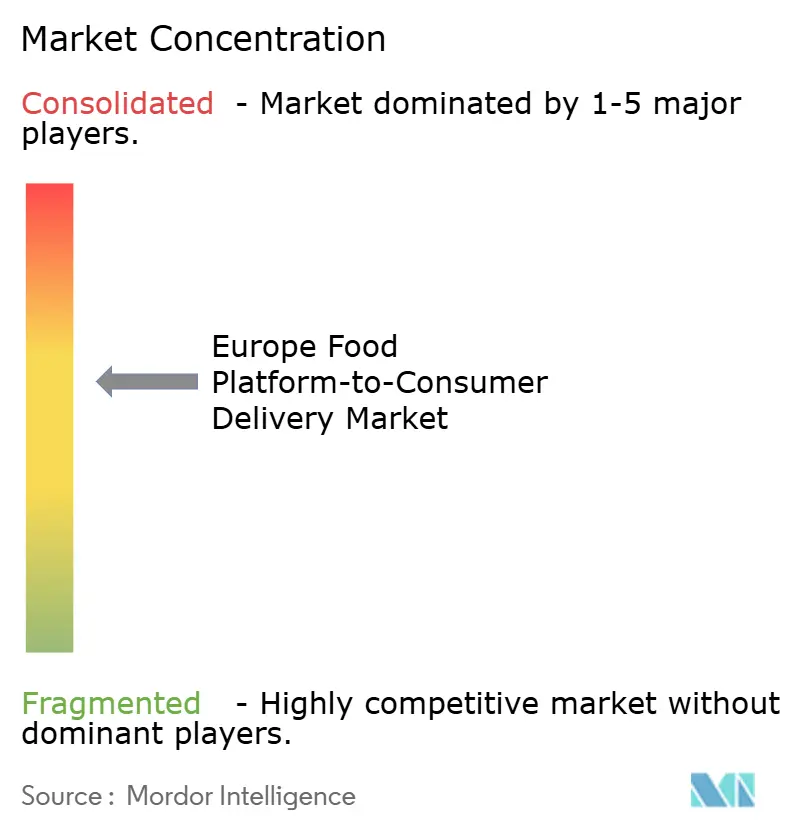
| Market Concentration | Medium |
Major Players *Disclaimer: Major Players sorted in no particular order Image © Mordor Intelligence. Reuse requires attribution under CC BY 4.0. | |
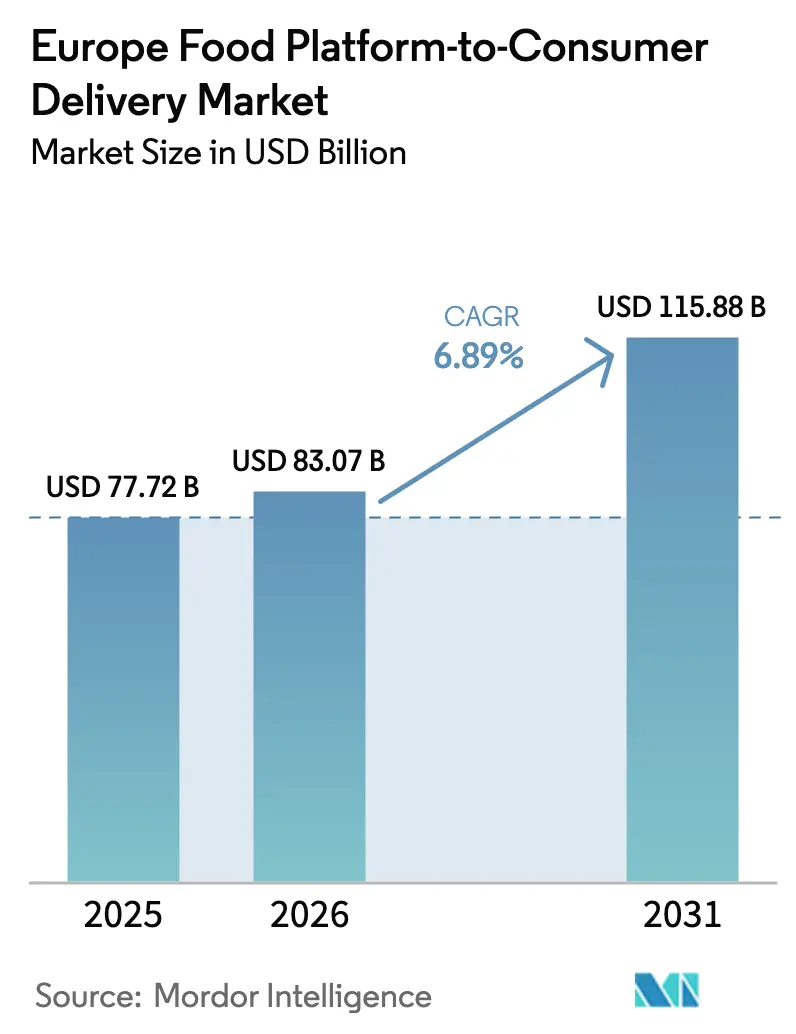
Europe Food Platform-to-Consumer Delivery Market Analysis by Mordor Intelligence
The Europe food platform-to-consumer delivery market size was valued at USD 77.72 billion in 2025 and estimated to grow from USD 83.07 billion in 2026 to reach USD 115.88 billion by 2031, at a CAGR of 6.89% during the forecast period (2026-2031). Demand is shifting from pure convenience toward a seamless digital food ecosystem in which platforms serve as the primary interface between consumers and restaurants, grocers and specialty stores. Mobile-first ordering already captures 90% of transactions, while AI-driven personalization and dynamic menu pricing lift conversion rates and average basket sizes during peak periods. Rapid subscription uptake, hyperlocal fulfilment hubs and growing grocery quick-commerce broaden revenue streams, whereas EU sustainability mandates accelerate electrification of last-mile fleets and encourage investment in micro-hubs that shorten delivery distances by up to 65%. Intensifying regulation of labour practices, however, continues to elevate courier acquisition costs, making route-density and automation critical to protecting operating margins
Key Report Takeaways
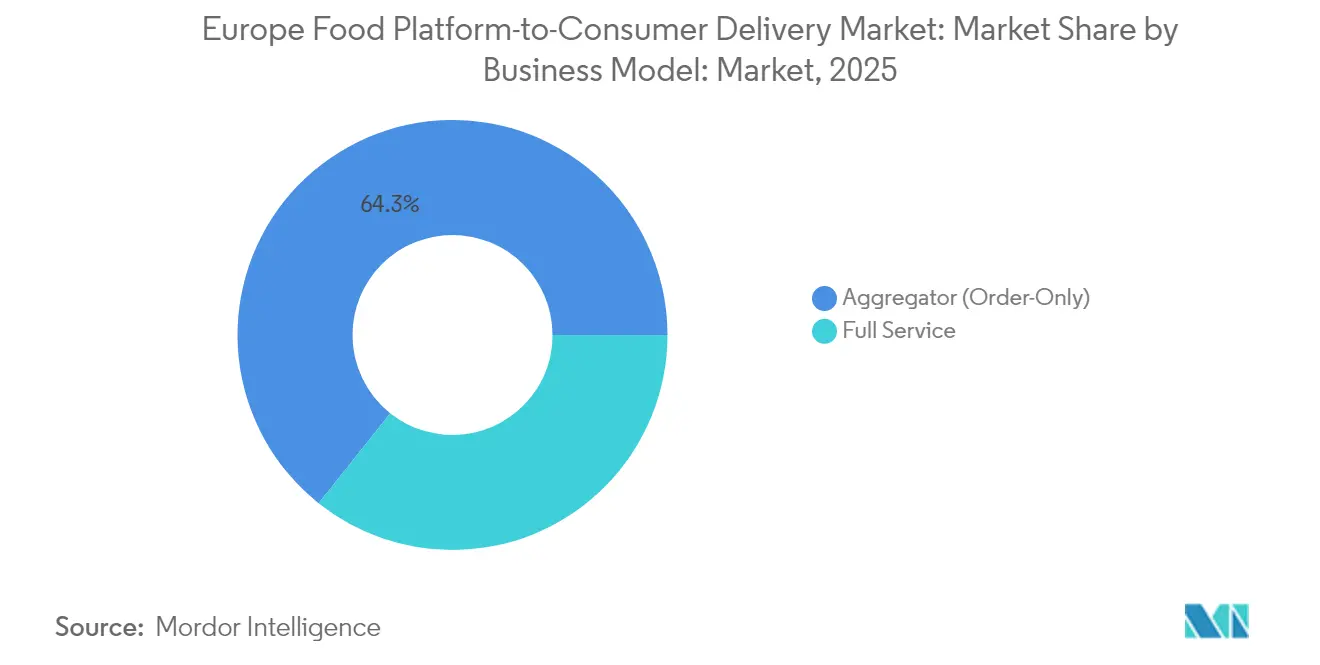
- By business model, Aggregators led with 64.30% of Europe food platform-to-consumer delivery market share in 2025, while Full-Service platforms are forecast to expand at a 8.55% CAGR to 2031.
- By device, mobile applications accounted for 89.20% share of the Europe food platform-to-consumer delivery market size in 2025 and are growing at an 7.9% CAGR through 2031.
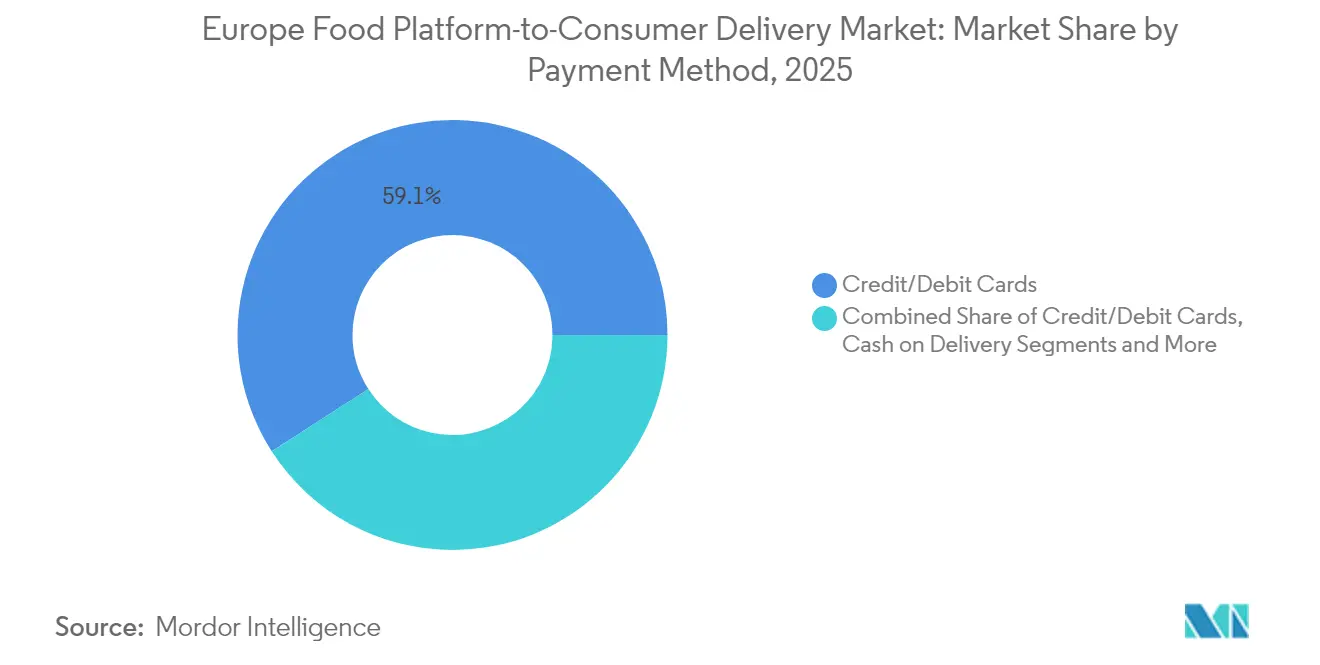
- By payment method, credit and debit cards held 59.10% revenue share in 2025; Digital Wallets and UPI record the fastest projected CAGR at 12.1% for 2026-2031.
- By type of delivery, Ready-to-Eat Meals commanded 44.30% share of the Europe food platform-to-consumer delivery market size in 2025, whereas the Groceries segment is advancing at a 14.6% CAGR.
- By geography, the United Kingdom generated 20.60% of market value in 2025; the Netherlands is poised for the fastest 9.15% CAGR through 2031.
Note: Market size and forecast figures in this report are generated using Mordor Intelligence’s proprietary estimation framework, updated with the latest available data and insights as of 2026.
Market Trends and Insights
Drivers Impact Analysis of Europe Food Platform-to-Consumer Delivery Market*
| Driver | (~) % Impact on CAGR Forecast | Geographic Relevance | Impact Timeline |
|---|---|---|---|
| Hyperlocal fulfillment centres accelerating delivery speed across Tier-1 European cities | +1.8% | UK, Germany, France, Netherlands | Medium term (2-4 years) |
| Rise of subscription-based "delivery club" models improving customer lifetime value | +1.2% | UK, France, Germany, Spain | Medium term (2-4 years) |
| Convergence of grocery quick-commerce with meal platforms in Western Europe | +2.1% | UK, Germany, France, Netherlands | Short term (≤ 2 years) |
| Regulatory support for low-emission urban logistics (e-bikes & e-scooters) | +0.7% | Netherlands, Germany, France, Spain | Long term (≥ 4 years) |
| Integration of real-time data & AI for dynamic menu pricing | +0.9% | UK, Germany, France | Medium term (2-4 years) |
| Millennial dual-income households' preference for convenience dining | +0.4% | Pan-European | Long term (≥ 4 years) |
| Source: Mordor Intelligence | |||
Hyperlocal Fulfilment Centres Accelerating Delivery Speed
Micro-hubs positioned within 2-3 km of dense neighbourhoods enable consistent sub-20-minute service, boosting repeat orders and lowering last-mile costs across the Europe food platform-to-consumer delivery market. Paris alone handles more than 300,000 daily deliveries, and these hubs now complete 78% of drops with electric bikes or cargo trikes, aligning with zero-emission goals. [1]Urbact Secretariat, “Making Every Step Count: Last-Mile Logistics For City Centres,” Urbact, November 04, 2024, urbact.eu. AI-powered demand forecasting improves inventory turn, trims waste and raises courier utilisation, reinforcing profitability.
Subscription-Based Delivery Models Enhancing Loyalty
Delivery-club subscriptions have reached penetration of 15-20% among active users in mature markets and drive 2.7-fold higher ordering frequency than non-subscribers. The predictable revenue stream shields platforms from volatility in average order value while granular usage data deepens personalisation. Millennial and Gen Z households exhibit the highest adoption, indicating further runway as these cohorts’ disposable income rises.
Grocery Quick-Commerce Convergence With Meal Platforms
Platforms extending into 30-minute grocery drops unlock 22% higher average baskets, offsetting lower commission rates. Dark stores dedicated to rapid picking underpin service-level reliability, while cross-selling of top-up baskets into evening meal windows smooths courier utilisation. Partnerships such as Uber Eats with Getir underscore the strategic value of integrated stock management as grocery orders trend toward surpassing meal orders in several Western European capitals by 2028.
Low-Emission Urban Logistics Regulatory Support
EU directives on clean mobility accelerate capital expenditure into electric vehicles and e-bikes that achieve 15-20% lower total cost of ownership over three years.[2]Polis Network, “Zero-Emission Zones For Freight: How-To Guide,” Polis Network, December 15, 2020, polisnetwork.eu. Cities including Rotterdam plan freight zero-emission zones by 2025, granting preferential access to compliant fleets; early movers therefore secure route-density advantages. Sustainable Urban Logistics Plans formalised under the European Commission framework push platforms to share data and invest in consolidated micro-depots, embedding environmental compliance as a competitive differentiator.
Restraints Impact Analysis of Europe Food Platform-to-Consumer Delivery Market*
| Restraint | (~) % Impact on CAGR Forecast | Geographic Relevance | Impact Timeline |
|---|---|---|---|
| Rising courier acquisition costs amid tighter EU labour rules | -1.2% | Spain, France, Italy, Germany | Medium term (2-4 years) |
| Declining average order value as consumers trade down to discount grocers | -0.9% | Pan-European, especially UK, Germany | Short term (≤ 2 years) |
| Restaurant margin push-back reducing allowable platform commission rates | -0.7% | France, Italy, Spain | Medium term (2-4 years) |
| Stringent GDPR / Digital Markets Act limits on personalised upselling | -0.5% | Pan-European | Medium term (2-4 years) |
| Source: Mordor Intelligence | |||
Rising Courier Acquisition Costs Amid Tighter Regulations
The EU directive classifying gig workers as employees raises fixed labour costs, social security contributions and administrative overheads. Spain’s employee model increased operating expense by about 20% for major platforms, and Delivery Hero warned of a EUR 100 million (USD 109 million) EBITDA hit. Heightened cost pressures incentivise automation in dispatch, heavier shift scheduling and industry consolidation as smaller operators exit.
Declining Average Order Value Amid Economic Pressures
Inflation and wage stagnation spur consumers to trade down, evidenced by a 15-20% rise in single-meal receipts and heightened sensitivity to delivery fees. Price-comparison behaviours intensify discount wars, compressing commission margins and prompting platforms to pivot performance metrics toward frequency and subscriber growth over basket size. Diversification into advertising and data monetisation helps offset margin compression.
*Our forecasts treat driver/restraint impacts as directional, not additive. The impact forecasts reflect baseline growth, mix effects, and variable interactions.
Europe Food Platform-to-Consumer Delivery Market Segment Analysis
By Business Model:
Aggregators Offset By Full-Service MomentumThe Europe food platform-to-consumer delivery market size attributed to Aggregators stood at 64.30% in 2025. However, the Full-Service model’s 8.55% CAGR is narrowing the gap as integrated logistics allow stricter control of customer experience. Urban density in Paris, Berlin and London favours Full-Service economics, while Aggregators retain advantage in suburban zones. Hybrid strategies that combine marketplace breadth with proprietary fleets are blurring traditional boundaries.



By Device:
Mobile Applications Consolidate User Interface PowerMobile apps captured 89.20% of orders in 2025 and will compound at an 7.9% CAGR. Geolocation, biometric authentication and push notifications create frictionless journeys, raising conversion and retention metrics. Desktop interfaces still serve corporate and group orders, yet incremental AI capabilities such as voice ordering favour mobile environments where average basket sizes rose 12-18%.
By Payment Method:
Digital Wallets Lead Transaction InnovationCredit and debit cards supplied 59.10% of spend in 2025; Digital Wallets and UPI, however, are outpacing at a 12.1% CAGR. Local solutions like iDEAL in the Netherlands and BLIK in Poland complement global wallets, supporting region-specific trust and regulation. Cash-on-delivery recedes but persists in parts of Southern and Eastern Europe, sustaining operational complexity.
By Type of Food Delivery:
Groceries Surpass Prepared Meals GrowthReady-to-Eat Meals retained a 44.30% share in 2025; groceries are expected to climb 14.6% annually, doubling the wider Europe food platform-to-consumer delivery market growth pace. Higher basket values and cross-meal order frequency position groceries as a strategic expansion vector, while adjacent categories optimise courier utilisation during off-peak periods.
Geography Analysis
Broader European Markets
The United Kingdom contributed 20.60% of 2025 revenue. DoorDash’s USD 3.86 billion purchase of Deliveroo in May 2025 consolidated share and scaled innovations such as drone pilots. Germany ranked second at 17.60% share, underpinned by the EU’s largest food-and-beverage sector worth USD 128.7 billion in 2023. Strong environmental regulations encourage electric-fleet deployment, and subscription adoption outperforms the European average. The Netherlands, projected to post a 9.15% CAGR to 2031, benefits from compact city layouts conducive to 20-minute drops and forthcoming zero-emission freight zones.
Regulatory Landscape
The regulatory environment for platform-to-consumer food delivery in Europe is shaped by EU-wide governance and member-state implementation requirements. The Digital Services Act (Regulation (EU) 2022/2065) applies to online intermediation services used by food delivery apps, driving trader and merchant identification, complaint handling, and transparency reporting across marketplace partners.
Labor and tax policy changes add operational complexity at member-state level. Directive (EU) 2024/2831 on improving working conditions in platform work introduces a rebuttable presumption of employment and requires transposition by December 2, 2026, pushing platforms to adapt rider models and algorithmic management practices. The VAT in the Digital Age (ViDA) package, adopted on March 11, 2025 with phased rollout through 2035, signals deeper administrative obligations for platforms as the EU updates VAT rules for digitally facilitated services.
Value Chain Analysis
The value chain begins with restaurants, dark kitchens, grocers, and specialty retailers onboarding to platforms, followed by menu and catalog management, pricing and promotions, and payment processing inside the app where mobile ordering dominates. Order orchestration and dispatch link to last-mile execution using contracted couriers, in-house fleets, and micro-hubs or dark stores for fast grocery picking; customer service, refunds, and reputation management close the loop, while advertising and sponsored listings monetize merchant visibility.
Scale and compliance capabilities are becoming core value-chain assets, alongside route density and fleet utilization. Consolidation is reshaping how platforms negotiate with merchants and couriers and how they fund logistics infrastructure, highlighted by Uber signing a business combination agreement in July 2026 to acquire Delivery Hero, and Delivery Hero agreeing to divest operations in 14 overlapping markets to SSW Partners as part of the transaction structure. Regulatory classification questions also influence downstream operating requirements, as seen in the November 2025 referral in Case C-762/25 (Foodinho Srl v AGCOM) to the Court of Justice of the European Union on whether food delivery services should fall under postal services rules, a potential hinge point for licensing and service obligations in specific markets.
Competitive Landscape
Approximately 65% of sales accrue to the top five operators, signalling moderate concentration. DoorDash-Deliveroo and Prosus-Just Eat Takeaway combinations demonstrate the premium on scale, while Delivery Hero’s brand merger streamlines overlapping assets.[3]Delivery Hero, “Delivery Hero Merges Its Foodora, Yemeksepeti And Foodpanda Business Teams,” Delivery Hero, July 31, 2024, deliveryhero.com. Technology leadership—especially AI-driven dispatch and dynamic pricing—remains the decisive differentiator as platforms seek 15-20% efficiency gains.
Europe Food Platform-to-Consumer Delivery Industry Leaders
Just Eat
Foodhub Limited
Uber Technologies Inc. (Uber Eats)
Delivery Hero SE
Deliveroo plc
- *Disclaimer: Major Players sorted in no particular order
Europe Food Platform-to-Consumer Delivery Market Companies Covered in this Report
- Deliveroo plc
- Just Eat Takeaway.com N.V.
- Uber Technologies Inc. (Uber Eats)
- DoorDash Inc.
- Delivery Hero SE
- Glovoapp23, S.L.
- Wolt Enterprises Oy
- Bolt Technology OÜ (Bolt Food)
- Foodhub Limited
- Foodpanda GmbH
- Delivery Club LLC
- Getir Perakende Lojistik A.Ş.
- Gorillas Technologies GmbH
- GoBrands Inc. (Gopuff)
- JustKitchen Holdings Corp.
- Stuart Delivery Ltd.
- Yandex LLC (Yandex.Eats)
- Rebel Foods Services UK Ltd.
- Frichti SAS
- Smood SA
Read Analysis of Europe Food Platform-to-Consumer Delivery Companies

Market Opportunities and Future Outlook
A near-term opportunity exists in compliance-led differentiation as EU rules tighten on platform governance and work arrangements. The Digital Services Act drives stronger merchant verification and transparency, and the December 2, 2026 transposition deadline for Directive (EU) 2024/2831 on platform work creates whitespace for operators that can deploy country-specific labor models, scheduling, and rider support without compromising service levels. This compliance push also reinforces demand for standardized APIs and auditable data flows across onboarding, catalog, payments, and dispatch as platforms coordinate merchants, couriers, and customer service at scale.
Consolidation and multi-vertical operations provide another opportunity to reconfigure unit economics through denser networks and broader order mix. In July 2026, Uber and Delivery Hero announced a business combination agreement (paired with Delivery Hero planning to sell operations in 14 overlapping markets to SSW Partners), underscoring a strategic emphasis on scale, overlapping logistics capabilities, and cross-platform engagement between delivery and mobility. At the category level, the market context shows momentum in rapid grocery delivery, where dark-store and micro-hub models lift basket size and smooth courier utilization across dayparts, creating room for platforms to expand assortment, subscriptions, and merchant advertising while navigating tighter rules on personalization under GDPR and the Digital Markets Act.
Recent Industry Developments in Europe Food Platform-to-Consumer Delivery Market
- July 2026: Uber entered into a business combination agreement to acquire Delivery Hero in an all-cash offer of EUR 41.50 per share, valuing the equity at about EUR 13.0 billion. The announcement signaled accelerated consolidation across European food delivery platforms and a push to combine delivery and mobility scale under one operator. The proposed transaction also highlights how large players are structuring deals to address overlap and regulatory scrutiny.
- October 2025: Foodhub relocated its global headquarters to Dublin, Ireland and announced expansion of European operations through new regional offices to support technology, sales, and customer service.
- July 2024: Delivery Hero merged business teams across Foodora, Yemeksepeti, and Foodpanda to streamline overlapping operations.


Europe Food Platform-to-Consumer Delivery Market Report Scope and Research Methodology
Market Definition and Coverage
This market covers the value of online, platform-to-consumer food delivery across Europe where a digital platform takes the order and delivery is fulfilled to the end customer, typically for prepared meals from partner restaurants.
Scope exclusions: We exclude telephone orders, unpacked food intended for immediate consumption, and non-processed or non-prepared food.
Segments Covered in This Report
- By Business Model
- Aggregator
- Full Service
- By Device
- Mobile Applications
- Desktop / Web
- By Payment Method
- Digital Wallets and UPI
- Credit/Debit Cards
- Cash on Delivery (COD)
- By Type of Food Delivery
- Ready-to-Eat Meals
- Cooked-to-Order Meals
- Groceries
- Other Type of Food Deliveries
- By Country
- United Kingdom
- Germany
- France
- Italy
- Spain
- Netherlands
- Rest of Europe
Data Sources, Market Sizing, and Validation
Desk Research
Desk work starts with mapping the addressable demand and the operating rules across Europe, then aligning definitions so like is compared with like. We refer to public statistics and policy sources such as Eurostat, the European Commission, national statistical offices, and central bank releases to understand consumption, inflation, and digital commerce patterns that influence order values.
To ground the supply side, we also review company annual reports, investor presentations, and reputable business press, which helps us track platform expansion, delivery economics, and reported regional revenue signals. Where available, we use paid subscriptions for company financials and intelligence, news and financials, and a patent database to check technology direction and competitive moves, without relying on a single source. These sources are used to set starting assumptions and to flag areas that require direct validation, and this list is not exhaustive since many other references were used for data collection, cross-checks, and clarification.
Primary Interviews and Surveys
Primary work is used to pressure-test what we see in public data, especially around how platform commission rates, delivery fee structures, and consumer frequency vary by country and city density. We spoke with a mix of platform operators, restaurant partners, and logistics stakeholders, and we balanced views across major European markets so that extreme cases do not drive the final totals.
Distribution of primary research fieldwork respondents
| Company type | Respondent position |
|---|---|
| Top tier: 37% | CXOs: 13% |
| Mid tier: 48% | Functional/Unit leaders: 30% |
| Smaller Players: 15% | Managers: 57% |
Market-Sizing & Forecasting
Our sizing logic uses a top-down build that starts from country-level online ordering activity and then reconstructs platform-to-consumer revenue through verified take-rate and fee components, before it is summed to the Europe total. The totals are then corroborated with selective bottom-up checks, such as sampling average order value times estimated order frequency for key countries and comparing it with supplier and channel signals.
A few practical inputs that shape the model include average order value trends, order frequency per active user, platform commission and delivery fee structures, rider availability and utilization patterns, and food inflation that shifts basket size in local currency. We also track the share of mobile ordering and the mix shift between restaurant meals and adjacent offerings, since these can inflate numbers if boundaries are not kept tight. For forecasting, scenario analysis is used because regulation, labor costs, and promotional intensity can change quickly by country, and then expert views are applied to keep assumptions realistic. When bottom-up indicators are sparse for smaller markets, we fill gaps using peer-country proxies based on income levels, urbanization, and digital adoption, and then re-check the outputs with interview feedback.
Data Validation & Update Cycle
Validation is done through multiple rounds of cross-checks so we do not rely on one calculation path. We compare model outputs with independent signals like reported platform regional revenue cues, macro consumption direction, and pricing inflation, then anomalies are reviewed until the variance is explainable.
Before sign-off, a second analyst reviews the assumptions and the math flow, and we re-contact sources when a key input (like fee structure or delivery cost pass-through) looks inconsistent across countries. Reports are refreshed annually, and interim updates are made when major events materially change market behavior. Right before delivery, we complete a final pass so clients receive the latest updated view.
Mordor Intelligence's Europe Food Platform to Consumer Delivery Market Estimate Compared With Other Published Estimates
Published market sizes can differ even when they sound like they cover the same topic, because service boundaries, included revenue lines, and base-year choices are not always aligned. Differences also show up when one study uses aggressive adoption curves or mixes restaurant delivery with broader food e-commerce categories.
By tracking commission and fee components and refreshing currency and inflation inputs for each major country, Mordor Intelligence keeps the 2025 total tied to prepared-meal, platform-to-consumer transactions and avoids pulling in non-prepared food or offline ordering activity that can inflate the number.
Benchmark comparison
| Source | Market Size | Gaps in Research Methodology |
|---|---|---|
| Mordor Intelligence | USD 77.72 B (2025) | |
| Trade Journal A | USD 62.59 B (2032) | Uses a different base year and forecast window and is commonly framed as a broader online food delivery revenue pool, which can blend platform delivery with adjacent models and narrower country coverage. |
| Regional Consultancy B | USD 31.24 B (2024) | Often reflects a narrower definition anchored to app-based ordering revenue, with less transparent treatment of service fees and commission pass-through, which tends to undercount the full platform-to-consumer monetization stream. |
The spread across sources mostly comes from boundary choices, timing, and how revenue components are counted. When the scope is kept to prepared meals delivered via platforms, and inputs like fees, commissions, and inflation are updated country by country, the resulting market size becomes easier to replicate and explain in a decision process.


Key Questions Answered in the Report
What is the expected value of the Europe food platform-to-consumer delivery market by 2031?
The market is forecast to reach USD 115.88 billion in 2031, growing at a 6.89% CAGR from 2026.
Which segment is expanding fastest within the market?
Grocery quick-commerce leads with a 14.6% CAGR for 2026-2031, outpacing restaurant meal delivery.
How large is the UK’s share of the market?
The United Kingdom generated 20.60% of market revenue in 2025, making it the region’s largest national market.
Why are hyperlocal fulfilment centres important to market growth?
Micro-hubs reduce last-mile distances by up to 65% and enable consistent sub-20-minute delivery, improving customer satisfaction and repeat order rates.
What impact do EU labour regulations have on delivery platforms?
Reclassification of couriers as employees raises labour expenses by roughly 20% in affected markets, accelerating consolidation and investment in automation
Which payment methods are gaining popularity across the market?
Digital Wallets and UPI are the fastest-growing payment modes, projected to expand at a 12.1% CAGR, driven by tokenised security and one-click check-out experiences
Page last updated on:


 Your data is secure and never sold or shared.


