
Market Overview
| Study Period | 2020 - 2031 |
|---|---|
| Forecast Data Period | 2026 - 2031 |
| Base Year Market Size (2025) | USD 1.02 Billion |
| Market Size (2026) | USD 1.06 Billion |
| Market Size (2031) | USD 1.26 Billion |
| Growth Rate (2026 - 2031) | 3.53 % |
| Market Concentration | Medium |
Major Players *Disclaimer: Major Players sorted in no particular order Image © Mordor Intelligence. Reuse requires attribution under CC BY 4.0. | |
Europe Cosmetic And Perfumery Glass Bottle Packaging Market Analysis by Mordor Intelligence
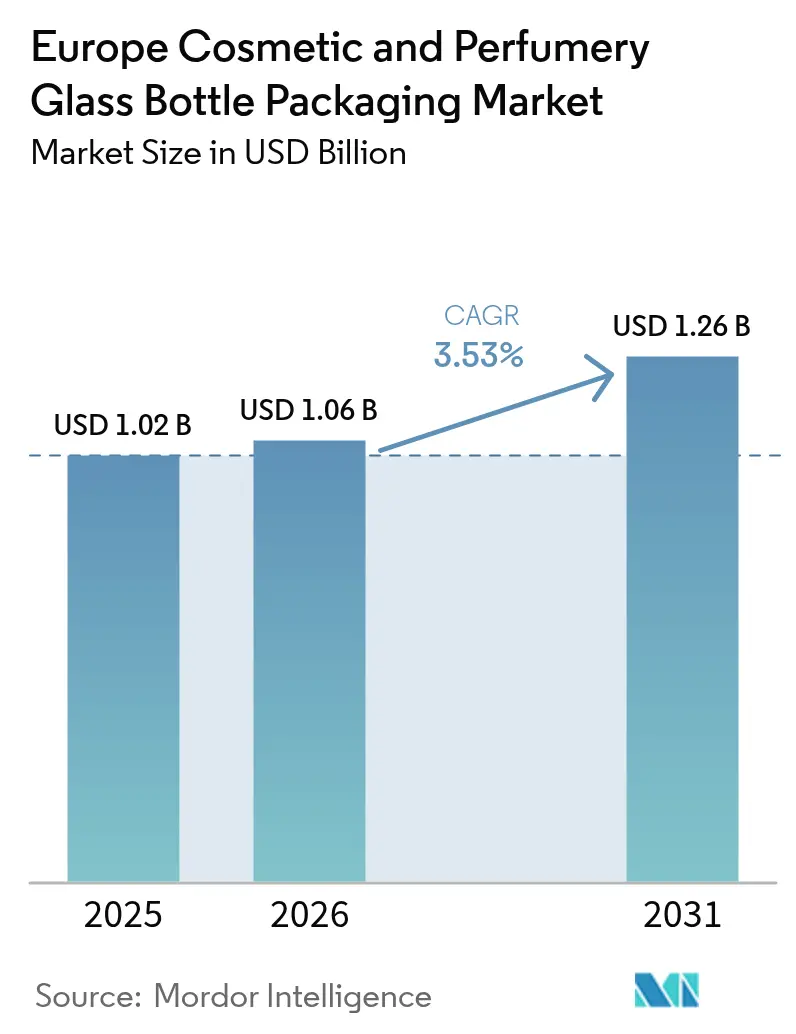
The Europe cosmetic and perfumery glass bottle packaging market size was valued at USD 1.02 billion in 2025 and estimated to grow from USD 1.06 billion in 2026 to reach USD 1.26 billion by 2031, at a CAGR of 3.53% during the forecast period (2026-2031). This moderate headline growth masks a shift toward high-PCR compositions, furnace electrification, and refillable formats, which are reshaping capital spending, supplier selection, and bottle design. Luxury houses are incorporating minimum recycled-glass thresholds into their specifications, while specialty converters are installing hybrid methane-electric furnaces that promise double-digit gas savings but require multimillion-euro investments. Cost inflation is therefore migrating from energy to equipment, and producers able to amortize these investments across food, spirits, and pharmaceutical lines are better positioned to defend margins. At the same time, niche beauty labels are utilizing stock amber vials and digital decoration to compete on sustainability narratives, rather than relying on bespoke molds, thereby enlarging the addressable customer base for mid-size converters.
Key Report Takeaways
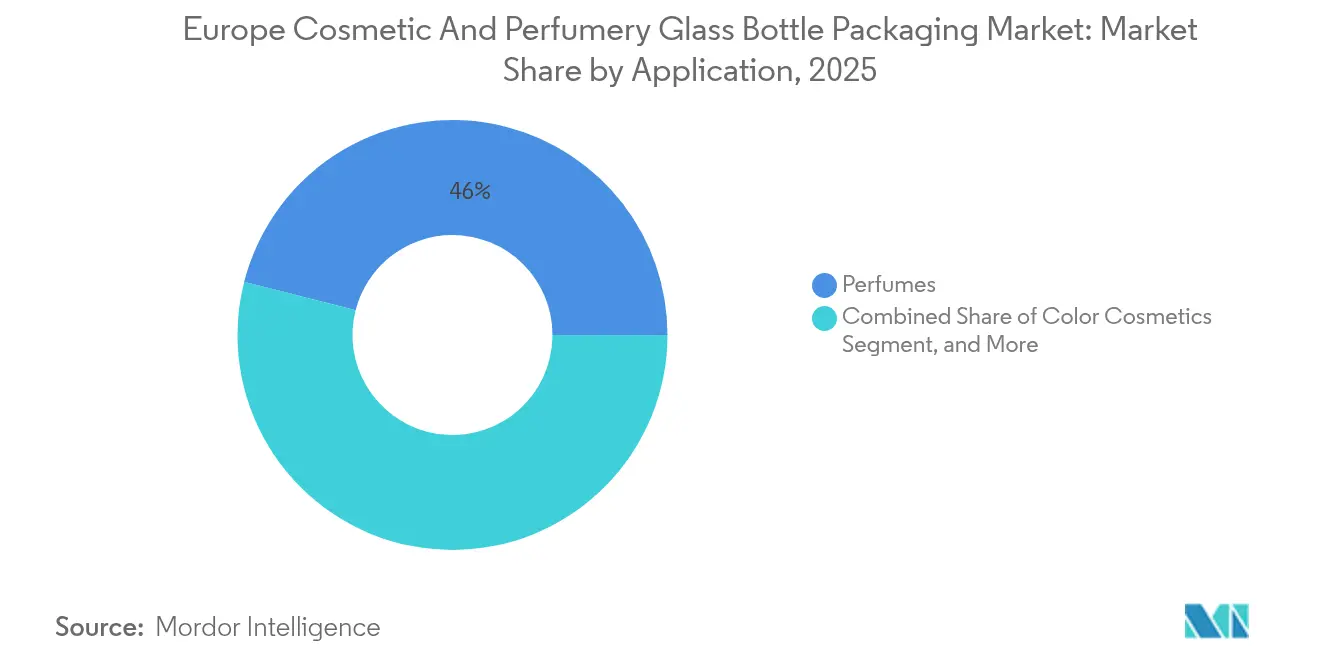
- By application, perfumes led the Europe cosmetic and perfumery glass bottle packaging market with a 46.02% share in 2025; skin care is expected to expand at a 4.56% CAGR through 2031.
- By capacity, the 50-100 ml segment captured 42.10% of the Europe cosmetic and perfumery glass bottle packaging market share in 2025, while the 100-150 ml segment is forecast to post the fastest growth, with a 5.49% CAGR through 2031.
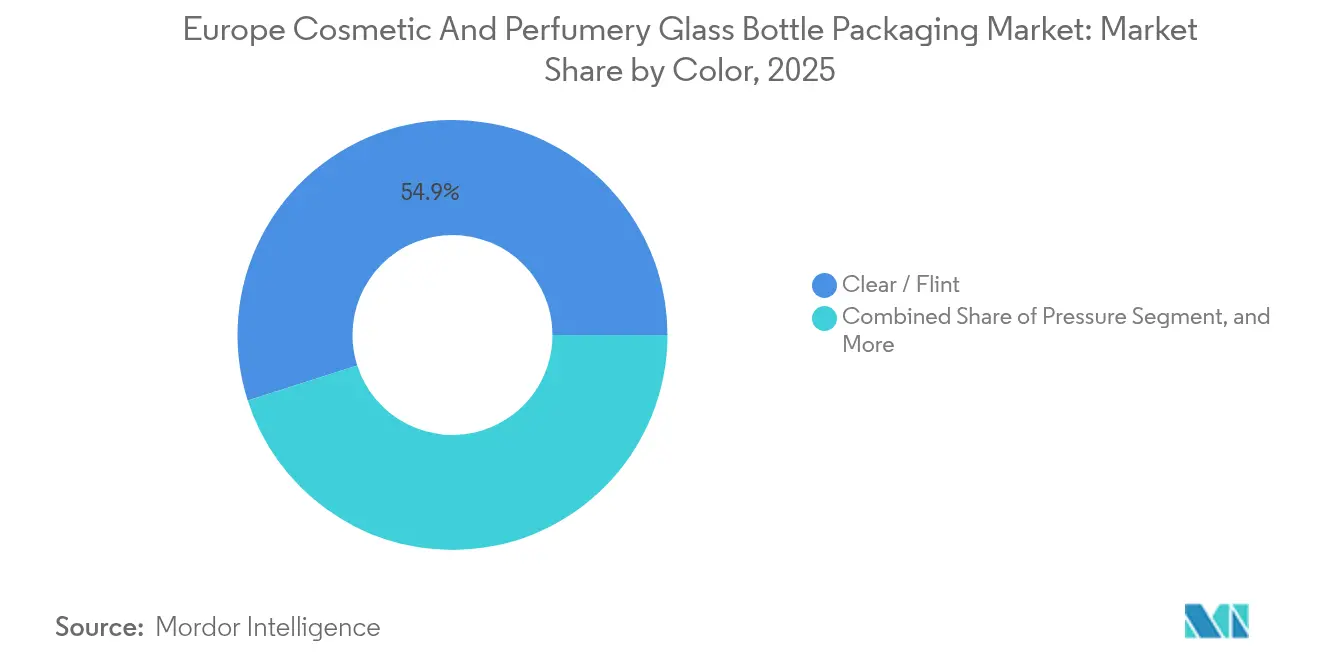
- By color, clear glass accounted for 54.92% of the Europe cosmetic and perfumery glass bottle packaging market share in 2025; amber glass is projected to advance at a 4.81% CAGR over 2026-2031.
- By end-user, luxury brands retained 47.70% of the Europe cosmetic and perfumery glass bottle packaging market share in 2025; indie and private-label brands are set to grow at a 5.17% CAGR to 2031.
- By country, Germany dominated the Europe cosmetic and perfumery glass bottle packaging market with a 22.35% share in 2025, whereas Spain is poised to achieve the highest 5.86% CAGR through 2031.
Note: Market size and forecast figures in this report are generated using Mordor Intelligence’s proprietary estimation framework, updated with the latest available data and insights as of 2026.
Market Trends and Insights
Drivers Impact Analysis of Europe Cosmetic And Perfumery Glass Bottle Packaging Market*
| Driver | (~) % Impact on CAGR Forecast | Geographic Relevance | Impact Timeline |
|---|---|---|---|
| Rising Demand for Dropper Bottles | +0.6% | Germany, France, Benelux (serum-intensive markets) | Medium term (2-4 years) |
| Increased Emphasis on Packaging for Product Differentiation | +0.5% | Global, with premium concentration in France, UK, Italy | Long term (≥ 4 years) |
| Premiumization of European Fragrance and Skin Care Segments | +0.8% | France, Germany, UK, Italy (luxury hubs) | Long term (≥ 4 years) |
| EU Packaging and Packaging Waste Regulation Accelerating High-PCR Glass Adoption | +0.9% | EU-27 (regulatory mandate) | Short term (≤ 2 years) |
| Expansion of Refillable and Returnable Glass Systems Across Luxury Beauty | +0.5% | France, Germany, Benelux (early-adopter luxury brands) | Medium term (2-4 years) |
| Automation Investments Driven by Skilled-Glassmaker Shortages | +0.3% | Germany, Italy, France (high-wage manufacturing hubs) | Medium term (2-4 years) |
| Source: Mordor Intelligence | |||
Rising Demand for Dropper Bottles
Formulators seeking high-potency serums are championing glass droppers because the format signals precision dosing, enhances perceived efficacy, and commands price premiums of 15-25% over screw-cap bottles.[1] Virospack’s 2024 rollout of tubular vials with Blowback and Antirotation patents underscores that dimensional repeatability, not furnace output, is the gating factor, nudging converters to co-engineer neck finishes with closure suppliers. As the Europe cosmetic and perfumery glass bottle packaging market deepens its focus on actives, bottles below 50ml are capturing new formulations that rely on dropper caps to meter retinol, niacinamide, and microbiome cultures. German and Dutch fillers, many operating at pharmaceutical-grade clean-room standards, are exploiting their QC credentials to win turnkey contracts from clinical-beauty startups that lack in-house filling lines. The net result is a shift toward small-batch, high-margin orders that reward converters with rapid changeover capability and digitally enabled decoration.
Increased Emphasis on Packaging for Product Differentiation
Luxury and premium mass labels alike are upgrading their decorations to convey exclusivity while preserving recyclability. Bormioli Luigi opened a vacuum sputtering unit in 2024 that metallizes entire bottles without lacquers, allowing converters to keep the container in the clear-glass recycling stream.[2] Baralan then introduced 3D relief technology in 2025, embedding raised logos directly in the mold so that tactile branding replaces secondary labels. These capabilities accelerate time to market because decoration is integral, not post-process, reducing cycle times for limited runs that indie brands demand. Converters that can bundle design, molding, and decoration are therefore capturing a higher wallet share, a trend visible in France and Italy, where integrated glassworks can deliver full-service prototypes in under eight weeks. The Europe cosmetic and perfumery glass bottle packaging market is benefiting as brand managers allocate incremental budget from digital advertising back toward physical differentiation, reviving value growth even as unit sales flatten.
Premiumization of European Fragrance and Skin Care Segments
Fragrances priced above EUR 100 (USD 109) per 75ml are growing faster than the total fragrance market, and the aesthetic of heavy, thick-walled flint glass remains central to the perceived luxury.[3] Verescence, which supplies LVMH, Puig, and L’Oréal, produces over 600 million bottles annually and operates five dedicated decoration plants, demonstrating how production scale and artistry coexist in the top tier. In skin care, premium jars weighing 150-200g are replacing plastic in the EUR 50-plus bracket because consumers associate glass with product purity and inertness. German specialty retailers report that facial serums in amber glass outsell those in plastic droppers by double-digit margins, despite higher shelf prices. Private-equity interest reinforces the momentum that the 2025 sale of Verescence to a Movendo Capital-led consortium signals, indicating that investors see headroom in premium glass, rather than commoditized beverage grades. The Europe cosmetic and perfumery glass bottle packaging market, therefore, skews toward value per tonne, not volume, insulating converters from the cyclical lows seen in mass beverages.
EU PPWR Accelerating High-PCR Glass Adoption
Regulation (EU) 2023/1545 mandates tiered recycled-content thresholds, encouraging cosmetic brands to adopt verified PCR supply. Each 10% PCR increment reduces CO₂ emissions roughly 5%, aligning with corporate net-zero pledges. Verescence’s Infini 20 and Infini 40 lines already exceed the regulation and recorded a 77% PCR integration in 2023, positioning the firm as the supplier of choice for brands seeking scope 3 carbon reductions. Yet PCR introduces color tints and defect risk, so converters are installing optical-sorting cullet systems and investing in advanced forehearth controls to stabilize melt. In Spain and France, regional governments co-fund cullet-processing centers, thereby reducing the length of reverse logistics loops and increasing bottle-to-bottle yields. The Europe cosmetic and perfumery glass bottle packaging market is thus moving toward closed-loop procurement contracts where brand, filler, and converter share PCR-quality KPIs.
Restraints Impact Analysis of Europe Cosmetic And Perfumery Glass Bottle Packaging Market*
| Restraint | (~) % Impact on CAGR Forecast | Geographic Relevance | Impact Timeline |
|---|---|---|---|
| Growth of Plastic Packaging as a Substitute for Glass Bottles | -0.4% | Mass-market segments across Europe (price-sensitive retail) | Medium term (2-4 years) |
| High Energy Costs and Carbon Footprint of Glass Production | -0.6% | Germany, Italy, France (energy-intensive manufacturing) | Short term (≤ 2 years) |
| Freight-Surcharges for E-commerce Fragile Goods | -0.2% | UK, Germany, Benelux (high e-commerce penetration) | Short term (≤ 2 years) |
| Soda-Ash Supply Volatility Disrupting Furnace Scheduling | -0.3% | EU-27 (import-dependent supply chains) | Medium term (2-4 years) |
| Source: Mordor Intelligence | |||
Growth of Plastic Packaging as a Substitute for Glass Bottles
Below EUR 20 price points, PET and monomaterial PP are eroding glass's share because freight, breakage, and dangerous-goods surcharges add 25-40% to the cost during e-commerce fulfillment. Quadpack’s 2025 Lola PET jar targets this sensitivity by offering a single-polymer pack that sidesteps glass weight penalties. DHL’s cosmetics sector guide highlights that alcohol-rich perfumes in glass face hazmat classification, raising compliance overhead for small web merchants. However, the EU’s 2027 microplastics ban will prohibit certain plastic additives, aluminum, and bio-PET, and offer medium-term relief for cost-driven brands. Converters respond by lightweighting flint bottles, but acceptance varies: mass drugstores calculate total landed cost without assigning monetary value to sustainability claims, so glass loses out unless a supplier can prove parity on grams per dose.
High Energy Costs and Carbon Footprint of Glass Production
Furnace fuel remains the highest variable cost. Natural-gas prices, while below the 2022 spike, still average 50-70% above 2019 levels, and electricity remains volatile as nuclear shutdowns squeeze supply. O-I Glass invested EUR 95 million (USD 103 million) to install oxy-fuel-assisted furnaces in France, claiming 18% CO₂ cuts. Bormioli Luigi’s 2024 hybrid furnace, co-funded by the EU Innovation Fund, mixes methane with electric boosting to trim gas usage by 30%. Financing these rebuilds is challenging against a 3.58% CAGR topline, so converters with diversified beverage or pharma exposure cross-subsidize cosmetics capacity. Meanwhile, contract terms index glass-price surcharges to the German Day-Ahead Power Price, directly passing energy volatility to brand customers and making packaging budgets harder to forecast.
*Our forecasts treat driver/restraint impacts as directional, not additive. The impact forecasts reflect baseline growth, mix effects, and variable interactions.
Europe Cosmetic And Perfumery Glass Bottle Packaging Market Segment Analysis
By Application:
Perfumes Anchor Value, Skin Care Unlocks Incremental GrowthPerfumes maintained a 46.02% share in 2025, underscoring the importance of scent preservation and brand storytelling, which rely on inert, fragrance-impermeable glass. EDP and extrait concentrations require thick-wall bottles to prevent evaporation and oxidation, and leading houses allocate up to 15% of ex-factory cost to primary packaging, well above the cosmetics average. Within Europe, flagship SKUs such as Lancôme La Vie Est Belle and Dior Sauvage each sell over 3 million units annually in flint bottles that act as quasi-collectibles. The Europe cosmetic and perfumery glass bottle packaging market benefits because refill pods use the same high-spec ratios to fit existing bottle geometries, embedding a base load of replacement demand.
Skin care, which accounts for only 33% of the volume, is expanding at a 4.56% CAGR as clinical-grade serums proliferate. Airless pumps built into glass barrels now meet ISO 15378 pharma-pack standards, letting cosmeceutical brands validate 36-month stability for retinoids and peptides. Dropper bottles account for nearly half of new skin-care treatment launches in France and the Netherlands, where dermocosmetics often capture dermatologist recommendations. Indie brands often prefer amber glass droppers under 30ml to reinforce apothecary cues and minimize UV degradation. In both strands, the Europe cosmetic and perfumery glass bottle packaging industry leverages pharmaceutical know-how, clean-room molding, EO sterilization, and tamper bands to upsell value-added services that plastic cannot match.

By Capacity:
Mid-Range Dominates, Large Formats AccelerateBottles between 50 ml and 100 ml held a 42.10% share of the Europe cosmetic and perfumery glass bottle packaging market in 2025, as they align with the portability of handbags and customs duty-free limits. The 75 ml size remains flagship for prestige fragrances, driving economies of scale in mold cavitation and carton sizes. Yet the 100-150 ml bracket will clock a 5.49% CAGR on the back of “value jar” night creams and premium body oils that justify pantry-size packs. Vetropack’s upcoming thermally hardened lightweight technology promises 30% lighter glass in that range without sacrificing drop resistance, a breakthrough that could unlock mass-premium adoption.
Formats under 30 ml thrive in booster concentrates and discovery sets, where lower fill volumes support retail pricing of EUR 1 per milliliter. However, for ampoules below 10 ml, plastic and aluminum blister sticks compete aggressively due to airline carry-on rules and the weight of secondary packaging. At the opposite extreme, formats exceeding 150 ml remain niche but are gaining traction in bath elixirs and spa oils sold through direct-to-consumer channels. These tend to use flint or coated black bottles to emphasize ritual and aesthetics, reinforcing the experiential pull that glass confers. For converters, the capacity mix dictates furnace scheduling: small formats demand narrow-neck press-and-blow, while jars require wide-mouth presses, so multi-IS lines rotate molds weekly to balance changeover losses with inventory risk.
By Color:
Clear Leads, Amber Gains MomentumClear or flint glass accounted for 54.92% of the 2025 volume, primarily because transparency showcases the hue of juice in fragrances and reveals texture gradients in skin creams. Decoration can then add color via internal lacquers or external metallization without sacrificing the base raw material. Yet amber glass is the fastest climber, with a 4.81% CAGR, because “clean beauty” and probiotic serums often tout UV protection and apothecary aesthetics. Notably, vitamin C serums degrade 50% slower in amber versus flint, according to supplier stability tests, allowing brands to extend shelf-life guarantees to 24 months.
Color segmentation also plays a role in refill systems, where translucent shells with inner PET cartridges allow consumers to monitor the fill level while the structural outer bottle remains pristine. Mixing cullet streams, however, complicates recycling as color impurities downgrade flint batches. Germany’s dual-stream system mandates color-sorted returns, providing its converters with superior cullet purity and thereby a cost advantage over flint melts. Southern markets with single-stream collection struggle to supply color-sorted PCR, forcing converters to import high-grade cullet at premium prices, a logistics cost now amplified by fuel surcharges.
By End-User:
Luxury Retains Scale, Indie Brands Deliver GrowthLuxury conglomerates, including LVMH, Estée Lauder, and Chanel, held a 47.70% share in 2025, deploying multi-year framework agreements that guarantee furnace utilization for suppliers such as Verescence and Stoelzle. These contracts often bundle exclusivity on mold ownership, preventing converters from reselling unused capacity, but provide long-run visibility essential for financing furnace rebuilds. Upmarket brands also demand ISO 50001 certification and full scope-3 carbon accounting, raising the barrier to entry for smaller glassworks.
Indie and private-label players are advancing at a 5.17% CAGR by using contract packers such as Quadpack and Lumson. Minimum order quantities of 5,000 units permit test-and-learn product drops without inventory obsolescence. Digital inkjet decoration supports a 10-day turnaround, crucial for social-commerce flash sales. While unit economics are lean, indie brands pay 30% more per bottle than their luxury peers; they offset this by leveraging direct-to-consumer margins and crowdfunding. For converters, the challenge is operational flexibility: short runs risk idle furnace time, so AI-driven batch planning tools schedule independent orders as fillers between luxury campaigns, maximizing tonnage per day.
Geography Analysis
Germany Cosmetic and Perfumery Glass Bottle Packaging Market
Germany contributed 22.35% of 2025 demand, driven by a USD 24.0 billion (EUR 22.0 billion) domestic beauty spend and a network of precision glassmakers concentrated in Bavaria and Thuringia. Gerresheimer’s Lohr am Main plant underwent a hybrid furnace retrofit, which reduced gas use by 15% and lowered CO₂ emissions by 40%, solidifying Germany’s position as a leading pilot for decarbonized melting on the continent. The market also benefits from pharmacy-channel dermocosmetics, where regulatory traceability favors glass over plastic. Germany’s dual-stream recycling system collects 85% of container glass, feeding high-quality cullet back into the cosmetic loop and lowering the effective cost per tonne.
Spain Cosmetic and Perfumery Glass Bottle Packaging Market
Spain, although with only 12% of the current volume, will post the region’s top 5.86% CAGR through 2031. A 5.30% expansion in domestic beauty spending, a USD 7.8 billion (EUR 7.2 billion) export engine, and Verescence’s La Granja investment are mutually reinforcing tailwinds. Catalonia’s government subsidizes cullet-processing plants, accelerating closed-loop PCR supply that aligns with EU PPWR. Spanish fragrance leader Puig channels local bottle supply into its brands and third-party fill contracts, anchoring furnace utilization. Tourism rebound fuels duty-free perfume traffic through Barcelona and Madrid airports, boosting demand for high-unit-value bottles.
France Cosmetic and Perfumery Glass Bottle Packaging Market
France remains the export powerhouse, with USD 25.4 billion (EUR 23.3 billion) in cosmetics shipments in 2024, sustaining a vast capacity in Normandy and the Loire Valley. The PFAS ban, effective January 2026, and allergen-label expansion in 2026 push formulators toward stable, inert containers, favoring thick-walled glass. Verescence, Pochet, and SGD Pharma share a deep understanding of decorative know-how, enabling French brands to iterate on bottle design without importing capacity. Meanwhile, state-backed green-loan schemes fund hybridization of legacy furnaces, closing the gap between sustainability ambition and capex constraints.
Broader European Markets
Italy and the United Kingdom round out the major blocs, each with mature yet premium-oriented spend. Italy’s Bormioli Luigi and Zignago Vetro lead the way in lightweight jars, while UK converters cater to heritage fragrance houses navigating post-Brexit border frictions. Benelux, although small, houses logistics hubs and Verescence’s decoration site in Belgium, which distributes amber serum bottles across Northern Europe overnight. Central and Eastern Europe exhibit pockets of 4-5% growth as rising incomes drive beauty spending; however, the glass supply there still imports molds and decorations from Western Europe, limiting local bottle diversity.
Regulatory Landscape
Cosmetic products placed on the EU market must comply with Regulation (EC) No 1223/2009, which governs safety and product information requirements that flow through to primary pack presentation and labelling, including fragrance allergen disclosures. A key near-term compliance milestone is the updated fragrance allergen labelling under Commission Regulation (EU) 2023/1545 (amending Annex III). The rule allows placing non-compliant products on the market until 31 July 2026 and making them available until 31 July 2028, tightening timelines for artwork changes and pack inventory run-downs across fragrance and skin care lines.
For packaging sustainability, the Packaging and Packaging Waste Regulation (PPWR), Regulation (EU) 2025/40, entered into force on 11 February 2025 and applies from 12 August 2026. It introduces EU-wide requirements on packaging minimization, labelling, and recyclability-by-design, with performance grading (A, B, C) and restrictions for packaging below grade C starting 1 January 2030. This pushes glass bottle suppliers and brand owners to document recyclability performance and reduce superfluous components while maintaining premium aesthetics.
Value Chain Analysis
The value chain starts with raw-material and cullet supply (silica, soda ash, limestone, and post-consumer recycled glass), followed by container-glass melting and forming (press-and-blow and narrow-neck processes), and then value-added steps such as annealing, inspection, and specialty decoration. In Europe, suppliers such as Verescence, Pochet, Stoelzle, and Zignago Vetro serve cosmetics and perfumery flacons, while downstream decoration and assembly incorporate silk-screening, hot stamping, lacquering/metallization, and integration with closures and dispensing systems (droppers, pumps, and airless solutions). These steps are often coordinated with brand-approved component vendors.
Distribution runs either directly from glassmakers to luxury houses and large fillers via framework agreements, or through packaging distributors and service partners that aggregate demand for indie/private-label brands and manage smaller lot sizes. The chain is increasingly shaped by PCR and circularity requirements, which add cullet qualification, optical sorting, and traceability steps upstream. Development cycles are also being compressed through co-located design and industrialization capabilities, including technical validation and decoration under one roof, which can reduce iteration time for new molds and decorated SKUs.
Competitive Landscape
Consolidation defines the Europe cosmetic and perfumery glass bottle packaging market. Gerresheimer’s EUR 800 million (USD 872 million) purchase of Bormioli Pharma in 2024 added nine plants and significant closure capacity, unlocking one-stop supply for jars, vials, and droppers. Verallia’s EUR 230 million (USD 251 million) acquisition of Vidrala’s Italian arm strengthened cross-category scalability, letting it shuttle molds between food and beauty orders. Private-equity capital poured in when Movendo Capital and Draycott acquired Verescence in 2025, signaling that investors value luxury-skewed portfolios insulated from fluctuations in beverage volume.
Strategically, players are focusing on three key levers: furnace hybridization, automation, and the design of refill systems. Stoelzle’s AI process control reduces scrap by 8%, resulting in a direct EBIT uplift as scrap melts consume unbillable energy. Bovone’s 7-axis robotic polishing reduces manual defects, elevating A-grade output critical for the clarity of fragrance flacons. On decarbonization, O-I’s oxy-fuel furnaces and Bormioli Luigi’s methane-electric hybrids set benchmarks that regulators may codify into best practices. Hemorrhaging skilled labor accelerates the adoption of robotics, with Vetropack’s automated Italian warehouse eliminating 3-5% of handling losses and enabling 24-hour dispatch windows.
White-space innovation lies in refillable architecture and advanced PCR formulations. Lumson’s Slim 50 ml jar features a twist-off cup, allowing only the inner pod to be replenished, which cuts the lifecycle glass mass by 60%. Techniplast’s RT-Lift technology enables vertical cartridge swaps without unscrewing entire assemblies, making it ideal for eye-cream jars where torque can induce stress cracks. Smaller disruptors that master these mechanics can punch above their weight by licensing IP to major brands. Industry certifications have become table stakes: ISO 9001 and 22716 guarantee cosmetics GMP, ISO 14001 attests to environmental governance, and the forthcoming ISO 23969 will govern PCR traceability, reinforcing the compliance moat for incumbents.
Europe Cosmetic And Perfumery Glass Bottle Packaging Industry Leaders
-
Verescence France SASU
-
Vitro S.A.B. de C.V.
-
Zignago Vetro SpA
-
Piramal Glass Private Limited
-
Pragati Glass Private Limited
- *Disclaimer: Major Players sorted in no particular order

Europe Cosmetic And Perfumery Glass Bottle Packaging Market Companies Covered in this Report
- Verescence France SASU
- Vitro S.A.B. de C.V.
- Zignago Vetro SpA
- Piramal Glass Private Limited
- Pragati Glass Private Limited
- Roma International PLC
- Saver Glass SAS
- SGB Packaging Group Inc.
- SKS Bottle and Packaging Inc.
- Stölzle-Oberglas GmbH
- APG Group BV (Verbeeck Packaging Group)
- Baralan International SpA
- Bormioli Luigi SpA
- Consol Glass (Pty) Ltd
- Continental Bottle Company Ltd
- Gerresheimer AG
- Heinz-Glas GmbH and Co. KGaA
- Lumson SpA
- Pochet du Courval SA
- Quadpack Industries SA
- Vidrala SA
Read Analysis of Europe Cosmetic And Perfumery Glass Bottle Packaging Companies
Market Opportunities and Future Outlook
PPWR (EU) 2025/40 applying from 12 August 2026 creates immediate whitespace in compliant pack redesign, particularly where brands must reduce packaging weight and volume and evidence recyclability performance grades across multi-component prestige packs. Glass bottle makers and decorators that can supply documented PCR content, tighter dimensional control for refill systems, and simpler, label-free decoration (for example, relief and in-mold branding) are closer to brand decision cycles as procurement shifts from unit price toward compliance, scope-3 accounting, and recyclability performance.
The opportunity set is reinforced by active industry programs and capex aimed at both recycled feedstock and lower-carbon melting. Cosmetics Europe partnered with Close the Glass Loop in July 2025 to support a 90% EU glass collection ambition by 2030, improving the availability and quality of cullet needed for high-PCR cosmetic flacons. On supply, major furnace modernization and new capacity are progressing, including Gerresheimer completing a EUR 100 million Lohr investment with an oxy-hybrid furnace in May 2025, and Ciner Glass securing EUR 504 million financing for its Lommel, Belgium container-glass facility (1,300 tonnes/day) with operations scheduled to start in Q2 2026. Together, these changes expand regional access to container-glass output that can be allocated across end markets, including beauty.
Recent Industry Developments in Europe Cosmetic And Perfumery Glass Bottle Packaging Market
- May 2026: Verescence announced the flacon for Emporio Armani POWER OF YOU produced at its Mers-les-Bains site using 20% post-consumer recycled glass. The launch indicates that premium fragrance programs are shifting PCR targets from pilots into branded, high-visibility SKUs, tightening supplier qualification on cullet quality and cosmetic-grade defect control.
- March 2025: Baralan introduced 3D decoration technology alongside its Re-Charge refillable glass system, embedding raised branding directly in the mold while enabling reuse-focused pack architectures. This combination shifts differentiation toward mold-integrated tactile effects and refill mechanics, reducing reliance on secondary labels and helping smaller brands access premium cues at shorter lead times.
- October 2024: Stoelzle Perfumery and Cosmetics launched its Phoenix collection of reduced-weight glass perfume bottles positioned around eco-friendly design. This supports lightweighting as a route to lower transport emissions and improved e-commerce economics while keeping glass as the hero material for prestige fragrance presentation.
Europe Cosmetic And Perfumery Glass Bottle Packaging Market Report Scope and Research Methodology
Market Definition and Coverage
This market covers the value of glass bottles used to pack cosmetic and perfumery products across Europe, counted at the packaging level in USD for the defined study and forecast years.
Scope exclusions: It excludes non-bottle glass formats (such as jars and vials) and any non-glass primary packaging.
Segments Covered in This Report
- By Application
- Perfumes
- Skin Care
- Color Cosmetics
- Other Applications
- By Capacity
- Up to 50 ml
- 50 – 100 ml
- 100 – 150 ml
- Above 150 ml
- By Color
- Clear / Flint
- Amber
- Other Colors
- By End-User
- Luxury Brands
- Premium Mass
- Mass Market
- Indie / Private Label
- By Country
- Germany
- United Kingdom
- France
- Italy
- Spain
- Benelux
- Rest of Europe
Data Sources, Market Sizing, and Validation
Desk Research
Desk work started with assembling the Europe demand context for cosmetics and fragrances, then narrowing it to glass bottle packaging. We used public sources such as Eurostat, UN Comtrade, national statistical offices, and customs and trade releases to map trade flows, manufacturing activity, and country-level shifts. We also reviewed publications from industry bodies such as FEVE (European Container Glass Federation) and broader packaging association updates to track topics like recycled content, energy transition, and refill momentum.
On the supply side, we relied on company annual reports, investor presentations, and press releases to map capacity changes, plant upgrades, and portfolio focus in cosmetic and perfumery bottles. Where needed, a paid subscription for company financials and a shipment-level trade database were used to cross-check revenues, export mixes, and price movements, then to flag outliers that required follow-up. These desk sources are illustrative only, and many other public references were used for data collection, validation, and clarification.
Primary Interviews and Surveys
Primary interviews and surveys were used to pressure-test what we saw in public data, especially around bottle specifications, pricing logic, and how demand splits between perfumes and cosmetics across key European countries. We spoke with stakeholders across the value chain, including packaging decision-makers, procurement and supply chain roles, and commercial teams, and then revisited a few respondents when assumptions on recycled content and premium mix created large swings in the sizing outputs.
Distribution of primary research fieldwork respondents
| Company type | Respondent position |
|---|---|
| Top tier: 39% | CXOs: 12% |
| Mid tier: 46% | Functional/Unit leaders: 40% |
| Smaller Players: 15% | Managers: 48% |
Market-Sizing & Forecasting
Sizing was built using a top-down approach where Europe cosmetics and fragrance demand indicators were reconstructed by country, then filtered through the share that typically uses glass bottles and the mix of sizes and colors used in the market. The totals were corroborated with selective bottom-up checks using supplier revenue directionally, sampled bottle price ranges by capacity, and volume sanity checks from channel conversations, which helped adjust country splits when trade signals and local demand did not align.
Inputs used in the model included perfumes versus skin care and color cosmetics mix, average bottle capacity bands (up to 50 ml, 50-100 ml, 100-150 ml, and above 150 ml), color mix (clear or flint versus amber and other colors), end-user mix (luxury, premium mass, mass market, and indie or private label), and recycled content adoption as it affects pricing and availability. When a bottom-up proxy could not be built for a smaller country, the gap was handled using peer country ratios based on similar product mix and import reliance, and then rechecked in primary calls.
For the forecast, scenario analysis was used so that premiumization, refillable uptake, and energy-related glass cost pressure could be varied explicitly by country group. Scenario weights were aligned to what experts described as the most likely planning case, and the resulting growth path was compared against recent packaging and beauty demand trends before finalizing the CAGR trajectory.
Data Validation & Update Cycle
Outputs were validated through multiple checks, including comparing implied bottle pricing against typical capacity bands, testing country totals against trade and production signals, and reviewing year-on-year movements for sudden jumps that lacked a clear driver. If a variance could not be explained by changes in luxury mix, recycled content, or capacity shifts, respondents were re-contacted and assumptions were tightened.
A second analyst review is completed before sign-off so the inputs and calculations remain traceable and consistent across countries and applications. Reports are refreshed annually, and interim updates are done when material events occur, such as major capacity expansions, regulation-linked recycled content shifts, or sustained price moves. Before delivery, the model is re-run with the latest available indicators so the final view reflects the most current market conditions.
Mordor Intelligence's Europe Cosmetic Perfumery Glass Bottle Packaging Market Size Versus Other Published Estimates
Published market sizes for this space can look far apart because the boundaries are set differently, and the price and volume assumptions are not always built from the same signals. Differences also come from whether the estimate is focused only on bottles or also bundles adjacent glass formats, and from how quickly assumptions get refreshed when costs and premium mix change.
Import and export patterns for glass packaging in key European hubs, together with country-level beauty and fragrance demand checks, are the evidence points that keep Mordor Intelligence's 2025 value tied to bottle-only consumption for cosmetics and perfumery rather than wider glass packaging revenue pools. Other estimates often shift due to broader scope choices (adding jars or vials), aggressive premium pricing curves, or using a longer forecast cycle that does not recheck recycled content and energy cost pass-through each year.
Benchmark comparison
| Source | Market Size | Gaps in Research Methodology |
|---|---|---|
| Mordor Intelligence | USD 1.02 B (2025) | |
| Industry Research Portal A | USD 2.12 B (2025) | This figure uses a wider glass packaging scope for cosmetics and perfume that includes non-bottle formats, and the bottle segment is not cleanly separated before totals are reported. |
| Market Tracker B | USD 2.43 B (2022) | The stated value is anchored to an earlier year and appears to apply higher assumed pricing and broader country roll-ups without clearly normalizing for capacity bands, color mix, and end-user premium share. |
The spread in the table is mainly explained by what gets counted as in-scope packaging and by how pricing is progressed across luxury versus mass end users. By keeping the scope limited to glass bottles and tying price and mix assumptions back to observable country signals, the resulting number stays easier to reconcile and repeat in future updates.
Key Questions Answered in the Report
What is the value of Europe’s cosmetic and perfumery glass bottle packaging segment in 2026?
The segment is valued at USD 1.06 billion in 2026 and is projected to hit USD 1.26 billion by 2031.
How quickly is high-PCR glass adoption advancing under the EU Packaging and Packaging Waste Regulation?
PCR integration is rising sharply, with leading suppliers already embedding 20-40% recycled content and reporting 77% of total 2023 output produced with PCR glass.
Why are skincare brands shifting to glass dropper bottles?
Dropper formats signal precision dosing, justify 15-25% price premiums, and protect high-potency actives, making them a preferred choice for serums and treatment concentrates.
Which European geography is forecast to record the fastest growth in cosmetic glass packaging to 2031?
Spain is set to grow at a 5.86% CAGR, buoyed by export-oriented fragrance houses and rapid e-commerce expansion.
How are high energy costs shaping production strategies for glass containers?
Producers are investing in hybrid methane-electric furnaces and oxy-fuel technology to cut gas use 15-30% and lower on-site CO₂ emissions by up to 18%.
What innovation enables lighter cosmetic glass bottles without sacrificing durability?
Thermally hardened lightweight bottles, slated for industrial roll-out in 2026, reduce weight by about 30% while maintaining the structural strength required for refill cycles.