
Europe Architectural Services Market Size and Share
Market Overview
| Study Period | 2020 - 2031 |
|---|---|
| Forecast Data Period | 2026 - 2031 |
| Base Year Market Size (2025) | USD 84.33 Billion |
| Market Size (2026) | USD 89.40 Billion |
| Market Size (2031) | USD 114.76 Billion |
| Growth Rate (2026 - 2031) | 5.12% CAGR |
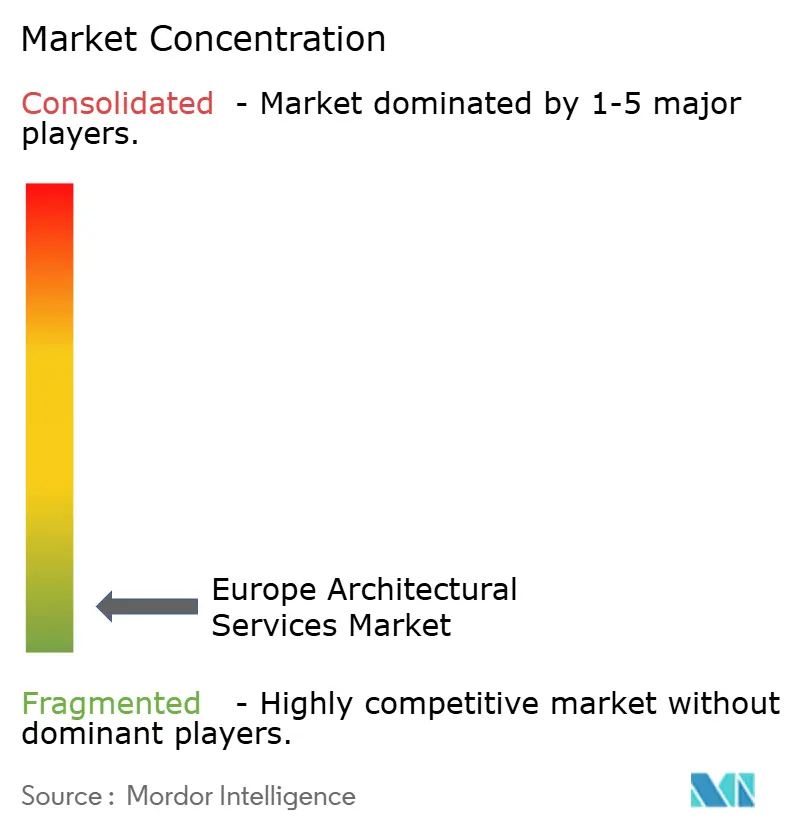
| Market Concentration | Low |
Major Players *Disclaimer: Major Players sorted in no particular order Image © Mordor Intelligence. Reuse requires attribution under CC BY 4.0. | |
Europe Architectural Services Market Analysis by Mordor Intelligence
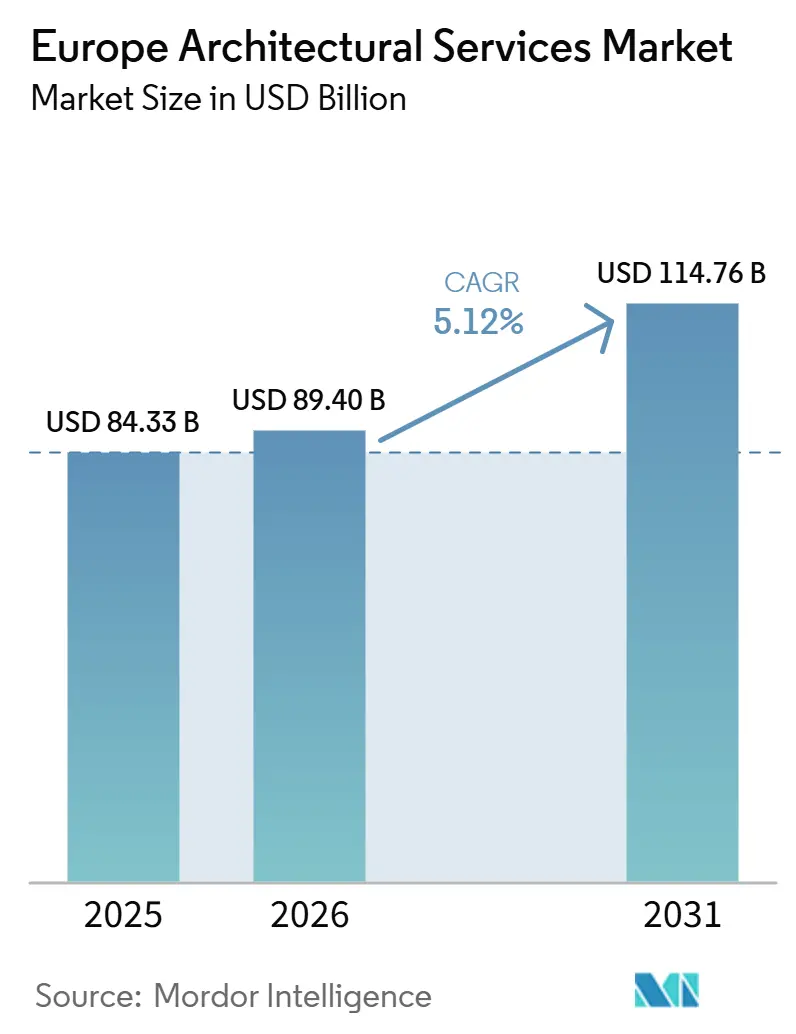
The Europe Architectural Services Market is projected to grow from USD 84.33 billion in 2025 to USD 89.40 billion in 2026, reaching USD 114.76 billion by 2031, registering a CAGR of 5.12% during 2026–2031. The market is primarily driven by increasingly stringent sustainability regulations and the growing need to modernize Europe's aging building stock. The recast Energy Performance of Buildings Directive (EPBD), which came into force in May 2024, requires member states to implement stricter building performance standards into national legislation by May 2026, accelerating demand for architectural design and renovation services. Additionally, with nearly 85% of Europe's buildings constructed before 2000 and renovation rates remaining relatively low, there is significant long-term demand for retrofit and refurbishment projects.
Growth is further supported by rising investments in high-value sectors such as data centers, life sciences facilities, and advanced manufacturing, which require specialized architectural expertise and integrated multidisciplinary design capabilities. Public sector investment continues to provide a stable pipeline of projects, particularly across healthcare, education, transportation, defense, and public infrastructure, supported by the implementation of National Building Renovation Plans scheduled through 2026. Although the market remains highly fragmented, with approximately 142,000 architectural firms operating across Europe and nearly 70% comprising single-person practices, larger firms are increasingly benefiting from complex projects requiring cross-border regulatory compliance, sustainability expertise, and integrated project delivery.
Key Report Takeaways
- By service type, architectural design services held 31% of the market in 2025, while urban design and master planning services recorded the fastest projected CAGR at 6.9% through 2031.
- By project type, renovation accounted for 61% of the market in 2025, while new Construction is forecast to grow at a 5.9% CAGR through 2031.
- By end use, commercial buildings accounted for 36% of the Europe architectural services market share in 2025, while infrastructure-linked buildings are projected to expand at a 6.5% CAGR through 2031.
- By investment source, Public clients captured 54% of the Europe architectural services market size in 2025, while Private investment is expected to grow at a 6.3% CAGR through 2031.
- By geography, Germany held 18% of the market in 2025, while the rest of Europe is forecast to record the fastest CAGR at 6.7% through 2031.
Note: Market size and forecast figures in this report are generated using Mordor Intelligence’s proprietary estimation framework, updated with the latest available data and insights as of January 2026.
Europe Architectural Services Market Trends and Insights
Drivers Impact Analysis*
| Drivers | (~) % Impact on CAGR Forecast | Geographic Relevance | Impact Timeline |
|---|---|---|---|
| Energy-Efficiency Retrofit Wave Across Aging Building Stock | +1.3% | EU-wide, concentrated in Germany, France, Nordic states, and Italy | Short term (≤ 2 years) |
| Data Center, Life-Sciences, and Advanced Manufacturing Investment | +0.8% | Germany, France, Netherlands, Poland, Ireland, and Nordic states | Medium term (2-4 years) |
| Public-Sector Decarbonization and Circularity Mandates | +0.7% | EU-wide, with early gains in Germany, Benelux, and Nordic countries | Medium term (2-4 years) |
| Transit-Oriented Urban Regeneration and Mixed-Use Redevelopment | +0.6% | Western and Central European capitals, with spillover to CEE cities | Long term (≥ 4 years) |
| Digital Design Adoption and Cross-Border Project Delivery | +0.5% | Regional, with early mover concentration in the UK, the Netherlands, and Denmark | Medium term (2-4 years) |
| Hospitality and Cultural Asset Repositioning | +0.3% | Southern and Western Europe, especially France, Spain, Italy, and Portugal | Medium term (2-4 years) |
| Source: Mordor Intelligence | |||
Energy-Efficiency Retrofit Wave Across Aging Building Stock
The Europe architecture services market is seeing sustained retrofit demand because the recast EPBD requires member states to embed stricter minimum energy performance standards into national law by May 2026. The directive also requires the 16% worst-performing non-residential buildings to improve by 2030, which moves more building owners from discretionary renovation to compliance-led design. From January 2028, energy performance certificates for new large buildings must disclose life-cycle global warming potential, which pulls architects earlier into data gathering, carbon modeling, and specification work. This change strengthens the position of practices that have already built whole-life carbon capability, because they can offer both design and compliance support in the same commission. The Europe architecture services market is therefore drawing a larger share of demand from refurbishment, which is consistent with the Architects’ Council of Europe finding that refurbishment already represented 49% of architects’ workload in 2024.
Data Center, Life-Sciences, and Advanced Manufacturing Investment
The Europe architecture services market is drawing higher-value work from data centers, life sciences buildings, and advanced production campuses that need tighter engineering coordination and deeper permitting support than conventional office or retail jobs. In France, the planned digital infrastructure campus in Île-de-France announced by Ardian and Verne shows how AI and cloud infrastructure are becoming direct sources of specialist design demand in the region. In the UK, HOK completed Merlin Place in Cambridge in June 2026 as a life sciences building with wet lab, dry lab, and computational functions, while also targeting BREEAM Excellent and whole-life net-zero carbon. These assignments are not easy entry points because they require coordination across the envelope, service integration, environmental review, phased construction, and specialist user needs. The Europe architecture services market is therefore seeing a wider fee gap between firms with specialist delivery credentials and firms that remain focused on standard commercial work.
Public-Sector Decarbonization and Circularity Mandates
The Europe architecture services market is also benefiting from public procurement rules that now place more weight on whole-life carbon, circular materials, and end-of-life planning rather than on upfront design quality alone. This makes large government competitions harder for smaller firms to access if they do not have formal environmental management systems or proven reporting workflows. The NEB Reallabor planning contract issued in Zeitz in 2026 shows that circularity and social outcomes are now part of live public tender structures, not just policy language. The Viktoriakarree Bonn competition also used sustainability and economic efficiency as central jury criteria, confirming that these requirements are being incorporated into urban regeneration programs with large design scopes. The Europe architecture services market is therefore tilting toward firms that can document carbon, materials, and delivery controls alongside architecture itself.
Transit-Oriented Urban Regeneration and Mixed-Use Redevelopment
The Europe architecture services market is also gaining from large transit-led regeneration programs that combine housing, jobs, retail, and public realm into phased urban projects with long delivery periods. Berlin resolved the Molkenmarkt Block B/2 and Block A competitions in June 2026, which signaled continued demand for urban design, planning, and documentation work in central redevelopment areas. These programs differ from single-building commissions because they create repeat design tasks across concept design, permitting, public coordination, and phased implementation. That helps firms build better revenue visibility over a longer period and supports the fastest service-line growth in Urban Design and Master Planning Services, which is projected at a 6.9% CAGR through 2031. The Europe architecture services market is therefore benefiting from redevelopment models that reward scale, planning depth, and long-term client coordination rather than isolated building design alone.
Restraints Impact Analysis*
| Restraints | (~) % Impact on CAGR Forecast | Geographic Relevance | Impact Timeline |
|---|---|---|---|
| High Labor and Professional Service Cost Base | -0.9% | EU-wide, with the strongest pressure in Germany, Switzerland, Nordic states, and the UK | Medium term (2-4 years) |
| Fragmented Planning and Building Compliance Regimes | -0.7% | EU-wide, with the greatest pressure in cross-border and CEE work | Long term (≥ 4 years) |
| Slower Commercial Office Recovery in Selected Cities | -0.4% | Major office markets across Western Europe | Medium term (2-4 years) |
| Tight Public Procurement and Sustainability Verification Burden | -0.3% | EU-wide, especially in large public tenders across Germany, France, Benelux, and Nordic countries | Medium term (2-4 years) |
| Source: Mordor Intelligence | |||
High Labor and Professional Service Cost Base
The Europe architecture services market also remains constrained by a cost base that is rising faster than many firms can offset through productivity gains. Average architect pre-tax earnings reached EUR 43,500 in 2024, confirming that staffing costs are already high across the profession. The broader construction ecosystem could require 3.6 million additional workers by 2030, while FIEC stated that the European Union may need 2 million extra workers by the same year, suggesting a labor market that remains tight through the forecast period. Small and mid-sized firms are more exposed because they have less room to absorb wage pressure while clients remain fee-sensitive after recent inflation. The Europe architecture services market also faces a capacity issue as 20% of architects were aged 60 and above in 2024, which points to a gradual retirement-driven supply squeeze unless replacement improves.
Fragmented Planning and Building Compliance Regimes
The Europe architecture services market still faces friction from the fact that firms must work across many national planning systems and local approval structures, which raises documentation time and pre-design overhead. The ACE 2024 Sector Study found that 31% of architects seeking to work across borders cited insufficient knowledge of host-country regulations as a key obstacle, indicating that the issue is operational rather than theoretical. The burden is heavier on projects that need both domestic planning consent and wider environmental assessment, because fee recognition moves later into the project cycle when approvals take longer. The same EPBD framework also becomes harder to manage when each member state translates a common directive into a different national process. The Europe architecture services market therefore, favors firms that can carry multi-country compliance knowledge at scale, while smaller practices remain at a disadvantage in cross-border bids.
*Our forecasts treat driver/restraint impacts as directional, not additive. The impact forecasts reflect baseline growth, mix effects, and variable interactions.
Segment Analysis
By Service Type: Architectural Design anchors revenue while master planning accelerates
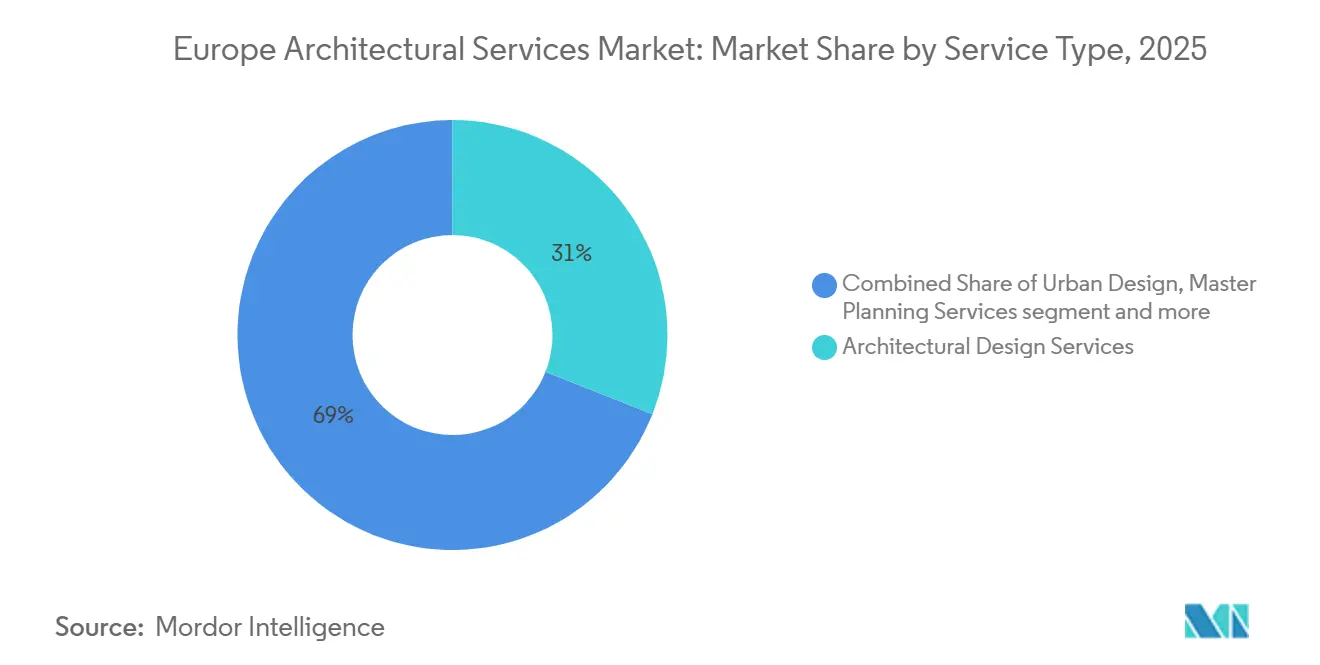
Architectural Design Services accounted for 31% of the service-type mix in 2025, which gave them the largest position in the Europe architecture services market share for that year. This leadership reflects the way clients still appoint architecture firms first for concept design, early approvals, and project definition before more specialized delivery work widens around the brief. The segment also remains central to retrofit-led work, because energy upgrades, repositioning, and reuse projects still start with architectural redesign rather than with documentation alone. Documentation, delivery, and interior architecture remain important adjacent categories, especially where office refurbishment and mixed-use repositioning require detailed coordination across tenants, services, and phased occupation.
Urban Design and Master Planning Services are forecast to expand at a 6.9% CAGR through 2031, which makes them the fastest-growing service line in the Europe architecture services market. This pace aligns with the growing pipeline of urban regeneration, transit-linked redevelopment, and industrial land conversion projects that span several phases and involve multiple stakeholder groups. Digital readiness is becoming more important here, because the ACE study reported that 27% of practices used BIM in 2024 and 51% were using 3D modeling tools. Firms that built interoperable workflows are in a stronger position when clients ask for structured information management and wider consultant coordination[1]Architects’ Council of Europe, “The Architectural Profession in Europe, 2024 Sector Study,” Architects’ Council of Europe, ace-cae.eu.



By Project Type: Renovation dominates share as new construction narrows the gap
Renovation represented 61% of the project-type mix in 2025, which means this segment accounted for the largest share of the Europe architecture services market size in that year. The segment reflects the economics of a region where older building stock, regulatory tightening, and occupancy upgrades are pushing owners toward refurbishment rather than replacement. That structure is also consistent with the ACE finding that refurbishment already formed 49% of architects’ workload in 2024. Renovation work also tends to stay specification-heavy, because energy upgrades, carbon disclosure, access improvements, and tenant repositioning often need more coordination than cosmetic refreshes.
New Construction is forecast to grow at a 5.9% CAGR through 2031, which shows that the gap with renovation is narrowing in selected investment categories. The growth is coming less from broad office expansion and more from data centers, healthcare, life sciences, defense-related facilities, and major transport-linked developments. The ACE study also showed that private housing accounted for 54% of average practice turnover in 2024, which means many firms still depend on a project-based approach that moves with residential credit and household renovation appetite. Perkins&Will’s approved GBP 125 million Oxford retrofit into a life sciences and planetary health hub in 2025 also shows how adaptive reuse now approaches new-build levels of technical design complexity.[2]Perkins&Will, “Perkins&Will Selected to Design New James Paget Hospital in Great Yarmouth,” Perkins&Will News, perkinswill.com
By End-Use: Commercial anchors the market as infrastructure-linked buildings lead growth
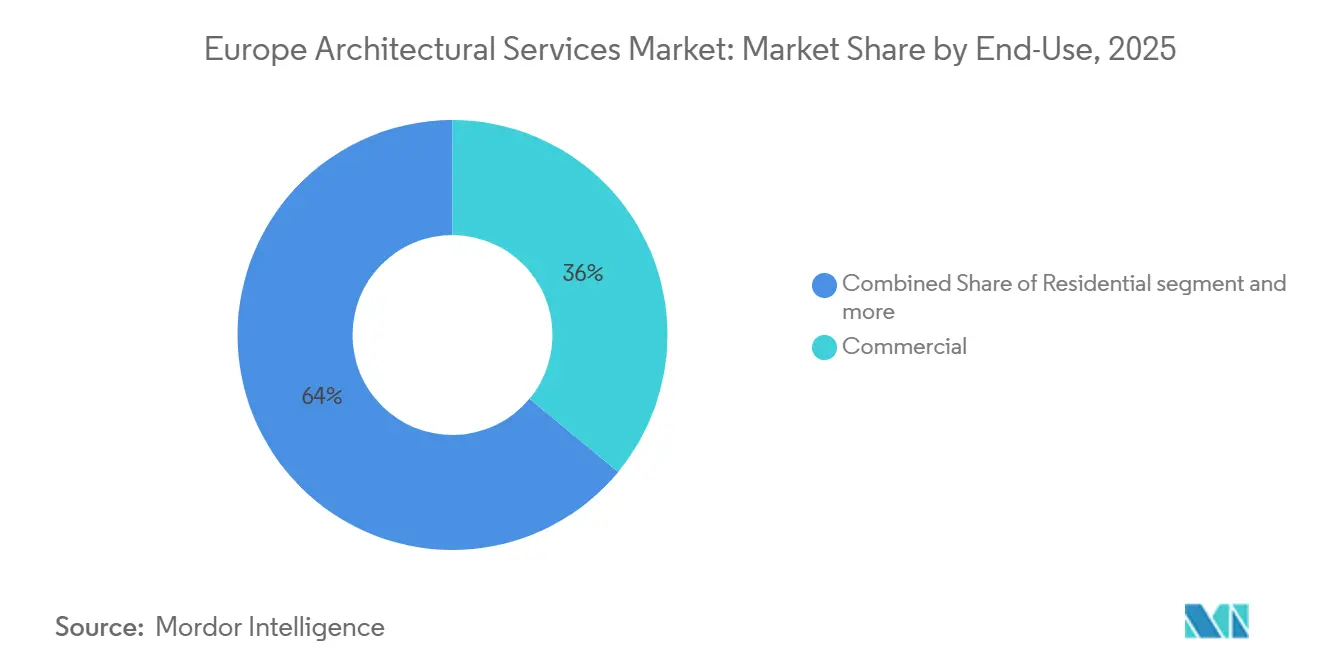
Commercial buildings accounted for 36% of demand in 2025, which gave them the largest share of the Europe architecture services market size among end uses. The category is being supported by office refurbishment, retail repurposing, and private campus expansion rather than by a simple return of routine speculative office projects. In many cities, the better opportunity is now the deep repositioning of existing stock into higher-performing and lower-carbon space. Gensler’s work on 10 Gresham Street in London, which achieved a 72% operational carbon reduction and BREEAM Outstanding certification, demonstrates that refurbishment-led commercial work can retain strong design value and leasing relevance.
Infrastructure-linked Buildings are projected to advance at a 6.5% CAGR through 2031, which makes them the fastest-growing end-use group in the Europe architecture services market. This segment includes data centers, airport expansion, healthcare campuses, and defense-related programs that require long delivery horizons and closer coordination with engineering and environmental review. AECOM’s July 2025 award of two USACE Europe District architecture and engineering contracts worth more than USD 490 million shows the scale of multi-country public and strategic infrastructure work entering active pipelines. These assignments are attractive because they usually carry higher technical content and lower dependence on a single commercial property cycle.
By Investment Source: Public investment leads while private capital posts faster growth
Public clients commanded 54% of activity in 2025, which means they accounted for the largest share of the Europe architecture services market size by investment source. This reflects the weight of healthcare, education, defense, transit, and government estate programs that operate through multi-year procurement routes. Public demand is also reinforced by policy timing, because National Building Renovation Plans are due by December 2026 under the EPBD framework. When those plans move into implementation, architecture firms with public-sector compliance experience should continue to benefit from a steady flow of renovation and redevelopment commissions.
Private investment is forecast to expand at a 6.3% CAGR through 2031, which makes it the faster-moving funding source in the Europe architecture services market. The strongest pull is coming from hyperscale digital infrastructure, life sciences developers, and mixed-use platforms that expect both technical delivery and sustainability reporting from design partners. The planned digital infrastructure campus in Île-de-France announced by Ardian and Verne is a clear sign that private capital is now funding projects with a scale once associated more closely with state-led infrastructure. That shift concentrates repeat mandates among firms that can combine design, carbon accountability, permitting support, and multi-phase execution.
Geography Analysis
Germany held 18% of the Europe architecture services market share in 2025, which made it the largest national market in the region. Its position reflects strong exposure to both building renovation and strategic infrastructure design, two of the most specification-heavy areas of work in Europe. Germany also remains a demanding regulatory environment, so architectural fees often reflect the extra effort needed to navigate layered approvals and documentation. Public competition activity stayed visible in 2026, including the Molkenmarkt Block B/2 and Block A decisions in Berlin, which pointed to continued institutional demand in urban regeneration. The United Kingdom remains an important volume market, supported by public frameworks and private work tied to life sciences, financial services, and residential regeneration, with AECOM securing nine lots on the UK Government Commercial Agency CPS2 framework in June 2026. France also stands out for specialist digital infrastructure demand, supported by the planned Ardian and Verne campus in Île-de-France.[3]Verne, “Ardian and Verne Announce Plans for a Digital Infrastructure Campus in Île-de-France,” Verne News, verne.co
Spain and Italy continue to contribute meaningful volume through hospitality repositioning, residential renovation, and public cultural work. Italy also had the largest registered architect base in Europe at 152,000 in 2024, which shows both strong local capacity and continued fee competition within the profession. The Netherlands remains influential in design quality and procurement sophistication even when measured against a smaller national scale. The Nordic cluster also stays active, with Sweco reporting 13 acquisitions in 2025, which confirms that platform-building around architecture and adjacent services is still moving in that part of Europe.
Rest of Europe is projected to grow at a 6.7% CAGR through 2031, which makes it the fastest-growing geography in the Europe architecture services market. The region is benefiting from urban regeneration, healthcare, and mixed-use development in Central and Eastern Europe, where sophisticated design capacity has historically been more limited than in Western Europe. Romania is a useful example, since the RIVUS Cluj-Napoca regeneration project received its building permit in March 2026 and moved into construction on a former industrial site. The May 2026 EPBD transposition deadline applies across member states, which means markets with lower existing retrofit capacity could see a sharper increase in design demand than their current local supply can meet.
Competitive Landscape
The Europe architecture services market remains structurally fragmented, because 142,000 practices were active in 2024 and 70% of them were sole practitioners. That structure does not prevent consolidation at the top end of the market, because complex public, infrastructure, and cross-border projects still favor firms that can offer larger delivery teams and broader compliance capacity. Sweco’s acquisition of CONIX RDBM Architects in March 2026 is one example of capability-led expansion aimed at adding depth in architecture, interior design, and master planning to a wider platform. AECOM’s July 2025 USACE Europe District contract win is another example, because it strengthened the firm’s position in multi-country architecture and engineering service delivery across Europe. Verka Collective’s 2025 formation and acquisition push shows that private equity-backed aggregation is also becoming a viable route for scaling architect-led groups across national markets.
The most attractive openings still sit in a narrow set of specialist areas rather than in broad-based general practice. Data center and AI-related architecture remains one of those areas, because the delivery model requires detailed coordination across power, cooling, containment, permitting, and environmental review. Circular design advisory is another area of opportunity, especially as the EPBD pushes life-cycle global warming potential disclosure into building documentation and procurement. Cross-border urban regeneration and public master planning also remain selective, because procurement rules are increasingly tied to sustainability, information management, and demonstrated delivery structure.
Digital project execution is becoming a practical dividing line inside the Europe architecture services market. The ACE study showed that BIM use reached 27% of practices in 2024, while 51% used 3D modeling tools, which means digital adoption is moving forward but is still far from universal. Firms that can manage common data environments, structured information exchange, and consultant coordination are better placed to win large public and infrastructure projects. The Europe architecture services market is therefore likely to remain fragmented at the small-firm level while becoming more concentrated in the subset of firms that can handle scale, compliance, and specialist delivery at the same time.
Europe Architectural Services Industry Leaders
AECOM
Jacobs Solutions Inc.
Arcadis NV
Ramboll Group A/S
WSP Global Inc.
- *Disclaimer: Major Players sorted in no particular order

Recent Industry Developments
- June 2026: HOK completed the 139,000-square-foot Merlin Place life sciences building in Cambridge for Kadans Science Partner, achieving UK EPC A rating and WiredScore Gold certification while targeting BREEAM Excellent and whole-life net-zero carbon.
- March 2026: Sweco acquired CONIX RDBM Architects, a Belgian architecture firm with EUR 7.6 million (USD 8.2 million) in 2025 revenues and approximately 50 specialists in architecture, interior design, and master planning. The acquisition was explicitly linked to EU climate and urban-policy compliance drivers in Sweco's announcement.
- March 2026: AtkinsRéalis was appointed by Manchester Airports Group to provide consultancy and design services under a Capital Investment Consultancy Services framework, supporting long-term strategic growth and infrastructure investment planning.


Europe Architectural Services Market Report Scope
| Architectural Design Services |
| Architectural Documentation and Delivery Services |
| Interior Architecture and Space Planning Services |
| Urban Design and Master Planning Services |
| Others |
| New Construction |
| Renovation |
| Residential | |
| Commercial | Office |
| Retail | |
| Institutional | |
| Industrial and Logistics | |
| Others | |
| Infrastructure-linked Buildings |
| Public |
| Germany |
| United Kingdom |
| France |
| Spain |
| Italy |
| Netherlands |
| Sweden |
| Denmark |
| Norway |
| Rest of Europe |
| By Service Type | Architectural Design Services | |
| Architectural Documentation and Delivery Services | ||
| Interior Architecture and Space Planning Services | ||
| Urban Design and Master Planning Services | ||
| Others | ||
| By Project Type | New Construction | |
| Renovation | ||
| By End-Use | Residential | |
| Commercial | Office | |
| Retail | ||
| Institutional | ||
| Industrial and Logistics | ||
| Others | ||
| Infrastructure-linked Buildings | ||
| By Investment Source | Public | |
| By Country | Germany | |
| United Kingdom | ||
| France | ||
| Spain | ||
| Italy | ||
| Netherlands | ||
| Sweden | ||
| Denmark | ||
| Norway | ||
| Rest of Europe | ||


Key Questions Answered in the Report
What is the 2031 value forecast for architecture services in Europe?
The Europe architecture services market is projected to reach USD 114.8 billion by 2031 from USD 89.4 billion in 2026, with a 5.12% CAGR over 2026-2031.
What is driving renovation demand across Europe?
Binding EPBD requirements, an aging building base where 85% of buildings were built before 2000, and still-low renovation rates are keeping retrofit design work active.
Which service type is growing the fastest?
Urban Design and Master Planning Services are forecast to grow at a 6.9% CAGR through 2031, supported by transit-led regeneration and phased mixed-use redevelopment.
Which project type leads current demand?
Renovation held 61% of project activity in 2025, reflecting the weight of refurbishment, reuse, and energy upgrade programs across the region.
Page last updated on:






