
Market Overview
| Study Period | 2020 - 2031 |
|---|---|
| Forecast Data Period | 2026 - 2031 |
| Base Year Market Size (2025) | USD 9.62 Billion |
| Market Size (2026) | USD 9.98 Billion |
| Market Size (2031) | USD 11.98 Billion |
| Growth Rate (2026 - 2031) | 3.73 % |
| Market Concentration | Medium |
Major Players *Disclaimer: Major Players sorted in no particular order Image © Mordor Intelligence. Reuse requires attribution under CC BY 4.0. | |
Europe Aircraft Engine MRO Market Analysis by Mordor Intelligence
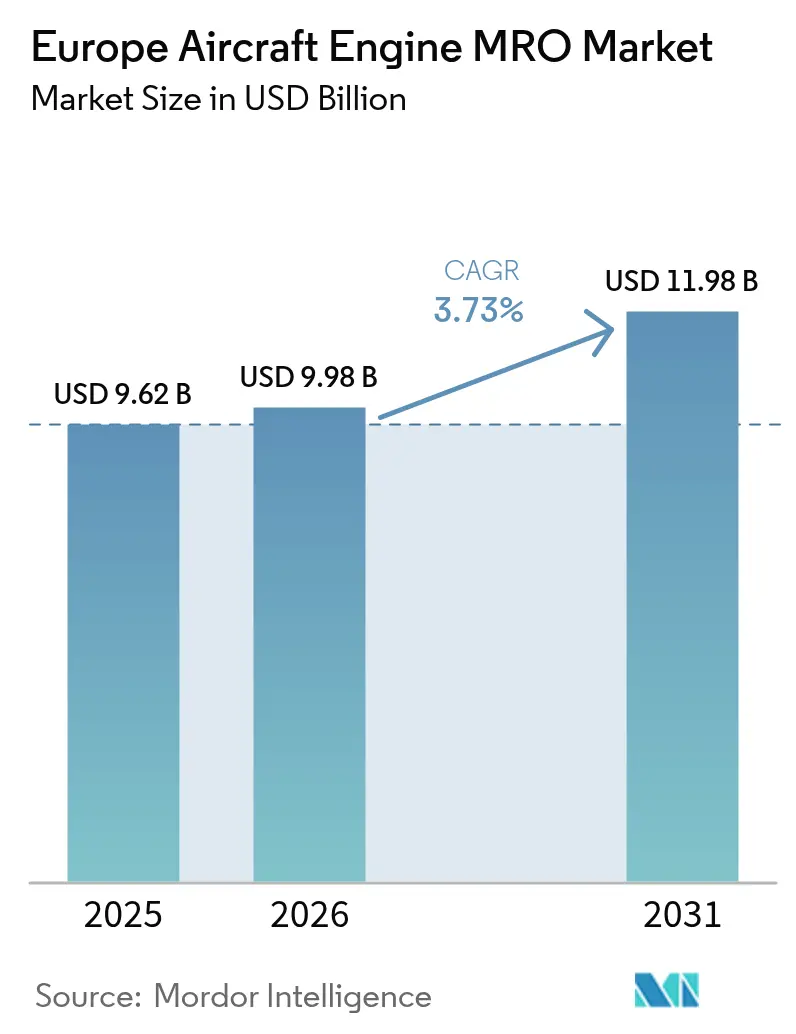
Europe aircraft engine MRO market size in 2026 is estimated at USD 9.98 billion, growing from 2025 value of USD 9.62 billion with 2031 projections showing USD 11.98 billion, growing at 3.73% CAGR over 2026-2031. Growth is shaped by high leasing penetration, which tightens shop-visit intervals, sustained delivery backlogs that keep older engines in service, and the broader adoption of predictive maintenance, which compresses turnaround times. Independent providers are capitalizing on flexible time-and-materials contracts while OEM-affiliated shops expand capacity through licensing agreements and proprietary health-monitoring data. Spare engine lease rates are rising, signaling an operator's willingness to pay premiums to avoid aircraft-on-ground events, and EU funding for emissions retrofits is de-risking investment in next-generation propulsion maintenance. At the same time, labor shortages and life-limited part bottlenecks temper the overall expansion of the Europe aircraft engine MRO market.
Key Report Takeaways
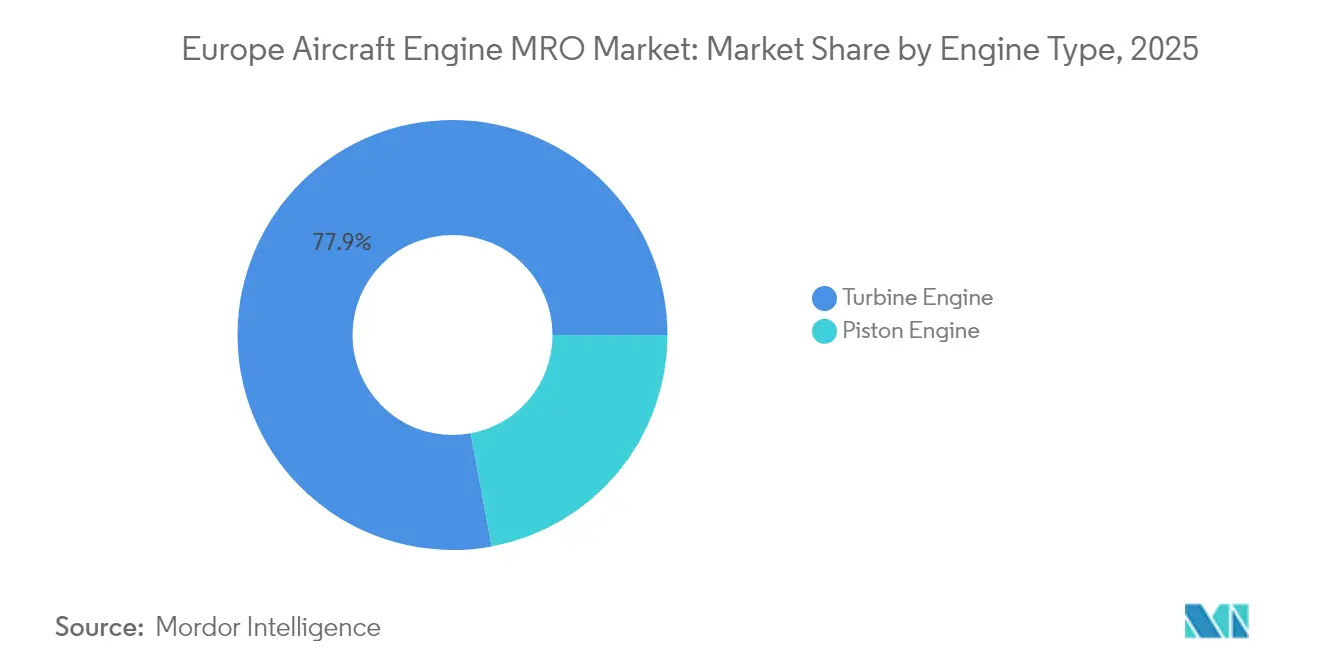
- By engine type, turbine engines held 77.92% of the Europe aircraft engine MRO market share in 2025, while the segment is expected to advance at a 4.39% CAGR through 2031.
- By aviation segment, commercial aviation accounted for 66.95% of the Europe aircraft engine MRO market size in 2025, whereas UAVs led growth at a 6.93% CAGR from 2026 to 2031.
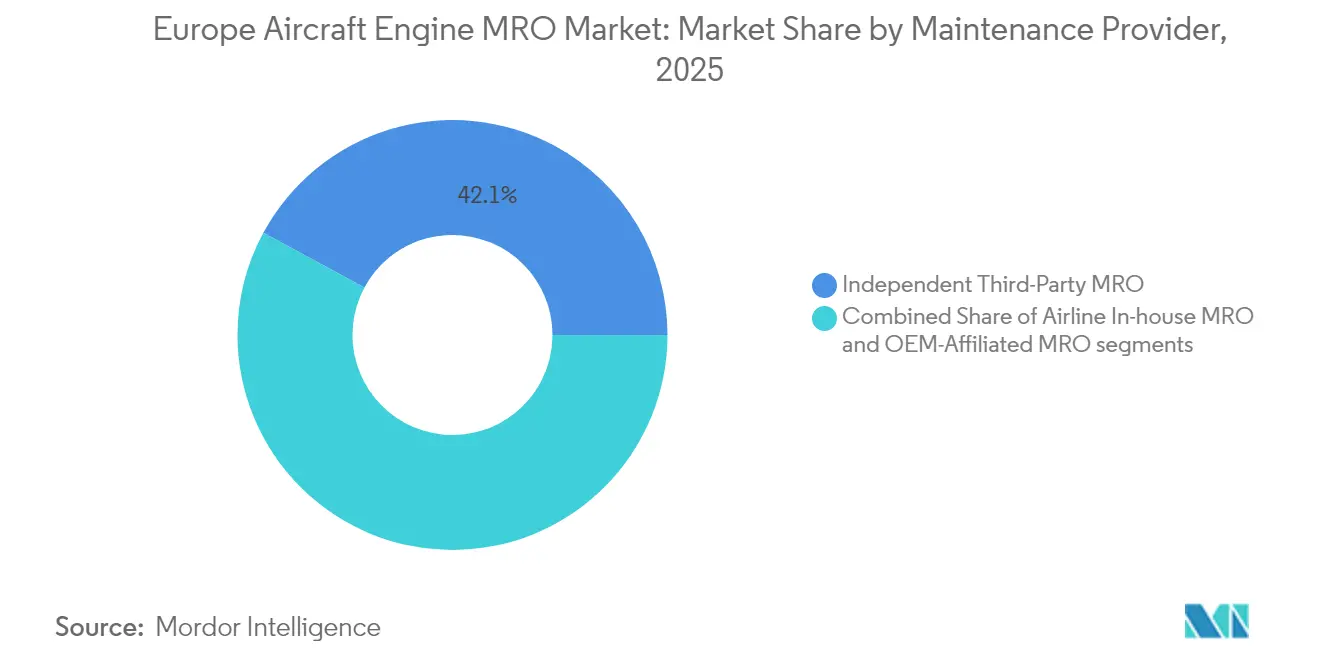
- By maintenance provider, independent third-party MROs captured a 42.12% share of the Europe aircraft engine MRO market in 2025; however, OEM-affiliated facilities are projected to record the highest CAGR at 4.96% through 2031.
- By geography, the United Kingdom led with 21.10% revenue share in 2025, while Spain posted the fastest regional CAGR at 5.18% through 2031.
Note: Market size and forecast figures in this report are generated using Mordor Intelligence’s proprietary estimation framework, updated with the latest available data and insights as of 2026.
Market Trends and Insights
Drivers Impact Analysis of Europe Aircraft Engine MRO Market*
| Driver | (~) % Impact on CAGR Forecast | Geographic Relevance | Impact Timeline |
|---|---|---|---|
| Recovery in flight hours and delivery backlogs increasing engine utilization | +1.2% | UK, Germany, France | Short term (≤ 2 years) |
| Ageing European aircraft fleets extending engine maintenance cycles | +0.9% | UK, Germany, France, Italy | Medium term (2-4 years) |
| Adoption of predictive maintenance and engine health monitoring systems | +0.6% | Frankfurt, Amsterdam, Paris hubs | Medium term (2-4 years) |
| EU funding programs supporting engine efficiency and emissions retrofits | +0.4% | EU | Long term (≥ 4 years) |
| Open-access LEAP and GTF MRO licensing expanding independent MRO capacity | +0.8% | Spain, Poland, Turkey | Short term (≤ 2 years) |
| Growing aircraft leasing and fleet transitions increasing shop visit frequency | +1.0% | Dublin, Amsterdam, Zurich | Short term (≤ 2 years) |
| Source: Mordor Intelligence | |||
Recovery in Flight Hours and Delivery Backlogs Increasing Engine Utilization
Daily traffic across European airspace rebounded to 31,000 to 34,000 flights in 2024, representing 95% of the 2019 levels, and pushing engines to accumulate cycles faster than pandemic-era forecasts had anticipated. IBA projects that regional shop visits will increase from 2,500 in 2024 to more than 3,500 in 2025, a 40% rise that strains available capacity. Delivery backlogs exceeding 14,000 aircraft worldwide keep older engines, such as the CFM56-7B, in service, while early LEAP-1A fleets enter their first performance-restoration events. Spare-engine lease rates for CFM56-7B rose to USD 100,000 per month in 2024, signaling operators’ willingness to pay premiums to avoid aircraft-on-ground events.[1]
Ageing European Aircraft Fleets Extending Engine Maintenance Cycles
A large share of A320ceo and B737NG aircraft operating in Europe has exceeded 15 years of service, and nearly half of the installed CFM56 base had not yet reached a first shop visit as of early 2024. Rolls-Royce forecasts 1,100 to 1,200 large-engine shop visits annually through the mid-term, sustaining demand despite the introduction of new-generation deliveries. Older engines also suffer more unscheduled removals, illustrated by Lufthansa Technik’s 2025 uptick in surprise inductions, which further loads independent shops. Operators increasingly run end-of-lease assets to failure, transferring maintenance liability to lessors, who then source faster, lower-cost solutions.
Adoption of Predictive Maintenance and Engine Health-Monitoring Systems
GE Aerospace’s AI borescope tool cut inspection time from three hours to 90 minutes in 2024, allowing faster on-wing assessments and fewer precautionary removals. Lufthansa Technik’s AVIATAR now aggregates real-time data from over 100 operators, enabling the prediction of component failures up to 60 days in advance. The DLR-led PREDICT program, launched in 2025, focuses on non-destructive on-wing inspection for hydrogen and hybrid-electric engines. Meanwhile, MTU partnered with Teledyne to stream engine data via GroundLink Comm+. Condition-based interventions can extend time-on-wing 20 to 40%, yet when anomalies appear, they compress visit windows, creating lumpy demand patterns.
EU Funding Programs Supporting Engine Efficiency and Emissions Retrofits
The EU Clean Aviation Joint Undertaking awarded EUR 25 million (USD 29.30 million) in 2024 for next-generation turboshaft research and development, while Horizon Europe funds studies on the compatibility of SAF with in-service engines. NATO’s Defence Fund backed a modular 3,000-shp turboshaft concept that promises 30% lower maintenance labor. France’s DGA co-finances Safran’s new turboshaft family, with ground testing slated for 2026. Although focused on development, these programs accelerate the adoption of digital twins, additive repairs, and advanced coatings, which quickly migrate into MRO processes.
Restraints Impact Analysis of Europe Aircraft Engine MRO Market*
| Restraint | (~) % Impact on CAGR Forecast | Geographic Relevance | Impact Timeline |
|---|---|---|---|
| Shortage of skilled EASA-certified maintenance personnel | −0.5% | Germany, UK, France | Medium term (2-4 years) |
| Supply-chain constraints in life-limited parts and forged components | −0.7% | France, UK | Short term (≤ 2 years) |
| Uncertainty around SAF certification and retrofit costs for legacy engines | −0.3% | EU | Long term (≥ 4 years) |
| High energy and utility costs increasing MRO operating expenses | −0.4% | Germany, UK, Italy | Medium term (2-4 years) |
| Source: Mordor Intelligence | |||
Shortage of Skilled EASA-Certified Maintenance Personnel
EASA Part-66 licensure demands thousands of practical hours and multiple exams, creating a talent pipeline that cannot scale rapidly. Airbus forecasts that Europe will need 640,000 new technicians over the next 20 years.[2] MTU is spending EUR 150 million (USD 175.99 million) to automate processes and expand apprenticeships in Germany, yet still warns of throughput limits. StandardAero built an in-house mechanic academy in San Antonio, a model that European shops now emulate. High-pressure turbine blade repair and non-destructive testing roles remain the hardest to fill.
Supply Chain Constraints in Life-Limited Parts and Forged Components
Rolls-Royce booked GBP 410 million (USD 549.17 million) in 2023 contract-loss provisions tied to delays in titanium forgings for turbine disks and compressor blades. GE’s FLIGHT DECK initiative increased supplier on-time delivery above 90% in 2024; however, lead times for certain LEAP and GTF nozzles remain 18 to 24 months. OEMs are prioritizing new-engine production, forcing MRO shops to cannibalize used serviceable material or extend turnaround times. The constraint removes 0.7 percentage points from forecast growth.
*Our forecasts treat driver/restraint impacts as directional, not additive. The impact forecasts reflect baseline growth, mix effects, and variable interactions.
Europe Aircraft Engine MRO Market Segment Analysis
By Engine Type:
Turbine Engines Anchor Aftermarket RevenueTurbine engines generated 77.92% of Europe aircraft engine MRO market revenue in 2025 and are forecast to expand at a 4.39% CAGR through 2031, overtaking piston activity in absolute growth terms. Turbofans power the majority of narrowbody and widebody fleets, and LEAP shop visits are expected to triple by 2030. Hot and harsh operations compress on-wing life, further boosting demand. Safran and GE Aerospace are competing for next-generation turboshaft awards that will direct future MRO work to European hubs. Turbojet engines form a declining niche, while turboprops receive support from Avio Aero’s Catalyst program. OEM-affiliated shops specialize in high-margin performance-restoration work, whereas independents compete on price and faster turnaround times. Rolls-Royce recorded an 11.6% operating margin on GBP 7.3 billion (USD 9.77 billion) civil revenue in 2023, underscoring the advantage of scale in turbine aftermarket economics.
A residual 22.08% share comes from piston engines, which serve fragmented general aviation fleets and record limited growth. Their maintenance activity remains distributed among small regional shops and does not materially alter aggregate forecasts for the Europe aircraft engine MRO market. However, hybrid-electric projects currently under EU research funding could revive interest in small-displacement piston designs configured as range extenders, potentially opening up longer-term specialization opportunities.

By Aviation:
Commercial Aviation Dominates, UAVs Scale FastestCommercial operators accounted for 66.95% of Europe aircraft engine MRO market value in 2025, driven by an installed base of more than 10,000 active aircraft. Narrowbody engines average higher daily utilization than widebodies, yet widebody shop visits deliver greater revenue per event, with Trent XWB overhauls exceeding USD 3 million. Regional jets powered by CF34-10 engines benefit from ITP Aero’s localized repair capabilities introduced in 2025. Military fleets, including Eurofighter Typhoon and F-135 engines, ensure steady throughput but slower growth.
UAVs are leading the relative expansion at a 6.93% CAGR, supported by EASA maintenance rules for engines with a mass exceeding 150 kg. Military UAVs, such as the MQ-9 and Eurodrone, require turboprop overhauls similar to those of manned aircraft, while emerging cargo drones collaborate with general aviation shops. The Europe aircraft engine MRO market, therefore, widens its scope to new propulsion classes and security-cleared facilities.
By Maintenance Provider Type:
Independent Share Holds, OEM-Affiliated Capacity AcceleratesIndependent providers retained a 42.12% share of the Europe aircraft engine MRO market sales in 2025, due to their multi-OEM capabilities and price flexibility. Still, OEM-affiliated shops advance at a 4.96% CAGR as manufacturers leverage proprietary data and service agreements to secure higher-margin work. GE Aerospace generated 70% of its USD 35 billion in 2024 turnover from aftermarket services, and Rolls-Royce TotalCare invoiced GBP 4.60 billion (USD 6.16 billion) in flying-hour receipts that same year. Airline in-house units face capital constraints and are increasingly outsourcing heavy maintenance visits while retaining line maintenance. StandardAero will ramp up LEAP capacity at its San Antonio site to meet demand from European carriers, signaling cross-regional service models that reinforce competition in the Europe aircraft engine MRO market.
Geography Analysis
United Kingdom Aircraft Engine MRO Market
The United Kingdom generated 21.10% of Europe's aircraft engine MRO market turnover in 2025, anchored by Rolls-Royce Derby and Dahlewitz, as well as GE Aerospace Wales. Rolls-Royce invested GBP 55 million (USD 73.63 million) in 2024 to expand Trent XWB assembly, and AerFin doubled quick-turn capacity at its new South Wales site in 2025. British providers benefit from regulatory expertise and closer proximity, but they face higher labor costs than those in Eastern Europe.
Broader European Markets
Spain represents the fastest-growing national segment at a 5.18% CAGR through 2031. ITP Aero posted EUR 1.61 billion (USD 1.89 billion) in revenue in 2024 and joined GE’s CF34-10 repair network in 2025, while Iberia Maintenance aligned with Honeywell on accessory repair. Italy, Switzerland, Turkey, and the Rest of Europe complete the regional landscape, with SR Technics, Turkish Technic, and Magnetic MRO scaling LEAP and Trent capabilities. Expansion trends confirm a multi-hub structure that disperses growth across the Europe aircraft engine MRO market.
Regulatory Landscape
Aircraft engine MRO activity in Europe is overseen through the European Union Aviation Safety Agency (EASA) framework, anchored by Basic Regulation (EU) 2018/1139 and the continuing airworthiness rules in Regulation (EU) No 1321/2014, including Part-145 maintenance organization approvals and Part-66 licensing. In April 2025, EASA issued ED Decision 2025/003/R introducing Amendment 8 to CS-E (Certification Specifications for Engines), updating engine test and substantiation expectations that then feed into maintenance program design and shop-level compliance for turbine engines.
Rulemaking in 2026 broadened the compliance perimeter for MRO organizations supporting new propulsion architectures and streamlined administrative processes. Commission Implementing Regulation (EU) 2025/111, applicable from 13 February 2026, amends (EU) No 1321/2014 to integrate continuing airworthiness requirements for electric and hybrid-propulsion aircraft, including protocols relevant to high-voltage systems. Commission Implementing Regulation (EU) 2026/100 (15 January 2026) also amends (EU) No 748/2012 and (EU) No 1321/2014 to modernize airworthiness review processes and occurrence reporting, changing how maintenance events are documented and released to service across the region.
Value Chain Analysis
The Europe aircraft engine MRO value chain starts with engine OEMs (e.g., GE Aerospace, Safran, Rolls-Royce, Pratt & Whitney) and key tier suppliers that provide life-limited parts, castings/forgings, and control systems, and then extends to engine lessors and operators that shape induction timing through lease-return conditions and utilization profiles. Parts provisioning and repair content are increasingly influenced by licensed channels for new-generation engines, where access to technical data, tooling, and approved repairs is secured via OEM and component-OEM agreements rather than through open independent sourcing.
Capacity downstream is delivered via a mix of OEM-affiliated shops, airline units, and independent third-party MROs, supported by specialist repair vendors and test-cell infrastructure. Recent licensing moves point to tighter component-level integration: in April 2026, AFI KLM E&M and Lufthansa Technik each signed Elite Licensed Repair Service Facility agreements with Woodward to support LEAP engine control components, while IAG (Iberia Maintenance) secured a CFM Premier MRO license for LEAP-1A/1B in April 2026, aligning European induction streams more directly with approved supply and repair channels. The chain remains sensitive to life-limited-part availability and long lead times, which pushes providers to expand used serviceable material and module-level repair strategies to protect turnaround times.
Competitive Landscape
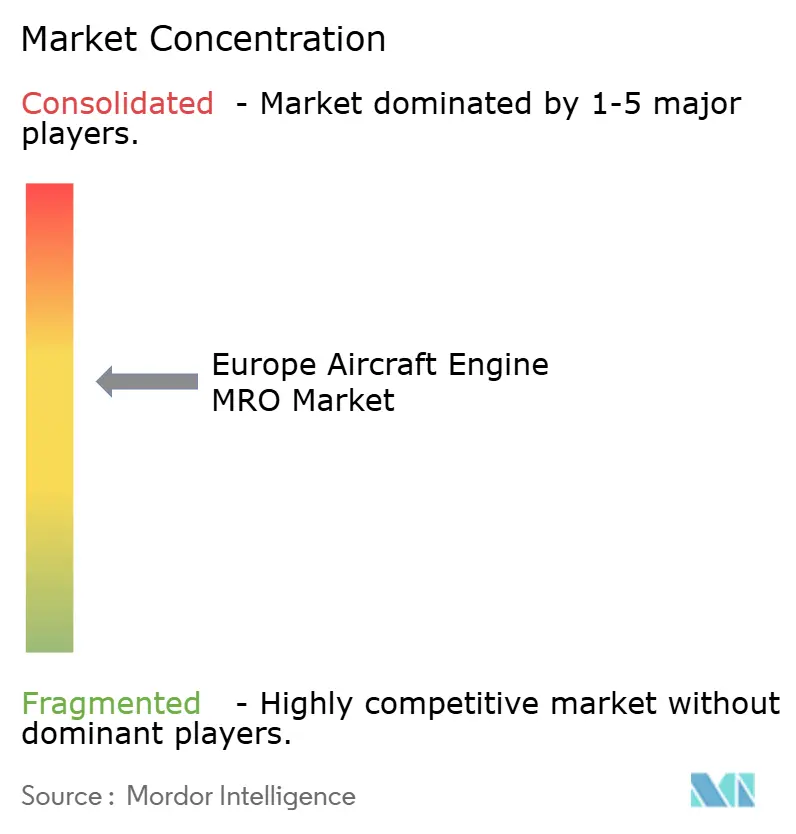
Five leading groups, Lufthansa Technik AG, Rolls-Royce Holdings plc, Pratt & Whitney (RTX Corporation), GE Aerospace (General Electric Company), and Safran SA, control the majority of the European aircraft engine MRO market revenue, indicating moderate concentration. OEMs leverage data platforms such as GE FLIGHT DECK, Rolls-Royce TotalCare, and AVIATAR to bind customers into long-term service agreements. Independent providers respond with aggressive test-cell investment, industrialized component repairs, and alliances that pool licensing rights. ST Engineering opened new LEAP lines in Singapore in 2025, and StandardAero is accelerating capacity to secure European contracts.
White-space opportunities lie in additive manufacturing, on-wing repairs, and hydrogen-ready maintenance. The DLR PREDICT program aims to cut shop-visit frequency by 30% through advanced inspection, while GE Additive deploys multi-laser printing for turbine parts. Digital marketplaces for spare engines, illustrated by Shannon Engine Support’s USD 875 million LEAP financing in 2024, enhance asset utilization and disrupt traditional slot-allocation models. Competitive intensity therefore rises, yet the Europe aircraft engine MRO market rewards scale, proprietary data, and diversified licensing portfolios.
Europe Aircraft Engine MRO Industry Leaders
-
Lufthansa Technik AG
-
Pratt & Whitney (RTX Corporation)
-
GE Aerospace (General Electric Company)
-
Safran SA
-
Rolls-Royce Holdings plc
- *Disclaimer: Major Players sorted in no particular order
Europe Aircraft Engine MRO Market Companies Covered in this Report
- Lufthansa Technik AG
- Rolls-Royce Holdings plc
- Pratt & Whitney (RTX Corporation)
- GE Aerospace (General Electric Company)
- Safran SA
- MTU Aero Engines AG
- Honeywell International Inc.
- Air France-KLM
- TAP Maintenance & Engineering
- IBERIA, L.A.E., S.A.
- SR Technics Switzerland Ltd.
- StandardAero Aviation Holdings, Inc.
- TARMAC AEROSAVE
- Aero Norway AS
- FL Technics
- Turkish Technic Inc.
- Industria de Turbo Propulsores, S.A.
Market Opportunities and Future Outlook
Near-term whitespace is tied to scaling licensed capability for new-generation narrowbody engines and moving more module and component work onshore in Europe to reduce turnaround time exposure. The licensing cadence already provides directional evidence of this shift, including IAG (Iberia Maintenance) signing a CFM Premier MRO license for LEAP-1A and LEAP-1B in April 2026, with initial inductions planned from Q1 2027, and Woodward expanding its elite licensed repair network through agreements signed in April 2026 with AFI KLM E&M and Lufthansa Technik for LEAP engine control repairs. Together, these steps create room for adjacent opportunities in test-cell throughput, parts pooling, and approved component repairs that sit between full overhauls and line maintenance.
A second opportunity set is capacity build-out and industrialization of module and component repair across multiple European hubs, tied to both shop-visit growth and supply-chain constraints in life-limited parts. In June 2026, Brussels Airport and Safran broke ground on a 15,000 square meter Module Factory expansion to lift capacity to 1,500 modules annually by 2028, and Lufthansa Technik broke ground in June 2026 on a new 55,000 square meter Portugal facility focused on engine parts and component repair. On the demand side, airlines are also shifting toward more direct control of engine maintenance capacity, illustrated by Ryanair signing a multi-year engine services agreement with CFM in February 2026 linked to developing two proprietary MRO shops designed around 150 engines per year each, which reinforces how European providers differentiate through faster slots, licensed repairs, and more resilient parts access.
Recent Industry Developments in Europe Aircraft Engine MRO Market
- March 2026: GE Aerospace announced an investment of more than EUR 110 million in its European manufacturing sites, including EUR 40 million earmarked for MRO and component repair facilities. The spending targets capacity and capability upgrades aimed at shortening turnaround times and improving throughput for operators facing higher shop-visit volumes.
- June 2025: Pratt & Whitney added ITP Aero to its GTF MRO network. This broadened approved European repair and overhaul coverage for geared turbofan engines, helping distribute inductions and reduce bottlenecks as the installed base matures.
- October 2024: GE Aerospace announced a USD 130 million multi-year investment plan for European MRO and component repair facilities to be completed by the end of 2026, including support for XEOS in Poland. This investment signaled an accelerated build-out of LEAP-related capacity and tooling in Europe as newer engine families move deeper into their maintenance cycles.
Europe Aircraft Engine MRO Market Report Scope and Research Methodology
Market Definition and Coverage
This market covers the value of aircraft engine maintenance, repair, and overhaul work carried out in Europe, including scheduled and unscheduled shop visits, repairs, and overhauls that restore engines to service.
Scope exclusions: We exclude military-unrelated UAV engine work, and we do not count new engine sales or airframe-only MRO activity.
Segments Covered in This Report
- By Engine Type
- Turbine Engine
- Turboprop Engine
- Turbofan Engine
- Turboshaft Engine
- Turbojet Engine
- Piston Engine
- Turbine Engine
- By Aviation
- Commercial Aviation
- Narrowbody
- Widebody
- Regional Jets
- Military Aviation
- Combat
- Transport
- Special Mission
- Helicopters
- General Aviation
- Business Jets
- Commercial Helicopters
- Unmanned Aerial Vehicles (UAVs)
- Commercial Aviation
- By Maintenance Provider Type
- Airline In-house MRO
- Independent Third-Party MRO
- OEM-Affiliated MRO
- By Geography
- United Kingdom
- Germany
- France
- Italy
- Spain
- Switzerland
- Rest of Europe
Data Sources, Market Sizing, and Validation
Desk Research
Desk work started by setting the operating footprint for European engine maintenance, then mapping demand drivers that can be checked year over year. We used public aviation statistics and safety publications to understand fleet activity and maintenance cycles, and then checked how those same signals behaved across major European countries.
For desk anchoring, we relied on sources such as EUROCONTROL traffic and delays dashboards, EASA safety and airworthiness publications, ICAO aviation data releases, Eurostat macro and transport series, and OECD economic indicators to ground utilization and country context. For market structure, we also reviewed company annual reports, filings, and investor presentations, alongside industry association updates and reputable aviation press for shop capacity changes and overhaul backlogs. Where we needed consistency on aircraft and engine installed base, we referenced paid aerospace and aviation databases at an aggregated level to cross-check active fleet profiles. These examples are not exhaustive, and we used additional sources to support data collection, validation, and research clarification.
Primary Interviews and Surveys
Primary work focused on validating how engine shop visits translate into revenue in Europe, since published assumptions sometimes diverge from shop-level billing and service mix. We spoke with airline maintenance teams, independent engine MRO providers, OEM-affiliated repair networks, parts and module specialists, and leasing and engineering stakeholders to confirm service mix, turnaround constraints, and pricing direction.
Distribution of primary research fieldwork respondents
| Company type | Respondent position |
|---|---|
| Top tier: 29% | CXOs: 12% |
| Mid tier: 53% | Functional/Unit leaders: 41% |
| Smaller Players: 18% | Managers: 47% |
Market-Sizing & Forecasting
Sizing was built using a top-down and bottom-up mix, where flight activity and maintenance intervals are first used to reconstruct the engine MRO demand pool across Europe. The model starts with active engine populations across commercial, military, and general aviation, then applies shop-visit cadence, removal rates, and service mix to estimate annual spend.
To keep totals grounded, selective bottom-up checks were added using sampled price ranges for shop visits, module repairs, and life-limited part replacements. These were compared with reported MRO revenue splits and known capacity additions at major European shops. Key inputs that were tracked (illustrative) include flight cycles and hours trends, the engine mix across turbine and piston, the share of work handled by airline in-house teams versus third parties, turnaround time pressure, and the timing of life-limited part replacement cycles. Where coverage gaps showed up for smaller operators or thinly reported countries, we used proportional allocation based on fleet presence and traffic patterns, and then rechecked the results with expert feedback.
For forecasting, we used scenario analysis because demand is sensitive to traffic growth, parts availability, and shop capacity, and these factors can shift faster than long-term averages. Assumptions were adjusted only after reconciling expert views with observable signals such as utilization, retirement trends, and announced engine shop expansions.
Data Validation & Update Cycle
Outputs were triangulated across independent checks, so the final number does not rely on a single indicator. We compared market totals against fleet utilization signals, shop capacity announcements, and country-level aviation trends, then investigated outliers before internal sign-off.
If a variance was material, the related assumptions were rechecked, followed by re-contacting relevant respondents to confirm the direction and magnitude. Reports are refreshed annually, with interim updates when material events occur such as major capacity expansions, regulatory shifts, or sudden changes in aircraft utilization. Before delivery, a final analyst pass is completed so clients receive the most up-to-date view available.
Mordor Intelligence's Europe Aircraft Engine MRO Market Size Measured Against Other Published Estimates
Published market sizes for European aircraft engine MRO can differ even when the title looks the same, because firms do not always count the same maintenance events or the same provider revenue streams. Differences usually come from what gets included in engine MRO versus adjacent maintenance work, how shop-visit frequency is estimated, and how pricing and currency timing are handled.
The main gap comes from whether military-only UAV engine maintenance and provider coverage are filtered consistently, and Mordor Intelligence counts UAV-related engine work only when it is tied to military aviation and the provider revenue is clearly from engine MRO activity. Other differences often come from using aggressive shop-visit assumptions during recovery years, rolling broader component work into engine totals, or applying blended pricing to Europe without checking regional labor and parts constraints.
Benchmark comparison
| Source | Market Size | Gaps in Research Methodology |
|---|---|---|
| Mordor Intelligence | USD 9.62 B (2025) | |
| Trade Journal A | USD 15.10 B (2025) | Often presented as cumulative multi-year engine MRO demand totals, which can bundle broader maintenance events and may not isolate Europe-only annual spend for engine shop activity. |
| Regional Consultancy B | USD 11.00 B (2024) | Uses a different base year and can include a wider set of engine-related services (including adjacent APU and non-core repairs) with limited disclosure of shop-visit frequency and pricing assumptions. |
The spread is mainly explained by scope and timing differences, rather than a single disputed input. When the demand pool is tied back to fleet utilization and maintenance cycle logic, the resulting market value is easier to trace and replicate across update cycles.
Key Questions Answered in the Report
What is the current value of the Europe aircraft engine MRO market?
The Europe aircraft engine MRO market is valued at USD 9.98 billion for 2026 and is forecasted to reach USD 11.98 billion by 2031.
Which engine segment brings the most revenue?
Turbine engines generate 77.92% of market revenue and are growing at a 4.39% CAGR.
Which aviation category is expanding fastest?
UAVs lead growth at a 6.93% CAGR through 2031.
Why are OEM-affiliated MRO shops gaining share?
OEMs leverage proprietary health-monitoring data and licensing to win high-margin service agreements, driving a 4.96% CAGR for their facilities.
Which European country shows the highest growth rate?
Spain posts the fastest national expansion at a 5.18% CAGR, supported by ITP Aero and Iberia Maintenance investments.
What is the biggest restraint facing providers?
Shortages of EASA-certified technicians and persistent supply-chain delays in life-limited parts combine to reduce forecast CAGR by more than one percentage point.