
Market Overview
| Study Period | 2019 - 2031 |
|---|---|
| Forecast Data Period | 2026 - 2031 |
| Historical Data Period | 2019 - 2024 |
| Market Size (2026) | USD 10.55 Billion |
| Market Size (2031) | USD 13.35 Billion |
| Growth Rate (2026 - 2031) | 4.82 % |
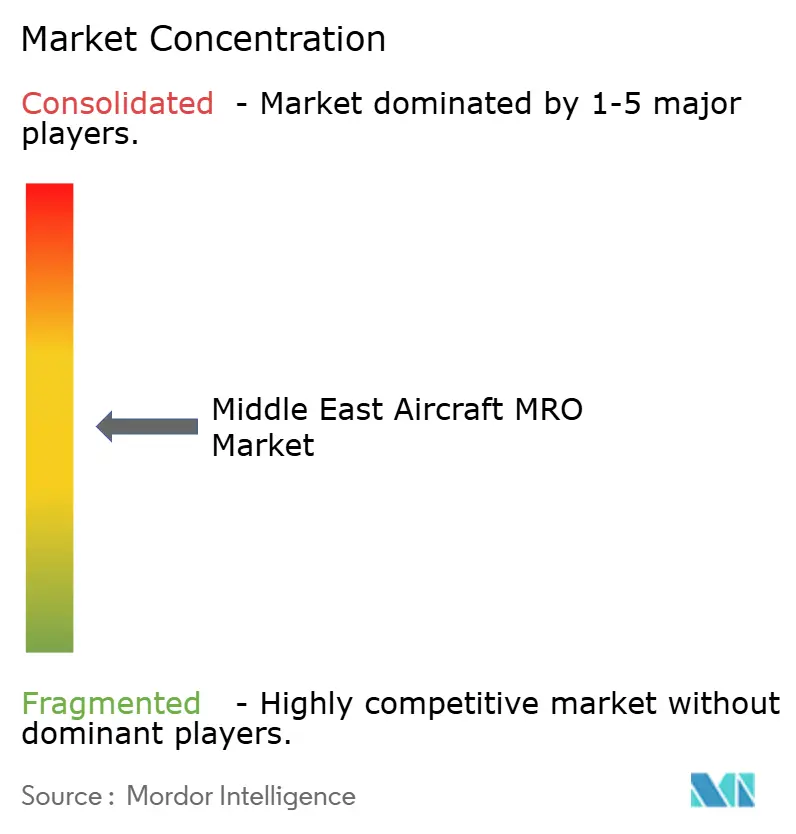
| Market Concentration | Medium |
Major Players *Disclaimer: Major Players sorted in no particular order Image © Mordor Intelligence. Reuse requires attribution under CC BY 4.0. | |

Middle East Aircraft MRO Market Analysis by Mordor Intelligence
The Middle East aircraft MRO market size stands at USD 10.55 billion in 2026 and is projected to reach USD 13.35 billion by 2031, reflecting a 4.82% CAGR over the forecast period. The acceleration of fleet expansion by GCC flag carriers, ongoing airport privatization programs, and the rapid induction of CFM LEAP and Pratt & Whitney GTF engines underpin a positive growth outlook for the Middle East aircraft MRO market. Independent third-party shops are scaling their capacity at a faster pace than airline-affiliated facilities, aided by policy reforms that unlock on-airport land and lower capital-cost structures. Digital-twin platforms are reducing turnaround times by up to 20%, enabling shops to process more airframes per bay each year. Meanwhile, modular component-repair strategies limit aircraft-on-ground days and redistribute budgets from rotable inventory to repair labor. Engine-shop concentration, skilled-technician shortages, and geopolitical uncertainty in the Levant temper growth but do not outweigh the structural demand drivers that keep the Middle East aircraft MRO market on a steady upward trajectory.
Key Report Takeaways
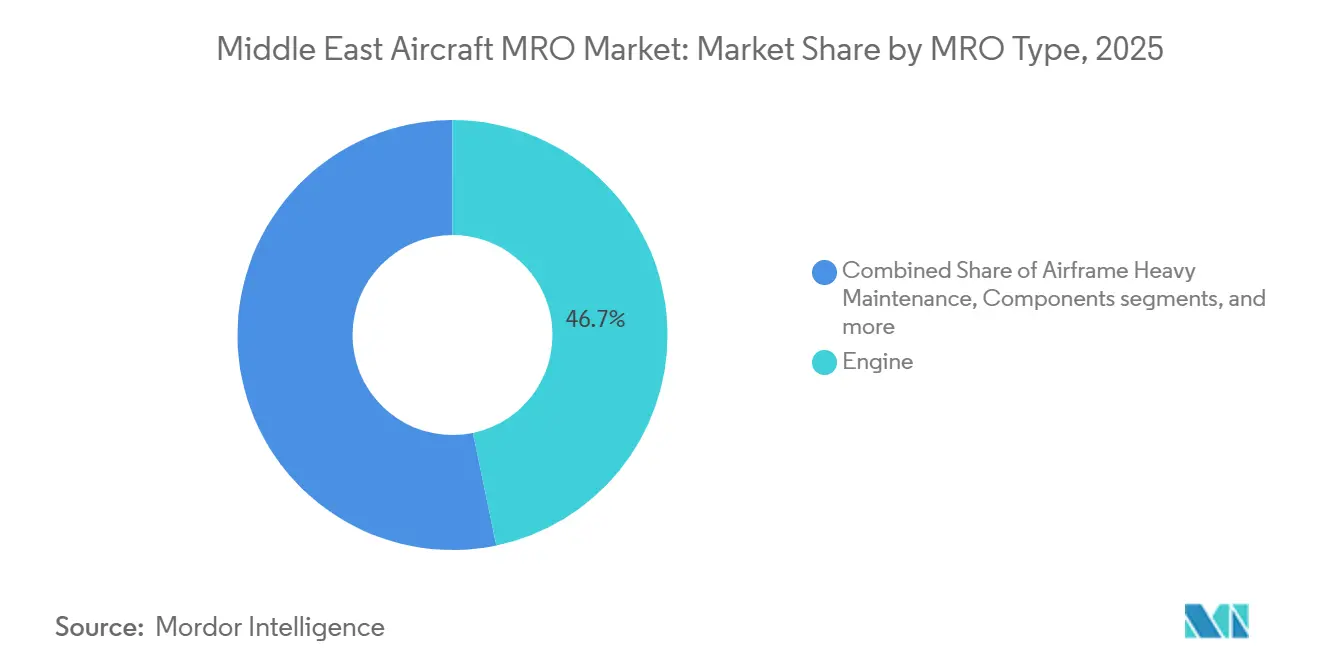
- By MRO type, engine maintenance led with 46.73% of 2025 revenue, while component repair is forecasted to expand at a 5.38% CAGR through 2031.
- By aircraft class, fixed-wing platforms held 91.14% of 2025 spending, yet rotary-wing work is advancing at a 6.65% CAGR to 2031.
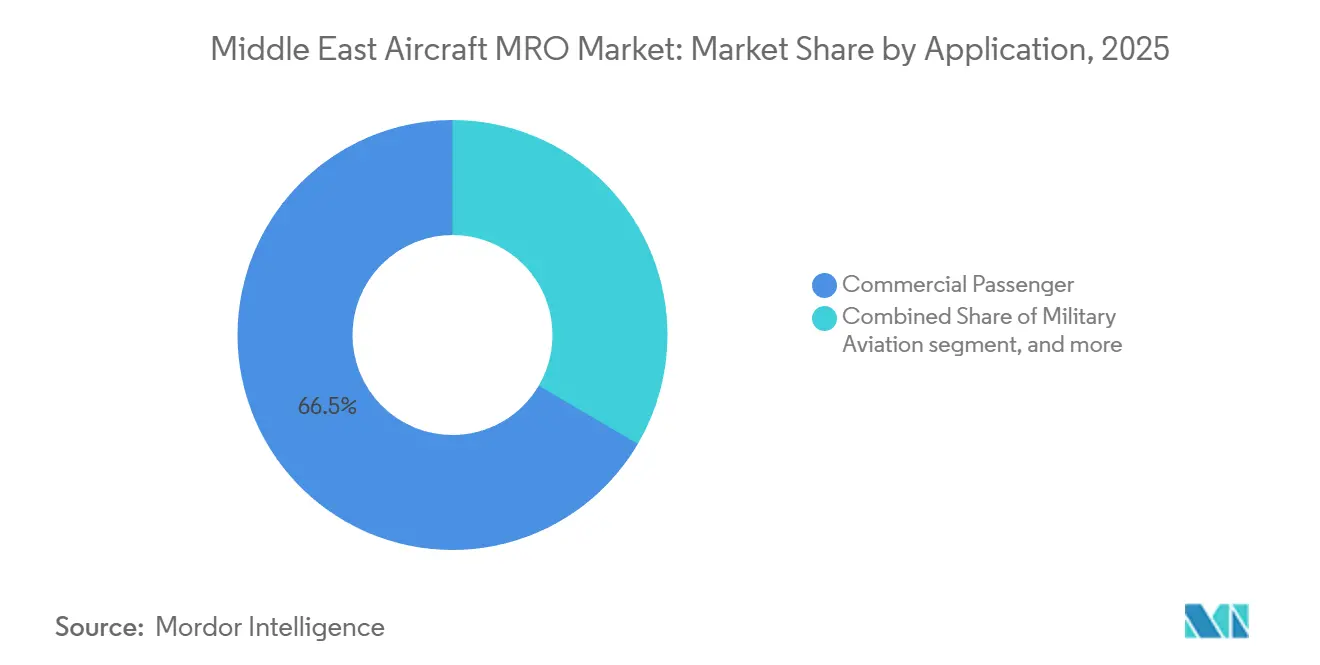
- By application, commercial passenger operations accounted for 66.54% of 2025 demand, and cargo freighter activity is growing at a 5.19% CAGR through 2031.
- By service provider, airline-affiliated shops captured 50.17% of the 2025 spending, but independent third-party facilities are projected to rise at a 6.58% CAGR through 2031.
- By geography, Turkey secured 33.25% of the 2025 revenue, whereas Saudi Arabia is the fastest-growing market, with a 4.87% CAGR through 2031.
Note: Market size and forecast figures in this report are generated using Mordor Intelligence’s proprietary estimation framework, updated with the latest available data and insights as of January 2026.
Market Trends and Insights
Drivers Impact Analysis of Middle East Aircraft MRO Market*
| Driver | (~) % Impact on CAGR Forecast | Geographic Relevance | Impact Timeline |
|---|---|---|---|
| National-carrier fleet expansion programs in GCC boosting heavy-check demand | +1.2% | Saudi Arabia, UAE, Qatar | Medium term (2-4 years) |
| Privatization of Saudi and UAE airports creating third-party MRO opportunities | +0.9% | Saudi Arabia, UAE | Long term (≥ 4 years) |
| Ramp-up of LEAP and GTF engine fleets necessitating new engine shops | +1.1% | GCC core, Turkey, Egypt | Medium term (2-4 years) |
| Digital twin adoption reducing turnaround time and increasing shop-visit volume | +0.7% | UAE, Saudi Arabia, Turkey | Short term (≤ 2 years) |
| Emergence of LCCs driving line-maintenance outsourcing | +0.5% | Saudi Arabia, UAE, Kuwait | Short term (≤ 2 years) |
| Military offset policies pushing OEMs to localize component repair | +0.6% | Saudi Arabia, UAE | Long term (≥ 4 years) |
| Source: Mordor Intelligence | |||
National-Carrier Fleet Expansion Programs in GCC Boosting Heavy-Check Demand
Saudia ordered 105 A320-family aircraft in 2024 and 39 B787-9s in 2025, aiming for a 200-unit fleet by 2030; these deliveries compress heavy-check intervals and inject an estimated 120 additional airframe checks per year into the Middle East aircraft MRO market. Emirates’ record order for 90 B777-8 freighters in 2024 will require two dedicated widebody bays at a USD 950 million complex coming online at Dubai World Central in 2027. Qatar Airways adjusted the C-check frequency for its A350-1000s and B777-9s from 18 months to 14 months in 2025 and awarded overflow contracts to Turkish Technic and Joramco, thereby expanding regional third-party opportunities. Etihad Engineering’s Al Massar program aims to double revenue by integrating newly acquired Abu Dhabi Aviation line stations, which collectively increase widebody throughput by 25%.
Privatization of Saudi and UAE Airports Creating Third-Party MRO Opportunities
Saudi Arabia’s General Authority of Civil Aviation framework now permits long-term land leases for independent hangars, ending the historic monopoly of Saudia Technic and reallocating roughly 15% of heavy-check volume toward non-airline shops by 2030. The Public Investment Fund’s USD 1.5 billion infusion into Jeddah’s MRO Village extends 10 new bays to third-party operators scheduled for completion in 2027. In the UAE, Mubadala’s Sanad logged AED 2.3 billion (USD 626.28 million) revenue in H1 2024 after onboarding Asiana Airlines and European lessors under an expanded engine-maintenance contract. Dubai Airports Authority has allocated 1.2 million square feet at Dubai South to IER MRO Industries, whose USD 1.3 billion facility is expected to feature twin LEAP-capable test cells by 2027.[1]
Ramp-Up of LEAP and GTF Engine Fleets Necessitating New Engine Shops
CFM LEAP-1A/1B and Pratt & Whitney GTF powerplants will propel roughly 60% of narrowbody deliveries across the region by 2028, pushing the installed base beyond 1,200 engines and concentrating engine work among Sanad, Emirates Engineering, and Turkish Technic.[2] Sanad inducted 160 LEAP engines during 2024 and activated a fourth test cell calibrated for 32,000 lbf thrust ratings. GE invested USD 10 million to upgrade tooling in Dubai and Doha service centers, cutting on-wing time for LEAP fan-blade exchanges by 12%. Turkish Technic’s January 2025 contract with IndiGo covers 150 LEAP engines and positions Istanbul as a South Asia and Middle East hub.
Digital Twin Adoption Reducing Turnaround Time and Increasing Shop-Visit Volume
Emirates Engineering’s collaboration with Boeing introduced fleet-wide digital twins in 2024, which predict component failures 30 days in advance with 85% accuracy, reducing the average C-check turnaround time to 38 days and increasing annual bay utilization by 18%. Etihad Engineering integrated Airbus Skywise data into its workflows, resulting in a 22% increase in shop-visit throughput in 2025. Qatar Airways Technic equipped 120 aircraft with predictive-maintenance sensors, cutting unscheduled removals by 18%. Lufthansa Technik Middle East applied similar analytics to Saudia’s component-support contracts, deferring 12% of shop visits through condition-based monitoring.
Restraints Impact Analysis of Middle East Aircraft MRO Market*
| Restraint | (~) % Impact on CAGR Forecast | Geographic Relevance | Impact Timeline |
|---|---|---|---|
| Skilled-technician shortage elevating labor costs in Dubai and Riyadh | -0.8% | UAE, Saudi Arabia | Short term (≤ 2 years) |
| Prolonged redelivery delays at OEM shops limiting aftermarket share | -0.6% | GCC core, Turkey | Medium term (2-4 years) |
| Political instability in the Levant impacting widebody utilization rates | -0.3% | Jordan, Lebanon | Medium term (2-4 years) |
| High capex for engine test cells deterring independent entrants | -0.5% | Regional, Saudi Arabia, Egypt | Long term (≥ 4 years) |
| Source: Mordor Intelligence | |||
Skilled-Technician Shortage Elevating Labor Costs in Dubai and Riyadh
Vacancy rates for EASA B1/B2 mechanics reached 22% in Dubai in 2025, pushing monthly wages above USD 7,000 and squeezing independent shop margins by 200 basis points.[3] Etihad Engineering’s tri-party academy with GE and Lufthansa Technik will graduate its first 200 Emirati technicians in 2027, leaving a near-term supply gap. Saudi training programs enroll 150 students annually, yet fewer than 40% secure GCAA licenses within two years, compounding wage inflation. Military rotary-wing specialists in the UAE command a monthly salary of USD 7,400, reflecting the scarcity of their expertise.
Prolonged Redelivery Delays at OEM Shops Limiting Aftermarket Share
Pratt & Whitney GTF overhaul times exceeded 300 days in early 2025 due to turbine-blade shortages, obliging lessors to extend leases and defer shop visits. CFM admitted to a 15% capacity shortfall for LEAP maintenance in its 2024 annual report, resulting in the prioritization of airline-owned engines over third-party jobs and a reduction in independent revenue potential. Rolls-Royce Trent programs averaged a 180-day turnaround in 2025, twice the target, leading Emirates Engineering to strike a deal for in-house A380 Trent 900 capability and bypass OEM queues.
*Our forecasts treat driver/restraint impacts as directional, not additive. The impact forecasts reflect baseline growth, mix effects, and variable interactions.
Middle East Aircraft MRO Market Segment Analysis
By MRO Type:
Component Repair Outpaces Engine DominanceComponent maintenance will grow at a 5.38% CAGR through 2031, the fastest among MRO types, as operators adopt modular repair strategies to cut aircraft-on-ground durations. Engine work held 46.73% of 2025 revenue within the Middle East aircraft MRO market, a share tied to LEAP and GTF overhauls that can exceed USD 8 million per shop visit. Prolonged OEM redelivery cycles shift incremental spend toward landing gear, avionics, and APU overhaul, where Etihad Engineering’s five-year component-support deal with Lufthansa Technik generates USD 120 million in annual revenue. Emirates’ Aviation Supply Centre stocks 12,000 line-replaceable units (LRUs) and offers 24-hour turnaround, attracting contracts from Qatar Airways and Turkish Airlines.
Airframe heavy checks and line maintenance together account for 35% of the 2025 spend, with widebody work concentrated in Istanbul, Jeddah, and Dubai hangars that handle 30,000 to 50,000 labor-hour events. Passenger-to-freighter (P2F) conversions and cabin retrofits form a fast-growing niche; Israel Aerospace Industries completed 18 P2F projects in 2024 for Middle East carriers, each adding USD 8 million to USD 12 million in revenue. Line-maintenance outsourcing by LCCs redistributes USD 200 million annually toward independent stations, accelerating the shift in the Middle East aircraft MRO market.

By Aircraft Class:
Rotary-Wing Gains Traction Amid Fixed-Wing DominanceFixed-wing platforms controlled 91.14% of 2025 revenue, while rotary-wing work is projected to grow at a 6.65% CAGR through 2031, as Saudi Arabia and the UAE expand their military and offshore-energy helicopter fleets. Saudi contracts for 60 UH-60M Black Hawks include 10 years of sustainment worth USD 400 million to local shops, while Abu Dhabi Aviation operates a dedicated rotary-wing center servicing AW139, S-92, and H225 fleets. Narrowbody jets continue to dominate fixed-wing spending, driven by LCC growth, whereas widebody heavy checks cluster at Turkish Technic’s Istanbul base, which inducted 22 units in Q1 2025.
Regional jets and turboprops account for less than 5% of the spend, reflecting retirements in favor of larger narrowbody aircraft on intra-GCC routes. Rotary-wing demand relies on specialized tooling and OEM partnerships, limiting provider participation and concentrating share among a handful of shops, which positions the Middle East aircraft MRO market for higher margins in this niche.
By Application:
Cargo Freighters Accelerate as Passenger Ops Hold ShareCommercial passenger fleets generated 66.54% of 2025 demand across the Middle East aircraft MRO market, underpinned by Emirates’ 260 aircraft, Qatar Airways’ 250 units, and Saudia’s planned 200-aircraft fleet by 2030. Cargo and freighter work, however, is expanding at a 5.19% CAGR thanks to record 777-8 freighter orders and sustained e-commerce growth. Emirates’ USD 950 million facility at Dubai World Central allocates two bays exclusively to B777-8 freighters from 2027.
Military aviation accounts for 15% of 2025 spending, driven by the F-15SA, Mirage 2000, and F-16 sustainment. General aviation remains below 10%, though ExecuJet and Jetex are enlarging FBO footprints to serve Gulf business-jet owners. Passenger operations remain the volume anchor, but cargo growth diversifies revenue streams within the Middle East aircraft MRO market.
By Service Provider:
Independent Third-Party Shops Gain GroundIndependent third-party providers are forecast to grow at a 6.58% CAGR, chipping away at the 50.17% share held by airline-affiliated facilities in 2025. Joramco’s USD 100 million seventh hangar in Amman features 22 parallel maintenance lines, catering to European and Asian carriers seeking cost relief from rates in the UAE and Turkey. FL Technics’ Dubai station has secured contracts with flydubai and Fly Vaayu, targeting a USD 25 million revenue by 2027. Gulf Aircraft & Engineering Services broke ground at Bahrain International in 2025, addressing demand from Gulf Air and regional LCCs.
Airline-affiliated giants, such as Emirates Engineering, Etihad Engineering, Saudia Technic, and Turkish Technic, enjoy captive demand and OEM licenses; however, capacity constraints during peak seasons drive overflow to independents, altering the competitive dynamics within the Middle East aircraft MRO market.
Geography Analysis
Turkey, Middle East and APAC Aircraft MRO Market
Turkey secured 33.25% of the 2025 MRO revenue, leveraging Turkish Technic’s 1.2 million square feet of facilities, which resulted in complex and labor costs roughly 20% below the UAE benchmarks. The 10-year IndiGo LEAP contract for 150 engines further solidifies Istanbul as a hub for South Asia and the Gulf. Saudi Arabia, powered by USD 1.5 billion in PIF funding for the Jeddah MRO Village, is the fastest-growing geography, with a 4.87% CAGR through 2031.[4] The UAE accounts for approximately 30% of 2025 spending and maintains a stronghold in engines and components through Sanad, which posted a 22% revenue increase in the first half of 2024.
MEA Aircraft MRO Market
Qatar focuses on captive maintenance in its 1 million square feet facility, limiting the potential for third-party revenue. Jordan’s Joramco expanded hangar capacity but contends with Levant instability that restrains widebody utilization. Egypt, Kuwait, Bahrain, and Oman collectively account for less than 15% of the spend, with EgyptAir Maintenance & Engineering holding EASA and FAA approvals yet struggling to attract Gulf carriers amid currency volatility.
Regulatory Landscape
Aircraft MRO activity in the Middle East is primarily governed through national civil aviation authority frameworks that align with Part-145 style approval and continuing airworthiness requirements. In the UAE, the General Civil Aviation Authority (GCAA) administers CAR-145 Approved Maintenance Organisation requirements (Issue 09) alongside CAR-M Continuing Airworthiness Requirements (Issue 05), which frame how line and base maintenance organizations are approved, how certifying staff are licensed (CAR-66 or equivalents), and how tooling, facilities, and technical data are controlled.
In other key markets, Oman mandates CAR-145 under the Civil Aviation Authority framework (referenced under Royal Decree 76/2019), Qatar governs maintenance organization approvals through QCAR 1003 (including Amendment 12, 2024), and Saudi Arabia regulates repair stations under GACA GACAR Part 145 with a defined certification process and ongoing surveillance (Volume 12 surveillance guidance for Part-145 inspections). A recurring compliance anchor is the Maintenance Organisation Exposition (MOE) requirement, supported in the UAE by associated guidance such as the CAR-145 MOE user guide and acceptable means of compliance (AMC) documents that guide audit readiness and expansion approvals.
Value Chain Analysis
The Middle East aircraft MRO value chain starts with OEMs and licensed part suppliers (engines, rotable components, consumables), then moves through logistics and distribution, into certified MRO execution (line stations, base maintenance hangars, engine shops, component shops, and specialist processes such as painting and composite repair), and finally into release-to-service under national authority approvals. Hubs such as Dubai South (Mohammed Bin Rashid Aerospace Hub), Abu Dhabi, Doha, and Jeddah increasingly combine hangars, workshops, and materials logistics in one location, reducing transport loops for high-value parts while concentrating throughput.
Material availability and long repair turnaround times for high-value components (landing gear, avionics, and structural subassemblies) remain central constraints, which pushes operators toward local stocking and integrated supply-chain programs. Partnerships that embed materials management into MRO operations are increasingly part of the chain design. Satair and Etihad Engineering, for example, implemented an Integrated Material Services model with a dedicated local facility for consumable and expendable parts, while Sanad collaborating with AMMROC to use an Al Ain MRO facility supports engine maintenance capability expansion. Large-scale infrastructure projects also reinforce this hub-based shift, including Emirates breaking ground on a USD 5.1 billion engineering complex at Dubai South (May 2026), where bays, workshops, and logistics are planned to be co-located.
Competitive Landscape
Airline-affiliated giants hold captive demand and OEM licenses, but independent entrants, such as Joramco and FL Technics, leverage cost advantages and faster turnarounds to win overflow work. OEM-captive centers operated by GE, Safran, and Rolls-Royce dominate proprietary engine and component segments, maintaining technological barriers that restrict third-party participation.
Digital-twin adoption by Emirates and Etihad reduces turnaround times by 15-20%, allowing for higher annual throughput without proportional bay expansion, a scale efficiency that strengthens their competitive edge. IER MRO Industries plans a USD 1.30 billion Dubai South complex with dual test cells, signaling fresh competition in engine overhaul once financing closes. Safran Electrical & Power’s Dubai wiring-repair center exemplifies OEM compliance with offset rules that drive local capability build-out.[5] Smaller specialists, such as Wallan Aviation, focus on rotary-wing components, a niche that is buffered from commercial aviation cycles.
Middle East Aircraft MRO Industry Leaders
-
Lufthansa Technik AG
-
General Electric Company
-
Safran SA
-
Emirates Engineering (Emirates Group)
-
Turkish Technic Inc.
- *Disclaimer: Major Players sorted in no particular order
Middle East Aircraft MRO Market Companies Covered in this Report
- Safran S.A.
- General Electric Company
- Rolls-Royce plc
- RTX Corporation
- Lufthansa Technik AG
- Turkish Technic Inc.
- Saudia Technic
- Etihad Airways Engineering L.L.C
- Emirates Engineering (Emirates Group)
- FL Technics (Avia Solutions Group)
- ExecuJet MRO Services (Pty) Ltd.
- Joramco
- Sanad (Mubadala Company)
- Honeywell International Inc.
- Textron Inc.
- Jordan Aeronautical-systems Company (JAC)
- Wallan Aviation
- KH Aviation
- Mukamalah Aviation Company limited (Aloula Aviation)
- AeroGulf Services
Market Opportunities and Future Outlook
Capacity and capability for next-generation engine and piece-part repair inside the region stands out as a key whitespace, particularly as LEAP and GTF-powered fleets ramp up and exposure from external shop queues becomes a more direct cost and lead-time risk. Investment signals include Emirates breaking ground on a USD 5.1 billion engineering complex at Dubai South (May 2026) and signing an agreement with GE Aerospace to develop piece-part component repair capabilities for GE90 and GP7200 engines at the Emirates Engine Maintenance Centre, supported by a USD 300 million infrastructure scale-up. Together, these actions expand local depth beyond traditional module-level work and point to faster turnaround for high-value engine assets.
Digital execution and paperless workflows offer a near-term differentiation path for both independent and airline-affiliated providers, especially where productivity constraints from technician scarcity are already visible. In recent rollouts, Saudia Group selected Veryon Defect Analysis (February 2026) to digitize maintenance analytics using AI to identify recurring defects, and Joramco moved to a fully paperless MRO operation in the MENA region using EASA-approved digital workflows (April 2026). On the build-out side, additional workshop space and specialized process capacity also supports structural, cabin, and component work. AMES, for instance, announced a new 1,900-square-meter workshop in Dubai (Jebel Ali Free Zone) as part of a growth phase that expands floor space versus 2025 and targets multiple aircraft platforms.
Recent Industry Developments in Middle East Aircraft MRO Market
- May 2026: Emirates broke ground on a USD 5.1 billion engineering complex at Dubai South designed to consolidate heavy maintenance at scale. The site is planned to service up to 28 wide-body aircraft simultaneously, strengthening Dubai South as a center for regional hangar capacity and associated component logistics. The investment raises competitive pressure on other hub locations to match bay availability and turnaround performance.
- February 2026: GE Aerospace signed agreements in Saudi Arabia tied to expanding F110-129 repair and overhaul support, including arrangements with Middle East Propulsion Company (MEPC) and an Industrial Participation Agreement with the General Authority for Military Industries (GAMI). The package links sustainment capability expansion with skills training and localization, reinforcing Saudi Arabia as a center for defense engine MRO work and supplier ecosystem build-out. It also increases regional capacity for engine repair processes that require OEM-aligned tooling and approvals.
- December 2024: Saudia signed an MoU with Air France-KLM to expand and localize MRO operations, including module assembly and disassembly for GE90 engines powering Boeing 777 aircraft. The initiative supports local capability development in Saudi Arabia for widebody engine work that typically relies on specialized processes and documentation control. It also signals deeper collaboration models where airline groups tap external MRO expertise while shifting selected workscopes closer to the operating base.
Middle East Aircraft MRO Market Report Scope and Research Methodology
Market Definition and Coverage
For this study, the market covers third-party and in-house spending on aircraft maintenance, repair, and overhaul services delivered for aircraft operating from the Middle East, including line checks, base maintenance, engine shop visits, and component repair.
Scope exclusions: Pure spare-parts trading and distribution activity is excluded when no repair or overhaul work is performed.
Segments Covered in This Report
- By MRO Type
- Airframe Heavy Maintenance
- Engine
- Components
- Line and Routine Checks
- Modifications and Upgrades
- By Aircraft Class
- Fixed Wing
- Rotary Wing
- By Application
- Commercial Passenger
- Commercial Cargo/Freighter
- Military Aviation
- General Aviation
- By Service Provider
- Airline-affiliated MRO
- Independent Third-party MRO
- OEM-Captive MRO
- Military Depots
- By Geography
- Saudi Arabia
- United Arab Emirates
- Qatar
- Kuwait
- Bahrain
- Oman
- Jordan
- Turkey
- Egypt
Data Sources, Market Sizing, and Validation
Desk Research
We start with desk research to map the addressable fleet and the maintenance workload that typically follows from it. Public sources that help anchor this include civil aviation authority publications and airport traffic statistics, IATA releases, ICAO data tables, and OEM outlook documents that discuss fleet growth and utilization, alongside peer reviewed articles on maintenance intervals and engine shop visit drivers.
This base is then improved using airline annual reports and investor presentations, press releases on hangar expansions, and tender notices for heavy checks or engine support, which help confirm where work is being performed and how capacity is evolving. Where needed, we also refer to paid subscriptions for company financials and intelligence, aircraft and engine fleet databases, and patent databases to cross-check timelines and service capability builds. These examples are not exhaustive, and other public and paid sources were used to collect, validate, and clarify the data.
Primary Interviews and Surveys
Our team supplements desk findings with expert interviews and structured surveys across airlines, MRO facilities, parts repair specialists, leasing and aftermarket advisors, and aviation regulators, so demand and supply signals can be tested in practical terms. Since this is a regional market, discussions cover key Middle East hubs and secondary countries, and then assumptions are adjusted where operating hours, labor mix, and shop visit patterns differ by fleet profile.
Distribution of primary research fieldwork respondents
| Company type | Respondent position |
|---|---|
| Top tier: 30% | CXOs: 16% |
| Mid tier: 53% | Functional/Unit leaders: 27% |
| Smaller Players: 17% | Managers: 57% |
Market-Sizing & Forecasting
Sizing is built using top-down logic where aircraft fleet by type, average utilization, and maintenance event frequencies are used to reconstruct the yearly service demand pool for the Middle East. We then corroborate totals using selective bottom-up approximations, such as rolling up sampled provider revenues, applying typical labor-hour and material splits for heavy checks, and sense-checking average shop visit value against observed contract ranges, while handling gaps by using proxy rates from similar fleets when a country level data series is thin.
Inputs used in the model include fleet size and age mix (widebody versus narrowbody and rotorcraft), flight cycles and flight hours, expected engine shop visit rates, heavy airframe check cadence, and the repairable component mix that changes with aircraft utilization. Pricing assumptions are carried through as average service value by event type, then reconciled with interview feedback on labor rates, material inflation, and turnaround time effects. Forecasting is done using scenario analysis, where fleet delivery schedules, utilization recovery, and localized maintenance capacity additions are varied, and the final path follows the range most consistently supported by primary expert consensus.
Data Validation & Update Cycle
We validate outputs through triangulation across independent checks, including comparing implied spend per aircraft against known maintenance benchmarks and checking whether modeled shop visit volumes align with reported capacity and facility expansions. Outliers are reviewed by a second analyst, and any variance that cannot be explained by fleet mix or utilization triggers a re-check of assumptions and, when needed, a follow-up call with respondents.
The report is refreshed annually, and interim updates are made when material events occur, such as major fleet orders, new hangar openings, or regulatory changes that alter maintenance routing. Before delivery, the latest data is re-pulled, the currency conversion timing is re-checked, and the model is re-run so clients receive an updated view.
Mordor Intelligence's Middle East Aircraft MRO Market Size Measured Against Other Published Estimates
Published market sizes can look far apart because the timing of currency conversion, the refresh month used for fleet and utilization inputs, and the way service pricing is stepped up year to year are not consistent across publishers. Differences also come from whether values represent actual work performed in the region or broader "services" spend tied to airlines headquartered there.
In this study, exchange-rate timing is aligned to the same update cycle as fleet and shop visit assumptions, and price escalation is validated through repeated interview checks on labor and material changes, which is why the 2026 starting point reported by Mordor Intelligence can diverge from estimates built on older base years or longer-horizon service forecasts.
Benchmark comparison
| Source | Market Size | Gaps in Research Methodology |
|---|---|---|
| Mordor Intelligence | USD 10.55 B (2026) | |
| Regional Consultancy A | USD 12.52 B (2022) | Uses a broader Middle East and Africa geography and an earlier base year, and the scope is component-led across MEA, which can lift totals versus Middle East-only sizing. |
| Trade Journal B | USD 25.00 B (2041) | Long-range forecast framing and broader aviation services wording can blend adjacent services and aggressive fleet growth assumptions, and the year is far beyond the near-term pricing and utilization validation window. |
The spread across sources is mostly explained by geography boundary, base year choice, and how far the forecast extends, which changes how pricing and utilization are treated. By keeping the service scope tight to MRO work performed for the Middle East operating fleet, and by updating currency and pricing inputs on the same cadence, the estimate stays traceable to clear demand drivers and repeatable checks.
Key Questions Answered in the Report
What is the current value of the Middle East aircraft MRO market and its expected growth rate?
The Middle East aircraft MRO market is valued at USD 10.55 billion in 2026 and is forecasted to reach USD 13.35 billion by 2031 at a 4.82% CAGR.
Which MRO type is growing the fastest in the region?
Component repair is expanding at a 5.38% CAGR through 2031, outpacing engine, airframe, and line-maintenance segments.
Why is Saudi Arabia considered the fastest-growing geography?
Saudi Arabia benefits from a USD 1.5 billion investment in Jeddah MRO Village and Saudia’s plan to double its fleet, which together generate a 4.87% CAGR to 2031.
How are digital twins influencing maintenance turnarounds?
Digital-twin platforms adopted by Emirates and Etihad cut turnaround times by up to 20% and raise annual bay utilization by nearly the same percentage.
What factors are limiting new entrants in engine overhaul?
LEAP- and GTF-rated test cells cost more than USD 50 million and require lengthy certification, creating high capital barriers that deter smaller providers.
Which service-provider category is gaining market share?
Independent third-party shops are growing at a 6.58% CAGR as airport privatization and LCC outsourcing redirect work away from airline-affiliated facilities.