
Enterprise and Legacy Single Sign-On Market Size and Share
Market Overview
| Study Period | 2021 - 2032 |
|---|---|
| Market Size (2027) | USD 5.15 Billion |
| Market Size (2032) | USD 7.56 Billion |
| Growth Rate (2027 - 2032) | 7.95 % |
| Fastest Growing Market | Asia-Pacific |
| Largest Market | North America |
| Market Concentration | Medium |
Major Players *Disclaimer: Major Players sorted in no particular order Image © Mordor Intelligence. Reuse requires attribution under CC BY 4.0. | |
Enterprise and Legacy Single Sign-On Market Analysis by Mordor Intelligence
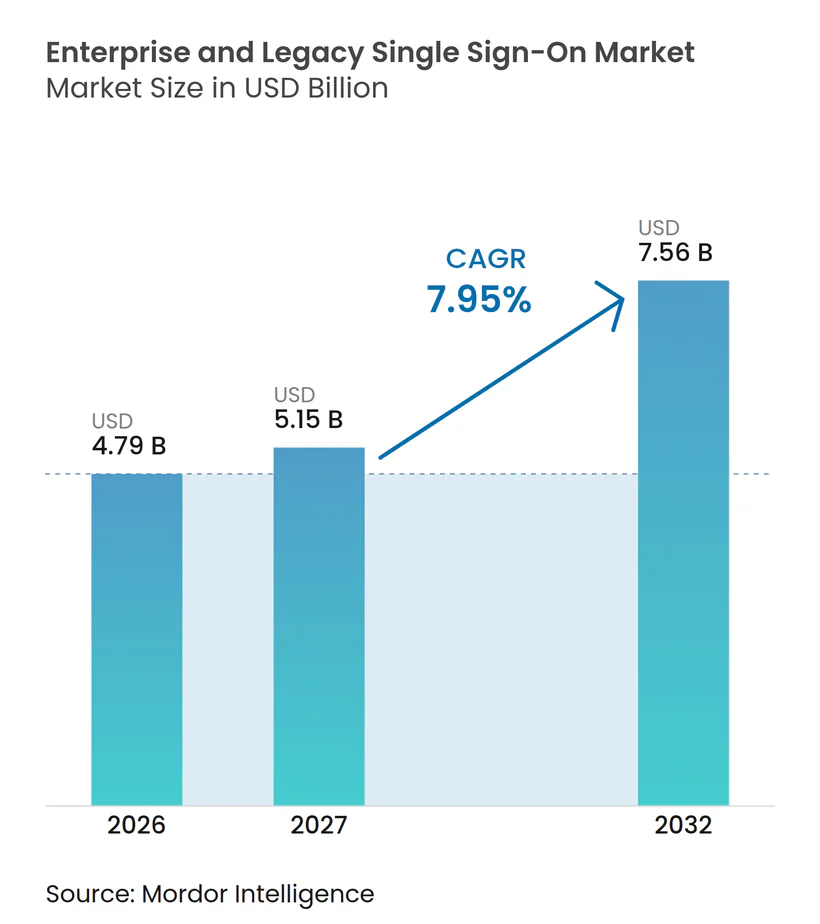
The enterprise and legacy single sign-on market size is projected to expand from USD 4.79 billion in 2026 and USD 5.15 billion in 2027 to USD 7.56 billion by 2032, registering a CAGR of 7.95% between 2027 to 2032. The enterprise and legacy single sign-on market has moved beyond convenience features into a core control layer for identity-first security across cloud, on-premises, and mainframe systems. Zero Trust requirements, expanding use of software-as-a-service, and credential theft are bringing security, risk, and compliance teams into purchasing decisions. The resulting buying process favors platforms that can enforce common policies and maintain audit records across diverse applications. DORA and NIS2 are shortening modernization timelines for regulated organizations in Europe, while strong authentication requirements are shaping procurement in other regions. Competition centers on cloud-hosted identity services, legacy application connectivity, and the ability to support new forms of non-human access without leaving older systems behind.
Key Report Takeaways
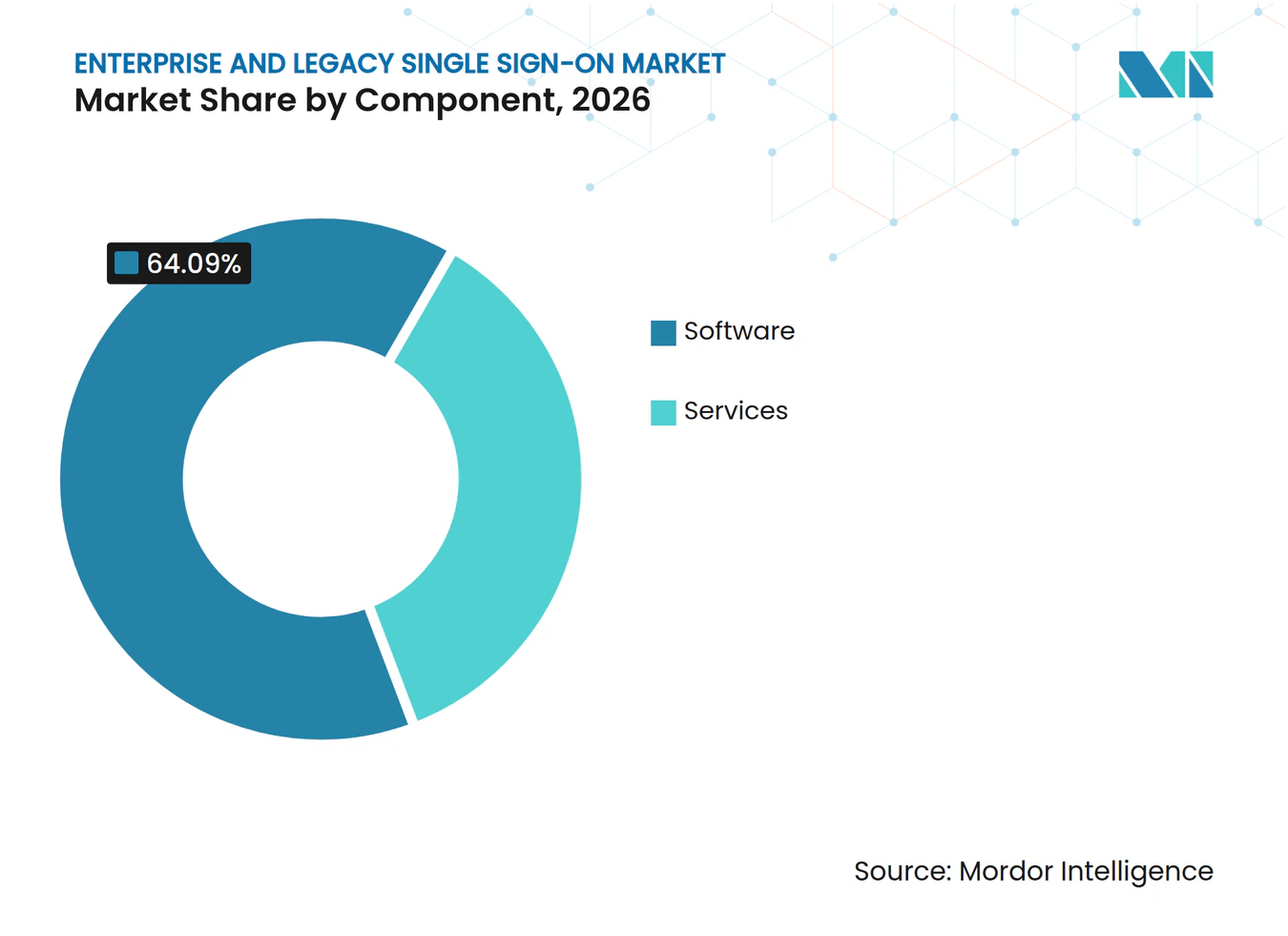
- By component, software held 64.09% of revenue in 2026, while services are projected to expand at an 8.35% CAGR through 2032.
- By deployment mode, cloud-based SSO accounted for 57.55% of the enterprise and legacy single sign-on market in 2026 and is projected to grow at an 8.54% CAGR through 2032.
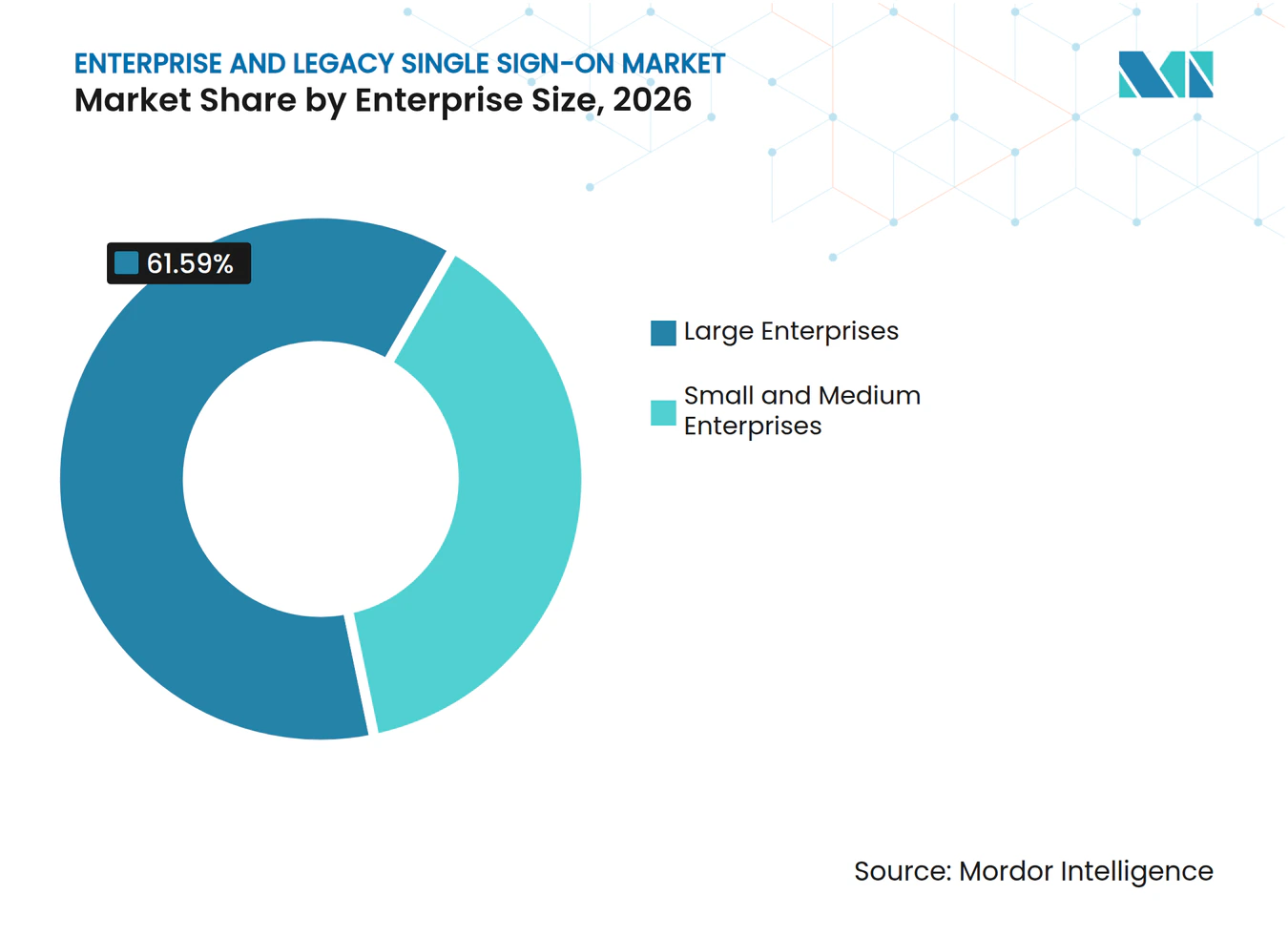
- By enterprise size, large enterprises accounted for 61.59% of revenue in 2026, while SMEs are projected to grow at an 8.37% CAGR through 2032.
- By SSO type, federated and web-based SSO held 49.21% of revenue in 2026, while healthcare-integrated SSO configurations are projected to expand at an 8.48% CAGR through 2032.
- By application environment, cloud and SaaS applications held 46.42% of revenue in 2026, while developer tools and SDKs are projected to expand at an 8.92% CAGR through 2032.
- By industry vertical, BFSI accounted for 23.07% of revenue in 2026, while healthcare and life sciences are projected to expand at a 9.33% CAGR through 2032.
- By geography, North America held 38.44% of revenue in 2026, while Asia-Pacific is projected to expand at an 8.96% CAGR through 2032.
Note: Market size and forecast figures in this report are generated using Mordor Intelligence’s proprietary estimation framework, updated with the latest available data and insights as of January 2026.
Market Trends and Insights
Drivers Impact Analysis of Enterprise and Legacy Single Sign-On Market*
| Driver | (~) % Impact on CAGR Forecast | Geographic Relevance | Impact Timeline |
|---|---|---|---|
| Zero Trust Architecture Adoption | +2.1% | Global | Medium term (2-4 years) |
| Cloud and SaaS Application Proliferation | +1.8% | Global | Short term (≤ 2 years) |
| Escalating Credential Theft and Account Takeover Risk | +1.3% | Global | Short term (≤ 2 years) |
| Regulatory Requirements for Strong Authentication and Auditability | +1.0% | North America and EU | Medium term (2-4 years) |
| Brownfield Identity Bridging for Mainframe and Thick-Client Applications | +0.6% | North America and EU | Long term (≥ 4 years) |
| Passkey Migration Through SSO Control Planes | +0.4% | North America, EU, and Asia-Pacific | Long term (≥ 4 years) |
| Source: Mordor Intelligence | |||
Zero Trust Architecture Adoption
Zero Trust practices make every access request subject to verification, which places federation and centralized policy enforcement at the center of access controls. This approach makes identity platforms a continuing security investment rather than an optional usability project. HPE reported that 82% of surveyed security and IT professionals considered Universal Zero Trust Network Access essential, while only 17% had fully implemented it. The gap leaves many organizations funding identity modernization in stages, and the enterprise and legacy single sign-on market benefits from this long implementation cycle. AI systems that operate across applications also require short-lived identities and immediate revocation when access changes. Cloud-hosted SSO control planes can issue and withdraw these credentials across several connected systems, giving security teams a common way to define how automated activity is authorized, monitored, and stopped when an agent, user, or device should no longer retain access.
Cloud and SaaS Application Proliferation
A growing number of cloud applications gives organizations more separate authentication endpoints to protect and manage. The enterprise and legacy single sign-on market, therefore, serves as an integration layer for applications that would otherwise rely on separate credentials. Okta reported that technology buyers increasingly expect enterprise-ready identity capabilities when procuring SaaS. Every additional application requires policies, connection settings, and ongoing support for federation standards such as SAML and OpenID Connect. Centralizing these controls can make access reviews and employee changes more consistent across the application portfolio. It also makes unsupported or newly adopted applications more visible to identity teams, which can then decide whether those applications need a formal connection, a compensating control, or a managed exception under the organization’s broader access policy.
Escalating Credential Theft and Account Takeover Risk
Credential theft continues to provide attackers with a direct route into enterprise systems and reinforces the need for stronger, centralized authentication. Verizon found that stolen credentials appeared in 22% of breaches reviewed in its 2025 report and in 88% of attacks against basic web applications.[1] Verizon also reported that credential stuffing accounted for a median of 19% of daily enterprise authentication attempts, rising to 25% at large enterprises. A single hardened identity broker can reduce dependence on separate password stores across a large application estate. This does not remove the need for security monitoring, because authenticated sessions and tokens can also be compromised. It does, however, give organizations a common location to implement stronger authentication and investigate suspicious sign-ins, which helps security teams respond consistently when an access pattern deviates from normal user behavior or when a credential is known to have been exposed.
Regulatory Requirements for Strong Authentication and Auditability
Regulatory obligations are making identity spending less discretionary for financial institutions and other essential entities. DORA has been applied since January 17, 2025, and sets digital operational resilience requirements for EU financial entities. NIS2 requires essential and important entities to consider measures, including multi-factor or continuous authentication, under Article 21. PCI DSS v4.0 also brought future-dated authentication requirements into effect in March 2025 for applicable payment environments. These frameworks underscore the value of a unified control plane that enforces authentication requirements and retains usable audit records, while giving compliance and security teams a clearer view of which applications, users, and access events fall within the organization’s regulated operating scope. They also make implementation quality important because organizations must demonstrate that their access controls operate across the full scope of covered applications, including older systems that may not support the same authentication methods as those used by recently deployed cloud services.
Restraints Impact Analysis of Enterprise and Legacy Single Sign-On Market*
| Restraint | (~) % Impact on CAGR Forecast | Geographic Relevance | Impact Timeline |
|---|---|---|---|
| Integration Complexity Across Heterogeneous Legacy Estates | -2.1% | Global | Long term (≥ 4 years) |
| Identity Consolidation and Vendor-Bundling Pressure | -1.5% | North America and EU | Medium term (2-4 years) |
| Credential-Mapping Fragility in Mainframe and Thick-Client Workflows | -0.9% | Global | Long term (≥ 4 years) |
| Residual Password and Session-Token Exposure in Screen-Scraping SSO | -0.7% | Global | Medium term (2-4 years) |
| Source: Mordor Intelligence | |||
Integration Complexity Across Heterogeneous Legacy Estates
Older identity environments remain difficult to connect because their data models do not always align with modern SAML assertions or OpenID Connect tokens. The enterprise and legacy single sign-on market must address systems that use IBM RACF, CA ACF2, CA Top Secret, Kerberos directories, and newer cloud identity providers. IBM described a configuration that uses a Credential Mapper plug-in, PassTicket generation roles, and synchronization between an external identity provider and a RACF database.[2] Each added application may require mapping work and testing across several technical teams. This work is especially demanding for SAP ECC, IBM CICS, and thick-client applications, where authentication flows, client behavior, and authorization records may have evolved over several years without a common integration design. The complexity can extend project timelines and cause professional services costs to exceed the value of a platform license.
Identity Consolidation and Vendor-Bundling Pressure
Bundled identity services can limit the need for a separate SSO platform when an organization already uses a broader productivity or security suite. Microsoft Entra ID is a significant example because it is included within selected Microsoft 365 licensing packages. This pressure makes feature parity insufficient for independent providers in the enterprise and legacy single-sign-on markets. Thales found that BFSI respondents used an average of 4 identity vendors and that 89% sought to reduce this number. Consolidation can favor broad platform vendors, particularly when purchasing teams prioritize fewer suppliers. Specialists must demonstrate clear value through deep connectors, orchestration, mainframe integration, or more focused security operations capabilities, particularly when a bundled product does not support the organization’s legacy access paths or operational requirements.
*Our forecasts treat driver/restraint impacts as directional, not additive. The impact forecasts reflect baseline growth, mix effects, and variable interactions.
Enterprise and Legacy Single Sign-On Market Segment Analysis
By Component:
Software Leads While Services Support Complex DeploymentsSoftware held 64.09% of the enterprise and legacy single sign-on market share in 2026, reflecting customer demand for direct control of authentication policy engines, policy exceptions, and audit-log retention across regulated business processes. Regulated organizations often need a clear chain of custody for each authentication event. The enterprise and legacy single sign-on market supports this requirement through configurable policies that can be applied across connected applications. Licensed software remains relevant for on-premises and hybrid deployments that require deep directory integration. These customers may prefer to retain policy ownership rather than delegate it entirely to an outside service. Vendors with established legacy connector libraries can benefit from long multiyear relationships in these environments, because replacing a working connection can introduce operational risk and require renewed security validation.
Services are projected to expand at an 8.35% CAGR through 2032 as organizations seek help with deployment, configuration, and migration work. Embedded and transactional magic-link authentication is part of this service opportunity in partner gateways and ERP approval workflows, where organizations need to support external users without requiring them to manage an additional permanent password. A magic link gives a user a time-limited, single-use URL instead of requiring a password. This method can be useful in brownfield settings where users resist hardware keys or biometric enrollment. It also reduces the need for client-side changes in selected legacy workflows. The services opportunity remains linked to the difficulty of fitting modern authentication practices around older application behavior, changing user populations, and application owners with different operating requirements.


By Deployment Mode:
Cloud-Based SSO Establishes the Default ArchitectureCloud-based SSO accounted for 57.55% of revenue in 2026, making it the leading deployment option in the enterprise and legacy single sign-on market. Its position reflects the direct connection between cloud application adoption, distributed work patterns, and the need for a central identity broker that can apply a consistent decision to every sign-in. Cloud providers can distribute policies across SAML, OpenID Connect, and OAuth 2.0 endpoints without waiting for local maintenance windows. Continuous security updates can also reach connected applications more quickly. Hybrid models remain important for organizations moving applications in stages. On-premises SSO retains a role in air-gapped networks and other environments with strict local-control requirements, including organizations that cannot place sensitive directories or authentication records outside their own facilities.
Cloud-based SSO is projected to grow at an 8.54% CAGR through 2032, driven by migration to large cloud environments and the adoption of automated workloads. These workloads require narrowly scoped credentials that can be revoked in real time as access changes. Okta, Ping Identity, and JumpCloud all introduced capabilities for AI-related identity use cases in 2026. Regional data requirements also shape cloud deployment decisions in India, Singapore, and Australia, where customers may need identity data, security logs, and recovery processes to remain within an approved geography. Providers that can support data residency requirements without fragmenting policy management have a clearer position with regulated buyers, because local hosting expectations should not prevent administrators from applying the same baseline access rules, logging practices, and response procedures across the wider organization. The enterprise and legacy single sign-on market must therefore support cloud expansion while preserving links to systems that cannot move, so that a mixed technology estate does not create separate and inconsistent access rules.
By Enterprise Size:
Large Enterprises Hold the Leading Position While SMEs AdvanceLarge enterprises held 61.59% of revenue in 2026 because they manage more complex application portfolios and broader compliance obligations. Their identity teams must coordinate access across business units, jurisdictions, older platforms, temporary external users, and the applications acquired through corporate transactions. The enterprise and legacy single sign-on market is particularly relevant where a large organization has several existing identity products. Thales reported that 75% of surveyed BFSI identity decision-makers identified legacy identity systems as their largest operational pain point. Centralized SSO helps these customers set common sign-in policies while preserving application-specific access rules. The value proposition is strongest where authentication failures affect transaction processing, customer service, regulatory compliance, or the continuity of business functions that depend on several connected systems.
SMEs are projected to expand at an 8.37% CAGR through 2032 as subscription delivery reduces entry costs for more advanced identity tools. Per-user pricing in the USD 2-7 per month range has reduced a barrier that once limited these controls to larger organizations. Cloud services can also reduce the internal infrastructure work needed to begin using SSO, allowing smaller teams to concentrate on configuring policies and connecting priority applications rather than maintaining authentication infrastructure. Smaller businesses still need to connect their customer-facing applications, employee systems, and third-party services without a large identity engineering team. This creates demand for simpler deployment paths and prebuilt connectors. Providers serving SMEs must balance ease of use with credible controls for compliance and audit requirements, especially when smaller organizations serve larger customers that expect formal identity controls from their suppliers

By SSO Type:
Federated And Web-Based SSO Leads While Healthcare Configurations AdvanceFederated and web-based SSO held 49.21% of revenue in 2026, supported by the widespread use of SAML 2.0, OpenID Connect, and OAuth 2.0. These standards enable common authentication patterns across cloud tenants, partner portals, and business-to-business software links. They are the primary connection method for web-based systems in the enterprise and legacy single sign-on markets, helping application owners use a recognized standard rather than building a separate authentication process for each connection. Enterprise and legacy SSO remain strategically important for organizations that operate IBM z/OS, SAP ECC, desktop applications, or terminal emulators. Those environments often use Kerberos, NTLM pass-through, or specialized authentication methods. Full modernization may require extensive application changes that are not practical for every organization, particularly when a business-critical system has been stable for years, and its internal authentication logic is difficult to alter.
Healthcare-integrated configurations are projected to expand at an 8.48% CAGR through 2032. Their demand is tied to electronic health record interoperability, SMART on FHIR adoption, and telehealth workflows. Healthcare organizations must apply role-based access to information that differs in sensitivity and must retain access logs. Clinical tools may also run on thin clients or specialized hardware that requires careful integration, because the sign-in process must fit time-sensitive workflows without creating inappropriate access to patient information. IBM has documented an OpenID Connect path for SSO to z/OS applications through HATS Web Express Logon and IBM Z Multi-Factor Authentication. These conditions support demand for specialists that can bring modern authentication to complex clinical and administrative environments, while allowing providers to retain the applications and devices that their workforce already depends on.
By Application Environment:
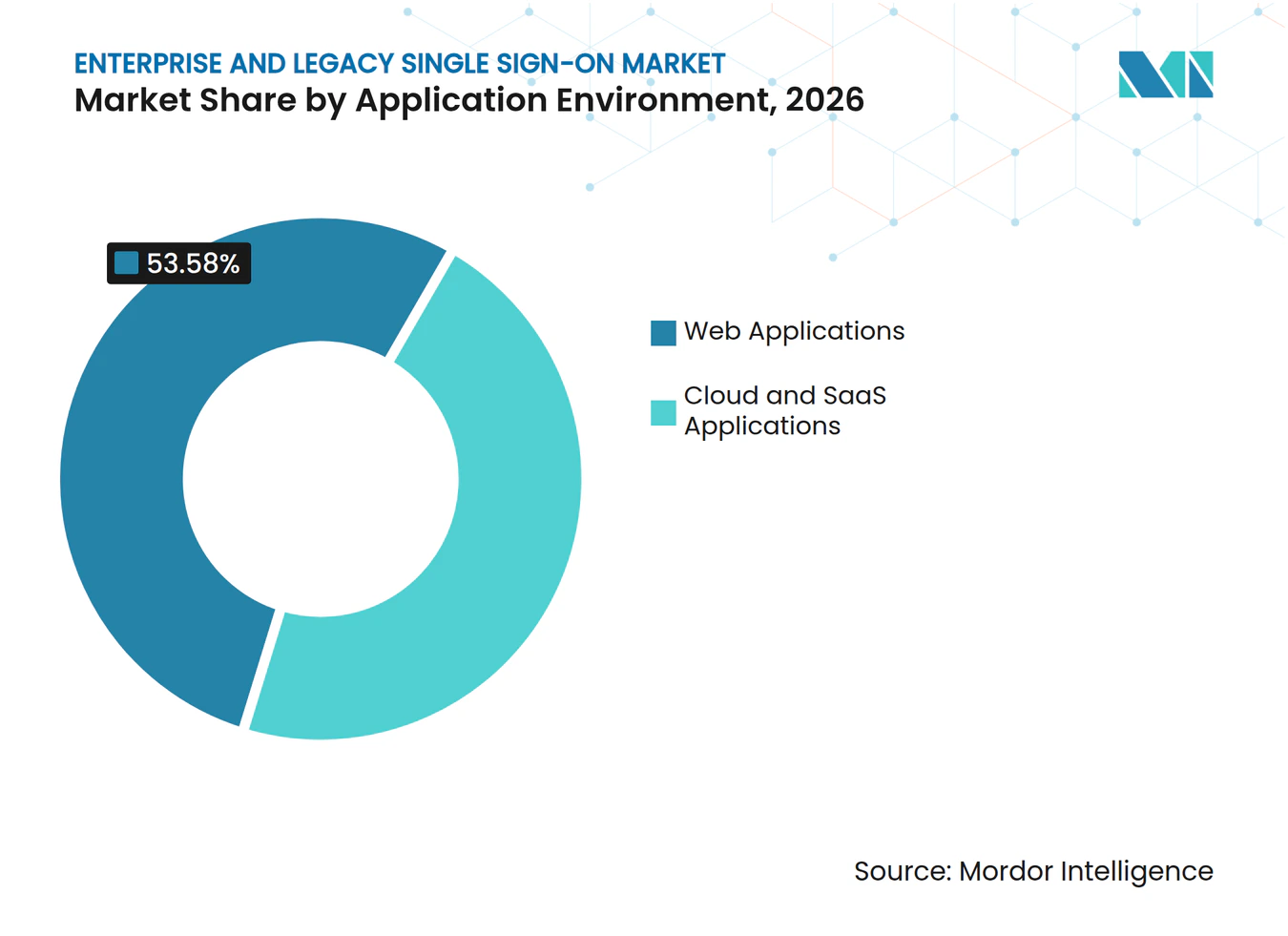
Cloud And SaaS Applications Lead While Developer Tools Gain PaceCloud and SaaS applications accounted for 46.42% of revenue in 2026, reflecting the prominence of web-based workloads in enterprise authentication. Each connected application requires SAML or OpenID Connect settings that must remain up to date as the vendor updates its product. The enterprise and legacy single sign-on market helps administrators use shared policy controls across these connections. Web applications and on-premises client-server systems remain substantial deployment environments. Mainframe and virtual desktop settings form narrower categories that often require deeper integration. Their technical complexity can support higher-value implementation work where general connectors are insufficient, because specialists must translate modern identity decisions into interfaces that were not originally designed for standards-based federation.
Developer tools and SDKs are projected to expand at an 8.92% CAGR through 2032, the fastest rate among application environments. Identity is becoming a build-time choice for teams creating internal platforms and AI-related orchestration layers. Okta reported that 96% of technology buyers include identity and access management requirements in SaaS vendor requests for proposal. This puts SDK quality and developer documentation closer to the buying decision, because development teams need clear implementation guidance, stable libraries, and predictable support when they embed authentication features into applications that will be maintained over several release cycles. Vendors with broad SDK support can make it easier for teams to incorporate sign-in, token, and authorization functions earlier in the development process. The opportunity also depends on continued demand for connected application ecosystems, because development teams need identity functions that can be consistently incorporated into new internal services, partner links, and customer experiences as these are created and maintained across increasingly distributed technology environments over time.

By Industry Vertical:
BFSI Anchors Revenue While Healthcare And Life Sciences AccelerateBFSI accounted for 23.07% of revenue in 2026, the largest vertical position in the enterprise and legacy single sign-on market. Banks, insurers, and financial services firms operate numerous applications subject to strict availability and audit requirements. They face intersecting requirements from payment standards, DORA, national banking rules, and internal risk programs. These conditions make consistent authentication and immutable audit records important across application tiers, from employee access to payment systems to supplier connections, which may be subject to different control requirements. Thales found that BFSI workforce identity budgets were expected to increase by 11.5% annually among the surveyed organizations. Identity projects in this vertical must minimize operational disruption, as authentication problems can interrupt transaction processing, delay customer activity, and expose institutions to operational and compliance risks.
Healthcare and life sciences are projected to expand at a 9.33% CAGR through 2032. Telehealth normalization, electronic health record consolidation, and access logging requirements are increasing the number of systems that must share controlled sign-in processes. Providers use SSO for employee applications, patient portals, laboratory interfaces, and connected device management consoles. The varied user groups require policies that reflect their roles and the sensitivity of the data they may view, with a clear need to distinguish among clinical, administrative, patient, partner, and device access. Retail and e-commerce use SSO to support connected customer and workforce journeys across channels. Education is also adopting federated identity for research collaboration, including arrangements supported by the InCommon Federation, which provides a shared trust approach for participating institutions and their users.
Geography Analysis
North America Enterprise and Legacy Single Sign-On Market
North America held 38.44% of the enterprise and legacy single sign-on market share in 2026, supported by a mature identity services ecosystem and a large base of regulated enterprises. Federal cybersecurity direction in the United States has reinforced the use of phishing-resistant authentication for government-related environments. The enterprise and legacy single sign-on market in the region also benefits from complex technology estates that span cloud services, locally managed directories, and mainframe applications. Canada adds demand through technology-risk expectations for financial institutions, where reliable access controls and evidence of technology-risk management remain important to regulated firms. Large enterprises in the region are more likely to have established identity teams that can manage broad modernization programs, coordinate several application owners, and maintain specialized security and compliance functions.
Europe Enterprise and Legacy Single Sign-On Market
Europe is the second-largest region, where DORA became applicable in January 2025, and NIS2 expanded cybersecurity expectations across 18 sectors.[3] These overlapping obligations make a unified SSO control plane relevant to organizations that operate across legal entities and jurisdictions. Germany, France, and the United Kingdom are key sources of procurement activity because of their large regulated enterprise bases. GDPR, DORA, and NIS2 together increase the importance of demonstrating controlled access and reliable records. This supports ongoing identity investment even when organizations take a cautious approach to broader technology spending, because a failure to address authentication and audit obligations can create a more immediate compliance exposure.
APAC, MEA and South America Enterprise and Legacy Single Sign-On Market
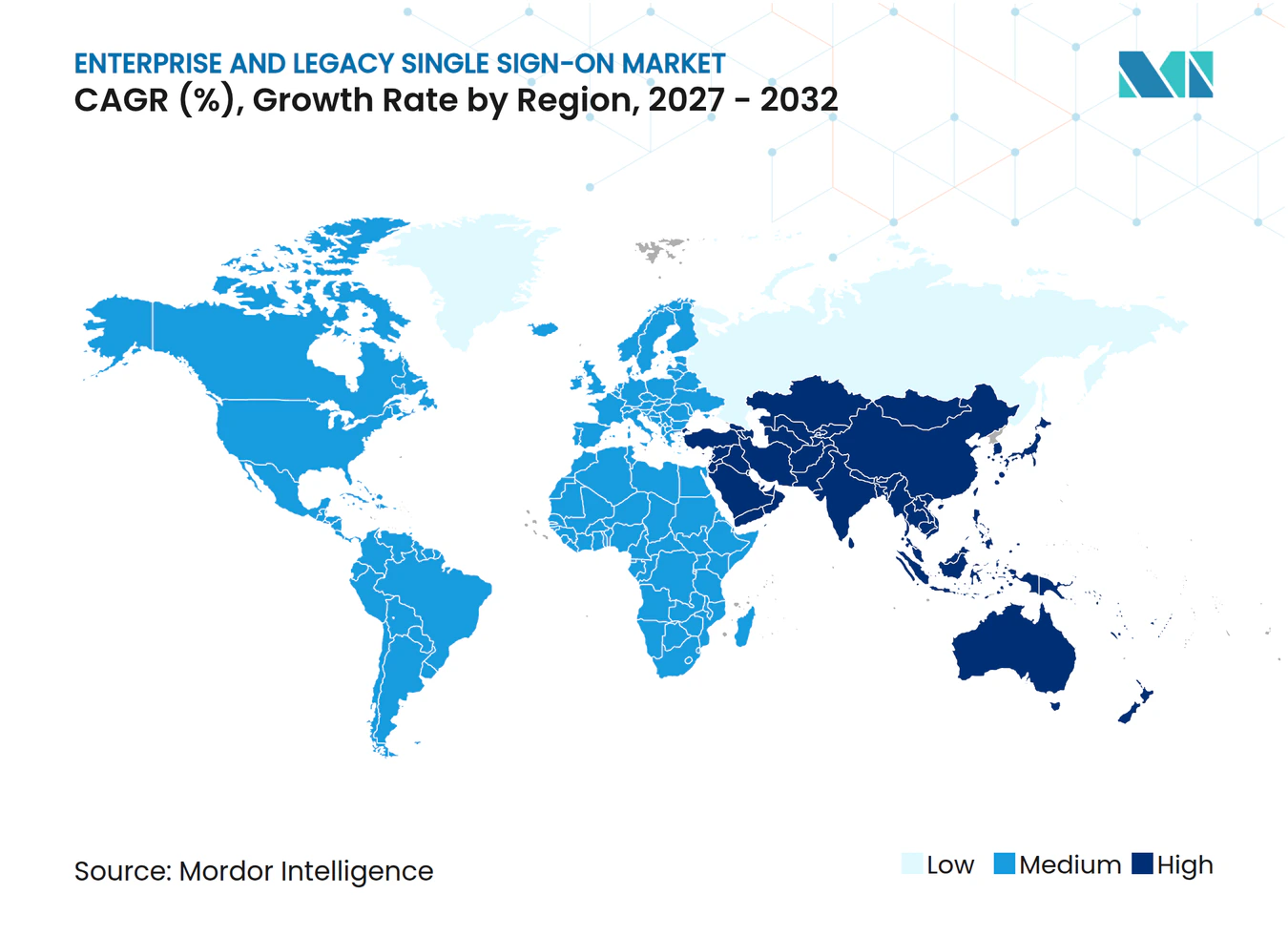
Asia-Pacific is projected to expand at an 8.96% CAGR through 2032, the fastest regional rate in the enterprise and legacy single sign-on market. Infrastructure investment in India and Southeast Asia, rising identity threats, and data-localization requirements shape the regional opportunity. China, India, and Singapore are encouraging architectures that retain appropriate regional control over identity data. High acceptance of mobile biometric use in India and South Korea can increase demand for platforms with native mobile binding. Japan has a sizeable enterprise base with varied legacy estates, while Australia and Singapore have adopted Zero Trust approaches early. The Middle East and Africa are supported by digital government programs in the UAE and Saudi Arabia, and South America is led by Brazil, where privacy-law enforcement is increasing demand for an auditable identity infrastructure.
Competitive Landscape
Market Concentration
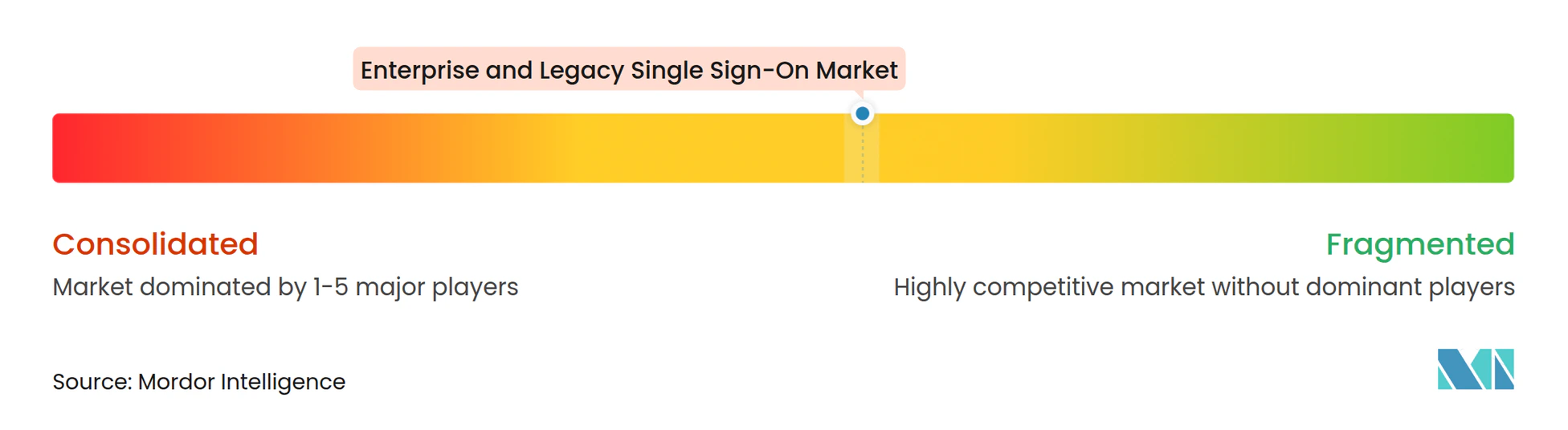
The enterprise and legacy single sign-on market is moderately concentrated, with specialized identity providers competing against larger security and productivity platforms that bundle SSO with broader offerings. Microsoft exerts price pressure through Entra ID, while pure-play vendors seek differentiation through identity depth, integration capabilities, and security operations. Okta reported fiscal year 2026 revenue of USD 2.919 billion, up 12% from the prior year.[4] This result shows the continuing scale of subscription revenue in workforce identity despite bundled competition. The competitive field is also changing through acquisition activity and product consolidation, as providers seek to combine authentication, privileged access, threat detection, and governance capabilities in a more integrated offering.
Okta acquired Axiom Security in September 2025 for USD 54 million in cash, adding identity-focused privileged-access capabilities to its Workforce Identity Cloud. This move extended its position from federation toward just-in-time access and privileged controls. JumpCloud acquired Breez in October 2025 to advance its identity threat detection and response roadmap. Ping Identity introduced just-in-time privileged access in August 2025 across access management, governance, and privileged access. These actions show that vendors are competing through the security controls that surround authentication, not only through protocol support, since customers increasingly evaluate how a platform handles privileged access, threats, and post-authentication activity.
Open opportunities remain in mainframe bridging, non-human identities, and compliance-oriented deployment for smaller organizations. Few suppliers offer mature RACF-to-OpenID Connect integration, leaving room for specialists that can preserve older investments while applying modern policy controls, connect established directories to cloud identity providers, and limit the need for a disruptive application replacement program. FIDO Alliance reported 5 billion passkeys in active use globally in May 2026 and said 68% of organizations had deployed passkeys for workforce sign-ins. This is changing how vendors position their SSO capabilities, particularly where certified FIDO2 support is expected. The enterprise and legacy single sign-on market also includes vendors such as Strata Identity that focus on orchestration across existing identity investments. Competition is likely to remain strongest where customers need both modern controls and practical links to applications that cannot be rewritten, a requirement that combines cloud-scale policy management with careful treatment of legacy operating constraints.
Enterprise and Legacy Single Sign-On Industry Leaders
-
Ping Identity Corporation
-
Okta, Inc.
-
One Identity LLC
-
JumpCloud, Inc.
-
Palo Alto Networks
- *Disclaimer: Major Players sorted in no particular order
Enterprise and Legacy Single Sign-On Market Companies Covered in this Report
- Okta, Inc.
- Ping Identity Corporation
- One Identity LLC
- JumpCloud, Inc.
- CyberArk Software Ltd.
- SailPoint Technologies, Inc.
- SecureAuth Corporation
- miniOrange, Inc.
- LoginRadius Inc.
- FusionAuth, Inc.
- EmpowerID, Inc.
- Avatier Corporation
- Simeio Solutions, LLC
- Saviynt, Inc.
- HYPR Corp.
- 1Kosmos, Inc.
- Strata Identity, Inc.
- WSO2 LLC
- Axiad IDS, Inc.
- StrongKey, Inc.
- Ilantus Technologies Private Limited
- iWelcome B.V.
Recent Industry Developments in Enterprise and Legacy Single Sign-On Market
- September 2026: Okta made Agent SSO generally available on August 24, 2026, Ping Identity launched Enterprise Personal Agent Access on September 1, 2026, and JumpCloud extended Agentic IAM on September 10, 2026, formally establishing agentic authentication, unique, short-lived per-agent tokens with instant revocation, as a standard SSO capability tier.
- August 2026: Okta completed its acquisition of Permiso Security on August 26, 2026, for approximately USD 200 million in cash following the July 30, 2026 deal announcement. Permiso's identity threat detection and response capabilities extend Okta's SSO platform to detect post-authentication anomalous access and compromised token activity in real time.
- June 2026: JumpCloud launched Agentic IAM on Google Cloud on June 11, 2026, making it available within the Google Cloud Marketplace. Ping Identity extended its Runtime Identity framework across AWS, Google Cloud, and Cloudflare on June 16, 2026, enabling real-time, policy-enforced authorization for autonomous AI agent workloads.
- April 2026: JumpCloud launched Agentic IAM on April 27, 2026, introducing unique agent identities with instant revocation, automated discovery of MCP configurations, and uniform policy enforcement across SaaS tools accessed by machine accounts. The launch positioned JumpCloud as the first mid-market-focused vendor offering enterprise-grade agentic identity governance.
Global Enterprise and Legacy Single Sign-On Market Report Scope
The Enterprise and Legacy Single Sign-On Market is the global market for software solutions and services that enable organizations to centrally manage user authentication and provide secure access to multiple enterprise applications, systems, and IT environments with a single set of login credentials. These solutions support federated and web-based authentication, enterprise and legacy application integration, and Windows integrated authentication across modern cloud and SaaS applications, web applications, on-premises client-server systems, mainframe and host environments, and virtual desktop and remote applications.
The Enterprise and Legacy Single Sign-On Market is Segmented by Component (Software and Services), Deployment Mode (Cloud-Based SSO, On-Premises SSO, and Hybrid SSO), Enterprise Size (Large Enterprises and Small and Medium Enterprises), SSO Type (Federated and Web-Based SSO, Enterprise and Legacy SSO, and Windows Integrated SSO), Application Environment (Cloud and SaaS Applications, Web Applications, On-Premises Client-Server Applications, Mainframe and Host Applications, and Virtual Desktop and Remote Applications), Industry Vertical (BFSI, IT and Telecom, Healthcare and Life Sciences, Retail and E-Commerce, Public Sector and Utilities, Education, and Other Industry Verticals), and Geography (North America, South America, Europe, Asia-Pacific, Middle East, and Africa). The Market Forecasts are Provided in Terms of Value (USD).
Segmentation Overview
| Software |
| Services |
| Cloud-Based SSO |
| On-Premises SSO |
| Hybrid SSO |
| Large Enterprises |
| Small and Medium Enterprises |
| Federated and Web-Based SSO |
| Enterprise and Legacy SSO |
| Windows Integrated SSO |
| Cloud and SaaS Applications |
| Web Applications |
| On-Premises Client-Server Applications |
| Mainframe and Host Applications |
| Virtual Desktop and Remote Applications |
| BFSI |
| IT and Telecom |
| Healthcare and Life Sciences |
| Retail and E-Commerce |
| Public Sector and Utilities |
| Education |
| Other Industry Verticals |
| North America | United States |
| Canada | |
| Mexico | |
| South America | Brazil |
| Argentina | |
| Chile | |
| Rest of South America | |
| Europe | Germany |
| United Kingdom | |
| France | |
| Italy | |
| Spain | |
| Rest of Europe | |
| Asia-Pacific | China |
| Japan | |
| India | |
| South Korea | |
| Australia | |
| Singapore | |
| Malaysia | |
| Rest of Asia-Pacific | |
| Middle East | Saudi Arabia |
| United Arab Emirates | |
| Turkey | |
| Rest of Middle East | |
| Africa | South Africa |
| Nigeria | |
| Egypt | |
| Rest of Africa |
| By Component | Software | |
| Services | ||
| By Deployment Mode | Cloud-Based SSO | |
| On-Premises SSO | ||
| Hybrid SSO | ||
| By Enterprise Size | Large Enterprises | |
| Small and Medium Enterprises | ||
| By SSO Type | Federated and Web-Based SSO | |
| Enterprise and Legacy SSO | ||
| Windows Integrated SSO | ||
| By Application Environment | Cloud and SaaS Applications | |
| Web Applications | ||
| On-Premises Client-Server Applications | ||
| Mainframe and Host Applications | ||
| Virtual Desktop and Remote Applications | ||
| By Industry Vertical | BFSI | |
| IT and Telecom | ||
| Healthcare and Life Sciences | ||
| Retail and E-Commerce | ||
| Public Sector and Utilities | ||
| Education | ||
| Other Industry Verticals | ||
| By Geography | North America | United States |
| Canada | ||
| Mexico | ||
| South America | Brazil | |
| Argentina | ||
| Chile | ||
| Rest of South America | ||
| Europe | Germany | |
| United Kingdom | ||
| France | ||
| Italy | ||
| Spain | ||
| Rest of Europe | ||
| Asia-Pacific | China | |
| Japan | ||
| India | ||
| South Korea | ||
| Australia | ||
| Singapore | ||
| Malaysia | ||
| Rest of Asia-Pacific | ||
| Middle East | Saudi Arabia | |
| United Arab Emirates | ||
| Turkey | ||
| Rest of Middle East | ||
| Africa | South Africa | |
| Nigeria | ||
| Egypt | ||
| Rest of Africa | ||
Key Questions Answered in the Report
What is the enterprise and legacy single sign-on market size?
The enterprise and legacy single sign-on market is projected to expand from USD 4.79 billion in 2026 and USD 5.15 billion in 2027 to USD 7.56 billion by 2032.
What is driving demand for enterprise and legacy single sign-on solutions?
Zero Trust adoption, cloud application expansion, credential-theft risks, and stronger authentication requirements are driving adoption.
Which deployment model leads enterprise and legacy single sign-on adoption?
Cloud-based SSO held 57.55% of revenue in 2026 and is projected to expand at an 8.54% CAGR through 2032.
Which customer group accounts for the largest share of SSO spending?
Large enterprises held 61.59% of revenue in 2026 because they manage complex application estates and broad compliance programs.
Which vertical is projected to expand fastest for single sign-on deployments?
Healthcare and life sciences is projected to expand at a 9.33% CAGR through 2032, supported by telehealth, electronic health record consolidation, and access logging needs.
Which region is projected to expand fastest for enterprise and legacy single sign-on?
Asia-Pacific is projected to expand at an 8.96% CAGR through 2032, supported by infrastructure investment, threat exposure, and data-localization requirements.