
Engineered Wood Flooring Market Size and Share
Market Overview
| Study Period | 2020 - 2031 |
|---|---|
| Market Size (2026) | USD 19 Billion |
| Market Size (2031) | USD 24.40 Billion |
| Growth Rate (2026 - 2031) | 5.18 % |
| Fastest Growing Market | Asia-Pacific |
| Largest Market | Europe |
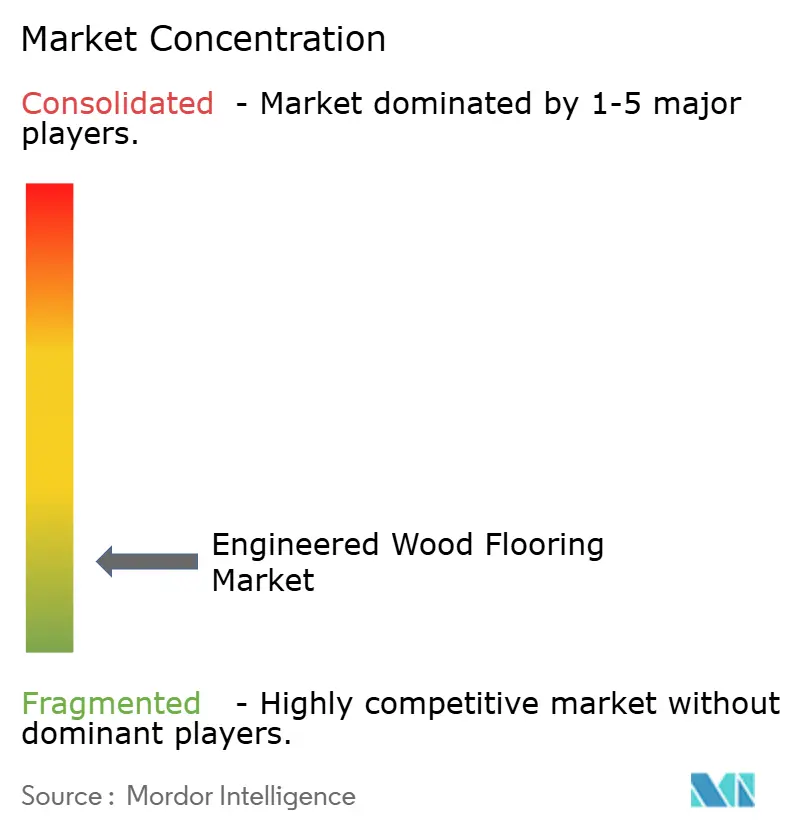
| Market Concentration | Low |
Major Players *Disclaimer: Major Players sorted in no particular order Image © Mordor Intelligence. Reuse requires attribution under CC BY 4.0. | |
Engineered Wood Flooring Market Analysis by Mordor Intelligence
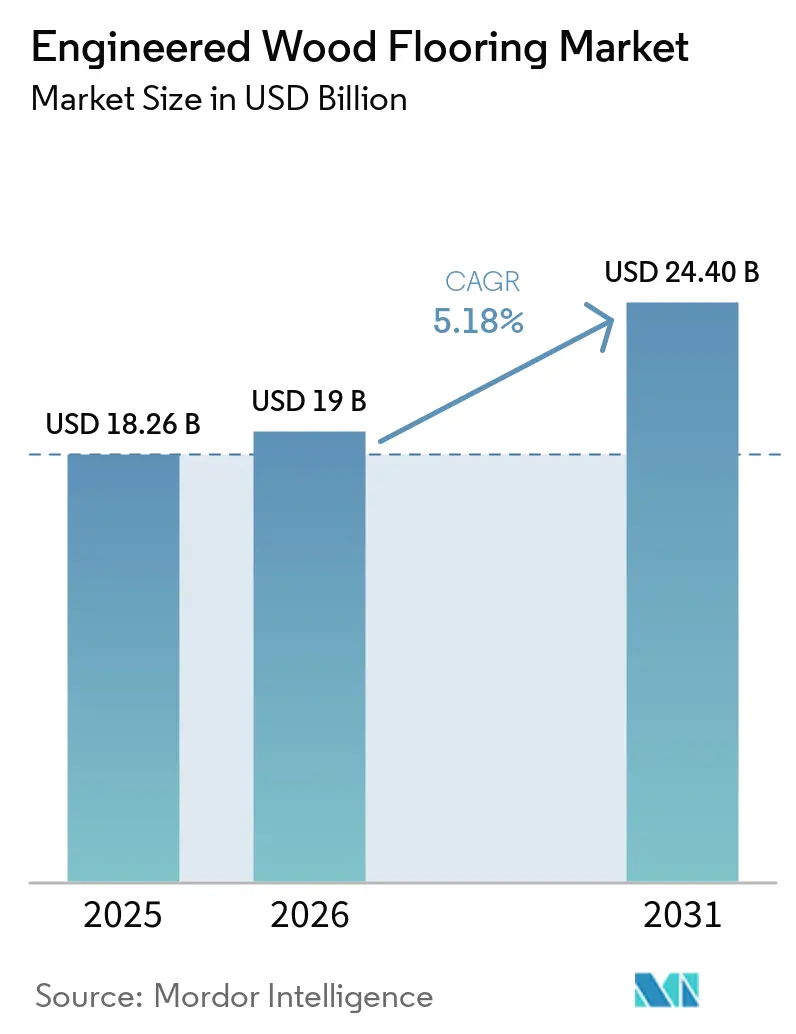
The engineered wood flooring market was valued at USD 18.26 billion in 2025, is estimated at USD 19.00 billion in 2026, and is forecast to reach USD 24.40 billion by 2031, growing at a 5.13% CAGR during 2026–2031. Demand is supported by homeowners who remain in their existing homes and direct spending toward flooring upgrades, especially where moving is less attractive than improving a property already owned. Prefinished planks reduce disruption during renovation work because buyers receive a finished surface without the extended sanding, drying, and finishing process associated with solid boards. Suppliers are responding with moisture-resistant hybrid products, click-lock systems, documented wood sourcing, varied plank widths, and surface treatments intended for heavily used rooms [1]Forest Stewardship Council, “FSC Certification,” Forest Stewardship Council, fsc.org.. These features help manufacturers compete with lower-cost resilient products while supporting premium specifications in renovation, hospitality, workplace, education, and other commercial projects. Compliance capability is becoming an important differentiator for suppliers serving Europe, as wood traceability requirements add cost, increase procurement scrutiny, and can influence which veneer sources a manufacturer can use.
Key Report Takeaways
- By product type, multi-layer engineered wood flooring accounted for 58.1% of the engineered wood flooring market share in 2025, while rigid-core hybrid engineered flooring is forecast to grow at a 6.2% CAGR during 2026–2031.
- By wood species, hardwood held 85.5% of the engineered wood flooring market share in 2025, while softwood veneers are forecast to expand at a 5.7% during 2026–20311.
- By installation method, nail-and-staple methods held 45.7% of the engineered wood flooring market share in 2025, while floating click-lock systems are forecast to grow at a 6.1% CAGR during 2026–2031.
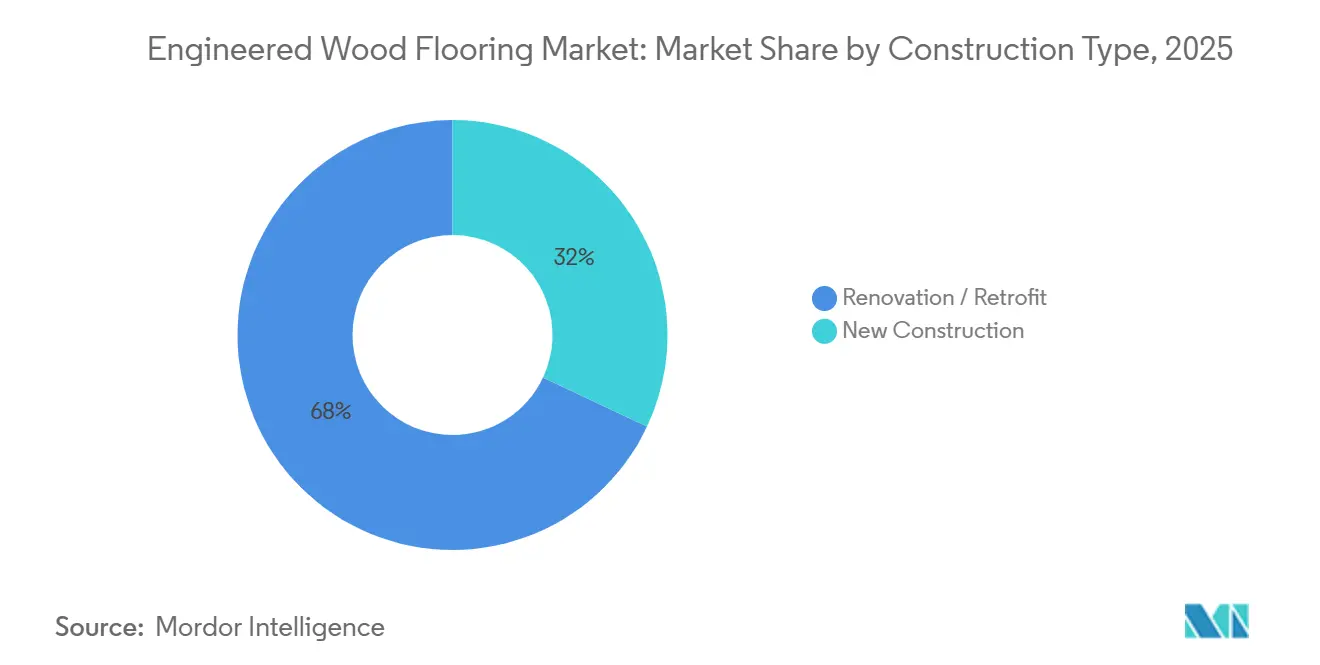
- By construction type, renovation and retrofit projects accounted for 68.1% of the engineered wood flooring market share in 2025, while new construction is forecast to expand at a 5.9% CAGR during 2026–2031.
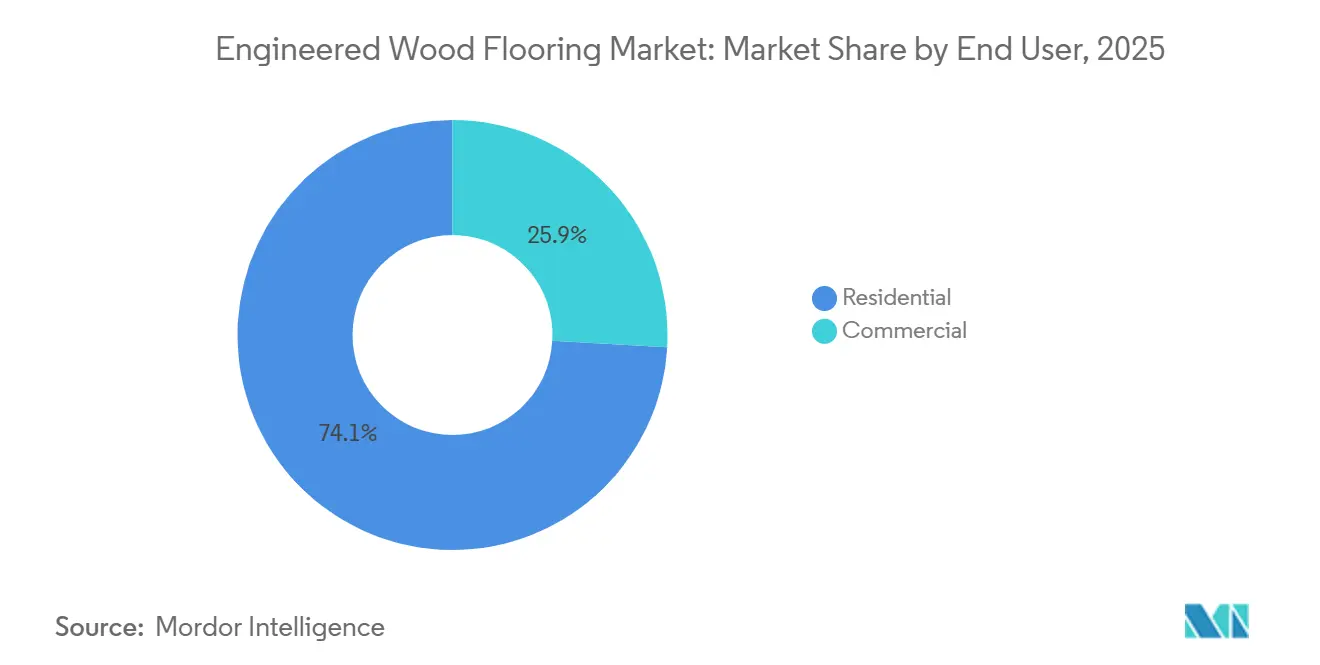
- By end-user, residential users held 74.1% of the engineered wood flooring market share in 2025 and are forecast to grow at a 5.6% during 2026–2031.
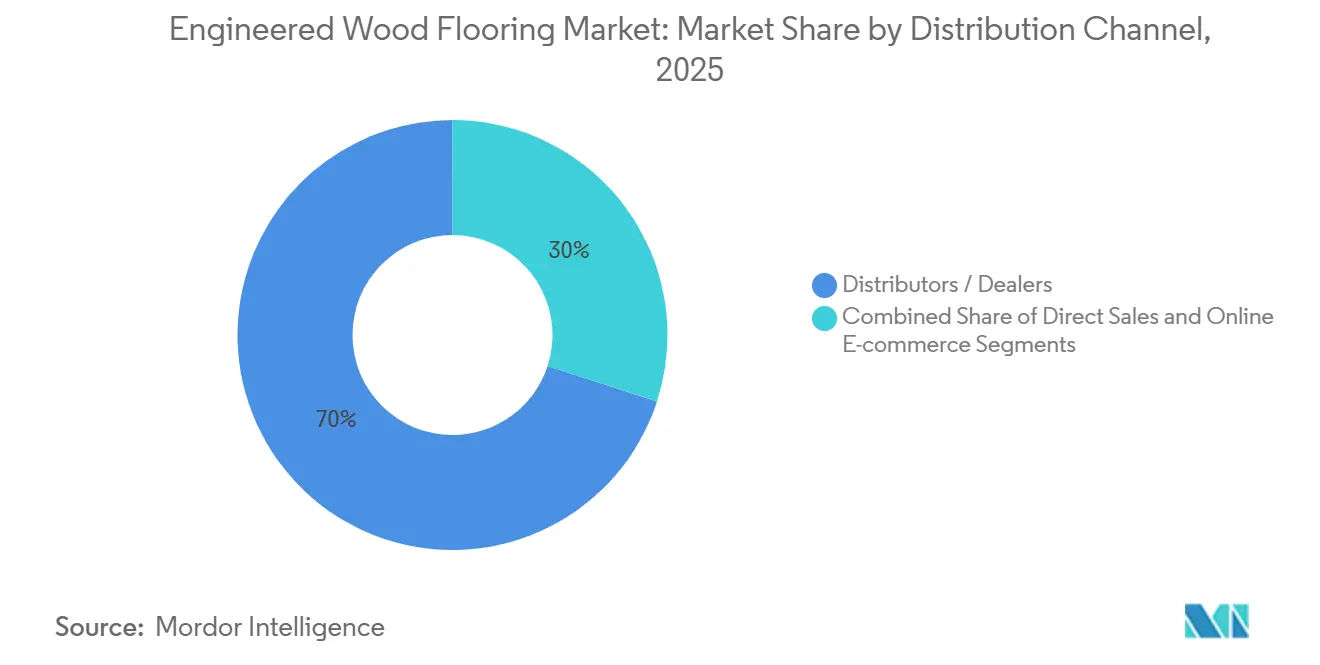
- By distribution channel, B2C and retail channels held 70.3% of the engineered wood flooring market share in 2025, while B2B contractors and builders are forecast to expand at a 6% during 2026–2031.
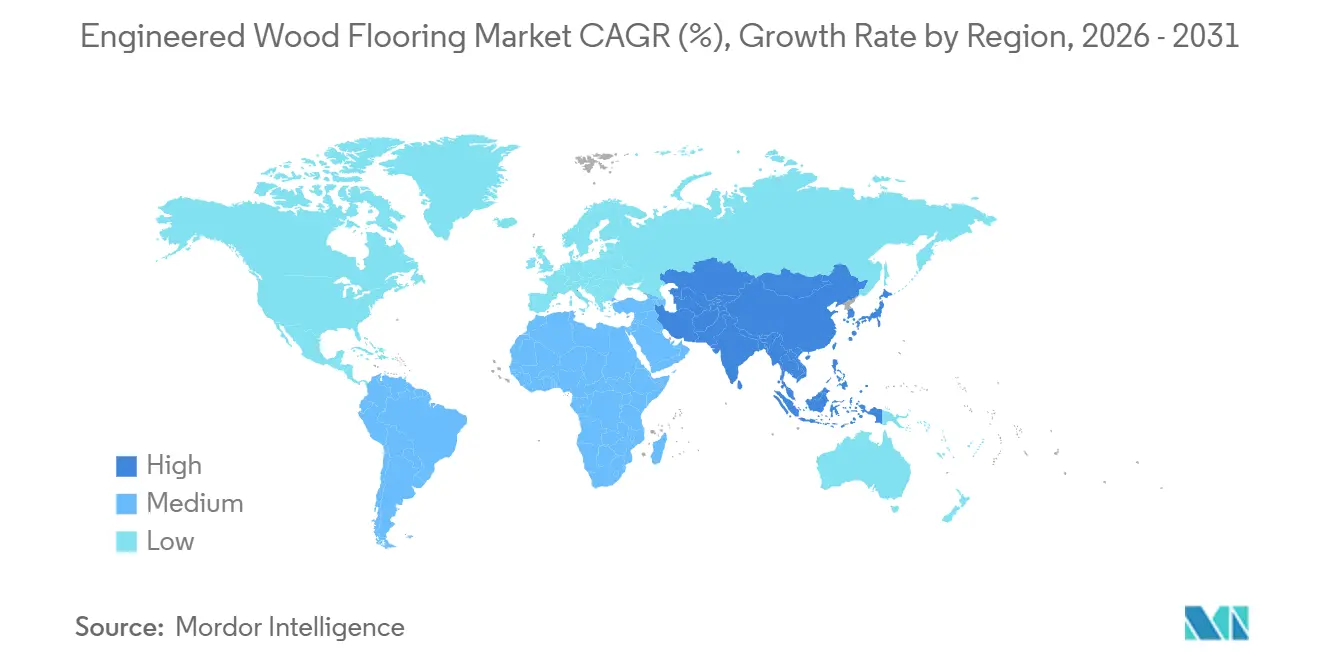
- By geography, Europe held 33.21% of the engineered wood flooring market share in 2025, while Asia-Pacific is forecast to expand at a 6.5% during 2026–2031.
Note: Market size and forecast figures in this report are generated using Mordor Intelligence’s proprietary estimation framework, updated with the latest available data and insights as of January 2026.
Global Engineered Wood Flooring Market Trends and Insights
Drivers Impact Analysis*
| Driver | (~) % Impact on CAGR Forecast | Geographic Relevance | Impact Timeline |
|---|---|---|---|
| Residential replacement cycle and home renovation intensity | +1.8% | Global, concentrated in North America & Europe | Medium term (2-4 years) |
| Engineered share gains over solid hardwood | +1.4% | Global, with Asia-Pacific adoption accelerating | Long term (≥ 4 years) |
| Asia-Pacific construction and housing formation underpinning demand | +1.1% | Asia-Pacific core, spill-over to MEA | Medium term (2-4 years) |
| Underfloor heating compatibility and dimensional stability | +0.4% | Europe & North America, emerging in the Asia-Pacific premium segment | Long term (≥ 4 years) |
| EUDR-driven traceability and certification premium | +0.2% | European Union-bound global exporters have compliance costs distributed across tiers. | Short term (≤ 2 years) |
| Hybrid engineered (veneer-on-rigid core) niche growth | +0.1% | North America and Western Europe are early adopters | Medium term (2-4 years) |
| Source: Mordor Intelligence | |||
Residential Replacement Cycle and Home Renovation Intensity
High borrowing costs keep move-up buyers in place, which channels spending into renovation projects that refresh worn floors and boost perceived home value in resale scenarios. A value uplift associated with wood floors encourages discretionary upgrades to engineered planks, which offer durability, prefinished surfaces, and shorter project timelines compared to site-finished alternatives [2]Derwenthorpe Flooring, “Value Impact and Underfloor Heating Advice,” Derwenthorpe Flooring, derwenthorpeflooring.co.uk . In Europe, renovation-led demand helped stabilize parquet consumption in 2025 after a sharp decline in 2023, underscoring how replacement cycles cushion flooring volumes during weaker construction cycles. Households identify appearance, durability, and maintenance as primary triggers for replacements, which favors engineered constructions that accept factory finishes and resist seasonal movement better than solid wood in occupied homes. Compatibility with radiant heating and moisture barriers supports deeper penetration into kitchens and basements without the post-install disruption of sanding or coating. As homes built from the late 1980s to early 2000s age into prime remodeling years, steady replacement intent reinforces a multi-year runway for the engineered wood flooring market.
Engineered Share Gains Over Solid Hardwood
Engineered wood held 71.98% of the hardwood flooring category in 2025 and is projected to grow at a 6.05% CAGR through 2031, which outpaces solid formats as installers and builders standardize on prefinished planks that reduce callbacks. Multi-layer cores and click-lock systems compress installation time and reduce skill dependencies, which enables faster room turnover in new construction and quicker completion in occupied renovations. Dimensional stability allows direct installation over concrete slabs and supports compatibility with hydronic or electric underfloor heating systems, expanding applications beyond those available with solid nail-down formats. Wide-format designs sustain demand in premium segments where flatter planks and refined edges support clean-line aesthetics without seasonal gapping concerns. Builders use factory-applied finishes that eliminate on-site sanding and coating, tightening project schedules and improving quality across multiple jobs. As product innovation compounds around locking profiles and surface densification, the engineered wood flooring market continues to gain share from traditional solid hardwood lines.
Asia-Pacific Construction and Housing Formation Underpinning Demand
Asia-Pacific is projected to lead growth through 2031 as urban apartment construction, rising disposable incomes, and steady household formation support upgrades from laminate to real-wood veneered floors. Dense multi-family projects depend on quick-turn installations and stable assemblies over concrete subfloors, which aligns with engineered wood’s click systems and prefinished construction. As middle-class households focus on aesthetics that read as upscale but remain practical for maintenance, engineered formats are beginning to displace entry-level laminates in priority rooms. Hospitality and office retrofits in major Asian cities add volume, especially where acoustic underlayments and low-VOC finishes are specified to meet building wellness and sustainability criteria. Certification pathways that include FSC and PEFC strengthen trust among institutional buyers and international brands, thereby improving the premium mix in commercial jobs. The regional pipeline supports continued growth in engineered wood flooring as housing completions normalize and renovation cycles deepen in older urban housing stock.
Underfloor Heating Compatibility and Dimensional Stability
Layered construction in engineered planks supports more stable heat transfer and controlled expansion, making them a preferred choice for hydronic and electric underfloor heating systems. Installers follow temperature caps and moisture controls that maintain plank integrity, while cross-laminated cores accommodate dimensional change within narrow tolerances. Glue-down and floating methods over radiant systems reduce energy loss and enable even warmth, which supports modern energy retrofits paired with heat pumps. Retailers describe engineered wood as the favored option for underfloor heating in climates with temperature swings because it manages moisture and heat exposure more predictably than solid timber. These attributes extend to wide-plank designs that remain flatter in service, which sustains demand in premium renovations where comfort, energy performance, and visual continuity all matter. As heating retrofits scale in Europe and high-end North American builds, underfloor-compatible designs add a durable, functional edge that supports the engineered wood flooring market.
Restraints Impact Analysis*
| Restraint | (~) % Impact on CAGR Forecast | Geographic Relevance | Impact Timeline |
|---|---|---|---|
| Resilient alternatives (LVT/SPC) cannibalizing entry-level wood | -1.2% | Global, strongest in North America & Asia-Pacific | Short term (≤ 2 years) |
| Moisture failures and jobsite risk vs waterproof rigid core | -0.5% | North America, Europe; less impact in climate-controlled Asia-Pacific builds | Medium term (2-4 years) |
| EUDR compliance costs and supply re-routing risk (2025) | -0.2% | European Union imports, indirect cost to non-European Union suppliers | Short term (≤ 2 years) |
| Oak supply concentration risk heightens exposure | -0.1% | Europe (83% oak dependency), North America, and the white oak markets | Medium term (2-4 years) |
| Source: Mordor Intelligence | |||
Resilient Alternatives (LVT/SPC) Cannibalizing Entry-Level Wood
Resilient planks replicate hardwood visuals at lower prices, with waterproof, scratch-resistant surfaces that draw budget-conscious buyers away from entry-level engineered wood. Larger production footprints and short installation cycles make resilient categories attractive to developers and property managers who manage unit turns and maintenance costs. The value equation in many standard-grade projects favors resilient products over thin-veneer engineered SKUs, which press volume out of the low end of wood. Premium engineered segments with thicker veneers retain value due to refinish potential and authentic texture, but they do not offset entry-level erosion in aggregate. As resilient makers scale design realism and locking precision, substitution pressure persists in single-family renovations and multi-family common areas. This shift forces wood suppliers to sharpen differentiation through click speed, refinishability, and antimicrobial or protective surfaces to protect their share in the engineered wood flooring market.
Moisture Failures and Jobsite Risk vs Waterproof Rigid Core
Engineered wood manages humidity swings better than solid wood, yet it remains vulnerable to standing water and improper acclimation, which can cause cupping or veneer issues. Subfloor moisture conditions and acclimation practices require careful management to preserve warranties and installed performance, which raises the bar for contractor discipline [3]Frankly Flooring, “Moisture Testing and Acclimation Best Practices,” Frankly Flooring, franklyflooring.co.uk . Waterproof rigid-core alternatives reduce risk in basements and kitchens, where spills and humidity are common, making them attractive in spec-driven settings. Wood lines respond with edge sealing, water-resistance warranties, and tighter locking mechanisms, yet permanent waterproof claims remain concentrated in rigid-core categories. Enhanced installation guidance and moisture-barrier underlayments reduce field failures, but the relative simplicity of rigid-core options keeps pressure on the engineered wood flooring market.
*Our forecasts treat driver/restraint impacts as directional, not additive. The impact forecasts reflect baseline growth, mix effects, and variable interactions.
Segment Analysis
By Product Type: Rigid Core Hybrids Redefine Performance Benchmarks
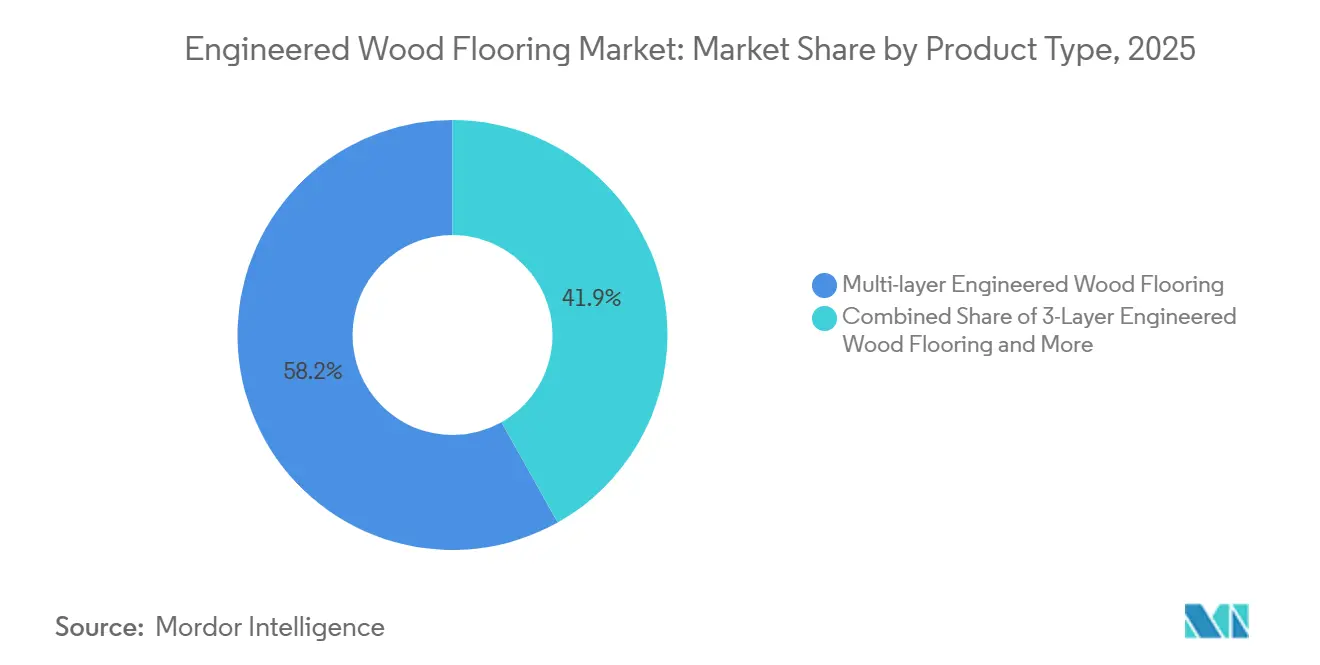
Multi-layer engineered flooring held 58.1% of the engineered wood flooring market share in 2025. Three to five cross-laminated plies give these products the stability needed for residential renovation and hospitality work. The layered core can accept factory-applied finishes and support use with radiant heating. Multi-layer products are widely used where buyers need authentic wood surfaces with lower installation disruption. Their construction also supports wide planks and premium finishes without relying on a solid board. This makes the format a core product in the engineered wood flooring market.
Rigid core hybrid flooring is projected to grow at a 6.2% CAGR through 2031. It combines a real hardwood veneer with a stone-plastic composite or wood-polymer composite base. This design addresses moisture exposure while retaining the surface character of natural wood. Mohawk’s TecWood Enhanced pairs white oak veneer with Uniclic locking and WetProtect spill resistance. Provenza’s Nuage line uses a high-pressure laminate wear layer for commercial durability. Certifications such as GreenGuard Gold and FloorScore are increasingly relevant for buyers seeking low-emission materials [4]UL Solutions, “GREENGUARD Certification,” UL Solutions, ul.com.. Hybrid designs also give suppliers a practical way to address concerns about dents, spills, and installation time without sacrificing the wood veneer that differentiates the category from vinyl products. Their performance claims matter most in kitchens, entryways, rental homes, and commercial interiors where traditional wood products have faced performance questions. This balance of visual authenticity and improved core stability is central to product development in the engineered wood flooring market.



By Wood Species: Softwood Gains Ground Amid Oak Cost Pressures
Hardwood species held 85.5% of the engineered wood flooring market share in 2025. European white oak remained the leading choice for European parquet, thanks to its hardness, grain, and versatility in staining. North American red oak and hickory also serve a broad range of residential applications. Hardwood options are favored in projects where visual depth and long-term refinishing potential are important. Exotic species such as walnut and Brazilian oak remain focused on luxury homes and boutique hospitality projects. The engineered wood flooring industry relies on these species to offer its premium products.
Softwood veneers are forecasted to grow at a 5.7% CAGR through 2031. Weyerhaeuser announced a USD 500 million TimberStrand facility in Arkansas that uses southern yellow pine. Thermal modification and staining help improve the appearance of softer species for interior use. Suppliers in the Nordic and North American regions may also benefit, as sourcing data is more readily available for EU documentation. Species selection is now influenced by aesthetics, cost, physical performance, and the capacity to provide credible origin information. That added procurement requirement can encourage manufacturers to qualify a broader range of fiber sources. It can also reinforce demand for suppliers that can link veneer inputs to documented forest locations.
By Installation Method: Click-Lock Momentum Accelerates Channel Adoption
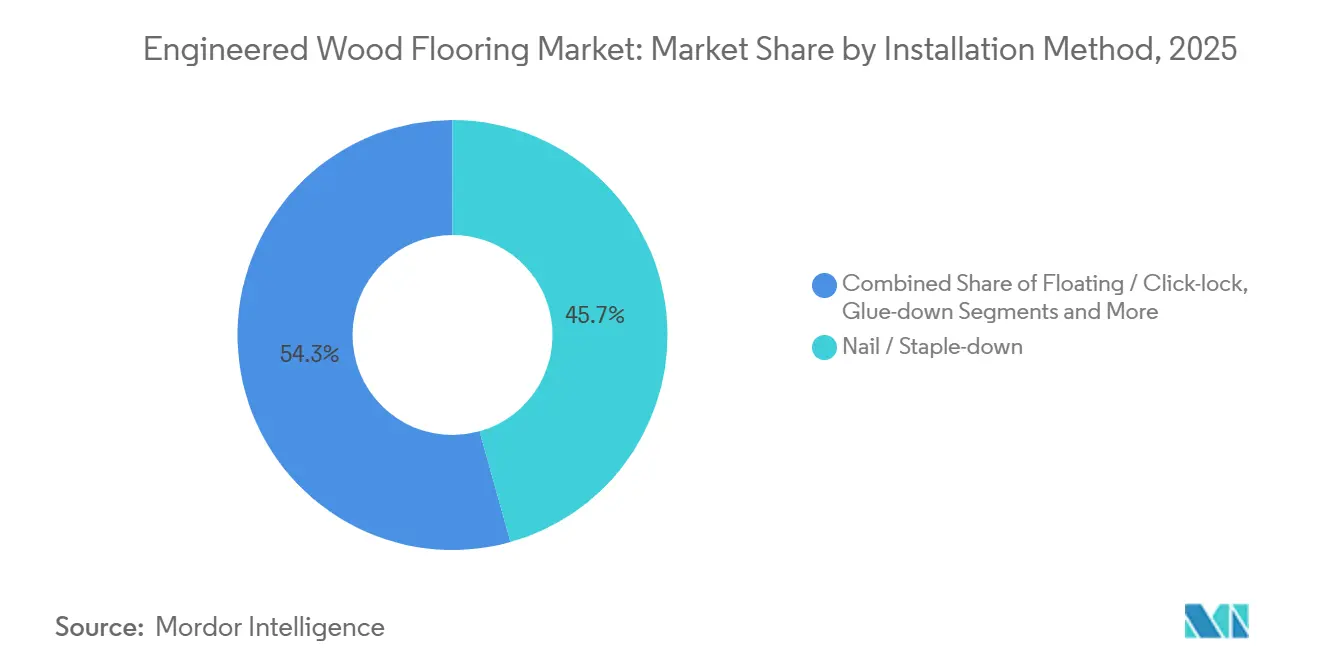
Nail-and-staple-down methods accounted for 45.7% of the engineered wood flooring market share in 2025. These methods remain common in new construction, where subcontractors use permanent attachment for wood or concrete subfloors. They are particularly relevant for wide premium planks that require stable subfloor attachment. Permanent installation can improve long-term stability in high-value projects. Nail-down and staple-down methods also retain a familiar place within contractor workflows. Their large share reflects continued demand for conventional installation in the engineered wood flooring market.
Floating click-lock systems are projected to grow at a 6.1% CAGR through 2031. They are suited to DIY projects, rental properties, and renovations where reversibility is useful. Välinge, I4F, and 5G mechanisms reduce the labor time needed to connect planks. Crews can install a 400-square-foot room in 4 to 8 hours using click-lock products. Flatness requirements and perimeter expansion gaps remain important, as poor subfloor preparation can compromise performance. Glue-down and loose-lay formats serve narrower commercial and retrofit settings. Contractors still assess site moisture, subfloor condition, room dimensions, and heating systems before selecting an installation method. Those practical checks can determine whether the labor savings from click-lock products translate into lower total project costs. Installation choices, therefore, shape product availability, contractor preference, and customer satisfaction across the engineered wood flooring market.
By Construction Type: Renovation Dominance Extends Through 2031
Renovation and retrofit projects accounted for 68.1% of the engineered wood flooring market size in 2025. Older housing stock and homeowner equity supported demand for floor replacement in the United States. Prefinished click-lock planks can be installed without the extensive sanding and finishing process required for unfinished wood floors. This reduces disruption for households remaining in occupied homes. European renovation activity also moderated the effect of weaker new construction on parquet consumption. Renovation is therefore the principal volume base for the engineered wood flooring market.
New construction is forecast to grow at a 5.9% CAGR through 2031. New housing pipelines provide project-based demand even as financing conditions remain difficult. Builders use prefinished 3/8-inch engineered products in multi-family developments where cost and appearance must be balanced. New construction in the Asia-Pacific region can add volume through urban apartment development. Commercial new-build projects can also specify certified engineered flooring for hospitality, education, and health-care spaces. These applications broaden demand beyond household replacement cycles. New projects allow manufacturers to secure specifications earlier in the building process and to supply repeatable product ranges across multiple units. The pace of this demand depends on financing conditions, permitting, and builders' ability to control material costs. It remains an important secondary source of volume alongside renovation-led purchases.
By End-User: Residential Concentration Leaves Commercial as the Margin Opportunity
Residential users accounted for 74.1% of the engineered wood flooring market share in 2025. They are also forecast to grow at a 5.6% CAGR through 2031. Living rooms, bedrooms, kitchens, and basements are the main residential applications. Buyers choose engineered planks for their appearance, material quality, and performance in rooms where solid wood may be less suitable. The large residential share makes the category sensitive to renovation budgets and consumer confidence. It also creates room for differentiated finishes, plank sizes, and installation systems.
Commercial users represented 25.9% of demand in 2025. Hospitality renovations, workplaces, and educational facilities use certified, low-emission flooring in projects with formal material specifications. Office vacancy and cautious capital spending limited commercial expansion relative to residential demand. Some commercial projects require thicker wear layers, antimicrobial finishes, and acoustic backing. These requirements can support higher product values where suppliers meet specification standards. Health-care and senior-living facilities remain a smaller opportunity for materials that combine natural surfaces with low-emission requirements. Commercial purchasers commonly evaluate lifecycle maintenance, acoustic performance, emissions documentation, and the reliability of the local installation network. These factors can make a project more demanding than a household purchase, but they can also support higher-value specifications. The commercial segment gives suppliers a route to diversify beyond residential renovation cycles in the engineered wood flooring market.
By Distribution Channel: Contractors Drive Volume as B2C Channels Fragment
B2C and retail channels held 70.3% of the engineered wood flooring market share in 2025. These channels include home centers, specialty stores, online platforms, and local hardware sellers. They serve homeowners who want samples, design advice, and installation support. Specialty retailers increased their share of hardwood sales to 40% in 2024. Their role is strongest in renovation projects where consultation can support premium selections. Retail remains important even as digital product discovery becomes more common.
B2B contractors and builders are forecast to grow at a 6% CAGR through 2031. Contractors value reliable lead times, technical support, just-in-time delivery, and volume pricing. Multi-family projects, hospitality refurbishment, and institutional work support this channel. Online programs increasingly connect dealer inventory with national product catalogs and professional installation. Mohawk’s Edge Aligned Stores and Omnify programs illustrate this approach. Direct-to-consumer brands also use sample programs and digital visualization to reach price-aware homeowners. This mix of physical samples, online research, dealer stock, and professional installation reflects a more fragmented purchase journey than a traditional store-only sale. Suppliers that coordinate these touchpoints can reduce delays between selection, delivery, and installation. The channel shift is changing how manufacturers reach both small renovation customers and project-based buyers.
Geography Analysis
Europe held 33.2% of the engineered wood flooring market share in 2025, making it the largest regional market. Germany, France, Italy, and the Nordic countries have established renovation markets, widespread familiarity with parquet, and procurement practices that value FSC- and PEFC-certified products. FEP reported that multi-layer planks accounted for 83% of regional parquet production, underscoring the importance of engineered construction in the European product mix. Growth remained moderate due to high interest rates, political uncertainty, and weaker purchasing power, which affected construction activity and discretionary consumption. European parquet consumption fell sharply in 2023, declined marginally in 2024, and remained flat in 2025, suggesting stabilization rather than a strong recovery.
North America accounted for 31% of the engineered wood flooring market in 2025. High homeowner equity, the convenience of prefinished products, and specialty retail support the regional demand base. Mortgage rates limited single-family starts in 2024 and 2025, yet renovation needs from aging homes continued to drive significant demand for replacement flooring. Engineered products accounted for 75% of the United States wood flooring demand in 2025, reflecting a preference for dimensional stability and efficient installation. Canada favors stable engineered products in cold climates, while Mexico benefits from residential growth in major urban areas and upgrades from ceramic tile. American Hardwood Assured supports United States exporters with county-level geolocation data for 33 states, helping reduce documentation friction in EU-facing sales.
Asia-Pacific is projected to grow at a 6.5% CAGR through 2031, the fastest regional rate. China, India, Vietnam, Indonesia, Japan, and South Korea each support demand through housing activity, renovation, commercial fitout, and premium interior projects. Vietnam supplied 47% of Southeast Asian engineered exports to the EU and North America in 2024, aided by its established plywood supply and export manufacturing capability. Japan and South Korea favor design-led products that suit traditional interiors and underfloor heating, while Australia and New Zealand emphasize certified sourcing and durable finishes. In the Middle East and Africa demand is linked to commercial development and longer-term affordable-housing activity, although these markets remain smaller than the major regions.

Competitive Landscape
The engineered wood flooring market remains highly fragmented, with regional manufacturers across Europe, North America, and Asia sharing the market, so that even category leaders do not hold outsized global positions. Industry participants continue to calibrate portfolios toward performance and sustainability credentials while protecting price points in slower macro conditions. Companies emphasize click-lock speed, antimicrobial and low-VOC finishes, and traceability features that support compliance with European Union trade requirements and institutional projects.
Strategic actions include targeted acquisitions and capacity realignment that strengthen core capabilities and adjacent categories. Tarkett Sports acquired five United States construction companies to bolster design-and-build competencies across sports facilities, deepening vertical integration and service reach. Boise Cascade expanded and modernized its Oakdale, Louisiana, veneer operations to increase engineered wood feedstock capacity, supporting downstream product availability for flooring and structural applications. MSI Surfaces highlighted a multi-layer genuine hardwood plank collection with water-resistant technology and low-VOC finishes, which underscores how product narratives blend performance and environmental care.
Regulatory events influence competitive positioning and sourcing strategies in Europe and beyond. The European Commission imposed definitive anti-dumping measures on multi-layer wood flooring imports from China in 2025, which temporarily boosted European Union producers while buyers monitored pricing from alternative sources. As EUDR enforcement phases in, industry associations and public agencies partner with technology providers to enable geolocation mapping and automated compliance reporting. Suppliers that institutionalize traceability and legality proof position themselves to retain European Union market access and capture compliance-driven premiums, reinforcing the value of digital documentation as a commercial differentiator in the engineered wood flooring market.
Engineered Wood Flooring Industry Leaders
Mohawk Industries
AHF Products
Shaw Industries Group
Bauwerk Group
Kährs Group
- *Disclaimer: Major Players sorted in no particular order

Recent Industry Developments
- July 2025: The European Commission imposed definitive Anti-Dumping measures on imports of multi-layer wood flooring from China, providing relief to European parquet producers. However, effectiveness is weakening due to lower Chinese import prices (below pre-investigation levels) and increased parquet shipments from alternative countries previously supplying small European Union volumes.
- March 2025: Tarkett Sports announced acquisitions of five US-based construction companies (Deluxe Athletics, PCC Sports, Benchmark Contracting, Mid-Atlantic Sports Construction, Anchor Management Group) to strengthen design and construction capabilities. The companies will operate as Tarkett Sports Construction or retain names, supporting over 80,000 installations globally. Tarkett Sports launched Ampere, a new brand for architectural design services and master planning in sports facilities.


Global Engineered Wood Flooring Market Report Scope
Engineered wood flooring is defined as a durable, multi-layered flooring product that consists of a real wood veneer top layer bonded to a high-quality plywood or hardwood core. It is specifically designed to offer enhanced stability, effectively resisting moisture and temperature fluctuations compared to solid wood. This type of flooring is widely utilized in basements, over underfloor heating systems, and for DIY click-lock installations.
The engineered wood flooring market report is segmented by product type (multi-layer engineered wood flooring, 3-layer engineered wood flooring, 2-layer engineered wood flooring, rigid core hybrid engineered wood flooring, and others/custom formats), wood species (softwood species, hardwood species, and mixed/engineered composite species), installation method (floating/click-lock, glue-down, nail/staple-down, and loose lay), construction type (new construction and renovation/retrofit), end-user (residential and commercial), distribution channel (B2C and B2B), and geography. The market forecasts are provided in terms of value (USD).
| Multi-layer Engineered Wood Flooring |
| 3-Layer Engineered Wood Flooring |
| 2-Layer Engineered Wood Flooring |
| Rigid Core Hybrid Engineered Wood Flooring |
| Others / Custom Formats |
| Softwood Species |
| Hardwood Species |
| Mixed/Engineered Composite Species |
| Floating / Click-lock |
| Glue-down |
| Nail / Staple-down |
| Loose Lay |
| New Construction |
| Renovation/Retrofit |
| Residential |
| Commercial |
| B2C/Retail | Home Centers |
| Specialty Flooring Stores | |
| Online | |
| Local Hardware Shops (unorganized market) | |
| Other Distribution Channels | |
| B2B/Contractors/Builders |
| North America | Canada |
| United States | |
| Mexico | |
| South America | Brazil |
| Peru | |
| Chile | |
| Argentina | |
| Rest of South America | |
| Europe | United Kingdom |
| Germany | |
| France | |
| Spain | |
| Italy | |
| BENELUX (Belgium, Netherlands, Luxembourg) | |
| NORDICS (Denmark, Finland, Iceland, Norway, Sweden) | |
| Rest of Europe | |
| Asia-Pacific | India |
| China | |
| Japan | |
| Australia | |
| South Korea | |
| South-East Asia | |
| Rest of Asia-Pacific | |
| Middle East & Africa | United Arab Emirates |
| Saudi Arabia | |
| South Africa | |
| Nigeria | |
| Rest of Middle East & Africa |
| By Product Type | Multi-layer Engineered Wood Flooring | |
| 3-Layer Engineered Wood Flooring | ||
| 2-Layer Engineered Wood Flooring | ||
| Rigid Core Hybrid Engineered Wood Flooring | ||
| Others / Custom Formats | ||
| By Wood Species | Softwood Species | |
| Hardwood Species | ||
| Mixed/Engineered Composite Species | ||
| By Installation Method | Floating / Click-lock | |
| Glue-down | ||
| Nail / Staple-down | ||
| Loose Lay | ||
| By Construction Type | New Construction | |
| Renovation/Retrofit | ||
| By End-user | Residential | |
| Commercial | ||
| By Distribution Channel | B2C/Retail | Home Centers |
| Specialty Flooring Stores | ||
| Online | ||
| Local Hardware Shops (unorganized market) | ||
| Other Distribution Channels | ||
| B2B/Contractors/Builders | ||
| By Geography | North America | Canada |
| United States | ||
| Mexico | ||
| South America | Brazil | |
| Peru | ||
| Chile | ||
| Argentina | ||
| Rest of South America | ||
| Europe | United Kingdom | |
| Germany | ||
| France | ||
| Spain | ||
| Italy | ||
| BENELUX (Belgium, Netherlands, Luxembourg) | ||
| NORDICS (Denmark, Finland, Iceland, Norway, Sweden) | ||
| Rest of Europe | ||
| Asia-Pacific | India | |
| China | ||
| Japan | ||
| Australia | ||
| South Korea | ||
| South-East Asia | ||
| Rest of Asia-Pacific | ||
| Middle East & Africa | United Arab Emirates | |
| Saudi Arabia | ||
| South Africa | ||
| Nigeria | ||
| Rest of Middle East & Africa | ||


Key Questions Answered in the Report
What is the projected growth rate for engineered wood flooring through 2031?
It is forecast to grow at a 5.1% CAGR from 2026 to 2031, reaching USD 24.4 billion by 2031.
Why do homeowners choose engineered wood floors?
They provide real-wood appearance, dimensional stability, and simpler prefinished installation for renovation projects.
Which engineered flooring product is growing the fastest?
Rigid-core hybrid engineered flooring is projected to grow at a 6.2% CAGR through 2031, combining real veneer with moisture resistance.
Which regions create the strongest demand for engineered wood flooring?
Europe led with a 33.2% share in 2025, while Asia-Pacific is forecast to grow fastest at a 6.5% CAGR.
How is the EU Deforestation Regulation affecting wood flooring suppliers?
It requires wood traceability and due diligence, favoring suppliers with documented sourcing systems.
How do click-lock products affect flooring installation?
They enable faster, reversible installation and are forecast to grow at a 6.1% CAGR through 2031.
Page last updated on:


 Your data is secure and never sold or shared.


