
Electric Arc Furnace Market Size and Share
Market Overview
| Study Period | 2021 - 2031 |
|---|---|
| Market Size (2026) | USD 1.76 Billion |
| Market Size (2031) | USD 2.33 Billion |
| Growth Rate (2026 - 2031) | 5.67 % |
| Fastest Growing Market | Asia-Pacific |
| Largest Market | Asia-Pacific |
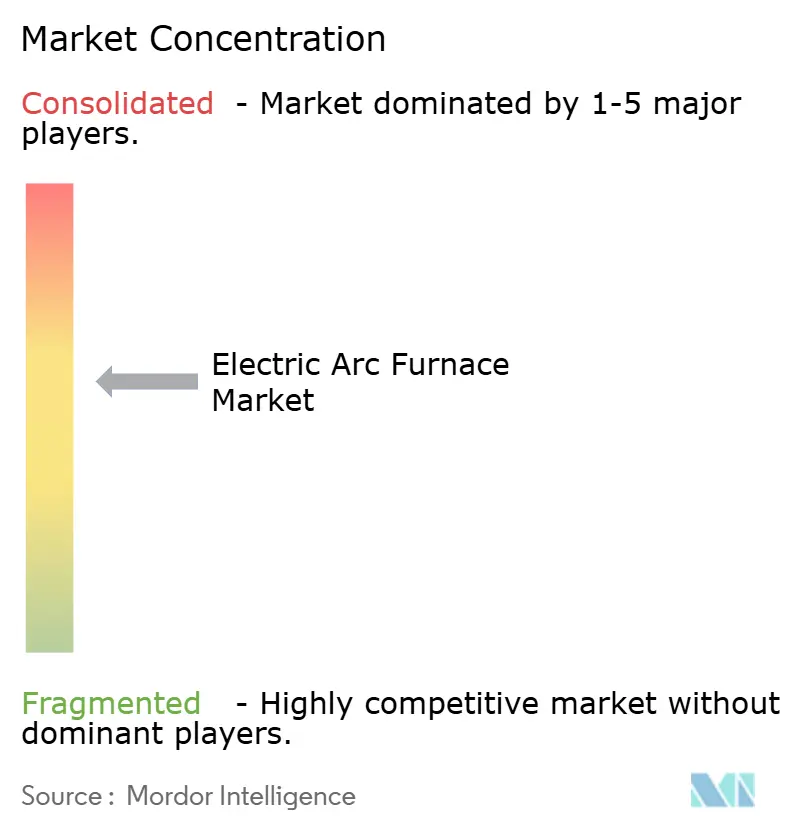
| Market Concentration | Medium |
Major Players *Disclaimer: Major Players sorted in no particular order Image © Mordor Intelligence. Reuse requires attribution under CC BY 4.0. | |
Electric Arc Furnace Market Analysis by Mordor Intelligence
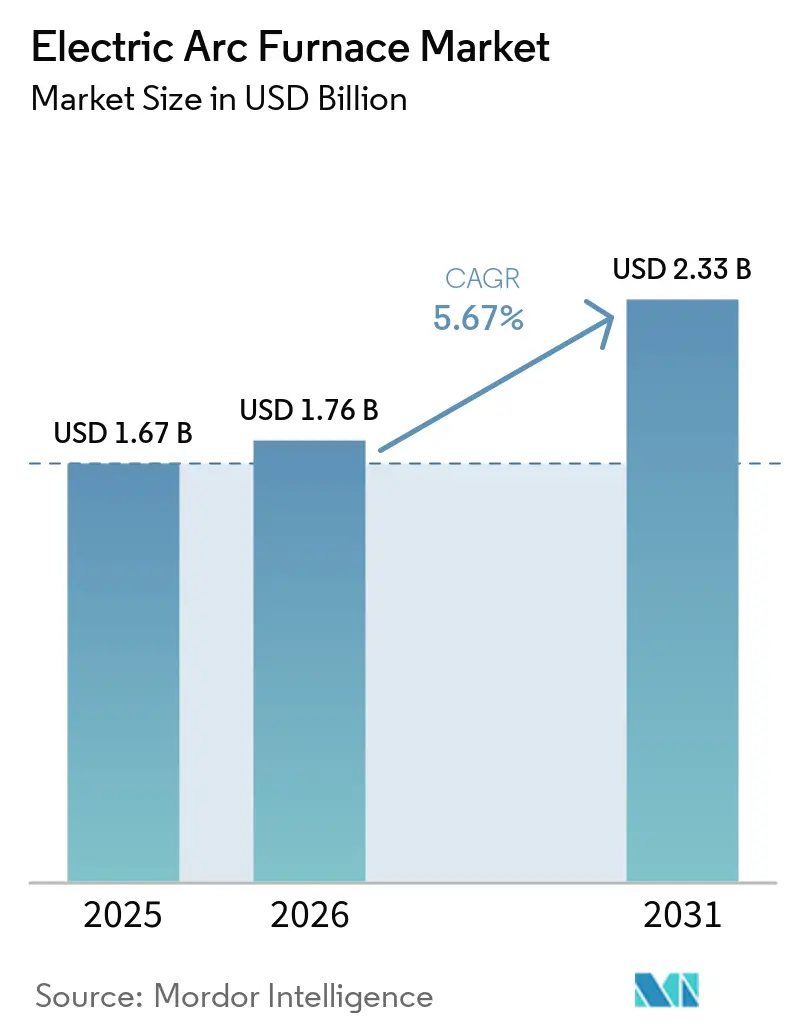
The Electric Arc Furnace Market size was valued at USD 1.67 billion in 2025 and is estimated to grow from USD 1.76 billion in 2026 to reach USD 2.33 billion by 2031, at a CAGR of 5.67% during the forecast period (2026-2031). The electric arc furnace market is being shaped by steelmakers that need to lower carbon emissions while maintaining reliable output. New projects increasingly combine electric arc furnaces with direct reduced iron capacity, which broadens the range of charge materials available to producers. Carbon-related procurement requirements are also affecting equipment decisions, particularly among suppliers to automotive and construction customers. Equipment suppliers are responding with designs that improve power control, shorten operating cycles, and reduce the footprint of new plants. High capital requirements, electricity costs, and inconsistent scrap quality will continue to affect the timing and economics of investment decisions.
Key Report Takeaways
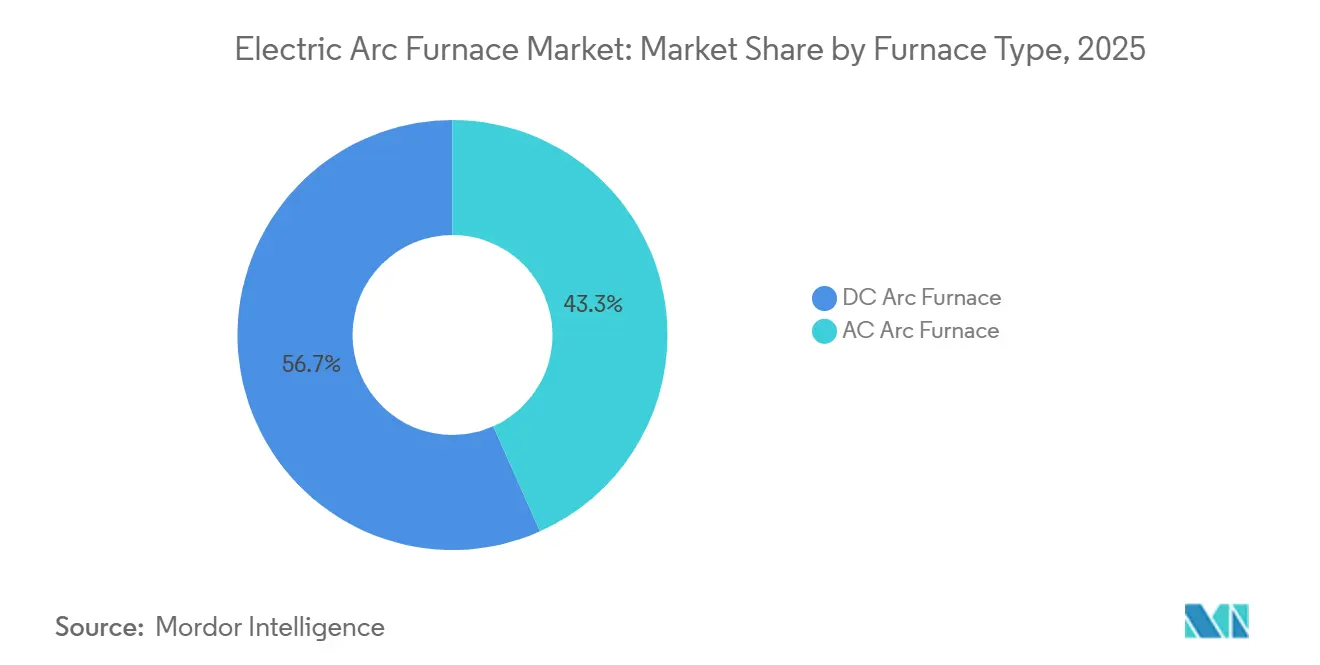
- By furnace type, direct current (DC) arc furnace held 56.68% of the electric arc furnace market share in 2025 and is projected to advance at a 6.23% CAGR through 2031.
- By capacity, 100-300 tons held 45.85% of the electric arc furnace market share in 2025, while the above 300 tons is projected to advance at a 6.54% CAGR through 2031.
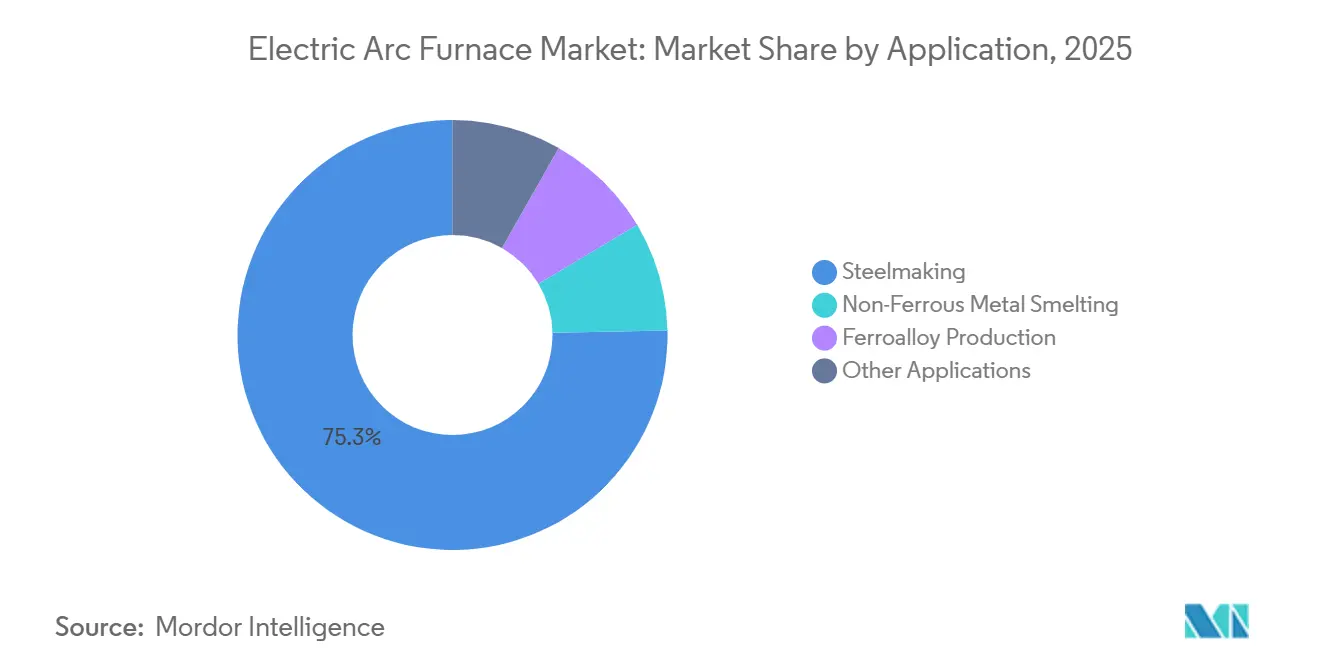
- By application, steelmaking held 75.34% of the electric arc furnace market share in 2025, while ferroalloy production is projected to advance at a 6.78% CAGR through 2031.
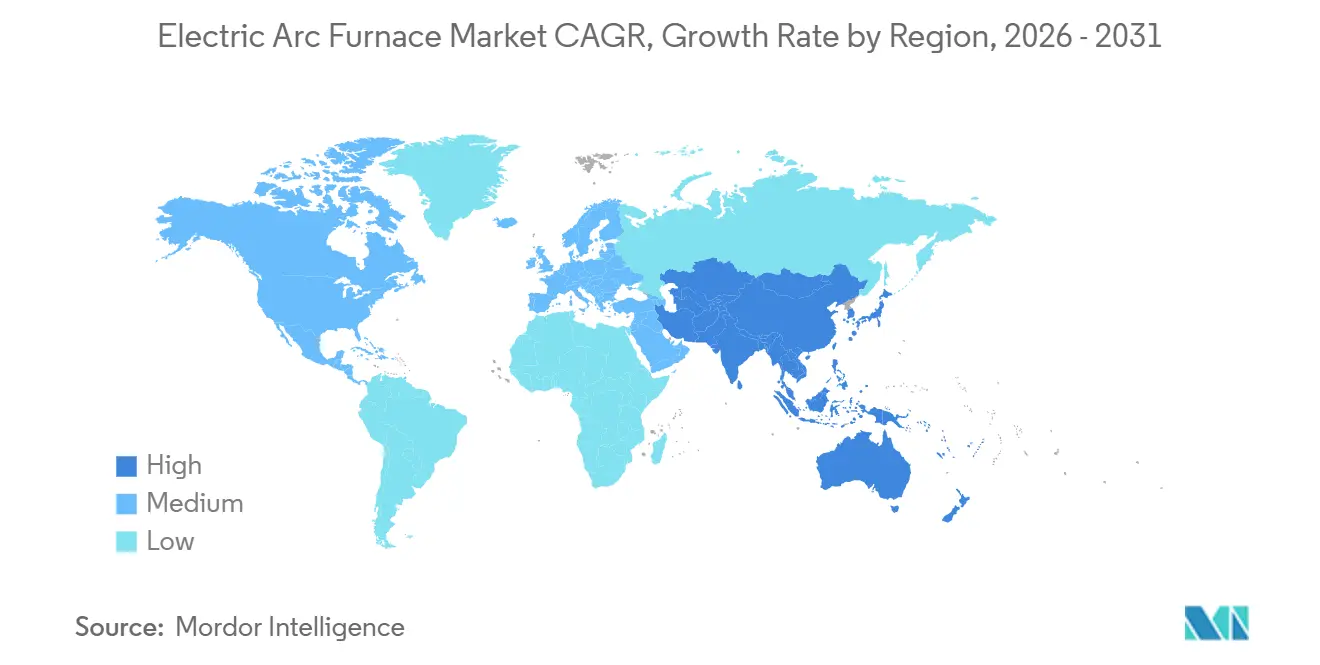
- By geography, Asia-Pacific held 40.17% of the electric arc furnace market share in 2025 and is projected to advance at a 6.66% CAGR through 2031.
Note: Market size and forecast figures in this report are generated using Mordor Intelligence’s proprietary estimation framework, updated with the latest available data and insights as of January 2026.
Market Trends and Insights
Drivers Impact Analysis of Electric Arc Furnace Market*
| Driver | (~) % Impact on CAGR Forecast | Geographic Relevance | Impact Timeline |
|---|---|---|---|
| Decarbonization of Primary Steelmaking | +2.0% | Global; concentrated in Europe, Japan, South Korea | Long-term (≥ 4 years) |
| Expansion of Scrap-Based Steel Production | +1.5% | APAC core, spillover to North America and MEA | Medium-term (2–4 years) |
| Rising Demand for Flexible Steelmaking Capacity | +0.9% | North America, Europe | Medium-term (2–4 years) |
| Retrofitting of Existing Steel Plants | +0.7% | Europe, Japan | Medium-term (2–4 years) |
| Green-Steel Procurement by Automotive and Construction Customers | +0.5% | North America, EU | Long-term (≥ 4 years) |
| Source: Mordor Intelligence | |||
Decarbonization of Primary Steelmaking
Carbon-emissions requirements are changing how steelmakers assess long-lived furnace assets. Electric arc furnaces provide a near-term route for replacing part of the emissions profile associated with primary steelmaking. ArcelorMittal confirmed a EUR 1.3 billion (approximately USD 1.55 billion) investment in a 2-million-metric-ton electric arc furnace at Dunkirk, France, with commissioning targeted for 2029. The facility is designed for 2 million tons of annual output and is expected to produce 0.6 tons of carbon dioxide per ton of steel, while Energy Efficiency Certificates support 50% of the investment. JFE Steel announced in April 2025 that it would invest JPY 329.4 billion (approximately USD 2.2 billion) in a 2-million-ton electric arc furnace at Kurashiki, Japan[1]. The electric arc furnace market benefits when operators first add supporting equipment to existing plants and later move toward full furnace replacement. A 2026 study found that China’s pathway toward a 97% reduction in steel-sector emissions by 2060 requires facility retirements and faster retrofits before 2040.
Expansion of Scrap-Based Steel Production
The availability and recovery of steel scrap are becoming more important to electric arc furnace planning. Higher scrap volumes can support a larger share of steel output from electric routes, but they also increase the need for reliable collection and sorting systems. China consumed 214 million tons of scrap in 2024, and 30% of that volume entered the electric arc furnace. The electric arc furnace market will therefore depend not only on furnace orders but also on the development of feedstock networks. Producers converting integrated sites may combine scrap with direct reduced iron to meet charge-quality requirements. This approach supports demand for larger vessels that can process mixed burdens at high throughput. The China Iron and Steel Association established an electric arc furnace steelmaking sub-association in February 2025.
Rising Demand for Flexible Steelmaking Capacity
Electric arc furnaces allow operators to adjust their charge mix in response to material availability and cost conditions. This flexibility is important where the price relationship between scrap, direct reduced iron, and natural gas changes quickly. Primetals Technologies introduced EAF Ultimate Move in May 2026 for greenfield projects that can process scrap, hot briquetted iron, and blast furnace hot metal in different combinations. The design aimed to reduce plant footprint and tap-to-tap time while supporting variable feedstock use. SMS group received a second order in August 2026 for a Hybar minimill configuration in Arkansas that uses an EDGE DC furnace and X-Pact AURA digital power architecture. The equipment can produce more than 80 tons per hour and uses machine-learning-based monitoring. Such capabilities give the electric arc furnace market a stronger role where steelmakers need to change input ratios without interrupting output requirements.
Retrofitting of Existing Steel Plants
Retrofitting provides a lower-disruption option for plants that still have usable steelmaking assets. Operators can improve electrode control, carbon injection, heat recovery, feedstock handling, and power systems in phases. A 2025 life cycle assessment at a Spanish electric steelmaking plant found that targeted furnace retrofits reduced environmental impacts without requiring a full new-build investment. Tenova was selected in June 2026 to upgrade the electric arc furnace at Tenaris’s Koppel, Pennsylvania, plant as part of an investment exceeding USD 90 million. Most of the work is due for completion in the second half of 2027. Phased work can reduce technical risk because steelmakers can assess each upgrade before approving the next stage. It also allows them to document lower emissions for customers and regulators while avoiding the longer lead time associated with a new greenfield plant.
Restraints Impact Analysis of Electric Arc Furnace Market*
| Restraint | (~) % Impact on CAGR Forecast | Geographic Relevance | Impact Timeline |
|---|---|---|---|
| High Furnace Installation and Modernization Costs | -1.5% | Global | Medium-term (2–4 years) |
| Electricity-Price Volatility and Grid-Connection Constraints | -1.2% | Europe, APAC | Short-term (≤ 2 years) |
| Scrap-Quality Variability and Contaminant Management | -0.7% | Global; stronger in APAC and MEA | Long-term (≥ 4 years) |
| Source: Mordor Intelligence | |||
Electricity-Price Volatility and Grid-Connection Constraints
Electric arc furnaces require a substantial and dependable electricity supply. The energy cost represented 10%-15% of steel production costs under stable grid conditions. Large furnaces can also create flicker, harmonic distortion, and reactive power demand that complicate grid connection. Primetals Technologies stated in February 2026 that its Active Power Feeder uses modular multilevel converter technology to stabilize full-power furnace operation while reducing flicker and energy use. The need for such equipment adds to project cost and can extend connection approval timelines by 6-12 months. Electricity price uncertainty also makes it harder to assess the operating case for a new furnace. ArcelorMittal’s June 2025 decision to withdraw from planned direct reduced iron and electric arc furnace projects in Germany showed that public support alone may not resolve the financial burden of a large conversion.
Scrap-Quality Variability and Contaminant Management
Scrap quality determines the product range that a scrap-based electric arc furnace can serve. Copper, tin, nickel, and antimony can accumulate in recycled material and limit the production of higher-value grades. Copper content above 0.2 wt% in recycled steel can cause hot shortness during high-temperature processing, which can restrict output to lower-value rebar applications. A 2025 study also found greater residual-element accumulation when electric arc furnaces accounted for more than 70% of steelmaking activity. The European Union-funded CAESAR Project documented variation within standardized European scrap grades, including variation linked to inadequate shredding and residue contamination[2]. Better inbound characterization and charge optimization can help producers manage this issue.
*Our forecasts treat driver/restraint impacts as directional, not additive. The impact forecasts reflect baseline growth, mix effects, and variable interactions.
Electric Arc Furnace Market Segment Analysis
By Furnace Type:
DC Arc Furnace Capturing Large-Format InstallationsThe DC arc furnace held 56.68% of the electric arc furnace market share in 2025. Its position reflects demand for stable operation and lower electrode consumption in large-scale projects. The direct-current furnaces consumed 350-380 kilowatt-hours per ton of steel, compared with 380-420 kilowatt-hours for alternating-current units. A DC design uses 1 graphite electrode rather than 3 electrodes. It also produces a more stable arc and lower grid flicker. These operating features can reduce the need for power-quality mitigation where grid standards are strict. The DC arc furnace is projected to advance at a 6.23% CAGR through 2031, which supports continued growth in the electric arc furnace market size for this type.
SMS group’s EDGE DC platform was selected for Hybar’s twin CMT 550 configuration in Arkansas. DANIELI & C. S.p.A. also supplied its Zerobucket DC furnace for a project at Henan Jiyuan Iron & Steel in China. These examples show how suppliers are applying direct-current architecture to modern minimill layouts. The AC arc furnace remains relevant for high-alloy specialty steel, smaller regional mills, and plants with established alternating-current equipment. SMS group received an order for a 185-metric-ton AC furnace for Saarstahl in Völklingen, Germany, with a 300 megavolt-ampere transformer. Furnace selection will continue to reflect local grid requirements, charge chemistry, and the cost of changing installed equipment.
By Capacity:
Above 300 Tons Challenging the 100–300 Tons CapacityThe 100–300-tons segment held 45.85% of the electric arc furnace market share in 2025. This range serves regional construction and industrial demand through established minimill configurations. Its broad installed base gives operators access to experienced suppliers and operating references. It can also operate across varying utilization rates, which helps producers respond to changes in local demand. DANIELI & C. S.p.A. delivered a 100-metric-ton furnace to Acciaierie Venete’s Padova works by summer 2026. The project included Digital Electromagnetic Stirring and automated operations. Below 100 tons remains relevant for specialty steel, ferroalloy smelting, and markets that are building initial electric arc furnace capacity.
The above 300-tons segment is projected to advance at a 6.54% CAGR through 2031. Its expansion reflects projects that seek to replace blast furnace output with a single larger electric unit. POSCO completed a 2.5-million-ton facility at Gwangyang in June 2026. Tenova is due to commission a 285-metric-ton Consteel furnace for HKM in Duisburg in 2029 with 2.5 million tons of design capacity. JFE Steel’s 2-million-ton Kurashiki facility is targeted to begin production in the first quarter of fiscal year 2028. These projects bring electric furnace capacity closer to the output range traditionally associated with medium-sized blast furnaces. They also make the electric arc furnace market more relevant for producers that cannot trade volume for lower carbon intensity.
By Application:
Ferroalloy Production Emerging as the Fastest-Scaling SegmentSteelmaking held 75.34% of the electric arc furnace market share in 2025. Construction, automotive, and infrastructure demand supported this leading application. ArcelorMittal’s Dunkirk project is designed for 2 million tons of annual output, and the company confirmed the investment in April 2026. Hyundai Steel announced a USD 5.8 billion electric arc furnace-based integrated steel mill in Louisiana in March 2025. The plant is intended to produce 2.7 million tons of automotive steel plates each year and use an adjacent ENERGIRON direct reduced iron plant supplied by Tenova and DANIELI & C. S.p.A. These investments show that demand for lower-carbon steel is becoming part of product planning for large steel producers.
Ferroalloy production is projected to advance at a 6.78% CAGR through 2031. Electric arc furnaces offer the temperature control and chemistry management needed for specialized alloy production. Inner Mongolia recorded 17.628 million tons of ferroalloy output and 270 billion kilowatt-hours of clean energy generation in 2025. It also stated that DC-powered furnace deployment reduced electricity consumption by 10%-15% per ton. Demand for low-phosphorus and low-sulfur ferroalloys can rise as steel producers require more controlled charge compositions. Non-Ferrous Metal Smelting and Other Applications account for the remaining electric arc furnace market size. Secondary copper and aluminum smelting activity supports non-ferrous demand in the United States, Japan, and Germany.

Geography Analysis
APAC Electric Arc Furnace Market
Asia-Pacific held 40.17% of the electric arc furnace market share in 2025 and is projected to advance at a 6.66% CAGR through 2031. JFE Steel committed JPY 329.4 billion (approximately USD 2.2 billion) for its Kurashiki project in April 2025. NIPPON STEEL CORPORATION also announced JPY 869 billion (approximately USD 6 billion) in electric arc furnace investments across 3 Japanese plants in May 2025. POSCO completed a 2.5-million-ton furnace at Gwangyang in June 2026. These commitments support the region’s installed base and project pipeline. Tata Steel’s planned 750,000-metric-ton scrap-based facility in Ludhiana reflects a localized model that targets customers within a 300-kilometer supply radius.
North America and Europe Electric Arc Furnace Market
North America is building capacity that is closely linked to automotive steel demand. Hyundai Steel’s Louisiana facility is designed to produce 2.7 million tons of automotive steel plates annually. ArcelorMittal’s Calvert, Alabama, furnace reached full capacity by mid-2026 and produces 1.5 million tons per year. Europe is pursuing a deeper shift as producers respond to carbon regulation and the Carbon Border Adjustment Mechanism. Tenova’s Duisburg project, Tata Steel UK’s Port Talbot project, and ArcelorMittal’s Dunkirk project represent large blast furnace replacement programs. The electric arc furnace market size in Europe will still be affected by power prices, regulatory conditions, and the timing of public support. ArcelorMittal’s June 2025 cancellation of planned German projects showed that investment schedules may not progress evenly.
MEA and South America Electric Arc Furnace Market
South America has an established minimal base that supports demand for 100-300 ton furnaces serving construction markets. Brazil provides a stable foundation for this activity, while Argentina and other Mercosur economies can add demand as infrastructure spending improves. The Middle East and Africa have a smaller electric arc furnace market share, but their project pipeline is developing. Saudi Arabia’s Vision 2030 and domestic steel production goals are supporting greenfield planning. Competitive renewable energy could support hydrogen-based direct reduced iron and electric arc furnace projects in the region. South Africa’s ferroalloy production also supports demand from specialized melting applications. Steelmakers in the region may give greater attention to lower-carbon production when supplying customers exposed to European carbon requirements.
Competitive Landscape
The electric arc furnace market is moderately concentrated, with the top five players including DANIELI & C. S.p.A., SMS group GmbH, Primetals Technologies, Tenova S.p.A., and Electrotherm. Regional specialists and Chinese manufacturers compete more often in smaller-capacity projects where cost and delivery time carry greater weight. Suppliers are strengthening their digital tools as well as their mechanical furnace designs. SMS group applies DataXpert machine-learning capabilities, while DANIELI & C. S.p.A. uses Q-One power supply technology. Primetals Technologies has tested its Active Power Feeder at BGH Edelstahl to address flicker and other grid-quality issues.
Primetals Technologies introduced EAF Ultimate Move in May 2026 to combine elements of its EAF Ultimate and EAF Quantum platforms. The design targets shorter tap-to-tap time, lower maintenance, and smaller layouts for greenfield projects. Tenova secured the August 2026 contract for HKM’s 285-metric-ton Consteel furnace in Duisburg, which will have 2.5 million tons of annual design capacity. SMS group’s August 2026 order for Hybar’s second CMT 550 minimill extends its position in digitally managed direct-current projects. These moves show that suppliers are competing to reduce operating complexity and manage grid constraints. Large suppliers have an advantage in projects where technical approval cycles are lengthy and power-quality requirements are demanding.
A commercial opportunity remains in linking scrap characterization, charge optimization, and closed-loop process control. CHNZBTECH Co., Ltd., HANI Metallurgy, Xi’an Taoyuan Metallurgical Equipment Engineering Co., Ltd., and Xiye Tech Group Co., Ltd. compete through localized support and faster execution in cost-sensitive markets. INTECO melting and casting technologies GmbH serves precision vacuum metallurgy, while SARRALLE focuses on specialized flat-product electric furnace lines. ISO 50001 energy management certification and compliance with International Electrotechnical Commission (IEC) 62271 high-voltage switchgear requirements are increasingly relevant to project qualification. The competitive landscape, therefore, reflects both large technology platforms and specialized suppliers serving defined process needs.
Electric Arc Furnace Industry Leaders
-
DANIELI & C. S.p.A.
-
SMS group GmbH
-
Primetals Technologies
-
Tenova S.p.A.
-
Electrotherm
- *Disclaimer: Major Players sorted in no particular order
Electric Arc Furnace Market Companies Covered in this Report
- CHNZBTECH Co., Ltd.
- DANIELI & C. S.p.A.
- Electrotherm
- HANI Metallurgy
- INTECO melting and casting technologies GmbH
- JP Steel Plantech Co.
- NIKKO INDUSTRY CO., LTD.
- Paul Wurth IHI Co., Ltd.
- Primetals Technologies
- SARRALLE
- SMS group GmbH
- Tenova S.p.A.
- Xi'an Taoyuan Metallurgical Equipment Engineering Co., Ltd
- Xiye Tech Group Co., Ltd.
Recent Industry Developments in Electric Arc Furnace Market
- August 2026: Tenova S.p.A. was awarded a contract by HKM/Salzgitter AG to supply, construct, and commission Germany’s largest electric arc furnace in Duisburg, a 285-metric-ton Consteel unit with a design capacity of 2.5 million tons per year. The project adds large-scale EAF capacity and supports the expansion of electric steelmaking infrastructure in Europe.
- May 2026: Primetals Technologies launched EAF Ultimate Move, combining the EAF Ultimate and EAF Quantum platforms to deliver shorter tap-to-tap times, compact layouts, lower maintenance, and reduced capital expenditure. The technology improves the efficiency and economics of greenfield electric arc furnace projects, supporting wider adoption of electric arc furnace technology.
Global Electric Arc Furnace Market Report Scope
Electric arc furnaces are industrial melting systems that use electric arcs to generate high temperatures for melting metallic feedstocks and producing molten metal. They offer flexible operation and can accommodate recycled metal inputs, making them suitable for metal production processes requiring efficient and controllable melting.
The Electric Arc Furnace Market is segmented by furnace type, capacity, application, and geography. By furnace type, the market is segmented into DC arc furnace and AC arc furnace. By capacity, the market is segmented into below 100 tons, 100-300 tons, and above 300 tons. By application, the market is segmented into steelmaking, non-ferrous metal smelting, ferroalloy production, and other applications. The report also covers the market size and forecasts for electric arc furnaces in 15 countries across major regions. For each segment, the market sizing and forecasts have been done on the basis of value (USD).
Segmentation Overview
| DC Arc Furnace |
| AC Arc Furnace |
| Below 100 Tons |
| 100-300 Tons |
| Above 300 Tons |
| Steelmaking |
| Non-Ferrous Metal Smelting |
| Ferroalloy Production |
| Other Applications |
| Asia-Pacific | China |
| India | |
| Japan | |
| South Korea | |
| Rest of Asia-Pacific | |
| North America | United States |
| Canada | |
| Mexico | |
| Europe | Germany |
| United Kingdom | |
| France | |
| Italy | |
| Rest of Europe | |
| South America | Brazil |
| Argentina | |
| Rest of South America | |
| Middle East and Africa | Saudi Arabia |
| South Africa | |
| Rest of Middle East and Africa |
| By Furnace Type | DC Arc Furnace | |
| AC Arc Furnace | ||
| By Capacity | Below 100 Tons | |
| 100-300 Tons | ||
| Above 300 Tons | ||
| By Application | Steelmaking | |
| Non-Ferrous Metal Smelting | ||
| Ferroalloy Production | ||
| Other Applications | ||
| By Geography | Asia-Pacific | China |
| India | ||
| Japan | ||
| South Korea | ||
| Rest of Asia-Pacific | ||
| North America | United States | |
| Canada | ||
| Mexico | ||
| Europe | Germany | |
| United Kingdom | ||
| France | ||
| Italy | ||
| Rest of Europe | ||
| South America | Brazil | |
| Argentina | ||
| Rest of South America | ||
| Middle East and Africa | Saudi Arabia | |
| South Africa | ||
| Rest of Middle East and Africa | ||
Key Questions Answered in the Report
What is the size of the electric arc furnace market?
The electric arc furnace market stands at USD 1.76 billion in 2026 and is projected to reach USD 2.33 billion by 2031.
What is driving demand for electric arc furnaces?
Decarbonization requirements, scrap-based production, flexible feedstock use, and plant retrofits are supporting demand.
Which furnace type held the largest share in 2025?
The DC arc furnace held a 56.68% share in 2025.
Which capacity is expected to grow fastest through 2031?
Above 300 tons is projected to advance at a 6.54% CAGR through 2031.