
Direct-to-Consumer Marketing Services Market Size and Share
Market Overview
| Study Period | 2020 - 2031 |
|---|---|
| Market Size (2026) | USD 9.87 Billion |
| Market Size (2031) | USD 15.03 Billion |
| Growth Rate (2026 - 2031) | 8.77 % |
| Fastest Growing Market | Asia-Pacific |
| Largest Market | North America |
| Market Concentration | Low |
Major Players *Disclaimer: Major Players sorted in no particular order Image © Mordor Intelligence. Reuse requires attribution under CC BY 4.0. | |
Direct-to-Consumer Marketing Services Market Analysis by Mordor Intelligence
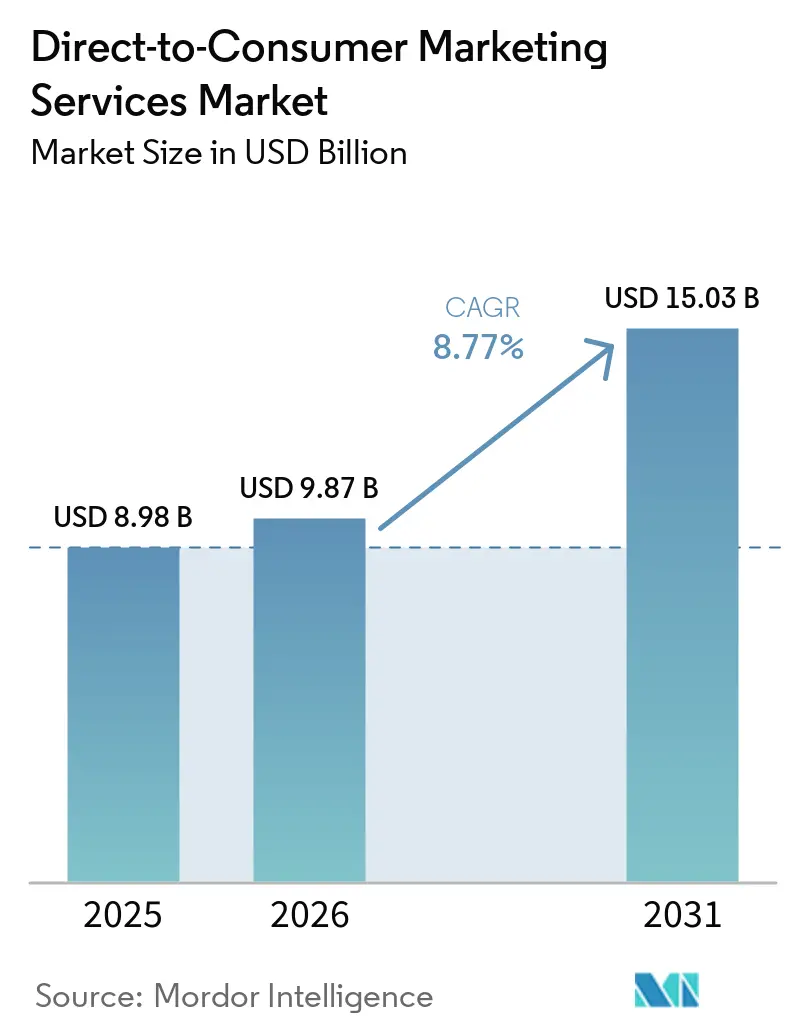
The Direct-to-Consumer Marketing Services Market size is projected to be USD 8.98 billion in 2025, USD 9.87 billion in 2026, and reach USD 15.03 billion by 2031, expanding at a CAGR of 8.77% from 2026 to 2031. The D2C Marketing Services Market is being reshaped by the move from third-party signals to consented first-party and zero-party data. Brands are directing more spending toward customer data, email, SMS, and retention systems because acquisition still depends on more reliable audience and event data. AI-enabled campaign tools are reducing the time needed to plan, personalize, and manage engagement across channels. This change favors providers that combine data management, content, activation, and measurement within a connected platform. Subscription fatigue and failed payments remain material risks for brands that rely on replenishment and membership revenue.
Key Report Takeaways
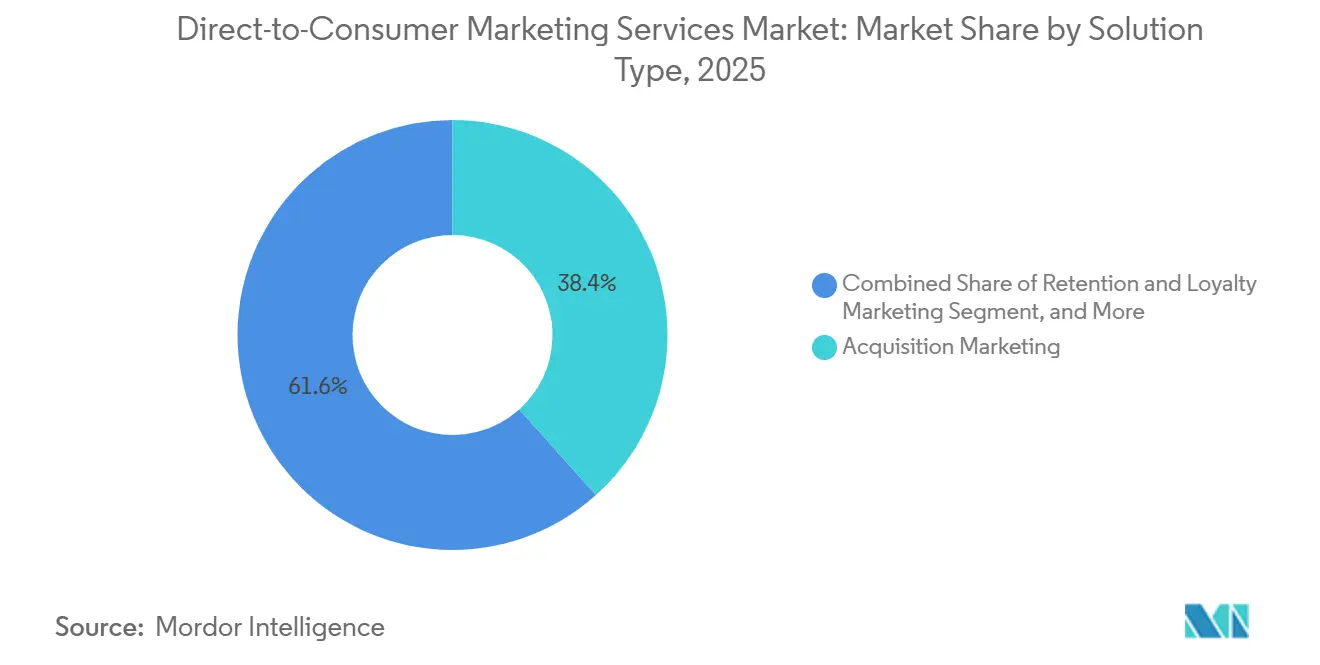
- By solution type, Acquisition Marketing held 38.36% of the Direct-to-Consumer Marketing Services Market share in 2025, while Lifecycle and CRM Orchestration is projected to expand at a 9.21% CAGR through 2031.
- By enterprise size, Large Enterprises held 58.74% of revenue in 2025, while Small and Medium-Sized Enterprises are projected to expand at a 9.73% CAGR through 2031.
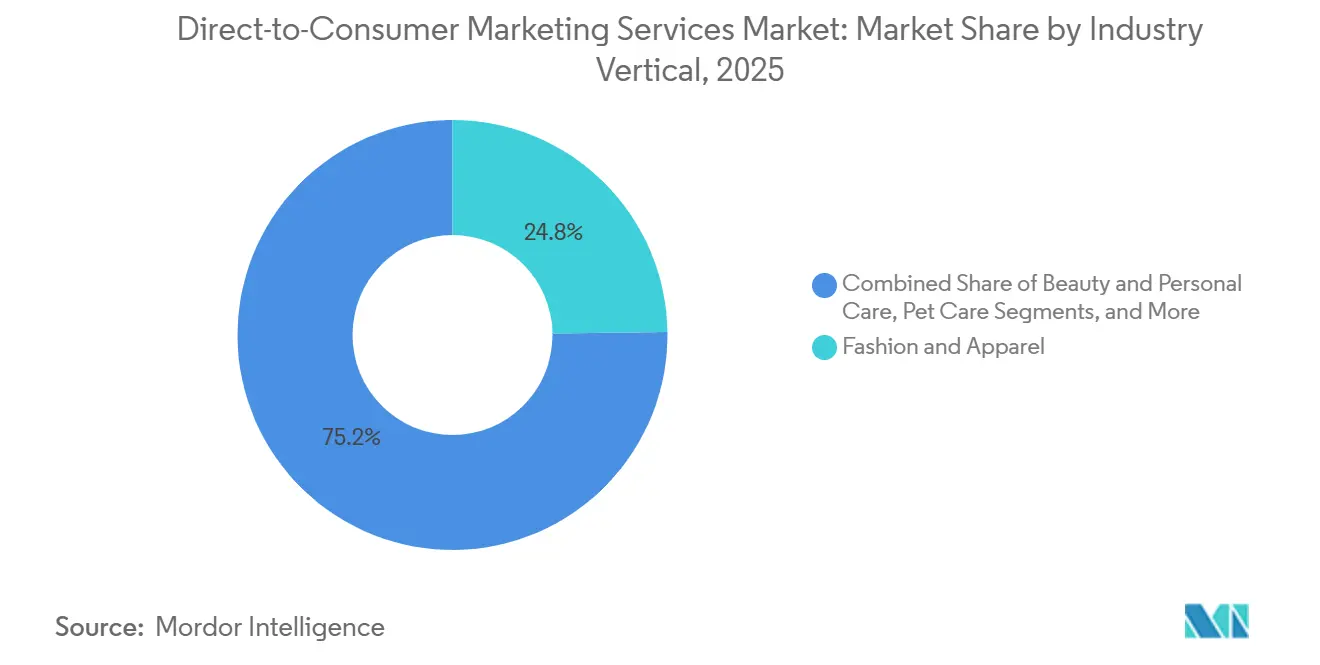
- By industry vertical, Fashion and Apparel held 24.77% of revenue in 2025, while Health and Wellness is projected to expand at a 9.55% CAGR through 2031.
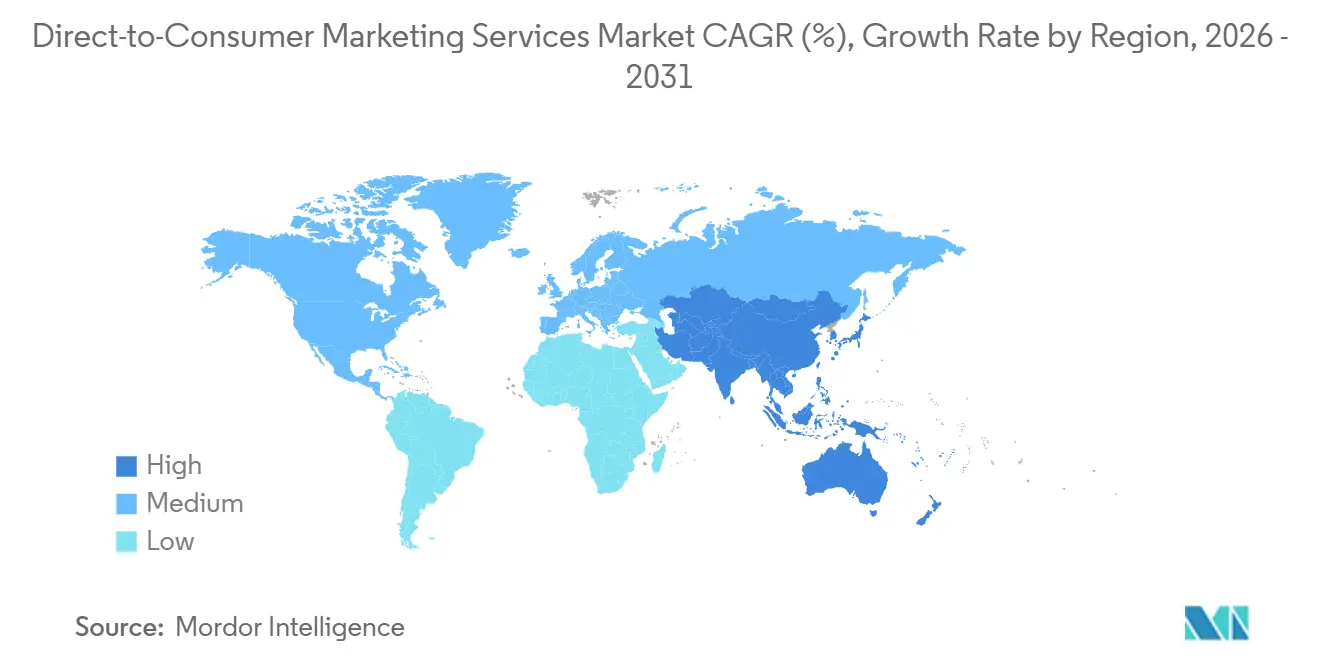
- By geography, North America accounted for 36.83% of revenue in 2025, while Asia-Pacific is projected to expand at a 9.88% CAGR through 2031.
Note: Market size and forecast figures in this report are generated using Mordor Intelligence’s proprietary estimation framework, updated with the latest available data and insights as of January 2026.
Global Direct-to-Consumer Marketing Services Market Trends and Insights
Drivers Impact Analysis*
| Driver | (~) % Impact on CAGR Forecast | Geographic Relevance | Impact Timeline |
|---|---|---|---|
| Rising First-Party and Zero-Party Data Activation | +2.5% | Global, mostconcentrated in North America and Europe where privacy regulation enforcement is strongest | Medium term (2-4 years) |
| AI-Native Personalization and Journey Automation | +2.2% | Global, with early adoption in North America, Western Europe, and Asia-Pacific core markets | Short term (≤ 2 years) |
| Omnichannel Retention Focus as Customer Acquisition Costs Rise | +1.8% | Global, most acute in North America and Western Europe where paid-media inflation is steepest | Short term (≤ 2 years) |
| Subscription and Replenishment-Led Revenue Expansion | +1.2% | North America and Europe, with emerging adoption in Asia-Pacific and the Middle East | Medium term (2-4 years) |
| Retail Media and Creator Commerce Performance Convergence | +0.8% | North America, Europe, and Asia-Pacific, expanding into the Middle East and Africa through retail media networks | Medium term (2-4 years) |
| AI Search and Agentic Commerce Discovery Optimization | +0.6% | Global, with North America and Asia-Pacific as primary adoption centers | Long term (≥ 4 years) |
| Source: Mordor Intelligence | |||
Rising First-Party and Zero-Party Data Activation
The Direct-to-Consumer Marketing Services Market is benefiting from a durable shift toward data that brands collect with customer permission. Privacy rules have made consent records, preference centers, quizzes, and wish lists more valuable inputs for marketing programs. These inputs can support more relevant messages while giving brands clearer evidence of how customer data was obtained. The shift also increases demand for server-side event tracking and for integrations with platforms such as Meta Conversions API and Google Enhanced Conversions. Providers that connect consent, identity, and activation in one workflow can reduce the operational burden on DTC teams. The result is a stronger role for owned data infrastructure in acquisition and retention decisions.
AI-Native Personalization and Journey Automation
AI-based tools are shortening the work needed to build and adjust customer journeys in the Direct-to-Consumer Marketing Services Market. Salesforce made Brand Center, Real-Time Offer Management, and Einstein Studio generally available in its Marketing Cloud Summer '26 release, adding governance and model flexibility to campaign operations.[1] Bloomreach reported that a significant share of its brand customers used AI agents. The company also reported a notable increase in revenue per email for Sideshow during the holiday period. These tools perform best when identity records and customer events are complete, making data quality a critical factor for stronger results. As a result, platforms that combine customer data with orchestration are better positioned than isolated point tools.
Omnichannel Retention Focus as Customer Acquisition Costs Rise
The D2C Marketing Services Market is placing more weight on retention because new customer acquisition requires sustained investment. Brands are using email, SMS, loyalty, service, and replenishment programs to improve the value created after the first order. Chewy reported that its Autoship program generated most of its net sales, reflecting a stronger contribution over time. This performance shows why recurring purchase programs can provide more stable revenue when they are part of the customer experience rather than a separate promotion. Marketing providers, therefore, need to connect post-purchase signals with loyalty and service journeys. This shift supports spending on tools that coordinate messages across owned channels.
Subscription and Replenishment-Led Revenue Expansion
Within the D2C Marketing Services Market, subscription and replenishment programs are increasing the need for marketing services that can identify the right time for a reminder, offer, or recovery message. Shopify launched its Predictive Commerce API in January 2026, and the system processed more than 2.3 million automated replenishment orders each month.[2] RRecharge reported that protein and satiety subscription products grew faster than its platform-wide cohort during the period, while subscription GMV also increased. These patterns are particularly relevant to health, wellness, food, and pet care brands with repeat purchase cycles. They also raise the value of systems that link payment recovery, product availability, customer preferences, and campaign timing. Providers that support these connections can capture more retention spending as brands simplify their technology stacks.
Restraints Impact Analysis*
| Restraint | (~) % Impact on CAGR Forecast | Geographic Relevance | Impact Timeline |
|---|---|---|---|
| Privacy-Driven Signal Loss and Higher Customer Acquisition Costs | -1.5% | Global, most acute in North America and Europe, with growing impact in Asia-Pacific as local privacy frameworks mature | Medium term (2-4 years) |
| Stack Fragmentation and Integration Complexity | -1.0% | Global | Medium term (2-4 years) |
| Deliverability and Identity Resolution Degradation | -0.7% | Global, amplified in markets with high iOS user penetration | Short term (≤ 2 years) |
| Involuntary Subscription Churn and Payment Failure Leakage | -0.5% | North America and Europe, where subscription penetration is highest | Medium term (2-4 years) |
| Source: Mordor Intelligence | |||
Privacy-Driven Signal Loss and Higher Customer Acquisition Costs
Privacy-driven signal loss can make it harder for brands to identify customers, measure paid media, and allocate budget across channels. The California Consumer Privacy Act and its California Privacy Rights Act amendments require businesses to document consent and manage data used for cross-context behavioral advertising. This compliance work can require additional engineering resources, especially for smaller DTC operators. It also makes first-party measurement systems more important, but the transition can be costly and slow. The Direct-to-Consumer Marketing Services Market must therefore address both performance needs and the practical requirements of data governance. Providers with clear consent controls and dependable data connections can reduce this burden for their customers.
Stack Fragmentation and Integration Complexity
Many DTC brands use separate systems for email, SMS, loyalty, subscriptions, reviews, customer data, and attribution. Different event structures and application programming interfaces can delay the movement of a churn signal from one system to another. This delay can prevent a retention program from reaching a customer when it is most useful. The Direct-to-Consumer Marketing Services Market is responding with connected data and activation products that allow teams to act on customer signals more quickly. Full interoperability will take time because technology stacks are already complex. Vendors that maintain closed data silos may face greater replacement risk as brands give more weight to integration.
*Our forecasts treat driver/restraint impacts as directional, not additive. The impact forecasts reflect baseline growth, mix effects, and variable interactions.
Segment Analysis
By Solution Type: Acquisition Marketing Leads While Lifecycle Orchestration Advances
Acquisition Marketing held 38.36% of the Direct-to-Consumer Marketing Services Market share in 2025. Brands still need a steady flow of new customers to offset attrition and sustain loyalty or subscription programs. Higher acquisition costs have not removed demand for this solution type. Instead, they have increased demand for tools that improve audiences, conversion paths, and measurement. Providers are also being asked to connect acquisition activity with owned-channel data instead of treating paid media as a separate process. Retention and Loyalty Marketing was the second-largest solution category as brands shifted more budget toward programs that support repeat purchases. This reflects the need to protect customer value after the initial transaction. Subscription and Replenishment Marketing is also gaining use among consumables brands that need timely customer communication.
Lifecycle and CRM Orchestration is projected to expand at a 9.21% CAGR from 2026 to 2031, the highest rate among solution types in the D2C Marketing Services Market. AI agents can review existing flows, identify gaps, and support changes across email, SMS, and other channels. Klaviyo introduced Composer in March 2026 as an agentic experience for generating and optimizing campaigns and flows from a prompt. Salesforce launched Marketing Cloud Next in June 2025 as a platform built on Data Cloud for both B2B and B2C marketing. These releases show that lifecycle tools are moving beyond batch campaigns toward more continuous engagement. The value of those systems depends on unified customer records and reliable event data. This is moving budget toward broader engagement suites that bring data, workflow management, and delivery together.

By Enterprise Size: Large Enterprises Lead While SMEs Expand Faster
Large Enterprises commanded 58.74% of revenue in 2025. Their position in the Direct-to-Consumer Marketing Services Market reflects the investment required to deploy broad marketing technology environments across several channels and teams. Larger brands often have dedicated data engineering resources that can support personalization, identity resolution, and predictive models. These resources allow them to use complex software from providers such as Salesforce, Adobe, and Oracle. Their current lead does not guarantee a permanent advantage because smaller platforms are accumulating more first-party behavior data from a wide client base. Large organizations must also manage more complex integrations and governance requirements. This makes ease of deployment a meaningful competitive factor even in enterprise accounts.
Small and Medium-Sized Enterprises are projected to expand at a 9.73% CAGR through 2031. This growth reflects a lower starting level of adoption and the wider availability of tiered software pricing. Klaviyo served more than 196,000 paying customers and offered more than 350 integrations in 2026. AI-assisted setup can help smaller teams build flows, segments, and campaigns without deep specialist knowledge. In the Direct-to-Consumer Marketing Services Market, this lowers the barrier for brands that previously relied on basic point tools. HubSpot launched Agent Hub in public beta in July 2026 to centralize the development and management of agents across sales, marketing, and service. This type of product targets the mid-market brands that have moved beyond point tools but lack large technical teams.
By Industry Vertical: Fashion and Apparel Leads While Health and Wellness Expands
Fashion and Apparel commanded 24.77% of revenue in 2025. The segment benefits from frequent transactions, varied creative formats, and a mature base of DTC brands with established customer databases. Fashion companies can use product drops, seasonal activity, reviews, and loyalty programs to support regular engagement. In the Direct-to-Consumer Marketing Services Market, these attributes support demand for campaign tools and customer data systems. Beauty and Personal Care followed as a major category because replenishment cycles and product discovery support recurring communications. Food and Beverage, Consumer Electronics, Home and Furniture, and Pet Care have different purchase timing and customer journey needs. This makes industry-specific segmentation important when providers design campaigns and retention programs. Consumer Electronics and Home and Furniture can benefit from post-purchase review collection and loyalty efforts despite lower replenishment frequency.
Health and Wellness is projected to expand at a 9.55% CAGR from 2026 to 2031, making it the fastest-growing vertical in the Direct-to-Consumer Marketing Services Market. This vertical is becoming a key source of demand for the Direct-to-Consumer Marketing Services Market. Demand is supported by GLP-1-adjacent supplements, recurring purchases, and digital health brands that need coordinated lifecycle communication. Recharge reported strong subscription GMV growth for protein and satiety products, along with an increase in average order value per subscription order. Pet care shows similar subscription dynamics through Chewy's Autoship program, which generated a significant share of net sales. These categories require systems that can act on product usage, billing, and customer preference signals. Companies can improve loyalty and data collection to drive repeat purchases when they integrate these capabilities into the customer relationship. As a result, demand is increasing for platforms that connect subscriptions, payment recovery, and personalized marketing.
Geography Analysis
North America accounted for 36.83% of revenue in 2025. The region has a dense concentration of DTC-native brands and a mature ecosystem for customer data, email, SMS, and retail media. The United States drives much of regional demand as privacy requirements increase spending on consent management, identity resolution, and first-party measurement. The proposed American Data Privacy and Protection Act remained under congressional review in mid-2026, leaving brands to manage a mix of state-level requirements. Canada is adopting many U.S.-based technology stacks, while Mexico is drawing investment in fashion, beauty, and food as digital retail and payments develop. South America is led by Brazil, where Instagram and WhatsApp support social commerce and two-way customer engagement. Argentina, Chile, and Colombia are also developing DTC ecosystems in fashion, beauty, and food. This regional depth makes North America an important base for the Direct-to-Consumer Marketing Services Market.
Asia-Pacific is projected to expand at a 9.88% CAGR through 2031, the highest geographic rate in the Direct-to-Consumer Marketing Services Market. This geographic expansion is strengthening the Direct-to-Consumer Marketing Services Market across diverse local channels. The region combines local channel requirements with demand for platforms that can operate across several markets. Japan's D2C sector reached JPY 3 trillion, equivalent to USD 19.4 billion, and annual expansion was reported at 15-20%. Dentsu Digital and Dentsu launched TikTok Shop consulting services in Japan in June 2025. South Korea requires marketing systems that can work with KakaoTalk as an owned channel. China depends heavily on Douyin live-stream commerce and WeChat's closed ecosystem. India, Australia, and Southeast Asia are gaining momentum as logistics and digital payments support more DTC activity.
Europe is shaped by GDPR compliance, which encouraged brands to invest early in consent management and email-SMS lifecycle programs. Germany, the United Kingdom, and France are the largest European markets, while Italy and Spain are developing in fashion, beauty, and food. The Middle East is increasing investment in beauty, health, and consumer electronics under national digital economy programs in the UAE and Saudi Arabia. Africa remains at an earlier stage, but retail media infrastructure is becoming more visible in key markets. South Africa, Egypt, and Nigeria offer addressable opportunities as mobile internet access expands. These local differences require the Direct-to-Consumer Marketing Services Market to provide channel support that fits regional buying and communication habits.
Competitive Landscape
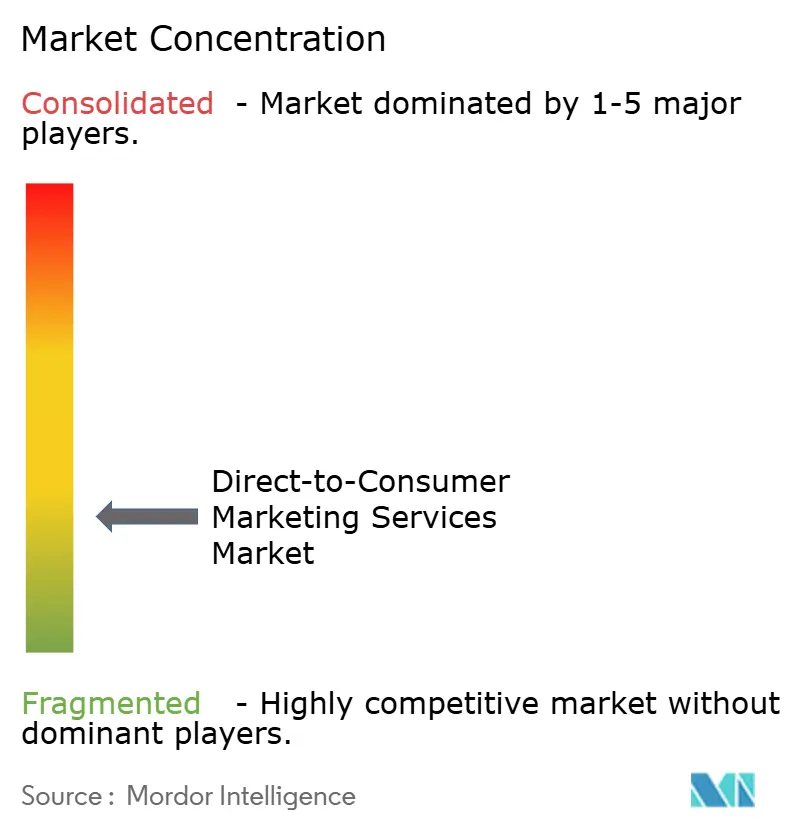
The Direct-to-Consumer Marketing Services Market is fragmented because enterprise software companies and DTC-focused specialists compete across several product categories. Salesforce, Adobe, and Oracle are building systems for AI-assisted campaign planning, content, activation, and optimization. Klaviyo, Braze, and Bloomreach are responding by adding more lifecycle functions to platforms designed for consumer brands. Bloomreach exceeded USD 260 million in annual recurring revenue in 2025 and reported that nearly half its customer base used at least 1 AI agent.[3] Braze made BrazeAI Operator, BrazeAI Agent Console, and Braze Creative Studio generally available in April 2026. Adobe introduced Brand Intelligence in April 2026 as a continuously learning brand governance engine created through co-development with Xfinity. These moves place more value on proprietary data, product integration, and brand-specific learning.
The mid-market is a major competitive opportunity because many brands with USD 10 million to USD 100 million in DTC revenue have outgrown standalone tools but do not have enterprise-level engineering capacity. Criteo has expanded its retail media position through its Google onsite retail media partnership, announced in September 2025. Yotpo, ActiveCampaign, and Bloomreach offer loyalty, reviews, SMS, and related functions at pricing intended to be accessible to smaller brands. This competition is narrowing the gap between features that were once reserved for large enterprise platforms. It is also increasing pressure on providers that cannot show strong data connections or ecosystem reach. The Direct-to-Consumer Marketing Services Market is therefore rewarding vendors that can combine specialist functions with an integrated customer data foundation.
Klaviyo expanded its social marketing capabilities in 2026 to help brands bring social engagement signals into its B2C. Salesforce agreed to acquire Contentful, a composable content management platform used by more than 4,800 brands, to connect content production and marketing activation more closely. Bloomreach also deepened its Databricks relationship in June 2026 through the CustomerLake integration, enabling governed warehouse-native customer data to support personalization across channels. These actions show that the market is moving toward broader customer engagement environments rather than isolated campaign tools. Differentiation is becoming harder for basic functions such as send-time optimization and predictive churn scoring. Providers are responding through partnerships, acquisitions, and wider product coverage.
Direct-to-Consumer Marketing Services Industry Leaders
-
Adobe Inc.
-
Salesforce, Inc.
-
Shopify Inc.
-
Klaviyo, Inc.
-
Intuit Inc.
- *Disclaimer: Major Players sorted in no particular order
Recent Industry Developments
- July 2026: Criteo announced a retail media partnership with Massmart, Walmart's South African subsidiary, covering more than 280 stores in South Africa and introducing Sponsored Product Ads and Onsite Display Ads on Makro.co.za. The deal expanded Criteo's global retailer footprint to 235 partners, including 75% of the top 30 U.S. retailers.
- July 2026: HubSpot launched Agent Hub and Agent Builder in public beta for all professional and enterprise customers, providing a unified console to build, monitor, and manage AI agents across sales, marketing, and service with shared customer context. First-quarter 2026 revenue reached USD 881 million, up 23% year over year, with enterprise deals above USD 120,000 in annual recurring revenue increasing 64%.
- June 2026: Klaviyo launched Social Marketing as a generally available product, enabling DTC brands to capture social engagement signals, including comments, direct messages, and tags, as owned data within its B2C CRM. The company also moved its Composer AI marketing agent to public beta.
- June 2026: Bloomreach announced a launch partnership with Databricks CustomerLake, extending its Loomi AI personalization platform across email, web, and other channels using governed warehouse-native customer data without duplication.
Global Direct-to-Consumer Marketing Services Market Report Scope
Direct-to-Consumer Marketing Services Market refers to the agencies, consultancies, and service providers that help brands sell and market directly to end customers without relying on wholesalers, retailers, or other intermediaries. It covers performance media, creative, lifecycle email/SMS, SEO, influencer programs, conversion optimization, and customer analytics for DTC brands.
The Direct-to-Consumer Marketing Services Market Report is Segmented by Solution Type (Acquisition Marketing, Retention and Loyalty Marketing, Lifecycle and CRM Orchestration, and Subscription and Replenishment Marketing), Enterprise Size (Large Enterprises, and Small and Medium-Sized Enterprises), Industry Vertical (Fashion and Apparel, Beauty and Personal Care, Food and Beverage, Consumer Electronics, Home and Furniture, Health and Wellness, and Pet Care), and Geography (North America, South America, Europe, Asia-Pacific, Middle East, and Africa). The Market Forecasts are Provided in Terms of Value (USD).
| Acquisition Marketing |
| Retention and Loyalty Marketing |
| Lifecycle and CRM Orchestration |
| Subscription and Replenishment Marketing |
| Other Solution Types |
| Large Enterprises |
| Small and Medium-Sized Enterprises |
| Fashion and Apparel |
| Beauty and Personal Care |
| Food and Beverage |
| Consumer Electronics |
| Home and Furniture |
| Health and Wellness |
| Pet Care |
| Other Industry Verticals |
| North America | United States |
| Canada | |
| Mexico | |
| South America | Brazil |
| Argentina | |
| Chile | |
| Rest of South America | |
| Europe | Germany |
| United Kingdom | |
| France | |
| Italy | |
| Spain | |
| Rest of Europe | |
| Asia-Pacific | China |
| Japan | |
| India | |
| South Korea | |
| Australia | |
| Rest of Asia-Pacific | |
| Middle East | Saudi Arabia |
| United Arab Emirates | |
| Qatar | |
| Rest of Middle East | |
| Africa | South Africa |
| Egypt | |
| Nigeria | |
| Rest of Africa |
| By Solution Type | Acquisition Marketing | |
| Retention and Loyalty Marketing | ||
| Lifecycle and CRM Orchestration | ||
| Subscription and Replenishment Marketing | ||
| Other Solution Types | ||
| By Enterprise Size | Large Enterprises | |
| Small and Medium-Sized Enterprises | ||
| By Industry Vertical | Fashion and Apparel | |
| Beauty and Personal Care | ||
| Food and Beverage | ||
| Consumer Electronics | ||
| Home and Furniture | ||
| Health and Wellness | ||
| Pet Care | ||
| Other Industry Verticals | ||
| By Geography | North America | United States |
| Canada | ||
| Mexico | ||
| South America | Brazil | |
| Argentina | ||
| Chile | ||
| Rest of South America | ||
| Europe | Germany | |
| United Kingdom | ||
| France | ||
| Italy | ||
| Spain | ||
| Rest of Europe | ||
| Asia-Pacific | China | |
| Japan | ||
| India | ||
| South Korea | ||
| Australia | ||
| Rest of Asia-Pacific | ||
| Middle East | Saudi Arabia | |
| United Arab Emirates | ||
| Qatar | ||
| Rest of Middle East | ||
| Africa | South Africa | |
| Egypt | ||
| Nigeria | ||
| Rest of Africa | ||
Key Questions Answered in the Report
What is the size of the Direct-to-Consumer Marketing Services Market?
The Direct-to-Consumer Marketing Services Market was valued at USD 8.98 billion in 2025 and is estimated at USD 9.87 billion in 2026. It is forecast to reach USD 15.03 billion by 2031 at an 8.77% CAGR.
What is driving demand for direct-to-consumer marketing services?
The shift to first-party data, AI-based personalization, and stronger retention programs are increasing demand for connected customer engagement tools.
Which solution type leads direct-to-consumer marketing services?
Acquisition Marketing led with 38.36% of revenue in 2025. Lifecycle and CRM Orchestration is projected to record the fastest expansion at a 9.21% CAGR through 2031.
Which company size segment is expanding fastest?
Small and Medium-Sized Enterprises are projected to expand at a 9.73% CAGR through 2031 as AI-assisted onboarding and tiered pricing make advanced tools easier to adopt.
Which vertical has the highest projected expansion?
Health and Wellness is projected to expand at a 9.55% CAGR through 2031, supported by subscription replenishment models and demand for coordinated lifecycle programs.
Which region is projected to expand fastest?
Asia-Pacific is projected to expand at a 9.88% CAGR through 2031, supported by social commerce, localized channels, digital payments, and developing DTC ecosystems.