
Diisopropylbenzene Market Size and Share
Market Overview
| Study Period | 2021 - 2031 |
|---|---|
| Market Size (2026) | USD 3.98 Billion |
| Market Size (2031) | USD 6.87 Billion |
| Growth Rate (2026 - 2031) | 11.56 % |
| Fastest Growing Market | Asia-Pacific |
| Largest Market | Asia-Pacific |
| Market Concentration | High |
Major Players *Disclaimer: Major Players sorted in no particular order Image © Mordor Intelligence. Reuse requires attribution under CC BY 4.0. | |
Diisopropylbenzene Market Analysis by Mordor Intelligence
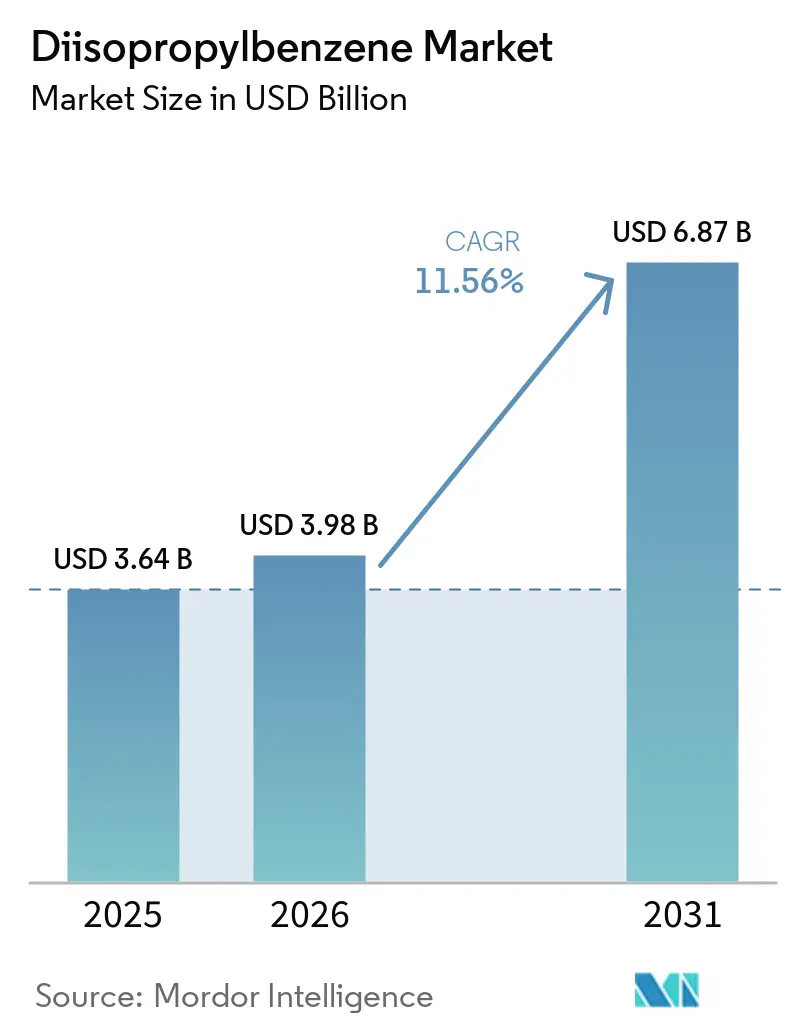
The Diisopropylbenzene market size was valued at USD 3.64 billion in 2025 and is estimated to grow from USD 3.98 billion in 2026 to USD 6.87 billion by 2031, at a CAGR of 11.56% during the forecast period (2026-2031). The diisopropylbenzene market is driven by demand for polymerization initiators, rubber antioxidants, hydroquinone, and synthetic lubricant formulations. Downstream users increasingly require chemical intermediates with controlled isomer purity, as purity affects product performance, processing reliability, and selling prices. This requirement shifts purchasing decisions toward suppliers that can demonstrate stable specifications rather than simply offer aromatic material at the lowest price. China's environmental controls are affecting hydroquinone sourcing, while electric vehicle fluid requirements are increasing demand for stable synthetic formulations. Integrated producers can benefit from regional capacity additions, but non-integrated suppliers remain exposed to benzene, propylene, energy, and separation costs. The diisopropylbenzene market, therefore, favors suppliers that combine feedstock access, high-purity processing, established customer qualification capabilities, and practical compliance support for customers operating across multiple regions.
Key Report Takeaways
- By isomer, p-diisopropylbenzene held 72.67% of the Diisopropylbenzene market share in 2025 and is forecast to grow at a CAGR of 13.06% through 2031.
- By application, polymers held 42.25% of the Diisopropylbenzene market share in 2025, while synthetic lubricants are forecast to grow at a CAGR of 14.12% through 2031.
- By geography, Asia-Pacific held 42.38% of the Diisopropylbenzene market share in 2025 and is forecast to grow at a CAGR of 14.25% through 2031.
Note: Market size and forecast figures in this report are generated using Mordor Intelligence’s proprietary estimation framework, updated with the latest available data and insights as of January 2026.
Global Diisopropylbenzene Market Trends and Insights
Drivers Impact Analysis*
| Drivers | (~) % Impact on CAGR Forecast | Geographic Relevance | Impact Timeline |
|---|---|---|---|
| Growth in Hydroperoxide and Polymer-Initiator Demand | +2.8% | Global, led by APAC and North America | Medium term (2-4 years) |
| Expansion of High-Performance Polymer and Stabilizer Applications | +2.2% | Global | Medium term (2-4 years) |
| Increasing Demand for High-Purity Intermediates in Electronics and Advanced Materials | +1.9% | APAC core, spillover to North America | Short term (≤2 years) |
| Asia-Pacific Specialty-Chemical and Petrochemical Capacity Expansion | +2.5% | APAC | Short to medium term (≤4 years) |
| Isomer-Selective Oxidation and Dihydroperoxide Process Improvements | +0.7% | Global | Long term (≥4 years) |
| Source: Mordor Intelligence | |||
Growth in Hydroperoxide and Polymer-Initiator Demand
p-Diisopropylbenzene is used to produce diisopropylbenzene dihydroperoxide, an initiator for low-temperature emulsion polymerization of styrene-butadiene rubber. The compound generates free radicals at temperatures where conventional peroxide systems are less effective, making it relevant to controlled elastomer production. This relationship links the diisopropylbenzene market to synthetic rubber production, tire manufacturing activity, and the quality requirements set by tire producers. The same chemistry supports peroxide crosslinking and antioxidant applications, so its relevance extends beyond a single tire production step. Electric vehicle tires require consistent polymer chain properties and lower rolling resistance, which raises purity requirements for peroxide intermediates used in rubber processing. These requirements can increase demand for high-purity p-diisopropylbenzene across the diisopropylbenzene market, as downstream users cannot readily accept variable isomer composition. LANXESS launched Vulkanox 4060 in September 2026 as an alternative to 6PPD after completing EU REACH registration, supporting continued development of compliant tire additive systems and replacement opportunities in regulated tire markets[1]LANXESS, “Sustainable Tire Protection, LANXESS Launches New Anti-Aging Agent as an Alternative for 6PPD,” LANXESS, lanxess.com.
Expansion of High-Performance Polymer and Stabilizer Applications
Diisopropylbenzene dihydroperoxide serves as a crosslinking initiator in cross-linked polyethylene for cable insulation, hot-water pipes, and thermosetting foams. This use connects demand with construction, electrical infrastructure, and specialized polymer processing, as well as the need for materials that perform reliably under heat and mechanical stress. Compounders are also applying tighter antioxidant specifications to address electronics performance and longer service-life requirements in automotive and industrial applications. The process requirements of wire, cable, and piping products make stable formulation performance important throughout the material's useful life. Such specifications favor intermediates that can meet consistent quality and purity requirements across repeat production runs, not only during laboratory qualification. SI Group presented NAUGARD BIO-XL and NaugaShield bio-based performance resins at K 2025 and India Rubber Expo 2026, reflecting customer interest in additive systems that combine performance, lower-concern chemistry, and sustainability. The diisopropylbenzene market may face gradual pressure in premium applications if intermediate suppliers do not meet evolving purity, functional performance, and sustainability expectations.
Increasing Demand for High-Purity Intermediates in Electronics and Advanced Materials
Electronics manufacturing uses many chemical inputs, and contamination control remains important for packaging, printed circuit boards, semiconductor-related materials, and other advanced applications. High-purity diisopropylbenzene grades are relevant where trace contaminants can affect device reliability, signal performance, or the consistency of downstream chemical processing. The diisopropylbenzene market benefits when qualified suppliers can provide consistent purity across successive customer orders and maintain clear documentation for each grade. Chemical qualification can also create durable supply relationships, as customers validate materials at specific purity levels and cannot change inputs without operational risk. Qualifying a material can be a lengthy process, so a producer that maintains performance can retain an advantage even when competing grades are available. South Korea and Japan represent important regional demand bases, supported by established infrastructure for electronic materials, semiconductors, and specialty chemicals. These qualification requirements favor producers with reliable purification, documentation, supply continuity, and technical customer support over suppliers competing solely on price.
Asia-Pacific Specialty-Chemical and Petrochemical Capacity Expansion
Asia-Pacific combines large-scale polymer processing with high-purity specialty chemical production, giving the region a broad base of demand and multiple routes for consuming diisopropylbenzene derivatives. China's synthetic rubber, new-energy vehicle, wind power, and communications supply chains support the consumption of initiators and crosslinking agents used across several material systems. These activities create linked demand for polymer stabilizers, peroxide systems, and high-purity intermediates used in more specialized formulations. BASF inaugurated its Zhanjiang Verbund site in March 2026, with an integrated complex producing more than 70 products and a 1-million-metric-ton annual ethylene cracker powered by renewable electricity. The project demonstrates the scale of integrated capacity that has entered Asian chemical value chains and the importance of feedstock integration to regional cost structures. Large integrated sites can strengthen Asia-Pacific's cost position for commodity and semi-specialty grades within the diisopropylbenzene market. This environment can narrow margins for suppliers in North America and Europe that lack comparable feedstock integration, production scale, or access to expanding local demand.
Restraints Impact Analysis*
| Restraints | (~) % Impact on CAGR Forecast | Geographic Relevance | Impact Timeline |
|---|---|---|---|
| Benzene and Propylene Price Volatility | -1.2% | Global | Short term (≤2 years) |
| Environmental, Health, Safety, and Chemical-Registration Compliance Costs | -0.8% | Europe & North America, spillover to APAC | Medium term (2-4 years) |
| Isomer-Separation Constraints and o-Diisopropylbenzene Accumulation | -0.5% | Global | Long term (≥4 years) |
| Source: Mordor Intelligence | |||
Benzene and Propylene Price Volatility
Benzene and propylene are key raw materials in diisopropylbenzene production, and their prices directly affect producer costs and the ability to maintain predictable margins. Weak downstream styrene demand reduced Asian benzene prices during the 12 months ending May 2025, altering the economics of the broader aromatics chain. This decline reduced aromatics' profitability and limited operating rates for non-integrated suppliers, even where downstream demand remained comparatively resilient. Price declines can be as disruptive as price increases because changes in inventory value, contract terms, and customer pricing may not occur simultaneously. The diisopropylbenzene market is exposed when feedstock prices move faster than contract prices for downstream products, or when purchasing conditions differ among suppliers. Producers with integrated benzene, propylene, or alkylation operations hold a stronger cost position than toll converters that buy feedstocks on the spot market. This difference creates a two-tier supply structure in which spot-exposed suppliers face greater pressure on margins, capacity utilization, customer pricing, and inventory decisions.
Environmental, Health, Safety, and Chemical-Registration Compliance Costs
The European Chemicals Agency increased Registration, Evaluation, Authorization and Restriction of Chemicals (REACH) fees by 19.5% as of November 2025, pursuant to Commission Implementing Regulation (EU) 2025/2067[2]European Commission, “Commission Implementing Regulation (EU) 2025/2067 of 15 October 2025 Amending Regulation (EC) No 340/2008 on REACH Fees,” EUR-Lex, eur-lex.europa.eu. Higher fees increase the cost of maintaining registrations for specialty aromatic intermediates supplied into Europe, including products that serve narrow downstream applications. Producers serving both European and US customers must also manage separate regulatory, disclosure, and risk-assessment requirements, which can require additional internal expertise and customer documentation. This challenge is particularly relevant for materials used in sensitive downstream applications, where customers may require evidence that a supplier's compliance information remains up to date. These responsibilities are more difficult for smaller exporters with limited product portfolios and fewer sales over which to spread fixed compliance costs. Larger multinational producers can spread registration costs across a broader range of products, plants, and customer relationships while maintaining dedicated compliance teams.
*Our forecasts treat driver/restraint impacts as directional, not additive. The impact forecasts reflect baseline growth, mix effects, and variable interactions.
Segment Analysis
By Isomer: p-Diisopropylbenzene Supports Hydroquinone and Peroxide Demand
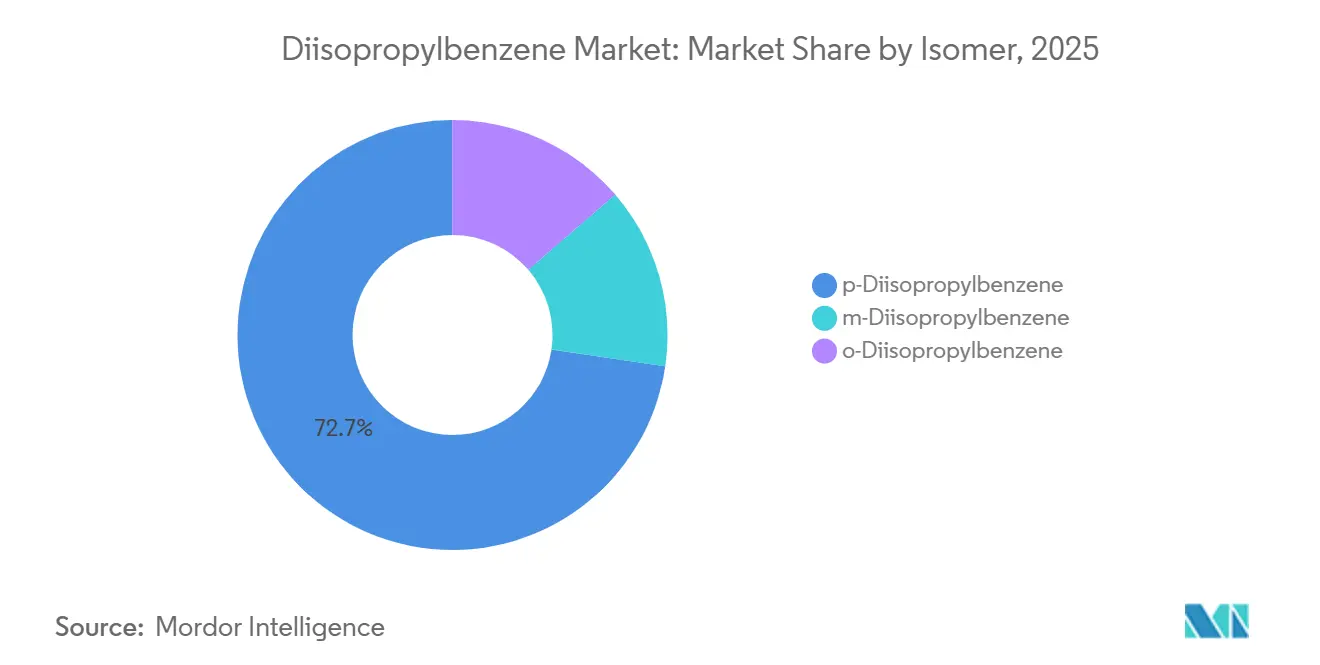
p-Diisopropylbenzene held 72.67% of the diisopropylbenzene market share in 2025 and is forecast to grow at a CAGR of 13.06% through 2031. Its market position is driven by its use in hydroquinone production via the dihydroperoxide route, in which feedstock purity directly affects process performance. It is also used in peroxide-initiated elastomer crosslinking and related specialty chemical applications that require consistent material behavior. High-purity para-isomer feedstock supports oxidation processes that require controlled reaction conditions and reliable product yields across batches. Impurities from other isomers can affect oxidation performance and hydroquinone quality, increasing the importance of separation and purification. This makes p-diisopropylbenzene materially different from lower-specification aromatic products used in less demanding applications and raises the value of separation processes that can consistently deliver high-purity grades at commercial scale. China's volatile organic compound standards have increased pressure on older hydroquinone processes, which supports the relevance of the p-diisopropylbenzene route. These factors make the p-isomer important to both demand and the technical standards applied across the diisopropylbenzene market.
The p-diisopropylbenzene value chain is served by producers who can control isomer content during production and purification. Mitsui Chemicals in Japan and Eastman Chemical in the United States have commercial positions in related high-value chemical pathways. Eastman lists 1,4-diisopropylbenzene among its commercial products, demonstrating its continued availability as a specialty aromatic intermediate. m-Diisopropylbenzene serves as a precursor to resorcinol, used in tire cord-to-rubber bonding, giving it a focused but commercially relevant downstream role. o-Diisopropylbenzene is produced alongside the other isomers and has fewer high-value end uses, making its management an operational concern. Its accumulation can create inventory and disposal challenges for the diisopropylbenzene industry, particularly where separation units are not designed to recycle material efficiently. Recycling m- and o-isomers into the alkylation loop can improve p-isomer yields and reduce waste. Producers using such recycling routes can strengthen their position in contracts requiring consistent quality and reliable availability. The diisopropylbenzene market for p-diisopropylbenzene is driven by applications that prioritize purity, yield, reliable qualification, and traceable supply.



By Application: Polymers Provide a Broad Demand Base
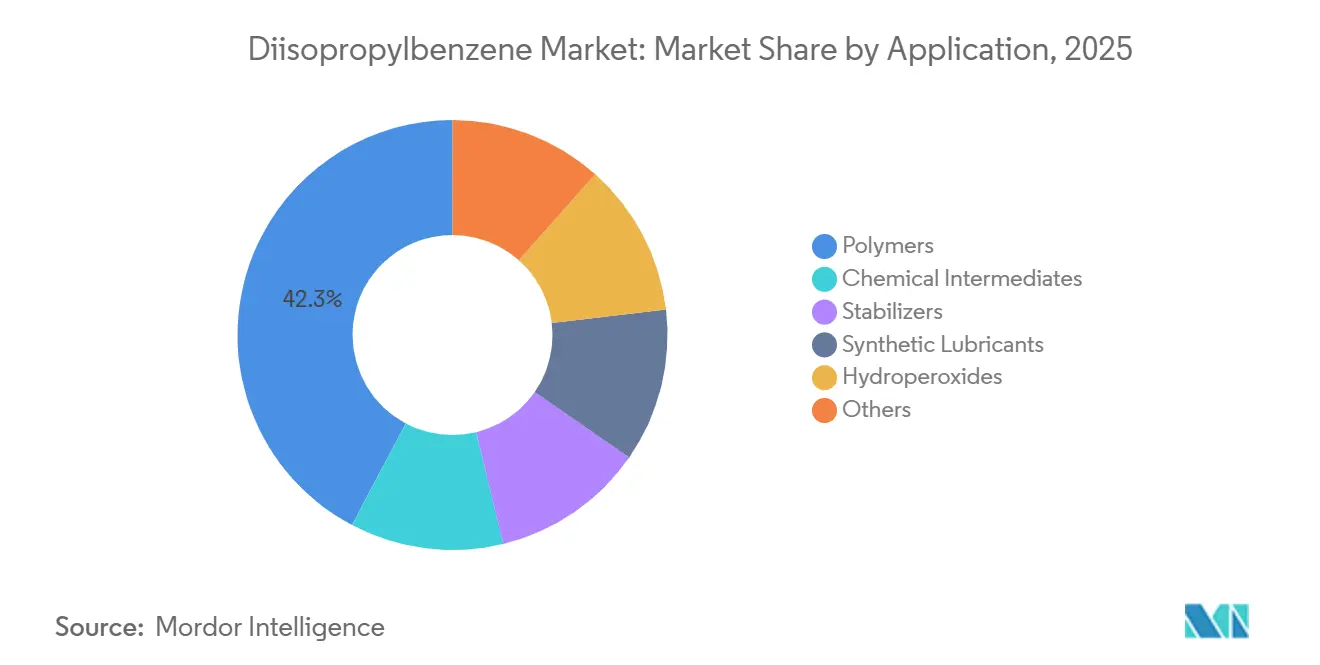
Polymers accounted for 42.25% of the diisopropylbenzene market share in 2025. This reflects the use of diisopropylbenzene-derived peroxide initiators in polyethylene crosslinking, styrene-butadiene rubber polymerization, and resin curing across a wide range of processed materials. Wire and cable insulation, specialty resins, automotive materials, and packaging each support demand for polymer additives through distinct production cycles and quality requirements. Hydroquinone-related chemistry also contributes to demand for inhibitors and antioxidant intermediates used in polymer and rubber formulations. These applications give the diisopropylbenzene market exposure to several downstream processing chains rather than a single end-use segment. Chemical intermediates and stabilizers provide additional application bases for polymer formulation, including products designed to protect materials during processing or service. Hydroperoxides serve as co-initiators in rubber vulcanization and specialty resin manufacturing. Process solvents and graphic arts applications have lower demand outside core polymer processing. This range of uses reduces reliance on a single downstream customer group and helps sustain demand when individual applications experience weaker conditions.
Synthetic lubricants are forecast to grow at a CAGR of 14.12% from 2026 to 2031, the highest application growth rate in the supply segmentation. Electric vehicle drivelines and thermal management fluids require thermal stability, electrical compatibility, and oxidation resistance that conventional mineral-oil formulations cannot always provide. Electric powertrains place different demands on fluid performance and material compatibility compared to conventional drivetrains. A peer-reviewed study found that synthetic polyalphaolefins are well-suited for electric vehicle applications due to their thermal stability and electrical compatibility. Hybrid vehicles also require advanced transmission and e-axle fluids, extending demand beyond battery-electric vehicles and providing formulators with multiple routes to market for higher-performance products. The diisopropylbenzene market for synthetic lubricants is expanding as formulators favor higher-performance fluid systems for electric and hybrid vehicle applications. The diisopropylbenzene industry can participate through aromatic intermediates that support thermal stabilization in specialty lubricant formulations. This application requires technical performance, predictable purity, dependable supply, and continued compatibility with qualified fluid systems.
Geography Analysis
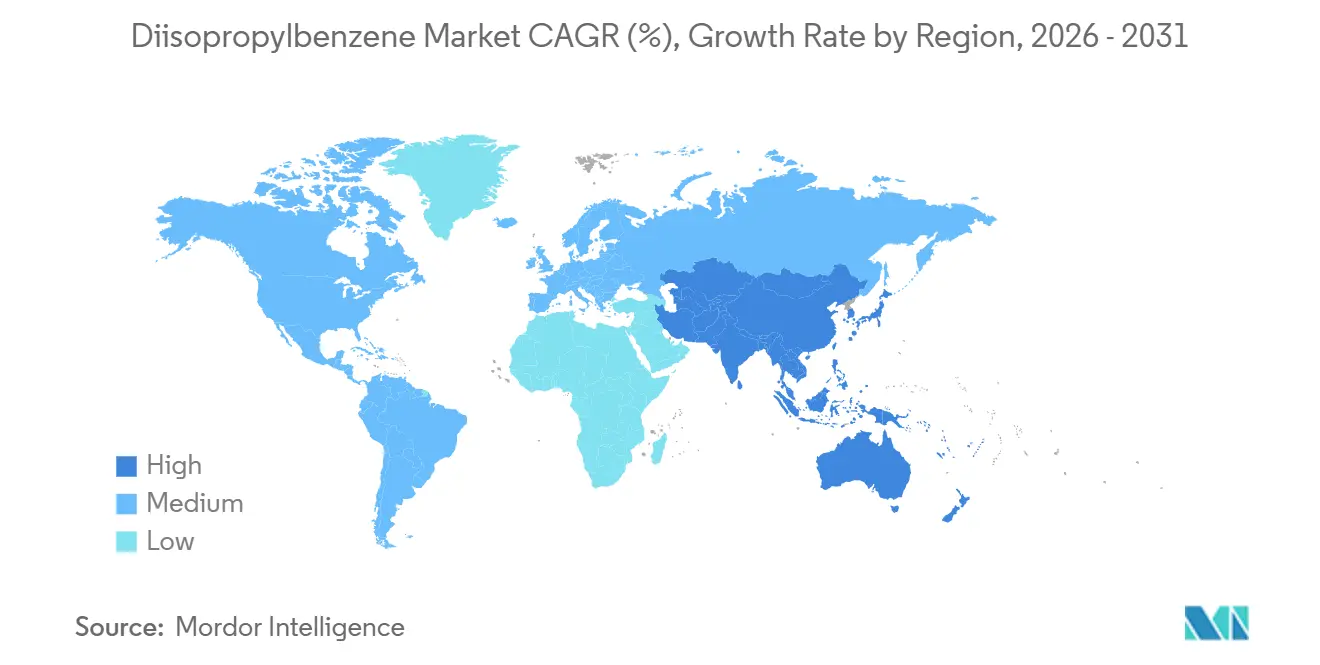
Asia-Pacific held 42.38% of the diisopropylbenzene market share in 2025 and is forecast to grow at a CAGR of 14.25% through 2031. The region combines China's large synthetic rubber base with Japan's high-purity chemical capabilities, generating demand from both large-scale polymer processing and specialized chemical applications. South Korea contributes integrated phenol, bisphenol A, and epoxy supply chains that use related aromatic feedstocks and support technical material requirements. India is expanding its role in specialty chemicals and hydroquinone-linked value chains, adding another demand center for p-diisopropylbenzene derivatives. These varied demand centers support both commodity and higher-purity grades, making the Asia-Pacific region relevant to producers across different technical positions.
BASF's March 2026 Zhanjiang investment illustrates the scale of new integrated chemical capacity in the region, encompassing more than 70 products and a 1-million-metric-ton-per-year ethylene cracker powered by renewable electricity. Asia-Pacific is therefore significant as both a consumption center and a production base for the diisopropylbenzene market, particularly for suppliers that require local access to feedstocks and service capabilities. China's environmental controls and capacity rationalization are shaping the regional supply environment by raising operating requirements for smaller plants. These producers face higher operating costs and increased pressure to improve process efficiency, separation performance, and control over product specifications. This dynamic tends to concentrate effective production among suppliers with greater scale, stronger process technology, and the ability to serve customers requiring consistent quality.
Japan's electronic materials activity supports demand for specialty aromatic intermediates for which reliable purity and documented production quality are essential. South Korea's producers are seeking opportunities outside domestic markets as local phenol and bisphenol A spreads remain compressed, increasing the importance of exports and higher-value products. In North America, the diisopropylbenzene market is supported by Eastman's commercial production in Kingsport, Tennessee, which serves both domestic and international customers. U.S. semiconductor construction is also increasing interest in the continuity of high-purity chemical supply, as material qualification and predictable deliveries are important for specialized downstream users. Europe remains a mature, quality-focused market for specialty polymer additives and industrial lubricants, while South America, the Middle East, and Africa represent longer-term opportunities tied to future growth in polymer and rubber processing.

Competitive Landscape
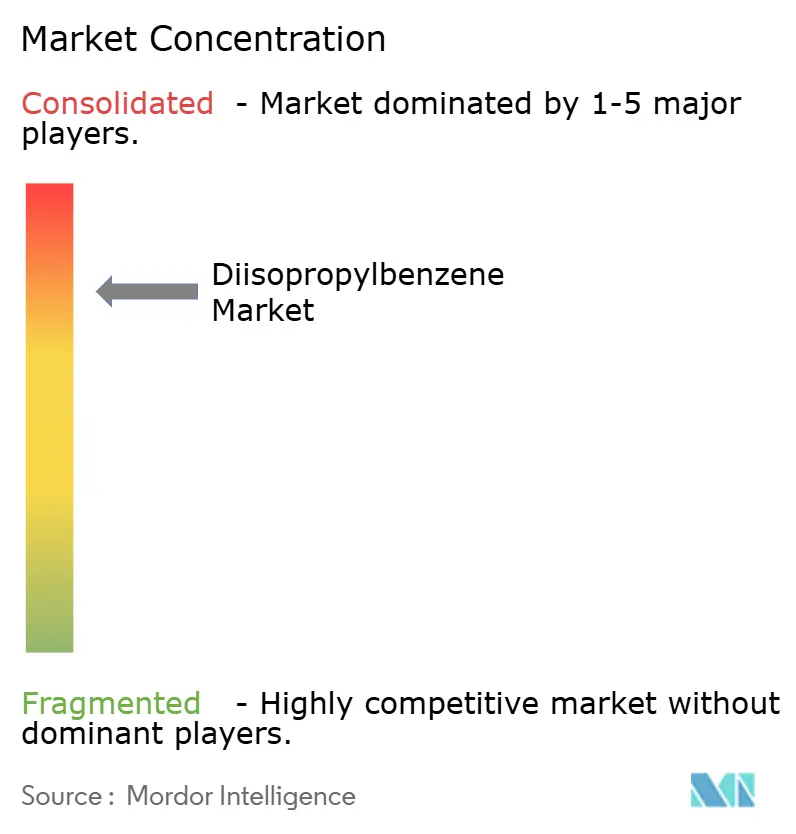
The diisopropylbenzene market is consolidated. Eastman Chemical, Mitsui Chemicals, and Kumho P&B Chemicals hold established positions in relevant chemical value chains, while smaller suppliers compete in more localized or lower-specification segments. The most important competitive factor is the ability to efficiently separate and purify isomers, since p-diisopropylbenzene is required for hydroquinone, peroxide, and specialty-material applications. Producers that recycle m- and o-diisopropylbenzene can increase p-diisopropylbenzene yields and reduce byproduct accumulation, improving both material efficiency and supply reliability. This capability supports high-purity grades used in electronics, pharmaceutical, and performance-material applications where customers require consistent quality and a documented supply.
Suppliers without advanced separation technology face higher energy consumption, lower yields, and greater difficulty managing byproducts. As a result, competition extends beyond nameplate capacity to include process control and customer qualification. Large integrated operations reinforce the advantage of established suppliers, as they can combine feedstock sourcing, production assets, logistics, and technical sales within broader chemical operations. BASF's Zhanjiang Verbund site began operations in March 2026, with more than 70 products and a 1-million-metric-ton-per-year cracker powered by renewable electricity. This level of integration can improve feedstock access and support lower-cost production across connected chemical chains, creating pressure for mid-tier suppliers that purchase feedstocks externally. LANXESS completed the EU Registration, Evaluation, Authorisation and Restriction of Chemicals (REACH) registration for Vulkanox 4060 before its September 2026 launch, demonstrating how regulatory compliance can be incorporated into product development and commercial positioning.
SI Group has emphasized low levels of Substances of Very High Concern (SVHCs) and bio-based additive products in its communications, reflecting customer demand for materials that meet both performance and sustainability requirements. North American localization is a strategic opportunity for suppliers who can provide electronics-grade p-diisopropylbenzene with a reliable domestic supply, complete documentation, and technical support. The diisopropylbenzene market presents high barriers to new entrants, as isomer separation requires specialized process capability and feedstock integration reduces exposure to volatile spot markets. Established companies can also use broad product portfolios to absorb compliance costs that challenge smaller exporters, leaving technical capability and customer qualification as the primary basis of competition.
Diisopropylbenzene Industry Leaders
Eastman Chemical Company
The Goodyear Tire & Rubber Company
Mitsui Chemicals, Inc.
BASF
LANXESS
- *Disclaimer: Major Players sorted in no particular order

Recent Industry Developments
- September 2026: LANXESS launched Vulkanox 4060, a CCPD-based anti-aging agent developed as a regulatory-compliant alternative to N-(1,3-Dimethylbutyl)-N'-phenyl-p-phenylenediamine (6PPD) for tire applications, a key end-use segment for diisopropylbenzene derivatives. EU REACH registration (Annex VII) was completed, and initial commercial production is planned for Q4 2026.
- June 2026: Arkema started up a 15% polyvinylidene fluoride (PVDF) capacity expansion at its Calvert City, North America site, targeting lithium-ion battery and data center cable markets, both of which rely on diisopropylbenzene-based chemical intermediates. The company simultaneously announced a 20% PVDF capacity expansion at its China facility, expected to be completed by 2028.


Global Diisopropylbenzene Market Report Scope
Diisopropylbenzene is an organic chemical compound consisting of a benzene ring substituted with two isopropyl groups. It exists in three structural isomers, namely ortho-, meta-, and para-diisopropylbenzene, differentiated by the relative positions of the two isopropyl groups on the benzene ring. The compound is primarily derived from the alkylation of benzene with propylene in the presence of an acid catalyst.
The diisopropylbenzene market is segmented by isomer, application, and geography. By isomer, the market is segmented into o-diisopropylbenzene, m-diisopropylbenzene, and p-diisopropylbenzene. By application, the market is segmented into chemical intermediates, stabilizers, polymers, synthetic lubricants, hydroperoxides, and others. The report also covers market size and forecasts for diisopropylbenzene across 15 countries in major regions. The market sizes and forecasts are provided in terms of value (USD).
| o-Diisopropylbenzene |
| m-Diisopropylbenzene |
| p-Diisopropylbenzene |
| Chemical Intermediates |
| Stabilizers |
| Polymers |
| Synthetic Lubricants |
| Hydroperoxides |
| Others |
| Asia-Pacific | China |
| India | |
| Japan | |
| South Korea | |
| ASEAN Countries | |
| Rest of Asia-Pacific | |
| North America | United States |
| Canada | |
| Mexico | |
| Europe | Germany |
| United Kingdom | |
| France | |
| Italy | |
| NORDIC Countries | |
| Rest of Europe | |
| South America | Brazil |
| Argentina | |
| Rest of South America | |
| Middle East and Africa | Saudi Arabia |
| South Africa | |
| Rest of Middle East and Africa |
| By Isomer | o-Diisopropylbenzene | |
| m-Diisopropylbenzene | ||
| p-Diisopropylbenzene | ||
| By Application | Chemical Intermediates | |
| Stabilizers | ||
| Polymers | ||
| Synthetic Lubricants | ||
| Hydroperoxides | ||
| Others | ||
| By Geography | Asia-Pacific | China |
| India | ||
| Japan | ||
| South Korea | ||
| ASEAN Countries | ||
| Rest of Asia-Pacific | ||
| North America | United States | |
| Canada | ||
| Mexico | ||
| Europe | Germany | |
| United Kingdom | ||
| France | ||
| Italy | ||
| NORDIC Countries | ||
| Rest of Europe | ||
| South America | Brazil | |
| Argentina | ||
| Rest of South America | ||
| Middle East and Africa | Saudi Arabia | |
| South Africa | ||
| Rest of Middle East and Africa | ||


Key Questions Answered in the Report
What is current market size of Diisopropylbenzene Market?
The Diisopropylbenzene market size was valued at USD 3.64 billion in 2025 and is estimated to grow from USD 3.98 billion in 2026 to USD 6.87 billion by 2031, at a CAGR of 11.56% during the forecast period (2026-2031).
Which isomer leads demand?
P-Diisopropylbenzene led with a 72.67% share in 2025 and is forecast to grow at a CAGR of 13.06%.
Which application is growing fastest?
Synthetic lubricants are forecast to expand at a CAGR of 14.12% through 2031, supported by electric vehicle fluid requirements.
Which region has the strongest outlook?
Asia-Pacific held a 42.38% share in 2025 and is forecast to grow at a CAGR of 14.25% through 2031.
Page last updated on:





