
Dietary Fiber Gummies Market Size and Share
Market Overview
| Study Period | 2021 - 2031 |
|---|---|
| Market Size (2026) | USD 1.86 Billion |
| Market Size (2031) | USD 3.20 Billion |
| Growth Rate (2026 - 2031) | 11.44 % |
| Fastest Growing Market | Asia-Pacific |
| Largest Market | North America |
| Market Concentration | Low |
Major Players
*Disclaimer: Major Players sorted in no particular order Image © Mordor Intelligence. Reuse requires attribution under CC BY 4.0. |
|
Dietary Fiber Gummies Market Analysis by Mordor Intelligence
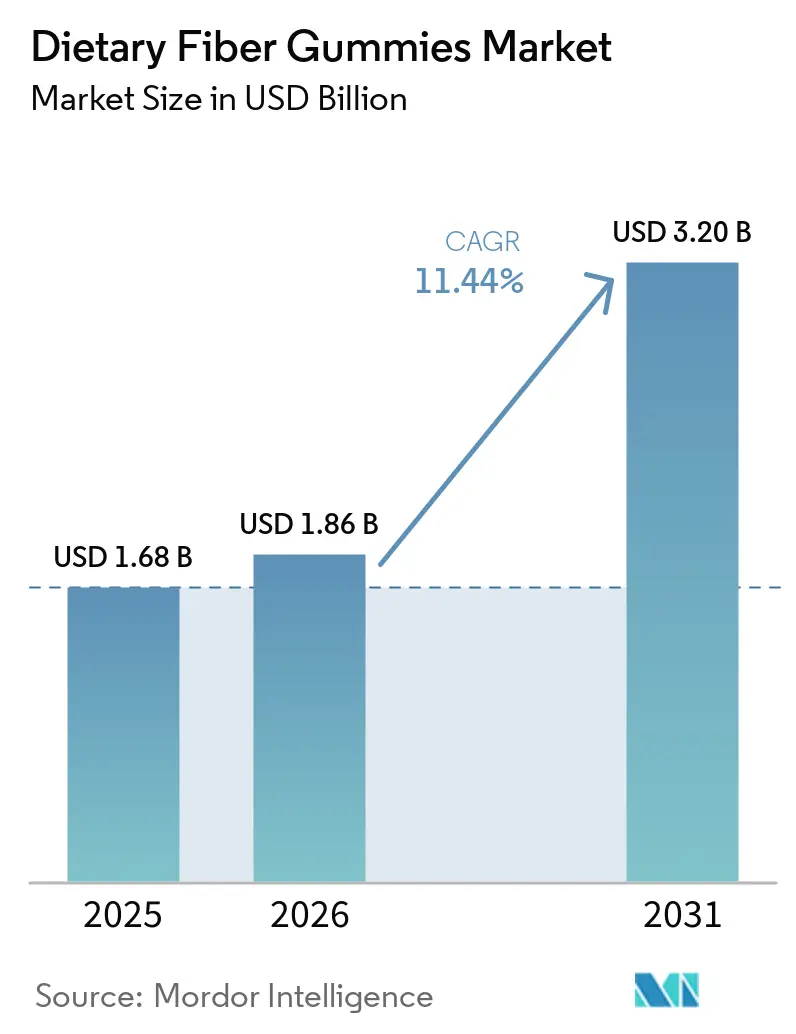
The dietary fiber gummies market size was valued at USD 1.68 billion in 2025 to USD 1.86 billion in 2026, and is forecast to reach USD 3.20 billion by 2031 at a 11.44% CAGR over 2026-2031. The dietary fiber gummies market is supported by persistent gaps between actual fiber intake and recommended levels across major consumer economies. Palatable gummy formats help consumers maintain daily supplement routines, particularly when powders or capsules are less acceptable. Growing awareness of digestive health is expanding the category beyond occasional use for digestive discomfort. Product development increasingly combines fiber with probiotics, vitamins, and other nutritional ingredients. These developments enable brands to drive repeat purchases and sustain premium positioning.
Key Report Takeaways
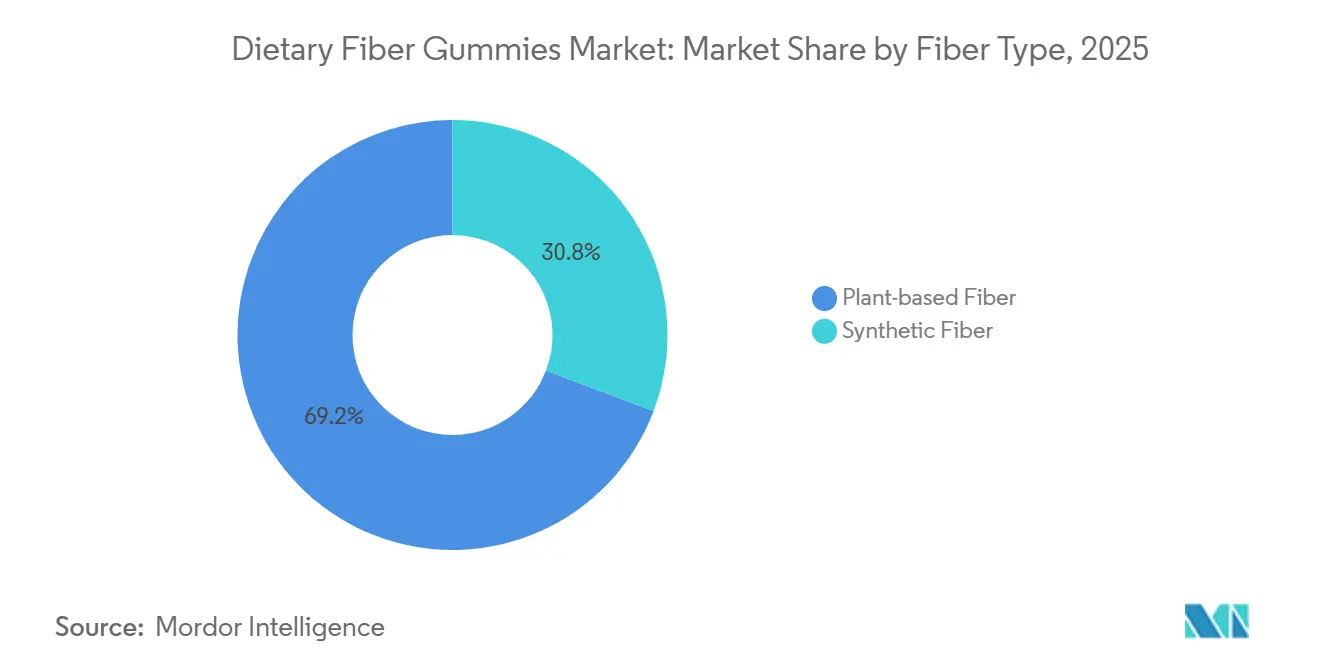
- By fiber type, plant-based fiber led the dietary fiber gummies market with a share of 69.24% in 2025, while synthetic fiber products are anticipated to register the fastest CAGR of 12.93% during 2026-2031.
- By product type, conventional retained a 72.58% share in 2025, whereas sugar-free is forecast to expand at a 12.25% CAGR through 2031.
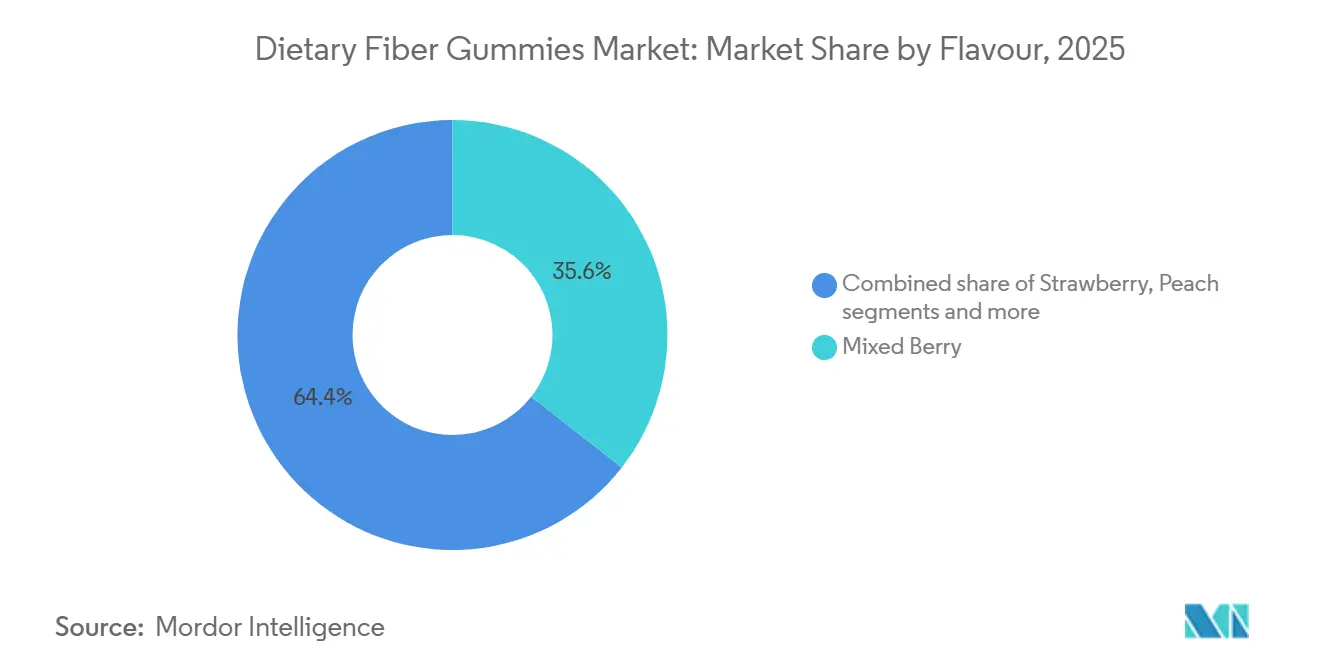
- By flavour, mixed berry retained a 35.57% share in 2025, whereas strawberry is forecast to expand at a 12.63% CAGR through 2031.
- By distribution channel, hypermarkets and supermarkets led the market with a share of 42.45% in 2025, while online retail is anticipated to register the fastest CAGR of 11.99% during 2026-2031.
- By geography, North America led the dietary fiber gummies market in 2025 with a 39.12% share, while Asia-Pacific is projected to advance at a 12.44% CAGR through 2031.
Note: Market size and forecast figures in this report are generated using Mordor Intelligence’s proprietary estimation framework, updated with the latest available data and insights as of January 2026.
Global Dietary Fiber Gummies Market Trends and Insights
Drivers Impact Analysis*
| Driver | (~) % Impact on CAGR Forecast | Geographic Relevance | Impact Timeline |
|---|---|---|---|
| Persistent dietary fiber intake gaps create a supplementation demand | +2.5% | Global | Long term (≥ 4 years) |
| Rising gut health awareness reshapes consumer supplement priorities | +2.2% | Global, highest in North America, Western Europe, and Japan | Medium term (2-4 years) |
| Preventive health and digital access support daily use | +1.8% | North America and Europe, gaining in Asia-Pacific | Medium term (2-4 years) |
| Multi-functional and sugar-free formulations expand product relevance | +1.5% | North America and Europe | Medium term (2-4 years) |
| Rising preference for sugar-free and low-sugar supplements | +1.0% | North America and Europe, growing in Asia-Pacific | Short term (≤ 2 years) |
| Expansion of online and specialty supplement distribution channels | +1.2% | Global, fastest in Asia-Pacific and North America | Short term (≤ 2 years) |
| Source: Mordor Intelligence | |||
Persistent Dietary Fiber Intake Gaps Create a Supplementation Demand
The dietary fiber gummies market addresses a persistent dietary fiber shortfall across developed consumer markets. In 2025, the United States Dietary Guidelines indicate that more than 90% of women and 97% of men do not meet recommended fiber intake levels [1]Source: National Library of Medicine, " The Dietary Guidelines for Americans," pmc.nlm.nih.gov. This gap underscores the relevance of supplementation for consumers who do not adjust their food choices or maintain a high-fiber diet. Gummies reduce sensory barriers for consumers who dislike powdered formats or capsule-based routines. Consumers are more likely to use these products repeatedly when they fit seamlessly into daily routines and provide a familiar taste experience. The format also allows brands to position fiber supplementation as a convenient daily wellness habit rather than a therapeutic intervention, expanding the addressable consumer base beyond those actively seeking traditional fiber supplements.
Rising Gut Health Awareness Reshapes Consumer Supplement Priorities
Digestive wellness has become a more prominent factor driving consumer consideration of fiber supplements. The dietary fiber gummies market benefits as consumers increasingly view fiber as part of routine nutrition rather than solely as a solution for irregularity. Existing evidence continues to support attention to adequate fiber intake in countries with established supplement usage. Growing consumer interest in prebiotics is also expanding the conversation beyond digestive regularity to include fiber’s role in supporting the gut microbiota. This trend positions fiber gummies as part of a broader daily digestive health routine. The dietary fiber gummies market is responding with product messaging that connects fiber, prebiotics, and probiotics. These connections are most effective when brands clearly explain the role of each ingredient without overstating health outcomes.
Preventive Health and Digital Access Support Daily Use
The dietary fiber gummies market benefits from a shift from episodic supplement use to regular nutritional management. Daily-use products can generate more stable purchasing patterns than products consumers buy only during short periods of digestive discomfort. The dietary needs of individuals using glucagon-like peptide (GLP)-1 medications have also created a relevant adjacent use case. Vitafusion introduced its GLP-1 Support Fiber Gummy in 2025, positioning fiber as part of nutritional support for this consumer group. This approach demonstrates how brands can adapt a familiar supplement format to address a specific consumer need. It also increases the importance of clearly communicating serving guidance and ingredient content. Retail and digital channels complement each other, as consumers may discover products online and subsequently purchase them through familiar retail stores. This combination provides the dietary fiber gummies market with broader consumer access than categories that depend solely on pharmacy sales.
Multi-Functional and Sugar-Free Formulations Expand Product Relevance
The dietary fiber gummies market is moving beyond single-ingredient positioning, with brands combining fiber with probiotics, vitamins, and related ingredients. In March 2025, Pharmavite launched Nature Made Probiotic + Prebiotic Fiber Gummies, which contain the Lactospore probiotic strain and 3 g of prebiotic fiber. In the same month, TopGum launched Gummiotics, which combines probiotics, postbiotics, and a prebiotic fiber matrix. These formulations provide brands with a stronger basis for premium positioning than taste or format alone. However, they also increase the need for clinical evidence, accurate ingredient disclosures, and consistent product quality. Sugar-free product development represents another key direction in the dietary fiber gummies market. Manufacturers must therefore balance sweetening systems, sensory quality, and fiber content in the finished serving. This balance is particularly important when consumers compare sugar-free gummies with conventional products that offer a more familiar taste profile.
Restraints Impact Analysis*
| Restraint | (~) % Impact on CAGR Forecast | Geographic Relevance | Impact Timeline |
|---|---|---|---|
| Dosing constraints and tolerability can limit continued use | -1.3% | Global | Long term (≥ 4 years) |
| Price premiums and low-cost alternatives restrict broader adoption | -1.0% | Asia-Pacific, South America, and Middle East and Africa | Medium term (2-4 years) |
| Gastrointestinal side effects can reduce consumer compliance | -0.8% | Global | Short term (≤ 2 years) |
| Competition from lower-cost fiber powders and capsules | -0.9% | Global, highest in price-sensitive markets | Medium term (2-4 years) |
| Source: Mordor Intelligence | |||
Dosing Constraints and Tolerability Can Limit Continued Use
The dietary fiber gummies market faces a clear gap between typical gummy serving sizes and recommended daily fiber intake. Standard servings generally provide 3 g to 5 g of fiber, while public health guidance recommends substantially higher daily intake levels for adults. Consumers who expect gummies to address their entire dietary fiber shortfall may be disappointed by the amount provided in a practical serving size. This gap may reduce consumer confidence when digestive benefits are not experienced quickly. Increasing the fiber dose presents formulation challenges related to texture, taste, and the number of gummies required per serving. Brands must set realistic expectations regarding the product’s role as part of a broader diet. A randomized trial conducted by the National Library of Medicine in 2026 found that gelation and fiber type affected colonic gas production in healthy participants [2]Source: NCBI NLM, " A randomised, placebo-controlled trial in healthy humans," pmc.ncbi.nlm.nih.gov. This finding highlights the importance of fiber selection, even when products list similar total fiber content. Rapidly fermented ingredients may cause bloating or gas in some consumers, potentially discouraging continued use.
Price Premiums and Low-Cost Alternatives Restrict Broader Adoption
The dietary fiber gummies market competes with powders and capsules, which often provide higher fiber doses at a lower cost per serving. This difference is particularly significant in markets where supplement spending remains discretionary. Private-label powders and psyllium husk capsules appeal to consumers because they deliver fiber efficiently. Consequently, gummies must differentiate through convenience, flavor, and formulation quality rather than dosage alone. Price sensitivity is likely to remain higher across parts of Asia-Pacific, South America, and the Middle East and Africa. The dietary fiber gummies market also faces increased pressure as retailers expand their private-label offerings. These products can lower shelf prices and enable easier comparison shopping. Established manufacturers can respond by providing clinical support, ensuring ingredient transparency, and offering product combinations that are more difficult to compare directly with basic powder products.
*Our forecasts treat driver/restraint impacts as directional, not additive. The impact forecasts reflect baseline growth, mix effects, and variable interactions.
Segment Analysis
By Fiber Type: Plant-Based Leadership Faces a Tolerability Challenge
Plant-based fiber accounted for 69.24% of global category sales in 2025. Consumer familiarity with inulin, acacia fiber, and psyllium husk supports the segment. These ingredients align with clean-label preferences and provide recognizable sources on product packaging. The regulatory environment also supports established plant-derived ingredients with accepted labeling pathways. Plant-based sources are expected to remain important because they combine a familiar identity with a broad range of formulation options. Their recognizable origin can also help consumers interpret product labels during initial purchases.
Synthetic fiber is projected to grow at a CAGR of 12.93% between 2026 and 2031. The segment includes polydextrose, methylcellulose, and resistant dextrin. Manufacturers can select these ingredients to mitigate bloating and gas concerns associated with rapidly fermented fibers. Blended matrices can combine plant-based and synthetic sources to achieve a balance between a plant-derived positioning and acceptable tolerance. Consequently, synthetic options can gain relevance in premium and clinically positioned products. The segment’s growth reflects a practical response to formulation constraints rather than a rejection of plant-based fiber. It can develop alongside plant-based ingredients through blended products.


By Product Type: Conventional Products Provide Scale While Sugar-Free Products Gain Momentum
Conventional products accounted for 72.58% of revenue in the dietary fiber gummies market in 2025. Familiar sweetness, broad retail availability, and accessible price points support this segment. Many consumers select conventional gummies because taste and daily convenience influence their initial purchase decisions. The format is also easy for households already purchasing gummy vitamins to understand. Conventional formulations cater to a wide range of income levels and remain suitable for routine retail promotions. Their substantial consumer base provides manufacturers with volume opportunities across supermarkets, pharmacies, and online stores. The segment will remain relevant among consumers who prioritize a familiar and convenient experience.
The sugar-free segment is projected to expand at a CAGR of 12.25% from 2026 to 2031. Demand from consumers managing their sugar and carbohydrate intake supports this growth. The segment also appeals to individuals using GLP-1 medications and health-conscious consumers who assess added sugar on product labels. Sugar-free products can support multifunctional formulations that combine fiber with probiotics or vitamins. Success will depend on delivering desirable taste and texture without compromising the reduced-sugar positioning. The category can benefit when these combinations simplify consumers’ daily routines rather than requiring them to purchase an additional product. Clear disclosure of ingredients and serving sizes will remain important for this health-conscious consumer group.
By Flavor: Mixed Berry Retains Broad Appeal While Strawberry Gains Attention
Mixed Berry accounts for 35.57% of category revenue in the dietary fiber gummies market in 2025. Its broad appeal stems from familiarity across age groups and adjacent gummy vitamin categories. Familiar flavor profiles can reduce barriers to trial among consumers new to fiber supplementation. This is important because sensory acceptance often shapes consumers’ initial experience before they assess gradual digestive benefits. Mixed Berry also provides brands with a reliable format for combining fiber, probiotics, or vitamins in a single product. Its established position supports broad distribution across supermarkets and pharmacies. The flavor is expected to remain a core option for brands targeting broad household appeal.
Strawberry is forecast to register a CAGR of 12.63% from 2026 to 2031. Its growth reflects demand for simple, single-fruit flavor profiles among clean-label-focused consumers. Lemme launched strawberry-flavored Lemme Nº2 Fiber + Probiotic Gummies, positioned as a sugar-free digestive health product in March 2025. Good Enough Brands launched Blackberry Postbiotic Fiber Gummies in May 2025 through an online, zero-sugar format. Novel flavors can drive product trials and improve digital visibility in the crowded gummy category. While flavor alone cannot replace formulation credibility, it remains important for in-store and online product discovery. Smaller flavor formats enable brands to differentiate products without altering their core fiber proposition.

By Distribution Channel: Supermarkets Provide Reach While Online Retail Builds Repeat Demand
Hypermarkets and supermarkets accounted for 42.45% of revenue in the dietary fiber gummies market in 2025. This channel benefits from routine grocery shopping and impulse purchases near health, wellness, and pharmacy sections. Promotional displays and shelf placement help unfamiliar products reach consumers who may not have planned to purchase a fiber supplement. Metamucil gummies are available at Walmart, Target, CVS, and Walgreens, providing the brand with broad consumer visibility. Large-format retailers also enable consumers to compare formats, flavors, and price points during a single visit. Pharmacies and drug stores further provide a healthcare-oriented environment that can support more therapeutic product positioning.
Online retail is projected to grow at a CAGR of 11.99% from 2026 to 2031. The channel supports subscription models, targeted product information, and lower entry barriers for new brands. It is particularly suitable for formulations that require more detailed explanations of fiber sources, serving sizes, or additional ingredients. Online channels also enable brands to maintain engagement with repeat buyers after the initial purchase. Good Enough Brands adopted an online-only strategy for the launch of its postbiotic fiber gummies in May 2025. Therefore, online retail remains important for consumer education and replenishment, even as broad supermarket distribution continues to be critical for scale.
Geography Analysis
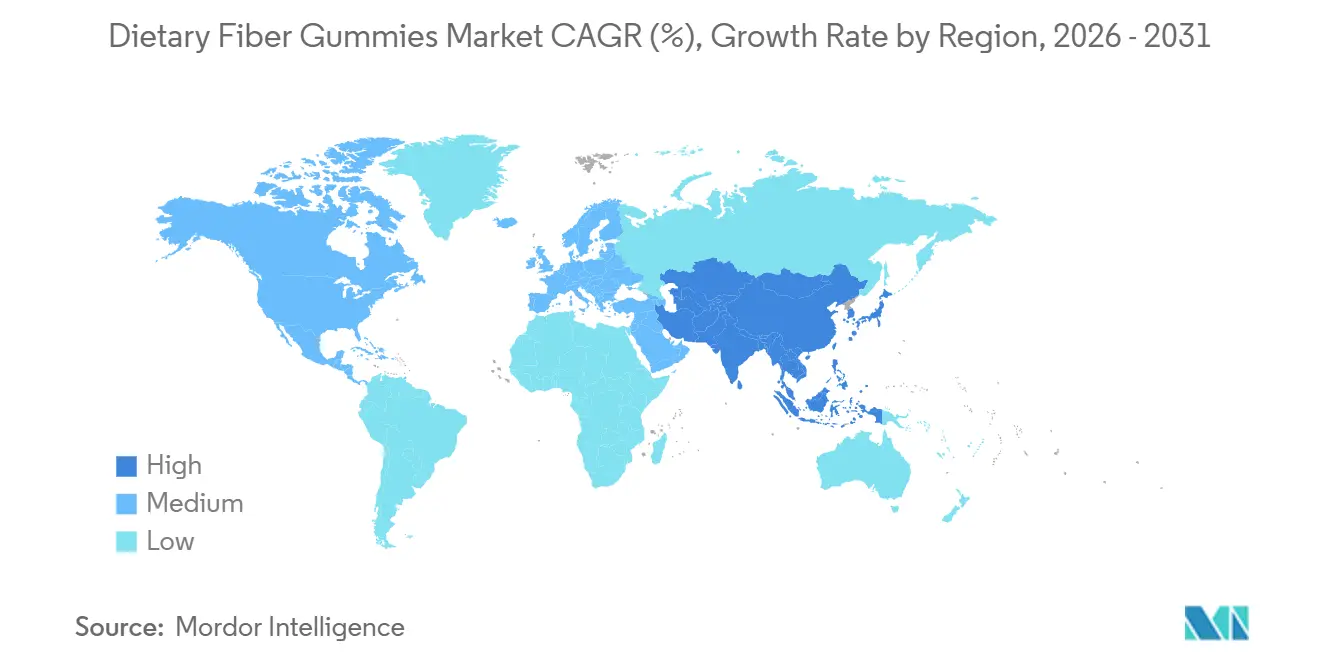
North America accounted for 39.12% of category sales in 2025. The region benefits from an established supplement culture, high consumer awareness, and broad access to large-format retail channels. The United States represents the largest country market, supported by familiar brands such as Metamucil and clear Food and Drug Administration labeling pathways as of July 2024 [3]Source: U.S. Food and Drug Administration, " Questions and Answers on Dietary Fiber," fda.gov. Canada contributes demand through its established natural health product framework. Mexico and other North American markets remain at earlier stages of adoption; however, organized retail and e-commerce channels can expand access over time. The region’s mature retail environment enables branded products to serve different purchasing occasions through pharmacy, grocery, and digital channels. Familiarity with fiber supplements reduces the need for basic category education, although brands must still clearly explain product-specific claims.
Europe has a quality-focused demand profile across Germany, the United Kingdom, France, Italy, Spain, and Belgium. The United Kingdom’s fiber intake gap signals a clear consumer need, with average intake reported at 19 g compared with the recommended 30 g. Germany is well positioned for clinically supported formulations, as consumers place considerable value on functional foods and pharmacist recommendations. France provides a dual route to market through pharmacy and online sales channels. Italy and Spain present smaller opportunities, where urban wellness consumers may favor convenient supplement formats. The region’s regulatory focus favors brands that substantiate product claims with clear evidence.
Asia-Pacific is forecast to expand at a CAGR of 12.44% from 2026 to 2031, making it the fastest-growing regional opportunity. Urbanization, rising disposable incomes, and lower-fiber processed diets support demand across several countries. China serves as a major growth engine, while Japan’s gummy supplement consumer base accelerated following the safety-related market disruption in 2024. India offers an expanding nutraceutical landscape as organized retail and urban health awareness increase. Australia also contributes demand through products such as Swisse Fibre Boost Gummies. The dietary fiber gummies market can benefit from this broader access; however, premium positioning must reflect local format alternatives. Product education is particularly important in markets where consumers are shifting from food-based fiber sources to supplement formats.

Competitive Landscape
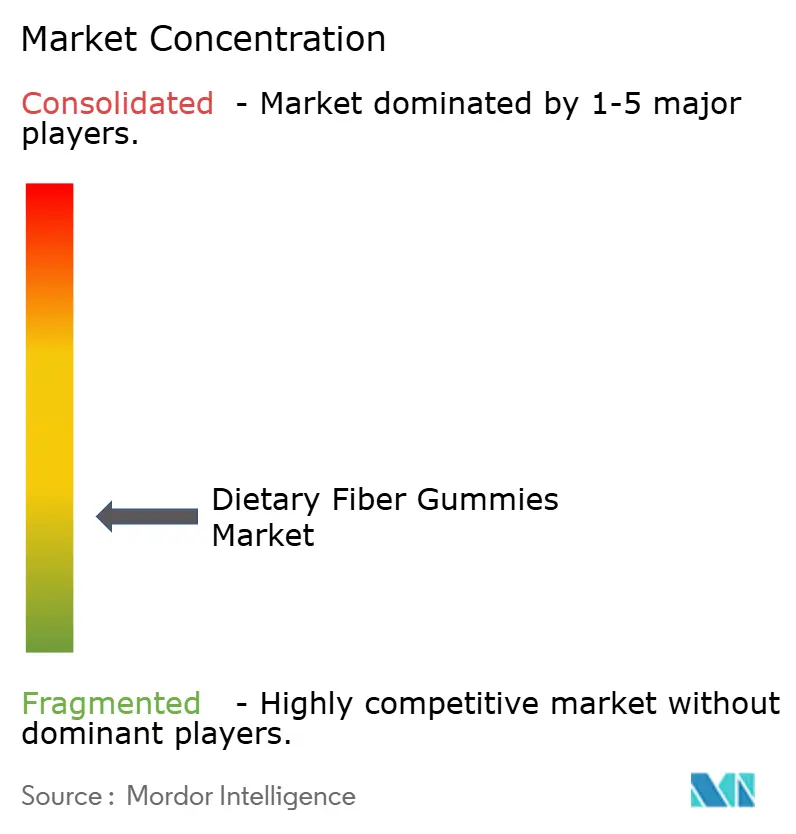
The dietary fiber gummies market is fragmented, with no single company controlling the category’s economics. As a result, brand recognition, formulation quality, and channel execution play critical roles. Established consumer health companies compete with dedicated gummy manufacturers and emerging direct-to-consumer brands. Procter & Gamble participates through Metamucil, while Herbaland Naturals, Hero Nutritionals, Vitafusion, and other specialists serve the gummy category. Competition centers on multifunctional products, sugar-free alternatives, and convenient online replenishment options. These priorities favor brands that can clearly communicate product value beyond the gummy format alone.
This investment strengthens the company’s ability to develop and manufacture gummy products at scale. Pharmavite launched Nature Made Probiotic + Prebiotic Fiber Gummies in March 2025. Similarly, TopGum introduced Gummidotics in March 2025, featuring a proprietary prebiotic fiber matrix for its synbiotic gummy. These developments indicate that formulation capabilities and manufacturing expertise are becoming key competitive assets. The Pharmavite facility adds dedicated capacity at a time when gummy products require specialized manufacturing controls and sustained product development. Its planned March 2025 launch also demonstrates a strategy of combining established brand equity with a more targeted digestive health proposition.
Opportunities remain in pediatric and older-adult formulations, where dosage, flavor, and sugar content require careful adaptation. Brands offering clinically supported products can establish greater credibility with caregivers and healthcare professionals. Social-media-native brands can also use direct sales channels and influencer outreach to compete with established retail brands. Samyang is expected to present Fibernova in July 2026, a prebiotic fiber ingredient designed for gummy formulations. Ingredient technology can help companies differentiate their offerings when basic fiber ingredients are widely available. Transparent sourcing and clear label communication also remain important for building consumer trust at the point of purchase, particularly when multiple brands make similar digestive health claims and offer comparable gummy formats.
Dietary Fiber Gummies Industry Leaders
-
Church & Dwight Co., Inc.
-
Unilever PLC
-
Bayer AG
-
Procter & Gamble Company
-
Haleon Plc
- *Disclaimer: Major Players sorted in no particular order

Recent Industry Developments
- February 2026: TopGum Industries Ltd., a gummy supplement manufacturer, has developed a new line of beauty-from-within gummies to address consumers’ growing demand for holistic solutions that support skin health and appearance. The functional gummy range contains natural ingredients that target specific hair, skin, and nail (HSN) benefits.
- December 2025: Church & Dwight completed the sale of its VitaFusion and L'il Critters brands to Piping Rock Health Products. The transaction transferred ownership of these established gummy supplement brands.
- May 2025: Pharmavite opened a USD 250 million, 225,000-square-foot manufacturing and research facility in New Albany, Ohio. The facility includes a Gummies Innovation Center of Excellence and has created 225 jobs.
- March 2025: Pharmavite launched Nature Made Probiotic + Prebiotic Fiber Gummies, which combine the clinically studied Lactospore probiotic strain with 3 g of prebiotic fiber in mixed berry-flavored gummies. The company also introduced a reformulated Nature Made Prebiotic Fiber Gummies product.


Global Dietary Fiber Gummies Market Report Scope
Dietary fiber gummies are chewable dietary supplements formulated with soluble, insoluble, or prebiotic fibers. They support digestive health and help consumers meet their daily fiber intake requirements. These gummies offer a convenient, flavored alternative to traditional fiber powders, capsules, and tablets.
The dietary fiber gummies market is segmented by fiber type, product type, flavour, distribution channel, and geography. By fiber type, the market is segmented into plant-based fiber and synthetic fiber. By product type, the market is segmented into conventional and sugar-free. By flavour, the market is segmented into mixed berry, strawberry, peach, and others. By distribution channel, the market is segmented into supermarkets/hypermarkets, pharmacies and drug stores, online retail, and other distribution channels. Based on geography, the market is classified into North America, Europe, South America, Asia-Pacific, and the Middle East and Africa. The Market Forecasts are Provided in Terms of Value (USD).
| Plant-based Fiber |
| Synthetic Fiber |
| Conventional |
| Sugar-free |
| Mixed Berry |
| Strawberry |
| Peach |
| Others |
| Hypermarkets/Supermarkets |
| Pharmacies and Drug Stores |
| Online Retail Channels |
| Other Distribution Channels |
| North America | United States |
| Canada | |
| Mexico | |
| Rest of North America | |
| Europe | Germany |
| United Kingdom | |
| Italy | |
| France | |
| Spain | |
| Belgium | |
| Rest of Europe | |
| Asia-Pacific | China |
| India | |
| Japan | |
| Australia | |
| Rest of Asia-Pacific | |
| South America | Brazil |
| Argentina | |
| Rest of South America | |
| Middle East and Africa | South Africa |
| Saudi Arabia | |
| United Arab Emirates | |
| Rest of Middle East and Africa |
| By Fiber Type | Plant-based Fiber | |
| Synthetic Fiber | ||
| By Product Type | Conventional | |
| Sugar-free | ||
| By Flavour | Mixed Berry | |
| Strawberry | ||
| Peach | ||
| Others | ||
| By Distribution Channel | Hypermarkets/Supermarkets | |
| Pharmacies and Drug Stores | ||
| Online Retail Channels | ||
| Other Distribution Channels | ||
| By Geography | North America | United States |
| Canada | ||
| Mexico | ||
| Rest of North America | ||
| Europe | Germany | |
| United Kingdom | ||
| Italy | ||
| France | ||
| Spain | ||
| Belgium | ||
| Rest of Europe | ||
| Asia-Pacific | China | |
| India | ||
| Japan | ||
| Australia | ||
| Rest of Asia-Pacific | ||
| South America | Brazil | |
| Argentina | ||
| Rest of South America | ||
| Middle East and Africa | South Africa | |
| Saudi Arabia | ||
| United Arab Emirates | ||
| Rest of Middle East and Africa | ||


Key Questions Answered in the Report
What is the current size and growth outlook of the dietary fiber gummies market?
The dietary fiber gummies market was valued at USD 1.68 billion in 2025 and is projected to grow from USD 1.86 billion in 2026 to USD 3.20 billion by 2031, registering a CAGR of 11.44% during 2026-2031.
Which fiber type segment held the largest market share in 2025?
The plant-based fiber segment dominated the market in 2025, accounting for 69.24% of total revenue.
Which product type accounted for the largest share of the market in 2025?
The conventional dietary fiber gummies segment led the market with a 72.58% share in 2025.
What was the leading flavor segment in the dietary fiber gummies market in 2025?
Mixed berry was the most popular flavor, holding a 35.57% market share in 2025.
Which distribution channel generated the highest revenue in 2025?
Hypermarkets and supermarkets were the leading distribution channel, accounting for 42.45% of the market in 2025.
Which region dominated the dietary fiber gummies market in 2025?
North America held the largest regional market share in 2025, representing 39.12% of revenue.
Page last updated on:





