
Dextrose Market Size and Share
Market Overview
| Study Period | 2021 - 2031 |
|---|---|
| Market Size (2026) | USD 7.12 Billion |
| Market Size (2031) | USD 9.59 Billion |
| Growth Rate (2026 - 2031) | 6.14 % |
| Fastest Growing Market | Middle East and Africa |
| Largest Market | Asia-Pacific |
| Market Concentration | Medium |
Major Players *Disclaimer: Major Players sorted in no particular order Image © Mordor Intelligence. Reuse requires attribution under CC BY 4.0. | |
Dextrose Market Analysis by Mordor Intelligence
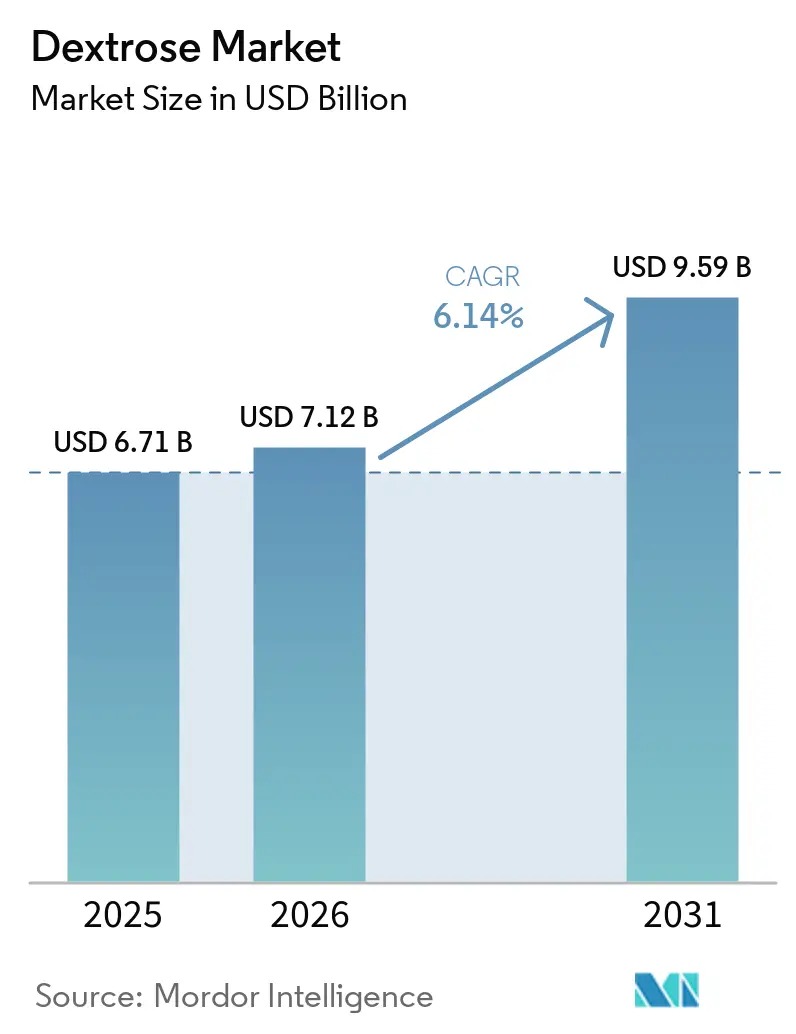
The Dextrose Market size was valued at USD 6.71 billion in 2025 and is estimated to grow from USD 7.12 billion in 2026 to reach USD 9.59 billion by 2031, at a CAGR of 6.14% during the forecast period (2026-2031). The dextrose market is supported by stable food processing demand and growing uptake in pharmaceutical, parenteral nutrition, and fermentation applications. Pharmaceutical grades carry higher specifications, as producers must meet strict limits for endotoxins, heavy metals, and purity, which raises entry barriers for smaller suppliers. Feedstock and energy costs remain significant factors, as wet milling requires corn or wheat inputs along with energy-intensive drying, evaporation, and crystallization processes. Companies respond through formulation capabilities, high-purity production, alternative feedstock sourcing, and investments that connect dextrose supply with precision fermentation. The dextrose market also faces pressure from sugar-reduction regulations in consumer foods, although medical and industrial applications provide demand that is less exposed to these policies.
Key Report Takeaways
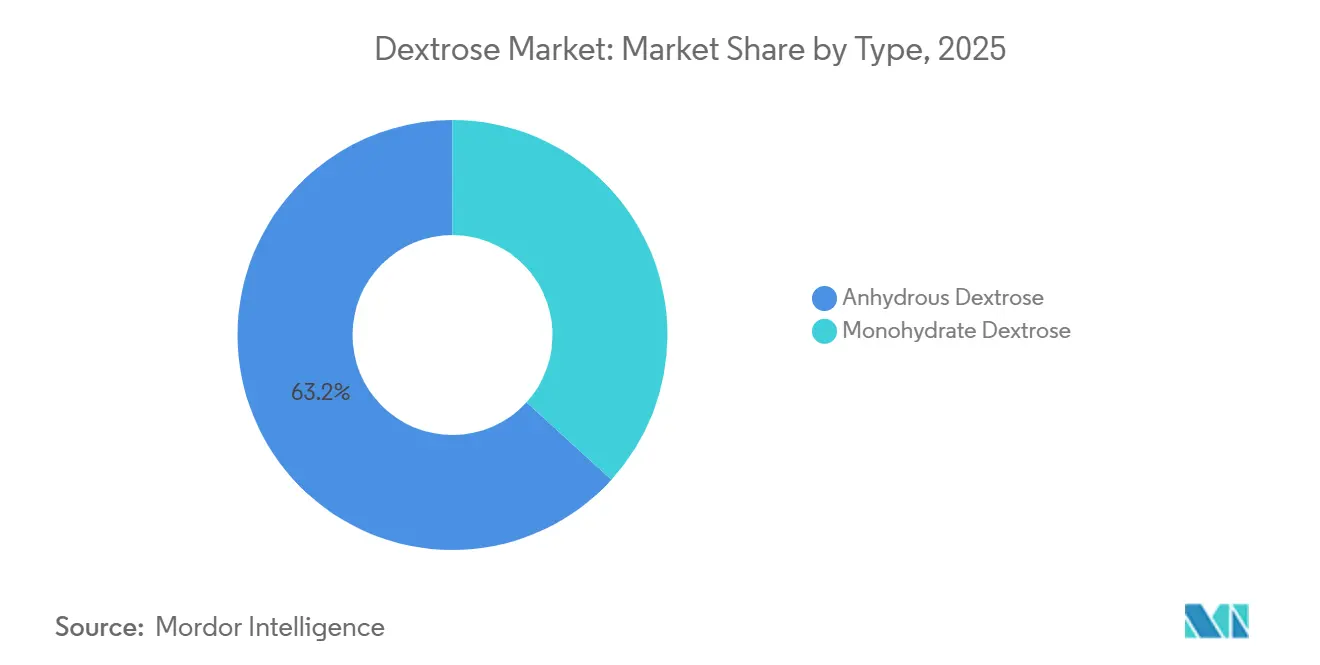
- By type, anhydrous dextrose held 63.24% of the dextrose market share in 2025 and is forecast to expand at a CAGR of 6.45% through 2031.
- By source, corn-based dextrose held 73.56% of the dextrose market share in 2025, while wheat-based dextrose is forecast to expand at a CAGR of 7.18% through 2031.
- By form, powdered dextrose held 48.05% of demand in 2025, while liquid dextrose is forecast to expand at a CAGR of 6.73% through 2031.
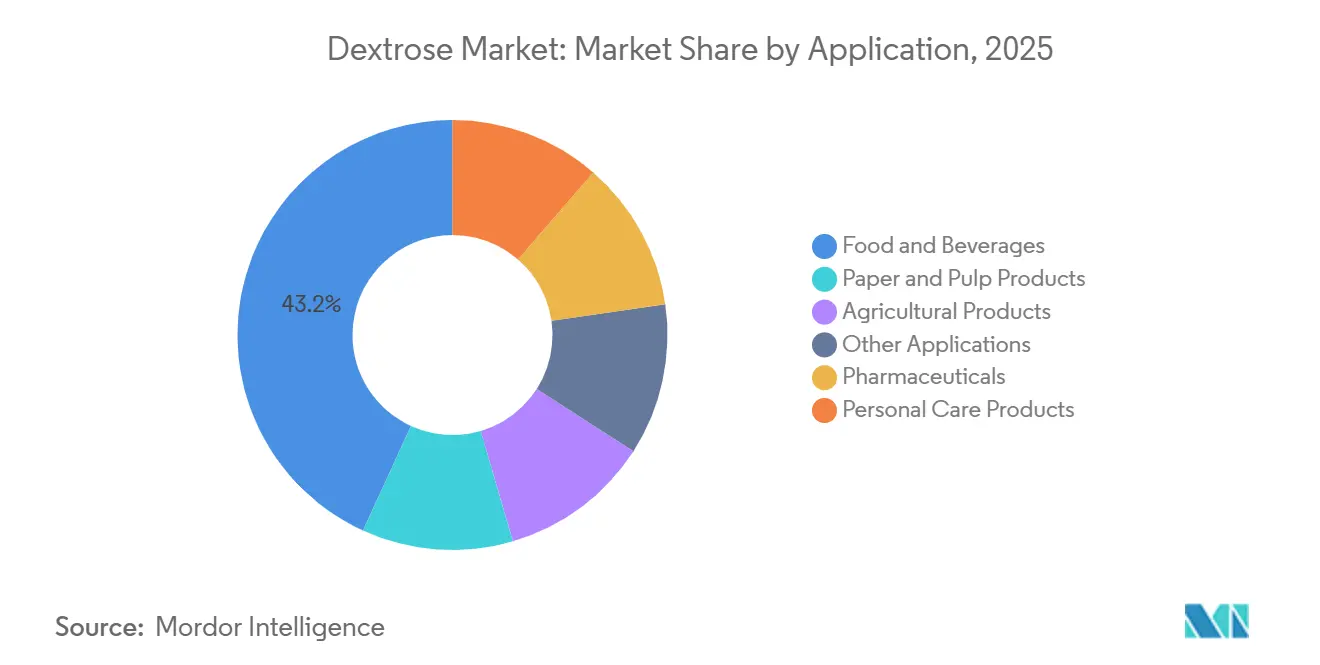
- By application, food and beverages accounted for 43.17% of demand in 2025, while pharmaceuticals are forecast to expand at a CAGR of 7.25% through 2031.
- By geography, Asia-Pacific held 42.78% of global revenue in 2025, while the Middle East and Africa are forecast to expand at a CAGR of 7.03% through 2031.
Note: Market size and forecast figures in this report are generated using Mordor Intelligence’s proprietary estimation framework, updated with the latest available data and insights as of January 2026.
Global Dextrose Market Trends and Insights
Drivers Impact Analysis*
| Drivers | (~) % Impact on CAGR Forecast | Geographic Relevance | Impact Timeline |
|---|---|---|---|
| Processed Foods and Convenience Products | +1.5% | Global, strongest pull in Asia-Pacific (APAC) and Middle East and Africa (MEA) | Medium term (2-4 years) |
| Pharmaceutical and Parenteral Nutrition Applications | +1.2% | Global, led by APAC, North America, and EU | Long term (≥ 4 years) |
| Sports Nutrition and Functional Beverages | +0.8% | North America, EU, and APAC core | Medium term (2-4 years) |
| Clean-Label and Non-GMO Ingredients | +0.6% | North America and EU, with spillover to APAC | Medium term (2-4 years) |
| Pharmacopoeia Alignment for High-Purity Dextrose | +0.5% | Global, particularly APAC, North America, and EU | Long term (≥ 4 years) |
| Source: Mordor Intelligence | |||
Growth in Processed Foods and Convenience Products
Dextrose performs several functions in processed foods, including supporting bakery fermentation, browning confectionery, stabilizing moisture in cured meats, and supplying rapid energy in convenience meals. Food manufacturers use the ingredient for its processing and finished-product characteristics rather than sweetness alone. These functions keep the dextrose market tied to food manufacturers that need consistent product performance across large production runs. ADM stated in January 2026 that its USD 26 million investment in Erlanger, Kentucky would strengthen reformulation capabilities as demand for recognizable ingredients increased. The same company's research found that 70% of global consumers favored recognizable label ingredients and 58% sought shorter ingredient lists. Food capacity additions in Asia-Pacific and the Middle East are widening the customer base for ready-to-eat foods, instant beverages, and fortified dairy products. This demand is especially relevant where packaged food consumption is increasing faster than in mature markets that face stronger sugar-reduction pressure.
Expansion of Pharmaceutical and Parenteral Nutrition Applications
Dextrose is a core carbohydrate input in parenteral nutrition and is also used in pharmaceutical processing and fermentation. The dextrose market benefits when hospitals expand nutrition programs and drug manufacturers increase output of injectable, tablet, and biopharmaceutical products. United States Pharmacopeia requirements make low-endotoxin and pyrogen-free production important for glucose used in intravenous solutions. These requirements limit the number of producers able to serve pharmaceutical customers at scale, as producers must maintain validated controls, testing methods, batch records, and reliable processes for highly regulated applications. Roquette completed its acquisition of IFF Pharma Solutions in 2025 and described the businesses as complementary within a broader drug-delivery portfolio[1]Roquette Frères, “2024 Results Announcement,” Roquette, roquette.com. The transaction supports a strategy in which high-purity carbohydrate ingredients are supplied alongside other pharmaceutical excipients, allowing buyers to work with fewer specialized ingredient partners.
Rising Demand for Sports Nutrition and Functional Beverages
Sports nutrition and functional beverages provide an additional source of demand for dextrose in consumer health products. Dextrose is a familiar carbohydrate ingredient for products intended to support energy intake and post-exercise recovery. Its use fits beverage powders, gels, and ready-to-drink formats when formulators need rapid carbohydrate delivery, particularly when a formulation must dissolve predictably and maintain a familiar carbohydrate profile for active consumers. This application also gives the dextrose market exposure to consumers who prefer ingredients they recognize on product labels. Manufacturers must still balance carbohydrate performance with lower-sugar product positioning in markets where health guidance is changing purchase decisions. Demand in this category is therefore strongest when brands can clearly explain the role of dextrose and use it within products designed for specific activity or recovery needs, rather than as a general sweetening ingredient.
Growing Adoption of Clean-Label and Non-GMO Ingredients
Clean-label and non-GMO preferences are changing procurement decisions for starch-derived ingredients in North America and Europe. The dextrose market can benefit when customers value traceable feedstocks and shorter ingredient declarations. Certified non-GMO corn availability remains limited in some supply chains, which has encouraged processors to assess wheat and other starch sources, particularly when food brands need a documented alternative that matches customer sourcing policies. This trend affects purchasing criteria more than the technical suitability of dextrose itself. It also creates an opening for suppliers that can maintain identity through sourcing, milling, and processing, and provide customers with supporting records on origin, segregation, and product consistency. This effect can extend to Asia-Pacific as export-oriented food producers align product specifications with North American and European customer requirements, particularly for branded foods that cross multiple regulatory and retail markets.
Restraints Impact Analysis*
| Restraints | (~) % Impact on CAGR Forecast | Geographic Relevance | Impact Timeline |
|---|---|---|---|
| Corn, Wheat, and Energy Cost Volatility | -0.8% | Global, most acute in EU and North America | Short term (≤ 2 years) |
| Sugar-Reduction Policies and Added-Sugar Health Concerns | -0.6% | North America and EU, with spillover to APAC | Medium term (2-4 years) |
| Natural Gums and Alternative Sweeteners | -0.4% | Global | Long term (≥ 4 years) |
| Source: Mordor Intelligence | |||
Corn, Wheat, and Energy Cost Volatility
Corn and wheat prices represent only one component of the production cost base for wet-milled dextrose. Drying, evaporation, and crystallization also require substantial energy, which can affect producer margins and selling prices. Purdue University and FAPRI projected a 2026/27 U.S. corn season-average price of USD 4.20 per bushel in their May 2026 commodity brief. The brief also noted that ethanol demand offered only a partial price floor, while higher nitrogen fertilizer costs added further pressure[2]Purdue University and Food and Agricultural Policy Research Institute, “Commodity Prices at the Crossroads: Trade Policy, the Iran Conflict, and the 2026 U.S. Grain Markets,” Purdue University, ag.purdue.edu. This uncertainty reduces visibility for both producers and buyers in the dextrose market, as changes in input costs can occur before contract prices and inventory plans are adjusted, making procurement discussions more dependent on delivery terms, inventory levels, and agreed pricing mechanisms. Longer-term offtake arrangements can help buyers manage supply and pricing exposure when grain and energy conditions change quickly, while providing millers with a clearer view of committed customer output.
Sugar-Reduction Policies and Added-Sugar Health Concerns
Sugar-reduction policies create a direct challenge for food-grade dextrose used in consumer-facing products. The World Health Organization recommends fiscal policies, including taxes on sugar-sweetened beverages, to promote healthier diets. A 2025 study of European tiered soft drink taxes found that these measures were associated with lower mean sales-weighted sugar content in soft drinks. Dextrose classified as added sugar on product labels is exposed to reformulation decisions in confectionery, soft drinks, and sweetened dairy foods, where consumer demand, retailer policies, and public health guidance can influence product development priorities. The dextrose market is less exposed in pharmaceutical, medical nutrition, and fermentation applications, as these uses are not driven by consumer sugar policy in the same way. Companies are also expanding sugar-reduction portfolios, which allows them to serve food manufacturers whether formulations retain or reduce conventional sweetening ingredients, and reduces reliance on a single consumer food positioning.
*Our forecasts treat driver/restraint impacts as directional, not additive. The impact forecasts reflect baseline growth, mix effects, and variable interactions.
Segment Analysis
By Type: Anhydrous Dextrose Holds the Largest Position and the Fastest Growth Rate
Anhydrous dextrose held 63.24% of the dextrose market share by type in 2025 and is projected to grow at a 6.45% CAGR through 2031. Its water-free composition supports moisture-sensitive formulations in hard candy, protein powders, dry beverages, and spray-dried pharmaceutical excipients. The material simplifies storage and handling in applications where water exposure would affect product stability, helping customers maintain consistent quality in dry blends, powders, and tightly specified formulations while reducing the risk that moisture variation alters the finished product's behavior. Its broad use across food, nutrition, and pharmaceutical processing explains why it holds both the largest share and the highest growth rate. This position gives suppliers reason to prioritize grades with consistent moisture control and particle characteristics, as these features affect customers' product handling, storage behavior, and processing performance.
Dextrose monohydrate retains a distinct role in applications requiring high aqueous solubility at ambient temperature. Intravenous solutions and sports hydration gels are examples in which formulation teams may specify the monohydrate form, as the chosen form must align with solubility requirements, fluid systems, and the manufacturing conditions of the finished product. The difference between the two forms is becoming more relevant as precision fermentation moves from pilot activity toward commercial output. Dextrose can serve as a carbon substrate in these processes when manufacturers require a consistent, readily available carbohydrate source. This opens up an additional industrial use for anhydrous material beyond conventional food and pharmaceutical demand, broadening the customer base for a type already established in dry and moisture-sensitive systems.



By Source: Corn Retains Scale While Wheat Gains Strategic Relevance
Corn-based dextrose captured 73.56% of the global supply in 2025, reflecting the scale of wet-milling operations in the U.S. Midwest and China. These facilities benefit from established corn sourcing, processing assets, and customer networks, which support high output and a familiar operating model for large food and industrial buyers, including customers that require dependable specifications across multiple plants and product lines. Cassava and tapioca sources are expanding in Southeast Asia, particularly where allergen-free and gluten-free positioning supports the growth of specialized food products. Potato-based production in Northern Europe remains smaller but serves selected functional needs. The source mix is changing primarily because customers seek supply security and non-GMO options, rather than because any single starch source is universally superior.
Wheat-based dextrose is forecast to grow at a 7.18% CAGR through 2031, the highest rate among sources. European processors are evaluating wheat starch when certified non-GMO corn availability is constrained, allowing them to keep supply programs aligned with food brand requirements without relying on a single agricultural source. Roquette processes substantial quantities of wheat-based starch in France and has capabilities relevant to multi-compendial pharmaceutical supply. Multi-feedstock sourcing can also help processors reduce dependence on a single agricultural input. For buyers, the choice between corn, wheat, tapioca, and other sources increasingly reflects certification, origin, and supply continuity requirements rather than a single technical measure of product performance.
By Form: Powdered Dextrose Leads Demand While Liquid Products Gain Ground
Powdered dextrose accounted for 48.05% of demand by form in 2025, supported by use in dry food blends, pharmaceutical tablets, and nutritional supplements. Its shelf stability and straightforward dosing make it compatible with standard blending and packaging equipment, allowing food, nutrition, and pharmaceutical manufacturers to integrate it into established operating procedures with limited process changes. Bakery, sports nutrition, and oral solid dosage production commonly use powdered formats. Crystalline dextrose is the second-largest form and is used in confectionery, where crystal size affects texture and sweetness delivery. These uses make powdered and crystalline formats important to the dextrose market across established customer groups.
Liquid dextrose is expected to grow at a 6.73% CAGR through 2031, making it the fastest-growing form. It is used beyond conventional food sweetening in applications where dissolved glucose concentration must be controlled during processing, particularly when liquid handling supports continuous operations or carefully managed feeding requirements in fermentation systems. Pharmaceutical-grade liquid material can support bioreactor cell culture media and other applications that require consistent glucose delivery. These settings require greater process control than standard food-grade liquid glucose can provide, including consistent quality, controlled concentration, and documentation suitable for regulated production environments. The dextrose market is seeing greater interest in liquid products designed for pharmaceutical and industrial fermentation customers. This creates a need for suppliers to combine dependable logistics with high-purity manufacturing and quality documentation, as bioprocess customers require reliable delivery schedules and closely controlled input specifications.
By Application: Food and Beverages Remain the Largest Outlet While Pharmaceuticals Expand Faster
Food and beverages represented 43.17% of demand in 2025, giving the segment the largest application share in the dextrose market. Bakery, confectionery, dairy products, and functional beverages each use dextrose for different processing and product functions. Personal care products use it as a humectant and skin-conditioning ingredient. Paper and pulp producers use its reducing properties in adhesives and coating starch. Agricultural uses in fermentation-based biopesticide production add smaller but stable demand streams. This range of uses gives food and beverage demand a broad foundation, even as health-related policies influence some product categories, since the ingredient serves processing functions that vary across finished products.
Pharmaceuticals are expected to grow at a 7.25% CAGR through 2031, the fastest rate among applications. Growth is linked to parenteral nutrition, biopharmaceutical fermentation, and generic drug manufacturing in India and China. Compendial requirements under the United States Pharmacopeia and European Pharmacopeia make quality compliance a practical threshold for suppliers. The European Directorate for the Quality of Medicines & HealthCare (EDQM) confirmed the harmonized Glucose monograph E-56 in August 2026. These requirements constrain the pool of qualified producers and support the value of pharmaceutical-grade supply. The application mix is shifting toward uses where purity, documentation, and supply assurance matter as much as unit price, increasing the commercial importance of qualified production systems and customer support.
Geography Analysis
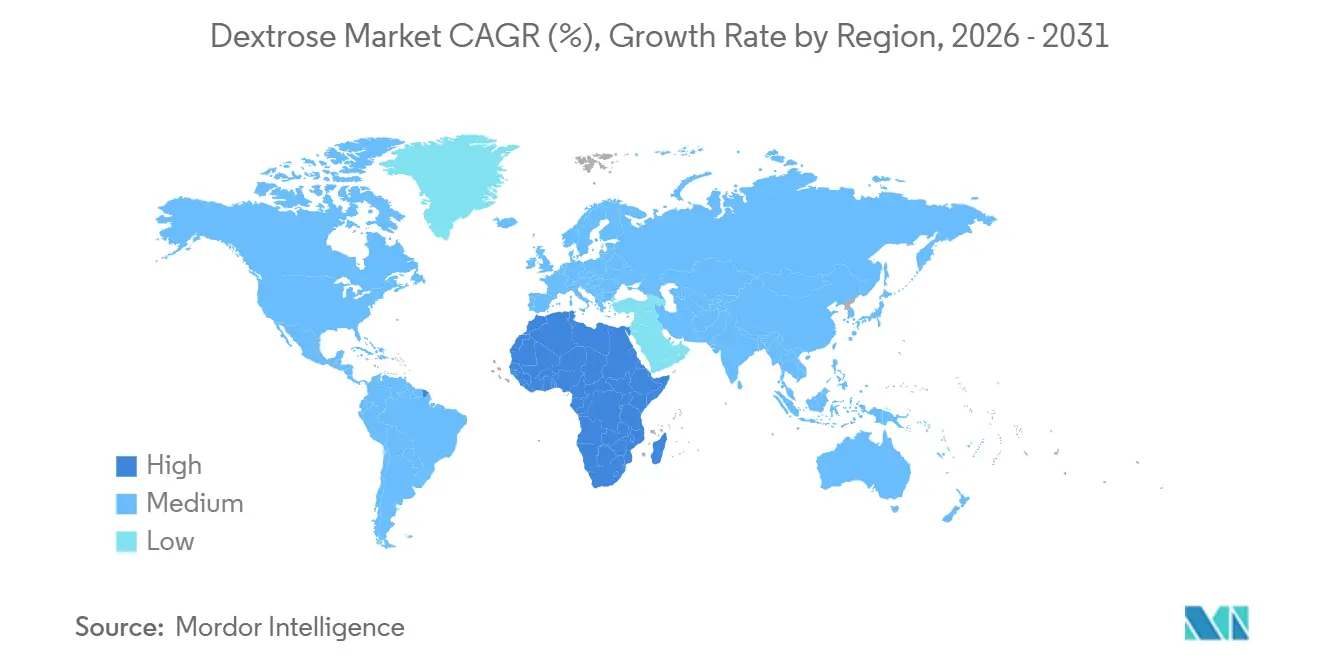
Asia-Pacific held 42.78% of the dextrose market share in 2025, making it the largest regional demand base. China operates large corn wet-milling facilities in Hebei, Jilin, and Heilongjiang, supplying food manufacturers and pharmaceutical exporters. India consumes pharmaceutical-grade dextrose for tablets, parenteral products, and oral rehydration applications, with regional demand linked to domestic generic drug output and product categories requiring documented pharmaceutical quality. Thailand, Vietnam, and Indonesia support demand through food processing that uses corn and tapioca-based inputs. Japan and South Korea maintain demand for products meeting Japanese Pharmacopeia standards. Cargill announced an expansion of its Beijing plant in January 2026, reflecting continued investment in the region.
North America maintains a strong supply position, supported by corn availability and wet-milling infrastructure in the U.S. Midwest. We supply pharmaceutical-grade dextrose that meets USP, EP, BP, and JP requirements for domestic and export customers. Europe relies primarily on wheat and corn processing. Germany, France, Poland, and the Netherlands host major starch processing operations. European customer demand for non-GMO certifications is increasing interest in wheat starch, while compendial standards and customer audits continue to determine supplier eligibility for higher-value applications. Regulatory alignment and quality requirements continue to shape sourcing and product specifications across the region.
The Middle East and Africa are projected to grow at a 7.03% CAGR through 2031, the fastest rate among all regions. Saudi Arabia, South Africa, and Egypt are the principal demand centers for processed food, healthcare, and pharmaceutical supplies. The region remains dependent on imported bulk inputs, which increases its sensitivity to freight disruptions, shipping route disruptions, and delivery timing, particularly for buyers without local production alternatives or large safety inventories. Investment in local production can reduce import exposure and improve responsiveness to healthcare demand. The region also has an opportunity to expand pharmaceutical-grade output as healthcare infrastructure develops. These conditions support a larger role for local and regional suppliers in the dextrose market over the forecast period, particularly where customers seek shorter supply chains for food and healthcare applications.

Competitive Landscape
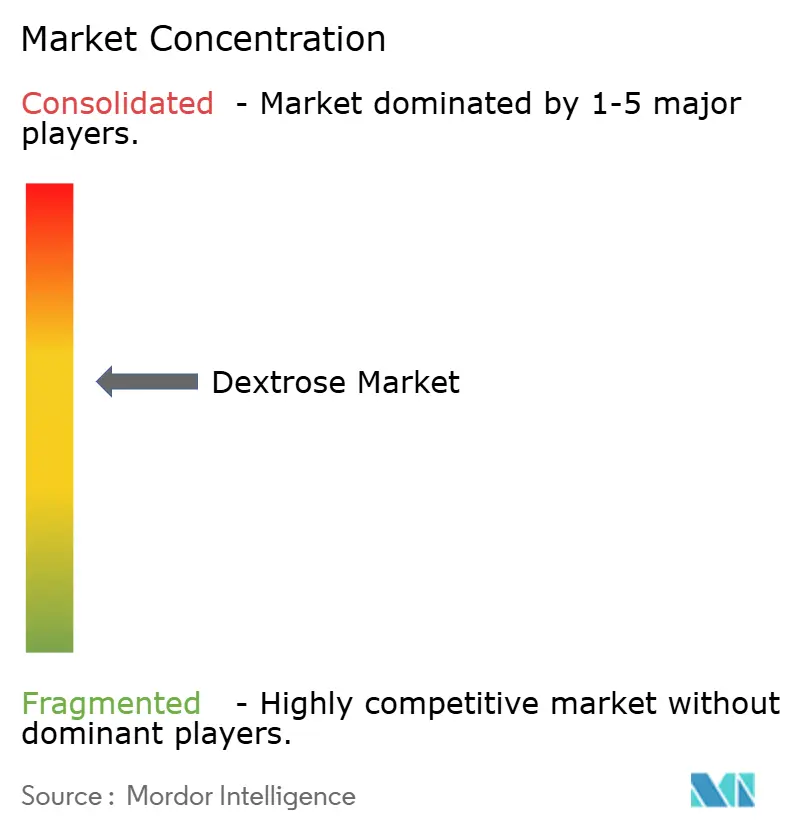
The dextrose market is moderately consolidated at the production tier. Cargill, ADM, Ingredion, Roquette Frères, and Tereos hold major pharmaceutical-grade and food-grade production capabilities. Gulshan Polyols, Grain Processing Corporation, Avebe Group, Global Sweeteners Holdings, AGRANA, Südzucker, and Belgosuc serve domestic or subregional customers. Larger suppliers compete on scale, quality systems, feedstock access, and the ability to support multiple applications, allowing them to serve food, nutrition, pharmaceutical, and fermentation customers through related product and service capabilities. Regional companies remain relevant where local customer relationships and targeted product portfolios outweigh the need for global capacity. The dextrose market is shifting beyond commodity output toward formulation support and differentiated grades, as customers seek ingredients that meet both processing requirements and evolving nutritional objectives.
Ingredion announced its recommended all-cash acquisition of Tate & Lyle on June 8, 2026, at an implied enterprise value of GBP 3.7 billion (USD 5.0 billion). Tate & Lyle shareholders approved the transaction on July 28, 2026, subject to stated conditions and regulatory clearances. Ingredion stated that the combined business targets USD 130 million in run-rate cost synergies by the end of 2030. The strategy combines dextrose, fibers, fortification, and sugar-reduction capabilities, allowing the combined company to support customer formulations that use traditional sweeteners as well as products designed to reduce them. The proposed transaction reflects how competitive strategies are broadening across ingredient systems, with large suppliers seeking greater ability to support reformulation decisions across customer product portfolios.
Roquette's 2025 acquisition of IFF Pharma Solutions strengthened its pharmaceutical excipient platform and its position in drug-delivery solutions. Riddhi Siddhi Gluco Biols Ltd. completed the acquisition of Cargill India's Davangere corn wet-milling facility in May 2026, adding 300,000 tons of annual processing capacity. Manufacturers are adapting existing assets for precision fermentation, where dextrose serves as a consistent carbohydrate input. Opportunities remain in high-purity dextrose for biopharmaceutical and cell culture applications, non-GMO and organic grades, and lower-carbon production, as customers increasingly evaluate ingredients on quality, origin, and supply chain criteria alongside purchase cost. Suppliers with multi-compendial certifications hold an advantage in premium applications. Firms that lack this capacity can still compete through regional specialization and application-specific service, particularly where they understand local feedstock conditions, customer specifications, and distribution requirements, and can respond quickly to smaller orders that may not be a priority for large multinational producers. Their position depends on maintaining reliable quality and competitive costs without the full capital burden of global certification programs. This leaves room for both large integrated suppliers and focused regional processors within the dextrose market, with each group serving customer needs that differ by certification, application complexity, delivery scale, feedstock access, commercial support requirements, and regional customer service expectations.
Dextrose Industry Leaders
Cargill, Incorporated
ADM
Ingredion
Roquette Frères
Tereos S.A.
- *Disclaimer: Major Players sorted in no particular order

Recent Industry Developments
- May 2026: Riddhi Siddhi Gluco Biols Ltd. completed the acquisition of Cargill India's corn wet-milling facility in Davangere, Karnataka, adding 300,000 tons of annual processing capacity, which expanded RSGBL's dextrose production presence in southern India.
- April 2026: ADM optimized corn wet-milling operations across its US facilities to improve high-purity dextrose yield, supporting rising demand from the nutraceutical and biopharmaceutical fermentation sectors.


Global Dextrose Market Report Scope
Dextrose is a simple sugar derived from plants such as corn or wheat. It is chemically identical to glucose, the primary sugar found in human blood. Dextrose is widely used across multiple industries, including food and beverage, pharmaceuticals, and personal care, owing to its functional properties, including rapid energy release, fermentation support, and moisture retention.
The dextrose market is segmented by type, source, form, application, and geography. By type, the market is segmented into monohydrate dextrose and anhydrous dextrose. By source, the market is segmented into corn-based dextrose, wheat-based dextrose, cassava- and tapioca-based dextrose, and other starch sources. By form, the market is segmented into crystalline, powdered, and liquid. By application, the market is segmented into food and beverages, pharmaceuticals, personal care products, paper and pulp products, agricultural products, and other applications. The report also covers market size and forecasts for dextrose across 15 countries in major regions. The market sizes and forecasts are provided in terms of value (USD).
| Monohydrate Dextrose |
| Anhydrous Dextrose |
| Corn-Based Dextrose |
| Wheat-Based Dextrose |
| Cassava- and Tapioca-Based Dextrose |
| Other Starch Sources |
| Crystalline |
| Powdered |
| Liquid |
| Food and Beverages |
| Pharmaceuticals |
| Personal Care Products |
| Paper and Pulp Products |
| Agricultural Products |
| Other Applications |
| Asia-Pacific | China |
| India | |
| Japan | |
| South Korea | |
| ASEAN Countries | |
| Rest of Asia-Pacific | |
| North America | United States |
| Canada | |
| Mexico | |
| Europe | Germany |
| United Kingdom | |
| France | |
| Italy | |
| NORDIC Countries | |
| Rest of Europe | |
| South America | Brazil |
| Argentina | |
| Rest of South America | |
| Middle East and Africa | Saudi Arabia |
| South Africa | |
| Rest of Middle East and Africa |
| By Type | Monohydrate Dextrose | |
| Anhydrous Dextrose | ||
| By Source | Corn-Based Dextrose | |
| Wheat-Based Dextrose | ||
| Cassava- and Tapioca-Based Dextrose | ||
| Other Starch Sources | ||
| By Form | Crystalline | |
| Powdered | ||
| Liquid | ||
| By Application | Food and Beverages | |
| Pharmaceuticals | ||
| Personal Care Products | ||
| Paper and Pulp Products | ||
| Agricultural Products | ||
| Other Applications | ||
| By Geography | Asia-Pacific | China |
| India | ||
| Japan | ||
| South Korea | ||
| ASEAN Countries | ||
| Rest of Asia-Pacific | ||
| North America | United States | |
| Canada | ||
| Mexico | ||
| Europe | Germany | |
| United Kingdom | ||
| France | ||
| Italy | ||
| NORDIC Countries | ||
| Rest of Europe | ||
| South America | Brazil | |
| Argentina | ||
| Rest of South America | ||
| Middle East and Africa | Saudi Arabia | |
| South Africa | ||
| Rest of Middle East and Africa | ||


Key Questions Answered in the Report
What is current market size of Dextrose Market?
The Dextrose Market size was valued at USD 6.71 billion in 2025 and is estimated to grow from USD 7.12 billion in 2026 to reach USD 9.59 billion by 2031, at a CAGR of 6.14% during the forecast period (2026-2031).
Which type of dextrose leads to global demand?
Anhydrous dextrose led by type with a 63.24% share in 2025 and is projected to grow at a 6.45% CAGR through 2031.
Which region has the largest demand for dextrose?
Asia-Pacific held 42.78% of global revenue in 2025, supported by food processing and pharmaceutical production.
What factors can restrain dextrose demand?
Corn, wheat, and energy cost volatility, sugar-reduction policies, and the use of alternative sweeteners can restrain demand in some applications, particularly in consumer-facing foods, where formulation decisions can change in response to price, regulation, and health positioning.
Page last updated on:


 Your data is secure and never sold or shared.


